
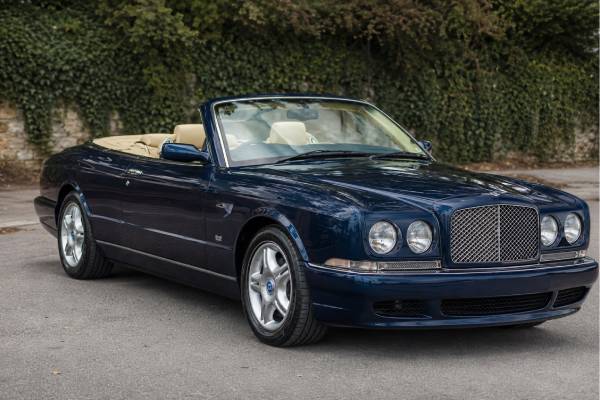
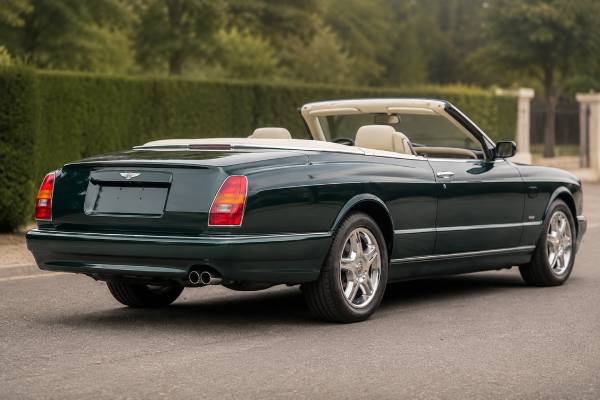
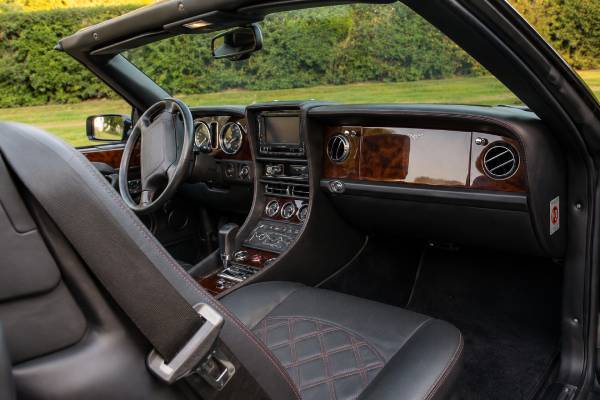
The 2003 Bentley Azure Final Series Performance closes the first-generation Azure line. It pairs the 420 hp L410M1T3 turbocharged V8 with distinctive late-Azure cues: muscular body detailing, wing vents, five-spoke wheels, Continental T-style instruments, a large starter button, diamond-quilted trim, and owner-selected finishes. Chassis research records 62 examples, including 47 left-hand-drive and 15 right-hand-drive cars. Bentley’s heritage narrative also says 62, but a data line on the same page says 11—an internal conflict requiring explanation.
The real challenge is establishing what a particular car was when new. Final Series, Mulliner, and bespoke Azure equipment overlap, and late cars were individually specified. Buyers must connect the VIN to factory records, inspect special exterior and cabin details, and distinguish original equipment from later upgrades. They must also budget for the demanding systems found throughout the range: turbo heat, cooling capacity, high-pressure hydraulics, adaptive damping, four-speed transmission, roof hydraulics, aged wiring, and a very heavy body. A complete car with transparent history is far more desirable than a cosmetically dramatic example with uncertain identity.
Table of Contents
- Final Series Performance History and Production
- What Defines the Performance Package
- Performance Model Technical Data
- Speed, Weight, and Chassis Balance
- Thermal, Hydraulic, and Roof Care
- Restoration Without Losing Identity
- Pre-Purchase Proof and Budget
Final Series Performance History and Production
The most defensible production figure is 62 cars, supported by chassis-by-chassis research and by the narrative text on Bentley’s heritage page. The “11 Final Series Performance” line in that page’s data panel conflicts with its own prose and with the registry, so it should be treated as a likely editorial or labeling error rather than combined with the 62-car total.
The edition arrived as Bentley closed the chapter on the Continental R-based Azure. The first-generation convertible had been introduced in 1995, built around a heavily reinforced version of the Continental R structure with Pininfarina involvement in the body and powered roof. By 2003, Bentley was moving into the Continental GT era, while the corporate link with Rolls-Royce had ended. The Final Series gave the established hand-built platform a purposeful farewell.
Production research separates the Final Series into 62 Performance cars and three Luxury cars. The Performance group is recorded as 47 left-hand drive and 15 right-hand drive. Its first listed chassis is SCBZK25E33CX01171 and its last is SCBZK26E73CH01238. Numbers within that span were not assigned in a simple uninterrupted block, and Luxury or Mulliner examples appear within overlapping sequences. That makes a range check insufficient for authentication.
The edition’s name can also be blurred in the market. Listings may call a car “Azure Final Series,” “Azure Mulliner Final Series,” “Final Series Wide Body,” or simply “Azure Mulliner.” Those descriptions can refer to genuine cars, but they can also hide uncertainty about factory classification. The build sheet, original invoice, market documentation, and physical specification must agree.
The significance of the Performance version lies in combination rather than a completely new engine. The 420 bhp tune already existed in the Azure Mulliner and related Continental models. The Final Series gathered late performance and appearance elements into a commemorative specification, then allowed extensive personalization. Two genuine examples can therefore differ in paint, hide, veneer, embroidery, entertainment equipment, and optional fittings while sharing the underlying edition identity.
A buyer should preserve evidence of that individuality. Factory correspondence, special-order codes, paint samples, trim labels, original photographs, and dealer invoices may explain features that would otherwise look like later modifications. The more bespoke the car, the more important the paper trail becomes.
What Defines the Performance Package
A correct Final Series Performance should show a documented 420 hp mechanical specification and a coherent set of late sporting and luxury details. Because many components resemble Azure Mulliner or Continental T parts, provenance is more reliable than visual recognition alone.
Bentley’s heritage car—the last first-generation Azure built—provides a useful reference. It uses Continental T-derived driver instrumentation with a turbo boost gauge and chrome starter button, front-wing vents, a machined “jewel” fuel filler cap, diamond-quilted seats, dark burr walnut, and Bentley-wing inlays in the waist rails. Published descriptions of other Performance cars add flared arches, special bright-finish wheels, sport bumpers, mesh, quad exhaust outlets, Bentley-branded brake calipers, and individually selected trim.
Not every advertised feature should be treated as universal. Specialist registry text and auction descriptions do not always agree on arch treatment, and bespoke ordering complicates any fixed checklist. Use the car’s own build record to determine whether it was narrow-body or wide-body, which wheel design and dimensions it carried, and what grille, vent, exhaust, veneer, and cabin details belonged to it.
A physical examination should work from large structures toward small trim:
- verify VINs, labels, stamped identity, and signs of panel replacement;
- compare arches, bumpers, sills, vents, grille mesh, and exhaust with factory records;
- inspect wheel markings, offsets, tire sizes, calipers, and brake hardware;
- confirm instruments, boost gauge, starter button, seats, door inserts, waist rails, inlays, and treadplates;
- compare engine bay equipment, labels, management hardware, and emissions parts with the documented market specification.
Later Bentley parts are not automatically undesirable. A dealer may have installed an approved upgrade early in the car’s life, or an owner may have replaced an unavailable component with the closest genuine part. The key is accurate description. A later wheel or retrim should not be presented as original production equipment merely because it is expensive or period-looking.
Color changes require special attention. Remove trim only with permission, but inspect protected edges around seals, hinges, labels, boot trim, and underbonnet areas for the original finish. A high-quality repaint can preserve a car; an undocumented color conversion may affect value and makes restoration of the original specification more difficult.
The same principle applies inside. Recolored leather can conceal wear, and a complete retrim can erase factory stitch patterns, hide combinations, and embroidery. Look behind removable panels for original material and record it. On a Final Series car, those hidden remnants may be the best evidence of a one-off order.
Performance Model Technical Data
This Azure is a conventional petrol ICE model with a front longitudinal 6.75-litre turbo V8, rear-wheel drive, and a GM four-speed automatic. The 420 bhp output matters, but its 875 Nm torque and 2,610 kg published weight explain the car’s real character more clearly.
| Specification | Value |
|---|---|
| Engine code | L410M1T3 |
| Configuration | 90-degree V8, front longitudinal |
| Displacement | 6,750 cc (6.8 L) |
| Block and cylinder heads | Aluminium alloy |
| Valvetrain | Pushrod OHV, 2 valves per cylinder, hydraulic tappets |
| Camshaft drive | Central gear-driven camshaft |
| Induction | Single Garrett AiResearch TO48 turbocharger and intercooler |
| Engine control | Zytek EMS3 |
| Maximum power | 420 bhp (313 kW) at 4,000 rpm |
| Maximum torque | 875 Nm (645 lb-ft) at about 2,200 rpm |
| Specification | Value |
|---|---|
| Transmission | GM Turbo Hydra-Matic four-speed automatic |
| Driven wheels | Rear |
| Final-drive ratio | 2.69:1 |
| Traction control | Electronic |
| Steering | Power-assisted recirculating-ball |
| Driver display | Continental T-derived instrumentation with boost gauge |
| Specification | Value | Notes |
|---|---|---|
| Structure | Steel monocoque with subframes | Convertible reinforcement |
| Front suspension | Independent wishbones, coil springs | Anti-roll bar |
| Rear suspension | Independent semi-trailing arms, coil springs | Anti-roll bar |
| Dampers | Electronically controlled adaptive ride | Self-adjusting response |
| Brakes | Four-wheel discs with ABS | High-pressure hydraulic assistance |
| Wheels | 18-inch five-spoke design | Exact style and width require build confirmation |
| Specification | Value | Context |
|---|---|---|
| Body | Two-door, four-seat convertible | Automatic fabric roof |
| Length | 5,350 mm (210.6 in) | Manufacturer heritage data |
| Wheelbase | 3,061 mm (120.5 in) | Continental R-derived platform |
| Track | 1,549 mm (61.0 in) | Published heritage figure |
| Published weight | 2,610 kg (5,754 lb) | Weight definition should be retained by source |
| Fuel tank | Approximately 108 L (28.5 US gal) | Late first-generation Azure figure |
| Measure | Value | Qualification |
|---|---|---|
| 0–100 km/h (0–62 mph) | 6.2 seconds | Manufacturer heritage figure |
| Maximum speed | 245 km/h (152 mph) | Published manufacturer figure |
| Chassis-registry production | 62 | 47 LHD and 15 RHD |
| Model year | 2003 | Final first-generation Azure year |
These tables describe the general model, not every bespoke car. Tire approvals, emissions components, fluids, pressures, service settings, and even some visible specification can differ by market and order, so VIN-specific documents remain essential.
Speed, Weight, and Chassis Balance
The Final Series Performance is fast because it produces exceptional torque at low engine speed, not because it disguises its mass. It is most convincing when driven with smooth inputs and enough road to let the chassis settle.
From a standstill, the turbo V8 should produce a strong but controlled surge. The throttle need not be opened aggressively, and a healthy transmission should take up drive promptly without a hard impact. Under full load, the car moves with surprising urgency, yet the four-speed gearbox gives each ratio a broad job. A kickdown is more noticeable than in a modern eight-speed automatic.
Acceleration tests are less useful during a purchase inspection than the quality of power delivery. Look for hesitation, uneven boost, smoke, misfire, detonation-like noise, or a sudden change in exhaust note. Observe whether the engine holds stable temperature after boost and whether the hot restart remains clean. The car should not need a cool day to behave properly.
On sweeping roads, the long wheelbase gives composure and the adaptive damping limits float. The steering is slower than contemporary sports cars, and the driver should avoid turning and braking sharply at the same time. Worn bushes, tired dampers, incorrect tires, or poor wheel alignment can turn the intended stability into tramlining and delayed responses.
Brake performance is a system check. The car’s mass means each stop generates substantial heat, while hydraulic assistance shapes pedal feel. During a road test, make several progressively firmer stops and watch for pull, vibration, changing assistance, warning lamps, or a pump that cycles excessively. Afterward, compare wheel temperatures carefully and inspect for fluid seepage.
The convertible structure should feel solid, although some movement over harsh surfaces is normal for a large roofless design of its period. Excessive windscreen shake, door rattles, changing panel gaps, or side glass that loses contact with the seals warrants closer examination of structure, mounts, roof adjustment, and prior accident repair.
A well-sorted car is comfortable enough for long distances. The seats, climate control, quiet roof lining, and deep torque reduce fatigue, while four-seat accommodation makes it more practical than many prestige convertibles. Fuel range and parking dimensions are the everyday limitations: the body is long and wide, visibility to the corners takes practice, and urban consumption can be very high.
Thermal, Hydraulic, and Roof Care
Three systems dominate reliability: cooling, high-pressure hydraulics, and the convertible roof. They should be inspected as complete systems because isolated part replacement often leaves the real cause unresolved.
Turbo heat challenges hoses, wiring, seals, and cooling airflow. Establish whether the radiator has been cleaned or recored, whether the condenser blocks airflow, and whether fans switch correctly with temperature and air-conditioning demand. Pressure-test the coolant circuit and inspect stains under clamps, around the water pump, at the expansion tank, and near hidden hose runs.
Temperature behavior must be assessed in several conditions: cold warm-up, steady cruise, slow traffic, hot idle, and restart after a heat soak. A gauge that appears normal during a short road test may not reveal reduced cooling margin. Any coolant loss, sweet smell, bubbling, fan irregularity, or unexplained pressure deserves diagnosis before further high-load driving.
The braking and ride-related hydraulics use stored pressure. Accumulators lose effectiveness with age, and hoses can deteriorate internally or externally. A specialist should measure pressure and reserve, observe pump cycles, inspect switches and valves, and verify fluid type. Never mix fluid because a generic product has similar color or marketing language.
The roof system depends on hydraulic rams, pump, relays, sequencing switches, latches, deck mechanism, frame alignment, and sufficient electrical voltage. One failing switch can stop the sequence; one leaking ram can contaminate trim. Test the system with a charged battery and enough clear space to watch both sides. Stop at the first asymmetry or abnormal noise.
Water control is part of roof maintenance. Flush drains using an appropriate low-pressure method, inspect membrane and seals, and test with controlled water rather than waiting for rain. Damp rear trim, wet carpets, condensation, or corrosion around electrical connectors can indicate a long-standing leak even when the cabin smells clean after detailing.
A useful preventive rhythm for a lightly driven car includes annual oil service, regular coolant condition checks, hydraulic pressure assessment at specialist intervals, battery testing, roof inspection, air-conditioning operation, tire-date review, and a proper road exercise. Exact intervals and procedures must come from the car’s official service information.
Storage should support those systems. Keep the car dry and ventilated, maintain—not overcharge—the battery, avoid leaving the roof partly operated, keep the fabric clean and fully dry, and do not park for months with old fuel and unwashed road salt. A breathable cover is appropriate only over a clean, dry car.
Restoration Without Losing Identity
The best restoration keeps a clear boundary between preserved factory material, necessary replacement, and later personalization. Final Series identity can be weakened by a flawless but generic rebuild that deletes original colors, trim patterns, and hardware.
Begin with documentation before disassembly. Photograph the car in natural light, then record panel gaps, paint depths, hidden edges, labels, wheel markings, instrument faces, upholstery seams, veneer figure, inlays, fasteners, roof construction, and engine bay routing. Create a numbered parts inventory and keep removed original items even if replacements are fitted.
Bodywork requires a shop able to handle a large, hand-finished convertible. Check long doors and hinge areas, sill strength, windscreen surround, floors, jacking points, wheel arches, boot floor, subframe mounts, and the transitions around any wide-body extensions. Repair should restore corrosion protection and drainage, not merely exterior shape.
Paint color must be established from records and protected samples. Bentley offered bespoke shades, and names or modern databases may not capture the actual mix. A repaint can be appropriate, but it should preserve identification labels, avoid excessive material at panel edges, and document all stripped or repaired areas.
Wheels, grilles, vents, filler cap, exhaust finishers, and badges are visually important and potentially hard to source. Refurbish original pieces where structurally safe. Over-polishing can erase markings or change the intended finish. Chrome, bright alloy, painted centers, and machined surfaces should not all receive the same treatment.
The cabin is a record of the individual order. Before recoloring leather, identify every original shade under seams and hidden panels. Match hide grain and perforation, not just color. Preserve embroidery patterns, quilting dimensions, piping, stitch length, and foam shape. Veneer repair should maintain book-matching and inlays rather than replacing the entire set with a fashionable species.
Mechanical restoration should remain visible in records. Note fluid specifications, hose materials, rebuilders, calibration data, torque references, and any deviation from factory parts. For reversible modern additions such as audio, navigation, tracking, or battery protection, avoid cutting original looms and retain the removed equipment.
Patina is acceptable when it is stable, honest, and compatible with use. A slightly worn original steering wheel or gently creased seat can be more informative than a complete retrim. Safety-critical corrosion, leaking hydraulics, hardened tires, and failed wiring are not patina; they require proper repair.
Pre-Purchase Proof and Budget
Do not buy a Final Series Performance until the model identity and operating condition have both been proven. A bargain price cannot compensate for an ordinary Azure represented as a limited edition or for a restoration that requires unobtainable trim.
Request the VIN and factory documentation before traveling. Ask for unedited cold-start and roof-cycle videos, photographs under the car, evidence of paintwork, tire dates, current fluid leaks, and a list of non-working equipment. Search earlier auction listings and advertisements to see whether mileage, color, wheels, or trim have changed.
Use two kinds of expertise. A marque historian or model specialist should assess authenticity and production context. A workshop should test mechanical systems and estimate repairs. A general exotic-car inspection may identify obvious wear but miss hydraulic pressure loss, roof-sequence faults, non-original Final Series details, or cooling weakness under heat soak.
The inspection should include:
- identity points and build-record comparison;
- paint depth and structural examination;
- cold start, smoke, boost behavior, and hot restart;
- cooling pressure and fan operation;
- hydraulic pressure, accumulator reserve, brake test, and warning systems;
- transmission engagement, shifts, lockup, leaks, and mounts;
- suspension, steering, wheel bearings, alignment, wheels, and tire age;
- complete roof operation and water-leak test;
- charging output, parasitic draw, climate control, instruments, seats, windows, locks, and accessories.
Convert every finding into a costed plan. Separate immediate safety work, reliability work for the first year, originality corrections, and optional cosmetics. Add enclosed transport, taxes or import compliance, specialist travel, storage, agreed-value insurance, and a contingency for hidden faults.
Low mileage should increase scrutiny rather than end it. Long storage can leave aged tires, seized brakes, stale fuel, dry seals, weak batteries, and corroded electrical contacts. Check history continuity and require evidence of recommissioning. A car that has covered moderate mileage with consistent specialist care may be the safer purchase.
Value depends on complete edition equipment, desirable and documented specification, excellent operation, sound structure, and ownership history. Missing original wheels or instruments can matter more than a minor paint flaw because cosmetic correction is straightforward while rare parts may not be available. Conversely, a fully original car with unsafe mechanical systems still needs substantial budgeting.
After purchase, establish a baseline report and photographic archive immediately. Record tire dates, pressures, fluids, hydraulic test results, roof behavior, paint map, key and alarm data, and the location of tools and original parts. This turns current condition into evidence and makes future maintenance more deliberate.
The Final Series Performance is at its best when it remains both a usable Bentley and a credible historical object. Preserve what makes the individual car unique, repair the systems that allow it to travel safely, and resist changes that imitate modern performance at the expense of its original grand-touring character.
References
- BENTLEY NEWSROOM : 2003 Azure Mulliner C2BML 2026 (Manufacturer Heritage Data)
- Bentley Azure Final Series Performance 2026 (Production Registry)
- UNPUBLISHED FACTS I Model year 2003 2019 (Production Research)
- Bonhams Cars : 2003 Bentley Azure Mulliner ‘Final Series Performance’ VIN. SCBZK25E83CX01232 2024 (Auction Record)
- 2003 Bentley Azure Final Series 2026 (Model History)
- Search Safety Issues | NHTSA 2026 (Recall Database)
Disclaimer
This guide is for informational purposes and is not a substitute for professional authentication, diagnosis, inspection, or repair. Specifications, torque values, service intervals, fluids, and procedures can differ by VIN, market, production date, and bespoke equipment; verify them through the vehicle’s official Bentley service documentation.
Please share this article on Facebook, X/Twitter, or a Bentley owners’ group to support well-researched information and responsible preservation.