
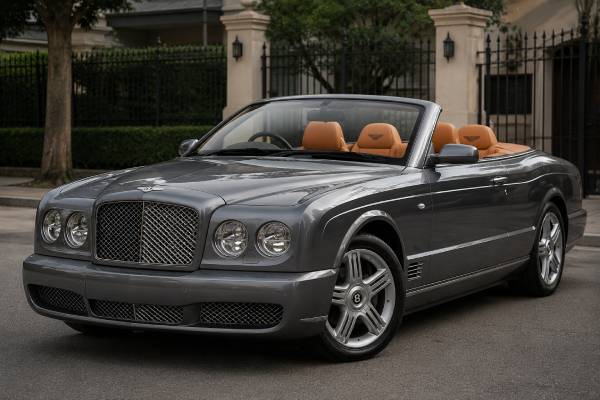
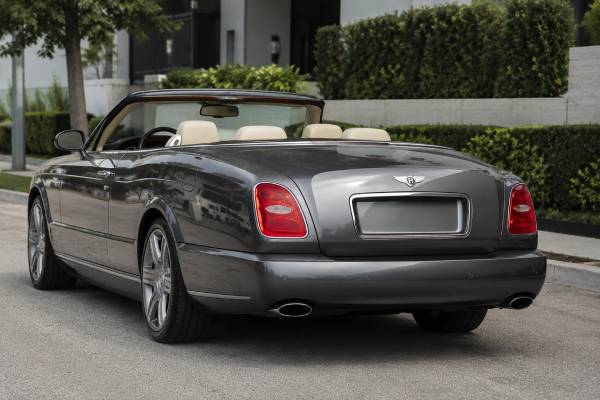
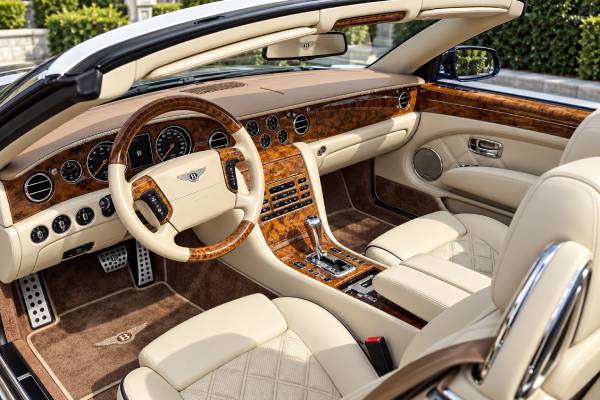
The Bentley Azure T is the fastest and most powerful production version of the Azure lineage. Revealed in 2008 for 2009–2010, it raises the second-generation convertible’s twin-turbo 6.75-litre V8 to 500 hp and 1,000 Nm, uses a six-speed ZF automatic with rear-wheel drive, and reaches a published 179 mph. Its identity is equally specific: 20-inch two-piece wheels, 255/40 ZR20 Pirelli tires, Le Mans-style wing vents, dark grilles, a billet-aluminium “jewel” filler cap, body-color mirror mounts, diamond-quilted leather, and drilled alloy pedals. Specialist production records identify 80 cars.
It is a high-speed machine, not a lightweight sports convertible. It still weighs about 2,695 kg and carries four people beneath a fully automatic three-layer fabric roof. Its appeal comes from compressing huge performance and hand-finished luxury into one imposing final-era Bentley. Buying well means testing every system that supports that experience: cooling, twin-turbo plumbing, transmission, adaptive self-leveling dampers, stability control, brakes, 20-inch wheels, roof hydraulics, water sealing, battery management, and bespoke cabin equipment. A low-mileage car with dormant systems can be a greater risk than an exercised example with detailed specialist records.
Table of Contents
- The Azure T as Bentley’s Final Flagship Convertible
- The 500 hp Transformation
- Azure T Specification Tables
- Using the Performance Safely
- High-Output Powertrain and Chassis Maintenance
- Roof, Trim, Wheels, and Options
- A Collector-Grade Buying Process
The Azure T as Bentley’s Final Flagship Convertible
The Azure T is both the performance derivative of the second-generation Azure and the final production chapter of the model. Registry data identifies 80 examples, while Bentley’s own heritage car was the last Azure T completed, leaving the line in January 2010.
The standard second-generation Azure had entered production in 2006 with 450 hp and 875 Nm. It already used the Arnage platform, a unique open body, carbon-fibre underfloor cross-bracing, four full seats, and a power roof. For the T, Bentley applied the higher-output engine philosophy of its fastest Arnage-era cars and gave the convertible a stronger visual and dynamic identity.
The T designation had long signaled the more performance-focused side of Bentley’s large grand tourers. In this application it did not remove luxury or turn the Azure into a stripped special. The cabin remained lined in hide, veneer or metal finishes, wool carpet, and polished fittings, with extensive choice through Bentley and Mulliner. The distinction came through power, torque, calibration, wheels, tires, styling details, and optional high-performance hardware.
Production records list the first Azure T as SCBDC45H5ACH14341 and the last as SCBDC45HXACH14495. Chassis numbers in the broader Arnage-family period are intermingled across models, so an Azure T should be verified through its complete VIN and factory data rather than by the final digits alone. The engine code in this assignment, L410M1T4, should likewise be checked against the individual car’s records and engine markings.
The model’s short run creates several market descriptions. Some cars are advertised as 2009, some as 2010, and some as “Final Series,” depending on market registration, model year, or reference to the last production batch. Bentley’s heritage page calls its own final car the “2010 Azure T Final Series,” while specialist records group all 80 under 2010 production data. A buyer should document build date, model year, first registration, and market specification separately.
Its rarity is meaningful but not absolute proof of collectability. The Azure T sits at the end of the traditional large Bentley V8 convertible line and has clear flagship status. However, values remain sensitive to mileage, color, original options, service history, geographic demand, and the condition of expensive systems. Scarcity magnifies the difference between a complete, carefully maintained car and one missing unique wheels, trim, or records.
The 500 hp Transformation
The T’s engineering upgrade is defined by 500 bhp and 1,000 Nm, a 125 Nm increase over the standard Azure. That extra torque, combined with revised control and a 2.92:1 final drive, cuts the official 0–100 km/h time to 5.5 seconds and raises maximum speed to 288 km/h.
Bentley retained its 6,750 cc pushrod V8 with an aluminium block and heads, a central gear-driven camshaft, hydraulic tappets, twin Garrett turbochargers, intercooling, and Bosch Motronic management. The engine’s architecture is traditional, but its output is not. One tonne-metre of torque places exceptional demands on cooling, transmission control, rear tires, mounts, differential, and electronic stability systems.
The six-speed ZF 6HP-32 automatic is central to the car’s usability. It allows the engine to operate in a broad low-rpm torque band while providing more responsive ratios for acceleration. A sophisticated lockup strategy reduces converter slip during cruising. Manual selection offers more control on a descent or when positioning the car before a bend, although it does not turn the gearbox into a modern dual-clutch unit.
The final-drive ratio is shorter than the standard car’s relaxed cruising emphasis, helping the T respond more urgently. Even so, full power arrives through the rear wheels only. Tire quality and stability-control operation are therefore fundamental, especially on cold or wet roads. A driver can overwhelm old 255-section rear tires long before noticing visible tread wear.
Chassis changes and equipment reinforce the performance message. The standard 20-inch two-piece wheels use 255/40 ZR20 Pirelli P Zero tires. The adaptive electrohydraulic dampers and self-leveling function control body motion, while electronic stability and traction systems manage the enormous torque. Optional carbon-ceramic brakes were offered for buyers seeking greater heat capacity and lower unsprung mass, paired with large multi-piston calipers.
Styling supports function without becoming theatrical. Le Mans lower wing vents help distinguish the front quarters; dark upper and lower grilles reduce brightwork; twin oval exhaust outlets communicate the engine’s role; and the body-color mirror mounts tighten the appearance. The billet-aluminium fuel cap is a tactile detail rather than a performance part, but it became one of the model’s strongest visual signatures.
The result should be understood as a high-performance luxury platform, not simply an engine tune. If the dampers are weak, the tires are wrong, the transmission flares, or the stability system is faulted, the car no longer delivers the integrated behavior Bentley intended. A specialist inspection must evaluate the complete package.
Azure T Specification Tables
The Azure T is an ICE grand tourer with a twin-turbo V8, six-speed automatic, rear-wheel drive, and a power-operated four-seat convertible body. Its published figures are remarkable for a 2.7-tonne car, although individual market equipment and source definitions must be kept separate.
| Specification | Value | Notes |
|---|---|---|
| Engine code | L410M1T4 | Verify against VIN and engine records |
| Configuration | 90-degree V8, front longitudinal | Traditional Bentley L-series architecture |
| Displacement | 6,750 cc (6.8 L) | Petrol/gasoline |
| Construction | Aluminium block and cylinder heads | Central gear-driven camshaft |
| Valvetrain | Pushrod OHV, 2 valves per cylinder | Hydraulic tappets |
| Induction | Twin Garrett AiResearch T3 turbochargers | Intercooled |
| Engine management | Bosch Motronic | Electronic throttle and boost control |
| Maximum power | 500 bhp (373 kW) at about 4,000–4,200 rpm | Published rpm differs by source |
| Maximum torque | 1,000 Nm (738 lb-ft) at approximately 3,200 rpm | Published model figure |
| Fuel | Premium unleaded petrol | Use market-specified octane |
| Specification | Value |
|---|---|
| Transmission | ZF 6HP-32 six-speed automatic |
| Drive | Rear-wheel drive |
| Final-drive ratio | 2.92:1 |
| Driver control | Automatic modes plus manual gear selection |
| Traction management | Electronic traction control and stability program |
| Tire-pressure monitoring | Factory system |
| Fuel-tank capacity | Approximately 96 L (25.3 US gal) |
| Specification | Value | Configuration |
|---|---|---|
| Structure | Steel monocoque with subframes | Carbon-fibre underfloor cross-bracing |
| Front suspension | Independent wishbones and coil springs | Anti-roll bar |
| Rear suspension | Independent coil-sprung layout | Self-leveling control |
| Dampers | Computer-controlled adaptive electrohydraulic | Variable response |
| Standard wheels | 8.5J × 20-inch two-piece, five-spoke alloys | Bright-finish design |
| Standard tires | 255/40 ZR20 Pirelli P Zero | Same nominal size front and rear |
| Standard brakes | Large ventilated steel discs with ABS | Electronic brake assistance |
| Optional brakes | Carbon-ceramic discs with multi-piston calipers | Inspect condition and remaining service life carefully |
| Specification | Value | Condition |
|---|---|---|
| Body style | Two-door, four-seat convertible | Three-layer power fabric roof |
| Length | 5,410 mm (213.0 in) | Manufacturer figure |
| Body width | Approximately 1,900 mm (74.8 in) | Excluding mirrors |
| Height | Approximately 1,490 mm (58.7 in) | Published figure |
| Wheelbase | 3,116 mm (122.7 in) | Arnage-derived platform |
| Track | 1,608 mm (63.3 in) | Published manufacturer figure |
| Published kerb weight | 2,695 kg (5,941 lb) | Retain source weight definition |
| Luggage volume | Approximately 310 L (10.9 cu ft) | Roof packaging limits space |
| Measure | Value | Standard or source |
|---|---|---|
| 0–60 mph | 5.2 seconds | Bentley published figure |
| 0–100 km/h (0–62 mph) | 5.5 seconds | Bentley published figure |
| Maximum speed | 288 km/h (179 mph) | Manufacturer figure |
| EPA combined economy | 11 mpg US | 2010 Azure listing, premium gasoline |
| EPA city/highway | 9/15 mpg US | 2010 listing |
| Registry production | 80 cars | Azure T chassis count |
The manufacturer heritage page contains an obvious kilowatt typo beside the 500 bhp output; 500 bhp converts to approximately 373 kW, not 313 kW. Retaining the horsepower figure while correcting the exact conversion avoids propagating that internal inconsistency.
Using the Performance Safely
The Azure T’s straight-line ability is much greater than its relaxed controls suggest. A driver should build trust in tires, brakes, temperature control, and stability systems before exploring full boost.
Begin every drive by noting ambient temperature, tire pressures, warning lamps, and fuel level. Let the fluids warm through normal driving rather than extended idling. The engine produces enough torque at partial throttle that there is no need to load it heavily while cold.
On dry pavement, acceleration is a continuous surge rather than a dramatic rush to a high redline. The gearbox should choose ratios decisively, with no flare or hard engagement. Manual selection can keep the engine from shifting unexpectedly in a sequence of bends, but downshifts should still be requested with mechanical sympathy.
Wet and cold conditions require restraint. Rear-wheel drive, one tonne-metre of torque, and wide high-performance tires can create rapid wheelspin when the rubber is old or below its working temperature. Stability control is an aid, not a substitute for grip. Do not disable systems on a public road to “test” the car.
Braking deserves equal attention. The standard steel setup should deliver strong, repeatable deceleration without vibration or pull. Carbon-ceramic brakes may feel different when cold and are extremely costly to replace if chipped, cracked, overheated, or worn beyond specification. A specialist should inspect disc surfaces, measure thickness or wear indicators according to Bentley procedure, and confirm correct pads.
At speed, the Azure T should track steadily, with the adaptive dampers containing vertical movement. Floating, repeated oscillation, steering shimmy, or a rear-end step over bumps suggests tired dampers, bushes, alignment problems, wheel damage, or unsuitable tires. The car’s weight can mask wear during a short urban drive, so include varied roads.
The body is large enough that wind, road crown, and standing water matter. Avoid abrupt lane changes and allow more braking distance than the acceleration time might imply. The performance headline is 179 mph, but the practical measure of a good car is whether it remains calm at ordinary touring speeds and predictable when avoiding a hazard.
After hard use, complete a cooling-down period with light load and airflow, then inspect for odors, fluid loss, wheel heat, and tire damage. Do not shut down immediately after repeated high boost unless the official procedure says conditions permit. A considered cool-down protects turbo and oil temperatures without resorting to myths or arbitrary idle times.
High-Output Powertrain and Chassis Maintenance
The T needs the same service disciplines as the standard Azure, but its extra output reduces tolerance for weak cooling, marginal ignition, old tires, transmission slip, and tired dampers. Maintenance should be preventive and measurement-led.
Cooling service starts with airflow. Inspect every heat exchanger, the spaces between them, fan assemblies, controls, shrouds, hoses, expansion tank, thermostat, and water pump. Clean debris without bending fins, and pressure-test the complete system. Confirm stable temperature in traffic, after sustained load, and during a hot restart.
Twin-turbo plumbing should be examined for oil seepage, loose clamps, cracked hoses, heat damage, and pressure leaks. A small leak may cause reduced power or incorrect fueling before it creates a warning. Inspect turbo oil and coolant lines, intercoolers, bypass and wastegate controls, vacuum circuits, and heat shields.
Ignition and fuel delivery must support cylinder pressure under boost. Misfire that appears only at high load can come from plugs, coils or related ignition parts, injectors, fuel pressure, air leaks, or control issues. Do not continue full-throttle tests after a misfire; unburned fuel can damage catalysts and overheat components.
The ZF transmission should be scanned, road-tested cold and hot, and inspected for fluid condition and leaks. Use the exact fluid, filter, pan or sealing parts, and temperature-based fill procedure required for the VIN. Torque-converter shudder, delayed engagement, or ratio faults need diagnosis before a routine service is attempted.
Check engine, gearbox, differential, and subframe mounts under load. One thousand newton-metres can expose softened rubber through a thump, exhaust contact, driveline wind-up, or changing alignment. Differential oil and seals should be evaluated according to service history rather than ignored as lifetime components.
Adaptive dampers and self-leveling hardware need electronic and physical checks. Compare ride height, inspect for leakage, verify mode response, examine bushes and joints, and align the car only after worn parts are corrected. Twenty-inch wheels increase the consequence of pothole impact, so test each wheel for runout and cracking during tire replacement.
Tire management is part of powertrain maintenance. Replace by age and condition, not tread depth alone. Use four matching approved tires when possible, preserve correct load and speed ratings, and check the tire-pressure monitoring sensors. Incorrect tire circumference or construction can disrupt stability calibration and ride.
A strong annual inspection includes engine oil and filters, cooling pressure, turbo plumbing, diagnostic scans, transmission behavior, differential and mount checks, brake condition, suspension response, wheel runout, tire age, battery health, roof operation, water ingress, and a current recall search by VIN.
Roof, Trim, Wheels, and Options
The Azure T’s model-specific fittings are expensive to lose and easy to damage during ordinary repairs. Preserve the 20-inch wheels, grilles, vents, filler cap, exhaust finishers, quilted trim, pedals, instruments, and factory options with the same care given to the engine.
The roof should disappear beneath the tonneau in about 30 seconds, operating its windows, latches, deck, hydraulic rams, pump, and sensors in sequence. Test it only with stable voltage and clear space. If movement becomes uneven, the pump strains, or the deck approaches the fabric incorrectly, release the switch rather than forcing completion.
Inspect the three-layer hood for wear over bows, shrinking, edge separation, and staining. The glass rear window and heating element should function. Water-test the header, side seals, quarter area, tonneau perimeter, and drains, then examine hidden carpet and modules. A dry-looking cabin can still hold moisture under insulation.
The five-spoke two-piece wheels should be checked for correct markings, fasteners, finish, runout, corrosion at joints, and previous machining. Bright finishes are easily altered by generic wheel refurbishers. Photograph original surfaces and select a company experienced with multi-piece luxury wheels.
Le Mans vents and dark grilles attract road debris. Clean from both sides using methods that protect paint and mesh. The billet filler cap should open, seal, and lock or release correctly; do not polish away its intended finish. Body-color mirror mounts and low bumpers are vulnerable to chips and parking damage.
Inside, diamond-quilted seats and door panels, embroidered Bentley emblems, drilled pedals, black instrument faces, knurled controls, and the jeweled gear selector establish the T atmosphere. Depending on specification, the fascia may use engine-turned aluminium or veneer, and Bentley offered a broad palette of hides and woods.
The optional Naim for Bentley audio system used ten speakers, a dual-channel subwoofer, an 1,100-watt amplifier, and selectable processing modes. Confirm that all channels work without distortion and that repairs have not introduced battery drain. Other cars may have different factory audio or later upgrades, so the build record matters.
Leather care should preserve matte texture and stitching. Veneer and lacquer need stable humidity and protection from strong sun. Engine-turned aluminium must not be polished in a way that erases the pattern. Drilled pedals should be secure and free of slippery dressing products.
Keep every removed original part. An owner may choose a modern head unit, alternative wheels, or a reversible phone interface, but the factory components support value and give future custodians options. Modifications should use adapters rather than cutting the loom, veneer, or structural trim.
A Collector-Grade Buying Process
The right Azure T purchase proves identity, specification, and system health before discussing cosmetic perfection. Because only 80 were built, missing model-specific equipment and undocumented changes carry more weight than on a standard high-volume luxury car.
Obtain the full VIN, factory build data, first-registration information, service books, invoices, recall records, keys, manuals, tool kit, and original equipment list. Separate model year from registration year. Confirm whether “Final Series” is a documented factory description or sales shorthand.
Research the car’s earlier public record. Auction photographs and old advertisements can reveal prior colors, wheels, mileage, trim, accident damage, or a roof problem. A changed description is not automatically dishonest, but it should be explained. Save copies because listings disappear.
The specialist inspection should start with the engine cold and battery voltage measured. It should include:
- VIN and engine identity, build-sheet comparison, and model-specific trim;
- scan of all accessible modules and a check that warning lamps have not been disabled;
- cooling pressure, fan operation, heat soak, turbo plumbing, and hot restart;
- transmission engagement, shifts, lockup, fluid evidence, mounts, and differential;
- damper operation, ride height, bushes, steering, wheel runout, alignment, and tire dates;
- brake measurements, including specialist carbon-ceramic assessment where fitted;
- complete roof cycle, hydraulic leak search, glass adjustment, drain, and water test;
- climate control, seats, memories, mirrors, locks, parking sensors, audio, navigation, lamps, and charging system;
- body structure, carbon braces, sills, floors, door alignment, paint depth, and underbody damage.
A short test drive is inadequate. The engine and transmission must reach operating temperature, the car should encounter urban traffic and open road, and the inspector should recheck it after shutdown. Many cooling, electrical, and hydraulic faults appear only when heat has built up.
Build a first-year financial model before purchase. Include transport, registration, immediate safety work, all overdue age-based servicing, four correct tires if dates are uncertain, battery or charging work, cooling reserve, roof repairs, suspension, brakes, and cosmetic preservation. Carbon-ceramic replacement or damaged model-specific wheels can change the economics dramatically.
Mileage must be supported by continuity. A 5,000-mile car may have spent years stationary, while a 30,000-mile example may have benefited from regular temperature cycles and scheduled work. Evaluate storage environment, fuel age, brake corrosion, seal condition, flat spotting, and whether the roof and air conditioning were exercised.
Color and options affect desirability, but condition should lead. Bentley offered 42 exterior colors, numerous hides and veneers, and significant bespoke choice. A restrained factory combination can appeal broadly; a rare personal commission may be more valuable to the right buyer if fully documented.
Insurance should be agreed-value and name the exact Azure T specification, including rare options and recent work. Confirm transport and workshop coverage, parts-retention rights, and permission to use an appropriate Bentley body or mechanical specialist. Keep a detailed photographic archive away from the car.
Once acquired, record a baseline immediately and drive the car often enough to keep it healthy. The Azure T was created to cross distance at formidable speed while carrying four people in handcrafted comfort. Preserving that dual character—rather than reducing it to a static object or modifying it into something harsher—is the best way to respect the final and most powerful Azure.
References
- BENTLEY NEWSROOM : 2010 Azure T Final Series 2026 (Manufacturer Heritage Data)
- Bentley Story | Bentley Motors 2026 (Manufacturer History)
- Bentley Azure T 2026 (Production Registry)
- 2010 Bentley Azure 2026 (Official Fuel Economy Data)
- 2010 Bentley Azure T Review & Ratings | Edmunds 2026 (Model Review)
- Search Safety Issues | NHTSA 2026 (Recall Database)
Disclaimer
This article is for informational purposes and does not replace professional diagnosis, inspection, or repair. Specifications, torque values, service intervals, fluids, and procedures can vary by VIN, market, production date, and optional equipment; verify every technical decision against the vehicle’s official Bentley service documentation.
Please share this guide on Facebook, X/Twitter, or a Bentley owners’ community to support informed maintenance and preservation of the Azure T.