
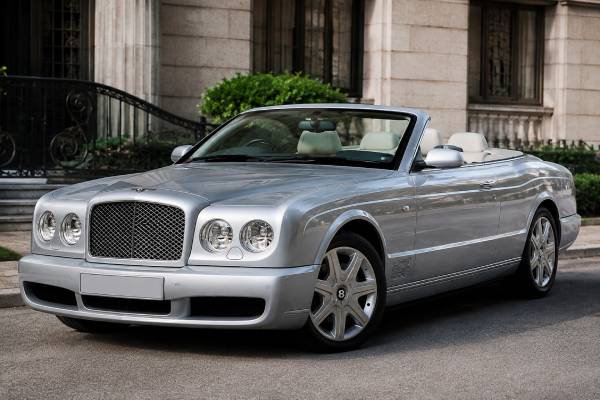
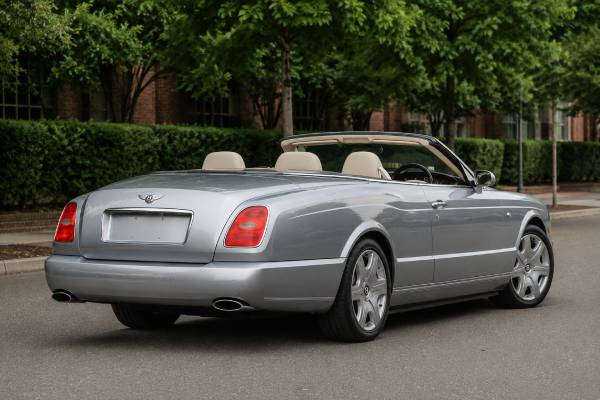
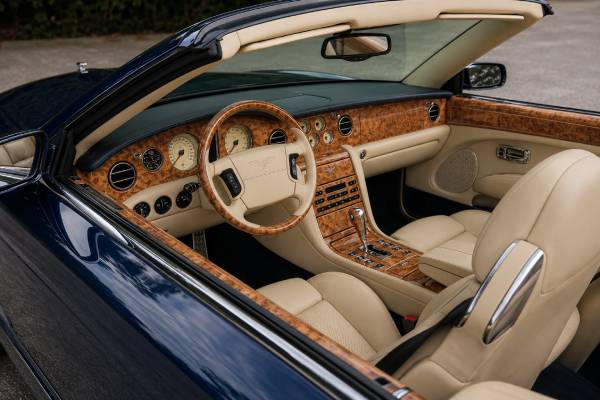
The 2006–2009 Bentley Azure is a new-generation car, not a facelift of its 1990s predecessor. It moved to the Arnage platform, gained a Crewe-designed body, carbon-fibre underfloor cross-bracing, a three-layer power roof with a heated glass rear window, improved cabin space, and a revised 6.75-litre twin-turbo V8 producing 450 hp and 875 Nm. Specialist chassis research records 716 examples, making it rare but still available for comparison and specialist service.
At roughly 2,695 kg, the Azure is designed to carry four adults at high speed in calm comfort, not behave like a lightweight roadster. The low-revving V8, six-speed automatic, rear-wheel drive, adaptive self-leveling suspension, powerful brakes, and extensive electronics control that mass together. When one system is weak, the whole car can feel wrong. Cooling faults, tired suspension, roof leaks, low battery voltage, aging hydraulic components, neglected transmission service, or incorrect tires can turn an elegant grand tourer into a costly project. The best purchase is a regularly exercised, thoroughly documented car whose roof, climate control, chassis, and drivetrain perform correctly from cold start through full heat soak.
Table of Contents
- The Arnage-Platform Reinvention
- Second-Generation Design and Everyday Use
- Azure 450 Technical Specifications
- Grand-Touring Performance on the Road
- Drivetrain, Chassis, and Brake Service
- Roof, Body, Cabin, and Electrical Care
- Buying, Budget, and Ownership Plan
The Arnage-Platform Reinvention
The second Azure was engineered from the Arnage architecture and has no direct body relationship to the first-generation Pininfarina-built shell. Its longer wheelbase, unique two-door rear body, carbon-fibre cross-bracing, twin-turbo engine, and modernized chassis created a more spacious and dynamically capable convertible.
Bentley previewed the idea as the Arnage Drophead Coupé concept at the 2005 Los Angeles Auto Show. Strong customer interest led quickly to the production Azure, shown at Frankfurt later that year and delivered from 2006. The front styling clearly relates to the Arnage, but the cabin, doors, rear quarters, boot, roof packaging, and flowing waistline were developed specifically for the convertible.
Removing a fixed roof always reduces structural stiffness. Bentley addressed the problem with reinforcement in the steel body and lightweight carbon-fibre braces beneath the floor. This allowed the body to resist twisting without relying only on heavy steel additions. A sound car should therefore feel substantial over uneven roads, with limited steering-column shake and no obvious movement at the doors or side glass.
The platform change also improved occupant packaging. Four adults can use the car in genuine comfort, and the integrated front-seat belts allow access to the rear without a conventional B-pillar. The rear seats remain more suited to touring than to tall passengers on very long trips, but this is a true four-place convertible rather than a nominal 2+2.
The 6.75-litre V8 was extensively developed for the later Arnage era. Two turbochargers replaced the first generation’s single-turbo arrangement, and modern Bosch management improved response, emissions control, and drivability. Output rose to 450 bhp while maximum torque remained an enormous 875 Nm. The engine’s character is still traditional Bentley: low-revving, quiet, and forceful rather than sharp or highly strung.
A six-speed ZF automatic gives closer ratios and more flexible control than the older four-speed gearbox. Some secondary sources and even Bentley heritage text contain inconsistent transmission descriptions, so a buyer should verify the actual unit and service requirements by VIN. Production cars in this generation are generally identified with a six-speed automatic and manual-selection capability.
Specialist records list 716 standard second-generation Azures from 2006 through 2009: 585 left-hand-drive and 131 right-hand-drive. Annual production was 113 for 2006, 249 for 2007, 183 for 2008, and 171 for 2009. These figures help place a car in context, but they do not replace factory build data because paint, hide, veneer, wheels, audio, brightwork, and Mulliner options vary widely.
Second-Generation Design and Everyday Use
The Azure is practical enough for long journeys if the owner plans around its width, fuel use, roof packaging, and specialist maintenance. It offers real rear seating and a refined roof-up cabin, but it is a very large luxury car rather than an effortless city convertible.
The fabric hood uses three layers and a heated glass rear screen, a major usability improvement over the flexible plastic window of the first Azure. Bentley published opening times of roughly 25 to 30 seconds in different heritage materials. The roof disappears beneath a flush tonneau, preserving the body line without a separate fabric cover.
Operate the roof only with a healthy battery and according to the owner’s instructions. The sequence coordinates the side windows, latches, deck cover, hydraulic pump, rams, frame, and position sensors. A low-voltage interruption can leave the mechanism between stages. Do not keep pressing the switch when movement stops; record the position and seek correct diagnostic help.
The car’s 5.41-metre length and approximately 1.90-metre body width demand parking discipline. Width across the mirrors is greater, and the long doors require generous space. Front and rear parking sensors help, but they should not substitute for checking low obstacles and wheel position. Many damaged Azure bumpers and wheels result from ordinary garage and curb contact rather than high-speed incidents.
Roof-down refinement is excellent in the front seats. Raising the side glass reduces turbulence, while rear passengers experience more airflow. Loose items should be secured because the rear cabin and tonneau area can create unexpected air movement at speed. Protect leather and veneer from prolonged direct sun, especially in dark color combinations.
Boot capacity is modest relative to the exterior size because the folded roof and its mechanism occupy valuable space. Published sources commonly list about 310 litres, while U.S. data describes roughly 8 cubic feet under its procedure. Use soft luggage and confirm that nothing can interfere with the roof storage zone.
Fuel consumption is a real operating consideration. The U.S. EPA rates the 2007 model at 11 mpg combined, 10 city, and 15 highway on premium gasoline. That official result is not a defect; it reflects a 6.75-litre twin-turbo engine moving nearly 2.7 tonnes. Budget for range as well as cost, particularly on rural tours where high-octane fuel may be scarce.
Cabin controls blend traditional craftsmanship with mid-2000s electronics. The navigation and audio interfaces are dated by current standards, but replacing them carelessly can damage the visual integrity of the fascia and introduce electrical faults. Reversible upgrades, hidden connectivity modules, or professional refurbishment are generally preferable to cutting veneer and factory looms.
Azure 450 Technical Specifications
The 450 hp Azure is a petrol ICE grand tourer with a front longitudinal twin-turbo V8, six-speed automatic transmission, and rear-wheel drive. Its technical priorities are torque, structural stiffness, four-seat comfort, and stable high-speed travel rather than minimum mass or fuel consumption.
| Specification | Value |
|---|---|
| Engine code | L410M1T5 |
| Configuration | 90-degree V8, front longitudinal |
| Displacement | 6,750 cc (6.8 L) |
| Construction | Aluminium block and cylinder heads |
| Valvetrain | Pushrod OHV, 2 valves per cylinder, hydraulic tappets |
| Bore × stroke | 104.1 × 99.1 mm |
| Induction | Twin turbochargers with intercooling |
| Engine management | Bosch Motronic |
| Maximum power | 450 bhp (336 kW) at approximately 4,100 rpm |
| Maximum torque | 875 Nm (645 lb-ft) |
| Fuel requirement | Premium unleaded gasoline/petrol |
| Specification | Value | Notes |
|---|---|---|
| Transmission | ZF six-speed automatic | Manual selection and lockup control |
| Drive | Rear-wheel drive | Front-engine layout |
| Stability systems | ABS, traction control, and electronic stability control | Market specification should be verified |
| Steering | Power-assisted rack-and-pinion | Speed-sensitive calibration |
| Fuel tank | Approximately 96 L (25.3 US gal) | EPA tank-size listing |
| Specification | Value |
|---|---|
| Body structure | Steel monocoque with subframes and carbon-fibre underfloor cross-bracing |
| Front suspension | Independent double wishbones, coil springs, anti-roll bar |
| Rear suspension | Independent suspension with coil springs and anti-roll control |
| Damping | Computer-controlled adaptive, self-leveling electrohydraulic dampers |
| Brakes | Large ventilated discs with ABS and electronic brake assistance |
| Standard wheel size | 8.0J × 19 inches |
| Standard tire size | 255/45 ZR19 |
| Specification | Value | Condition |
|---|---|---|
| Length | 5,410 mm (213.0 in) | Published manufacturer/registry dimension |
| Body width | About 1,900–1,910 mm (74.8–75.2 in) | Excluding mirrors |
| Height | About 1,490 mm (58.7 in) | Unladen published figure |
| Wheelbase | 3,116 mm (122.7 in) | Arnage-derived platform |
| Front track | Approximately 1,608 mm (63.3 in) | Published figure |
| Published kerb weight | 2,695 kg (5,941 lb) | Confirm exact weight definition by source |
| Luggage volume | Approximately 310 L (10.9 cu ft) | Measurement methods vary |
| Measure | Value | Standard or condition |
|---|---|---|
| 0–60 mph | 5.6 seconds | Bentley published figure |
| 0–100 km/h (0–62 mph) | 5.9 seconds | Bentley published figure |
| Maximum speed | 270–274 km/h (168–171 mph) | Manufacturer pages publish both conversions |
| EPA combined | 11 mpg US | 2007 model, premium gasoline |
| EPA city/highway | 10/15 mpg US | 2007 model |
| EPA estimated range | 278 miles (447 km) | 2007 listing and test assumptions |
Where credible publications disagree, the range or source condition is shown rather than selecting a falsely precise number. Use the official manual and parts information for the exact VIN before servicing, fitting tires, or setting pressures and torque values.
Grand-Touring Performance on the Road
A correct Azure feels fast, quiet, and unhurried rather than explosive. The twin-turbo system reduces lag, the six-speed gearbox keeps the engine in its broad torque band, and the long chassis settles into high-speed travel with remarkable calm.
Start the test drive with the car cold. The engine should fire without extended cranking, settle cleanly, and show no persistent smoke. Listen near the front and beneath the car for exhaust leaks, belt noise, fluid pump strain, or ticking that changes with temperature. Warning lamps should illuminate for their self-check and then extinguish normally.
In gentle driving, shifts should be nearly unobtrusive. A delay selecting drive or reverse, a thump at low speed, flare between ratios, shudder under light load, or refusal to lock the converter needs investigation. Do not accept “they all do that” without comparison to another healthy car or specialist measurement.
Full-throttle performance should be assessed only after temperature and tire condition are confirmed. The car should pull in one continuous wave with no surging, misfire, excessive smoke, or sudden reduction in power. Watch the temperature gauge after the run and let the car idle long enough to test heat management.
The steering is accurate but deliberately weighted for a large luxury car. On a good road, the Azure changes direction more tidily than its weight suggests. On broken surfaces, worn bushes, weak dampers, incorrect alignment, or old tires create shimmy, float, and nervous tracking. A newly fitted tire is not automatically correct; construction, speed rating, load rating, size, and matching axle pairs matter.
The brakes should stop the car straight with a stable pedal. Pulsation can indicate disc variation, while steering pull may come from calipers, tires, alignment, or suspension joints. Repeat a few moderate stops rather than one dramatic stop, then check for odor or one wheel heating more than the others.
Roof-up refinement is an important test. At motorway speed, listen for wind noise at the header rail, side windows, quarter seals, and mirrors. Water entry often follows poor glass adjustment or a roof that has shrunk or been installed inaccurately. A quiet cabin suggests that the frame, seals, glass, and latches are working together.
The Azure’s dynamic limits are high enough for public-road use, but physics remains clear. Smooth braking before a bend and progressive power on exit produce the best result. Repeatedly forcing the car to act like a smaller sports model increases heat in tires, brakes, transmission, cooling system, and dampers without improving its core experience.
Drivetrain, Chassis, and Brake Service
Preventive maintenance should protect cooling margin, clean power delivery, transmission quality, suspension control, and braking capacity. Service records that show only annual oil changes do not demonstrate that these systems are healthy.
The twin-turbo V8 generates substantial heat. Inspect radiators, condenser, fans, fan controls, coolant hoses, expansion tank, thermostat, water pump, turbo coolant and oil connections, intercooler plumbing, and heat shields. Debris between heat exchangers can restrict airflow even when the visible front surface looks clean.
Use a pressure test and a long heat-soak drive to judge cooling condition. A stable gauge on the highway does not prove adequate low-speed airflow. Let the car idle with the air conditioning operating, confirm fan stages, and inspect after shutdown for seepage or coolant odor. Unexplained topping-up should be investigated before it becomes an overheating event.
Oil leaks should be traced, not merely cleaned. Small seepage can be typical of an older large V8, but oil reaching hot exhaust parts, turbo lines, mounts, or electrical connectors is a fire and reliability concern. Verify crankcase ventilation and avoid overfilling.
The ZF automatic needs condition-based service using the correct fluid, filter, sealing components, fill temperature, and procedure. An incomplete history calls for inspection by a transmission specialist familiar with the unit. A power flush is not an automatic solution, especially if the gearbox already slips or the fluid contains debris.
Suspension diagnosis should include ride height, damper response, self-leveling operation, bushes, ball joints, wheel bearings, steering joints, subframe mounts, and alignment. The heavy wheels and high axle loads expose looseness quickly. Replacing only one visibly failed bush may leave the car inconsistent; a measured axle-by-axle plan often gives a better result.
Brake service must account for rotor dimensions, pad condition, caliper movement, hoses, fluid age, ABS and stability-control faults, and parking-brake operation. Use approved parts with correct thermal capacity. Cheap pads that fit physically can reduce pedal consistency and produce noise or dust that damages expensive wheel finishes.
A sensible service baseline includes:
- oil, filters, and a complete leak survey;
- coolant analysis, pressure test, and fan verification;
- turbo and intercooler plumbing inspection;
- transmission scan, road evaluation, and fluid-history review;
- brake-fluid, disc, pad, hose, caliper, and parking-brake checks;
- suspension, steering, ride height, wheel, tire, and alignment measurements;
- battery load test, alternator output, grounds, and parasitic draw;
- a VIN recall search and proof that applicable campaigns were completed.
The exact schedule depends on time, mileage, climate, use, and previous work. A car used for 1,000 miles a year still needs age-sensitive items and full-temperature exercise.
Roof, Body, Cabin, and Electrical Care
The roof and electrical systems should be treated as core vehicle functions, not optional luxuries. A non-working hood or persistent water leak can damage trim, modules, wiring, and resale value far beyond the original fault.
Inspect the hood fabric for abrasion over bows, shrinking at edges, damaged stitching, discoloration, and signs of aggressive cleaning. The heated glass rear window should be secure and clear. Check the headlining for stains or sagging, then examine the tonneau and surrounding paint for contact marks caused by poor sequencing.
Run the roof from fully closed to fully open and back while observing both sides. The windows should lower and return correctly, latches should release and engage without manual help, and the deck cover should clear the fabric. Listen for a pump that strains, continues too long, or changes note. Look for hydraulic fluid beneath trim and in the boot.
Water-test methodically. Begin at the header, then side seals, rear deck, tonneau perimeter, and drains. Do not use a pressure washer as proof of sealing. Afterward, lift mats and inspect hidden cavities. Corrosion on connectors or a polished but damp floor can reveal a leak that detailing has concealed.
The steel body should be checked at sill and floor seams, subframe mounting areas, door bottoms, wheel arches, boot floor, screen surround, and under decorative trim. Carbon-fibre braces must be inspected for impact damage and correct mounting. Lift placement matters; an inexperienced shop can damage underbody structures or covers.
Long doors place stress on hinges and latches. They should open without dropping and close without being slammed. Misalignment can come from hinge wear, body movement, prior collision repair, or incorrect striker adjustment. Examine paint edges and weather seals before adjustment hides the symptom.
Cabin materials respond best to conservation. Clean leather with mild products, protect it from strong sunlight, and repair stitching before panels split. Veneer cracks and cloudy lacquer require a specialist rather than furniture polish. Chrome and knurled metal should retain crisp edges; abrasive polishing can soften detail.
Electrical testing should include every seat movement and memory, mirrors, windows, locks, lamps, parking sensors, climate zones, heated elements, audio, navigation, instruments, tire-pressure monitoring where fitted, boot release, and roof controls. Record faults with voltage stable. A weak battery can create multiple misleading symptoms, but not every fault should be blamed on voltage.
Aftermarket installations deserve scrutiny. Trackers, chargers, stereos, phone kits, and alarms are common sources of parasitic drain and cut wiring. A tidy visible installation can still hide twisted connections behind the dashboard. Ask for diagrams and invoices, and restore abandoned circuits properly.
Buying, Budget, and Ownership Plan
Purchase on system condition and history, then use mileage and cosmetic presentation as secondary filters. A neglected low-mileage Azure can cost more to recover than a well-used car that has already received cooling, roof, suspension, brake, and transmission work.
Before an inspection, obtain the VIN, build sheet if available, service invoices, recall evidence, owner’s manuals, keys, tool kit, wheel and tire information, and a list of modifications. Request a video that starts before the engine is run, shows every warning lamp, cycles the roof, and demonstrates the climate control.
Choose an inspector with Arnage-platform and Azure experience. The report should give measurements and repair priorities, not simply green, amber, and red boxes. Cooling pressure, battery health, scan results, ride height, brake measurements, tire dates, paint readings, roof behavior, and estimated labor should be documented.
Budget in layers:
- transport, tax, registration, and insurance;
- immediate safety work for tires, brakes, steering, lighting, and structural faults;
- first-year reliability work for cooling, leaks, transmission, battery, suspension, and roof;
- preservation work for water ingress, leather, veneer, paint, and corrosion;
- optional upgrades only after the factory systems are dependable.
Ask how the car was stored and exercised. A dry garage is not enough if the battery was repeatedly allowed to discharge or the car was started briefly without being driven. Look for fuel records, inspection dates, and service intervals that show regular use. Flat-spotted tires, surface-rusted discs, stiff seals, and dormant air conditioning suggest long inactivity.
Check the specification carefully because Mulliner options and individual colors can influence desirability. Confirm that an advertised special trim is supported by build information. Original wheels, books, keys, tools, umbrellas, luggage, and audio components are worth retaining even when modern alternatives are fitted.
An agreed-value insurance policy should recognize the exact year, color, options, mileage, condition, and recent specialist work. Confirm coverage for enclosed transport and time at a repair shop. Standard collision networks may not understand the hand-finished body, carbon braces, rare brightwork, or matched veneer.
Ownership becomes easier with a relationship-based workshop rather than emergency-only repairs. Schedule an annual examination before the main touring season, keep a small stock of appropriate consumables approved by the specialist, and record symptoms in detail. Date-stamped photographs of leaks or warning messages can save diagnostic time.
Use the car. Long trips at full operating temperature suit the Azure better than repeated short errands, provided the baseline is sound. Plan fuel stops, carry the relevant assistance contacts, and inspect tires and fluids before departure. The second-generation Azure rewards preparation with a combination that remains unusual: genuine four-adult space, a roof that disappears cleanly, traditional Bentley craftsmanship, and effortless 450 hp performance.
References
- BENTLEY NEWSROOM : 2010 Azure T Final Series 2026 (Manufacturer Heritage Data)
- Bentley Story | Bentley Motors 2026 (Manufacturer History)
- Bentley Azure 2026 (Production Registry)
- 2007 Bentley Azure 2026 (Official Fuel Economy Data)
- 2007 Bentley Azure Review & Ratings | Edmunds 2026 (Model Review)
- Search Safety Issues | NHTSA 2026 (Recall Database)
Disclaimer
This article is for informational purposes and is not a substitute for professional diagnosis, inspection, or repair. Specifications, torque values, service intervals, fluids, and procedures can vary by VIN, market, model year, and equipment; verify all work with the vehicle’s official Bentley service documentation.
Please share this guide on Facebook, X/Twitter, or a Bentley enthusiast community to support useful, accurate ownership information.