
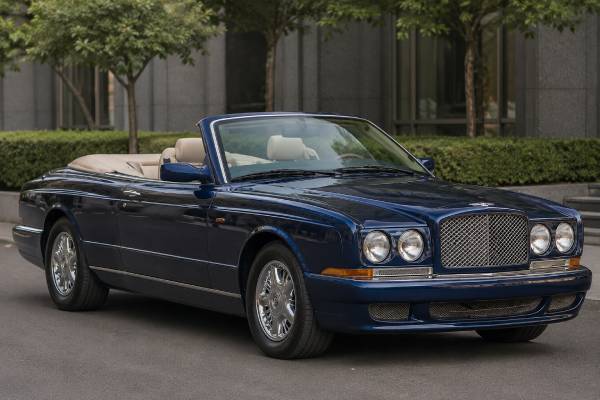
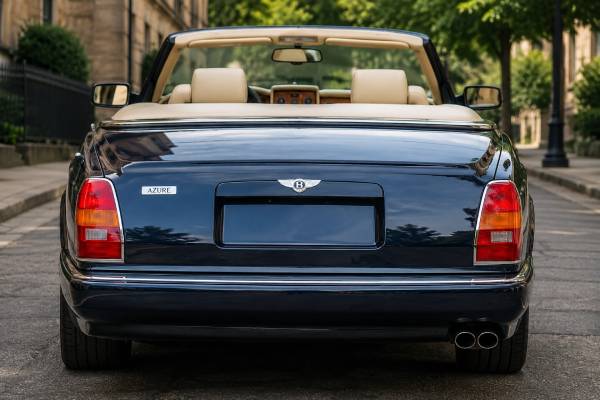
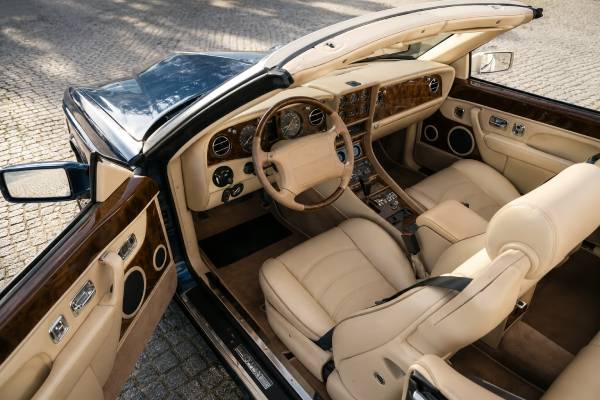
The 1998–2002 Bentley Azure with the L410M1T2 engine occupies the middle ground in the first-generation range. It keeps the original car’s Pininfarina-developed convertible body, traditional 6.75-litre pushrod V8, four-speed automatic, and rear-wheel drive, but raises output to 400 hp and gives the enormous four-seater a stronger reserve of torque. It is the version many buyers picture when they think of a late standard Azure: still visually restrained compared with a Mulliner, yet quicker and more developed than the launch specification.
That apparent simplicity can be misleading. Azure production changes did not always align neatly with calendar years, and many cars were ordered with Mulliner features, market-specific equipment, or later cosmetic updates. The first job when evaluating one is therefore identification, not assumption. Confirm the VIN, build date, engine code, original specification, and documented powertrain configuration before using a generic model-year description. Once verified, the 400 hp Azure can be a superb long-distance convertible, provided its roof, hydraulics, cooling system, brakes, electrical supply, and service record are all genuinely healthy.
Table of Contents
- Placing the 400 hp Azure in the Model Timeline
- Technical Dossier for the L410M1T2 Version
- Torque, Performance, and Chassis Behavior
- Fuel, Range, and Real-World Use
- A Preservation-Focused Service Plan
- Verification Before Purchase
- Ownership Value and the Right Buyer
Placing the 400 hp Azure in the Model Timeline
The 400 hp Azure is the evolved standard model, not the 420 hp Mulliner or one of the later special editions. Its importance comes from adding stronger performance while preserving the cleaner launch-era appearance and the relaxed grand-touring setup.
The first Azure appeared in 1995 with a turbocharged 6.75-litre V8 rated at 384 hp. During the late 1990s Bentley developed the engine-management and boost calibration, creating the 400 hp specification identified in this assignment by the L410M1T2 code. At the same time, customers could order increasingly extensive Mulliner personalization. As a result, an Azure can wear larger wheels, different bumpers, special trim, or other bespoke details without necessarily being the 420 hp Azure Mulliner derivative.
That overlap is why badges alone are not enough. A useful identification process checks:
- the VIN and factory build information;
- the engine code or confirmed engine specification;
- original order records, build sheets, or dealer invoices;
- the shape and finish of the wheel arches, bumpers, and wheels;
- cabin instruments, treadplates, badges, and bespoke trim;
- any later upgrades recorded by a recognized Bentley specialist.
A car advertised as a “400 hp Mulliner” may be a standard L410M1T2 Azure fitted with Mulliner options, while another may have received later body parts during repair or refurbishment. Neither situation automatically makes the car undesirable, but the description should match the evidence. Authenticity influences collectability, insurance, parts ordering, and future resale.
The 1998–2002 version also sits across a major corporate transition. Volkswagen Group took control of Bentley in 1998, but the first-generation Azure remained fundamentally the Vickers-era Continental R convertible. It retained the hand-built Crewe atmosphere, the old-school low-revving V8, and the body-production relationship with Pininfarina. Later manufacturing investment would transform Bentley’s range, yet this Azure continued as a product of the earlier engineering philosophy.
For a buyer, that makes the L410M1T2 car appealing in a specific way. It offers more urge than the original 384 hp model without moving fully into the visually assertive and rarer 420 hp variants. It is still a formal luxury convertible first and a performance car second.
Technical Dossier for the L410M1T2 Version
This Azure is a conventional petrol ICE car with a longitudinal front engine, single turbocharger, four-speed automatic transmission, and rear-wheel drive. The mechanical layout is straightforward in concept, but the vehicle surrounding it is unusually complex because of its high-pressure hydraulic systems, adaptive damping, power-operated roof, bespoke electrical equipment, and hand-finished body and cabin.
| Specification | Value |
|---|---|
| Engine code | L410M1T2 |
| Engine type | Turbocharged and intercooled petrol V8 |
| Displacement | 6,750 cc (6.8 L) |
| Valvetrain | Pushrod OHV, 2 valves per cylinder, 16 valves total |
| Block and cylinder heads | Aluminium alloy |
| Bore × stroke | 104.1 × 99.1 mm (4.10 × 3.90 in) |
| Induction | Single Garrett AiResearch turbocharger with intercooler |
| Engine management | Zytek EMS3 digital management |
| Maximum power | 400 bhp (298 kW) at about 4,000 rpm |
| Maximum torque | About 835 Nm (616 lb-ft) at about 2,100 rpm |
| Specification | Value |
|---|---|
| Transmission | Four-speed GM-sourced automatic |
| Drive | Rear-wheel drive |
| Final-drive ratio | 2.69:1 |
| Front suspension | Independent wishbones, coil springs, anti-roll bar |
| Rear suspension | Independent semi-trailing arms, coil springs, anti-roll bar |
| Ride control | Electronically controlled adaptive damping |
| Traction assistance | Electronic traction control |
| Braking system | Four-wheel discs with ABS and high-pressure hydraulic assistance |
| Measure | Value | Context |
|---|---|---|
| 0–60 mph | About 6.3 seconds | Period quoted performance |
| 0–100 km/h | Roughly 6.5–6.7 seconds | Published figures vary by market and test method |
| Maximum speed | About 250 km/h (155 mph) | Governed or manufacturer-quoted limit |
| Power-to-weight ratio | About 163 bhp per metric ton | Using a 2,450 kg published kerb figure |
| Specification | Value |
|---|---|
| Body | Two-door, four-seat fabric-roof convertible |
| Length | Approximately 5,350 mm (210.6 in) |
| Width | Approximately 1,878 mm (73.9 in), excluding mirrors |
| Height | Approximately 1,475 mm (58.1 in) |
| Wheelbase | 3,061 mm (120.5 in) |
| Track | Approximately 1,549 mm (61.0 in) front and rear |
| Published kerb weight | Approximately 2,450 kg (5,401 lb) |
| Fuel capacity | Approximately 108 L (28.5 US gal) |
| Rating | Value | Test basis |
|---|---|---|
| Combined | 12 mpg US (19.6 L/100 km) | EPA adjusted rating for 1998–2001 listings |
| City | 10 mpg US (23.5 L/100 km) | EPA adjusted rating |
| Highway | 15 mpg US (15.7 L/100 km) | EPA adjusted rating |
| Fuel requirement | Premium gasoline | Use the octane stated for the car’s market |
Published dimensions and weights can conflict because sources use different measuring points, equipment levels, and kerb-weight definitions. Some later first-generation Azure material lists a figure around 2,610 kg. The safe approach is to retain the source definition rather than treating every number as directly interchangeable, especially when calculating transport limits or lift capacity.
Torque, Performance, and Chassis Behavior
The extra appeal of the 400 hp car is the size of its mid-range reserve. Peak power is modest by modern supercar standards, but more than 600 lb-ft of torque arrives at little more than idle speed, so the Azure gathers speed with very little apparent effort.
That behavior is different from a naturally aspirated performance engine. The V8 is not intended to be extended toward a high redline, and the transmission does not chase gears. Press the accelerator at cruising speed and the car should first lean on its existing torque, then downshift when necessary and continue accelerating in one long movement. A car that hesitates, surges, smokes, or feels dramatically weaker than its mass alone would explain needs investigation.
Turbo control and engine management are central to the L410M1T2 specification. The Zytek system manages fueling, ignition, and boost, while the intercooler reduces charge-air temperature. Age-related faults in vacuum hoses, sensors, wiring, grounds, or intake plumbing can upset that coordination. A specialist should diagnose the whole system rather than increasing boost or replacing expensive components without test data.
The chassis supports high-speed touring rather than abrupt direction changes. Its 3,061 mm wheelbase and substantial weight give reassuring stability, and adaptive damping tightens body control when the car is driven harder. The Azure can carry surprising pace through broad bends, but narrow roads expose its width, long nose, heavy doors, and large turning circle. Drivers need to plan placement and braking earlier than they would in a smaller grand tourer.
Tires have an outsized effect on the experience. Correctly specified premium tires with fresh date codes help the steering track cleanly and let the suspension work as intended. Old or mismatched tires can create wander, vibration, harshness, and poor wet grip even when the tread appears deep. Larger wheels may suit some bespoke specifications, but fitment must account for load rating, offset, clearance, and the effect on ride quality.
The brakes should feel powerful and progressive. Because assistance is linked to the car’s high-pressure hydraulic architecture, a weak or inconsistent pedal cannot be dismissed as ordinary age. The same is true of warning lights that appear only intermittently. Hydraulic pressure, accumulators, pumps, hoses, switches, calipers, discs, and fluid condition need systematic testing.
A road test should include low-speed maneuvering, rough pavement, steady motorway cruising, repeated moderate braking, and at least one full-temperature restart. That broader route reveals more than a short burst of acceleration. Listen for suspension knocks, driveline clunks, wind noise around the side glass, roof squeaks, transmission flare, and cooling fans that do not behave normally.
Fuel, Range, and Real-World Use
Fuel consumption is a planning issue rather than a surprise: the 400 hp Azure is officially a 12 mpg combined car in U.S. testing. Its large tank provides useful touring range, but urban traffic, repeated cold starts, and heavy throttle can reduce that range quickly.
At the EPA combined figure, a nominal 108-litre tank represents a mathematical range of roughly 350 miles, but owners should not plan to use every drop. Real journeys need a reserve for traffic, detours, fuel availability, and the difference between test-cycle results and actual conditions. A practical stop interval can be far shorter, especially when the car is driven in cities or on mountain roads.
Premium fuel is important because boost, compression, ignition control, and operating temperature were calibrated around an appropriate octane level. The correct grade depends on the market, so the filler label and official documentation take priority over a generic internet recommendation. Fuel that has aged during storage can also cause poor starting and drivability problems; keeping the car active is better than leaving a nearly empty tank for long periods.
The Azure works best on longer trips where the engine, transmission, brakes, and hydraulic systems reach stable operating temperature. Short urban journeys amplify its disadvantages: limited visibility with the roof raised, high fuel use, a large turning circle, difficult parking, and little opportunity for the V8 to operate efficiently. The car can handle such use, but it was designed to make distance disappear, not to be a compact commuter.
Cabin and luggage packaging require realistic expectations. Four adults can travel, but rear-seat comfort depends on front-seat position and roof status. Wind disturbance is greater in the rear with the hood down. The luggage area is constrained by the roof mechanism, so soft bags work better than rigid cases. Before a tour, perform a full roof cycle with the planned luggage loaded to ensure nothing interferes with the mechanism or storage well.
Air conditioning matters even in an open car. It demists the cabin with the roof raised, cools occupants in traffic, and helps preserve the usability expected of a luxury grand tourer. Test temperature output, blower speeds, vent selection, and compressor engagement. Converting or repairing an old refrigerant system should be done properly, with leak testing and the correct oil and charge, not by repeatedly adding refrigerant.
A Preservation-Focused Service Plan
The right service plan treats time, heat, and inactivity as seriously as mileage. A 2,000-mile year can still age coolant hoses, hydraulic seals, brake fluid, tires, batteries, fuel, roof cylinders, and electrical connectors.
Begin by establishing a documented baseline. Even when the service book is stamped, invoices should confirm what was actually replaced. A specialist inspection can then divide the car into systems and create a staged plan rather than reacting to one warning light at a time.
Powertrain and heat management
Change engine oil and the filter at a sensible time interval using the viscosity and specification confirmed for the VIN and climate. Inspect the cooling circuit closely: radiator condition, hose softness, clamp marks, expansion tank, thermostat behavior, water pump, fan operation, and any dried residue. The V8’s durability depends on stable temperature and clean oil more than on frequent high-rpm use.
Check turbocharger and intercooler plumbing for loose clamps, soft hoses, oil contamination, and cracks. Inspect vacuum lines and wiring around hot areas. Spark plugs, ignition components, injectors, and sensors should be evaluated through symptoms and service history rather than changed blindly, because access and parts cost can make random replacement wasteful.
The four-speed automatic benefits from leak inspection, cooler-line checks, and fluid evaluation. A specialist should decide whether a conventional service, staged fluid replacement, or further diagnosis is appropriate. Aggressive flushing without understanding the transmission’s condition is not a universal solution.
Hydraulics, suspension, and brakes
Use only the fluid specified for the particular hydraulic circuit. Mixing fluids can damage seals and create expensive contamination. Record pump behavior, accumulator condition, pressure tests, and any hose replacement. Examine suspension bushes and ball joints under load, not only with the wheels hanging, and confirm that adaptive damping faults are not being hidden by disconnected warning lamps.
Brake-fluid service, caliper movement, disc thickness, flexible hoses, and parking-brake operation deserve scheduled attention. The car’s performance and mass leave little margin for neglected brakes. Wheel alignment should follow replacement of worn joints or bushes and should be checked against the factory wheel and tire setup.
Roof, weather sealing, and electrical supply
A strong battery and charging system are preventive maintenance for the roof. Low voltage can interrupt a cycle and create misleading controller faults. Keep drains open, inspect hydraulic lines and rams for seepage, and clean seals with products that will not swell or harden them. Never force the deck cover or roof frame.
The fabric hood should be cleaned gently and allowed to dry fully. Store the car with the roof raised so the material and flexible rear window are not left creased. Inspect window alignment because frameless glass that sits too high or low can overload seals and prevent the roof from closing correctly.
A battery maintainer is helpful during storage, but it does not replace periodic driving. Bring the entire car to operating temperature, use the brakes, cycle the climate controls, and watch the instruments. The aim is to discover small changes before they become a non-starting car with multiple simultaneous faults.
Verification Before Purchase
A purchase decision should be evidence-led: identity first, system condition second, cosmetics third, and mileage last. The cheapest apparent bargain can become the most expensive car once roof, hydraulic, cooling, and trim work are added.
Use a cold inspection and a long test drive. Before starting, look for fluid under the car, check coolant level only when safe, inspect tire dates, and note whether the battery has been connected to a charger immediately before your arrival. A seller who has already warmed the engine may be concealing difficult starting, smoke, noise, or charging weakness.
Cycle every major function:
- roof fully down and fully up;
- all side windows and mirrors;
- seat motors, heaters, and memory where fitted;
- climate control and every blower speed;
- exterior and interior lighting;
- central locking, alarm, and both keys;
- audio and any factory telephone or navigation equipment still installed;
- warning-lamp self-test and gauge operation.
During the drive, confirm straight tracking, smooth boost, stable coolant temperature, clean shifts, progressive brakes, and controlled damping. Repeat the roof cycle after the car has been driven because heat and voltage changes can expose faults. Inspect the roof well and luggage compartment again for fresh hydraulic fluid or water.
The body inspection should include sill seams, jacking points, wheel arches, door hinges, lower door edges, screen surround, roof-deck alignment, and evidence of overspray. Long doors naturally require careful adjustment, but sagging, damaged catches, or inconsistent gaps may indicate wear or repair. Use a paint-depth gauge as a guide, not as the sole verdict, because hand finishing and previous cosmetic work can produce variation.
Interior condition can reveal storage quality. Mildew, lifted veneer, cloudy instruments, stiff leather, corroded seat runners, and damp lambswool suggest moisture. Check that the flexible rear window remains transparent and supple. A replacement hood is not negative when done correctly, but the invoice, material, stitching, and fit should support the claim.
Finally, obtain a written pre-purchase report from a Rolls-Royce and Bentley specialist familiar with Continental R and first-generation Azure systems. Ask for estimated costs and parts availability, not just a list of observations. Verify open recalls or campaigns by VIN in the relevant national database, as model-year lists alone may not identify every affected car.
Ownership Value and the Right Buyer
The 400 hp Azure suits an owner who values occasion, craftsmanship, and long-distance comfort more than low operating costs or modern convenience. It can be bought for a fraction of its original price, but it still expects maintenance appropriate to a hand-built flagship.
Market value is driven by condition, provenance, originality, color, steering position, mileage credibility, and recent specialist expenditure. Standard cars generally do not command the same premium as scarce Le Mans, Mulliner, or Final Series derivatives, yet an outstanding standard Azure may be a better purchase than a special edition that needs extensive recommissioning.
A useful buying budget includes the purchase price plus a substantial first-year reserve. The reserve should cover immediate safety work, fluids, tires, batteries, leaks, alignment, roof adjustment, and items found during specialist inspection. It should not be based on the assumption that a low-mileage example needs nothing. Infrequent use can increase seal, fuel, brake, and electrical problems.
The strongest ownership candidates usually share several qualities:
- continuous invoices from recognizable specialists;
- regular use rather than years of unexplained inactivity;
- a roof that operates correctly without excuses;
- no cooling or hydraulic warning signs;
- factory-consistent wheels, tires, trim, and badging;
- dry carpets and luggage compartment;
- a seller willing to permit cold inspection and independent testing.
The L410M1T2 version has a clear practical advantage within the range: it delivers nearly all the effortless character of later cars while often avoiding the price premium attached to named limited editions. Its 400 hp label is less important than the broad 835 Nm torque figure and the way the chassis uses it. A well-sorted car feels powerful at ordinary road speeds without needing dramatic throttle inputs.
For collectors, production provenance and original specification deserve careful research. For drivers, recent system-level maintenance matters more. The ideal purchase combines both: a correctly identified 1998–2002 400 hp Azure with coherent history, preserved materials, and evidence that expensive mechanical work has been done before failure rather than after it.
References
- Vehicle Specifications 2026 (Manufacturer Heritage Data)
- Bentley Story | Bentley Motors 2026 (Manufacturer History)
- Fuel Economy of the 2000 Bentley Azure 2026 (EPA Fuel Economy)
- 1995 – 2002 Bentley Azure Specifications – Ultimatecarpage.com 2026 (Technical Specifications)
- 1999 Bentley Azure – HandH 2026 (Vehicle History and Specification)
- Search Safety Issues | NHTSA 2026 (Recall Database)
Disclaimer
This article is provided for informational purposes and cannot replace professional diagnosis, repair, or a model-specific inspection. Specifications, torque values, service intervals, fluids, and procedures may differ by VIN, market, build date, and installed equipment; confirm them in official Bentley service documentation before work begins.
Share this article on Facebook, X/Twitter, or a relevant owners’ group if it helps another buyer identify and assess a 400 hp Bentley Azure.