
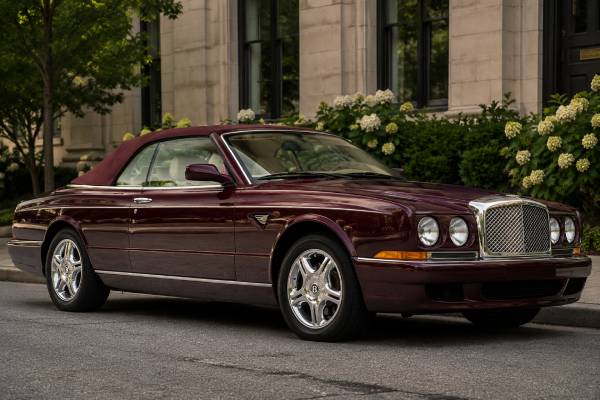
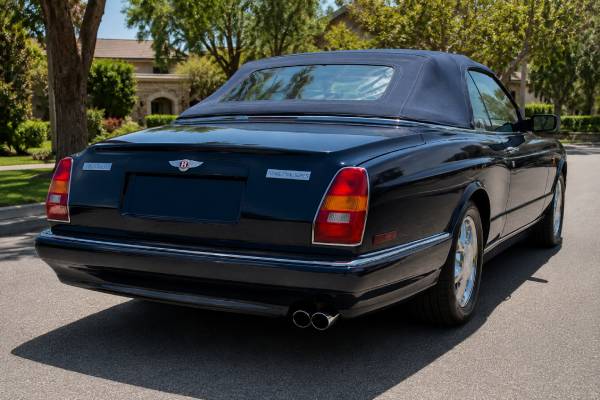
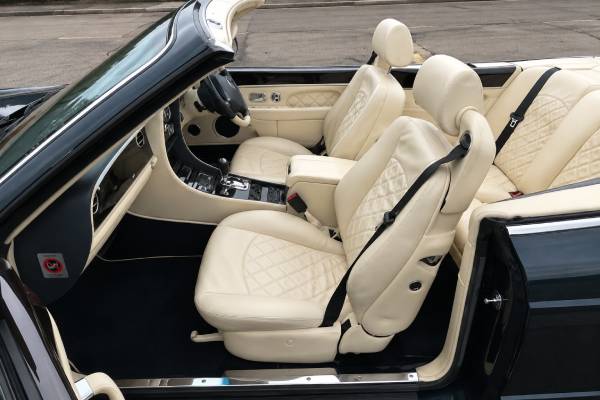
The 2003 Bentley Azure Final Series Luxury is one of the rarest forms of the first-generation Azure: specialist VIN research identifies only three examples. Its importance is not based on extra horsepower over the contemporary Mulliner or Final Series Performance. All used the 420 hp version of Bentley’s 6.75-litre turbocharged V8. The Luxury edition instead concentrated on cabin craftsmanship, including a cigar humidor, additional hide on the waist rails, and special leather and wood treatment, while retaining the imposing four-seat convertible format.
That makes authenticity unusually dependent on interior evidence. A missing humidor, retrimmed waist rail, changed veneer, or undocumented color conversion can erase much of what separates a Luxury car from another late Azure. Mechanical condition is equally important because the edition still carries the full complexity of a 2.6-tonne turbocharged Bentley: high-pressure hydraulics, adaptive damping, a four-speed automatic, a large cooling system, extensive electrics, and an electrohydraulic fabric roof. The right car is therefore not merely a rare VIN. It is a complete, traceable example whose bespoke materials and major systems have been preserved or restored with evidence.
Table of Contents
- The Three-Car Final Series Luxury
- Luxury Trim, Humidor, and Originality
- Final Series Luxury Specifications
- Road Manners and Appropriate Use
- Preserving Its Bespoke Materials
- Mechanical Baseline and Service Priorities
- Authenticating and Buying One
The Three-Car Final Series Luxury
Only three Azure Final Series Luxury cars are identified in specialist chassis records, all for the 2003 model year and all left-hand drive. Its scarcity comes from customer preference: 62 buyers selected the Performance trim, while just three ordered the more cabin-focused Luxury specification.
The Final Series appeared at a turning point for Bentley. Production of the Continental R-based Azure was ending, the corporate separation from Rolls-Royce had become effective, and Bentley was entering a new period centered on the Continental GT. The farewell Azure was announced in two forms rather than one. Both used the late 420 bhp powertrain, but the Luxury version emphasized hand-finished interior detail instead of the stronger visual sporting theme associated with the Performance car.
Registry research lists these three chassis numbers:
- SCBZK25E73CX01190;
- SCBZK25E43CX01194;
- SCBZK25E63CX01195.
Those numbers are valuable because Final Series, Azure Mulliner, and other late first-generation chassis occupy overlapping sequences. A number within the broad 2003 range does not by itself prove the exact model. Each claimed Luxury car should be tied to factory build information, its original order, and physical trim.
The production total also helps explain why public photographs can mislead. Press images for “Azure Final Series” are not always clearly identified as Luxury or Performance, and auction descriptions often shorten the name to Azure Final Series or Azure Mulliner. A car with diamond quilting, chrome instrument bezels, a starter button, or winged-B inlays may look correct for either version. The Luxury-specific evidence is in the detailed cabin specification and the documentation connecting it to one of the three cars.
Rarity should not be confused with a guaranteed value premium. Three-car production makes an authentic, complete example historically significant, but the pool of buyers is also specialized. Condition, originality, color combination, ownership history, road legality, geographic location, and the cost of deferred work still influence value. A damaged or heavily altered Luxury car may be harder to restore than a more common Performance car because reference examples and edition-specific pieces are so limited.
The most useful way to think about the model is as a coachbuilt interior commission attached to the final evolution of the first Azure. Its identity is subtle. It rewards close examination more than instant visual recognition, and its strongest evidence lives in records, material choices, and craftsmanship rather than in a dramatic change of engine or body architecture.
Luxury Trim, Humidor, and Originality
The Luxury edition is distinguished chiefly by interior treatment, so preservation of its cabin is central to authenticity. The cigar humidor, hide-covered waist rails, and special leather and wood details should be inventoried against the build sheet before any restoration begins.
Period research identifies the most important difference between the two Final Series versions as interior trim. The Luxury car added a cigar humidor, extra hide on the waist rail, and distinctive leather and wood work. Shared Final Series features could include five-spoke wheels, Bentley-branded brake calipers, 18-inch tires, a boost gauge, chrome instrument bezels, a prominent starter button, diamond-quilted seats and door inserts, and winged Bentley motifs.
Because each car could be individually specified, do not expect all three to use the same colors, veneers, stitching, or humidor finish. Bentley’s bespoke process allowed combinations that may appear unusual today. Factory records should determine whether a contrasting hide, black lacquer panel, dark-stained walnut, special piping, or nonstandard embroidery is original.
The humidor deserves its own inspection. Confirm that it is the factory item, fits its intended location, closes correctly, retains its lining and hardware, and has not suffered moisture damage. A humidor is designed to manage humidity for cigars, while a valuable car cabin is vulnerable to excess moisture. Any humidification element should be handled conservatively, and the surrounding veneer, leather, fasteners, and storage compartment should be checked for swelling, corrosion, odor, or staining.
Additional hide on the waist rails can be more difficult to authenticate than a badge. Inspect stitching pattern, seam placement, edge finishing, grain, color, padding, and the way the leather meets neighboring trim. Modern retrimming may look flawless yet differ from the original construction. Before removing an aged covering, photograph hidden edges and look for labels, chalk marks, original adhesive patterns, or color protected from sunlight.
Wood treatment also requires restraint. Veneer on a late Bentley is thin and carefully matched. Cloudy lacquer, lifting edges, or sun checking should be evaluated by a specialist who can conserve the original face rather than sanding aggressively. Re-veneering may be necessary when the substrate has failed, but it should reproduce species, figure, book-matching, stain, inlay, and gloss accurately.
A complete originality file should include:
- the factory order and build record;
- delivery invoice and dealer correspondence;
- a map of every hide color and material;
- close photographs of the humidor and mounting;
- veneer species, inlays, and finish notes;
- stitch, piping, quilting, and embroidery details;
- instrument and starter-button configuration;
- wheel, brake-caliper, badge, and treadplate details;
- records for any retrim, refinish, or replacement.
This file is useful even when the cabin is untouched. It gives future conservators a reference before age, cleaning, or repair changes the materials. On a three-car edition, documenting what survives is part of preserving the model’s history.
Final Series Luxury Specifications
The Final Series Luxury is a petrol ICE convertible powered by the L410M1T3 6,750 cc turbocharged V8. It uses a four-speed automatic and rear-wheel drive, with performance essentially matching the 2003 Azure Mulliner rather than receiving a separate Luxury engine calibration.
| Specification | Value |
|---|---|
| Engine code | L410M1T3 |
| Layout | Front-mounted 90-degree V8 |
| Displacement | 6,750 cc (6.8 L) |
| Construction | Aluminium block and cylinder heads |
| Valvetrain | Pushrod OHV, 2 valves per cylinder, hydraulic tappets |
| Induction | Single Garrett AiResearch turbocharger with intercooler |
| Engine management | Zytek EMS3 |
| Maximum power | 420 bhp (313 kW) at 4,000 rpm |
| Maximum torque | 875 Nm (645 lb-ft) at approximately 2,200 rpm |
| Fuel | Premium unleaded petrol |
| Specification | Value |
|---|---|
| Transmission | GM Turbo Hydra-Matic four-speed automatic |
| Drive | Rear-wheel drive |
| Final drive | 2.69:1 |
| Traction control | Electronic |
| Front suspension | Independent wishbones, coil springs, anti-roll bar |
| Rear suspension | Independent semi-trailing arms, coil springs, anti-roll bar |
| Damping | Electronically controlled adaptive ride |
| Brakes | Four-wheel discs with ABS and hydraulic assistance |
| Specification | Value | Notes |
|---|---|---|
| Body type | Two-door, four-seat convertible | Power fabric hood |
| Length | 5,350 mm (210.6 in) | Manufacturer heritage figure |
| Wheelbase | 3,061 mm (120.5 in) | Continental R-derived platform |
| Track | 1,549 mm (61.0 in) | Published manufacturer figure |
| Published weight | 2,610 kg (5,754 lb) | Confirm source weight definition |
| Seating | Four | Integrated front-seat belts |
| Item | Value | Context |
|---|---|---|
| Model year | 2003 | Final first-generation Azure year |
| Registry production | 3 cars | All listed as left-hand drive |
| First recorded chassis | SCBZK25E73CX01190 | Build documents still required |
| Last recorded chassis | SCBZK25E63CX01195 | Sequences overlap other late variants |
| Core distinction | Luxury-focused interior specification | Humidor, extra hide, special wood and leather |
| Measure | Value | Source context |
|---|---|---|
| 0–100 km/h (0–62 mph) | Approximately 6.2 seconds | Late Azure Mulliner heritage specification |
| Maximum speed | 245 km/h (152 mph) | Published manufacturer heritage value |
| Performance character | High low-rpm torque | Luxury grand touring rather than track use |
Do not use these figures to order parts or set workshop values without VIN confirmation. Bespoke equipment, market requirements, wheel packages, and production changes can alter service information even among three closely related cars.
Road Manners and Appropriate Use
The Luxury drives like a late 420 hp Azure, with abundant low-rpm thrust and deliberate, comfort-focused responses. Its special interior does not make it mechanically softer or less capable than the Performance edition, but preservation priorities may encourage more measured use.
The V8’s 875 Nm output allows the car to accelerate strongly without high engine speed. A proper example should pull cleanly, hold steady boost, and shift without flare or shock. The four-speed automatic has wider ratios than a modern multi-speed unit, so a downshift can feel more pronounced, but it should not bang into gear or hesitate excessively.
Steering effort is light for the car’s size, while the long wheelbase and large mass favor stable, flowing roads. Enter a bend at a settled speed and let the torque carry the car out. Abrupt mid-corner inputs can ask too much of old tires, dampers, and suspension joints even when the car feels composed. Correct tire construction, age, pressure, and load rating are essential to the intended ride.
The cabin’s value changes how occupants should treat it. Avoid placing sharp luggage, metal buckles, or damp clothing against special hides and waist rails. Do not use the humidor as ordinary storage. When the roof is open, prolonged strong sun can heat dark veneer and leather quickly; a windscreen shade and sensible parking choice reduce stress on finishes.
A rare car still benefits from regular exercise. Storage without heat cycles encourages seal shrinkage, stale fuel, flat-spotted tires, corroded brake surfaces, weak batteries, and roof faults. The appropriate pattern is a planned drive long enough to reach full temperature, operate the gearbox through its ranges, use the brakes progressively, run the climate system, and verify instruments.
Roof operation should be intentional rather than demonstrative. Confirm battery charge, use level ground, clear the storage area, and watch the frame and deck cover. If the pump changes note, one side hesitates, or glass alignment looks wrong, stop and diagnose. Repeatedly cycling the hood at shows adds wear without benefiting the car.
After a drive, allow heat to disperse before fitting a cover. Check for coolant odor, hydraulic leaks, oil drips, hot brakes, or a tire losing pressure. A simple post-drive walkaround can catch a developing fault while the evidence is still visible.
Preserving Its Bespoke Materials
Conservation should keep original material, construction evidence, and patina wherever those elements remain sound. Replacing everything for a showroom appearance can destroy more historical information than it saves.
Leather needs controlled cleaning and humidity, not repeated heavy feeding. Test any product on a hidden area and avoid coatings that create an artificial shine or seal dirt beneath pigment. Creases in a driver’s bolster are normal; cracking at a seam, dry piping, or detached hide needs intervention before it tears.
The extra hide covering the waist rails is vulnerable to sunlight, shrinking, and adhesive failure. Support lifting material rather than pulling it tight. A trimmer should inspect the substrate and preserve original seam positions. Where a localized repair is possible, it is often preferable to replacing the complete rail and losing original grain and color variation.
Veneer responds badly to rapid changes in heat and moisture. Keep the car in a stable, ventilated environment, avoid wet detailing near edges, and use soft cloths without silicone-heavy dressings. Tiny lacquer checks can be monitored; lifting veneer or white moisture bloom requires specialist assessment. Photograph the pattern before refinishing because matching the book-mirrored figure is crucial.
The humidor should be treated as a fitted cabinet. Remove loose accessories before transport, inspect hinges and latch tension, and prevent humidification media from leaking. If the original insert is missing, do not commission a replacement until dimensions, lining, hardware, and finish have been documented from reliable evidence. A generic luxury box can reduce rather than improve authenticity.
Diamond quilting, perforations, piping, and embroidery need gentle vacuuming and careful cleaning around thread. Re-dye work should preserve contrast and not fill perforations. If a panel must be remade, record thread size, stitch length, foam thickness, and pattern spacing. Those measurements are more useful than a casual color description.
Bright metal and chrome bezels should be cleaned without abrasive paste unless corrosion requires professional refinishing. Engine-turned or patterned metal can lose its geometry quickly when polished aggressively. Remove jewelry and watches when working around the center console and waist rails; accidental scratches in rare trim are expensive to correct.
Keep a materials log with dates, products, photographs, and the name of each craftsperson. The log helps diagnose reactions between old finishes and new products, and it gives a future owner confidence that restoration was considered rather than improvised.
Mechanical Baseline and Service Priorities
A newly acquired car needs a full mechanical baseline even when invoices appear complete. Age, storage, and low annual mileage can make a recently “serviced” Azure unready for sustained use.
Begin with fluids and evidence. Record oil pressure behavior, coolant condition, hydraulic fluid condition, transmission-fluid signs, brake wear, battery date, tire date codes, and leak locations before cleaning. Compare the findings with invoices. An unexplained fresh underbody wash or a spotless engine bay can hide useful diagnostic clues.
Cooling is the first major risk area. Pressure-test the system, verify both cold and hot levels using the correct method, inspect the radiator and condenser for blockage, and confirm fan operation at the required temperature and air-conditioning load. Check hoses behind shields and near the turbo where heat accelerates aging. Stable temperature in moving traffic is not enough; the car must also remain controlled at hot idle.
Hydraulic assistance affects brakes and ride behavior. Measure accumulator reserve and system pressure, inspect hoses and hard lines, and investigate warning lamps or frequent pump cycling. Use only the specified fluid. The cost of correct diagnosis is small compared with damage caused by mixed fluid or repeated operation at low pressure.
The turbocharged intake system should be smoke-tested or pressure-checked according to specialist practice. Small leaks can reduce response and alter fueling without producing a dramatic fault. Examine the turbo oil supply and drain, intercooler connections, vacuum hoses, wastegate control, heat shielding, and wiring close to hot components.
Transmission evaluation needs a cold and hot test. Note engagement time, each upshift, kickdown, converter lockup, coast-down behavior, and reverse. Inspect cooler lines and mounts. Service decisions should be based on condition and history; a unit with contaminated fluid or slipping clutches needs specialist planning rather than a routine flush.
The roof and electrical system share a dependency on good voltage. Load-test the battery, measure alternator output, clean grounds, and check parasitic draw before investigating intermittent modules. Roof rams, hoses, pump, relays, microswitches, frame joints, latches, seals, and drains should then be tested as one sequence.
Build the first-year budget around required outcomes rather than a cosmetic wish list:
- safe brakes, tires, steering, and suspension;
- stable cooling and hydraulic pressure;
- reliable starting, charging, fuel delivery, and transmission operation;
- watertight roof, clear drains, and functioning climate control;
- preservation of the Luxury-specific cabin;
- paint correction and optional detailing only after the car is dependable.
This order protects the rare interior from leaks, heat, electrical faults, and roadside recovery damage while keeping spending focused on the car’s long-term survival.
Authenticating and Buying One
A claimed Final Series Luxury should be authenticated before price negotiation, because the difference between one of three cars and a similarly equipped Azure is fundamental. Use a marque historian and a mechanical specialist, and require conclusions in writing.
The authentication process should connect five layers of evidence: VIN, factory order, production history, surviving physical specification, and ownership continuity. Any break can be explained, but it should not be ignored. A replacement interior after fire or water damage may be legitimate; without records, it becomes impossible to judge how much original Luxury content remains.
Ask for high-resolution images of:
- every VIN and identification label;
- the complete dashboard and waist rails;
- humidor inside, outside, hinges, latch, and mounting;
- seat quilting, piping, embroidery, and door inserts;
- veneer joins, inlays, and protected hidden areas;
- wheels, brake calipers, instruments, starter button, and badges;
- engine bay, underside, sills, wheel arches, roof frame, and boot floor.
The pre-purchase inspection must be performed from cold and continue until the car is fully heat-soaked. The roof should complete its cycle without assistance. Hydraulic reserve and cooling performance should be measured, not described as “fine.” A diagnostic scan should be supplemented by physical tests because many faults on this generation do not reduce to a modern fault-code report.
Calculate acquisition cost as purchase price plus transport, tax or import work, immediate mechanical repairs, material conservation, missing unique components, and a contingency. On such a rare car, the difficult line item may be craftsmanship rather than parts. Reproducing a damaged hide-covered rail or humidor correctly can require research, patterns, and custom work.
Mileage is secondary to continuity. Check odometer readings against services, registrations, inspections, auction catalogs, and photographs. Long gaps should lead to questions about storage conditions and recommissioning. A low number with no evidence of periodic use should increase the mechanical contingency.
Insurance valuation should describe the car as a documented Final Series Luxury and identify its chassis, not simply as a 2003 Azure. Agree how rare interior parts would be repaired, who may inspect a claim, and whether transport to a recognized specialist is covered. Keep copies of the build record and detailed photographs away from the vehicle.
The best custodian will accept that originality and usability must support each other. A brittle hose should not remain because it is factory-fitted, while an intact original waist rail should not be replaced merely to remove gentle patina. When safety work is documented and rare materials are conserved, the car can remain both functional and historically convincing.
References
- Bentley Azure Final Series Luxury 2026 (Production Registry)
- UNPUBLISHED FACTS I Model year 2003 2019 (Production Research)
- BENTLEY NEWSROOM : 2003 Azure Mulliner C2BML 2026 (Manufacturer Heritage Data)
- 2003 Bentley Azure Final Series 2026 (Model History)
- Bentley Story | Bentley Motors 2026 (Manufacturer History)
- Search Safety Issues | NHTSA 2026 (Recall Database)
Disclaimer
This article is for informational purposes and does not replace professional authentication, diagnosis, inspection, or repair. Specifications, torque values, service intervals, fluids, and procedures vary by VIN, market, build configuration, and bespoke equipment; verify all work against the car’s official Bentley records and service documentation.
Please share this article on Facebook, X/Twitter, or an appropriate classic-car community to support careful preservation of rare Bentley models.