
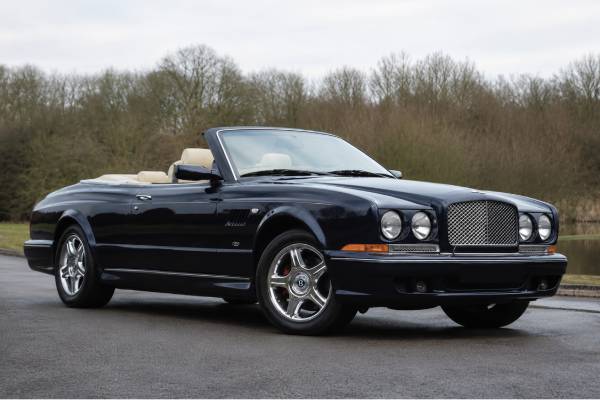
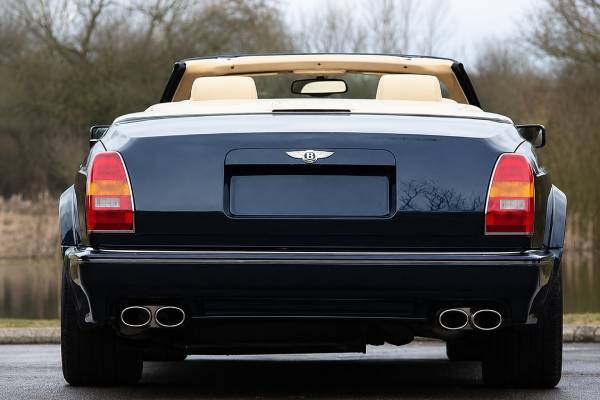
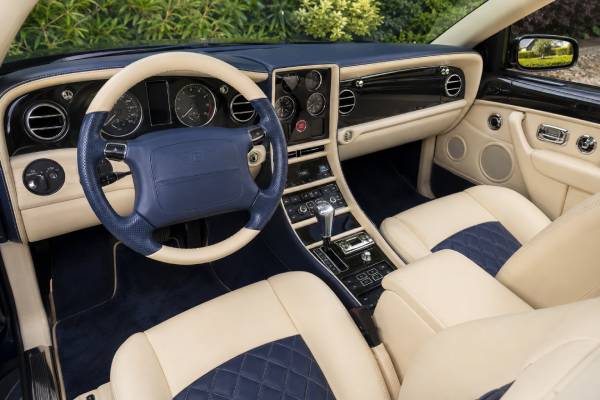
The Bentley Azure Le Mans is not simply a late first-generation Azure with badges. It is an exceptionally small-run derivative created around Bentley’s return to the 24 Hours of Le Mans, combining the 420 hp Mulliner powertrain and wide-body treatment with specific exterior and cabin details. Specialist production records identify only four Azure Le Mans cars: three assigned to the 2001 model year and one to 2002. That scarcity changes the way the model should be researched, inspected, valued, and restored.
For an ordinary Azure, excellent condition can outweigh a missing option or a later cosmetic change. For an Azure Le Mans, identity and completeness are inseparable from condition. Correct instruments, vents, wheels, calipers, exhaust finishers, badges, treadplates, trim, and documented chassis history all matter because replacing a missing edition-specific part may be difficult or impossible. Mechanical health remains essential—the roof, hydraulics, cooling system, turbocharged V8, brakes, and electrical systems can still generate major bills—but a prospective buyer must first prove that the car is one of the four genuine examples and understand exactly how it left Crewe.
Table of Contents
- Why the Four-Car Le Mans Edition Exists
- Authentication and Chassis Records
- Azure Le Mans Technical Specifications
- Edition-Specific Exterior and Interior Details
- Driving Character and Mechanical Care
- Collector Inspection and Purchase Strategy
Why the Four-Car Le Mans Edition Exists
The Azure Le Mans was produced to connect Bentley’s contemporary grand tourers with the marque’s renewed endurance-racing program. It was an additional special edition built from the Azure Mulliner formula, not a replacement for the standard Azure range.
Bentley had been absent from Le Mans as a factory competitor for decades. The company’s return at the start of the 2000s created a reason to use the Le Mans name on road cars, most visibly on the Arnage Red Label and Continental R. The Azure was never planned as the high-volume member of that celebration. Instead, a handful of customers received a Le Mans interpretation of Bentley’s flagship convertible.
Production registries consistently identify four Azure Le Mans cars. Three are listed as 2001 model-year examples and one as a 2002. The recorded chassis numbers are:
- SCBZK25E11CX62659
- SCBZK25E71CX62665
- SCBZK25E91CX62666
- SCBZK25E72CX01043
These numbers are useful starting points, but they are not a substitute for factory documentation. Chassis sequences can overlap with standard Azure and Azure Mulliner production, and a VIN decoder alone does not prove every feature or the car’s original trim. A complete authentication file should connect the VIN to the build sheet, delivery records, original invoices, known ownership, and physical edition details.
The Le Mans package drew from the 420 hp Azure Mulliner and the harder-edged Continental T visual vocabulary. Wide wheel arches, front-wing vents, red brake calipers, sport wheels, quad exhaust finishers, and specialized instruments made the car look more purposeful without changing its fundamental role. It remained a very large, four-seat, power-roof convertible intended for fast touring rather than circuit use.
That distinction matters when judging modifications. A firmer ride, louder exhaust, or modernized wheels may make a car feel more overtly sporting, but such changes can reduce historical accuracy. The original Le Mans concept balanced performance cues with Bentley luxury; it was not a stripped or lightweight homologation special.
Authentication and Chassis Records
Authenticating an Azure Le Mans requires agreement among documents, chassis identity, and physical features. No single badge, paint color, or auction description is strong enough on its own.
Begin with the VIN stamped and displayed on the car, then compare it with registration documents, service invoices, import records, and any Bentley build information. Inspect for signs that identification plates have been removed, refinished, or replaced. On a valuable low-production model, even an innocent repaint around a VIN label should be explained by supporting records.
Next, create an originality inventory. Photograph every Le Mans-specific element before negotiating a purchase or commissioning restoration. The inventory should cover:
- front-wing ducting vents;
- widened arches and the correct sport bumpers;
- five-spoke sport wheels and their finish;
- red brake calipers;
- quad exhaust outlets;
- exterior Le Mans Series identification;
- dark Racing Green instrument faces with edition lettering;
- turbo boost gauge and starter-button arrangement;
- drilled alloy pedals;
- edition-specific gear selector treatment;
- treadplate plaques;
- embroidered winged-B headrests and two-tone perforated hide;
- correct veneer style and Bentley-wing inlays.
Specialist registries also associate the Le Mans editions with Silver Storm, Black Oriole, and Le Mans Racing Green. A car in another color is not automatically false because Bentley and Mulliner regularly accepted bespoke commissions, and cars can be repainted. However, a nonstandard color should trigger deeper research into the original order and the quality of any color change.
Documentation should distinguish original equipment from later Bentley-supplied upgrades. A period owner may have added a factory part through a dealer, and a later keeper may have fitted visually similar Mulliner components. Both can be high-quality, but neither should be represented as original Le Mans production content unless the records prove it.
Auction history can help establish continuity. One of the four cars, chassis SCBZK25E91CX62666, was publicly sold by RM Auctions at the 2010 Sporting Classics of Monaco sale. Such appearances provide dated photographs, mileage statements, and specification descriptions that can be compared with the car today. They do not guarantee condition, but they can reveal when trim, wheels, paint, or instruments changed.
A strong provenance folder should include copies of old registration documents, delivery papers, service invoices, correspondence, prior advertisements, inspection reports, and high-resolution photographs. Because only four cars exist, the history of each individual chassis is more important than broad market statistics for the Azure range.
Azure Le Mans Technical Specifications
The Azure Le Mans is a petrol-powered ICE model using Bentley’s 6,750 cc turbocharged pushrod V8, a four-speed automatic gearbox, and rear-wheel drive. Its 420 hp engine specification is shared in principle with the late Azure Mulliner, while its edition value comes largely from rarity, presentation, and documented Le Mans content rather than a separate racing-derived powertrain.
| Specification | Value |
|---|---|
| Engine code | L410M1T3 |
| Configuration | 90-degree V8, front longitudinal installation |
| Displacement | 6,750 cc (6.8 L) |
| Valvetrain | Pushrod OHV, 2 valves per cylinder |
| Construction | Aluminium block and cylinder heads |
| Induction | Single Garrett AiResearch turbocharger with intercooler |
| Engine management | Zytek EMS3 digital management |
| Maximum power | 420 bhp (313 kW) at 4,000 rpm |
| Maximum torque | 875 Nm (645 lb-ft) at about 2,200 rpm |
| Fuel | Premium unleaded petrol |
| Specification | Value |
|---|---|
| Gearbox | GM Turbo Hydra-Matic four-speed automatic |
| Driven wheels | Rear |
| Final-drive ratio | 2.69:1 |
| Front suspension | Independent wishbones, coil springs, anti-roll bar |
| Rear suspension | Independent semi-trailing arms, coil springs, anti-roll bar |
| Damping | Electronically controlled adaptive ride system |
| Brakes | Four-wheel discs with ABS; red-painted calipers |
| Traction control | Electronic system |
| Specification | Value | Notes |
|---|---|---|
| Body style | Two-door, four-seat convertible | Power-operated fabric roof |
| Length | Approximately 5,350 mm (210.6 in) | First-generation Azure body |
| Width | Approximately 1,950 mm (76.8 in) | Wide-body Le Mans/Mulliner treatment |
| Height | Approximately 1,460 mm (57.5 in) | Published registry figure |
| Wheelbase | 3,061 mm (120.5 in) | Continental R-derived platform |
| Published kerb weight | Approximately 2,470 kg (5,445 lb) | Definition can vary among sources |
| Production | 4 cars | Three 2001 model year; one 2002 |
| Measure | Value | Interpretation |
|---|---|---|
| 0–100 km/h | About 6.0–6.2 seconds | Representative 420 hp Azure Mulliner performance |
| 0–60 mph | About 5.8–6.0 seconds | Period quoted range |
| Maximum speed | About 245 km/h (152 mph) | Conservative manufacturer heritage figure for the 420 hp Azure |
| Fuel economy | Roughly 10–12 mpg US in mixed use | Driving conditions have a large effect |
Some enthusiast registries publish faster acceleration and a 278 km/h top-speed figure for the Le Mans. Those numbers should not be presented as unquestionably official without the original model-specific homologation or manufacturer document. The car’s condition, tires, roof status, weather, fuel, and test procedure would also affect any real result today.
Edition-Specific Exterior and Interior Details
The Le Mans identity is expressed through a coherent group of details rather than one dramatic body change. Correctness comes from the combination, so missing or substituted pieces should be evaluated as a whole.
The widened arches contain five-spoke sport wheels and visually lower the car over its track. Front-wing vents link the Azure to the more aggressive Continental T and later performance Bentleys. Red calipers add color behind the wheels, while quad exhaust outlets and sport bumpers give the rear a less formal appearance. The changes are assertive by first-generation Azure standards but remain integrated with the long, elegant Pininfarina-assisted body.
Wheel condition deserves more attention than a normal cosmetic inspection. Confirm size, width, offset, casting marks, finish, center caps, and evidence of welding or severe straightening. A visually similar replacement may not carry the correct load rating or offset. Tires must match in specification and age, and the wide-body arches should be checked for contact marks caused by incorrect fitment.
Inside, the green-faced instruments and Le Mans lettering are among the most identifiable features. Their condition and authenticity matter because recreating dial graphics can be obvious under close examination. The stacked auxiliary instruments, boost gauge, and starter button should function correctly rather than merely being present.
The cabin also uses drilled pedals, a special gear selector, edition treadplates, embroidered headrests, perforated two-tone hide, and Bentley-wing veneer inlays. Inspect these items for signs of re-dyeing, incorrect embroidery, replacement veneers, or modern screws and adhesives. A careful restoration should preserve original substrates wherever possible instead of replacing rare parts simply to make them look new.
The hood and flexible rear window are not Le Mans-specific, but their presentation affects the entire car. A shrunken fabric roof, cloudy window, uneven deck cover, or misaligned side glass makes even a complete special edition look neglected. Replacement is acceptable when documented and executed with the correct material, stitching, color, headlining, and fit.
Paint evaluation requires nuance. These cars were hand-finished and may have received factory rectification before delivery. A uniform paint-depth reading is not guaranteed. Look instead for coherent color, correct metallic orientation, clean edges, preserved identification labels, proper panel alignment, and photographs or invoices explaining refinishing.
Driving Character and Mechanical Care
A healthy Azure Le Mans should feel like a stronger, more focused Azure Mulliner, not like a modern sports convertible. The engine delivers a large low-rpm surge, the four-speed automatic makes deliberate shifts, and the chassis favors high-speed stability over sharp rotation.
The 875 Nm torque figure is the most relevant performance number. It allows rapid overtaking without sustained high engine speed, but it also loads the transmission, differential mounts, rear suspension, tires, and cooling system. Any clunk when taking up drive, flare during an upshift, vibration under boost, or wandering under acceleration should be investigated before the car is driven hard.
Because so few Le Mans examples exist, preservation should not mean inactivity. Long storage dries seals, allows fuel to age, corrodes brake surfaces, weakens batteries, and encourages roof and hydraulic faults. A controlled exercise schedule is better: bring the drivetrain fully to temperature, operate the brakes progressively, use the climate control, and cycle the roof only when voltage and temperature are suitable.
A sensible maintenance framework includes:
- annual engine-oil and filter service for collector use, with the correct specification verified by VIN;
- regular pressure and leak checks of the braking and ride-control hydraulics;
- inspection of coolant hoses, radiator, water pump, thermostat, fans, and expansion tank;
- examination of turbo, intercooler, and vacuum plumbing for heat damage or leakage;
- transmission-fluid condition and cooler-line inspection by a specialist;
- brake-disc, caliper, flexible-hose, and tire-age checks;
- battery, alternator, starter, ground, and parasitic-draw testing;
- roof-hydraulic, microswitch, latch, drain, and weather-seal inspection;
- careful cleaning and conditioning of leather, veneer, brightwork, and hood fabric.
The hydraulic systems demand discipline. Use only the specified fluid and avoid mixing products based on color or generic compatibility claims. A warning lamp, frequently cycling pump, change in brake feel, or uneven ride height requires measurement of pressure and accumulator performance. Replacing one visible leaking hose may not address aged components elsewhere in the circuit.
Cooling-system care is equally important. The 6.75-litre turbo V8 produces considerable heat, and a rare badge does not protect it from a weak hose or blocked radiator. Monitor temperature during traffic, after a fast run, and during a hot restart. Dried coolant stains, sweet odor, unexplained loss, or fans that do not engage correctly justify immediate diagnosis.
The convertible mechanism should be operated without impatience. Start with a fully charged battery, level ground, and clear luggage area. Watch both sides of the frame and stop if the deck cover catches, the pump changes tone sharply, or one side leads the other. Forcing one cycle can damage rare trim and painted panels in addition to the hydraulic system itself.
Collector Inspection and Purchase Strategy
The correct purchase sequence is authenticity, structural and system condition, provenance, then price. A car that fails the first step should be valued as a modified Azure Mulliner until stronger evidence appears.
Commission two complementary reviews when possible. The first is a mechanical pre-purchase inspection by a workshop experienced with Continental R and first-generation Azure cars. The second is a provenance and originality review by a marque historian, club expert, or specialist who understands Le Mans production details. One person may be able to do both, but the questions are different.
The mechanical report should include a cold start, hydraulic pressure tests, cooling-system pressure test, diagnostic scan where supported, long road test, underside inspection, roof-cycle assessment, brake measurements, tire dates, fluid leaks, charging performance, and air-conditioning operation. It should assign costs and urgency rather than simply marking items “advisory.”
The originality report should map every edition component, compare it with period photographs or records, and identify later alterations. Request close-up images of the VIN, engine markings, instruments, treadplates, badges, wheel markings, veneer inlays, seat embroidery, exhaust, vents, and build documentation. Missing items should be priced with the possibility that no correct replacement is readily available.
Mileage should be treated as one data point. A low-mileage Le Mans with years of storage may need more work than a regularly driven example with complete invoices. Compare odometer readings with dated services, registrations, auction catalogs, tire records, and photographs. Investigate clerical discrepancies rather than assuming fraud or ignoring them.
Insurance needs an agreed-value policy supported by the car’s individual history. A generic Azure valuation may not reflect four-car scarcity, while an optimistic asking price may overstate the value of an incomplete or poorly restored example. Document the car extensively after purchase and update the valuation after major restoration or a significant public sale of a comparable chassis.
Transport and workshop handling also deserve planning. The car is long, wide, and heavy, with low bodywork and rare trim. Confirm trailer dimensions, ramp angles, tie-down points, lift capacity, and insurance before movement. A shop that can repair the engine but damages a Le Mans sill, wheel, or treadplate is not the right custodian.
A stored example should be recommissioned as a system rather than awakened with a battery and a short drive. Before the engine is started, inspect the fuel for age, turn the engine according to specialist procedure, confirm fluid levels and condition, and look for rodent damage around wiring, insulation, and air intakes. Brake calipers and parking-brake parts may have seized even when the car rolls freely. Old tires can look unworn yet be unsafe under the load and speed the Azure can generate. The first road test should therefore happen only after the cooling fans, hydraulic assistance, brakes, steering, charging system, and roof have been checked statically. Build speed and boost gradually while monitoring temperature, shift quality, smoke, noises, and fluid loss.
Restoration planning should preserve evidence before improving appearance. Photograph stamps, labels, fasteners, stitching, paint edges, hidden upholstery markings, wheel codes, and the backs of plaques before parts are removed. Bag and identify every original item, including damaged pieces that may provide patterns or material references. Ask the specialist to separate safety-critical work from cosmetic work and to record why each non-original replacement was selected. A carefully documented repair using the closest serviceable component is more credible than a perfect-looking result with no traceable decisions.
After purchase, establish a model-specific ownership file rather than relying on a general service book. It should contain a VIN and build-data summary, a dated originality inventory, roof-operation notes, hydraulic pressures, coolant-service history, battery isolation procedure, tire dates, paint map, key numbers, security information, and contact details for specialists familiar with these cars. Record every journey and fault while the details are fresh. On a four-car edition, that continuing record becomes part of the vehicle’s provenance and may be as useful to the next custodian as the original delivery papers.
The best Azure Le Mans is not necessarily the shiniest. It is the car whose identity can be traced, whose special components remain intact, whose mechanical systems function without excuses, and whose restoration decisions are documented. With only four examples, stewardship matters as much as ownership: every irreversible modification changes a meaningful share of the surviving population.
References
- 2002 Bentley Azure Le Mans Series Limited Edition | Sporting Classics of Monaco 2010 | RM Sotheby’s 2010 (Auction Record)
- Bentley Azure Le Mans 2026 (Production Registry)
- 2002 Bentley Azure Le Mans Series 2026 (Model History)
- Vehicle Specifications 2026 (Manufacturer Heritage Data)
- BENTLEY NEWSROOM : 2003 2026 (Manufacturer Le Mans History)
- Search Safety Issues | NHTSA 2026 (Recall Database)
Disclaimer
This guide is for informational purposes and does not replace professional authentication, diagnosis, inspection, or repair. Specifications, torque values, intervals, fluids, and procedures can differ by VIN, market, build date, and bespoke equipment; use the car’s official Bentley records and service documentation for every technical decision.
Please share this article on Facebook, X/Twitter, or a Bentley club channel to help preserve accurate information about the exceptionally rare Azure Le Mans.