
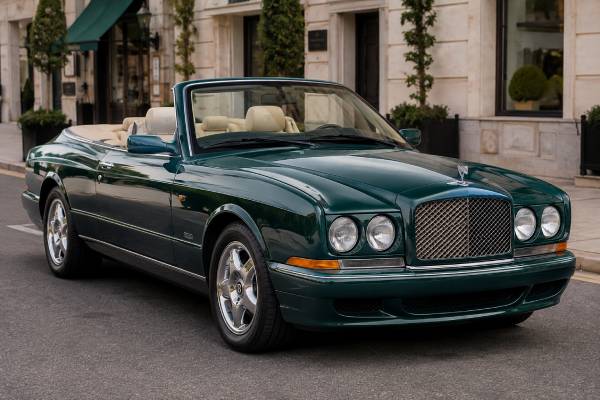
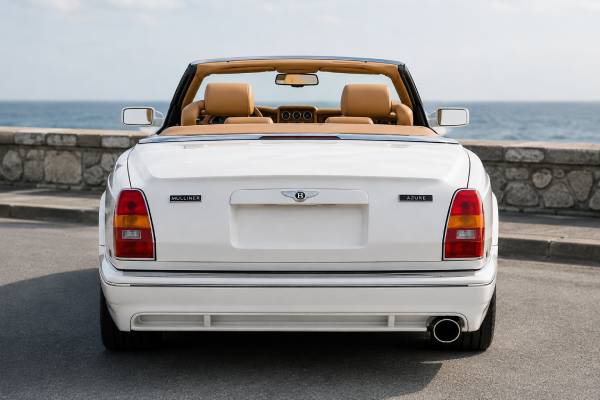
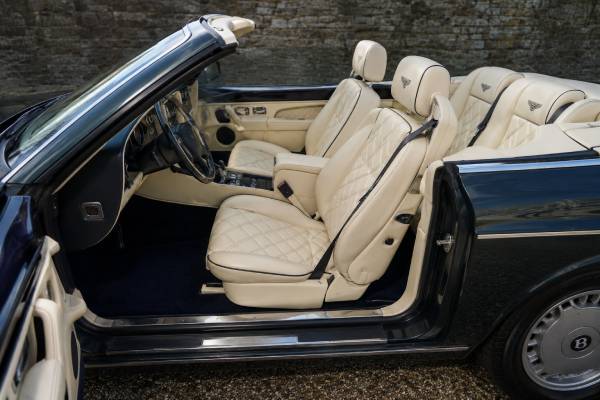
The 1999–2003 Bentley Azure Mulliner is the most assertive regular-production development of the first-generation Azure. It combines the hand-finished, Pininfarina-assisted four-seat convertible body with the 420 hp version of Bentley’s 6.75-litre turbocharged V8, widened bodywork, 18-inch wheels, stronger visual links to the Continental T, and a cabin that could be tailored far beyond the standard Azure specification. The result is not a lightweight sports car. It is a 2.6-tonne grand tourer that delivers immense low-speed torque, formal luxury, and open-air presence in equal measure.
Buying one requires more care than matching a badge to an advertisement. “Mulliner” was also used for bespoke equipment, and individual cars can differ substantially in trim, body details, and factory options. A correct assessment therefore starts with the VIN and build records, then moves through the turbocharged V8, four-speed transmission, high-pressure hydraulic systems, adaptive suspension, cooling system, roof mechanism, body structure, and rare cosmetic parts. Condition and documentation matter more than low mileage alone, because deferred maintenance can quickly exceed the cost difference between an average car and an excellent one.
Table of Contents
- What Mulliner Means on This Azure
- Recognizing a Correct Azure Mulliner
- Engine, Chassis, and Dimension Data
- How the 420 hp Azure Mulliner Drives
- Maintenance Systems That Control Ownership Cost
- Coachwork, Roof, and Cabin Preservation
- Inspection, Value, and Purchase Decisions
What Mulliner Means on This Azure
The Azure Mulliner is a defined high-performance, wide-body derivative, but its exact equipment can still vary by year and customer order. Treat the factory build specification—not a generic sales description—as the authority for an individual car.
Bentley offered extensive personalization throughout first-generation Azure production. A standard Azure could receive special paint, hides, veneers, embroidery, or individual fittings, while the Mulliner name also appeared in the wider company’s coachbuilding and customization work. The model covered here is the L410M1T3-powered Azure Mulliner built from 1999 through 2003, associated with 420 bhp, 875 Nm, flared arches, a wider track, sportier bumpers, wing vents, quad exhaust outlets, and 18-inch five-spoke wheels.
Specialist chassis records list 155 examples across those model years. That total should be understood as a production-registry figure rather than a promise that every car is visually identical. Early cars, later wide-body examples, regional specifications, and one-off commissions can create real differences. Some auction descriptions also use “Mulliner” loosely, and standard Azures have sometimes acquired Mulliner-style wheels, vents, badges, or bumpers later in life.
The model’s historical place is clearer than its option list. The original Azure arrived in 1995 with 384 bhp. Bentley subsequently raised standard output, while the Mulliner derivative took the convertible closer to the Continental T’s visual and mechanical character. It remained based on the Continental R platform and retained four full seats, an automatic fabric roof, rear-wheel drive, and a traditional four-speed automatic transmission.
Its engineering therefore blends several eras. The basic L-series V8 architecture dates back decades, yet this version uses electronic Zytek management, turbocharging, intercooling, adaptive damping, traction control, anti-lock brakes, and highly complex body and roof systems. The cabin is traditional in appearance but electrically dense. That combination explains both the appeal and the maintenance demands: many parts are robust when serviced properly, but neglect across several interconnected systems can create a very expensive recovery project.
The Mulliner should also be judged by its intended role. The wider tires and extra power make it more controlled and urgent than an early Azure, but it was conceived for effortless cross-country speed, not repeated track use. Modifications that make it louder, lower, or harsher may work against the original character and can reduce collector confidence if the removed factory parts are missing.
Recognizing a Correct Azure Mulliner
A genuine car should present a coherent combination of chassis history, 420 hp specification, wide-body hardware, and period Mulliner details. Badges alone prove almost nothing because most visible components can be added to a standard Azure.
Start with the full 17-character VIN and compare it with the vehicle registration, stamped identity points, service book, invoices, and factory information. Specialist records place Azure Mulliner chassis within ranges that overlap other first-generation Azure variants, so a VIN sequence is a useful filter rather than final proof. Obtain the build sheet or heritage record whenever possible.
The exterior normally provides the next layer of evidence. Relevant features include extended wheel arches, wider track, five-spoke 18-inch wheels, mesh front-wing vents, revised bumpers with mesh inserts, sport sills, twin exhaust outlets on each side, and Mulliner identification. Inspect these components from behind as well as from outside. Factory panels and later conversions may differ in attachment method, finish, symmetry, edge treatment, and corrosion protection.
Wheel authenticity deserves particular attention. Confirm manufacturer markings, dimensions, offset, date codes where present, center caps, and correct fasteners. The registry specification associates the model with 18-inch wheels and 285/45 tires, but an individual build record should settle the original wheel and tire package. Incorrect offsets can make a converted standard car look wide while adding bearing load, steering disturbance, or arch contact.
Inside, engine-turned aluminium fascia treatment is strongly associated with the model, although bespoke veneers and other finishes were possible. Look for consistency among instrument graphics, boost gauge, starter arrangement, badges, seat design, headrest embroidery, waist-rail inlays, console finish, switchgear, and original order documentation. A professionally retrimmed cabin can be beautiful without being original; the seller should describe it accurately.
Under the bonnet, verify the engine identity and supporting 420 hp equipment rather than relying on a painted plenum or plaque. Inspect management hardware, turbo and intercooler plumbing, labels, emissions equipment, and wiring for period-correct installation. A standard engine can be modified to produce similar output, but that does not make the car a factory Azure Mulliner.
Create a feature matrix during inspection:
- confirmed by build sheet;
- physically present and apparently original;
- present but replaced or restored;
- missing from the documented specification;
- added later;
- unclear and requiring specialist review.
This method prevents a common mistake: treating every change as bad or every factory-looking item as authentic. A replacement roof, repainted bumper, repaired wheel, or renewed hide may be entirely appropriate. The important questions are whether the work is disclosed, technically correct, visually faithful, and documented.
Engine, Chassis, and Dimension Data
The Azure Mulliner is an ICE vehicle with a front-mounted, single-turbo 6,750 cc V8, four-speed automatic transmission, and rear-wheel drive. Its defining technical advantage over earlier Azures is the 420 bhp and 875 Nm tune, which gives strong acceleration without changing the car’s heavy, comfort-led layout.
| Specification | Value |
|---|---|
| Engine family | Bentley L-series V8; L410M1T3 designation |
| Installation | Front longitudinal |
| Displacement | 6,750 cc (6.8 L) |
| Block and heads | Aluminium alloy |
| Valvetrain | Pushrod OHV, 2 valves per cylinder, hydraulic tappets |
| Camshaft drive | Central gear-driven camshaft |
| Induction | Single Garrett AiResearch turbocharger and intercooler |
| Management | Zytek EMS3 |
| Maximum power | 420 bhp (313 kW) at 4,000 rpm |
| Maximum torque | 875 Nm (645 lb-ft) at 2,200 rpm |
| Recommended fuel | Premium unleaded petrol |
| Specification | Value |
|---|---|
| Transmission | GM Turbo Hydra-Matic four-speed automatic |
| Driven wheels | Rear |
| Final-drive ratio | 2.69:1 |
| Traction control | Electronic |
| Steering | Power-assisted recirculating-ball system |
| Fuel-tank capacity | Approximately 108 L (28.5 US gal) |
| Specification | Value | Configuration |
|---|---|---|
| Front suspension | Independent wishbones and coil springs | Anti-roll bar |
| Rear suspension | Independent semi-trailing arms and coil springs | Anti-roll bar |
| Damping | Electronically controlled adaptive system | Ride response varies with conditions |
| Brakes | Four-wheel discs with ABS | Hydraulic assistance |
| Wheels | 18-inch five-spoke alloy | Mulliner wide-body fitment |
| Published tire size | 285/45 R18 | Confirm the individual build specification |
| Specification | Value | Notes |
|---|---|---|
| Body | Two-door, four-seat convertible | Power-operated fabric roof |
| Length | Approximately 5,350 mm (210.6 in) | Late first-generation Azure |
| Width | Approximately 1,920 mm (75.6 in) | Registry figure for Mulliner body |
| Height | Approximately 1,480 mm (58.3 in) | Published figure |
| Wheelbase | 3,061 mm (120.5 in) | Continental R-derived platform |
| Track | Approximately 1,549 mm (61.0 in) | Published manufacturer heritage figure |
| Published kerb weight | 2,610 kg (5,754 lb) | Weight definition may differ by market source |
| Measure | Value | Condition |
|---|---|---|
| 0–100 km/h (0–62 mph) | About 6.0–6.2 seconds | Published model and heritage figures |
| Maximum speed | 245–249 km/h (152–155 mph) | Electronically governed in published data |
| Power-to-weight context | High torque rather than low mass | Grand-touring calibration |
Published figures sometimes differ because sources group the Mulliner with late standard Azure or Final Series cars, use different weight definitions, or round metric conversions. For a workshop procedure, emissions requirement, tire approval, or ordering decision, use the VIN-specific Bentley documentation rather than a general table.
How the 420 hp Azure Mulliner Drives
The Mulliner’s defining sensation is immediate, sustained torque rather than high-revving drama. A healthy example gathers speed with little visible effort, but its mass, long wheelbase, and four-speed gearbox remain obvious and must shape the way it is driven.
At urban speeds, the throttle should be progressive and the transmission smooth when taking up drive. The engine’s low-rpm response means only modest pedal movement is needed. Harsh engagement, a long delay before reverse, shift flare, repeated hunting, or a heavy clunk is not part of the intended character. Those symptoms can point to fluid condition, controls, mounts, driveline wear, or a transmission problem that requires specialist diagnosis.
On a fast road, the wider stance and adaptive damping make the Mulliner feel more planted than the earliest Azure. Steering is measured rather than quick, and the car prefers a clean line through a long bend. The driver should settle the chassis before asking for full power. Sudden braking or abrupt throttle changes expose the amount of mass the tires and dampers must control.
The brake pedal should feel consistent and powerful. Because the braking and ride systems involve high-pressure hydraulics, a changing pedal, warning lamp, frequent pump operation, or uneven ride behavior is a diagnostic issue, not an acceptable old-car trait. Correct accumulators, clean fluid of the specified type, sound hoses, and functioning valves materially affect safety and refinement.
Roof-down driving is surprisingly calm in the front seats when the windows and wind management are used sensibly. Rear passengers experience more air disturbance, and the car’s length makes body movement noticeable on broken surfaces. Scuttle shake should be limited. Persistent steering-column vibration, door movement, squeaks that change over bumps, or poor glass alignment may indicate worn mounts, loose structure, incorrect roof adjustment, or prior body repair.
Heat management determines whether performance remains repeatable. The turbo V8 should hold a stable temperature in traffic, after a hard climb, and during a hot restart. A car that performs well only on a cool, short test may still have restricted radiators, weak fans, degraded hoses, a tired water pump, or airflow problems. Use a long road test that includes low-speed traffic and a full heat soak.
The best driving examples are not necessarily those with the lowest odometer reading. Cars exercised regularly and serviced by knowledgeable workshops often feel tighter, shift more cleanly, and operate their roof and accessories more reliably than static collection pieces. Smoothness across every control is a more useful quality signal than dramatic acceleration during a five-minute demonstration.
Maintenance Systems That Control Ownership Cost
Ownership cost is driven by the interaction of several expensive systems, not by routine oil changes. A sensible plan funds cooling, hydraulics, roof operation, transmission care, aging rubber, and electrical diagnosis before cosmetic upgrades.
The engine itself can cover substantial mileage when cooling, lubrication, ignition, fuel delivery, and boost control are kept correct. Annual servicing is prudent for a lightly used collector car because time, condensation, and short trips matter even when mileage is low. The oil specification, filters, plugs, belts, hoses, and service operations should be selected from VIN-specific information.
Cooling work deserves a baseline approach. Inspect the radiator core, condenser, fan operation, thermostat, water pump, expansion tank, cap, coolant concentration, hose condition, and evidence of previous sealing products. Replace aged components as a planned group when appropriate rather than waiting for one hose to fail. After service, verify fan cycling and stable temperatures under load and at idle.
The high-pressure hydraulic systems require a workshop familiar with the correct test procedure. Important checks include pump behavior, accumulator reserve, pressure switches, valves, flexible hoses, hard lines, calipers, and leaks near heat sources. Never top up with a generic hydraulic fluid based only on appearance. Mixing incompatible products can damage seals and create a much larger repair.
Transmission service is often neglected because “sealed for life” assumptions from newer vehicles are incorrectly applied. Evaluate fluid color and odor, pan condition, leaks, cooler lines, mount condition, shift timing, and torque-converter behavior. A gentle fluid service may be appropriate; an aggressive flush on an unknown, slipping unit may not be. The decision should follow diagnosis rather than a universal internet schedule.
Electrical reliability begins with voltage. A weak battery, incorrect battery type, poor ground, or failing alternator can trigger misleading warnings and interrupt the convertible-top sequence. Measure resting voltage, cranking drop, charging output, and parasitic draw. Confirm that any battery maintainer is suitable and connected according to the car’s documented procedure.
A practical annual inspection should cover:
- engine and transmission leaks, mounts, hoses, and heat shields;
- hydraulic pressure, accumulator performance, brake condition, and warning systems;
- radiator airflow, fans, coolant strength, and hot-idle temperature;
- turbo, intercooler, vacuum, and intake plumbing;
- suspension joints, dampers, ride-height behavior, and wheel bearings;
- tire age, pressure, sidewall condition, and correct load rating;
- roof fluid level, rams, hinges, latches, microswitches, drains, and seals;
- air conditioning, seat functions, windows, locks, lighting, instruments, and charging system.
Parts availability should influence preventive maintenance. Common service items can often be sourced through specialists, while Mulliner-specific body parts, wheels, trim, instruments, and interior fittings may require refurbishment or a long search. Preserve removed original components even when they are damaged. They may be rebuildable or valuable as references.
Coachwork, Roof, and Cabin Preservation
The body and roof can consume as much attention as the drivetrain, and cosmetic shortcuts are especially visible on a Mulliner. Inspect alignment, water control, trim originality, and hidden repair quality before being distracted by paint gloss.
The Azure shell required extensive reinforcement after the Continental R roof was removed, and Pininfarina participated in body and roof construction before final completion at Crewe. Check the sills, floor edges, jacking areas, wheel-arch extensions, screen surround, door apertures, boot floor, and mounting points for corrosion, distortion, or poor repairs. Long doors should close cleanly without needing to be lifted.
Wide-body components deserve a close underside inspection. Look for cracked filler, uneven arch lips, damaged liners, tire contact, inconsistent seam sealing, and corrosion where add-on or reshaped panels meet the original structure. Measure wheel position side to side and compare clearances. A collision repair can be structurally sound, but it should be documented and finished to the same standard on hidden surfaces.
The power hood must be tested through complete opening and closing cycles only after battery condition is confirmed. Observe the deck cover, frame symmetry, latch timing, side-glass indexing, hydraulic pump tone, and final seal compression. Stop immediately if one side moves ahead, trim catches, or the system stalls. Forcing a sequence can bend mechanisms and damage painted panels.
Inspect the fabric for shrinking, abrasion over bows, pulled stitching, discolored sections, and previous waterproofing products. The flexible rear window should be clear and correctly fitted. Drains must pass water away from the cabin and electronics. Damp carpets, misted glass, staining under rear trim, or a musty smell justify a full leak test rather than a quick sealant repair.
Cabin restoration should retain original material wherever possible. Bentley hides develop creasing and color wear that can often be cleaned, stabilized, and sympathetically recolored. Heavy surface coating may hide cracks briefly while making the leather look plastic. Veneer should be checked for lifting, clouding, sun damage, and cracks around fixings; engine-turned aluminium needs gentle cleaning that preserves its pattern.
Confirm every electrical function with the engine running and a stable charging voltage. Exercise seat memories, mirrors, windows, locks, climate control, audio equipment, parking aids where fitted, instruments, lamps, and the starter control. Aftermarket navigation and audio installations can involve extensive wiring changes, so inspect behind the dash and boot trim for cut looms, poor grounds, and abandoned modules.
A high-quality car should look coherent rather than newly over-restored. Correct gloss levels, original fasteners, matching hide grain, crisp but not exaggerated stitching, and carefully preserved labels carry more credibility than excessive chrome, modernized controls, or a cabin recolored without documentation.
Inspection, Value, and Purchase Decisions
Buy the most complete, best-documented car whose major systems have been demonstrated under real operating conditions. A lower asking price is rarely compensation for uncertain identity, a non-working roof, hydraulic warnings, overheating, or missing Mulliner parts.
Before viewing, request the VIN, build record, service history, cold-start video, roof-cycle video, underside photographs, tire dates, and a written list of faults. Compare the advertisement with registry and factory information, but do not assume that every difference is incorrect. Ask the seller to explain unusual equipment with invoices or order documents.
The pre-purchase inspection should begin with the car completely cold. Check starting behavior, smoke, fluid levels, warning lamps, charging voltage, hydraulic pump cycle, and initial transmission engagement. Continue through a long road test that includes traffic, uneven roads, firm braking, kickdown, motorway speed, hot idle, and hot restart. Then inspect immediately for leaks, odors, pressure loss, or fluid movement.
Ask the specialist to divide findings into four groups:
- safety and roadworthiness;
- failure risks that should be handled soon;
- normal age-related maintenance;
- cosmetic, originality, or convenience items.
This produces a realistic first-year budget. It also prevents attractive paint or a fresh interior from masking a weak cooling system, old tires, low hydraulic reserve, or a roof that works only when helped by hand.
Provenance influences value because specification varies so widely. Original invoices, factory correspondence, color and trim records, complete books, tools, keys, previous registrations, and dated photographs help establish what is special about the individual car. A famous first owner can add interest, but continuous technical records are usually more useful to ownership than celebrity association.
Mileage should be corroborated rather than worshipped. Compare services, inspections, auction catalogs, registrations, and wear. A 10,000-mile car may need hoses, accumulators, tires, seals, and a complete recommissioning; a 40,000-mile car with careful annual use may be ready for a continental trip. Price the work, not just the number on the odometer.
Plan storage before purchase. The Azure needs a dry, ventilated space with enough width to open its long doors and enough length to avoid bumper damage. Use a compatible maintainer, maintain tire pressure, control pests, keep drains clear, and exercise the car to full operating temperature. Do not repeatedly idle it in place as a substitute for driving.
Insurance should use an agreed value supported by photographs, records, and a description of the exact Mulliner specification. Confirm coverage while the car is at a specialist, in enclosed transport, or stored away from the declared address. Because rare trim may be difficult to replace, the claims plan should allow repair by an appropriate marque specialist rather than a generic body shop.
The strongest purchase is a car whose appearance, documents, and mechanical behavior tell the same story. When that alignment exists, the Azure Mulliner delivers something few cars can reproduce: the force of a high-torque Bentley grand tourer, the theater of a hand-finished four-seat convertible, and a level of individuality that remains visible decades after delivery.
References
- BENTLEY NEWSROOM : 2003 Azure Mulliner C2BML 2026 (Manufacturer Heritage Data)
- Bentley Azure Mulliner 2026 (Production Registry)
- 2002 Bentley Azure ‘Mulliner’ | Open Roads, The European Summer Auction | RM Sotheby’s 2020 (Auction Record)
- BENTLEY NEWSROOM : Mulliner 2026 (Manufacturer History)
- 1995 – 2003 Bentley Azure Mulliner 2026 (Model History)
- Search Safety Issues | NHTSA 2026 (Recall Database)
Disclaimer
This article is for informational purposes and is not a substitute for professional inspection, diagnosis, or repair. Specifications, torque values, service intervals, fluids, and procedures can vary by VIN, market, build date, and bespoke equipment; verify every technical decision against the car’s official Bentley service documentation.
Please share this guide on Facebook, X/Twitter, or a relevant owners’ community to support accurate, practical information for Bentley enthusiasts.