

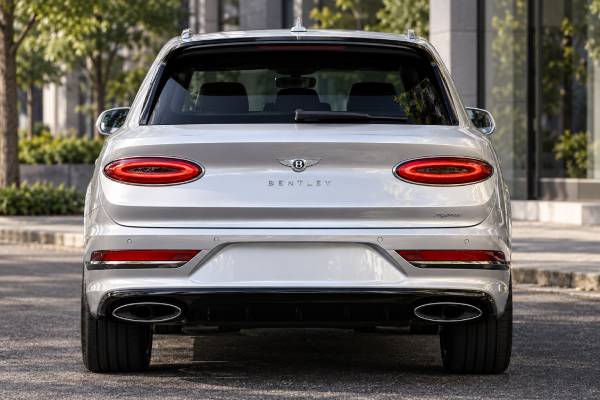
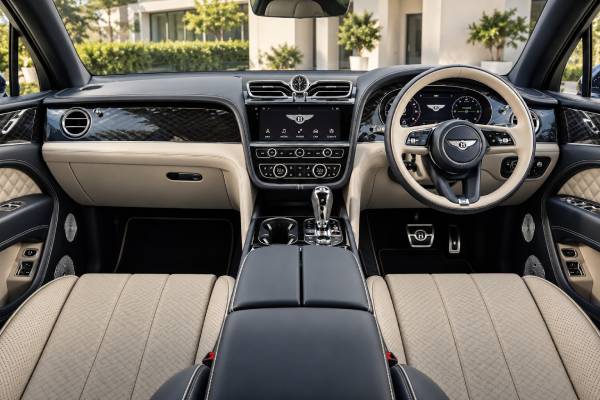
The 2022–present Bentley Bentayga Hybrid is the version to choose when a Bentley SUV must handle short urban journeys quietly without losing long-distance freedom. Its plug-in hybrid system combines a 3.0-litre turbocharged V6, an electric motor inside the transmission, and an 18.0 kWh high-voltage battery. Combined output is 456 bhp, while official electric range is up to 45 km (28 miles) on the WLTP cycle. That makes the car useful as an electric commuter when it is charged regularly, yet it can still cross countries without planning stops around public chargers.
This is not the fastest Bentayga, nor is it the least complex. Its strengths are refinement, immediate low-speed response, flexible energy management, and the ability to enter many urban areas with the engine off. Buyers should judge it as a premium plug-in hybrid rather than as a fuel-saving shortcut. The ownership case works best for drivers who can charge at home or work and who understand that a depleted-battery Bentayga remains a large, heavy petrol SUV.
Table of Contents
- What Defines This Bentayga Hybrid
- Powertrain and Technical Data
- Electric Driving, Charging, and Efficiency
- Road Behaviour, Performance, and Comfort
- Cabin Technology and Practicality
- Maintenance and Common Concerns
- Used Buying Guide and Ownership Fit
What Defines This Bentayga Hybrid
The important dividing line is the 2022 model-year update: this version uses the improved 18.0 kWh battery and an electric motor rated at 100 kW, producing an official combined 462 PS, or 456 bhp. Earlier facelifted Bentayga Hybrids were quoted at 449 PS with a smaller 17.3 kWh battery, so specifications from 2021 cars should not be copied across automatically.
Bentley retained the basic plug-in architecture because it suits the Bentayga’s character. The motor sits between the V6 engine and eight-speed automatic transmission, allowing electric drive through the normal all-wheel-drive system. There is no separate rear electric axle and no artificial “electric” personality grafted onto the car. Instead, the motor fills low-speed torque, starts the vehicle smoothly, recovers energy during deceleration, and lets the petrol engine shut down when load and speed permit.
The updated system produces 700 Nm (516 lb-ft) of combined torque. That figure matters more in daily use than the horsepower headline. A heavy luxury SUV needs clean response when joining traffic, climbing a ramp, or passing at moderate speed. The electric motor contributes up to 400 Nm immediately, masking much of the delay that can otherwise occur while a turbocharged engine and automatic gearbox select the right operating point.
Three operating ideas shape the experience:
- EV Drive prioritises electric propulsion while charge and conditions allow. The engine may still start for high power demand, very high speed, certain temperature requirements, or system protection.
- Hybrid mode balances both power sources and can use navigation data to deploy battery energy where it is most useful.
- Hold mode preserves high-voltage charge for a later part of the trip, such as an urban low-emission zone.
This model is a standard-wheelbase Bentayga, not the Extended Wheelbase. It may be configured with four, 4+1, or five seats depending on market and specification. Its basic body dimensions therefore match the regular Bentayga, although the battery and hybrid hardware increase mass and slightly reduce luggage volume compared with the V8.
Powertrain and Technical Data
The Bentayga Hybrid is a PHEV: it has a petrol engine, traction motor, externally chargeable battery, and an official electric-driving range. The 3.0-litre V6 provides sustained high-speed power, while the motor supports launch, low-load travel, regeneration, and combined acceleration. An eight-speed automatic and permanent all-wheel drive preserve the familiar Bentayga layout.
| Specification | Value | Notes |
|---|---|---|
| Powertrain type | Petrol plug-in hybrid | Externally chargeable PHEV |
| Combustion engine | 2,995 cc turbocharged V6 | 3.0-litre petrol engine |
| Engine output | 340 PS (335 bhp; 250 kW) | At 6,400 rpm |
| Engine torque | 450 Nm (332 lb-ft) | 1,340–5,300 rpm |
| Electric motor output | 100 kW (136 PS; 134 bhp) | Motor integrated with transmission |
| Electric motor torque | 400 Nm (295 lb-ft) | Immediate motor output |
| Combined system output | 462 PS (456 bhp) | Official combined figure |
| Combined system torque | 700 Nm (516 lb-ft) | Official combined figure |
| Battery capacity | 18.0 kWh | Manufacturer-published capacity |
| Specification | Value |
|---|---|
| Transmission | 8-speed automatic |
| Drive type | Permanent all-wheel drive |
| Motor location | Between combustion engine and transmission |
| AC charging | Up to 7.2 kW, market and supply dependent |
| Typical full AC charge | About 2.5 hours under suitable supply conditions |
| DC fast charging | Not supported |
| Regeneration | Blended motor recuperation and hydraulic braking |
| Specification | Value | Condition |
|---|---|---|
| 0–60 mph | 5.1 seconds | Manufacturer figure |
| 0–100 km/h | 5.3 seconds | Manufacturer figure |
| Top speed | 254 km/h (158 mph) | Combined-power operation |
| Electric-mode speed ceiling | Up to about 135 km/h (84 mph) | Engine may start sooner when conditions require |
| Specification | Value | Standard or condition |
|---|---|---|
| Electric range | 45 km (28 miles) | WLTP |
| Total driving range | 715 km (444 miles) | WLTP |
| Weighted fuel consumption | 6.7 L/100 km | WLTP; charging-dependent PHEV figure |
| Fuel consumption with discharged battery | 11.2 L/100 km | WLTP |
| Weighted electrical consumption | 15.5 kWh/100 km | WLTP published figure |
| Weighted CO₂ emissions | 153 g/km | WLTP |
| Fuel tank | 75 litres (19.8 US gal) | Smaller than the V8 tank |
| Specification | Value |
|---|---|
| Body style | Five-door standard-wheelbase luxury SUV |
| Overall length | 5,125 mm (202.5 in) |
| Wheelbase | 2,995 mm (117.9 in) |
| Width across mirrors | 2,222 mm (87.5 in) |
| Overall height | 1,710 mm (67.3 in) |
| Unladen weight | 2,510 kg (5,838 lb) |
| Boot volume | 479 litres (16.9 cu ft) |
| Seating configurations | Four, 4+1, or five seats, market dependent |
The figures above describe the updated 456 bhp hybrid, but regional homologation values can change with model year, wheel package, equipment, and test rules. A registration document or VIN-specific build record is the final authority for a particular car.
Electric Driving, Charging, and Efficiency
The Bentayga Hybrid delivers its best result when it begins most local trips with a charged battery. A driver covering 15 to 25 miles per day may complete much of that use electrically in mild weather, but the official 28-mile figure is a test-cycle result rather than a guarantee.
Cold weather, cabin heating, steep roads, high speed, large wheels, and repeated acceleration can reduce electric range. So can leaving the vehicle parked for long periods with climate functions active. Conversely, moderate urban speeds and smooth braking give the motor more opportunity to propel the car efficiently and recover energy.
The charging hardware is deliberately simple. AC charging at up to 7.2 kW suits overnight home use or a workplace unit. There is no DC fast charging, so a motorway rapid charger does not turn this into a quick-charge touring EV. That limitation is less troublesome than it sounds when the car is used as intended: charge at a destination, then rely on petrol for uninterrupted long journeys.
A practical routine is more valuable than obsessing over the dashboard estimate:
- Charge after the day’s final trip rather than waiting for the battery to reach zero.
- Pre-condition the cabin while connected to external power when the available app and market services support it.
- Enter the destination in the factory navigation system so hybrid energy management can anticipate the route.
- Use Hold mode only when there is a clear reason to save charge; carrying unused battery energy all day can waste the system’s advantage.
- Brake progressively, allowing blended regeneration to recover energy before the friction brakes do most of the work.
The weighted WLTP fuel figure needs careful interpretation. It assumes a prescribed share of electric operation after charging. Owners who rarely plug in may see consumption much closer to the discharged-battery result, and short cold trips can be worse. Owners who charge every night and drive mainly within the electric envelope may burn very little petrol for weeks, although the engine should still be allowed to reach full operating temperature periodically and the fuel should not be left to age indefinitely.
For home charging, the installation should be inspected by a qualified electrician. The circuit, protective device, earthing arrangement, cable, and connector must suit local regulations and the charging equipment. Repeated use of an unsuitable household extension lead is neither a premium solution nor a safe one.
Road Behaviour, Performance, and Comfort
The hybrid feels strongest in quiet, measured driving rather than in repeated maximum-effort acceleration. Electric torque moves the Bentayga away cleanly, the V6 joins with little drama, and the air suspension filters the first layer of road disturbance before it reaches the cabin.
At 5.3 seconds to 100 km/h, it is objectively quick. More important, it can add speed without the gearbox hunting through ratios. The motor supplies response while the engine builds boost, giving the powertrain the broad, unhurried delivery expected of a Bentley. A V8 Bentayga sounds richer and pulls harder at high speed, but the hybrid is often calmer in traffic and during early-morning departures.
Mass is the unavoidable trade-off. The battery, motor, power electronics, and cooling hardware push unladen weight to about 2.51 tonnes. The steering and chassis systems manage that weight well, yet physics still appears under hard braking or in fast direction changes. Drivers should not assume that instant electric response makes the car light. Tires and brakes work hard, especially on repeated mountain descents or when the vehicle is heavily loaded.
The brake pedal blends regenerative deceleration with hydraulic braking. A good system makes the handover difficult to notice, but low-speed feel can vary slightly as battery charge, temperature, and regeneration availability change. A test drive should include gentle stops, a firm stop from road speed, and creeping manoeuvres. Persistent grabbing, vibration, warning messages, or an inconsistent pedal deserve diagnosis.
Wheel choice strongly affects the ride. The largest designs can sharpen appearance and initial steering response, yet they add tire cost and reduce the amount of sidewall available to absorb sharp edges. For a car used on broken roads, a smaller factory wheel with the correct load-rated tire is often the more luxurious choice.
Bentley’s active anti-roll technology, adaptive air suspension, and drive modes create a useful spread between relaxed cruising and controlled cornering. They also add systems that must be healthy. A car that sits unevenly after parking, raises slowly, displays chassis warnings, or knocks over small bumps should not be dismissed as “normal for a heavy SUV.”
Cabin Technology and Practicality
The standard-wheelbase Hybrid remains a genuinely practical five-door SUV, but its packaging reflects the battery installation. Boot capacity is 479 litres, five litres below the current V8 figure, and the 75-litre fuel tank is smaller than the V8’s 85-litre tank. Those differences are modest, yet they show why range and cargo data must be taken from the hybrid rather than borrowed from another Bentayga.
The cabin’s value lies in material execution and configurability. Leather colour, stitching, veneer, carpeting, wheel design, audio, seating layout, and driver-assistance equipment can vary dramatically between two cars with the same model badge. A buyer should therefore examine the build sheet, not just the advertisement’s option list.
Key items worth testing include:
- all seat adjustment, heating, ventilation, and massage functions;
- rear climate control and rear-seat controls;
- the digital instrument display and central touchscreen;
- wireless phone integration, Bluetooth, navigation, and connected services;
- cameras, parking sensors, powered tailgate, soft-close functions, and keyless entry;
- panoramic-roof blind operation and evidence of water staining around the headlining;
- audio output from every speaker, especially on high-end Naim-equipped cars;
- charging timers, remote climate functions, and the displayed state of charge.
The infotainment hardware is far more modern than in the first-generation Bentayga, but connected functions depend on region, subscription, network support, and account transfer. A feature shown in an old brochure may not remain active in every country. Before purchase, confirm that the previous owner’s account has been removed and that the car can be added to the buyer’s My Bentley account.
The Hybrid can be a convincing family vehicle, provided the chosen seating configuration fits the job. A four-seat car is a luxurious executive shuttle but a poor substitute for a conventional five-seat SUV. A 4+1 layout offers an occasional centre position but should be inspected in person if three adults will use the rear regularly. Child-seat installation should be checked with the actual seat because thick cushions and sculpted bolsters can affect access to anchors and belt routing.
Maintenance and Common Concerns
Maintenance must cover two vehicles in one: a high-output petrol Bentley and a high-voltage plug-in hybrid. The most important ownership habit is not a particular oil brand or guessed interval; it is following the VIN-specific schedule and ensuring that technicians can diagnose both the combustion and electrified systems.
The V6 still needs normal engine care even when many journeys are electric. Oil can accumulate moisture and fuel dilution when the engine runs briefly without reaching full temperature. Cooling circuits, ignition components, filters, and the exhaust after-treatment system also age by time as well as mileage. A low annual odometer reading does not justify skipping scheduled inspections.
Hybrid-specific attention should include:
- checking charging-cable condition, plug pins, locking action, and port sealing;
- reviewing battery and power-electronics fault history with suitable diagnostic equipment;
- confirming that the high-voltage battery reaches a normal indicated full charge;
- testing electric drive, blended operation, regeneration, and transition to engine power;
- inspecting all cooling circuits for correct level and signs of leakage;
- verifying that no underbody or accident damage has reached the battery enclosure or orange high-voltage cabling;
- confirming completion of applicable software updates and recall campaigns.
High-voltage work is not a do-it-yourself area. The system must be isolated and tested by trained personnel using the correct procedure and protective equipment. An ordinary workshop may be able to service tires or brakes, but it should not open, depower, or repair high-voltage components without approved training and documentation.
Heavy SUVs also consume conventional components. Look for inner-edge tire wear, wheel damage, brake-disc corrosion, suspension-bush movement, air-suspension leaks, and alignment drift after pothole impacts. Regeneration can reduce friction-brake use, which sometimes allows surface corrosion to build on discs. A car driven gently should still produce smooth, vibration-free braking from higher speed.
Keep the 12-volt battery healthy. It powers control units, locks, contactors, and wake-up functions needed before the high-voltage system can operate. A weak 12-volt battery can create multiple warnings that appear unrelated. Long storage should follow Bentley’s approved battery-support guidance rather than relying on occasional idling.
Service history has unusual value on a car of this complexity. Digital records, invoices, campaign completion, tire dates, alignment reports, and evidence of correct charging equipment help distinguish a carefully managed vehicle from one that merely looks immaculate.
Used Buying Guide and Ownership Fit
A good Bentayga Hybrid is best bought by specification, condition, and documented care—not simply by year or mileage. The first check is that the car is truly the 456 bhp, 18.0 kWh version described here. Confirm the VIN, model year, registration data, and factory build record, especially around the transition from the earlier 449 PS system.
Start with the charging system. Ask the seller to present the car at a sensible state of charge, then connect it to a known-good AC unit. The port should unlock, communicate, and begin charging without repeated errors. Check the cable supplied with the vehicle and make sure its connector standard and current rating suit where the car will live.
During the drive, begin in electric mode. Listen for bearing noise, driveline clunks, or abrupt engagement. Ask for moderate acceleration so the V6 starts, then repeat the transition at different speeds. The handover should feel coordinated rather than like two separate powertrains taking turns. Confirm that the gearbox shifts cleanly and that no drivetrain warning remains after a restart.
Inspect tires as a matched set. Correct size, load rating, speed rating, and preferably Bentley-approved specification matter more than tread depth alone. Mixed brands or large differences in rolling circumference can compromise refinement and place unnecessary strain on an all-wheel-drive system. Replacement cost for 21- or 22-inch premium SUV tires should be included in the purchase budget.
A pre-purchase inspection should cover:
- a full diagnostic scan, including stored and intermittent faults;
- high-voltage battery condition and charging history where accessible;
- cooling-system pressure and leak checks;
- air suspension, active anti-roll hardware, steering, and alignment;
- brake thickness, disc condition, and parking-brake operation;
- underbody, battery enclosure, jacking points, and accident repairs;
- every comfort, camera, assistance, and connected feature;
- open recalls and market-specific service campaigns;
- authenticity and condition of expensive trim, veneers, wheels, and audio equipment.
The ownership fit is straightforward. Choose the Hybrid when there is dependable charging, daily distances often fall within its electric range, and quiet low-speed operation matters. Choose the V8 instead when the vehicle regularly covers long motorway distances, charging access is poor, maximum cargo or fuel capacity matters, or the richer engine character is central to the purchase.
Do not buy the Hybrid solely because an official weighted fuel number looks low. A PHEV saves fuel only when its operating pattern uses the battery. It may still be the more appealing Bentayga even without a financial payback, because electric departure, instant response, and silent urban progress are luxury features in their own right. The strongest purchase is one where those qualities match the owner’s real routine.
References
- Signature Bentayga | Bentayga Range | Bentley Motors 2026
- Bentley News 2022 : BENTAYGA HYBRID FAMILY EXTENDS WITH NEW S AND AZURE 2022
- Bentley News 2021 : BRINGING SERENITY TO THE CITY AND BEYOND – THE NEW BENTAYGA HYBRID 2021
- Service and maintenance 2026
- Bentley Services | Warranty and Maintenance | Bentley Motors 2026
- Check for Recalls: Vehicle, Car Seat, Tire, Equipment | NHTSA 2026 (Recall Database)
Disclaimer
This article is for informational purposes and is not a substitute for professional diagnosis, maintenance, or repair. Specifications, torque values, service intervals, charging equipment, and procedures can vary by VIN, market, model year, and fitted equipment. Verify all work and technical data against the vehicle’s official service documentation and use a qualified Bentley or high-voltage specialist where required.
Please share this guide on Facebook, X/Twitter, or another platform if it helped you; doing so supports our work and helps other Bentayga owners find reliable information.