
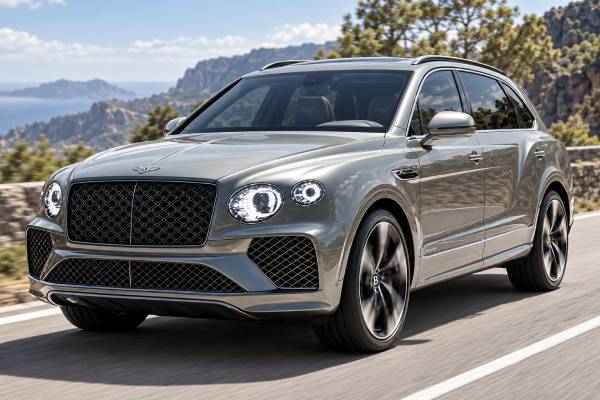
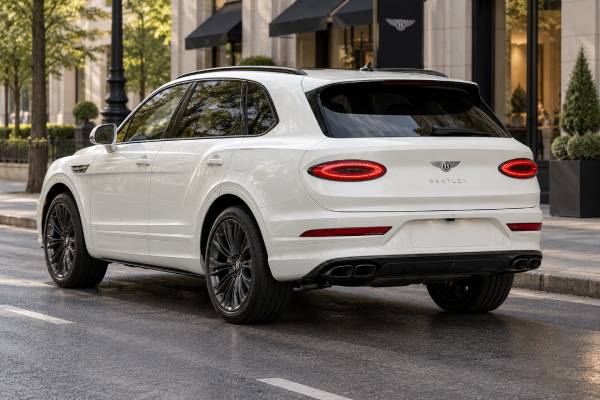
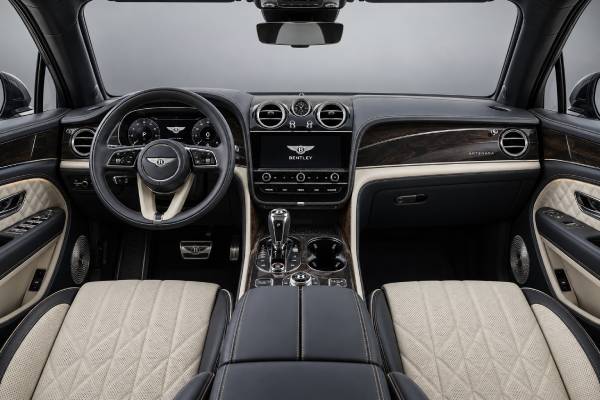
The 2026 Bentley Bentayga EWB Artenara Edition is the most spacious expression of Bentley’s Gran Canaria-inspired special edition. It combines the 180 mm wheelbase extension and rear-cabin technology of the Bentayga EWB with a Roque Bentayga motif, tri-colour leather, body-colour lower trim, and Mulliner-influenced exterior details. Power comes from the familiar 542 hp twin-turbo V8, so performance remains remarkable for a 5.3-metre luxury SUV: 0–60 mph takes 4.5 seconds and maximum speed is 180 mph. The real reason to choose this version, however, is the rear compartment. Four-seat, 4+1, and five-seat layouts serve very different owners, and the optional Airline Seat system can transform the car from a family SUV into a chauffeur-focused lounge. This guide approaches the EWB Artenara as a complete commission—body, seating, colour, comfort systems, and mechanical foundation—then explains its specifications, service needs, and the evidence buyers should demand.
Table of Contents
- Commissioning the EWB Artenara
- Choosing the Rear-Seat Architecture
- V8, Chassis, and Long-Wheelbase Dynamics
- EWB Artenara Specifications
- Passenger Experience and Travel Use
- Maintaining Complex Systems and Finishes
- Authenticity, Condition, and Value
Commissioning the EWB Artenara
The EWB Artenara should be commissioned from the inside out. Seating layout and passenger use determine the car’s function; only then should paint, three-colour leather, wheel finish, and decorative details be selected to support that purpose.
Bentley named the edition after Artenara, a mountain village near Roque Bentayga in Gran Canaria. The rock’s outline appears as an etched fascia graphic and as laser perforation in selected seat and door surfaces. In the extended-wheelbase cabin, that motif has more space to develop across the rear environment, so its placement and contrast become central design decisions rather than small accents.
The tri-colour interior treatment allows three hides to divide cabin zones. Bentley offered eight curated recommendations at launch, but the combinations should be treated as professional guidance rather than compulsory uniforms. A chauffeur-oriented car might use a calm primary colour, a darker lower section for durability, and a third accent that highlights the Roque graphic. A family car may prioritise stain resistance and easier repair.
Outside, the edition receives a Double Diamond grille, wing vents with double-diamond detail, illuminated treadplates, and an animated welcome lamp. The lower brightware can be painted in one of eight body colours, creating a cleaner transition between upper body and lower surfaces. Standard 22-inch Mulliner wheels combine grey paint and polished detail. A 23-inch Super Lux wheel was announced for selected 2027-model-year EWB Azure, Artenara, and Mulliner cars, so the actual build date and market specification must determine what is original.
The EWB Artenara is distinct from the standard-wheelbase Artenara V8 even though they share output. Its wheelbase is 3,175 mm, overall length is 5,305 mm, rear doors are longer, and official luggage capacity is 380 litres. It also offers seating architectures unavailable in the standard car. A casual visual conversion cannot recreate those proportions or factory passenger systems.
It differs from EWB Mulliner in emphasis. Mulliner presents the traditional flagship with its own grille, wheels, and formal tri-tone treatment. Artenara uses landscape, colour blocking, and a contemporary graphic story. EWB Azure remains the wellbeing-led alternative. Choosing among them should begin with the atmosphere the owner wants rather than a hierarchy of badges.
Every commission needs a permanent record. Keep the signed order, colour samples, option list, digital renderings, and delivery photographs. Those materials guide future repair and prove that unusual combinations were factory choices, not later improvisation.
Choosing the Rear-Seat Architecture
The seating layout is the most consequential option on an EWB Artenara. Four seats create the strongest individual-lounge experience, 4+1 provides occasional flexibility, and five seats prioritise conventional family use; none is universally best.
In the four-seat configuration, a full-length centre console divides the two rear occupants. It can support storage, controls, and a more formal separation between passengers. This arrangement is ideal for consistent chauffeur use or for owners who rarely need a fifth seat. Its limitation is obvious: an extra passenger cannot be accommodated without another vehicle.
The 4+1 layout places two highly developed outer seats around a narrower occasional centre position. It is often the most versatile EWB choice because it preserves premium outer-seat comfort while providing emergency five-person capacity. The centre place should be assessed physically. It is useful for short journeys, but it is not equivalent to a full-width conventional bench.
A five-seat rear bench offers the clearest family logic. Child seats, changing passenger combinations, and fold-down cargo needs may be easier to manage. Buyers should confirm which comfort functions remain available with the chosen seat architecture, because not every Airline Seat feature or console arrangement applies equally.
The Airline Seat Specification is the EWB’s signature technology. Where fitted, the outer rear seats can offer 22-way adjustment, a relaxation mode with up to 40 degrees of recline, massage, heating, ventilation, and automatic climate sensing. The passenger-side rear seat can deploy a footrest behind a moved-forward front passenger seat, creating a near-reclined travel posture.
Postural Adjustment changes pressure rather than simply vibrating the seat. Bentley describes 177 small adjustments across six zones over three hours. The feature is intended to reduce fatigue during long occupancy, but passenger preference varies. A prospective owner should spend time in the rear while the car is moving, because showroom testing cannot reproduce body movement, road texture, and climate behaviour.
The longer rear door improves access and gives the cabin its generous aperture. It also requires more space beside the car. Powered closure is helpful when a passenger cannot comfortably reach the open door. At inspection, test both rear doors repeatedly from internal and external controls, confirm soft-close latching, and listen for hesitation or misalignment.
Seat configuration affects resale and luggage use. A four-seat car may command interest from chauffeur buyers but exclude larger families. A five-seat car is broadly useful but less distinctive. The right choice is the one that matches the first owner’s real pattern and remains clearly documented.
V8, Chassis, and Long-Wheelbase Dynamics
The 542 hp V8 gives the EWB Artenara more performance than its rear-lounge mission requires, while all-wheel steering and active roll control make the stretched body manageable. The objective is not sports-car mimicry; it is to keep passengers calm while allowing the driver to place a large vehicle accurately.
The twin-turbocharged 4.0-litre engine produces 550 PS, 404 kW, or 542 bhp at 6,000 rpm, with 770 Nm from 2,000 to 4,500 rpm. An eight-speed automatic and permanent all-wheel drive deliver the power. Official acceleration is 4.5 seconds from 0–60 mph and 4.6 seconds from 0–100 km/h, with a 180 mph maximum.
Low-speed torque means the gearbox can avoid abrupt downshifts in chauffeur operation. Smooth pedal input is more important than outright ability because rapid acceleration can disturb rear passengers, especially in a reclined seat. The driver can select modes to change throttle, shift, steering, and suspension response, but the EWB’s best quality is its reserve rather than constant display.
All-wheel steering counteracts the length at parking speeds. The rear wheels turn opposite the front wheels, reducing the effective turning circle; at higher speeds they turn in the same direction to support stability. It helps in hotel entrances and urban turns, but cannot create clearance for the long rear doors or narrow the 2,222 mm mirror width.
Bentley Dynamic Ride uses 48-volt actuators to oppose body roll. In a corner, it helps keep the cabin level; over uneven surfaces, it can preserve more wheel independence than a very stiff passive anti-roll system. Air suspension provides height control and isolates sharp road inputs. Tyre choice remains critical because a 22- or 23-inch wheel leaves limited sidewall between the road and the cabin.
The EWB’s 2.5-tonne published unladen mass requires planning. Braking distances, tyre load, and momentum remain substantial despite advanced systems. Chauffeurs should avoid abrupt inputs, maintain larger gaps, and inspect tyres frequently. A quiet, stable cabin can make speed difficult for passengers to judge.
WLTP combined fuel use is 13.0 L/100 km, CO2 is 296 g/km, and official range is 654 km from the 85-litre tank. Extended idling for climate control, dense city work, short cold trips, and heavy payload can increase consumption. Owners should budget according to duty cycle rather than the brochure’s laboratory result.
EWB Artenara Specifications
This model is a petrol ICE vehicle built on the V8 Bentayga EWB. It has no plug-in system or electric-only mode. The engineering priorities are strong low-speed torque, permanent all-wheel drive, active suspension, rear steering, and packaging the extended passenger compartment without losing high-speed stability.
| Specification | Value |
|---|---|
| Powertrain classification | Petrol ICE |
| Engine | 4.0-litre twin-turbocharged V8 |
| Displacement | 3,996 cc |
| Maximum power | 550 PS / 542 bhp / 404 kW at 6,000 rpm |
| Maximum torque | 770 Nm from 2,000–4,500 rpm |
| Transmission | Eight-speed automatic |
| Drivetrain | Permanent all-wheel drive |
| Fuel-tank volume | 85 litres |
| Measure | Official figure |
|---|---|
| 0–60 mph | 4.5 seconds |
| 0–100 km/h | 4.6 seconds |
| Maximum speed | 290 km/h / 180 mph |
| Measure | Official combined value |
|---|---|
| Fuel consumption | 13.0 L/100 km |
| Fuel economy | 21.7 mpg Imperial / 18.1 mpg US |
| CO2 emissions | 296 g/km |
| Range | 654 km / 406 miles |
| Dimension | Value |
|---|---|
| Overall length | 5,305 mm |
| Wheelbase | 3,175 mm |
| Increase in wheelbase | 180 mm versus standard Bentayga |
| Width including mirrors | 2,222 mm |
| Height | 1,774 mm |
| Published unladen weight | Approximately 2,520–2,525 kg, depending on regional definition |
| Item | Specification |
|---|---|
| Available seating layouts | Four-seat, 4+1, or five-seat |
| Luggage capacity | 380 litres |
| Airline Seat adjustment | 22-way where specified |
| Maximum relaxation recline | Up to 40 degrees where specified |
| Chassis systems | Air suspension, Bentley Dynamic Ride, all-wheel steering |
| Edition wheel | 22-inch grey-painted and polished Mulliner design |
| Interior signature | Tri-colour hide and Roque Bentayga motif |
Current Bentley data lists 5,305 mm overall length, while original 2022 EWB launch information used 5,322 mm. When millimetre accuracy matters for transport or a garage, rely on the certificate and handbook for the specific car rather than transferring a value across model years.
Passenger Experience and Travel Use
The EWB Artenara earns its keep on long journeys when rear occupants can use the added space, seat technology, and climate control. Its smaller 380-litre luggage compartment means those journeys need more planning than the cabin’s vast legroom might suggest.
A four-person airport transfer can expose the packaging trade-off: passengers fit easily, but multiple full-size cases may not. Test actual luggage, including garment bags, mobility aids, sports equipment, or child hardware. The tailgate opening and floor shape determine usefulness more accurately than litres alone. Optional boot protectors or fitted luggage can help, but they also consume space.
Rear passengers should learn the seat controls before departure. Reclining and deploying a footrest require clear space around the front passenger seat. Loose objects should not be placed where mechanisms move. Drivers should return seats to safe positions for entry, exit, and any situation covered by the owner’s safety instructions.
Climate comfort is individual. Automatic seat climate sensing can heat or ventilate according to surface conditions, while cabin zones manage air temperature. A passenger who dislikes automatic intervention should know how to adjust or disable the relevant function. During inspection, confirm that sensors, fans, heating elements, and controls respond on both rear sides.
The tri-colour cabin can make journeys memorable, but it must survive real clothing and luggage. Provide clean blankets or approved seat protection for pets, avoid unapproved adhesive accessories, and remove spills promptly. Dark lower sections are practical around shoes and door apertures; pale upper surfaces can retain the visual spaciousness.
Chauffeur operation adds its own checklist. The driver should verify rear-door clearance before stopping close to walls or traffic, set a gentle climate before passengers arrive, and keep tyre pressures correct for load. Smooth acceleration and early braking are more important than exploiting the V8’s full capacity. A discreet cabin is part of the service.
For owner-driving trips, all-wheel steering reduces effort and the high seating position offers good visibility. Camera lenses should be kept clean because the long body creates areas the driver cannot see directly. Night-time image quality, not only daytime demonstration, should be evaluated.
Connectivity and audio can turn the rear cabin into an office or private listening room. Confirm charging ports, device compatibility, mobile coverage, connected-service subscriptions, and screen or remote-control functions in the actual market. Technology ages faster than leather, so software support and replacement availability should be part of long-term ownership planning.
Maintaining Complex Systems and Finishes
Preventive maintenance is cheaper than diagnosing several interacting EWB systems after they fail. The car combines a V8 powertrain, active chassis, powered rear doors, complex seats, climate modules, lighting, cameras, and bespoke trim, so service records should show both mechanical work and investigated electronic complaints.
Use the exact Bentley schedule for the VIN. Engine oil, filters, brake fluid, tyres, cooling systems, software updates, and inspections remain necessary even when a chauffeur-driven car accumulates mileage gently. Extended idling and short urban cycles are not automatically easy service; they can increase fuel dilution, heat exposure, and battery load.
Maintain the 12-volt battery during storage with approved equipment. Low voltage can create faults in unrelated-looking modules, including seat controls, doors, suspension, and infotainment. A workshop should test battery health and charging performance rather than merely erase fault codes. Keep scan reports when an intermittent issue is resolved.
Air suspension should move evenly through its height range and maintain level after the car is parked. Dynamic Ride and all-wheel steering must operate without warnings or unusual noise. Tyres should be inspected across their full width because inner wear may not be visible from the ground. Match load rating, speed rating, size, and construction across the all-wheel-drive system.
Powered rear doors need clean hinges, correct alignment, functional anti-trap protection, and unobstructed seals. Airline Seats should be cycled through all movements, but objects must be removed from mechanism paths first. If a function stops, avoid forcing it; a small obstruction can become damaged trim or a motor problem.
Clean laser-perforated leather with low moisture and soft tools. The Roque design depends on precise holes, so aggressive brushing can make an area look uneven. Tri-colour repairs should be entrusted to a leather specialist who can reproduce each shade and sheen without filling perforations or staining contrast stitching.
Body-colour lower brightware is vulnerable to stones, curbs, and careless lifts. Photograph it before service, and ensure lifting points are used correctly. Grey-and-polished wheels require a compatible refinishing process; a quick painted repair may be obvious beside the remaining originals. Inspect self-levelling or special wheel badges before and after tyre work.
For long storage, clean and dry the car, inflate tyres appropriately within factory guidance, avoid leaving the parking brake in conditions that encourage adhesion if the handbook provides an alternative, control humidity, and maintain electrical power. Do not cover a dirty vehicle or trap moisture under an unsuitable cover.
Authenticity, Condition, and Value
A genuine, well-documented EWB Artenara is worth more than an ordinary EWB dressed with similar trim, but condition and usability still determine the purchase. Verify identity first, then inspect every expensive system before assigning value to rarity.
The factory build sheet should identify the Artenara Edition, V8 engine, EWB body, paint, lower brightware colour, wheel, three hides, veneer, seat layout, Airline Seat equipment, and other options. Compare those records with the car. Missing treadplates, replaced fascia, non-original wheels, or retrimmed seats require explanation.
Paint inspection should cover the long rear doors and lower body in particular. Measure paint depth where appropriate, inspect edges for masking lines, and check camera or radar calibration records after collision work. A professional repair is not necessarily a rejection, but the materials and colour matching must meet the standard of the original commission.
Test the rear cabin before the road drive. Operate every seat direction, massage program, heating and ventilation setting, climate control, blind, door, light, port, table, and audio function. Look underneath seats for trapped objects or damaged rails. Then road-test from both front and rear positions so ride, noise, and seat behaviour can be assessed.
The mechanical inspection should begin with a cold start and full diagnostic scan. Review cooling performance, gearbox behaviour, driveline noise, steering, brake vibration, ride-height changes, Dynamic Ride, all-wheel steering, tyre age, inner tread, and underbody condition. Scan again after the drive to capture faults that appear only when systems are active.
Check service campaigns and recalls with Bentley and the relevant authority. Read any warranty rather than accepting “comprehensive” as a description. Trim, upholstery, wheel finish, batteries, noises, and wear components may have restrictions. Obtain estimates for every known defect before negotiation, including cosmetic work.
Four-seat, 4+1, and five-seat cars appeal to different markets. A rare layout is not automatically valuable if few buyers can use it. Colour is equally subjective: a courageous factory tri-colour scheme may attract a passionate buyer or narrow the audience. Provenance, original condition, and complete accessories can help preserve desirability.
Compare the EWB Artenara with an EWB Azure and EWB Mulliner in person. Azure may deliver the comfort equipment with a more understated exterior. Mulliner may feel more conventionally flagship. A regular EWB can be configured beautifully without edition constraints. Choose Artenara because its place-inspired design makes the passenger experience more meaningful, not because a future price increase is assumed.
References
- Artenara Edition | Bentayga Range | Bentley Motors 2026
- Bentley News 2026 : Bentayga Artenara Edition: A new pinnacle in contemporary luxury 2026
- Bentley Bentayga Extended Wheelbase | Bentayga EWB Range | Bentley Motors 2026
- Bentley News 2022 : THE MOST WELLBEING-FOCUSED CAR SEAT IN THE WORLD – AIRLINE SEAT SPECIFICATION 2022
- Service and maintenance 2026
- Check for Recalls: Vehicle, Car Seat, Tire, Equipment | NHTSA 2026
Disclaimer
This article is for informational purposes and is not a substitute for professional diagnosis or repair. Specifications, torque values, service intervals, procedures, seating systems, and dimensions can vary by VIN, market, build date, and equipment. Confirm an EWB Artenara through official service documentation, factory build records, current owner literature, recall records, and a Bentley retailer or qualified specialist before purchase or repair. Please share this guide on Facebook, X/Twitter, or another platform if it helps owners, chauffeurs, or advisers.