
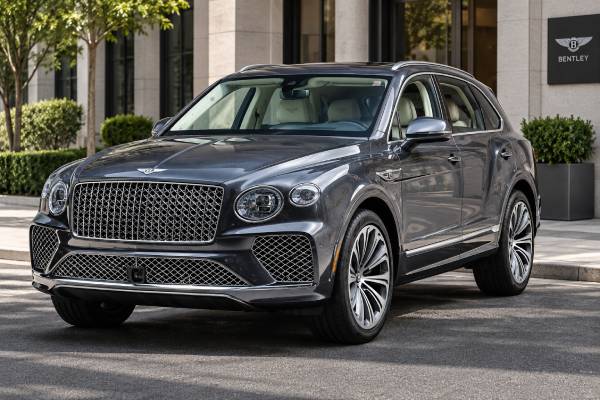
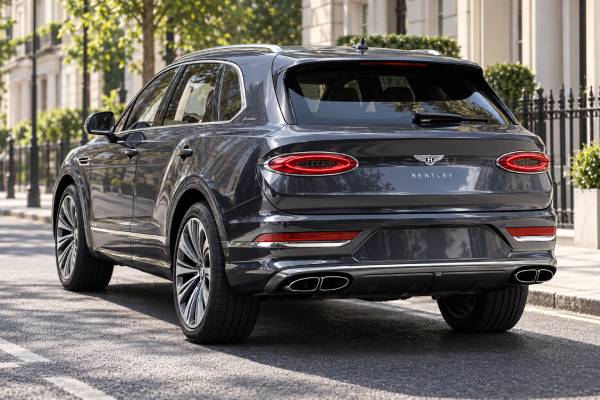
The V8-powered Bentley Bentayga Atelier Edition is a design-led special edition with the standard-wheelbase Bentayga’s most traditional modern powertrain. Its 4.0-litre twin-turbo engine produces 542 bhp and 770 Nm, sending the SUV to 60 mph in 4.4 seconds and on to 180 mph. Yet its identity is not performance-first. Bentley introduced the Atelier Edition in 2025 to showcase six curated colour themes, revive five historic Mulliner paints, and create a cleaner, more contemporary alternative to the dark, sporting appearance of the S Black Edition.
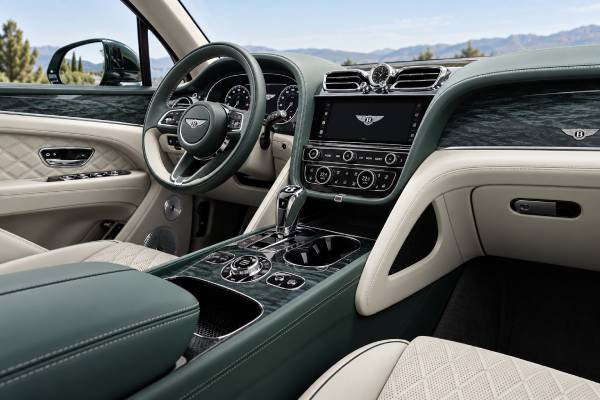
Atelier details are deliberately subtle. Hallmark Satin lower trim, a dedicated grille, edition wing vents, 22-inch ten-spoke wheels with Tungsten pockets, and a unique welcome-light sequence distinguish the exterior. Inside, Harmony Diamond quilting contains one elongated contrast-stitched diamond, while edition treadplates, headrest tags, piping, painted veneer carriers, and Bentley Diamond Illumination build a carefully coordinated cabin. This guide explains the V8 engineering underneath those finishes, how the edition differs from an ordinary Bentayga, what it costs to preserve, and how to verify that a used example is both genuine and correctly maintained.
Table of Contents
- The Atelier V8 Proposition
- Technical Specifications for the V8 Edition
- Design Language, Paint, and Materials
- V8 Performance and Chassis Balance
- Living With the Standard-Wheelbase Cabin
- Service, Detailing, and Value Protection
- Authentication and Pre-Purchase Checks
The Atelier V8 Proposition
The Atelier Edition V8 is best understood as a factory-curated specification, not as a higher-performance model. It uses the regular 550 PS V8 and standard-wheelbase body, then adds a group of Mulliner-influenced design and comfort features that would otherwise require time in the configurator.
Its appeal lies in coherence. Luxury-car option lists can produce combinations that are expensive without being harmonious. Bentley’s six recommended Atelier themes coordinate exterior colour, lower trim, wheels, hides, contrast colour, stitching, and veneer treatment. Buyers could still choose from the wider Bentley palette, but the curated cars provide the clearest expression of the concept.
Five paints came from the Mulliner archive: Light Onyx, Rubino, Porcelain, Quartzite, and Light Emerald. Obsidian Crystal was introduced as the sixth colour. These finishes range from pale mineral neutrals to richer red and green tones. None depends on loud graphics or carbon-fibre add-ons to announce the edition.
The exterior brightwork is finished in Hallmark Satin around the bumper valances, creating a soft metal appearance. A unique grille treatment and special wing vents provide closer-view identification. The 22-inch ten-spoke wheels use Tungsten pockets, adding shadow and contrast while retaining a refined, mostly metallic face.
Inside, the elongated diamond stitched into the Harmony Diamond pattern acts like a signature rather than a repeated logo. The headrest receives a small Atelier tag, and the treadplate wording “Hand Crafted in Crewe, England” reinforces the workshop theme. An animated welcome lamp projects an edition-specific sequence when the doors open.
The V8 version suits buyers who want this calm design but prefer a conventional petrol engine. It does not require charging, gives the Bentayga its fullest traditional soundtrack, carries an 85-litre fuel tank, and offers slightly more luggage volume than the Hybrid. The cost is significantly higher fuel consumption, especially in cities.
Technical Specifications for the V8 Edition
The Atelier V8 is a petrol ICE model. Its twin-turbocharged, 3,996 cc V8 is paired with an eight-speed automatic and permanent all-wheel drive. The suspension uses air springs and adaptive damping, while Bentley Dynamic Ride can counter body roll through a 48-volt active system. Equipment varies, so VIN-specific confirmation remains necessary.
| Specification | Value | Notes |
|---|---|---|
| Engine type | 3,996 cc twin-turbocharged V8 petrol | 32 valves; turbochargers mounted within the V |
| Maximum power | 550 PS (542 bhp; 404 kW) | At 6,000 rpm |
| Maximum torque | 770 Nm (568 lb-ft) | 2,000–4,500 rpm |
| Transmission | 8-speed automatic | Torque-converter unit |
| Drive type | Permanent all-wheel drive | Integrated with drive modes |
| Cylinder deactivation | Four-cylinder operation under suitable light load | Automatic efficiency strategy |
| Fuel tank | 85 litres (22.45 US gal) | Use the market-specified premium grade |
| Specification | Value | Procedure |
|---|---|---|
| 0–60 mph | 4.4 seconds | Current standard-wheelbase V8 manufacturer figure |
| 0–100 km/h | 4.5 seconds | Manufacturer figure |
| Maximum speed | 290 km/h (180 mph) | Manufacturer figure |
| Combined fuel consumption | 13.0 L/100 km | Current WLTP publication |
| Combined CO₂ emissions | 296 g/km | WLTP |
| Official range | 654 km (406 miles) | WLTP |
| Specification | Value |
|---|---|
| Body style | Five-door standard-wheelbase luxury SUV |
| Overall length | 5,125 mm (201.8 in on Bentley’s current V8 listing) |
| Wheelbase | 2,995 mm (117.9 in) |
| Width across mirrors | 2,222 mm (87.5 in) |
| Overall height | 1,728 mm (68.0 in) |
| Unladen weight | 2,412 kg (5,318 lb) under the published regional definition |
| Boot volume | 484 litres (17.1 cu ft) |
| System | Practical effect |
|---|---|
| Adaptive air suspension | Varies ride height and damping for road, load, and drive mode |
| Bentley Dynamic Ride | 48-volt active anti-roll control reduces cornering lean |
| All-wheel steering | Availability depends on model-year specification; confirm on the build sheet |
| Steel brakes | Standard friction-brake system, with specification dependent on wheel package |
| Drive modes | Adjust powertrain, damping, steering, and chassis responses |
| Hill and off-road functions | Availability depends on market and selected equipment |
| Category | Typical edition content |
|---|---|
| Exterior colours | Six curated choices led by five revived Mulliner legacy paints |
| Lower exterior finish | Hallmark Satin bumper valances |
| Wheel design | 22-inch ten-spoke wheels with Tungsten pockets |
| Seat treatment | Harmony Diamond quilting and elongated contrast diamond |
| Lighting | Edition welcome animation and Bentley Diamond Illumination |
| Detailing | Atelier wing vents, treadplates, headrest tags, and selected Mulliner options |
Current technical figures can change with homologation, equipment, and market. A precise tire pressure, towing value, wheel offset, or service quantity should come from the VIN-specific documentation rather than a general article.
Design Language, Paint, and Materials
The Edition’s most important design decision is restraint. Its special features are visible to someone who knows the model, but they do not overwhelm the Bentayga’s shape.
Hallmark Satin works because it reflects light differently from chrome or gloss black. It can appear warm in sunlight and cooler under artificial light. The finish should be cleaned with products suitable for satin metal; abrasive polish can create bright spots that are difficult to blend.
The launch paints deserve individual inspection. Pale colours reveal tar, iron contamination, and panel mismatch. Rubino can expose swirl marks under strong light. Darker Quartzite and Obsidian Crystal show dust and fine scratches. Light Emerald may be difficult to match after local repair because metallic orientation and clear-coat application affect the final hue.
Paint-depth readings are useful, but they must be interpreted correctly. A repaired panel is not automatically unacceptable, especially on a driven luxury SUV. The issue is whether the repair matches colour, texture, metallic lay, and orange peel, and whether it respects adjacent satin trim and edition graphics.
The wheels combine bright faces and darker pockets, so careless refinishing can flatten the original contrast. Check machining lines, edge profile, centre-cap mechanism, and the accuracy of the Tungsten colour. A replacement wheel should match part number and specification, not merely diameter.
Inside, the elongated contrast diamond should be centred and consistent across corresponding seats. Thread colour may continue through piping, embroidery, steering-wheel details, and painted veneer carriers. The value comes from that relationship. Replacing one damaged panel in an approximate colour can disrupt the whole cabin.
Harmony Diamond quilting contains many perforations and stitch lines. Clean it with minimal moisture and a soft tool that reaches the recesses without stretching the hide. Strong scrubbing can polish the raised surfaces and leave the valleys dull, producing an uneven appearance.
Bentley Diamond Illumination adds LEDs behind perforated leather. The effect should be even and controllable through the cabin lighting settings. Dead patches, flicker, or colour mismatch may indicate a lighting, connector, or trim issue. Diagnosis should precede disassembly because the leather itself is part of the finished light surface.
V8 Performance and Chassis Balance
The V8 provides the Atelier Edition with effortless speed and a deeper mechanical character than the Hybrid. Its 770 Nm plateau allows strong acceleration without sustained high revs, which suits a luxury SUV better than a peaky engine would.
At low speed, the engine and eight-speed automatic should cooperate smoothly. Turbocharged torque arrives early, and the gearbox can keep engine speed low. A harsh engagement into Drive, repeated shunting in traffic, or hesitation followed by a surge deserves investigation. Software adaptation may affect behaviour, but it should not be used to excuse a mechanical problem.
The 4.4-second 0–60 mph figure is impressive, yet the chassis experience matters more. Air suspension isolates broad road movements, while Bentley Dynamic Ride resists roll. This means the car can remain comfortable on a straight road and controlled when turning, rather than relying on permanently stiff springs.
Large 22-inch wheels can reduce the last degree of ride softness. Tire construction, pressure, and age are crucial. A premium tire designed for the Bentayga may be quieter and more compliant than a cheaper product of the same nominal size. Uneven inner-edge wear can create vibration before it is visible from outside.
All-wheel steering was expanded across the Bentayga range during the production cycle, but exact fitment should be confirmed. Where present, it improves low-speed rotation and high-speed stability. It also adds joints, actuators, sensors, and calibration requirements that should be included in inspection.
The V8’s fuel use is high in urban driving. Cylinder deactivation can reduce consumption under steady light load, but it cannot overcome mass, frontal area, and frequent acceleration. Buyers should budget from realistic local use, not from the most favourable official extra-high phase.
A performance test drive should include a cold start, moderate acceleration, a full-temperature motorway run, and repeated braking. Listen for turbo whistle that changes abruptly, driveline vibration, exhaust rattles, cooling fans running unusually hard, or a hot-fluid smell. The car should feel powerful without sounding distressed.
Living With the Standard-Wheelbase Cabin
The standard-wheelbase Atelier is the practical choice for an owner-driver who does not need the EWB’s limousine rear compartment. It is shorter, easier to garage, and offers a larger quoted boot than the long-wheelbase car.
Bentley offered multiple seating layouts across the standard Bentayga range. The Atelier Edition’s five-seat Comfort Specification is a useful default, but market equipment can vary. Confirm whether a particular car has four seats, 4+1 seating, or a conventional five-seat bench, especially when buying from photographs.
The driving position combines high visibility with a wide centre console and thick pillars. Cameras and sensors help, but the 2,222 mm mirror width remains real. Measure the garage opening and account for mirrors folding only after the vehicle has entered.
The 484-litre boot suits luggage and daily errands, though it is not class-leading by ordinary large-SUV standards. A tailored luggage set, subwoofer, spare-wheel arrangement, or accessory equipment can alter usable space. Test the tailgate beneath the home ceiling.
Cabin technology changed during 2025–2026. Depending on build, buyers may find My Bentley App Studio, native applications, connected navigation, remote services, and newer driver-assistance functions. Availability depends on country and subscription. Verify account transfer before delivery.
A special edition should still work as a vehicle. Test:
- all seat motions, memory, massage, heat, and ventilation;
- climate output in every zone;
- infotainment response and software version;
- phone pairing, audio channels, and voice control;
- cameras, parking assistance, adaptive cruise, and lane functions;
- panoramic roof, blinds, tailgate, soft-close, and keyless entry;
- welcome animation, mood lighting, and Diamond Illumination;
- both keys and any activity or valet key supplied.
A quiet cabin makes small noises prominent. Rattles from the treadplate area, doors, seat frames, roof cassette, or cargo cover should be located before purchase. Repeated trim removal can damage clips or introduce new noise, so repair quality matters.
Service, Detailing, and Value Protection
The best way to preserve an Atelier V8 is to separate mechanical maintenance from cosmetic care while documenting both. A full service history does not prove the paint was treated correctly, and perfect paint does not prove the V8 was maintained.
Use the engine oil grade, specification, quantity, and interval listed for the VIN. The hot-V turbo layout concentrates heat, making oil condition and cooling performance important. Avoid high load before warm-up and allow a calmer final stage after sustained fast driving.
Inspect the cooling system at every service. Look for residue, low level, hose deterioration, radiator damage, and debris. Repeated coolant loss requires pressure testing and diagnosis. Do not mix coolant based only on colour.
The chassis inspection should include air struts, compressor operation, active anti-roll hardware, steering, rear-steering components where fitted, bushes, wheel bearings, alignment, tires, and brakes. A vehicle parked for long periods can develop battery weakness, tire flat spots, and brake corrosion despite low mileage.
The 12-volt battery supports a large control network. Use an approved maintainer during storage and follow the correct connection procedure. Random jump-starting can create voltage spikes or module faults.
Cosmetic preservation needs finish-specific methods:
- wash satin metal without abrasive polish;
- use paint-protection products compatible with the exact gloss or satin surface;
- avoid harsh wheel acid on machined faces and Tungsten pockets;
- remove dye transfer from pale leather early;
- vacuum quilting and perforations before wiping;
- protect treadplates from grit trapped beneath shoes;
- keep original mats and accessories even if another set is used daily.
Repair invoices should identify paint codes, trim names, part numbers, and the workshop used. For a limited edition, transparency protects value better than concealing a properly completed repair.
Authentication and Pre-Purchase Checks
A genuine Atelier Edition is confirmed by factory records. Visible features support that record, but they do not replace it.
Obtain the VIN build sheet and match the original exterior colour, hide colours, wheel design, wing vents, grille, treadplates, quilting, welcome lighting, and included options. Check whether a non-curated paint was factory selected. That is valid, but should be documented.
Look for signs of incomplete collision repair around the front bumper, lower satin trim, wing vents, door sills, and wheel arches. Edition parts may be replaced with standard components if availability is poor. Small differences in grille finish, badge position, or treadplate wording can reveal the substitution.
The mechanical inspection should cover:
- Cold-start noise, oil or coolant leakage, and complete engine diagnostics.
- Eight-speed automatic operation from cold and hot.
- Air-suspension height, compressor run time, and active anti-roll faults.
- Steering and rear-steering calibration where fitted.
- Tire matching, date codes, wheel condition, alignment, and brake measurements.
- Camera, radar, infotainment, audio, lighting, and seat-module scans.
- Paint depth, finish consistency, wheel originality, and interior repair quality.
- VIN-based recall and campaign completion.
A low-mileage special edition may have spent months on display or in storage. Check tire dates, battery history, fuel age, brake surfaces, seal condition, and whether services were completed by time. A higher-mileage car with consistent use can be the healthier purchase.
Compare the V8 with the Hybrid before deciding. The V8 offers faster acceleration, a traditional Bentley sound, no charging requirement, a larger fuel tank, and slightly more luggage volume. The Hybrid offers silent local travel and lower petrol use when charged. The correct Atelier is the one whose powertrain supports the owner’s routine rather than merely matching a preferred badge.
Budget beyond the annual service
Ownership cost is shaped by infrequent large items as much as routine maintenance. Price a full set of correctly rated tires, front and rear brake work, 12-volt battery replacement, wheel refurbishment, and an air-suspension diagnosis before purchase. These figures create a sensible reserve and make it easier to compare two cars whose asking prices differ only modestly. A cheaper example with old tires and marked Atelier trim may be the more expensive car within its first year.
Insurance should be quoted against the VIN and declared factory specification. Legacy-colour paint, Hallmark Satin components, special wheels, cameras, and sensors can make a seemingly minor impact costly to return to original condition. Ask whether the policy supports a Bentley-approved repairer, genuine parts, recalibration, and an agreed value. A generic repair allowance may not reproduce an Atelier finish.
Storage has consequences too. A dry, powered garage supports battery maintenance and protects paint, but a car that never reaches operating temperature can develop its own problems. Regular, properly warmed journeys are preferable to repeated short starts. If the vehicle will remain unused for months, obtain a model-specific storage plan covering battery support, tires, fuel, ventilation, and corrosion prevention rather than relying on occasional idling.
Ask for two valuations when the colour scheme is unusual: one from a Bentley specialist familiar with Mulliner and Atelier cars, and one from the insurer who would cover it. A high original option cost does not transfer automatically to the used market, but a documented, tasteful commission can outperform an ordinary specification. The gap between those valuations is useful evidence of liquidity risk rather than a reason to accept a seller’s rarity claim.
Finally, value the specification as a whole. A rare paint can be attractive, but an awkward interior combination or missing documentation may narrow resale demand. The strongest cars are coherent, original, fault-free, and accompanied by records that explain exactly how they were built and cared for.
References
- Bentayga Atelier Edition| Bentayga Range | Bentley Motors 2026
- Bentley News 2025 : Mulliner legacy colours return for new Bentayga Atelier Edition 2025
- Signature Bentayga | Bentayga Range | Bentley Motors 2026
- Bentley News 2023 : NEW FEATURES FURTHER INCREASE DESIRABILITY OF BENTAYGA RANGE 2023
- Service and maintenance 2026
- Check for Recalls: Vehicle, Car Seat, Tire, Equipment | NHTSA 2026 (Recall Database)
Disclaimer
This article is for informational purposes and is not a substitute for professional diagnosis or repair. Specifications, torque values, service intervals, tire data, equipment, and procedures vary by VIN, market, and model year. Confirm every technical detail in official service documentation from Bentley and use qualified specialists for mechanical and special-finish work.
Please share this article on Facebook, X/Twitter, or another social platform if it was useful. Sharing supports our work and helps other Bentley buyers identify and preserve special-edition vehicles.