
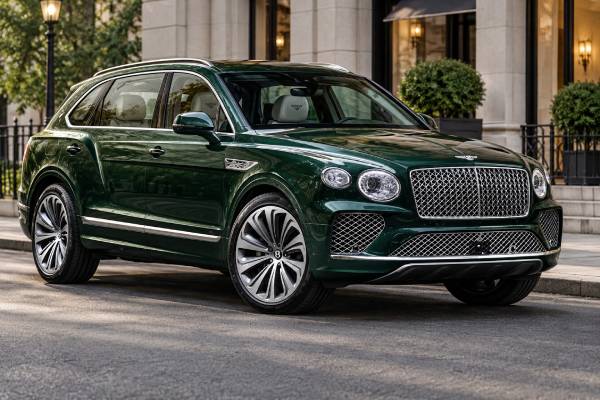
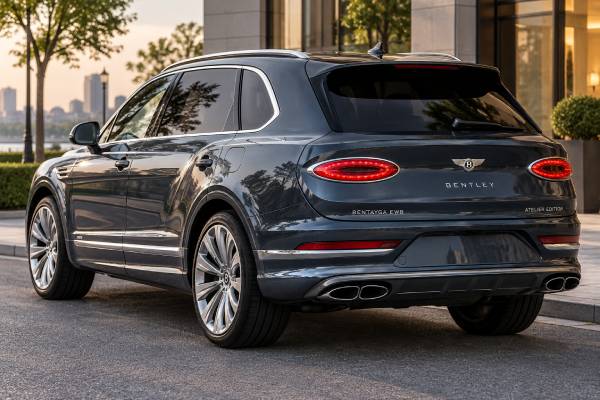
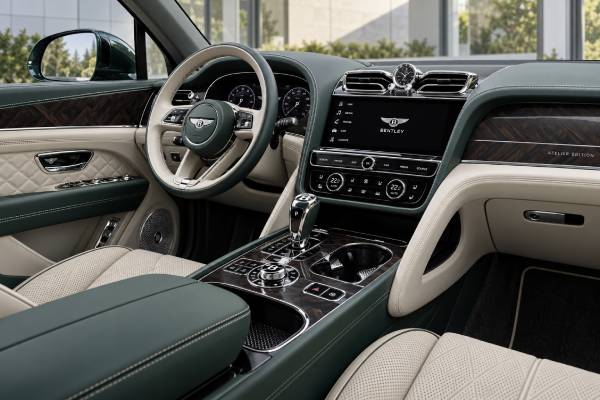
The Bentley Bentayga EWB Atelier Edition combines two different kinds of luxury: the extended-wheelbase model’s unusually generous rear cabin and a curated design package built around rare paints, restrained brightwork, and coordinated interior details. Introduced for 2025, it uses the familiar 542 hp 4.0-litre twin-turbo V8 rather than a unique high-output engine. Its appeal therefore depends less on acceleration statistics than on whether the Atelier treatment, rear-seat configuration, and factory options create a coherent car. The EWB body adds 180 mm between the axles, provides three seating layouts, and can be equipped with Bentley’s Airline Seat system, while the Atelier specification brings six selected exterior colours, a distinctive grille and wheels, Harmony Diamond quilting, and numerous features that are optional elsewhere. Buyers should treat it as a carefully commissioned grand-touring SUV, not simply a standard EWB with special badges. This guide explains the edition’s genuine differences, technical basis, ownership needs, and the checks that matter when ordering or buying one.
Table of Contents
- Atelier Concept and Edition Identity
- Rear Cabin, Seating Layouts, and Passenger Comfort
- V8 Performance and EWB Driving Character
- EWB Atelier Technical Data
- Colour, Material, and Option Strategy
- Care, Service, and Preservation
- Ordering and Used-Buying Checks
Atelier Concept and Edition Identity
The EWB Atelier Edition is a design-led factory specification based on the long-wheelbase V8 Bentayga. It does not alter the engine’s 550 PS output, but it groups distinctive exterior colours, model-specific details, and high-value cabin features into a version intended to feel more curated than a conventionally configured car.
Bentley launched the Atelier family in 2025 across three forms: the standard-wheelbase V8, the standard-wheelbase plug-in hybrid, and the EWB V8 covered here. “Atelier” is used in the traditional sense of a craft studio. The edition’s value lies in carefully paired finishes rather than a single dramatic ornament. That makes accurate identification important, because many individual elements could be imitated on an ordinary Bentayga.
Six exterior paints form the core palette. Five are revived or specially selected Mulliner colours—Light Onyx, Rubino, Porcelain, Quartzite, and Light Emerald—while Obsidian Crystal was introduced as a new finish. Availability can evolve, but a genuine Atelier build should have factory records showing the edition and its original colour rather than merely a repaint in a similar shade.
Exterior signatures include a dedicated grille treatment, Atelier wing vents, Hallmark Satin bumper valances, and 22-inch ten-spoke wheels with Tungsten-coloured pockets. The welcome-light sequence is edition-specific, while the treadplates state that the vehicle was hand crafted in Crewe, England. Self-levelling wheel badges, a jewel-like fuel-filler cap, mood lighting, and Bentley Diamond Illumination were among the Mulliner-style details included as standard at launch.
Inside, Harmony Diamond quilting provides the most recognisable theme. The pattern uses a field of diamonds interrupted by one elongated contrast-colour diamond, creating an intentionally irregular focal point. Headrest tags, contrast piping, and painted veneer carriers connect the upholstery palette to the exterior. These details should align with the factory build sheet; random replacement panels or later retrimming can disrupt both authenticity and value.
The Atelier sits differently from Mulliner. Mulliner is the flagship expression with its own elaborate tri-tone environment and traditional flagship cues. Atelier is quieter, more contemporary, and built around colour curation. It also differs from Azure, whose identity is centred on wellbeing and comfort equipment. An Atelier EWB can contain many comfort features, but its defining proposition is design coherence.
Rear Cabin, Seating Layouts, and Passenger Comfort
The EWB’s defining functional advantage is rear space: its wheelbase is 180 mm longer than the standard Bentayga’s, and the extension is devoted to the rear cabin. Buyers should choose the seating arrangement before becoming absorbed in paint and trim, because the layout determines how the vehicle works every day.
Bentley offers three broad configurations. The four-seat arrangement separates the rear occupants with a full centre console and creates the strongest chauffeur-driven atmosphere. The 4+1 arrangement provides two highly individual outer seats with an occasional centre position, making it the most flexible compromise for owners who normally carry two rear passengers but occasionally need a fifth person. A conventional five-seat layout prioritises family flexibility and a continuous rear bench.
The Airline Seat Specification is a major reason to buy the EWB. Its 22-way adjustment can include a relaxation position with up to 40 degrees of recline, a deployable footrest for the passenger-side rear occupant, seat heating and ventilation, massage, and advanced climate sensing. The auto climate system monitors temperature and humidity at the seat surface, then adjusts heat, ventilation, and airflow to help maintain comfort.
Postural Adjustment is more subtle. Instead of delivering a conventional strong massage pattern, it makes 177 small pressure changes across six independent zones over a three-hour period. The aim is to reduce fatigue by varying pressure points on long journeys. It is not a medical device, and its benefit is personal; prospective owners should experience the system during a meaningful test rather than assuming every passenger will prefer it.
Rear doors are longer than on the standard car, which improves entry but demands more clearance in tight parking spaces. Powered closing is particularly useful, allowing a seated passenger to close the door without reaching far outward. Check operation from inside and outside, listen for strained motors or latch noise, and make sure the soft-close function works consistently.
The EWB’s additional passenger room comes with a luggage trade-off. Official cargo capacity is 380 litres, versus 484 litres in a standard-wheelbase V8. That is enough for planned touring, but four adults with large cases may need disciplined packing. The luggage compartment’s shape, optional accessories, and the position of rear seats matter more than the headline litre figure. Owners who frequently carry bulky equipment should test their real luggage before ordering.
Comfort depends on specification as well as wheelbase. Acoustic glazing, rear privacy, climate controls, audio, powered blinds, and the exact seat package all affect the experience. The Atelier’s five-seat Comfort Specification was included in its launch description, but regional packages can differ. Confirm each function on the individual order sheet instead of inferring it from the edition name.
V8 Performance and EWB Driving Character
The 542 hp V8 gives the EWB Atelier effortless speed rather than overt aggression. It accelerates from 0–60 mph in 4.5 seconds and reaches 180 mph, yet its greater length and comfort brief encourage smooth, measured progress more than the sharp responses of a Bentayga Speed.
The engine is Bentley’s 3,996 cc twin-turbocharged V8, producing 550 PS, 404 kW, or 542 bhp at 6,000 rpm and 770 Nm from 2,000 to 4,500 rpm. An eight-speed automatic transmission sends power through permanent all-wheel drive. The broad torque plateau means the car rarely needs dramatic downshifts in normal traffic, and the gearbox can keep engine noise subdued when passengers want quiet.
All-wheel steering is especially valuable in this body. At low speed, the rear wheels turn opposite the fronts, shortening the effective turning circle and helping the 5.3-metre SUV manoeuvre. At higher speed, they turn in the same direction to support stability. The system does not change the car’s physical width or long rear doors, but it reduces the sense of managing a stretched chassis from the driver’s seat.
Bentley Dynamic Ride uses a 48-volt active anti-roll system to resist lean while preserving wheel independence over uneven surfaces. In a fast bend, it keeps the body more level than conventional passive anti-roll bars would; on a rough straight road, it can avoid linking left- and right-side wheel movement as rigidly. Air suspension then allows selectable ride heights and a broad range between comfort and control.
The Atelier launch specification stated that its V8 versions received Dynamic Ride and all-wheel steering. These systems should be verified on a market-specific build sheet, but they are central to how the EWB maintains composure. A warning lamp or intermittent chassis message should never be dismissed as a minor electronic quirk, because both systems are expensive and safety-relevant.
Fuel consumption is substantial. The official WLTP combined value is 13.0 L/100 km, with 296 g/km of CO2 and a published range of 654 km from the 85-litre tank. Urban chauffeur use, prolonged idling, cold trips, and frequent acceleration can produce much higher consumption. Buyers comparing it with the Atelier Hybrid should consider where the car will be driven and whether regular charging is realistic; the EWB Atelier itself is V8-only at launch.
The driving position remains commanding, but the extended body changes how the car fits roads and spaces. The surround-view camera should be treated as essential equipment, and drivers should learn where the rear wheels track around curbs. On narrow lanes, the 2,222 mm mirror-to-mirror width is more limiting than the steering circle.
EWB Atelier Technical Data
The EWB Atelier is an ICE luxury SUV powered only by its petrol V8. There is no traction motor, high-voltage battery, charging port, or official electric range. The relevant technical story is the combination of the 542 hp engine, permanent all-wheel drive, long-wheelbase body, active suspension systems, and rear-cabin packaging.
| Specification | Value |
|---|---|
| Powertrain classification | Petrol ICE |
| Engine | 4.0-litre twin-turbocharged V8 |
| Displacement | 3,996 cc |
| Maximum power | 550 PS / 542 bhp / 404 kW at 6,000 rpm |
| Maximum torque | 770 Nm from 2,000–4,500 rpm |
| Transmission | Eight-speed automatic |
| Drivetrain | Permanent all-wheel drive |
| Fuel-tank capacity | 85 litres |
| Measure | Manufacturer figure |
|---|---|
| 0–60 mph | 4.5 seconds |
| 0–100 km/h | 4.6 seconds |
| Maximum speed | 290 km/h / 180 mph |
| Measure | Official combined value |
|---|---|
| Fuel consumption | 13.0 L/100 km |
| Fuel economy | 21.7 mpg Imperial / 18.1 mpg US |
| CO2 emissions | 296 g/km |
| Driving range | 654 km / 406 miles |
| Dimension | Value |
|---|---|
| Length | 5,305 mm |
| Wheelbase | 3,175 mm |
| Wheelbase increase over standard Bentayga | 180 mm |
| Width including mirrors | 2,222 mm |
| Height | 1,774 mm |
| Published unladen weight | Approximately 2,520–2,525 kg, depending on market definition |
| Item | Specification |
|---|---|
| Seating layouts | Four-seat, 4+1, or five-seat |
| Luggage capacity | 380 litres |
| Airline Seat adjustment | 22-way, where specified |
| Maximum rear-seat recline | Up to 40 degrees, where specified |
| Suspension | Air suspension with Bentley Dynamic Ride |
| Steering | All-wheel steering |
| Atelier wheel design | 22-inch ten-spoke with Tungsten pockets |
Bentley’s 2022 launch communications quoted 5,322 mm for the first EWB, while the current model page publishes 5,305 mm. For ordering, transport, garage planning, or body repair, use the dimensions in the documentation supplied for the exact VIN rather than assuming every EWB model year is identical.
Colour, Material, and Option Strategy
A successful Atelier order should look intentional from paint to piping. The edition supplies a strong starting point, but buyers still need to resist selecting every contrast feature independently, because too many competing accents can obscure the calm design that makes this model distinctive.
Begin with exterior colour under natural light. Light Onyx has a warm metallic character, Rubino is rich and expressive, Porcelain is pale and clean, Quartzite is a neutral grey, Light Emerald introduces a sophisticated green, and Obsidian Crystal creates a darker, more dramatic result. Digital configurators and indoor lighting can misrepresent metallic flake, undertones, and contrast with Hallmark Satin trim. A physical paint sample beside the intended leather is preferable.
The Atelier wheel has Tungsten pockets that visually anchor the lower body. Because the EWB has a long side profile, the relationship among wheel finish, lower valance, glazing, and paint is more noticeable than on a smaller vehicle. Blackline-style darkening may suit some colours, but it can also remove the subtle contrast that the Atelier package was designed to create. Confirm whether any requested exterior change replaces an edition-specific component.
Inside, use the elongated contrast diamond as the organizing accent. Its colour can connect to piping, headrest tags, and painted veneer carriers without requiring every surface to match. Dark primary hides are easiest to maintain, while pale leather makes the rear cabin feel spacious but shows dye transfer, denim marks, and child-seat pressure more readily. The right choice depends on actual use, not solely launch photography.
Veneer is another major decision. Gloss finishes emphasise depth and formality but reveal fingerprints and fine scratches. Open-pore wood feels more tactile and contemporary but needs careful cleaning without oily products. Painted veneer carriers create visual continuity with the upholstery; inspect edges and joins because damage can be difficult to repair invisibly.
For chauffeur use, rear-seat controls, privacy features, powered blinds, tables, charging access, and audio should take priority. For owner-driving, front-seat massage, Touring Specification assistance, heated steering wheel, and camera systems may matter more. Naim audio is desirable for dedicated listeners, but the standard system may be sufficient in a car where conversation and quiet are priorities.
Do not assume included equipment is identical in every country. A launch press release may describe a global concept while local price lists package features differently. The signed order form should list every material, seat layout, wheel, assistance function, and comfort feature. Keep that document with the car, because it becomes an authenticity and resale record.
Care, Service, and Preservation
Mechanical maintenance follows the V8 EWB’s schedule, while the Atelier finishes add a second responsibility: preservation. Regular use is entirely appropriate, but careless cleaning, unapproved repair materials, and long periods of poor storage can damage the very details that justify the edition.
Service the engine, transmission, braking system, cooling circuits, air suspension, and electronics according to the vehicle’s market-specific schedule. Low annual mileage does not eliminate time-based oil, brake-fluid, battery, or inspection needs. Keep itemised invoices and software-campaign records rather than relying on stamps alone.
The 12-volt battery should be maintained during storage with approved equipment and procedures. A weak battery can trigger numerous network and comfort-system warnings. An EWB with powered rear doors, multiple seat modules, climate functions, blinds, audio amplifiers, and active chassis hardware has a particularly complex electrical load. Repeatedly clearing faults without finding the voltage or component cause is not acceptable maintenance.
Inspect air suspension at all ride heights and watch for one corner dropping after the car stands. Dynamic Ride and rear steering should operate without warnings, noises, or inconsistent response. Large wheels need careful alignment; inner-edge wear may be hidden unless the vehicle is raised. Replace tyres as a correctly matched set where required and use the specified load and speed ratings.
Atelier paint should be washed with clean tools and pH-appropriate products. Automatic brush washes can mar dark finishes and Hallmark Satin components. Paint-protection film may help high-impact zones, but poor templates, trapped edges, or knife cuts can create more harm than benefit. Any ceramic coating should be compatible with satin and gloss surfaces; products intended for gloss paint can alter the appearance of satin trim.
Leather needs gentle vacuuming and a manufacturer-compatible cleaner rather than glossy household conditioner. Perforated seats should not be saturated. Pale hides benefit from prompt removal of dye transfer, while contrast stitching and piping should be cleaned without aggressive brushing. Child seats must be installed correctly and periodically removed so pressure marks, trapped grit, or colour transfer can be addressed.
Harmony Diamond quilting, headrest tags, illuminated treadplates, and painted veneer carriers should be photographed when the car is new. Those images create a condition baseline and help document originality. If collision or trim repair is needed, use a facility capable of sourcing edition-correct components and matching complex paint. A superficially adequate substitute can reduce the car’s coherence and future desirability.
Ordering and Used-Buying Checks
The best EWB Atelier is the one whose seating, colour, and comfort equipment match a defined use case. Whether new or used, verify the car from its factory documentation outward: edition identity first, configuration second, condition third, and price only after the likely remedial costs are known.
For a new order, decide who will occupy the car most often. A chauffeur-driven owner may prefer four individual seats and maximum rear console functionality. A family may find 4+1 more useful, while a five-seat layout supports occasional passenger flexibility. Sit in every intended position, test ingress in a realistic parking space, and examine luggage capacity with representative cases.
Ask for a complete specification printout before signing. It should state paint, wheel, veneer, leather colours, seat configuration, Airline Seat equipment, assistance packages, audio, exterior treatments, and all Mulliner additions. Compare it with the final vehicle at handover. Check paint under daylight, inspect wheel rims and satin components, test every seat direction, and confirm the welcome animation, treadplates, mood lighting, and Diamond Illumination.
A used purchase requires proof that the vehicle began life as an Atelier Edition. Match VIN records, original invoice, option codes, and service history. Check whether paintwork is original, whether edition-specific wheels have been refinished correctly, and whether any interior panel has been retrimmed. A high-quality repair is not automatically disqualifying, but undocumented changes should reduce confidence.
Conduct the mechanical inspection with the car cold. Scan all modules before and after the road test. Exercise rear-seat climate, Postural Adjustment, massage, blinds, door motors, tailgate, camera system, audio, air suspension, rear steering, and Dynamic Ride. Examine tyres for age and inner wear, brakes for corrosion or vibration, and the underbody for impact damage. A short, smooth demonstration drive is insufficient for a car with this many systems.
Check recall and service-campaign status in the relevant national database and with Bentley. Warranty coverage should be read line by line: upholstery marks, paint, wheels, batteries, trim noises, and wear components may not receive the same protection as mechanical failures. Obtain written estimates for cosmetic defects as well as warning lights, because Atelier-specific refinishing can be costly.
Market value depends on more than rarity. Tasteful colour pairing, a useful seating layout, complete provenance, and excellent condition can matter more than the original option total. An extreme combination may be perfect for its first owner but narrow the resale audience. Conversely, the edition’s purpose is personal expression, so a buyer who loves an unusual factory scheme may value it more than a conservative market guide suggests.
Choose a standard EWB Azure instead when wellbeing equipment and a quieter visual identity are the priorities. Choose EWB Mulliner for the most overt flagship treatment and broader bespoke atmosphere. Select the EWB Atelier when its curated colours and modern craft details add genuine emotional value, not because “special edition” alone is expected to guarantee appreciation.
References
- Bentayga Atelier Edition| Bentayga Range | Bentley Motors 2026
- Bentley News 2025 : Mulliner legacy colours return for new Bentayga Atelier Edition 2025
- Bentley Bentayga Extended Wheelbase | Bentayga EWB Range | Bentley Motors 2026
- Bentley News 2022 : THE MOST WELLBEING-FOCUSED CAR SEAT IN THE WORLD – AIRLINE SEAT SPECIFICATION 2022
- Service and maintenance 2026
- Check for Recalls: Vehicle, Car Seat, Tire, Equipment | NHTSA 2026
Disclaimer
This article is for informational purposes and is not a substitute for professional diagnosis or repair. Specifications, torque values, service intervals, procedures, seating equipment, and colours can vary by VIN, market, build date, and factory revision. Verify the individual car through its official service documentation, order records, current owner literature, and a Bentley retailer or qualified specialist before purchase, maintenance, cleaning, or modification. Please share the guide on Facebook, X/Twitter, or another platform if its configuration and preservation advice is useful.