
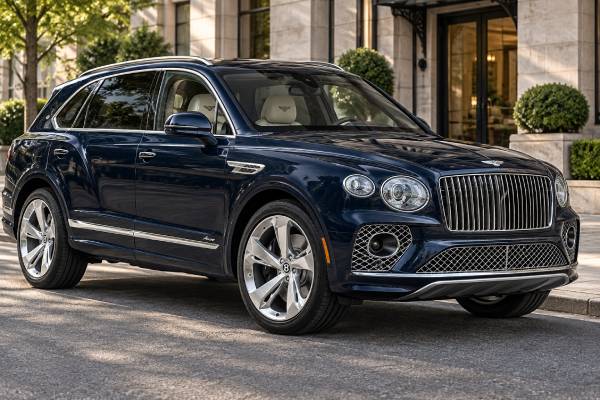
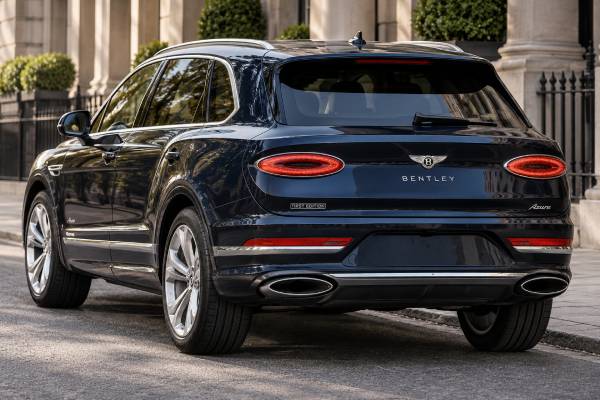
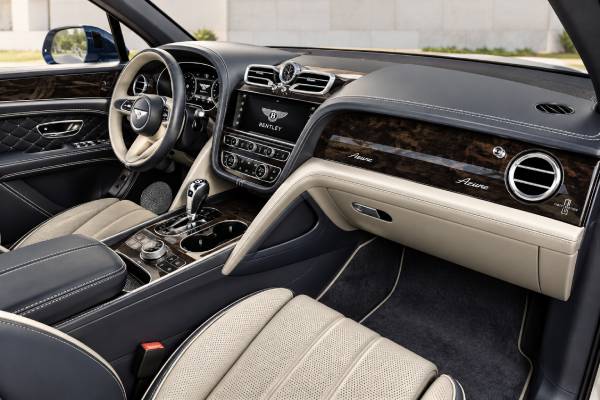
The Bentley Bentayga EWB Azure First Edition is the launch-specification version of Bentley’s extended-wheelbase luxury SUV. It combines the standard 4.0-liter twin-turbo V8 with a wheelbase stretched by 180 mm, rear-wheel steering, an unusually elaborate rear cabin, and a package of equipment that was intended to showcase the new body style at its debut. It is not a higher-output engine derivative, and the “First Edition” name should not be confused with the earlier 2016 Bentayga First Edition.
For a buyer, the important questions are therefore less about outright speed and more about authenticity, rear-seat equipment, maintenance history, and the condition of expensive comfort systems. A correctly specified example can function as a limousine, long-distance family SUV, or discreet collector-grade launch model. A poorly documented one can expose its next owner to costly work on air suspension, active anti-roll hardware, power-operated rear seating, electronics, or 22-inch wheels and tires. This guide explains the exact 2022–2023 version, its engineering, and how to assess one intelligently.
Table of Contents
- What Makes the EWB Azure First Edition Distinct
- Powertrain, Dimensions, and Technical Data
- How the Extended Rear Cabin Works
- Performance and Everyday Road Behavior
- Maintenance Priorities and Cost Risks
- Used-Buyer Inspection Guide
- Who Should Buy One
What Makes the EWB Azure First Edition Distinct
The First Edition is best understood as a heavily equipped launch package built on the comfort-focused Bentayga EWB Azure, not as a separate mechanical model. Its value comes from the combination of early-production status, identifiable First Edition details, and options that could otherwise make an EWB Azure exceptionally expensive to reproduce.
Bentley introduced the Extended Wheelbase body in 2022 and began series production later that year, with many cars registered or described as 2023 model-year vehicles. That timing explains why advertisements can show either 2022 or 2023 even when two cars are essentially from the same launch phase. The VIN, build sheet, first-registration date, and market-specific model-year coding are more reliable than a seller’s headline.
The EWB transformation added 180 mm between the axles. Nearly all of that gain benefits the rear compartment, where the longer rear doors and revised floor, roof, and side structures create substantially more legroom. Bentley paired the new body with rear-wheel steering so that the long SUV would not feel dramatically more cumbersome in tight streets or hotel entrances.
The Azure specification emphasized occupant comfort, quietness, driver assistance, and visual brightness. The launch First Edition added a curated group of premium features. Exact standard equipment varied by market and customer commission, but commonly promoted First Edition content included:
- First Edition exterior and cabin identification;
- Bentley Diamond Illumination in the door trim;
- Naim for Bentley audio with 20 speakers and 1,720 watts;
- LED welcome lamps;
- metal overlays integrated into the veneer;
- distinctive embroidery, quilting, and treadplates;
- a high level of Touring, comfort, and rear-cabin equipment.
A buyer should not assume that every First Edition has the same seat arrangement. The EWB could be ordered with a conventional rear bench, a 4+1 layout, or a four-seat arrangement, while the optional Airline Seat Specification brought the most advanced reclining, climate, and postural-adjustment functions. Confirm the actual car rather than relying on generic launch photography.
Authentication matters because many regular EWB Azure cars can look nearly identical after customization. The safest evidence is the original build specification from a Bentley retailer, supported by VIN-specific option codes, invoices, and visible First Edition details. Badges alone are not enough; they can be replaced.
Powertrain, Dimensions, and Technical Data
This version is a conventional gasoline SUV with a 3,996 cc twin-turbocharged V8, an eight-speed automatic transmission, and permanent all-wheel drive. It has no hybrid battery or external charging system. Its defining engineering features are the long-wheelbase body, air suspension, active chassis hardware, and rear-wheel steering rather than a unique engine tune.
| Specification | Value | Notes |
|---|---|---|
| Engine | 3,996 cc twin-turbocharged V8 | Gasoline, front-mounted |
| Maximum power | 550 PS / 404 kW / 542 bhp at 6,000 rpm | Manufacturer rating |
| Maximum torque | 770 Nm (568 lb-ft) at 2,000–4,500 rpm | Broad plateau for low-speed response |
| Transmission | 8-speed automatic | Torque-converter type |
| Drive | Permanent all-wheel drive | Torsen-based mechanical distribution |
| Efficiency systems | Cylinder deactivation and start-stop | Four cylinders can shut down at light load |
| Fuel tank | 85 L (22.45 US gal) | Premium gasoline required by market specification |
| Measure | Value | Condition |
|---|---|---|
| 0–60 mph | 4.5 seconds | Manufacturer figure |
| 0–100 km/h | 4.6 seconds | Manufacturer figure |
| Maximum speed | 290 km/h (180 mph) | Correct tire specification required |
| Braked towing capacity | 3,500 kg (7,716 lb) | Where approved and correctly equipped |
| Maximum wading depth | 500 mm (19.7 in) | Use only under suitable conditions |
| Longitudinal/lateral operating angle | Up to 35 degrees | Manufacturer capability statement |
The EWB’s published dimensions changed slightly across some launch and later technical documents, which may reflect homologation detail, measuring conventions, or running specification updates. For a 2022–2023 car, use its market-specific certificate of conformity for legal or transport planning. The values below reflect commonly published Bentley data for the EWB architecture.
| Specification | Value | Practical meaning |
|---|---|---|
| Wheelbase | 3,175 mm (125.0 in) | 180 mm longer than the standard-wheelbase Bentayga |
| Overall length | Approximately 5,305–5,322 mm (208.9–209.5 in) | Check the VIN-specific homologation record |
| Width across mirrors | 2,222 mm (87.5 in) | Important for garage entrances |
| Overall height | Approximately 1,740–1,774 mm (68.5–69.8 in) | Depends on published configuration and ride-height convention |
| Unladen weight | About 2,520–2,525 kg (5,556–5,567 lb) | Source definition varies by region |
| Boot volume | About 380 L (13.4 cu ft) | Seat configuration and measuring method matter |
| System | Configuration |
|---|---|
| Suspension | Four-corner adaptive air suspension with electronically controlled dampers |
| Active roll control | Bentley Dynamic Ride 48-volt electromechanical system |
| Rear-wheel steering | Standard EWB feature; opposite-phase at low speed and same-phase at higher speed |
| Steering | Electric power-assisted rack-and-pinion |
| Common wheel size | 22 inches on First Edition specifications |
| Seating layouts | Five-seat, 4+1, or four-seat depending on order |
| Infotainment | 10.9-inch central touchscreen with smartphone integration |
| Measure | Value | Standard |
|---|---|---|
| Combined fuel consumption | About 13.0 L/100 km (21.7 mpg UK) | WLTP |
| Combined CO₂ | About 296 g/km | WLTP |
| Rated driving range | About 654 km (406 mi) | WLTP calculation |
Real-world fuel use can be much higher in urban chauffeur service because the vehicle is heavy, powerful, and often left idling for climate control. Conversely, gentle motorway use allows cylinder deactivation and the tall eighth gear to work effectively. Do not budget from the homologation number alone.
How the Extended Rear Cabin Works
The EWB’s main achievement is that it adds limousine space without turning the Bentayga into a clumsy, purely chauffeur-driven vehicle. The structural stretch, powered rear doors, rear-wheel steering, and optional Airline Seat technology all serve that goal, but they also create more systems to inspect and maintain.
The longer rear doors provide a wider opening and easier access. They are heavy, so power assistance is more than a novelty. On equipped cars, occupants can close the rear doors electrically from their seats. During inspection, test every door from inside and outside, listen for strain or uneven movement, and confirm that soft-close latching works without repeated attempts.
The Airline Seat Specification is the centerpiece of the four-seat EWB. The rear passenger-side seat can recline deeply, deploy a footrest when the front passenger seat moves forward, and use Seat Auto Climate to manage heating and ventilation. Postural Adjust makes small pressure changes across the seat over time to reduce fatigue. These functions are subtle when operating correctly; a brief test drive is not enough. Allow the seat to run through its full travel, verify memory positions, and watch for warning messages.
Bentley Diamond Illumination uses small LEDs behind perforated leather panels to create a glowing diamond pattern. It is a signature First Edition feature and expensive-looking when intact. Check for dead sections, mismatched brightness, damaged perforations, or trim that has been removed and refitted poorly.
The Naim audio system is another important value item. Test it with a clean source at low and moderate volume, then adjust balance and fader to isolate speaker zones. Buzzing can come from a damaged speaker, loose trim, or an object in a door pocket. Because the system has many speakers and complex amplification, “it just needs coding” should never be accepted without a diagnostic report.
Cabin condition matters more than mileage alone. Light-colored hides show dye transfer, edge wear, sunscreen, and denim staining. Deep-pile or wool mats can conceal moisture. Examine the lowest points of the luggage area and rear footwells, and smell the cabin after it has been closed. Water intrusion can affect both luxury trim and electronic modules.
Performance and Everyday Road Behavior
Despite its limousine brief, the EWB First Edition is genuinely fast and surprisingly manageable. The V8’s 770 Nm arrives low in the rev range, so the car moves with little apparent effort rather than needing dramatic downshifts.
Rear-wheel steering is central to the experience. At parking speeds, the rear wheels turn opposite the fronts, effectively shortening the vehicle’s turning behavior. At higher speeds they turn in the same direction to improve stability during lane changes. The system should feel natural. Any steering warning, off-center wheel, inconsistent self-centering, or unusual rear-tire wear deserves specialist investigation.
Air suspension gives the Bentayga a broad operating range. Comfort settings isolate broken pavement, while firmer modes control body movement. Bentley Dynamic Ride uses 48-volt electric actuators to resist roll without relying on extremely stiff conventional anti-roll bars. That allows a soft ride in a straight line and better support in corners. The hardware is impressive, but faults can be costly, so warning-free operation is essential.
The EWB is still physically large. Width is more relevant than length in old garages, underground ramps, and European city streets. Its 22-inch wheels are vulnerable to curb damage, and their low-profile tires are expensive. A surround-view camera helps, but camera lenses, parking sensors, and remote-parking functions must all work correctly to deliver the usability buyers expect.
For towing, the 3.5-tonne rating is substantial, but the presence of a factory-approved towbar and the correct market certification matter. Inspect any tow-equipped car for electrical faults, bumper damage, overheated brakes, and heavy wear inside the luggage compartment. The engine has ample torque, yet repeated towing increases loads on tires, brakes, cooling systems, and transmission fluid.
The model is capable away from pavement, but its polished wheels, long body, luxury trim, and replacement costs make it better suited to gravel roads, wet fields, snow, and controlled estate access than casual rock crawling. A history of off-road use is not automatically bad, but underbody and sill inspection becomes more important.
Maintenance Priorities and Cost Risks
The best ownership strategy is preventive: service the car on time, keep its software and recall work current, and correct small chassis or electrical faults before they spread. Purchase price is only one part of the budget; tires, brakes, batteries, and diagnostic labor remain priced for a complex flagship Bentley.
Use the VIN-specific maintenance schedule because intervals differ by country, operating pattern, and time-based requirements. A complete record should show more than oil changes. Look for brake-fluid service, filters, spark plugs when due, air-conditioning checks, battery testing, software campaigns, and evidence that any fluid leaks or suspension warnings were investigated properly.
Important ownership areas include:
- Engine oil and cooling: The twin-turbo V8 produces substantial heat. Check for oil seepage, coolant odor, warning history, and residue around hose connections. Low annual mileage does not remove the need for time-based servicing.
- Air suspension: The vehicle should rise evenly, maintain height after being parked, and show no compressor overrun. A sagging corner may point to an air spring, valve block, line, sensor, or control issue.
- 48-volt system: Bentley Dynamic Ride depends on a separate high-power electrical architecture. Do not authorize guesswork; use Bentley-capable diagnostics and follow official procedures.
- Rear-wheel steering: Alignment requires the correct equipment and calibration. Uneven rear-tire wear can be a clue to impact damage, alignment error, or a control problem.
- Brakes and tires: A heavy 290 km/h SUV consumes premium components. Measure pad and disc condition rather than accepting a visual “good” assessment. Confirm tire age, load rating, speed rating, and matching specification on all four corners.
- 12-volt battery: A weak battery can trigger misleading warnings across multiple modules. Cars stored for long periods benefit from the approved maintainer and correct charging points.
- Powered cabin equipment: Exercise every seat, blind, door, massage unit, climate zone, USB port, screen, camera, and audio channel. Infrequently used functions can fail unnoticed.
Avoid universal fluid capacities or torque figures taken from unrelated Volkswagen Group models. The Bentayga shares engineering concepts with other vehicles, but its exact parts, software, calibration, and service procedures are VIN-dependent.
A pre-purchase diagnostic scan is especially valuable. Ask for a complete report before codes are cleared. Stored intermittent faults may reveal low-voltage events, seat-module issues, suspension errors, communication faults, or a history of repeated unsuccessful repairs.
Used-Buyer Inspection Guide
A strong First Edition should have verifiable identity, a coherent service history, matching premium tires, fully functional rear-cabin equipment, and no unexplained warning history. Inspect it in a disciplined order so the visual impact of the cabin does not distract from expensive mechanical details.
- Authenticate the specification. Obtain the original build sheet from a Bentley retailer and match the VIN, paint, trim, seat layout, First Edition equipment, and option codes.
- Review date and mileage evidence. Compare servicing, inspection records, tire dates, invoices, and electronic history. Very low mileage is attractive only when storage and time-based maintenance were handled correctly.
- Start the car cold. Listen for prolonged mechanical noise, watch exhaust behavior, and check that warning lights complete their normal self-test and extinguish.
- Cycle the chassis. Change ride heights and drive modes on level ground. Confirm even response and no warning messages.
- Test the rear compartment slowly. Run both rear seats through every function, operate powered doors and blinds, inspect illuminated trim, and test rear climate controls.
- Inspect wheels, tires, and brakes. Look for cracks, repairs, flat spots, sidewall damage, mixed brands, or worn inner shoulders. Carbon or cosmetic wheel repairs should be documented.
- Check the body underneath. The long sills and lower trim can hide lifting damage. Inspect undertrays, jacking points, exhaust, suspension arms, and signs of off-road contact.
- Scan all modules. A Bentley specialist should document current and stored faults, software status, campaign completion, and battery health.
- Drive on varied roads. Include parking maneuvers, rough surfaces, a steady highway section, and several firm but safe brake applications. Note vibration, steering pull, drivetrain shunt, wind noise, and trim rattles.
- Price the immediate work. Obtain written estimates for tires, brakes, overdue service, cosmetic repairs, and any fault before negotiating.
Check recall and service-campaign status by VIN rather than by model name alone. A campaign affecting some Bentaygas may exclude the EWB First Edition because of production dates, seat configuration, powertrain, or market. Conversely, a seller may wrongly assume that a low-volume car is unaffected.
Be cautious when a vehicle has extensive aftermarket modifications. Window tint, paint-protection film, trackers, entertainment equipment, wheel changes, and hardwired accessories can all be acceptable, but poor installation can disturb sensors, trim, antennas, or battery management. Originality and documentation usually support long-term value better than unexplained alterations.
Who Should Buy One
The EWB Azure First Edition suits a buyer who will use its rear space and appreciates a richly equipped launch model, yet still wants to drive rather than own a traditional limousine. It is less rational for someone who mainly travels alone, needs compact-city practicality, or wants the lowest possible running costs.
Compared with a standard-wheelbase Bentayga Azure, the EWB gives up some luggage volume and adds mass, length, powered-door complexity, and rear-seat hardware. In return it offers a notably more spacious and ceremonial rear compartment. Compared with a later EWB Azure, the First Edition’s appeal is its launch specification and bundled details, not superior performance.
Collector potential should be treated cautiously. It is a distinctive early EWB, but condition, color combination, factory specification, documentation, and market demand matter more than the badge alone. A tasteful four-seat Airline Seat car with complete provenance may be easier to place than an oddly configured example, even if both are genuine First Editions.
The smartest purchase is usually not the cheapest listing. Favor the car with the clearest build record, continuous Bentley or recognized specialist maintenance, recent premium tires, strong battery health, completed campaigns, and every luxury function operating. An independent inspection can cost little compared with one major seat, suspension, brake, or electronic repair.
When those standards are met, the Bentayga EWB Azure First Edition delivers exactly what its launch promised: unusually generous rear-seat comfort, effortless V8 performance, and the versatility of an all-wheel-drive SUV in a vehicle that still feels special from either row.
References
- Bentley News 2022 : THE BENTAYGA EWB AZURE FIRST EDITION: FIRST AND FOREMOST 2022
- Bentley News 2022 : LONG – AWAITED: THE BENTAYGA EXTENDED WHEELBASE 2022
- Bentley News 2022 : BENTLEY STARTS SERIES PRODUCTION OF CLASS-LEADING BENTAYGA EXTENDED WHEELBASE 2022
- NEW BENTAYGA EXTENDED WHEELBASE 2023 (Brochure)
- Bentley Bentayga Extended Wheelbase Azure | Bentayga EWB Range | Bentley Motors 2026
- Bentley Bentayga | History and Heritage | Bentley Motors 2026
Disclaimer
This article is for informational purposes and is not a substitute for professional diagnosis or repair. Specifications, torque values, maintenance intervals, campaign eligibility, and procedures can vary by VIN, market, production date, and equipment. Verify all work against the vehicle’s official Bentley service documentation and use a qualified technician.
Please share this guide on Facebook, X/Twitter, or your preferred automotive community if it helped you evaluate the Bentayga EWB Azure First Edition.