
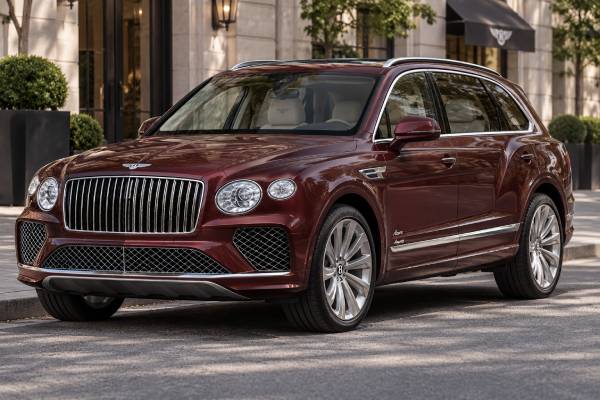
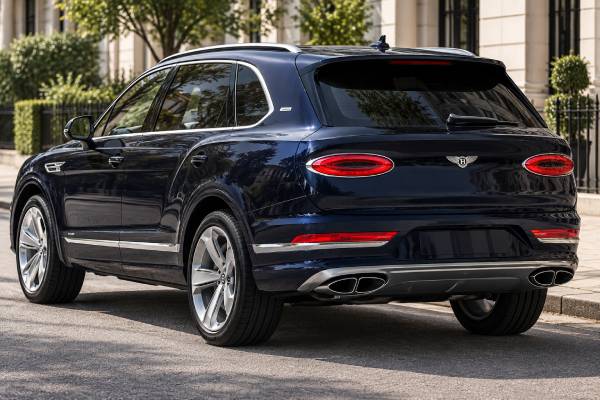
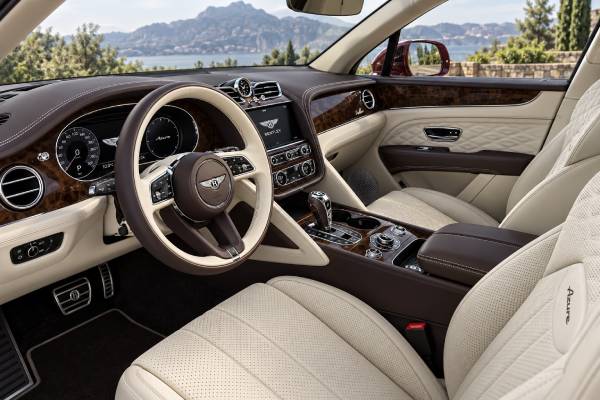
The Bentley Bentayga EWB Azure is the long-wheelbase Bentayga for buyers who place comfort and wellbeing ahead of sporting theatre. It combines the 180 mm wheelbase extension and rear-wheel steering of every EWB with an Azure specification developed around quieter travel, supportive seating, driver-assistance technology, and a calm visual character. Its 542 bhp twin-turbo V8 still launches the SUV to 60 mph in 4.5 seconds, but the reason to choose this derivative is what happens when nobody is in a hurry.
The rear compartment can be ordered with four, 4+1, or five seats, while the optional Airline Seat Specification adds deep recline, automatic thermal management, and subtle postural adjustment. Azure details—including dedicated badging, bright exterior elements, distinctive wheels, quilt patterns, and comfort-focused standard equipment—separate it from a base EWB without turning it into the heavily bespoke Mulliner flagship. Because option content changed through the production run and varies by market, a build sheet remains essential. This guide explains the hardware, the comfort systems, the ownership demands, and the checks that matter before purchase.
Table of Contents
- Azure Character and Model Scope
- EWB Azure Specification Data
- Wellbeing Systems in Practice
- Front-Seat and Chauffeur Experience
- Personalisation With Restraint
- Care, Costs, and Fault Prevention
- Choosing the Right EWB Azure
Azure Character and Model Scope
Azure is Bentley’s comfort-led line, and the EWB body gives that idea the space to work. The trim is neither an engine upgrade nor a separate platform. It uses the same 4.0-litre V8, eight-speed automatic, all-wheel drive, 3,175 mm wheelbase, air suspension, active anti-roll system, and rear-wheel steering as other V8 EWB versions.
What changes is the selection and presentation of equipment. At launch, Bentley highlighted bright lower bumper grilles, Azure badging, a dedicated 22-inch ten-spoke directional wheel, unique quilting, mood lighting, a heated steering wheel, and additional driver-assistance features. Later production brought broader range updates, so the exact standard list for a 2022 car may not match a 2026 configurator.
Azure’s design is deliberately less aggressive than a blacked-out sporting specification. Brightwork, polished surfaces, pale hides, and warm veneer choices suit the model’s purpose, although buyers can still commission dark paint, Blackline exterior trim, technical veneer, or contrasting accents. An Azure badge therefore does not guarantee a traditional chrome-and-walnut appearance.
The model was introduced when Bentley was repositioning the Bentayga EWB as a replacement for the rear-cabin experience once offered by the Mulsanne. That context matters. The EWB Azure is not merely a plusher family SUV; it can be configured as an executive transport car where the rear passenger receives more attention than the driver.
Yet it can also serve as an owner-driven grand tourer. The V8, rear steering, and active chassis make it far more responsive than its dimensions imply. A buyer does not need a chauffeur to benefit from Azure, but should avoid paying for elaborate rear systems that will rarely be used.
The model scope includes early First Edition cars, regular Azure production, and numerous Mulliner-personalized commissions. A First Edition may add unique badges, embroidery, lighting, and option bundles, but it is not the same as the later EWB Mulliner model. In classified listings, verify each designation against the factory build rather than relying on decorative details that can be added later.
EWB Azure Specification Data
The EWB Azure is a conventional petrol ICE vehicle. Its V8 places the turbochargers inside the cylinder banks for short exhaust paths and strong low-rpm response. Power reaches all four wheels through an eight-speed automatic, while rear-wheel steering and the 48-volt Bentley Dynamic Ride system help control the long, heavy body.
| Specification | Value | Context |
|---|---|---|
| Engine type | 4.0-litre twin-turbocharged V8 petrol | 3,996 cc, 32 valves |
| Maximum power | 550 PS (542 bhp; 404 kW) | At 6,000 rpm |
| Maximum torque | 770 Nm (568 lb-ft) | 2,000–4,500 rpm |
| Transmission | 8-speed automatic | Torque-converter automatic |
| Drivetrain | Permanent all-wheel drive | Integrated with drive-mode controls |
| Fuel capacity | 85 litres (22.45 US gal) | Premium petrol |
| Cylinder deactivation | Available under light load | Operates automatically when conditions permit |
| Specification | Value | Procedure |
|---|---|---|
| 0–60 mph | 4.5 seconds | Bentley manufacturer figure |
| 0–100 km/h | 4.6 seconds | Bentley manufacturer figure |
| Maximum speed | 290 km/h (180 mph) | Bentley manufacturer figure |
| Combined fuel consumption | 13.0 L/100 km | WLTP publication for current EWB V8 |
| Combined CO₂ emissions | 296 g/km | WLTP |
| Official driving range | 654 km (406 miles) | WLTP |
| Specification | Value |
|---|---|
| Overall length | 5,305 mm (208.9 in) |
| Wheelbase | 3,175 mm (125.0 in) |
| Width across mirrors | 2,222 mm (87.5 in) |
| Overall height | 1,774 mm (68.7 in) |
| Published unladen weight | Approximately 2,520–2,525 kg (5,556–5,567 lb), depending on regional definition |
| Boot volume | 380 litres (13.4 cu ft) |
| Rear-wheelbase increase | 180 mm (7.1 in) over standard Bentayga |
| Feature | Purpose |
|---|---|
| Adaptive air suspension | Balances soft primary ride with controlled body movement |
| Bentley Dynamic Ride | 48-volt active anti-roll control resists cornering roll |
| All-wheel steering | Improves low-speed manoeuvrability and high-speed stability |
| Touring assistance content | Can include adaptive cruise, lane guidance, head-up display, and night vision, depending on market and year |
| Airline Seat Specification | Optional 22-way rear seating with recline, Auto Climate, and Postural Adjust |
| Front Seat Comfort Specification | Heating, ventilation, massage, and extensive electrical adjustment |
| Layout | Best suited to | Trade-off |
|---|---|---|
| Four seats | Executive use and maximum rear separation | No fifth occupant position |
| 4+1 seats | Luxury outer seats with occasional fifth-passenger flexibility | Centre position is not a full conventional seat |
| Five seats | Family use and regular three-person rear travel | Less lounge-like presentation |
The tables describe the common EWB Azure foundation. Wheel size, tire specification, assistance hardware, audio, seating, trim, and some dimensions may vary with model year and market. Never transfer a towing, payload, or tire-pressure value from a different Bentayga without checking the car’s own documentation.
Wellbeing Systems in Practice
The wellbeing technology is useful when it reduces the number of adjustments occupants make during a long trip. It should not be treated as medical equipment, and it cannot correct poor posture, fatigue, or an unsuitable seating position by itself.
The optional Airline Seat begins with a deeply adjustable rear chair. Electric controls alter cushion angle, backrest, bolsters, headrest, and leg support. In Relax mode, the rear seat can recline to 40 degrees while the front passenger seat moves forward and deploys a footrest. In Business mode, the passenger sits more upright for reading or working.
Seat Auto Climate is the most unusual feature. Sensors monitor temperature and surface humidity where the occupant contacts the seat. The system then applies heat, ventilation, or a combination to maintain one of several chosen comfort levels. Because the response is automatic, the passenger may notice fewer hot or damp pressure points rather than a dramatic blast of air.
Postural Adjust works even more subtly. Six pressure zones make small support changes over a long journey. Bentley’s published description refers to 177 pressure changes across three hours. The intention is to vary loading on the body, not to imitate a strong massage. A buyer should test it for several minutes and confirm that every zone operates without clicking, deflation, or an error message.
Azure’s comfort also depends on ordinary fundamentals:
- correct tire pressures and evenly worn premium tires;
- quiet wheel bearings and properly aligned suspension;
- clean cabin filters and strong climate-control output;
- door seals that prevent wind noise;
- rattle-free screens, tables, blinds, and seat mechanisms;
- a battery and charging system healthy enough to support many electrical functions.
Noise is especially revealing from the rear. A chauffeur-driven test should include a period in the left and right rear seats at motorway speed. Listen for air movement around the long doors, tire roar from the rear arches, trim creaks, and resonance from the luggage compartment. The front seat can hide sounds that are obvious to the principal passenger.
The power rear doors deserve careful use. Their length and weight make them convenient, but they remain doors, not autonomous obstacle-avoidance devices. Passengers should check surrounding space, keep fingers clear, and know how the manual release works if electrical assistance is unavailable.
Rear entertainment, audio, and connectivity can add comfort or become a source of frustration. Confirm that headphones, remotes, screens, phone pairing, app access, and account transfer work before delivery. Network-dependent services may differ by country and may require active subscriptions.
Front-Seat and Chauffeur Experience
The EWB Azure is rewarding to drive because its chassis conceals much of the extra wheelbase without hiding the car’s true mass. Rear-wheel steering turns the back wheels opposite the fronts at lower speeds, making the vehicle rotate more readily into a bay. At higher speed, the rear wheels assist stability by steering in the same direction.
A chauffeur will appreciate the broad torque band. The V8 develops its 770 Nm peak from 2,000 to 4,500 rpm, so smooth acceleration rarely needs high engine speed. The most professional progress comes from using that reserve gently: early braking, measured throttle, and minimal steering correction allow the rear systems to work without drawing attention to themselves.
The eight-speed automatic should shift almost invisibly in normal driving. A delayed engagement from Park, shunt when selecting Drive, flare between ratios, or repeated low-speed hesitation is not part of the luxury character. Some behaviour can be software-related, but it still warrants diagnosis and a check of service history.
Bentley Dynamic Ride is equally important. Air suspension can soften vertical movement, while the active anti-roll system controls lateral lean. This separation helps the Azure remain comfortable on a straight road without feeling loose through a bend. When a warning disables the active system, the car may still move, but its handling and ride can change significantly.
The Touring Specification can reduce workload on long journeys. Depending on model year and region, it may include adaptive cruise control, lane guidance, predictive speed assistance, head-up display, and night vision. These systems are assistants, not substitutes for attention. Their sensors also make collision repair more expensive because radar, camera, and alignment calibration must be correct.
For owner-drivers, the size is the largest compromise. The EWB is wide across its mirrors and its long rear doors need clearance. A 360-degree camera cannot change a narrow entrance. Measure the home garage, note ramp breakover and gate angles, and confirm that the tailgate can open beneath the ceiling.
The V8’s performance is effortless rather than theatrical in Azure tune. It can reach 100 km/h in 4.6 seconds, yet large wheels, occupants, and luggage mean substantial kinetic energy. Smoothness should never be confused with short stopping distance. Leave room, especially in rain or on winter tires.
Personalisation With Restraint
The most convincing Azure specifications support the comfort theme instead of stacking every expensive option. A coherent car often ages better than one combining satin paint, bright polished wheels, multiple accent colours, technical veneer, contrast stitching, and extensive exterior carbon without a clear visual idea.
Traditional choices include a deep metallic exterior, bright grille and lower trim, polished or machined wheels, a light main hide, darker secondary hide, and open-pore or high-gloss wood. Contemporary alternatives may use Blackline trim, darker lamps, black wheels, piano veneer, and stronger contrast colours. Neither is inherently better; condition and consistency matter more.
Wheel choice deserves a functional decision. A 22-inch directional wheel helps identify early Azure cars and suits the body visually. It also carries expensive, low-profile tires that are vulnerable to pothole damage. A less aggressive factory wheel may produce quieter secondary ride and lower replacement cost.
Interior options should be evaluated by touch and maintenance needs. Pale leather shows dye transfer. Piano-black surfaces reveal scratches. Open-pore veneer must not be polished like a gloss finish. Deep-pile overmats trap grit. Bentley Diamond Illumination adds atmosphere but introduces perforated leather and lighting hardware that should be cleaned gently.
When comparing cars, separate factory options from dealer or aftermarket changes. Painted wheels, black badges, replacement grille parts, vinyl-wrapped trim, and non-original tint can make a base car resemble a special specification. The factory build record, part markings, paint-depth readings, and invoices provide a more reliable story.
An EWB Azure ordered for hotel or corporate service may have high idle time, repeated short journeys, and heavy rear-seat use despite modest mileage. Conversely, a private car may have low mileage but suffer from long storage, weak batteries, flat-spotted tires, and dried seals. Usage pattern is more informative than the odometer alone.
Care, Costs, and Fault Prevention
Preventive care should protect both the mechanical platform and the expensive comfort equipment. A missed oil service is serious, but so is a drink spilled into a rear control panel or a bag allowed to jam a powered footrest.
The V8 requires the approved oil specification, correct filter, and schedule for the VIN and market. Heat management around the turbocharged engine makes cooling-system condition critical. Check for coolant odour, residue around connections, damaged radiator fins, and evidence of repeated top-ups. A cold start should be clean and free from sustained chain, tappet, or turbo noise.
The air suspension should raise and lower evenly. After an overnight park, one corner should not sit visibly lower than the others. A compressor that runs for long periods may be compensating for a leak. Rear-wheel-steering and active anti-roll faults should be scanned even when no warning remains on the dashboard.
Tires are a major running cost. Inspect date codes, inner shoulders, sidewalls, and repair plugs. Four matching tires with the correct size, load rating, and speed rating are preferable to a mixed set with more tread. Alignment should be checked whenever unusual wear appears or after a significant wheel impact.
Rear-cabin prevention includes:
- vacuuming seat rails before operating long travel ranges;
- keeping liquids away from switch packs and pneumatic seat components;
- exercising blinds, tables, screens, and footrests regularly;
- cleaning perforated and quilted leather with suitable products;
- maintaining the 12-volt battery during storage;
- updating connected accounts and vehicle software through approved channels;
- investigating water staining or damp smells immediately.
Brake work can be costly because the discs and pads must control a heavy, fast SUV. Cars driven gently may develop corrosion; cars driven hard may develop heat spots or vibration. Measure components rather than judging them through wheel spokes. Confirm the electronic parking brake releases correctly and that all calipers wear evenly.
A full service history supports resale, but the best file contains detailed invoices, inspection reports, tire and brake dates, recall completion, warranty claims, and records of recurring faults. For a vehicle outside warranty, discuss likely annual and contingency costs with a Bentley specialist before purchase rather than after the first warning light.
Choosing the Right EWB Azure
The right EWB Azure is the one whose seating and option choices match the owner’s actual passengers. Start by deciding whether the fifth seat is essential. That single question removes many unsuitable cars from consideration.
Next, test the vehicle in the role it will perform. A chauffeur-driven buyer should spend most of the test in the rear. An owner-driver should park it, reverse it through a narrow entrance, and use the assistance systems. A family should fit child seats, load luggage, and confirm that the tailgate opens in the home garage.
The inspection should be systematic:
- Verify VIN, model designation, factory build, service record, and recall status.
- Examine paint, brightwork, wheels, long rear doors, seals, and evidence of body repair.
- Test every seat movement and comfort function under occupant load.
- Scan all control modules, not only the engine ECU.
- Inspect air suspension, rear steering, active anti-roll hardware, brakes, tires, and alignment.
- Test cameras, radar assistance, night vision, audio, screens, connected services, and both keys.
- Drive from cold, then repeat checks after the engine, transmission, and brakes are warm.
Watch for apparently minor symptoms that affect the Azure experience: a noisy fan, weak seat ventilation, a blind that hesitates, a camera that intermittently disappears, or a door that needs a second attempt to latch. On a complex flagship SUV, several small faults can produce a large combined repair estimate.
Compare the Azure with both the base EWB and EWB Mulliner. A well-optioned base EWB may provide nearly all desired comfort for less money. The Mulliner adds a more overt flagship identity, tri-tone interiors, exclusive design features, and broader curated personalization. Azure sits between them: recognizably special, comfort-oriented, and less dependent on extravagant bespoke content.
The EWB Azure makes the strongest case for buyers who regularly use the rear cabin, value a bright and calming design, and want V8 range without plug-in charging. It is less suitable where parking space is tight, rear seats are rarely occupied, or operating costs must remain predictable. Purchased with a verified specification and cared for proactively, it can function as both a grand touring SUV and a modern limousine.
References
- Bentley Bentayga Extended Wheelbase Azure | Bentayga EWB Range | Bentley Motors 2026
- Bentley News 2022 : LONG – AWAITED: THE BENTAYGA EXTENDED WHEELBASE 2022
- Bentley News 2022 : A REVEAL EVENT DURING THE MONACO YACHT SHOW TO CELEBRATE BENTAYGA EWB AZURE DEBUT IN EUROPE 2022
- Bentley News 2022 : THE MOST WELLBEING-FOCUSED CAR SEAT IN THE WORLD – AIRLINE SEAT SPECIFICATION 2022
- Service and maintenance 2026
- Check for Recalls: Vehicle, Car Seat, Tire, Equipment | NHTSA 2026 (Recall Database)
Disclaimer
This article is for informational purposes and is not a replacement for professional diagnosis, service, or repair. Specifications, torque values, service intervals, feature availability, and procedures vary by VIN, market, model year, and equipment. Verify details against official service documentation from Bentley and have qualified technicians inspect the vehicle.
Please share this article on Facebook, X/Twitter, or another social network if it helped you. Sharing supports our work and can help other owners locate a practical, carefully researched guide.