
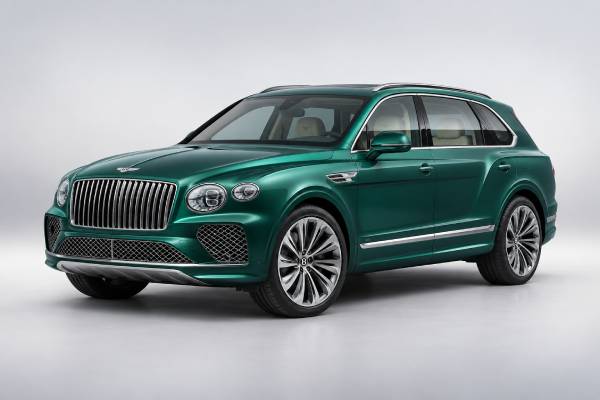
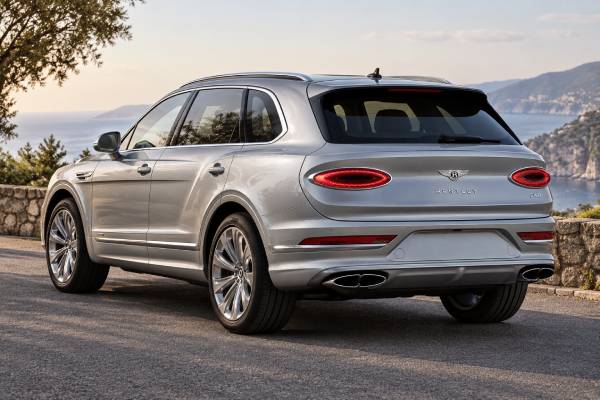
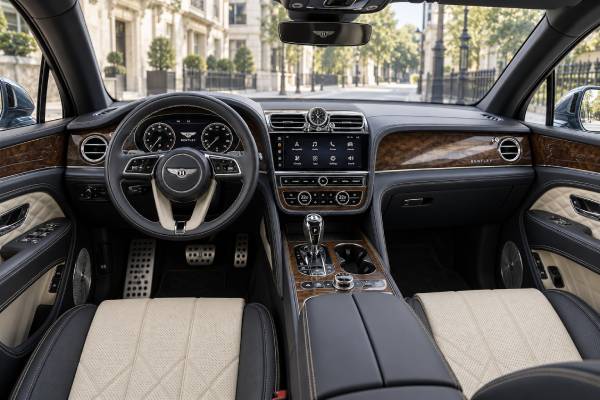
The Bentley Bentayga Extended Wheelbase is not simply a standard Bentayga with extra rear legroom. Bentley lengthened the wheelbase by 180 mm, redesigned the rear doors and underbody, added rear-wheel steering, and created a cabin intended to replace much of the experience once supplied by a traditional flagship limousine. The result is a 5.3-metre SUV that can carry four or five people, tow, cross poor roads, and still provide a rear compartment built around reclining comfort.
All 2022–present EWB models use Bentley’s 4.0-litre twin-turbo V8 with 542 bhp, an eight-speed automatic, and all-wheel drive. Performance remains unusually strong for a vehicle weighing roughly 2.5 tonnes: 0–60 mph takes 4.5 seconds and top speed is 180 mph. The more important achievement is that the longer body does not feel clumsy in normal traffic. Rear-wheel steering reduces the low-speed turning circle, while air suspension and active anti-roll control balance ride comfort with body control. Choosing the right seating layout and options is therefore as important as choosing the colour.
Table of Contents
- Why the Extended Wheelbase Exists
- Dimensions, Powertrain, and Specifications
- Rear-Cabin Layouts and Airline Seat Technology
- Driving a Long Luxury SUV
- Equipment and Configuration Decisions
- Service, Wear, and Long-Term Storage
- Inspection and Purchase Strategy
Why the Extended Wheelbase Exists
The EWB exists for buyers who want the elevated seating, luggage access, and all-weather ability of an SUV but expect the rear accommodation of a chauffeur-driven saloon. Bentley placed the entire 180 mm extension behind the front seats, so it benefits rear passengers rather than enlarging the engine bay or cargo area.
The engineering work went deeper than fitting longer sills. Bentley altered the body-in-white, floor, side panels, roof, and rear doors. The wheelbase rose from 2,995 mm to 3,175 mm, and the original launch body measured 5,322 mm overall; current Bentley technical pages list 5,305 mm for recent specifications, reflecting model-year or measurement-detail changes. A buyer should therefore use the VIN-specific technical record when an exact garage or transporter clearance matters.
Long rear doors improve access but create their own practical issue: they need space to swing. Available power-closing functions help passengers pull them shut from the seat, yet parking-bay width still matters. The EWB is happiest with a generous home garage, a carefully chosen office space, or a driver who plans stops rather than improvising in tight multi-storey car parks.
At launch, Bentley offered three seating concepts:
- 4+1 seating uses two outer rear seats with a narrower occasional centre position. It is the most flexible compromise.
- Four-seat configuration replaces the centre seat with a full console and turns the rear into a more formal lounge.
- Five-seat configuration gives conventional family utility and easier accommodation for three rear occupants.
The EWB is not automatically an Azure or Mulliner. The base EWB uses the same long body and V8, while higher derivatives add curated comfort, design, and personalization content. This distinction matters in the used market, where option-heavy base cars can resemble Azure examples and where advertisements sometimes treat “EWB” as a trim rather than a body style.
Dimensions, Powertrain, and Specifications
The EWB is an ICE vehicle powered only by a petrol engine. Its 3,996 cc V8 uses twin turbochargers, cylinder deactivation under suitable light-load conditions, and an eight-speed automatic. All-wheel drive, air suspension, Bentley Dynamic Ride active anti-roll control, and rear-wheel steering are central to making the long body usable.
| Specification | Value | Notes |
|---|---|---|
| Engine | 3,996 cc twin-turbocharged V8 petrol | 32-valve, hot-V turbo layout |
| Maximum power | 550 PS (542 bhp; 404 kW) | At 6,000 rpm |
| Maximum torque | 770 Nm (568 lb-ft) | 2,000–4,500 rpm |
| Transmission | 8-speed automatic | Torque-converter type |
| Drive | Permanent all-wheel drive | Road and all-weather focus |
| Cylinder deactivation | Four-cylinder light-load operation | When operating conditions allow |
| Fuel tank | 85 litres (22.45 US gal) | Premium petrol requirements vary by market |
| Specification | Value | Standard or condition |
|---|---|---|
| 0–60 mph | 4.5 seconds | Manufacturer figure |
| 0–100 km/h | 4.6 seconds | Manufacturer figure |
| Top speed | 290 km/h (180 mph) | Manufacturer figure |
| Combined fuel consumption | 13.0 L/100 km | Current WLTP publication |
| Combined CO₂ emissions | 296 g/km | Current WLTP publication |
| Driving range | 654 km (406 miles) | WLTP |
| Specification | Value | Definition |
|---|---|---|
| Body style | Five-door extended-wheelbase SUV | Long rear-passenger compartment |
| Overall length | 5,305 mm (208.9 in) | Current Bentley technical page |
| Wheelbase | 3,175 mm (125.0 in) | 180 mm longer than standard Bentayga |
| Width across mirrors | 2,222 mm (87.5 in) | Includes mirrors |
| Overall height | 1,774 mm (68.7 in) | Specification-dependent |
| Unladen weight | 2,520–2,525 kg (about 5,556–5,567 lb) | Published regional definitions differ |
| Boot volume | 380 litres (13.4 cu ft) | Published current figure |
| System | Function |
|---|---|
| Adaptive air suspension | Controls ride height and damping for comfort and body control |
| Bentley Dynamic Ride | 48-volt active anti-roll system counters body roll |
| All-wheel steering | Opposite-phase rear steering at low speed and same-phase assistance at higher speed |
| Airline Seat Specification | 22-way rear-seat adjustment, deep recline, auto climate, and postural adjustment |
| Powered rear doors | Assist rear passengers with closing the extended doors where fitted |
| Bentley Diamond Illumination | Optional light projected through perforated leather |
| Item | Practical note |
|---|---|
| Wheel sizes | Large 21- and 22-inch factory packages are common; exact tire fitment depends on wheel design |
| Towing | Confirm the VIN-specific towing package and regional rating before use |
| Roof load | Use only approved bars and the model-specific load limit |
| Ground clearance | Air suspension varies ride height; do not rely on one static number for every mode |
| Spare provision | May be a repair kit or optional spare arrangement depending on market and build |
The EWB’s cargo figure can surprise buyers because the model is longer than the standard Bentayga. The added body length is devoted to rear occupants, and seat, trim, or measurement differences can reduce the quoted luggage space. Buyers who carry large cases, sports equipment, or a dog crate should test the actual load area rather than assuming the longer car has the larger boot.
Rear-Cabin Layouts and Airline Seat Technology
The rear cabin is the reason to buy the EWB, and the seating specification determines whether it works as a family SUV, executive car, or mobile private lounge. The most advanced setup is the Airline Seat Specification, which combines extensive electrical adjustment with systems designed to reduce heat discomfort and pressure fatigue.
Each outer seat can offer 22 adjustment directions. In Relax mode, the backrest reclines to 40 degrees, the front passenger seat can move forward, and a footrest extends behind it. Business mode moves the seat toward a more upright working position. These features require space, electrical motors, pneumatic valves, sensors, and control modules, so their operation should be checked through the full range rather than demonstrated with a single button press.
Seat Auto Climate measures the temperature and humidity at the occupant-seat contact surface. Bentley states that the system samples with fine temperature accuracy and can apply heating, ventilation, or both to maintain a selected comfort level. This is different from a normal ventilated seat that simply runs a fan at a chosen speed. The value becomes clear on long journeys, where a passenger may feel neutral without repeatedly adjusting controls.
Postural Adjust uses six independent pressure zones to make small changes over time. It is not a conventional massage programme. Instead of delivering a noticeable rolling or pulsing effect, it varies support subtly to avoid one area carrying constant pressure. Bentley describes 177 possible pressure changes during a three-hour period. Some occupants notice the benefit more than the movement.
The 4+1 layout deserves particular attention. Its occasional middle seat preserves the ability to carry a fifth person, but it does not turn two sculpted executive seats into a flat three-person bench. Families should bring child seats and test buckle access. Adults should sit in all three positions. A four-seat car offers the greatest sense of separation and can include a substantial centre console, but it permanently removes the fifth seat.
Other rear-cabin items can matter as much as the headline seat:
- heated door and centre armrests;
- rear entertainment displays and their mounting hardware;
- folding picnic tables;
- powered blinds and privacy glass;
- separate climate controls and vent output;
- premium audio, including Naim or Bang & Olufsen systems depending on model year;
- deep-pile overmats or wool carpets that need correct cleaning;
- power door-closing controls and emergency manual operation.
The EWB is also quiet because Bentley treated noise, vibration, and harshness as part of wellbeing. Tire choice can undo some of that work. Aggressive replacement tires, uneven wear, or a mismatched set can introduce a low-frequency hum that becomes obvious in the rear, especially on coarse asphalt.
Driving a Long Luxury SUV
The EWB drives smaller than its wheelbase suggests, but it never becomes physically small. Rear-wheel steering is the key: at low speed the rear wheels turn opposite the fronts, effectively shortening the wheelbase and helping the nose rotate into a parking space. At higher speed they turn with the fronts to improve stability during lane changes.
A driver should still learn the car’s width and rear-door length. The camera system and parking sensors are valuable, yet clean lenses and correct calibration are essential. When viewing a used car, test the cameras in daylight and darkness, confirm that the stitched overhead image aligns properly, and watch for intermittent blank screens.
The V8 suits the EWB because it produces strong torque without requiring constant high revs. The official 4.5-second 0–60 mph time is quicker than many sports cars, but full acceleration is not the defining experience. More relevant is the ability to merge with traffic while carrying passengers without a strained engine note or abrupt downshift.
Bentley Dynamic Ride uses electric actuators to resist roll. On a motorway it helps the long body remain settled; on a winding road it keeps steering response more precise than the mass would suggest. Air suspension allows compliant primary ride, although sharp wheel impacts still reach the cabin on the largest wheels.
A test drive should include more than a smooth urban route. Use broken pavement to reveal wheel or suspension noise, a tight roundabout to feel steering consistency, a motorway lane change to assess stability, and a steep ramp to check low-speed gearbox and brake behaviour. Listen from the rear as well as the driver’s seat; a car can feel quiet up front while a door seal, blind, screen, or seat mechanism rattles behind.
Braking performance must be judged in context. A 2.5-tonne vehicle creates substantial heat, and replacement discs, pads, and tires are expensive. Vibration through the steering wheel, pulsing through the pedal, or a scraping noise after the brakes are warm should be investigated. Cars used mainly for short chauffeur trips may develop corrosion because the brakes do not receive regular higher-energy use.
The EWB can tow when correctly equipped, but towing should not be assumed from the presence of a removable hitch. Check the factory build, local registration rating, trailer-electrical function, cooling requirements, and maximum nose weight. The rear-wheel-steering and assistance systems also need the correct trailer settings and software recognition.
Equipment and Configuration Decisions
Specification can change the character and resale appeal of an EWB more than a one-year age difference. The first decision is seating. The second is whether the car will be primarily owner-driven or chauffeur-driven. The third is how much technology the buyer truly wants to maintain.
For an owner-driver, front-seat comfort, Touring Specification driver assistance, head-up display, night vision, good audio, and a practical rear layout may be more useful than the fullest rear-console package. For chauffeured use, Airline Seats, powered rear doors, privacy features, rear entertainment, and a four-seat or 4+1 arrangement move to the top of the list.
Paint and trim require practical thought. Satin paint, hand-applied coachlines, bright polished wheels, piano-black veneer, pale hides, and metal overlays can look spectacular but demand careful cleaning. A used car should be inspected under neutral light. Cosmetic repairs on a complex finish may cost far more than a conventional local paint correction.
Useful questions for a build-sheet review include:
- Is rear-wheel steering shown as standard for the model year, or was it part of a package?
- Does the car have Airline Seats or only a comfort-seat package?
- Which seating layout is registered and physically fitted?
- Are driver-assistance functions market-active and free from warning messages?
- Is the audio system standard, Bang & Olufsen, or Naim?
- Are the wheels original, and is the factory tire size still fitted?
- Does it have a tow package, roof rails, a spare wheel, or only a repair kit?
- Are special Mulliner materials documented so they can be repaired correctly?
Technology changes during the production run. Bentley added assistance, connected-car, air-quality, app, and comfort updates across later model years. Do not assume a 2022 launch car has every feature shown on a 2026 configurator, and do not assume a later car includes every earlier option as standard.
Service, Wear, and Long-Term Storage
The most economical way to run an EWB is to prevent small issues from becoming system-level repairs. Its V8, air suspension, active anti-roll hardware, rear-wheel steering, powered seating, door electronics, and extensive control network all reward regular use and documented specialist maintenance.
Engine service should follow the exact market schedule and oil specification in the official documentation. The V8’s turbochargers operate in the engine’s valley, so clean oil, correct warm-up, and cooling-system health matter. Repeatedly accelerating hard immediately after a cold start is poor practice, as is shutting down directly after sustained high-load driving without a gentler final period.
Inspect the cooling system for dried residue, low level, hose deterioration, and radiator damage. A luxury SUV may spend much of its life in cities, where leaves and debris collect around heat exchangers. Overheating warnings, strong coolant odour, or frequent topping-up require diagnosis rather than routine replenishment.
Chassis care should include:
- measuring tire tread across the full width, not only the outer shoulder;
- checking alignment after pothole or kerb impacts;
- inspecting air struts, lines, and height sensors;
- checking rear-steering joints and boots;
- scanning the 48-volt active anti-roll system for stored faults;
- checking brake-disc thickness, corrosion, and heat cracking;
- confirming that the vehicle raises, lowers, and settles evenly.
Interior mechanisms also need maintenance. Keep seat rails free of objects, do not force powered tables or screens, and clean perforated leather with products approved for the finish. Deep-pile wool or special carpets should not be soaked. Water from careless detailing can reach seat electronics, floor modules, or connectors.
For storage, maintain the 12-volt electrical system using approved equipment. The EWB contains many modules that may wake for security, connectivity, and access functions. A weak battery can cause a cascade of warnings or prevent powered doors and seats from behaving normally. Tire pressures should be set correctly, fuel kept fresh, and the vehicle moved enough to avoid brake and tire deterioration.
A full Bentley service history is valuable, but invoices add context. They show whether an oil service was accompanied by inspection, whether recurring warning lights were diagnosed, and whether tires or brakes were replaced as a complete matched set. For an out-of-warranty car, an independent Bentley specialist can be useful, provided the workshop has current diagnostic capability and model-specific experience.
Inspection and Purchase Strategy
Buy the EWB only after confirming that its extra size and rear-seat design match real use. A standard Bentayga may be easier to park and offer more convenient cargo space for some owners; the EWB earns its premium when rear passengers use the added room and technology.
Begin with provenance. Match the VIN on the body, glass records, documents, and diagnostic report. Obtain the factory specification and check that rare wheels, trim, screens, and seating components are original. A highly customized car can be desirable, but undocumented alterations make future repair difficult.
Inspect the body at door edges, sill extensions, rear quarters, and roof rails. The long doors are vulnerable to parking damage, and misalignment can affect wind noise or power-closing operation. Test each handle, soft-close latch, powered closing control, child lock, window, blind, and emergency manual release.
Run every seat function with someone sitting in the seat. Systems may move normally when unloaded but struggle under weight. Check memory positions, recline, footrest, bolsters, heating, ventilation, massage, Auto Climate, and Postural Adjust. Watch for slow motion, clicking, asymmetric support, or fault messages.
A professional inspection should include:
- complete scans of engine, transmission, suspension, steering, body, seat, and assistance modules;
- a cold start and examination for smoke, noise, or fluid leaks;
- air-suspension leak-down observation after the car has been parked;
- wheel run-out, tire age, tire matching, and alignment readings;
- brake measurements and road testing after the brakes are hot;
- rear-wheel-steering calibration and active anti-roll operation;
- camera, radar, night-vision, and driver-assistance calibration status;
- recall and service-campaign verification by VIN;
- underbody inspection for impact, lifting, or towing damage.
Budget beyond the purchase price. Insurance, tax, secure storage, premium fuel, large tires, brake work, paint care, and specialist labour are normal costs, not exceptional failures. Extended warranty or a manufacturer-backed service plan can reduce uncertainty, but coverage terms, age limits, exclusions, and regional availability must be read carefully.
The best EWB is not necessarily the cheapest or newest. It is the car with the right seating arrangement, a coherent option set, undamaged high-value trim, matched premium tires, fault-free chassis systems, and a history that shows consistent care. For buyers who regularly carry rear passengers, it offers something rare: limousine space without surrendering SUV access, all-wheel drive, or V8 performance.
References
- Bentley Bentayga Extended Wheelbase | Bentayga EWB Range | Bentley Motors 2026
- Bentley News 2022 : LONG – AWAITED: THE BENTAYGA EXTENDED WHEELBASE 2022
- Bentley News 2022 : BENTLEY STARTS SERIES PRODUCTION OF CLASS-LEADING BENTAYGA EXTENDED WHEELBASE 2022
- Bentley News 2022 : THE MOST WELLBEING-FOCUSED CAR SEAT IN THE WORLD – AIRLINE SEAT SPECIFICATION 2022
- Service and maintenance 2026
- Check for Recalls: Vehicle, Car Seat, Tire, Equipment | NHTSA 2026 (Recall Database)
Disclaimer
This article is for informational purposes and does not replace professional diagnosis, maintenance, or repair. Specifications, weights, towing limits, torque values, service intervals, and procedures vary by VIN, market, model year, and equipment. Confirm all technical information in the vehicle’s official service documentation and use properly qualified technicians.
If this guide was useful, please share it on Facebook, X/Twitter, or another social platform to support our work and help other Bentley owners make informed decisions.