


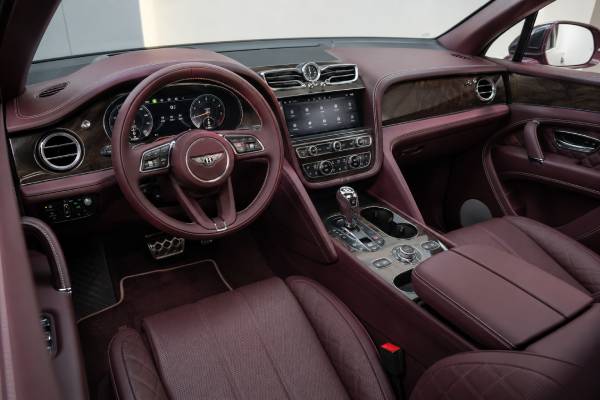
The 2021–2022 Bentley Bentayga Hybrid brought the original 443 bhp plug-in powertrain into the comprehensively redesigned Bentayga. Its 3.0-litre turbocharged V6, electric motor and 17.3 kWh battery still produce 700 Nm and up to 31 miles of NEDC electric range, but the surrounding vehicle changed substantially. The facelift added elliptical lighting, a new digital driver display, a 10.9-inch infotainment system, wireless Apple CarPlay, Android Auto and expanded connected services. Bentley also refined the way Hybrid Efficiency Navigation, the accelerator pressure point and regenerative braking communicate with the driver. A used example therefore has two identities to inspect: it is a high-voltage PHEV and a technology-rich facelift Bentayga. Battery state of health, onboard charging, brake blending and thermal management matter alongside screen performance, sensor calibration, air suspension and water integrity. This guide separates the 2021–2022 model from both the earlier body and the later 18.0 kWh, 456 bhp hybrid, then builds a practical ownership and buying process around verified specifications rather than optimistic range displays or incomplete advertisements.
Table of Contents
- Evolution Rather Than a New Powertrain
- Verified Hybrid, Battery, and Body Specifications
- Predictive Energy Control and Driver Feedback
- Charging Routine, Range Evidence, and Best Use Case
- Facelift Cabin, Chassis, and Brake Blending
- Maintaining a PHEV and a Luxury SUV Together
- Diagnostic Inspection and Purchase Decision
Evolution Rather Than a New Powertrain
Bentley announced the redesigned Bentayga Hybrid in January 2021. It was the third powertrain introduced in the facelifted family after the V8 and Speed. The change was visually obvious, but the underlying electrified system remained closely related to the first Bentayga Hybrid delivered from 2019.
The combined output stayed at 449 PS, or 443 bhp, with 700 Nm. The battery remained the 17.3 kWh generation and the official pure-electric capability was quoted as 31 miles under the older NEDC method. The major advances were design, cabin technology, connectivity and the integration of hybrid information into the new digital interfaces.
This distinction prevents a common listing error. Bentley introduced an 18.0 kWh battery and 462 PS, or 456 bhp, output in later derivatives including the Odyssean Edition. Those figures should not be applied to a normal 2021 or early 2022 443 bhp car without VIN-specific evidence.
The facelift changed every exterior panel at the front and rear. A more upright grille, raised elliptical headlamps and oval rear lamps created a closer family resemblance to the Continental GT. Inside, the older center screen and analog-heavy presentation gave way to a 10.9-inch touchscreen and a fully digital driver display with hybrid-specific graphics.
Bentley expected the Hybrid to become a major part of the range because owner-use data supported the concept. The company reported that most previous Bentayga Hybrid drivers used their vehicle daily or several times per week, nearly all used EV mode, and approximately half of their journeys were under 30 miles. That pattern explains the model better than a simple combined horsepower comparison.
A facelift Hybrid is most successful when it can begin routine journeys charged, complete much of the urban portion electrically and retain the V6 for longer travel. It is less compelling when parked without charging access, because the owner carries the mass and complexity of a PHEV while using it like a conventional petrol SUV.
Verified Hybrid, Battery, and Body Specifications
Specifications should be matched to the exact homologation market. Electric range and consumption figures can differ because NEDC and WLTP methods are not directly interchangeable. The following data identifies the core 443 bhp facelift system.
| Specification | Factory information |
|---|---|
| Petrol engine | 3.0-litre twin-scroll turbocharged V6 |
| Electric machine | Single E Motor integrated with the transmission |
| Combined power | 449 PS / 443 bhp / 330 kW |
| Combined torque | 700 Nm (516 lb-ft) |
| Transmission | Eight-speed automatic |
| Drive | Permanent all-wheel drive |
| Measure | Published figure | Buyer note |
|---|---|---|
| Battery capacity | 17.3 kWh | Do not substitute the later 18.0 kWh figure |
| Maximum AC charging | Up to 7.2 kW | With compatible AC equipment |
| Full charge time | 2.5 hours | Using a suitable 7.2 kW source |
| DC fast charging | Not provided | AC charging only |
| Pure-electric range | Up to 31 miles (50 km) | NEDC published capability |
| Total combined range | Up to 536 miles (862 km) | NEDC published capability |
| Measure | Figure |
|---|---|
| 0–60 mph | 5.2 seconds |
| 0–100 km/h | 5.5 seconds |
| Top speed | 254 km/h (158 mph) |
| Fuel tank | 75 litres (19.8 US gal) |
| Feature | Application |
|---|---|
| Central display | 10.9-inch high-resolution touchscreen |
| Driver display | Digital panel with EV power demand and engine-speed information |
| Apple CarPlay | Wireless capability introduced in the new range |
| Android Auto | Introduced to Bentley with the redesigned range |
| Connected services | Embedded SIM with hybrid-specific My Bentley content |
| Navigation | Hybrid Efficiency Navigation uses route data to manage energy |
| Item | Description |
|---|---|
| Suspension | Adaptive self-levelling air suspension |
| Active roll control | Optional Bentley Dynamic Ride 48-volt system |
| Seating layouts | Four- and five-seat factory arrangements |
| Rear comfort | Revised rear seats with increased recline and knee room |
| Charge inlet | Vehicle-side AC inlet with regional connector standard |
| Brake system | Regenerative deceleration blended with conventional hydraulic braking |
PHEV fuel figures are particularly sensitive to test assumptions. A car that starts every short trip with a full battery can show very low petrol use. The same vehicle driven long distances without charging will consume fuel like a heavy petrol SUV. Compare usage patterns, not just dashboard averages.
Predictive Energy Control and Driver Feedback
The Hybrid offers three selectable E Modes: EV Drive, Hybrid Mode and Hold Mode. These labels describe priorities rather than absolute guarantees. Battery temperature, charge level, cabin demand and requested acceleration can cause the V6 to start even when EV Drive was selected.
EV Drive is intended for short journeys and urban operation. The accelerator includes a pressure point that marks the approximate boundary of electric capability. Staying before that point encourages the car to remain electric; pushing through it requests stronger combined performance. Bentley allowed the feedback to be disabled, so its absence does not always indicate a fault.
Hybrid Mode allows the vehicle to blend both energy sources. With a destination entered, Hybrid Efficiency Navigation can use route information, traffic and road type to decide where electricity is most valuable. The objective is often to arrive with the battery appropriately depleted rather than to consume all charge in the first miles.
Hold Mode preserves charge for later. It is useful when a journey begins on a motorway and ends in a city center. It should not be misunderstood as free charging. Maintaining battery state through the engine still requires fuel, and plugging into the grid is normally the more efficient way to replenish energy.
The digital driver display replaces the conventional tachometer emphasis with hybrid information. When the engine is off, the dial can show electric power demand and regeneration. When the V6 starts, engine speed becomes relevant again. During inspection, check that the display changes logically and does not freeze or show contradictory state information.
Regenerative braking is adaptive. Navigation and sensor information can influence how strongly the car decelerates when the driver lifts off. That behavior may change by route and mode, so a single coast-down is not enough to judge it. The braking pedal should still feel predictable and linear.
A full battery can limit regeneration because there is little capacity to accept energy. Cold battery conditions can do the same. If the car relies more heavily on friction brakes at the beginning of a test, repeat the assessment later with a lower state of charge before diagnosing a fault.
The most useful ownership habit is to program destinations, even on familiar journeys. Doing so gives the energy manager information it cannot infer from direction alone. Owners who ignore navigation may never experience the system at its best.
Charging Routine, Range Evidence, and Best Use Case
This Bentayga charges through AC power. It does not have the DC fast-charging capability expected on many modern battery-electric vehicles. The practical routine is therefore overnight or workplace charging rather than brief motorway stops.
A 7.2 kW wallbox can complete a charge in roughly 2.5 hours under suitable conditions. Lower-power household supplies take longer. The cable, wall unit, vehicle inlet and onboard charger all form part of the system; a successful connection light alone does not prove that energy is flowing correctly.
During a pre-purchase test, begin at a recorded state of charge and use a known-good charging source. Confirm that the car locks the connector, accepts the expected power, displays a plausible completion time and reaches the selected charge target without interruption. Test scheduled charging if the owner intends to use off-peak electricity.
Inspect the inlet pins for discoloration, corrosion or damage. Check the door, weather seal and lock. Charging cables should be correctly rated, dry and free from cuts or heat marks. Verify that all promised regional adapters and storage bags are present.
Displayed range is an estimate based partly on recent driving and conditions. A car may show a low number after fast winter journeys even with a healthy battery. Conversely, a carefully reset display can show an attractive estimate that falls rapidly in use. The stronger evidence is usable energy measured through diagnostics and a repeatable route test.
Temperature, speed, heating, air conditioning, elevation and tire pressure all influence electric distance. Cabin heating can be especially significant in cold weather. Pre-conditioning while connected may reduce the initial energy demand, but available app and timer functions depend on market support.
Battery degradation is not judged by age alone. Request a high-voltage diagnostic report showing state of health, cell balance, fault history and thermal data. A pack with even cell behavior may be more reassuring than a low-mileage pack that has spent long periods at an extreme state of charge.
Regular plug-in use is desirable because it proves the owner engaged with the system, but it is not a complete condition test. Ask how and where the car was charged, whether interruptions occurred, and whether the wallbox or onboard charger has ever been repaired.
The best use case is a driver with a private charging point and daily journeys within much of the electric range, plus occasional long trips. The V6 then removes range anxiety while the motor covers quiet local travel. A driver who parks on the street and cannot charge will experience extra mass without the main benefit.
Electricity cost should be calculated from actual tariff and charging losses, not simply battery capacity multiplied by an advertised rate. Petrol cost should be calculated for the portion of annual travel beyond electric capability. This produces a more honest running-cost estimate than a homologation consumption number.
Facelift Cabin, Chassis, and Brake Blending
The redesigned cabin makes the 2021–2022 Hybrid feel newer than the earlier version even though output is unchanged. The 10.9-inch display integrates navigation, media, climate and vehicle functions. It should boot quickly, respond at every edge and retain settings after shutdown.
Pair both an Apple and Android phone when possible. Test calls, audio streaming, cable ports and wireless connection. Connected services can be affected by subscriptions and network changes, so distinguish discontinued remote functionality from a defective communication module.
The digital driver cluster should display charging, energy flow and mode transitions without pixel defects or rebooting. Check the head-up display where fitted. Hybrid route information, street names and distance data may be projected depending on settings and market.
New seat structures increased rear comfort. A five-seat car can offer more recline and optional ventilation, while a four-seat layout gives individual rear chairs and a center console. Test every motor, massage function, heater, ventilator and rear control. Battery packaging can affect luggage arrangements, so compare practicality with the owner’s needs.
Air suspension remains essential to refinement. The car should rise and lower evenly, hold height after parking and avoid constant compressor operation. Additional PHEV mass places high demand on dampers, bushings and tires. Inspect inner shoulders and compare all four tire circumferences.
Brake blending deserves a dedicated road-test sequence. At low speed, make several gentle stops and feel for a smooth transition as regeneration gives way to friction braking. Then perform safe, firmer stops to assess disc condition and straight-line stability. A pulsing pedal can come from corroded or distorted discs rather than hybrid software.
PHEVs may use friction brakes less often, allowing rust to build on the discs. Inspect both faces. Regular safe applications help keep the surfaces clean, but severe corrosion requires replacement. Brake fluid remains time-sensitive regardless of regenerative use.
The Hybrid’s steering and body control should feel consistent with a luxury SUV, not loose or floaty. Dynamic Ride, if fitted, uses a 48-volt system to control roll. It is separate from the traction battery and the 12-volt network, so a diagnostic scan may need to assess three electrical domains.
Maintaining a PHEV and a Luxury SUV Together
The maintenance mistake most likely with a PHEV is focusing on one half of the vehicle. The V6 still needs oil, filters, ignition service and a healthy fuel system, while the high-voltage side needs trained inspection, charging verification and thermal-management care.
Use only personnel qualified to work around high voltage. Orange cables, battery isolation and coolant loops have specific safety procedures. An ordinary workshop must not probe or disconnect components without the required training and protective equipment.
The 12-volt battery initiates control modules and high-voltage contactors. Weak low-voltage capacity can prevent the traction system from becoming ready and can produce many unrelated warning messages. Test it under load, record its age and use a compatible maintainer during storage.
Engine oil ages even when the V6 runs less often. Short electric journeys can be followed by brief cold engine starts when power or heat is requested, which may not allow moisture to evaporate. Annual time-based service and periodic fully warmed operation are sensible.
Fuel can also remain in the tank longer than in a conventional SUV. Use suitable fresh fuel, avoid storing the car indefinitely with an unknown mixture and follow Bentley guidance. A PHEV that never runs its engine is not maintenance-free.
The vehicle has multiple cooling needs. The engine, power electronics, electric motor and battery must remain within their operating windows. Inspect levels and leak evidence, confirm the correct coolant specification and investigate repeated top-ups. Color alone is not a reliable identifier.
Charging software and vehicle software should have applicable campaigns completed. Updates can address communication, energy display and control behavior. Keep invoices or dealer printouts that identify what was installed rather than accepting a vague statement that the software is “current.”
The eight-speed transmission integrates the electric motor into the driveline. It should engage smoothly, blend engine start without a harsh shock and shift consistently after warm-up. A symptom may involve mounts, software, clutch control or mechanical wear, so diagnosis requires the hybrid-capable scan tool.
Inspect air suspension, wheel alignment, panoramic-roof drains and underbody protection just as carefully as on a petrol Bentayga. The battery does not eliminate ordinary SUV vulnerabilities. Water in a luggage compartment or damaged undertray can be as consequential as a charging fault.
Keep a charging log for the first months of ownership. Note energy accepted, temperature, displayed range and interruptions. Trends can reveal deterioration or external wallbox problems before the car becomes unusable.
Diagnostic Inspection and Purchase Decision
Identify the model first. The VIN and build record should confirm a 443 bhp facelift Hybrid with the 17.3 kWh battery. Do not rely on an advertisement that calls every 2022-registered car the later 456 bhp version.
Ask the seller not to charge or warm the car immediately before inspection unless the test plan specifically requires it. Record ambient temperature, battery state of charge and displayed range. A cold start can reveal 12-volt weakness, engine noise and readiness faults.
Scan all modules before clearing anything. Obtain high-voltage battery state of health, cell-voltage spread, charging faults and isolation data, then review engine, transmission, brake, air-suspension, infotainment and driver-assistance modules. Codes marked intermittent still need context.
Complete a controlled charge. Use a reliable AC source, inspect the inlet and cable, and confirm energy transfer. If possible, compare the wallbox’s measured energy with the vehicle’s change in state of charge. Large unexplained differences can indicate losses, temperature conditioning or a reporting issue that deserves investigation.
Drive first in EV mode with moderate climate demand. Observe accelerator feedback, smooth torque delivery and range decline. Then request stronger acceleration so the V6 starts. The transition should be prompt but refined. Test Hybrid and Hold modes and enter a navigation destination to exercise predictive logic.
Evaluate brake blending at several speeds. Note whether behavior changes with battery state. Check that the car tracks straight and that no steering vibration develops. After the drive, inspect disc temperature carefully without touching hot components; a large side-to-side difference may reveal a dragging brake.
Test the facelift technology comprehensively. Pair phones, operate the digital display, cameras, navigation, climate, seats, tailgate and all fitted assistance systems. Confirm both keys. Check subscriptions and remote services separately because account transfer may be required.
Inspect the body for accident repair around headlamps, rear lamps and sensor areas. Look beneath the vehicle for battery-shield damage or evidence of improper lifting. Examine charging-port paint and hinge condition because repeated cable use can leave clues to care.
Review the high-voltage battery warranty terms for the specific country, original sale date and mileage. Transferability, duration and capacity conditions can vary. Written confirmation is more useful than a seller’s general claim about “an eight-year hybrid warranty.”
Budget for tires, conventional servicing and electronic repairs as well as battery risk. The powertrain may reduce petrol use, but it does not make Bentley suspension, trim or infotainment inexpensive. Obtain insurance and specialist-service quotes before purchase.
A strong example will have regular charging history, annual engine service, stable battery diagnostics, complete cables and no unresolved electronic warnings. It should make the transition between electricity and petrol feel almost uneventful. That smooth integration—not an inflated range estimate—is the clearest sign that the 2021–2022 Bentayga Hybrid is delivering the experience Bentley intended.
A Repeatable Diagnostic Drive
Begin the test with a meaningful battery charge and a cold engine. Drive first in EV mode, add cabin heating or cooling, then request enough power to start the V6 and note whether the transition is smooth. Repeat the process after the drivetrain is warm, test regenerative braking at different speeds and finish with an AC charging session. Scan every relevant control unit before clearing faults. This sequence separates normal PHEV changes from recurring charging, isolation, cooling or communication problems and produces evidence that can be compared after repairs.
References
- Bentley News 2021 : BRINGING SERENITY TO THE CITY AND BEYOND – THE NEW BENTAYGA HYBRID 2021
- BENTAYGA 2021
- New Bentley Bentayga, The Definitive Luxury SUV | Bentley Media 2020
- Bentley News 2019: DELIVERIES OF THE BENTAYGA HYBRID COMMENCES 2019
- Bentley Bentayga | History and Heritage | Bentley Motors 2026
- BENTLEY NEWSROOM : Technical Specifications 2026
Disclaimer
This PHEV article is for informational purposes, not a substitute for professional diagnosis or repair of high-voltage or mechanical systems. Battery data, charging equipment, torque values, service intervals and procedures vary by VIN and market; verify the fitted equipment in official service documentation. Please share the guide on Facebook, X/Twitter or another social platform if it was helpful.