
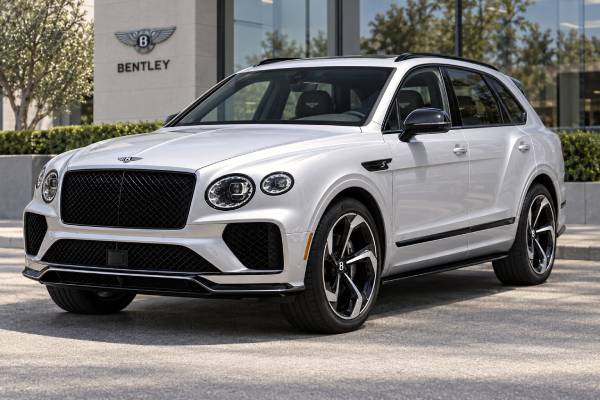
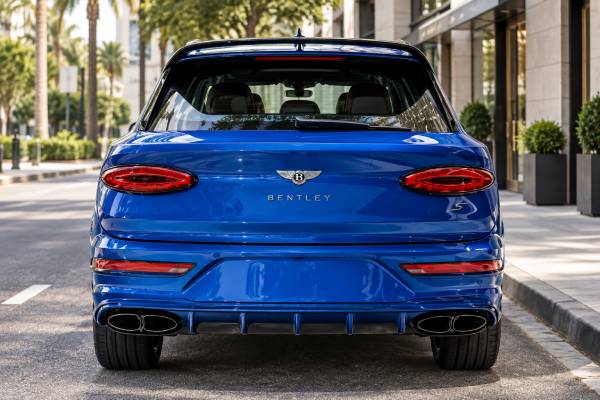
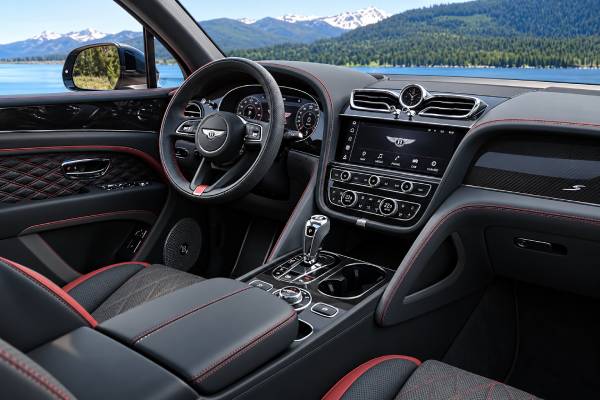
The 2021–2025 Bentley Bentayga S is the sport-focused V8 model for buyers who want a more expressive chassis and design without stepping up to the W12 Speed. It uses the same 542 bhp, 4.0-liter twin-turbo V8 found in the regular Bentayga, but adds standard Bentley Dynamic Ride, a firmer Sport calibration, a freer-flowing exhaust, Blackline exterior treatment, model-specific 22-inch wheels, and a more athletic cabin theme. Later cars also gained standard rear-wheel steering.
That positioning makes the S attractive on the used market: its performance is close to the regular V8 in a straight line, yet its steering response, body control, sound, and appearance feel more deliberate. It is not automatically the better choice for every owner. The firmer setup, large wheels, active chassis hardware, and electronic equipment increase inspection and maintenance demands. Buyers should also separate the V8 S from the S Hybrid and S Black Edition, which share styling ideas but use different powertrains or trim packages. This guide explains the exact V8 model, its year-to-year development, technical specifications, service priorities, and the checks that matter before purchase.
Table of Contents
- Why the Bentayga S Exists
- V8 S Specifications and Equipment
- Chassis Evolution from 2021 to 2025
- Daily Driving, Comfort, and Practicality
- Service Priorities and Common Cost Areas
- How to Assess a Used Bentayga S
- S Versus Other Bentayga Versions
Why the Bentayga S Exists
The Bentayga S turns the standard V8 into a more driver-focused package rather than increasing engine output. Bentley launched it in 2021 with a 15 percent increase in damping stiffness for Sport mode, a more permissive stability-control calibration, a sports exhaust, and standard 48-volt active anti-roll control.
The exterior treatment was equally important. Blackline Specification replaced most bright metal with gloss-black trim, while dark-tinted lamps, black mirrors, enlarged rear spoiler, black lower bodywork, model-specific S badging, and 22-inch wheels gave the car a more assertive identity. Inside, Bentley used a distinctive color split, Dinamica or Alcantara-type material in high-contact areas, S graphics, illuminated treadplates, and model-specific embroidery.
The S should not be described as a detuned Speed. During most of this period, the Speed used the 626 bhp W12 and offered substantially more power and maximum speed. The S instead occupied the middle ground between the comfort-oriented V8 and the flagship. Its appeal was responsiveness and visual character at speeds owners could use more often.
The range became more complicated after 2022. Bentley introduced an S Hybrid with the 456 bhp plug-in-hybrid system, and in 2024 added the S Black Edition in both V8 and hybrid forms. The Black Edition included additional black badging and vivid accent-color treatments. A standard S in a dark color with black trim is not automatically a Black Edition.
Equipment varies considerably because Bentley’s options list is broad. Touring Specification, Naim audio, carbon-fiber trim, four- or seven-seat layouts, tow equipment, carbon-ceramic brakes, rear entertainment, and Mulliner color choices can all change desirability. Always compare the actual factory build sheet rather than relying on a generic S equipment list.
V8 S Specifications and Equipment
The V8 S is a conventional gasoline vehicle with no traction battery or charging port. Its 3,996 cc twin-turbo V8, eight-speed automatic, and permanent all-wheel drive are shared with other V8 Bentaygas, while the S-specific value lies in chassis tuning and standard equipment.
| Specification | Value | Notes |
|---|---|---|
| Engine | 3,996 cc twin-turbocharged V8 | Gasoline, front-mounted |
| Maximum power | 550 PS / 404 kW / 542 bhp at 6,000 rpm | Same output as the regular V8 |
| Maximum torque | 770 Nm (568 lb-ft) at 2,000–4,500 rpm | Broad low- and mid-range plateau |
| Transmission | 8-speed automatic | Torque-converter type |
| Drivetrain | Permanent all-wheel drive | Torsen center differential |
| Efficiency systems | Cylinder deactivation and start-stop | Four cylinders can shut down at light load |
| Fuel tank | 85 L (22.45 US gal) | Premium gasoline |
| Measure | Value | Condition |
|---|---|---|
| 0–60 mph | 4.4 seconds | Manufacturer figure |
| 0–100 km/h | 4.5 seconds | Manufacturer figure |
| Maximum speed | 290 km/h (180 mph) | Approved tires required |
| Braked towing capacity | 3,500 kg (7,716 lb) | Where approved and tow-equipped |
| Maximum wading depth | 500 mm (19.7 in) | Manufacturer capability figure |
| Rated driving range | About 654 km (406 mi) | WLTP reference |
| Specification | Approximate value | Notes |
|---|---|---|
| Body | Five-door standard-wheelbase SUV | Four-, five-, or seven-seat layouts may be found |
| Overall length | 5,125 mm (201.8 in) | Facelift Bentayga body |
| Wheelbase | 2,995 mm (117.9 in) | Standard wheelbase |
| Width across mirrors | 2,222 mm (87.5 in) | Important for garage access |
| Overall height | About 1,728 mm (68.0 in) | Published measurement depends on ride height |
| Unladen weight | Approximately 2,410–2,440 kg (5,313–5,379 lb) | Options and regional definition vary |
| Boot volume | Approximately 484 L (17.1 cu ft) | Seat layout and measurement method matter |
| Area | Configuration |
|---|---|
| Suspension | Adaptive air suspension with S Sport calibration |
| Sport damping | Approximately 15 percent stiffer than the regular setup in Sport |
| Active roll control | Bentley Dynamic Ride 48-volt system fitted as standard |
| Rear-wheel steering | Standard on later model years; up to about ±4.8 degrees |
| Exhaust | Free-flowing S sports exhaust with black split-oval outlets |
| Wheels | 22-inch S directional design in several finishes |
| Exterior trim | Blackline brightware, dark-tint lamps, larger spoiler, S badging |
| Measure | Typical figure | Standard |
|---|---|---|
| Combined fuel consumption | About 13.0 L/100 km (21.7 mpg UK) | WLTP |
| Combined CO₂ | About 294–296 g/km | WLTP, model year dependent |
| Real-world urban use | Often substantially higher | Traffic, temperature, and driving style dependent |
The S’s official fuel figures are close to the regular V8 because the engine output is unchanged. In practice, its sound and sharper calibration may encourage more throttle use, while 22-inch tires and urban short trips can increase consumption. The model remains a heavy, high-output luxury SUV, not an economy derivative.
Chassis Evolution from 2021 to 2025
The core S formula stayed consistent, but the later cars gained meaningful chassis and technology updates. The most important change was the expansion of electronic rear-wheel steering to the standard-wheelbase range.
At low and medium speeds below roughly 37 mph, the rear wheels steer opposite the fronts. This reduces the turning circle by about one meter and helps the Bentayga rotate into tight spaces. Above that transition speed, the rear wheels steer in the same direction as the fronts, improving stability during lane changes and fast bends. Bentley made the system standard on S and Azure models for later production, while it was not part of the original 2021 launch specification.
A used-car advertisement may therefore claim “all-wheel steering” based on a current model description even when the early car does not have it. Confirm through the build sheet and physical inspection. Rear-wheel steering adds real value in urban use, but also requires correct alignment and calibration. Unusual rear-tire wear, an off-center steering wheel, or a chassis warning should be investigated by a Bentley-capable workshop.
Bentley Dynamic Ride was standard from the beginning. The 48-volt system uses electric actuators in the anti-roll bars to resist body lean when cornering while allowing more wheel independence over uneven roads. In the S, the stronger damping in Sport gives the system a firmer platform. Comfort and Bentley modes retain the broader ride quality expected from the brand.
Later updates also brought changes to driver assistance, infotainment functions, air-quality management, seat-comfort technology, and option availability. These features can vary by market and production date, and some connected services depend on regional network support. A newer car is not automatically better if its expensive options do not work or its service history is weaker.
The S’s torque-vectoring-by-brake calibration was also refined in later versions. By lightly braking an inside wheel at corner entry, the system can help the front axle turn more sharply. It is not a mechanical limited-slip differential, and its operation depends on brake condition, sensors, software, and stability-control logic.
Daily Driving, Comfort, and Practicality
The Bentayga S remains comfortable enough for long-distance use, but its character is busier and more audible than an Azure or softly specified V8. Buyers should test the exact wheel, tire, seat, and suspension combination on roads similar to those they use every day.
In Comfort mode, the air suspension isolates most surface imperfections and the V8 remains quiet at light load. In Sport, throttle response sharpens, the gearbox holds ratios longer, the exhaust becomes more noticeable, and body movement is controlled more tightly. The difference should be clear without introducing harsh knocks, repeated bouncing, or steering vibration.
The 770 Nm torque plateau makes everyday acceleration effortless. The transmission can stay in a high gear and still provide strong passing performance. A healthy car should pull cleanly without hesitation, flare, or driveline thump. Any roughness during low-speed maneuvering deserves diagnosis because the system should feel polished even when cold.
The cabin is spacious by performance-SUV standards. Five-seat cars provide the broadest everyday flexibility, seven-seat examples suit occasional extra passengers, and four-seat configurations emphasize rear comfort. Verify that the seating layout suits the owner’s real use; changing it later is neither simple nor economical.
The S’s black trim and Dinamica-rich interior hide some marks better than pale Azure cabins, but high-contact material can still polish, flatten, or stain. Inspect the steering wheel, seat bolsters, door pulls, center console, and dark gloss surfaces under direct light. Gloss-black exterior trim also shows wash scratches and water spotting.
Towing capacity remains 3.5 tonnes where approved. A factory retractable towbar is convenient, but it should be tested electrically and checked for corrosion or impact. Cars used to tow heavy trailers require particular attention to brakes, cooling, tires, transmission behavior, and rear suspension condition.
The S can handle snow, gravel, wet fields, and rough access roads, but its 22-inch wheels and low-profile tires are vulnerable. Examine lower bumpers, side sills, undertrays, jacking points, and inner wheel barrels for off-road or curb damage.
Service Priorities and Common Cost Areas
Preventive maintenance is the least expensive way to own a Bentayga S. The engine itself is widely used within the Volkswagen Group, but Bentley calibration, packaging, chassis systems, trim, and diagnostic requirements make generic assumptions risky.
Follow the VIN-specific schedule for oil, filters, brake fluid, spark plugs, cooling-system checks, and other time- or mileage-based work. Ask for itemized invoices rather than relying on service-book stamps. Low mileage does not cancel annual or time-based requirements.
Key areas include:
- V8 oil and cooling system: Inspect for seepage, coolant residue, odor after a drive, and evidence of overheating. Turbocharged engines generate substantial heat, especially after short hard use.
- Air suspension: The car should sit level after standing, change height evenly, and avoid excessive compressor operation. Faults may involve air springs, dampers, lines, valve blocks, sensors, or control modules.
- Bentley Dynamic Ride: A 48-volt fault requires trained diagnosis. Do not accept a proposal to replace conventional suspension parts without a complete scan and test plan.
- Rear-wheel steering: Later cars need correct four-wheel alignment and calibration. Inner-edge tire wear can be an early clue to geometry or component issues.
- Brakes: The vehicle’s mass and speed make disc and pad condition important. Optional carbon-ceramic brakes require specialist inspection and can transform the purchase economics.
- Tires: Use matching, Bentley-approved load and speed ratings. Check date codes, inner shoulders, repairs, and signs of flat spotting.
- 12-volt battery: Weak voltage can generate multiple unrelated warnings. Cars stored for long periods need the approved maintainer and correct battery replacement procedure.
- Electronics and comfort equipment: Test cameras, radar functions, seat motors, climate zones, audio, screens, power tailgate, blinds, and every key.
A full diagnostic scan should be performed before codes are cleared. Stored communication, low-voltage, suspension, steering, misfire, or driver-assistance faults can reveal patterns that are invisible during a short viewing.
Software updates and service campaigns should be checked by VIN. Campaign applicability can depend on production date and equipment. A seller’s statement that “all Bentaygas had that fixed” is not enough.
How to Assess a Used Bentayga S
A strong used S has coherent provenance, matching premium tires, no unexplained chassis warnings, clean body repairs, and fully functioning luxury equipment. Use a methodical inspection so its styling does not distract from mechanical condition.
Start with a cold engine. Confirm that warning lights perform their normal self-check, the idle settles smoothly, and there is no persistent smoke, fuel smell, coolant odor, or abnormal noise. Then operate every ride-height and drive-mode setting on level ground.
Inspect the body in natural light. Blackline trim can conceal refinishing differences, while large dark wheels often hide inner-barrel damage. Use paint-depth readings across the vehicle and check panel gaps, lamp mounts, bumper brackets, undertrays, and lower sills.
During the road test, include:
- Full-lock parking maneuvers in both directions.
- Rough urban pavement in Comfort and Bentley modes.
- A smooth road in Sport mode to feel the damping change.
- Steady-speed cruising to identify wheel or tire vibration.
- Several safe brake applications to test straight-line stability.
- Moderate acceleration once the engine is fully warm.
The steering should center naturally and the car should track straight. A later rear-steer model should feel unusually maneuverable for its size, not nervous. Knocks, a lateral step over bumps, or inconsistent steering assistance require inspection.
Check the exact options against the build sheet. Naim audio, Touring Specification, carbon trim, rear entertainment, special paint, seat layout, towbar, and carbon-ceramic brakes all influence value. Missing or nonfunctional expensive options should be priced realistically.
Ask for estimates for tires, brakes, scheduled service, alignment, battery, cosmetic work, and any diagnostic findings before negotiation. A discounted car can become the more expensive choice within its first year.
S Versus Other Bentayga Versions
Choose the S when its chassis character, exhaust sound, and darker styling are priorities. Choose another Bentayga when rear-seat comfort, plug-in capability, maximum performance, or a softer ride matters more.
The regular V8 has the same 542 bhp and nearly identical acceleration. It may ride more gently, cost less, and be easier to find in understated specifications. The S justifies its premium through standard Dynamic Ride, sport calibration, exhaust, wheels, and design—not through extra power.
The Azure V8 uses the same engine but focuses on wellbeing, bright exterior detailing, touring assistance, and comfort. It suits owners who spend more time cruising or carrying rear passengers. The EWB Azure goes further with a longer wheelbase and limousine-like rear cabin.
The S Hybrid adds plug-in electric capability and 456 bhp combined output. It is quieter in EV operation and may suit short urban journeys, but it is heavier, slower, and adds high-voltage battery and charging considerations. Its luggage and seating choices can also differ.
The W12 Speed offers 626 bhp and a 306 km/h top speed, plus the historic appeal of Bentley’s twelve-cylinder engine. It carries higher fuel, service, and front-end weight costs. The later high-output V8 Speed is a different generation of performance flagship and should not be confused with the 2021–2025 S.
The S Black Edition is primarily a more dramatic visual and trim package built on the S formula. It makes sense for buyers who specifically value its black wings, accent colors, and rarity. A well-specified ordinary S may be the better used purchase when its condition and color combination are stronger.
For most owners, the S is the range’s balanced driver choice: faster than needed, more engaging than the base V8, and still capable of long-distance luxury. Its best examples are those maintained as complex performance vehicles rather than treated as ordinary SUVs with expensive badges.
Planning the First Year of Ownership
A sensible first-year budget should cover more than the purchase price. Begin with an independent inspection, then reserve funds for a full baseline service unless invoices prove that it was completed recently. Confirm the age and specification of the battery, measure all four tires, inspect brake wear, and test every powered seat, camera, driver-assistance function, and infotainment feature. A single neglected consumable can turn an apparently attractive example into the more expensive car.
Insurance quotations should be obtained against the exact registration or VIN because wheel size, carbon trim, assistance systems, and declared options can materially affect repair costs. Owners who live far from a Bentley retailer should also identify a qualified independent workshop before buying. The S is not unusually fragile for its class, but its 48-volt anti-roll system, air suspension, active chassis electronics, and tightly packaged V8 reward diagnostic familiarity and correct service equipment.
Storage conditions matter as well. A maintained battery tender is useful when the vehicle sits for extended periods, while regular drives should be long enough to warm the oil, brakes, exhaust, and transmission fully. Keep drainage channels clear, avoid leaving the air suspension at an extreme height for prolonged storage, and record software updates or campaign work in the history file. Owners using the Bentayga S for towing or repeated mountain driving should shorten inspection intervals for tires, brakes, cooling components, and underbody protection.
Finally, preserve evidence. Retain alignment sheets, tire invoices, service reports, recall confirmations, and photographs of any cosmetic repair. Detailed documentation supports troubleshooting during ownership and distinguishes a carefully managed S when it is time to sell. On a vehicle whose value can vary sharply with condition and provenance, disciplined records are a practical asset rather than paperwork for its own sake.
References
- BENTLEY NEWSROOM : Bentayga S 2026
- THE BENTAYGA RANGE 2021 (Brochure)
- New Bentley Bentayga, The Definitive Luxury SUV | Bentley Media 2020
- Bentley News 2023 : NEW FEATURES FURTHER INCREASE DESIRABILITY OF BENTAYGA RANGE 2023
- BENTAYGA RANGE 2023 (Brochure)
- Bentley Bentayga | History and Heritage | Bentley Motors 2026
Disclaimer
This article is for informational purposes and is not a substitute for professional diagnosis or repair. Specifications, torque values, service intervals, campaign eligibility, and procedures vary by VIN, market, production date, and equipment. Verify all work against the official Bentley service information for the exact vehicle.
Please share this guide on Facebook, X/Twitter, or your preferred enthusiast forum if it helped you evaluate the Bentley Bentayga S.