
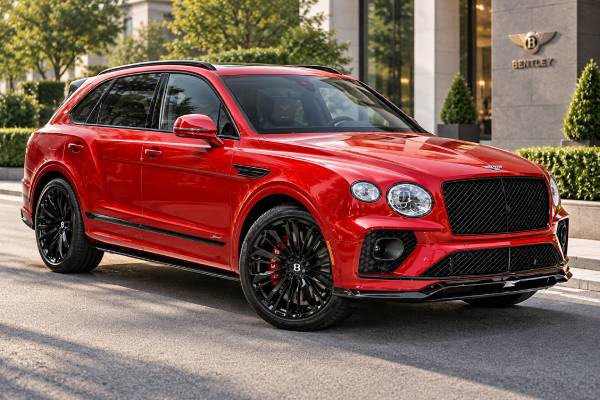
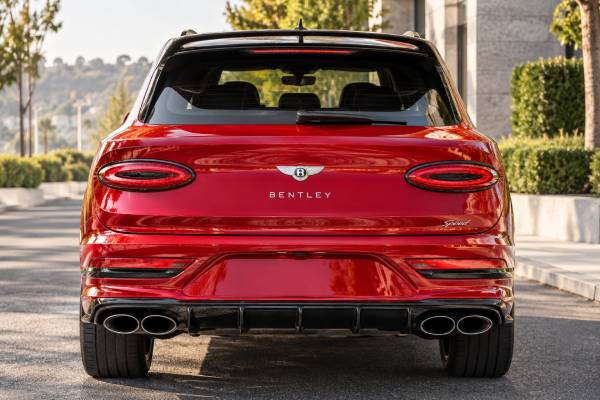
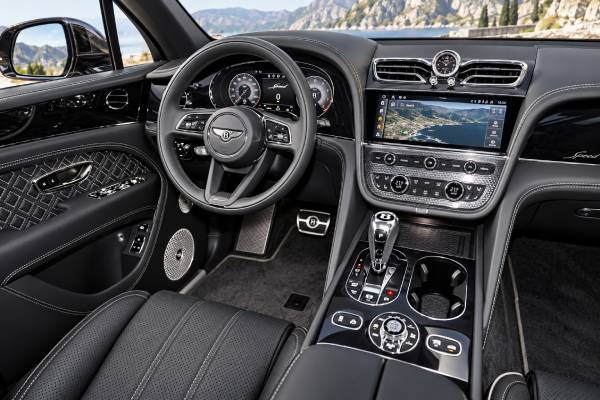
The Bentley Bentayga Speed Edition 12 is a limited-run farewell to the 6.0-liter W12, not a more powerful Bentayga Speed. It retains the regular W12 Speed’s 626 bhp, 900 Nm, eight-speed automatic, all-wheel drive, and 190 mph capability, then adds a carefully defined set of exterior, interior, and presentation details celebrating Bentley’s twelve-cylinder era. Only 120 Bentayga examples were planned, making authenticity and completeness central to any purchase.
That scarcity does not reduce the need for a rigorous mechanical inspection. The Edition 12 is still a very heavy, very fast, highly complex luxury SUV with air suspension, a 48-volt active anti-roll system, expensive wheels and brakes, and densely packaged W12 hardware. A collector-grade car should be both cosmetically correct and mechanically ready to use. Buyers need to confirm the numbered engine plaque, Edition 12 trim, original build record, brake specification, accessories, and service history rather than relying on badges or a seller’s description. This guide explains what separates the Edition 12 from a normal Bentayga Speed and how to judge its condition, originality, and long-term ownership prospects.
Table of Contents
- What the Edition 12 Package Includes
- W12 Mechanical Specification and Performance
- Design Details and Authentication
- How to Judge Collector-Grade Condition
- Service, Storage, and W12 Preservation
- Buying Strategy, Value, and Ownership Fit
What the Edition 12 Package Includes
The Speed Edition 12 was created in 2023 to mark the end of Bentley W12 production. Bentley applied the package to the Bentayga Speed, Flying Spur Speed, Continental GT Speed, and Continental GTC Speed, with 120 examples planned for each model. The Bentayga version is therefore one of 120, rather than one of 120 cars shared across the entire four-model program.
Mechanically, the Bentayga remained a standard facelift-generation W12 Speed. The Edition 12’s significance lies in its factory design treatment and documentation. Bentley specified identifying details that should appear as a coherent package, including:
- Edition 12 exterior badging;
- a numbered plaque on the engine cover;
- Edition 12 seat embroidery;
- graduated contrast stitching across the seats;
- Grand Black veneer with the W12 firing sequence etched into the fascia;
- an inlaid Edition 12 emblem in the dashboard;
- silver brake calipers, described as unique to the Edition 12 program;
- Blackline exterior treatment;
- model-specific presentation and commemorative elements.
Opalite, a pale grey-green paint with a copper effect in bright light, was introduced as an optional color associated with the edition. It was not the only available finish, so an Edition 12 in another factory color can be genuine. Conversely, an Opalite Bentayga Speed is not automatically an Edition 12.
The numbered engine plaque is useful evidence, but the build sheet is decisive. A plaque, badge, or embroidered panel can be replaced. Ask a Bentley retailer to provide the VIN-specific factory specification and confirm that the car was built as a Bentayga Speed Edition 12. The VIN, engine plaque number, registration documents, service records, and sales invoice should form a consistent history.
Edition 12 production sat close to the end of the W12 era. Bentley announced the engine’s retirement in 2023 and completed the last hand-built W12 in Crewe in July 2024. Some Edition 12 cars may therefore be registered in a different calendar year from their build date. Treat “2023” and “2024” as model-period descriptors, then verify the exact production and first-registration dates for the individual vehicle.
W12 Mechanical Specification and Performance
The Edition 12 is a gasoline-only, standard-wheelbase Bentayga with the 5,950 cc twin-turbo W12. It does not receive the higher-output W12 tune used in certain other Bentley models; the Bentayga version remains at 635 PS, equivalent to 626 bhp.
| Specification | Value | Notes |
|---|---|---|
| Engine | 5,950 cc twin-turbocharged W12 | Gasoline, compact four-bank layout |
| Maximum power | 635 PS / 467 kW / 626 bhp | Same output as the regular Bentayga Speed |
| Maximum torque | 900 Nm (664 lb-ft) | Approximately 1,500–5,000 rpm |
| Transmission | 8-speed automatic | Torque-converter type |
| Drivetrain | Permanent all-wheel drive | Torsen center differential |
| Fuel-saving systems | Cylinder deactivation, start-stop, and coasting strategy | Active only under suitable conditions |
| Fuel tank | 85 L (22.45 US gal) | Premium gasoline |
| Measure | Value | Condition |
|---|---|---|
| 0–60 mph | 3.8 seconds | Manufacturer figure |
| 0–100 km/h | 3.9 seconds | Manufacturer figure |
| Maximum speed | 306 km/h (190 mph) | Requires approved high-speed tires |
| Braked towing capacity | 3,500 kg (7,716 lb) | Where approved and correctly equipped |
| Maximum wading depth | 500 mm (19.7 in) | Manufacturer capability figure |
| Specification | Approximate value | Notes |
|---|---|---|
| Overall length | About 5,125–5,144 mm (201.8–202.5 in) | Published values vary by technical document |
| Wheelbase | 2,995 mm (117.9 in) | Standard-wheelbase body |
| Width across mirrors | 2,222 mm (87.5 in) | Relevant for garage clearance |
| Overall height | About 1,728 mm (68.0 in) | Ride-height convention can change quoted value |
| Unladen weight | Approximately 2,500 kg (5,512 lb) | Definition and options affect the figure |
| Boot volume | Approximately 484 L (17.1 cu ft) | Measurement method and seating layout matter |
| System | Configuration |
|---|---|
| Suspension | Adaptive four-corner air suspension with Speed calibration |
| Active roll control | Bentley Dynamic Ride 48-volt electromechanical system |
| Steering | Electric power-assisted rack-and-pinion |
| Standard wheel diameter | 22 inches |
| Brake calipers | Edition 12 silver finish |
| Optional braking system | Carbon-ceramic discs, approximately 440 mm front and 370 mm rear |
| Drive modes | Comfort, Bentley, Sport, Custom, plus off-road modes where fitted |
| Measure | Reference value | Standard or condition |
|---|---|---|
| Combined fuel consumption | Approximately 14–15 L/100 km | WLTP range across relevant W12 configurations |
| Combined CO₂ | Approximately 320–340 g/km | WLTP, market and equipment dependent |
| Real urban use | Can be substantially higher | Short trips and idling are especially costly |
The W12’s behavior is defined by torque more than revs. The 900 Nm plateau gives immediate passing power, while the close integration of engine and eight-speed automatic allows the SUV to build speed without a dramatic or strained feel. The Edition 12 should perform exactly like a healthy regular Speed; any claim of additional factory horsepower requires documentary proof and is generally a sign of confusion or aftermarket tuning.
Design Details and Authentication
Authenticity depends on the whole factory package, not one visible emblem. The Edition 12 was designed as a coordinated tribute, so missing, altered, or poorly recreated details can have a disproportionate effect on confidence and value.
Begin in the engine bay. The numbered plaque should be present, correctly mounted, and consistent with the car’s documentation. Inspect it for tool marks, fresh fasteners, damage, or signs that the engine cover was replaced. The plaque number is not the VIN, and a low number should not command a premium without full provenance.
Inside, the Grand Black fascia should show the W12 firing sequence and the inlaid Edition 12 emblem. The seat embroidery and graduated contrast stitching should be crisp, symmetrical, and consistent with the build record. Look for replaced seat covers, color mismatch, stretched perforations, or stitching that does not align across panels. Bentley interiors are hand-finished, but obvious inconsistency can point to repair.
Silver brake calipers are another key identifier. Their condition matters because refinishing can erase or distort factory markings. Check for overspray on bleed screws, seals, pads, or mounting hardware. A tasteful professional refinish may be mechanically acceptable, yet it reduces originality unless the work reproduced the exact factory appearance and is fully documented.
Blackline treatment replaces bright exterior elements with darker finishes. Inspect the grille, window surrounds, badges, lower trim, and exhaust details for uniform gloss and correct fit. Wrapped or painted brightwork can mimic the look, so compare every item with the factory specification.
Opalite paint deserves careful inspection under natural light. Its copper effect can make panel mismatch easier to see at some angles and harder at others. Use a paint-depth gauge across the body and inspect the car in shade, direct sun, and workshop lighting. A repaired panel does not automatically disqualify the car, but the quality, location, reason, and documentation should be understood.
Original wheels, keys, handbooks, tire-inflation equipment, battery maintainer, and presentation material should be inventoried. Limited editions often lose small items when passing through dealers or storage facilities. Replacements may be difficult to source and may not carry the same provenance as the original set.
How to Judge Collector-Grade Condition
Collector-grade condition means more than low mileage and glossy paint. The strongest Edition 12 cars combine originality, correct storage, continuous servicing, complete accessories, and enough exercise to keep mechanical and electrical systems healthy.
Very low mileage can create its own problems. Tires age from time and environment, not only tread wear. Brake discs can corrode, seals can dry, fuel can degrade, and batteries can cycle deeply. A car repeatedly started for a few minutes without reaching full temperature may accumulate condensation and fuel dilution while appearing “preserved.”
Inspect the following areas closely:
- Paint protection film: Check edges, discoloration, trapped contamination, cut marks, and adhesive damage. Film can protect paint or hide previous repairs.
- Wheels and tires: Confirm factory wheel design, finish, date codes, load and speed ratings, matching tire model, and absence of flat spots.
- Brake system: Measure iron-disc wear or have carbon-ceramic discs assessed by a Bentley-experienced specialist. Inspect the unique silver caliper finish.
- Leather and stitching: Look for dye transfer, bolster collapse, sunscreen staining, loose piping, and repairs that disturb Edition 12 embroidery.
- Veneer: Strong reflections should remain even across the Grand Black fascia. Cracks, lifting, deep scratches, or a cloudy finish are difficult to correct invisibly.
- Lower body: Examine front splitters, sill extensions, rear diffuser, undertrays, and jacking points for contact damage.
- Electronics: Test every camera, sensor, screen, seat, blind, climate zone, audio channel, USB connection, and driver-assistance feature.
Mileage should be consistent across service invoices, inspection records, diagnostic data, and tire history. A car that has covered only a few hundred miles but received several sets of tires, repeated wheel repairs, or extensive brake work deserves explanation.
Storage history is worth asking about directly. A climate-controlled private garage with a suitable battery maintainer is ideal, but evidence matters more than claims. Look for corrosion on fasteners, damp odors, mold at hidden carpet edges, water marks in the luggage area, and low-voltage faults in the diagnostic history.
A collector may prefer factory paint and untouched trim, while a user may accept high-quality repairs or protective modifications. Decide which standard you are buying to before inspection. Paying collector-level money for a car with ordinary used-car provenance creates unnecessary risk.
Service, Storage, and W12 Preservation
The Edition 12 must be maintained as a W12 Bentayga first and a collectible second. Skipping time-based service to preserve mileage is false economy, because the engine, cooling system, suspension, brakes, and batteries continue to age while the odometer stands still.
Follow the VIN-specific Bentley schedule for the market. Records should show regular engine-oil service, brake-fluid replacement, filters, spark plugs when due, software and campaign work, and inspection of the cooling and driveline systems. A stamp without itemized invoices cannot show whether advisories were deferred.
A cold start should be part of every pre-purchase assessment. The engine should settle promptly, idle smoothly, and show no persistent misfire, smoke, fuel odor, or abnormal mechanical noise. Twelve cylinders mean more ignition and injection components, while the compact engine bay makes heat management and access important cost factors.
Watch for oil seepage and coolant residue from above and below. Check the expansion tank level only when safe, inspect hose connections, and review any history of overheating or fan warnings. A small leak near hot components can become a larger reliability or fire concern.
Battery care is critical. The car has extensive electronic systems plus the 48-volt architecture used by Bentley Dynamic Ride. A weak 12-volt battery can generate a confusing spread of warnings. Use the approved charging point and a compatible maintainer, and record battery replacements with the correct specification and coding.
The air suspension should maintain height after parking, move evenly through its settings, and operate without long compressor runs. Bentley Dynamic Ride faults require factory-level diagnostic equipment and trained procedures. Do not treat a 48-volt warning as an ordinary anti-roll-bar issue.
For storage, keep the fuel reasonably fresh, maintain tire pressures, avoid leaving the car on damp surfaces, and exercise it with proper full-temperature drives rather than brief idle sessions. A planned route that operates the brakes, transmission, suspension, climate system, and charging systems is better than repeatedly moving the car a few meters.
Owners should retain removed original parts when making reversible changes. A different exhaust, wheel set, tint, tracker, or protective film may suit use, but factory components and documentation help preserve future options. Avoid engine tuning if originality and long-term collectibility matter; it adds mechanical stress and complicates warranty, diagnostics, emissions compliance, and resale.
Buying Strategy, Value, and Ownership Fit
A sound Edition 12 purchase begins with factory verification and ends with a mechanical inspection that is independent of the seller. Rarity should increase scrutiny, not lower it.
Use this sequence:
- Confirm the VIN as a factory Bentayga Speed Edition 12 through Bentley.
- Obtain the original build sheet and compare every identifying feature.
- Review invoices, campaign status, warranty history, and ownership chronology.
- Inspect paint, trim, wheels, silver calipers, plaque, embroidery, and presentation items.
- Perform a complete diagnostic scan before faults are cleared.
- Measure tires and brakes and inspect the vehicle on a lift.
- Drive it from cold through full operating temperature on varied roads.
- Price all immediate work before agreeing on value.
The road test should feel smooth and unified. The W12 should pull cleanly, the transmission should engage without harshness, the brakes should stop straight, and the air suspension should control the body without knocking or bouncing. Steering vibration, drivetrain shunt, warning messages, or repeated electronic resets need explanations supported by diagnosis.
Valuation depends on more than production volume. Color, interior design, options, brake system, mileage, geography, tax treatment, service history, and originality all matter. Opalite may be strongly associated with the edition, but a compelling alternative factory color can be equally desirable. A carbon-ceramic car may command a premium when the discs are healthy and documented, or a discount when replacement is near.
Compare the Edition 12 with an ordinary W12 Speed before paying a large premium. The regular Speed offers the same performance and may be available in a preferred specification. The limited edition justifies extra money when its commemorative details, complete provenance, and scarcity are important to the buyer—not merely because the advertisement calls it rare.
The model suits an enthusiast-collector who wants to use the car occasionally, values Bentley’s W12 history, and can support specialist maintenance. It is less suitable for someone seeking low-cost daily transport, maximum rear-seat room, or an investment that must appreciate. Luxury vehicles remain exposed to market cycles, storage costs, taxes, and expensive age-related repairs.
A correctly preserved Bentayga Speed Edition 12 has a clear historical story: it is one of the final factory celebrations of an engine central to modern Bentley. That story is strongest when the car remains mechanically excellent, visibly authentic, and complete down to its documents and accessories. Buy the condition and history first; the limited-edition number then becomes a meaningful bonus rather than a distraction.
Insurance and transport planning deserve attention before purchase. Some insurers will require an agreed value, approved tracking equipment, mileage limits, named-driver restrictions, or secure overnight storage. Confirm whether a tracker has been installed by cutting factory wiring or disturbing trim; a professionally integrated system is preferable. Enclosed transport is sensible for long-distance delivery, but the carrier must understand the vehicle’s width, weight, low-profile tires, air-suspension settings, and towing restrictions.
Ask how the car was used during its first ownership. A delivery-mile collector car, a dealer demonstrator, and a regularly driven grand tourer can show the same odometer reading for very different reasons. Demonstrators may have repeated cold starts and many drivers. Collector cars may have long storage gaps. Regularly driven cars may show more cosmetic wear but better exercise. There is no universally superior pattern; the key is whether maintenance and condition match the use.
Future parts and trim availability should also influence care. Mechanical service parts will remain supportable, but unique Edition 12 embroidery, etched veneer, silver-caliper finishes, plaques, and presentation items are harder to replace without affecting originality. Repair small interior damage early, protect high-contact surfaces without permanently altering them, and document any factory-authorized replacement. Keep high-resolution photographs of the car, engine plaque, build sheet, accessories, and condition when acquired.
Finally, distinguish preservation from inactivity. The car was engineered to be driven at full operating temperature, use its suspension range, and exercise its braking and climate systems. A thoughtful low-mileage routine—long enough to warm the oil and transmission, varied enough to operate the chassis, and gentle until temperatures stabilize—does more for long-term condition than long-term static display interrupted by short idle periods.
References
- Bentley News 2023 : TRIBUTE TO AN ENGINEERING ICON: BENTLEY SPEED EDITION 12 2023
- The New Bentayga Speed is the Ultimate Luxury SUV | Bentley Media 2020
- BENTAYGA RANGE 2020 (Brochure)
- Bentley News 2023 : BENTLEY ANNOUNCES END TO 12-CYLINDER ENGINE PRODUCTION WITH THE MOST POWERFUL VERSION EVER 2023
- Bentley News 2024 : End of an era as final Bentley W12 engine hand-built in Crewe 2024
- Bentley Bentayga | History and Heritage | Bentley Motors 2026
Disclaimer
This article is for informational purposes and is not a substitute for professional diagnosis, authentication, valuation, or repair. Specifications, torque values, intervals, campaign eligibility, and procedures vary by VIN, market, production date, and equipment. Verify the exact vehicle against official Bentley service and build documentation.
Please share this guide on Facebook, X/Twitter, or a Bentley enthusiast community if it helped you assess the Bentayga Speed Edition 12.