
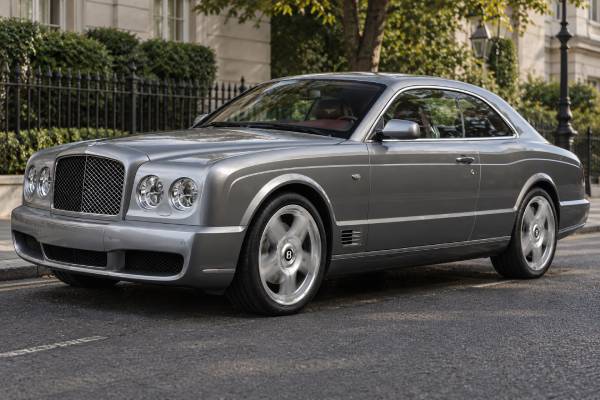
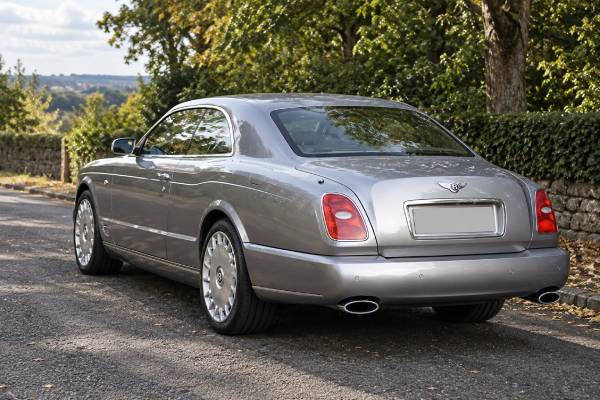
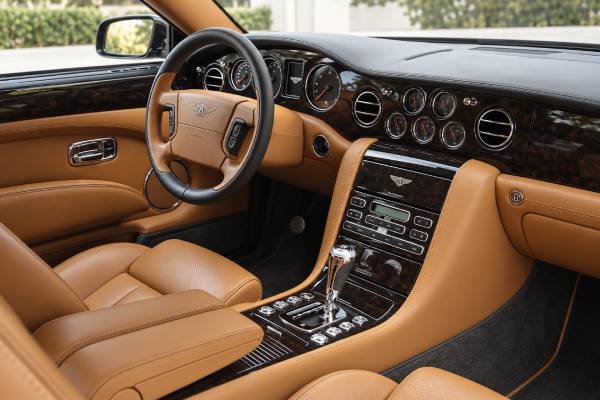
The 2008–2010 Bentley Brooklands Coupe is a hand-built, four-seat grand tourer powered by the final and strongest production development of Bentley’s traditional 6.75-litre V8. Twin turbochargers, 530 hp, and 1,050 Nm of torque move a 2,725 kg coupé from 0 to 100 km/h in about 5.3 seconds and on to roughly 296 km/h. Those figures are dramatic, but the car’s defining achievement is how quietly it delivers them while surrounding four adults with extensive leather, veneer, metalwork, and genuinely usable rear space.
Bentley planned no more than 550 cars and completed 426, with production ending in January 2010. That rarity, combined with the last-of-line engine and coachbuilt presentation, makes the Brooklands collectible. It does not make ownership simple. The coupé shares complex systems with the Arnage and Azure families, including adaptive dampers, self-levelling rear suspension, extensive electronics, twin-turbo engine management, a six-speed ZF automatic, large 20-inch tires, and optional carbon-silicon-carbide brakes. Buyers need a documented specialist inspection, a realistic maintenance reserve, and proof that every system works under full heat and load.
Table of Contents
- The Modern Brooklands Concept
- Powertrain and Complete Specifications
- Performance and Grand-Touring Behavior
- Body, Cabin, and Chassis Engineering
- Maintenance and Running Costs
- Common Problems and Pre-Purchase Inspection
- Buying, Value, and Collectibility
The Modern Brooklands Concept
The modern Brooklands is a fixed-roof grand-touring coupé derived from the Azure and Arnage-era architecture, not a continuation of the 1990s SZ Brooklands saloon. It was designed as Bentley’s most powerful production coupé of the period and as a final showcase for Crewe’s long-serving V8.
The name links the car to Bentley’s racing and high-speed heritage, but the product is intentionally luxurious. Two long doors open to a cabin with four individual seating positions, and the rear is designed for adults rather than emergency use. Compared with the Azure convertible, the fixed roof improves structural integrity and gives the coupé a more purposeful profile.
Production was deliberately limited. Bentley announced a maximum of 550 cars, while later historical records list 426 completed examples: 390 associated with the 2009 model year and 36 with 2010. Deliveries began in 2008, and the final car was completed in January 2010. Market registration dates can therefore differ from model-year descriptions.
The Brooklands used a highly developed version of the 6.75-litre L-series V8, often identified as L410TT in enthusiast classification. The basic pushrod architecture had deep historical roots, but the final installation included twin turbochargers, modern Bosch engine management, electronic throttle control, and emissions systems suitable for its time. It should not be treated as a simple old engine merely because the block design was familiar.
The coupé’s 1,050 Nm torque output is as important as its 530 hp. Maximum torque arrives at a relatively low 3,250 rpm, allowing the six-speed automatic to produce strong acceleration without chasing high engine speeds. The car’s pace is effortless rather than frantic.
Styling details reinforce the hand-built identity: a prominent mesh grille, muscular rear haunches, polished metal, deep paint, and extensive cabin personalization. Bentley offered dozens of exterior colors and hide choices, and bespoke commissions can differ considerably. A nonstandard color is not necessarily a repaint; the build record must decide.
The Brooklands should also be distinguished from the 2020s Bentley Continental GT range. Although both are luxury coupés, the Brooklands uses a different platform, engine family, manufacturing character, and service ecosystem. Parts costs and diagnostic requirements reflect the low-volume Arnage/Azure lineage.
Powertrain and Complete Specifications
The Brooklands is a front-engine, rear-wheel-drive petrol coupé with a twin-turbocharged 6.75-litre V8 and a six-speed ZF automatic. Its technical numbers combine supercar-level torque with limousine-scale mass, so brakes, tires, cooling, and suspension condition are as important as engine output.
| Specification | Value | Notes |
|---|---|---|
| Engine family | Bentley 6.75-litre twin-turbo V8; commonly identified as L410TT | Final high-output development of the traditional L-series |
| Configuration | 90-degree OHV V8, 2 valves per cylinder | Front longitudinal installation |
| Displacement | 6,761 cc (6.75 L) | Often rounded to 6.8 L |
| Induction | Two Mitsubishi TD04 turbochargers | One serving each cylinder bank |
| Engine management | Bosch ME7.1 | Integrated fuel, ignition, throttle, and boost control |
| Maximum power | 530 bhp / 537 PS / 395 kW at 4,000 rpm | Official published output |
| Maximum torque | 1,050 Nm (774 lb-ft) at 3,250 rpm | Exceptional low- and midrange output |
| Compression ratio | 7.8:1 | Period official specification |
| Fuel requirement | 98 RON recommended; 95 RON minimum in official data | Use market-equivalent premium fuel |
| Fuel tank | Approximately 96 L (25.4 US gal) | Confirm handbook value for market |
| Item | Specification | Ownership relevance |
|---|---|---|
| Transmission | ZF 6HP26 6-speed automatic | Electronic control and manual-shift function |
| Drive type | Rear-wheel drive | High torque places heavy demand on rear tires |
| Selector mode | Automatic with Tiptronic-style manual selection | All modes should work without delay |
| Final-drive layout | Conventional rear differential | Inspect seals, mounts, and driveline vibration |
| Traction and stability control | Electronic systems integrated with engine and brakes | Warning lamps require proper diagnosis |
| Parking brake | Mechanical/electrical specification should be verified by market documentation | Confirm operation and release during inspection |
| Measure | Official figure | Test or context |
|---|---|---|
| 0–60 mph | 5.0 seconds | Manufacturer figure |
| 0–100 km/h | 5.3 seconds | Manufacturer figure |
| Top speed | 296 km/h (184 mph) | Manufacturer figure |
| Urban fuel consumption | 28.8 L/100 km | Official European-cycle figure |
| Extra-urban fuel consumption | 14.1 L/100 km | Official European-cycle figure |
| Combined fuel consumption | 19.5 L/100 km | Official European-cycle figure |
| CO₂ emissions | 465 g/km | Official combined-cycle figure |
| Emissions compliance | EU4 / LEV II in period documentation | Market equipment differs |
| Specification | Value | Notes |
|---|---|---|
| Body | 2-door, 4-seat fixed-roof coupé | Hand-built at Crewe |
| Overall length | 5,411 mm (213.0 in) | Longer than many full-size luxury sedans |
| Width including mirrors | 2,078 mm (81.8 in) | Garage and road-width planning is essential |
| Height | 1,473 mm (58.0 in) | Low roofline for the vehicle’s size |
| Wheelbase | 3,116 mm (122.7 in) | Supports genuine rear-seat space |
| Front/rear track | Approximately 1,610 mm | Official heritage specification |
| Kerb weight | 2,725 kg (6,008 lb) | Manufacturer published value |
| Rear-seat packaging | Rear seats positioned about 100 mm farther back than Azure and 25 mm lower than Arnage | Improves legroom and headroom balance |
| Component | Specification | Inspection focus |
|---|---|---|
| Front suspension | Independent double wishbones with adaptive electrohydraulic damping | Bushes, ball joints, dampers, leaks |
| Rear suspension | Independent layout with self-levelling and adaptive damping | Ride height, accumulators or actuators, warning messages |
| Steering | Power-assisted rack and pinion | Leaks, pump noise, center play, alignment |
| Standard brakes | Large ventilated steel discs with ABS and stability integration | Disc wear, calipers, hoses, fluid |
| Optional brakes | Carbon-silicon-carbide ceramic discs | Damage, wear measurement, replacement cost |
| Wheels | 20-inch alloy wheels | Cracks, corrosion, refinishing quality, runout |
| Tires | 255/40 ZR20 | Correct load, speed rating, matched model, date |
| Item | Published detail |
|---|---|
| First customer deliveries | 2008 |
| Final production | January 2010 |
| Maximum announced run | 550 cars |
| Recorded completed production | 426 cars |
| 2009 model-year production record | 390 cars |
| 2010 model-year production record | 36 cars |
| Standard paint choice | 42 colors listed in period material |
| Hide choice | 25 colors listed in period material |
Always verify the build sheet because wheels, brake type, colors, veneer, audio, market emissions hardware, driver-assistance equipment, and bespoke features can differ materially among the 426 cars.
Performance and Grand-Touring Behavior
The Brooklands is extremely fast, but its character is defined by torque and isolation rather than aggressive response. A healthy car accelerates in one sustained surge, with the six-speed automatic keeping the engine in its broad midrange.
At small throttle openings, the V8 should be almost unobtrusive. The car moves away with little effort, and the gearbox changes early. Press farther and both turbochargers build pressure progressively. The sensation is that the road is being pulled toward the car rather than the engine working harder.
The 5.3-second 0–100 km/h figure is remarkable for a 2,725 kg coupé, yet full acceleration should be used carefully on old tires or wet roads. Rear-wheel drive and 1,050 Nm can overwhelm poor rubber despite electronic assistance. Stability-control warnings, unexpected wheelspin, or uneven power delivery require diagnosis.
The ZF 6HP26 should shift smoothly during ordinary driving and firmly under load. Delayed engagement, flare, shudder, harsh downshifts, or a transmission warning can involve fluid condition, valve body, solenoids, software, mounts, or internal wear. A road test must include cold and hot operation.
High-speed stability is a core strength. The long wheelbase, wide track, substantial mass, and aerodynamic body produce calm motorway behavior. The steering should remain accurate, and the car should not follow road grooves excessively. Bent 20-inch wheels, aged tires, worn bushes, or incorrect alignment quickly undermine this stability.
Adaptive damping allows the Brooklands to control its weight without a punishing ride. A working system should absorb small impacts, settle large movements, and keep the rear level with passengers. A car stuck in a firm mode, sitting low, or displaying suspension messages needs specialist diagnosis.
Braking is critical. Standard steel brakes are large, and the optional carbon-silicon-carbide system offers exceptional thermal capacity and lower unsprung mass. Ceramic discs are expensive and vulnerable to impact or mishandling. They should be inspected for chips, cracks, surface condition, wear limits, and correct pads using Bentley procedures.
The steering does not disguise the car’s size. On narrow roads, the 2,078 mm mirror width and long doors demand planning. Parking sensors should work on all corners, and any camera equipment should be checked. A scraped wheel or damaged mirror can be costly.
The rear seats change how the car can be used. Adults can travel long distances, but the front seats must move and return correctly for access. Test seat memory, folding or entry mechanisms, rear climate outlets, reading lamps, audio, and window sealing. A grand tourer is only complete when all four occupants are comfortable.
Body, Cabin, and Chassis Engineering
The Brooklands combines a large steel body with extensive hand-finishing and a fixed roof engineered to improve rigidity over the Azure. Body condition, door alignment, glass sealing, and cabin electronics deserve the same attention as the engine.
The two doors are long and heavy. Open each fully on level ground and watch for dropping, hinge movement, check-strap noise, or contact with the aperture. A misaligned door can strain seals, windows, locks, and soft-close or latch mechanisms. Garage space must allow safe opening.
Frameless or tightly sealed side glass must drop and rise correctly where the design requires it. Wind noise, water entry, or glass contacting trim can result from regulator, microswitch, seal, alignment, or control faults. Repeatedly test the windows and doors rather than operating them once.
Paint quality is a major part of the car’s value. Deep hand-finished paint can hide previous repairs under polish. Use a paint-depth gauge, inspect panel edges, compare metallic orientation, and examine the lower body for impact damage. The broad rear haunches and long doors are difficult to repair invisibly.
The cabin contains large areas of leather and veneer. Inspect dashboard top, rear quarter trim, door panels, seat bolsters, headlining, parcel shelf, steering wheel, and frequently handled switches. Sun shrinkage and adhesive failure can be more damaging than ordinary wear.
Bentley offered extensive personalization, so unusual colors, contrast stitching, embroidered emblems, special veneer, and metal finishes may be original. Obtain the build specification before judging correctness. A bespoke cabin restored to generic black and tan can lose historical value.
Climate control must heat and cool the full cabin. Test both zones, all outlets, demisting, compressor engagement, fan speeds, and rear delivery. A weak system can involve refrigerant leaks, control motors, sensors, valves, fans, or compressors. Cabin filters and drains should be serviced.
The adaptive suspension uses electronic and hydraulic functions to manage mass. Warning-free operation is not enough; a road test must confirm damping changes, rear level, and absence of leaks. Bushes and ball joints can wear without setting a fault code.
Underbody inspection should cover jacking points, floor panels, brake and fuel lines, suspension mounts, exhaust, heat shielding, differential, transmission, and evidence of curb or ramp impact. The car is low enough for damage despite its large dimensions.
Maintenance and Running Costs
The Brooklands should be maintained by an Arnage/Azure-era Bentley specialist with appropriate diagnostic equipment and access to correct parts. Routine service is expensive, but deferred service is far more costly because heat, torque, mass, and low-volume components multiply failures.
Engine oil and filter changes should follow Bentley’s time and mileage guidance, with shorter time-based intervals sensible for low-use cars. Use the approved oil specification. Track oil consumption and inspect for leaks around turbo oil lines, covers, seals, cooler connections, and crankcase ventilation.
Cooling-system condition is vital. Inspect radiators, condensers, fans, hoses, expansion tank, water pump, thermostat, auxiliary pumps, and intercooling circuits where applicable. Debris can collect between heat exchangers. A car that maintains temperature on the motorway may still overheat in traffic if airflow is weak.
Turbocharger systems require sound oil supply, intake hoses, intercooler connections, boost controls, diverter or control valves, and heat shielding. A small leak can reduce performance and create incorrect fuel control. Smoke, whistle, or a sudden change in torque should be investigated promptly.
The 6HP26 transmission should not be treated as permanently maintenance-free merely because older marketing used “lifetime” language. A specialist should assess fluid, pan/filter, leaks, software, shift adaptations, and temperature. Service strategy depends on history and condition; avoid indiscriminate flushing.
Brake costs vary enormously. Steel discs and pads are expensive but conventional. Carbon-silicon-carbide discs can last well when treated correctly, yet replacement is a major expense. Never let a tire shop strike a ceramic disc with a wheel, and use proper support during wheel removal.
Twenty-inch tires wear quickly if alignment is wrong. Replace them as a matched set where possible, and use the specified load and speed ratings. Inspect inner shoulders, which can wear out of sight. Wheel refinishing should preserve correct dimensions and avoid excess heat.
Adaptive dampers, suspension bushes, steering components, and rear-levelling hardware should be inspected at each service. One failed damper can alter braking and tire wear. Replacement in axle pairs may be appropriate depending on condition and official guidance.
Battery voltage is central to electronic reliability. Load-test the battery, verify alternator output, and measure parasitic draw. Use a quality maintainer during storage, but do not use it to conceal an abnormal drain. Low voltage can generate multiple unrelated warnings.
Annual ownership should include a reserve beyond scheduled service. A single major repair involving ceramic brakes, dampers, cooling modules, transmission, turbo plumbing, or interior electronics can be substantial. Buying the cheapest car rarely reduces total cost.
Common Problems and Pre-Purchase Inspection
The most important inspection targets are cooling, engine and turbo leaks, transmission behavior, suspension and damping, brakes, tires, battery-related electronics, climate control, and body sealing. A full specialist examination is essential because a warning-free dashboard does not prove health.
Cold-start evidence
See the car before it is started. Check oil, coolant, brake fluid, power-steering fluid, transmission leaks, and battery voltage. The engine should start cleanly without prolonged rattle, misfire, smoke, or fuel odor. All warning lamps should illuminate for their self-test and extinguish correctly.
Heat management
Drive until fully warm, then idle with the air conditioning on. Watch coolant temperature, fan operation, and warning messages. Inspect for coolant odor or fresh staining. Heat-soaked restart behavior can expose weak sensors, fuel pressure, starter, battery, or ignition issues.
Turbo and engine performance
Apply progressive load in more than one gear. Power should be even, without surging, flat spots, pinging, or smoke. Check boost hoses and intercooler connections for oil and leakage. A dyno number is less useful than clean repeatable road behavior and diagnostic data.
Transmission
Test Park-to-Drive and Park-to-Reverse engagement cold and hot. Use light throttle, full kickdown, manual mode, and low-speed downshifts. Shudder or harshness may be expensive. Review fluid and pan service history.
Suspension and steering
Check ride height after overnight parking and with passengers. Operate any damping modes and compare behavior. Listen for knocks and inspect dampers for leaks. Steering should be quiet and consistent, with no heavy spots or pump whine.
Brakes and wheels
Identify whether the car has steel or carbon-silicon-carbide brakes. Measure wear according to the correct procedure. Inspect wheel barrels, tire dates, inner shoulders, pressure sensors, and evidence of impact. A vibration under braking may involve discs, tires, suspension, or hubs.
Electronics and cabin
Operate every seat axis, memory, heater, lumbar function, window, mirror, lock, parking sensor, navigation, audio source, telephone interface, instrument display, lamp, and climate mode. Test the battery after the car has been left parked. Intermittent faults often appear only after voltage falls or the cabin heats.
Body and water entry
Inspect door seals, window alignment, boot seals, roof and rear-glass junctions, drains, and carpets. Smell for dampness. Water can damage modules before visible staining appears. Check body repairs around the long doors and rear quarters.
Use the VIN to search official recall and safety databases for the applicable market, then confirm completion with invoices or dealer records. A recall lookup returning no open campaign does not replace physical inspection.
Buying, Value, and Collectibility
The Brooklands is collectible because it is rare, powerful, hand-finished, and historically important, but the best purchase is still the car with the strongest mechanical and documentary evidence. Production scarcity cannot offset a poor cooling system or damaged ceramic brakes.
Start with the factory build sheet. Confirm colors, veneer, stitching, wheels, brake type, market equipment, and bespoke options. Compare the current car with early photographs and invoices. An unusual specification can be desirable when documented, while an undocumented repaint or retrim creates uncertainty.
Service history should show continuity rather than a recent burst of preparation before sale. Look for annual inspections, oil service, cooling work, transmission attention, brake measurements, tire replacement, suspension repairs, battery management, and correction of warning messages. Specialist names and part numbers improve confidence.
Mileage affects value but should not dominate. Very low-mileage cars can have old tires, dried seals, corroded brakes, stale fuel, discharged batteries, and inactive climate systems. Higher-mileage cars may show leather and wheel wear but prove that systems have been exercised. Condition and time-based maintenance explain the number.
Identify the brake system before negotiating. A car with healthy carbon-silicon-carbide discs may command a premium; one with damaged discs may require a large deduction. Converting to steel changes originality and must be engineered and documented correctly.
Budget for a specialist baseline immediately after purchase. Even with a good inspection, fluids, alignment, tire pressure sensors, battery, software checks, and small cabin issues may need attention. Maintain a major-repair reserve separate from routine service funds.
Storage must fit the car. Its 5.4-metre length, broad mirrors, and long doors exceed many domestic garages. A dry, secure space with power for a maintainer and room to inspect the car is part of the ownership cost.
Insurance should use an agreed value based on the exact specification and condition. Document bespoke materials, ceramic brakes, low production, keys, manuals, tools, covers, and accessories. Confirm transport and event coverage.
The Brooklands is most rewarding when used as intended: long journeys with the engine fully warm, the suspension working, and all four seats available. Controlled use preserves function better than endless static storage. Avoid short starts, prolonged idling, and aggressive acceleration before oil temperature is established.
The final decision should be based on total ownership capability. A buyer needs specialist access, suitable storage, a maintenance reserve, and tolerance for low-volume parts lead times. In return, the Brooklands offers a type of grand touring that is unlikely to be repeated: immense twin-turbo torque, traditional Crewe craftsmanship, and genuine four-seat comfort in a production run of only 426 cars.
References
- BENTLEY NEWSROOM : 2010 Brooklands Final Series 2025 (Bentley Heritage Collection)
- Bentley Brooklands 2009 2024 (Bentley Heritage Catalogue)
- Bentley Brooklands Coupe 2024 (Bentley Heritage Catalogue)
- Bentley Brooklands 2024 (Production and Technical History)
- 2009 BENTLEY BROOKLANDS | NHTSA 2026 (Recall and Safety Database)
- Bentley Brooklands Common Problems, Faults & Repair Costs (2026) | CarCostCheck 2026 (Ownership and Repair Context)
Disclaimer
This article is for informational purposes and is not a substitute for professional diagnosis, repair, or pre-purchase inspection. Specifications, torque values, intervals, software, brakes, emissions equipment, and bespoke features vary by VIN, market, and factory commission; verify all procedures against official Bentley service documentation and the individual build record. Please share this article on Facebook, X/Twitter, or a suitable Bentley community if it was useful.