
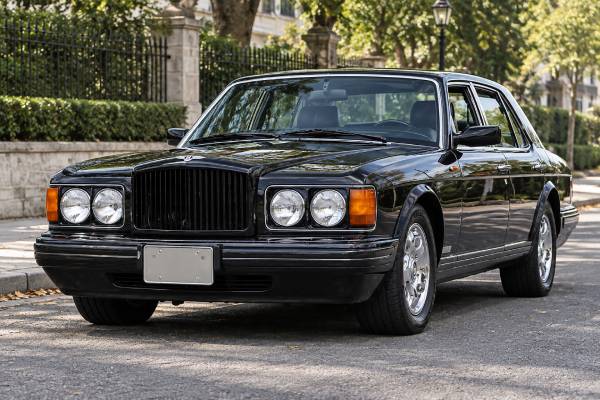
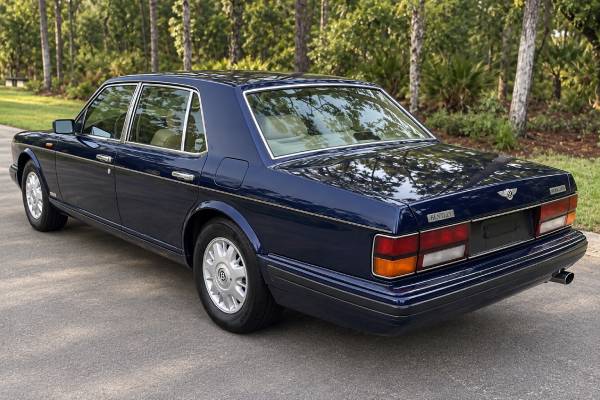
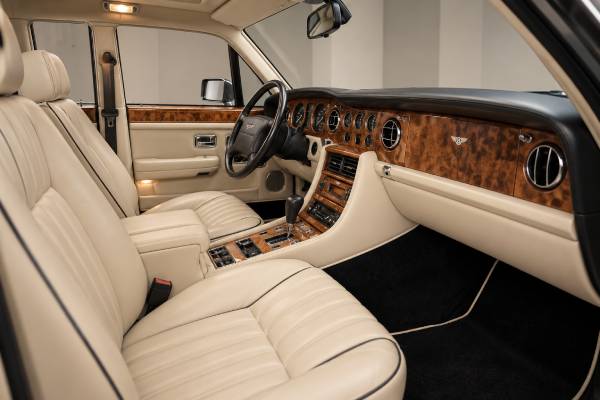
The 1997 Bentley Brooklands is the year in which the dignified entry saloon acquired the powertrain it had always seemed to deserve. A light-pressure turbocharger lifted the 6.75-litre L410MT V8 to about 300 hp, while retaining the quiet, torque-led delivery and formal character that separated the Brooklands from the harder-edged Turbo R. It was also the final model year for the regular Brooklands saloon before the short-lived Brooklands R took over the name.
That combination makes the 1997 standard-wheelbase car unusually appealing. It has the cleaner late-SZ body, stronger acceleration, modernized cabin details, and a more usable reserve of power without becoming an overt performance model. It is still a complex, hand-built Crewe Bentley, however, and age now matters more than mileage. Cooling, hydraulic pressure, turbo plumbing, engine-management condition, corrosion, and electrical completeness must all be assessed together. A carefully maintained example can be a relaxed long-distance express; a neglected one can consume a restoration budget with surprising speed.
Table of Contents
- Why 1997 Changed the Brooklands
- 1997 Technical Data and Specifications
- Light-Pressure Turbo Performance
- Late-SZ Design, Chassis, and Equipment
- Service Strategy for the L410MT Car
- Diagnostic Warning Signs
- Choosing and Owning a 1997 Brooklands
Why 1997 Changed the Brooklands
The 1997 Brooklands is not merely a late naturally aspirated car with an added turbo. It is a distinct final-year specification built around the L410MT light-pressure-turbo engine, giving the standard-wheelbase saloon a broader performance envelope while preserving its softer identity.
Earlier Brooklands models depended on displacement and low gearing to move more than two tonnes of car. Their naturally aspirated V8s were smooth and flexible, but fast motorway joining or a decisive overtake required patience. The 1997 system supplied boost conservatively, raising output to the commonly quoted 300 bhp region and torque to roughly 600 Nm. The change made the car feel less burdened by its mass, especially with two or more occupants and luggage.
The model remained deliberately separate from the Turbo R. The Brooklands did not receive the full sporting presentation, suspension calibration, and standard performance-brake package associated with Bentley’s flagship sports saloon. It was intended for buyers who wanted effortless speed without a conspicuous sporting image. In period terms, it occupied a useful middle ground between a formal luxury saloon and a serious high-performance Bentley.
Late exterior revisions also distinguish it from an early Brooklands. The lower radiator treatment, integrated body-color bumpers, door-mounted mirrors, deletion of the front quarterlights, revised headlamp surrounds, and cleaner lower-body finish give the 1997 car a more contemporary appearance. Inside, the later fascia, center console, electrically adjustable steering column, and improved rear ventilation make it feel more developed than the 1993 launch version.
Production context matters. The regular Brooklands line ended after 1997, and the model name continued briefly on the 1998 Brooklands R. A 1997 car is therefore both the ultimate standard Brooklands and the first turbocharged version of that standard formula. That position increases historical interest, but buyers should still judge an individual car by specification and condition rather than assuming every final-year example is collectible.
Identification starts with the VIN, build record, and engine configuration. A genuine 1997 L410MT car should have the correct turbo installation, late body details, and corresponding chassis documentation. Badges, wheels, grilles, and even complete interiors can be exchanged between SZ cars, so visual resemblance alone is not proof.
1997 Technical Data and Specifications
The 1997 Brooklands is a front-engine, rear-wheel-drive petrol saloon powered by a turbocharged 6,747 cc OHV V8 and a four-speed automatic transmission. The specification is best understood as a high-torque luxury package: the engine works at low rpm, the hydraulic systems handle braking and rear ride height, and the chassis favors stable progress over sharp responses.
| Specification | 1997 Brooklands value | Practical meaning |
|---|---|---|
| Engine code | L410MT | Light-pressure-turbo development of the Crewe L-series V8 |
| Layout | 90-degree V8, OHV, 2 valves per cylinder | Low-revving design with hydraulic tappets |
| Displacement | 6,747 cc (6.75 L) | Usually rounded to 6.8 L in model identifiers |
| Bore × stroke | 104.14 × 99.06 mm | Long-established L-series dimensions |
| Induction | Single light-pressure turbocharger | Tuned for progressive boost rather than a dramatic surge |
| Fuel and control | Electronic fuel injection with engine management | Sensors, wiring, and boost control must be healthy together |
| Maximum power | About 300 bhp (224 kW) | Period market ratings may be shown as 300 hp or 304 PS |
| Maximum torque | About 600–605 Nm (443–446 lb-ft) at roughly 2,000 rpm | Strong low-speed response is the main benefit |
| Fuel tank | About 108 L (28.5 US gal) | Useful capacity for a thirsty touring saloon |
| Item | Specification |
|---|---|
| Transmission | 4-speed electronically controlled automatic |
| Selector | Floor-mounted automatic selector |
| Drive type | Rear-wheel drive |
| Engine location | Front, longitudinal |
| Traction assistance | Electronic traction assistance available on some market specifications |
| Differential | Conventional rear final drive; inspect mounts and seals |
| Measure | Published or practical figure | Context |
|---|---|---|
| 0–100 km/h | Approximately 7.9–8.3 seconds | Figures differ by source and test convention |
| 0–60 mph | Approximately 7.6–8.0 seconds | Condition and launch method affect results |
| Top speed | About 225 km/h (140 mph) | Period published value for the light-pressure-turbo car |
| Mixed real-world fuel use | Roughly 18–25 L/100 km (9–13 mpg US) | Urban use can be substantially heavier |
| Recommended operating approach | Use high-quality premium petrol appropriate to the market | Correct octane and a healthy ignition system protect against detonation |
| Specification | Value | Notes |
|---|---|---|
| Body style | 4-door saloon | Standard-wheelbase late SZ body |
| Seating | 5 | Rear center position is best regarded as occasional |
| Length | Approximately 5,268–5,310 mm | Published data vary with bumper measurement convention |
| Wheelbase | Approximately 3,061 mm (120.5 in) | Shorter than the dedicated LWB derivative |
| Width | About 1,890–1,920 mm excluding mirrors | Source definitions differ |
| Height | About 1,485 mm | Ride height depends on loading and hydraulic condition |
| Kerb weight | Approximately 2,350–2,400 kg | Market and weight definition affect the number |
| Component | 1997 Brooklands specification |
|---|---|
| Front suspension | Independent double wishbones with coil springs and anti-roll control |
| Rear suspension | Independent semi-trailing arms with hydraulic self-levelling |
| Steering | Power-assisted rack and pinion; electrically adjustable column |
| Brakes | Four-wheel discs, ABS, high-pressure hydraulic actuation |
| Performance brakes | Turbo R-type braking hardware was optional in some specifications |
| Typical wheels | 16-inch alloy wheels on the standard Brooklands |
| Tire requirement | Correct heavy-load, speed-rated tires in matching sets |
The figures above identify the standard 1997 saloon, not the LWB, Trophy, Indonesian, Division, or 1998 R derivatives. Factory options and regional homologation can alter wheels, braking equipment, traction systems, emissions hardware, and trim. The build sheet remains the controlling document for a particular chassis.
Light-Pressure Turbo Performance
The turbocharged Brooklands feels faster because it removes hesitation from ordinary driving, not because it behaves like a modern high-boost sports saloon. The strongest improvement is the immediate reserve available between about 30 and 80 mph, where the V8 can accelerate without repeated downshifts.
Boost arrives with little drama. At small throttle openings, the car still moves like a naturally aspirated luxury saloon: quiet, smooth, and willing to hold a high gear. Press farther and torque builds progressively, pushing the car forward in one broad movement. A healthy example should not whistle loudly, surge unpredictably, or produce visible smoke under load.
The automatic transmission is central to the experience. Shifts should be decisive but cushioned, and kickdown should occur without a long flare in engine speed. A harsh engagement from Park, delayed selection of Drive, shudder under light load, or a slipping change is not a personality trait. It may indicate aged fluid, control faults, worn mounts, or internal wear.
Although the standard wheelbase is more manageable than the LWB, this remains a very heavy car on relatively soft suspension. It rewards a deliberate technique: brake early, turn once, allow the chassis to settle, and use torque on the exit. Trying to force rapid direction changes merely exposes body roll, tire load, and the work demanded of the brakes.
Straight-line stability is excellent when geometry, bushes, dampers, and tires are correct. The steering is light at parking speed and gains useful weight on the move, but worn front suspension joints can make the car wander or react to cambers. A vague center, steering shake, or uneven tire wear warrants a complete chassis examination rather than a quick alignment alone.
The high-pressure brake pedal feels firmer and shorter-travel than a conventional vacuum-assisted system. After a driver adapts, stopping power should be progressive and confidence-inspiring. The optional heavier-duty brake specification is desirable for frequent mountain or high-speed use, but standard brakes in proper condition are adequate for the car’s intended role. Hydraulic warning lamps, slow pressure build, repeated pump operation, or a change in pedal feel require immediate investigation.
Turbocharging adds heat. After sustained fast running, the final part of a journey should be calm enough for temperatures to stabilize; there is no need for theatrical idling, but switching off immediately after a hard climb is poor practice. More important is ensuring the cooling system, oil supply, intake hoses, boost controls, and exhaust shielding remain as designed.
Late-SZ Design, Chassis, and Equipment
The 1997 car represents the most resolved standard Brooklands cabin and body treatment. Its improvements are subtle, yet they make daily use easier and distinguish a correct final-year example from an earlier car updated with cosmetic parts.
The revised exterior removed some of the upright visual details of the first Brooklands. Door mirrors replaced the earlier arrangement associated with quarterlights, bumpers were more fully integrated, and lower panels were painted to harmonize with the body. The radiator and headlamp treatment sat lower and wider. These changes did not transform the basic SZ proportions, but they reduced the sense that the car belonged to the 1980s.
Inside, the reshaped fascia and center console grouped controls more coherently. The electrically adjustable steering column improved driving position, and extra headroom helped taller occupants. Rear ventilation outlets were a practical gain for a cabin with large glass areas and extensive leather. As always, exact wood, leather, piping, badges, audio equipment, and telephones could vary according to market and commission.
The cabin must be evaluated as a complete system. Climate control should cool strongly at idle and while driving, deliver heat through the correct outlets, and change modes without clicking actuators or long delays. Seat motors should move both sides evenly. Windows should not crawl in their channels. Central locking, mirror adjustment, cruise control, demisters, instrument lighting, warning lamps, and audio components all deserve repeated tests.
Late equipment can create a false sense of modernity. The car still uses many relays, mechanical linkages, vacuum or servo-operated climate components, specialized switches, and hand-routed wiring. Old aftermarket alarms and phone installations often cause more trouble than the original circuits. A tidy removal supported by wiring diagrams is better than leaving disconnected modules hidden behind trim.
The rear self-levelling suspension is not an optional luxury feature to ignore. It preserves rear geometry and ride height under load. A car that sits low after passengers enter, rises unevenly, or bounces after a bump needs diagnosis of accumulators, valves, pumps, dampers, or linkages. Disabling the system reduces originality and can compromise ride and braking balance.
Original 16-inch wheels suit the late car’s weight and steering. They should be free from cracking, severe corrosion, and poor repairs. Tire age is critical because low-mileage Bentleys commonly retain visually good but hardened rubber. Four matching tires with the correct load and speed ratings contribute more to safety and refinement than polished wheel faces.
Service Strategy for the L410MT Car
A successful maintenance plan treats the 1997 Brooklands as a collection of interdependent systems. Annual mileage alone is a poor guide because coolant, hoses, hydraulic accumulators, seals, tires, batteries, and fuel deteriorate with time even when the odometer barely changes.
Begin by establishing a documented baseline. Confirm engine oil and filter age, ignition condition, coolant chemistry, radiator flow, fan operation, fuel-hose security, transmission fluid condition, differential leaks, hydraulic pressure, accumulator reserve, brake wear, suspension play, tire dates, battery capacity, and charging voltage. A specialist road test should be part of the baseline, not an optional extra.
The L410MT engine is fundamentally durable, but the turbo makes clean oil and temperature control more important. Change oil at least yearly on a lightly used car and after any period of uncertain storage. Investigate a low oil level rather than simply topping up. Check turbo feed and drain areas, cam covers, front seals, oil cooler lines, and any point where leakage could reach hot exhaust components.
Cooling-system preservation deserves its own budget. The radiator can look clean externally while suffering internal restriction. Hoses may appear sound until pressure and heat expose soft spots near clamps. The viscous fan, auxiliary fans, thermostat, water pump, expansion tank, heater valves, and cabin heat exchangers must all operate together. A temperature gauge that rises in traffic but settles at speed is a warning, not normal behavior.
Turbo and intake plumbing should remain oil-tight and securely clamped. Light oil mist is not the same as pooled oil, split hoses, loose joints, or blue smoke. Check boost-control hoses and electrical connections for heat damage. A car with flat performance may have a relatively simple control fault, but it can also have ignition, fueling, exhaust, compression, or turbocharger problems. Avoid diagnosis by parts replacement.
Hydraulic fluid must be the exact mineral type specified for the system. Mixing conventional brake fluid can damage seals on a large scale. Pressure testing should measure pump performance, accumulator condition, warning-switch behavior, and reserve, while a lift inspection should cover pipes, flexible hoses, calipers, rear levelling valves, and spheres. The warning lamps are only the beginning of the assessment.
The four-speed automatic benefits from informed service. Examine fluid color and odor, inspect for leaks, and review invoices for previous work. On an unknown gearbox, a controlled pan removal and filter service is usually more defensible than a high-pressure flush. Mounts and driveline joints should be checked at the same time because they can mimic transmission harshness.
Regular use is preventive maintenance. A proper drive should bring oil, coolant, transmission, brakes, and air conditioning to operating temperature. It should include enough distance to recharge the battery and enough braking to keep surfaces clean. Repeated cold starts, short shuffles, and long stationary idling do not preserve the car.
Diagnostic Warning Signs
The best 1997 Brooklands inspection focuses on patterns rather than isolated faults. Several small defects—weak battery, intermittent climate control, old tires, damp carpets, slow windows, and missing records—usually indicate broad neglect, even when the paint appears excellent.
Cold start and warm-up
Ask to see the car completely cold. The engine should start promptly, settle without sustained misfire, and build hydraulic pressure within a reasonable period. Watch all warning lamps perform their self-check. Listen for exhaust leaks, metallic knocks, belt noise, pump distress, or abnormal turbo sounds. Check the expansion tank only when safe and observe the temperature through a full warm-up.
Full-load road test
Once warm, apply progressive throttle in a high gear. Power should build cleanly without hesitation, detonation, smoke, or sudden boost spikes. Repeat moderate kickdown and check that the transmission engages consistently. After the test, inspect for new oil, coolant, hydraulic fluid, or fuel seepage and note any hot odors.
Hydraulic and suspension behavior
Brake-pressure warning lamps must remain off while driving. The pedal should be firm but not wooden, and the car should stop straight. Drive over a variety of surfaces to expose worn bushes and dampers. Load the rear if practical and verify that the levelling system corrects ride height without leaks or repeated cycling.
Body and water entry
Inspect screen surrounds, rear window edges, wheelarches, lower wings, sills, door bottoms, jacking areas, boot floor, fuel-filler region, and suspension mounting points. Lift carpets and boot trim where permission is given. Dampness can damage electronics and wood while concealing corrosion beneath sound deadening.
Authenticity and documentation
Match VIN plates, stamped identifiers, registration records, and the build sheet. Confirm that the engine is the correct L410MT installation rather than assuming the turbo badge proves it. Look for unexplained late wheels, missing under-bonnet labels, altered grille parts, replacement steering wheels, cut wiring, or removed self-levelling components. Modifications are not automatically disqualifying, but they must be understood and priced.
A specialist pre-purchase inspection should include a lift, hydraulic tests, cooling pressure test, diagnostic checks supported by the car, paint-depth review, tire-date check, and a long enough road test to reveal hot faults. A brief inspection in a showroom cannot provide the same evidence.
Choosing and Owning a 1997 Brooklands
Buy the 1997 Brooklands for its final-year blend of pace and serenity, not because it appears cheap beside a restored example. Purchase price is only the entry point; condition, specialist access, parts quality, and a reserve for corrective work determine whether ownership is rewarding.
Prioritize cars with continuous invoices, evidence of cooling and hydraulic work, matching quality tires, complete trim, and regular exercise. Mileage can help explain wear, but an exceptionally low reading does not prove health. Storage environment and maintenance quality are usually more important. A 90,000-mile car used and serviced correctly may be safer than a 25,000-mile car revived after a decade of inactivity.
Color and specification affect desirability, but originality should not be confused with untouched deterioration. Refinished wood, retrimmed leather, rebuilt hydraulics, a recored radiator, or a professionally overhauled gearbox can add value when the work is documented and accurate. Poorly matched paint, heavily coated leather, generic hoses, improvised wiring, and cosmetic engine-bay detailing are different matters.
A sensible first-year ownership budget includes a full service, all fluid checks, tire replacement if age is uncertain, battery evaluation, air-conditioning service, wheel alignment after suspension inspection, and correction of warning lamps. Keep funds available for one major system, even after a clean pre-purchase report. That reserve prevents deferred faults from multiplying.
The standard wheelbase is the better format for an owner-driver. It still has a spacious rear compartment, but it is easier to garage and place on narrow roads than the LWB. The light-pressure turbo gives it enough performance for modern traffic without changing the Brooklands into a confrontational sports saloon. For many buyers, that is precisely the point.
Walk away from overheating, brake-pressure warnings, structural corrosion, severe water entry, unexplained identity issues, or a seller who refuses a specialist inspection. Those are not bargaining opportunities unless the buyer is deliberately purchasing a restoration project with facilities and a written cost plan.
When sorted, the 1997 Brooklands offers an unusual experience: traditional hand-finished construction, a deeply relaxed cabin, and torque that makes a large old saloon feel unexpectedly current. It is one of the most usable standard Brooklands variants, but it rewards discipline rather than optimism.
References
- Bentley Brooklands 2024 (Model History)
- Bentley Brooklands 1997 2024 (Bentley Heritage Collection)
- Bentley Brooklands Saloon Chassis Information | Technical Specifications & Features 2025 (Chassis Reference)
- Detailed Hydraulic Pressure Testing Guide for Rolls-Royce and Bentley Models 2025 (Technical Guide)
- Bentley Brooklands (1992–1998) — Common Car Problems, MOT Failures & Pass Rate Data | CarGarages.co.uk 2026 (Inspection Data)
- ブルックランズ(ベントレー)ブルックランズR(1998年1月)|カタログから中古車を探すなら【グーネット】 2025 (Period Specification Reference)
Disclaimer
This article is for informational purposes and is not a substitute for professional diagnosis, repair, or restoration advice. Specifications, torque values, intervals, equipment, and procedures can vary by VIN, market, and factory commission; verify all work against the official service documentation and build records for the specific car. Please share this article on Facebook, X/Twitter, or another enthusiast community if it helped you.