
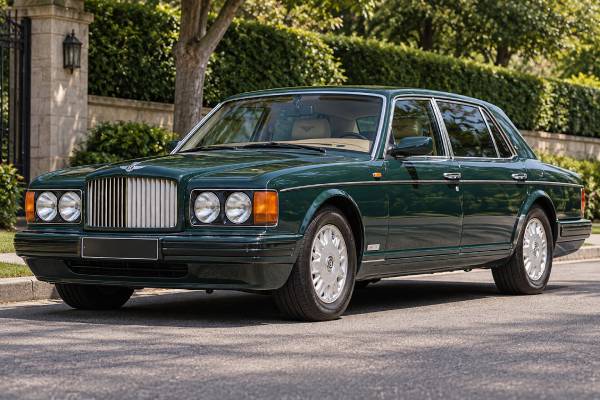
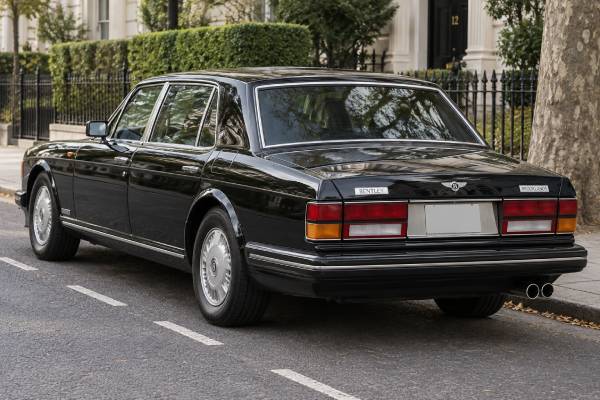
The 1994–1996 Bentley Brooklands LWB is a long-wheelbase luxury saloon built around the more powerful naturally aspirated L410I V8. It combines the approximately 241 hp tune introduced for 1994 with the rear-passenger space of the factory LWB body. Across the three model years it gained dual airbags, improved seats and shift control, 16-inch wheels, then the extensive 1996 body and interior revision. It remained naturally aspirated throughout this assignment scope; the 300 hp light-pressure-turbo LWB belongs to 1997.
The long body gives this Brooklands a clear purpose. It is at its best carrying passengers over distance, where the larger rear footwell, long doors, quiet powertrain, and self-levelling suspension can be appreciated. That same specification creates buying risks. LWB-only trim is scarce, rear-cabin systems are expensive to restore, long doors stress hinges and seals, and a poorly maintained hydraulic system can affect both braking and ride height. A careful buyer should assess provenance and body completeness as closely as the engine.
Table of Contents
- Why the Rear Compartment Comes First
- 1994, 1995, or 1996?
- Technical Layout and Specifications
- Chauffeur and Owner-Driver Experience
- Age-Sensitive Maintenance
- LWB Buyer’s Inspection
- Costs, Originality, and Long-Term Value
Why the Rear Compartment Comes First
The LWB makes sense only when its extra rear space and formal character are part of the buying decision. It is longer, rarer, and less maneuverable than the normal Brooklands, so the rear cabin must be complete, dry, comfortable, and functional.
Bentley extended the wheelbase by roughly 100 mm, placing most of the benefit between the axles rather than adding a decorative rear overhang. The rear door aperture is larger, the footwell is more generous, and tall passengers can sit behind tall front occupants without the intimacy of the standard saloon. The upright roofline and broad glass area make the cabin feel open rather than cocooned.
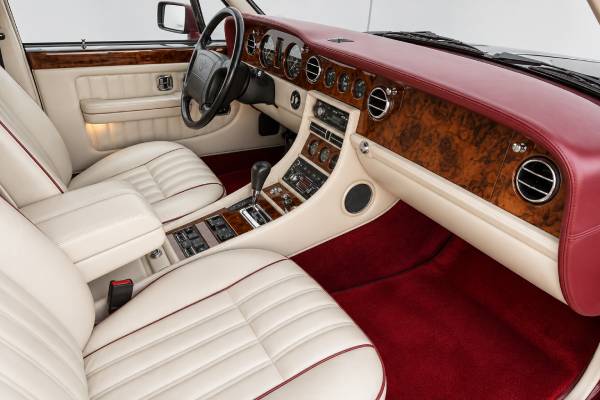
The quality of the rear environment depends on equipment condition. Check the leather for hardening and failed stitching, the veneer for cloudy or lifting lacquer, and the carpet for dampness. Picnic tables, when fitted, should release cleanly, sit level, and close without forcing. Rear reading lights, vanity mirrors, ashtrays, cigar lighters, audio controls, and ventilation outlets may seem minor, but incomplete or broken fittings can be difficult to replace in the correct color and finish.
Temperature control deserves special attention. A long cabin exposes weak blower performance and blocked ducts more clearly than the standard car. Test heating and cooling from the rear seats while the car is stationary and moving. The air should change temperature and distribution in response to controls; illuminated switches alone prove nothing.
The LWB may also have led a working life. Hotel, corporate, wedding, or private chauffeur service can produce extensive idling, frequent door use, short urban trips, and heavy wear at relatively low recorded mileage. Examine hinge pins, latch alignment, rear door checks, driver-seat wear, steering-wheel surface, pedal rubbers, and repeated paint repairs around door edges. A chauffeur car is not necessarily undesirable if maintained properly, but its use pattern should be reflected in price and records.
Production rarity adds context. The complete Brooklands LWB run from 1993 through 1997 totaled 188 cars. Recorded output was 41 cars for 1994, 29 for 1995, and 31 for 1996. The mix shifted from mostly left-hand drive in 1994 toward a nearly even split in 1996. Those numbers mean the right color, market, and specification may take time to find.
1994, 1995, or 1996?
The three years differ most in appearance and cabin equipment, not in basic engine layout. A buyer should choose a year only after locating a structurally sound, hydraulically healthy car with complete records.
The 1994 LWB carries the original Brooklands body style but benefits from the uprated naturally aspirated engine. Driver and passenger airbags became part of the updated specification, the seats were redesigned for better lateral and lumbar support, and Shift Energy Management softened automatic changes by briefly reducing torque. Illuminated picnic tables were also associated with the revised LWB equipment.
A 1995 car retains the early grille, bumpers, quarterlights, and mirrors while adding 16-inch wheels. It therefore suits owners who prefer the original visual treatment but want the later wheel package. Confirm that the wheels are genuine and that replacement tires have the correct load rating; heavy saloons can be unsafe on tires chosen only by size.
The 1996 LWB is visually and functionally different. Its radiator opening is lower, the bumpers and air dam are more fully integrated, exterior mirrors sit on the door cheater panels, the front quarterlights disappear, and body-colored lower surfaces modernize the profile. Inside are a redesigned fascia and console, electric steering-column adjustment with memory, an entry aid, improved front armrest storage, individually controlled rear cooling outlets, and extra headroom from revised seating.
The facelift car may be easier to use but harder to restore after an accident because its front and rear trim are model-year specific. The electric steering column, seat-memory integration, and newer controls also create more diagnostic work when neglected. Earlier simplicity and later convenience are both valid preferences.
Look beyond registration date. A vehicle first registered in early 1996 could be a 1995 model-year car, while a late-built 1996 specification may be registered later. VIN decoding, the Bentley heritage catalogue, original sales documents, and physical features should agree.
Technical Layout and Specifications
The 1994–1996 Brooklands LWB is a petrol ICE car with a front-mounted naturally aspirated V8, four-speed automatic transmission, rear-wheel drive, independent suspension, and high-pressure hydraulic braking. The long body does not use a different engine from the standard-wheelbase 241 hp version.
| Parameter | Value | Technical note |
|---|---|---|
| Engine code | L410I | Naturally aspirated fuel-injected L-series V8 |
| Configuration | 90-degree V8, OHV | Two valves per cylinder and hydraulic tappets |
| Capacity | 6,747 cc (6.75 L) | Often described as 6.8 L |
| Bore × stroke | 104.14 × 99.06 mm | Large-bore, low-speed design |
| Induction | Atmospheric | No turbocharger in 1994–1996 LWB cars |
| Maximum output | 241 hp assignment rating | Historic documents may state PS, bhp, or kW differently |
| Torque | Approximately 500 Nm (369 lb-ft) | Strongest effect is at low engine speed |
| Fuel system | Electronic multi-point injection | Correct diagnosis requires period-system knowledge |
| Fuel capacity | Approximately 108 L (28.5 US gal) | Nominal figures vary in some market records |
| Specification | Published value |
|---|---|
| Gearbox | Four-speed electronically controlled automatic |
| Drive type | Rear-wheel drive |
| Shift refinement | Shift Energy Management from model year 1994 |
| 0–100 km/h | About 9.6 seconds |
| Top speed | About 216 km/h (134 mph) |
| Realistic mixed fuel use | Approximately 19–25 L/100 km (9–12 mpg US) |
| Measure | Value | Practical meaning |
|---|---|---|
| Body style | Four-door long-wheelbase saloon | Factory-built, not an aftermarket stretch |
| Wheelbase | Approximately 3,161 mm (124.4 in) | About 100 mm longer than standard Brooklands |
| Overall length | Approximately 5,375 mm (211.6 in) | Requires a large garage and parking space |
| Width | Approximately 1,890–1,920 mm body width | Mirror-inclusive width is greater |
| Height | About 1,485 mm (58.5 in) | Ride-height condition can alter measurement |
| Kerb weight | Approximately 2,400–2,450 kg | Definition and options change published values |
| Seating capacity | 5 | Rear designed primarily for two adults |
| System | Configuration |
|---|---|
| Front suspension | Independent double wishbones and coil springs |
| Rear suspension | Semi-trailing arms, coil springs, hydraulic self-levelling |
| Steering | Hydraulically assisted rack and pinion |
| Service brakes | Four-wheel discs with two high-pressure hydraulic circuits |
| Anti-lock braking | ABS |
| Wheel progression | 16-inch wheels from 1995; revised 16-inch design for 1996 |
| Year | LHD | RHD | Total |
|---|---|---|---|
| 1994 | 35 | 6 | 41 |
| 1995 | 18 | 11 | 29 |
| 1996 | 15 | 16 | 31 |
Use these values to identify the general version, then confirm the exact car. Market equipment, emissions hardware, wheel packages, and weight definitions can differ. Never order critical parts from a generic “1994–1996 Brooklands” description without the chassis number.
Chauffeur and Owner-Driver Experience
The LWB is smoother and more settled in a straight line, but the extra length asks for deliberate steering and braking. It works best when driven early and gently rather than reacted to at the last moment.
From the driver’s seat, the bonnet corners help place the front of the car, while the rear remains more difficult to judge. The long rear doors and extended wheelbase need extra clearance when turning past gateposts or entering a narrow garage. A careful owner learns to use mirrors continuously and avoids parking spots that require abrupt full-lock corrections.
The 241 hp engine is adequate for the weight. It will not deliver the effortless surge of the 1997 turbo LWB, yet the broad low-speed torque allows dignified progress without revving. The throttle and transmission should behave consistently. Hesitation, a sudden surge, delayed engagement, or a flare between gears needs diagnosis.
Passengers judge the car by smoothness. Accelerate in one continuous movement, release the throttle gradually, and brake early so the high-pressure system can slow the mass without pitching occupants. A healthy car should settle after a bump and maintain rear ride height with passengers aboard. A harsh rear ride may indicate flat accumulator spheres or seized levelling components rather than “sports suspension.”
The longer wheelbase reduces the sensation of pitching over broad undulations. On the other hand, worn rear bushes can let the tail steer slightly, particularly under braking or on uneven surfaces. The driver may describe this as tramlining, but the cause can be rear geometry rather than the front tires.
At cruising speed, the engine should be quiet, the transmission should hold top gear, and the cabin should be free from persistent wind roar. Noise around a rear door can point to sagging hinges, compressed seals, or past body repair. Test the car from the back as well as the front; have another person drive while you listen and assess ride quality.
A 1996 car’s electric steering column improves entry and seating adjustment, but the mechanism must work reliably. Do not force a stalled column. Failure may involve the switch, memory module, motor, gear, wiring, or low system voltage, and careless manual movement can make the damage worse.
Age-Sensitive Maintenance
Time-based work is essential because every example is now old enough for rubber, seals, electrical contacts, and trim adhesives to matter as much as mileage. The best maintenance program begins with evidence, not assumptions.
Obtain a full baseline inspection after purchase. Record engine compression or running condition as appropriate, oil pressure behavior, cooling-system pressure, hydraulic pressure and accumulator reserve, transmission condition, suspension play, tire dates, brake wear, charging voltage, and every non-working electrical item. A written baseline allows future changes to be detected before they become failures.
Cooling-system preservation is critical. Flush only with compatible coolant, inspect hoses that disappear beneath covers, test the radiator rather than judging it by appearance, and verify fan-coupling operation. A weak heater can indicate restricted coolant flow as well as a climate-control fault. Persistent temperature rise in traffic must be solved before the car is used for weddings or long idling periods.
The braking and levelling circuits use high-pressure mineral hydraulic fluid. Fluid contamination can damage seals throughout the system, while old accumulators reduce stored pressure and worsen ride quality. A qualified specialist should test cut-in and cut-out pressure, warning-switch behavior, pump performance, and residual brake reserve. Home experimentation is unsafe because the system can retain pressure after shutdown.
Engine oil should be renewed annually on a lightly used car. Inspect fuel hoses, injection wiring, ignition components, engine mounts, and accessory belts at the same visit. A well-kept L410I should not require constant tuning, but small air leaks or poor electrical connections can make it run much worse than its basic condition suggests.
Transmission work should be conservative when history is unknown. Check for leaks, burnt odor, debris, and incorrect level using the proper procedure. A pan removal, filter change, and measured refill may be appropriate; a power flush can dislodge material in an old unit. Shift quality should be reassessed hot and cold after any service.
The long doors need periodic hinge and latch attention. Lubricate mechanisms with suitable products, correct sag before it damages seals, and keep drain holes clear. Avoid hanging on open doors or allowing wind to catch them. Door alignment affects water sealing, wind noise, window operation, and paint at the edges.
Keep the rear cabin ventilated and dry during storage. Use a breathable cover only in a dry building, maintain the battery with a smart conditioner, and move the car far enough to warm the drivetrain and brakes. Rolling it a few metres or idling it briefly does not prevent fuel deterioration, brake corrosion, or condensation.
LWB Buyer’s Inspection
Inspect the car in an order that prevents a beautiful cabin from distracting from safety and structure. Identity, corrosion, hydraulic condition, cooling behavior, and road performance come before cosmetic perfection.
First, verify VIN, model year, LWB designation, engine type, and original market. Compare the heritage record with the registration and service documents. Check whether the paint, hide, veneer, wheels, and major options match the build. Missing history should lower confidence even when the odometer is low.
Second, inspect the body on a lift. Look at sills, floor edges, jacking points, wheel tubs, rear suspension and subframe zones, door bottoms, screen surrounds, boot floor, and seams hidden by underseal. Search for differences in welds, sealant, and fasteners that indicate structural repair. The center body section and long rear doors should be straight and symmetrical.
Third, test the rear cabin. Operate every table, lamp, outlet, seat control, blind if fitted, window, lock, and ventilation function. Smell for dampness and fuel vapor. Lift removable carpet sections. Compare left and right door closing effort and window speed.
Fourth, evaluate hydraulics from cold. Observe warning-lamp behavior, pressure build, pump noise, brake feel, leaks, and rear ride height. Add passengers or controlled load only under specialist supervision to assess levelling. A rear end that rises slowly or unevenly needs investigation.
Fifth, road-test over different surfaces. Check for steering play, brake pull, transmission delay, vibration, driveline clonk, overheating, body creaks, and rear suspension steering. Perform a hot restart. Reinspect the ground and engine bay for fresh leakage.
Finally, price the work. Separate safety-critical repairs, reliability work, cosmetic work, and optional improvements. Obtain estimates from a workshop willing to put findings in writing. Do not let a seller’s informal promise replace a completed repair or a documented price adjustment.
Costs, Originality, and Long-Term Value
The most valuable LWB is not necessarily the lowest-mileage one; it is the car that remains structurally sound, mechanically current, complete in its rare trim, and supported by a continuous history.
Running costs are governed by condition. Fuel is obvious, but deferred hydraulics, climate control, body repairs, and interior restoration are larger threats. Maintain a contingency fund rather than spending the entire budget on purchase. A car with documented recent hydraulic and cooling work can be worth a substantial premium.
Original wheels and correct tire dimensions support ride quality and value. A 1994 should not be assumed to need the later wheel design, and a 1996 should not be backdated simply because earlier wheels are easier to find. Confirm factory fitment by build information. Any replacement tire must meet load and speed requirements for the heavy saloon.
Color changes reduce originality and can hide corrosion or accident repair. Inspect door shuts, under seals, inside the boot, beneath carpets, and behind trim for the original finish. A high-quality repaint in the original color can be positive; a quick external color change is not.
Interior patina is acceptable when the materials are genuine and usable. Refinished veneer and sympathetically repaired leather can preserve the car. Thick surface coatings, incorrect grain, modern foam shapes, or missing crossbanding are harder to reverse. For an LWB, the rear compartment often determines the car’s identity and should receive the closest scrutiny.
The 1994–1996 naturally aspirated LWB occupies a useful middle ground. It is more powerful and better equipped than the 1993 car, less mechanically intense than the 1997 turbo, and available in both original and facelifted styles. Its rarity makes patience sensible: buy the right example rather than trying to create one from an incomplete car.
Ownership is most rewarding when the car has a defined role. It can be a formal event vehicle, a spacious touring saloon, or a private luxury classic. It is less suitable as an only car in dense urban use or for someone without access to an SZ specialist. With disciplined maintenance and careful storage, the LWB delivers a rear-passenger experience that few modern cars reproduce at any price.
Before choosing an LWB for occasional ceremonial work, test the exact operating pattern it will face. Extended idling with the climate control running, slow processional speeds, repeated door use, and short journeys can be harder on cooling, batteries, window mechanisms, and brakes than a long motorway trip. Build maintenance around that duty: confirm fan performance, keep the charging system strong, lubricate the large door hardware, and schedule full-temperature exercise between events. A car prepared only for appearance may fail in service, while one maintained for its real passenger role can remain both elegant and dependable.
References
- Bentley Brooklands LWB 2026 (Production and Model-Year Changes)
- Bentley Brooklands 1996 2026 (Official Heritage Catalogue)
- Bentley Brooklands Saloon 2026 (Official Model Catalogue)
- Bentley Brooklands Saloon Chassis Information | Technical Specifications & Features 2026 (Chassis Reference)
- Bentley Brooklands (1992–1998) — Common Car Problems, MOT Failures & Pass Rate Data | CarGarages.co.uk 2026 (DVSA-Based Condition Data)
- Detailed Hydraulic Pressure Testing Guide for Rolls-Royce and Bentley Models 2023 (Hydraulic System Guide)
Disclaimer
This article is informational and does not replace professional diagnosis, repair, or an inspection of the specific vehicle. Specifications, torque settings, intervals, fluids, and procedures can differ by VIN, market, equipment, and production date. Verify all work against the official handbook, workshop information, and parts catalogue for the exact chassis.
Please share this guide on Facebook, X/Twitter, or a relevant Bentley owners’ community if it assisted your research and you would like to support our work.