
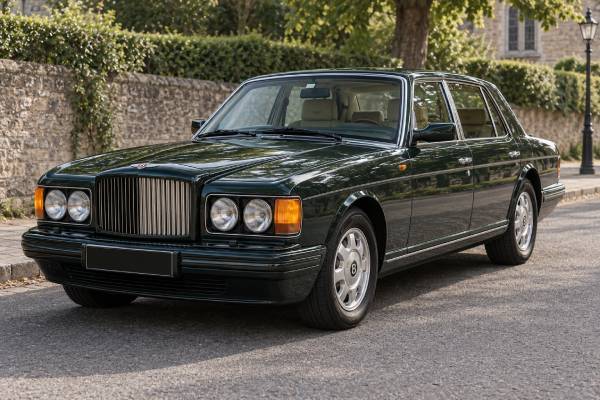
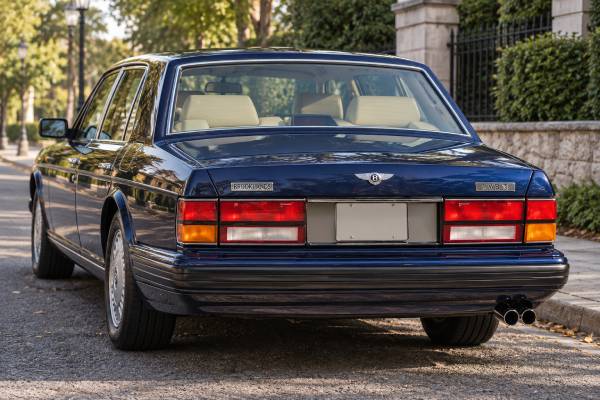
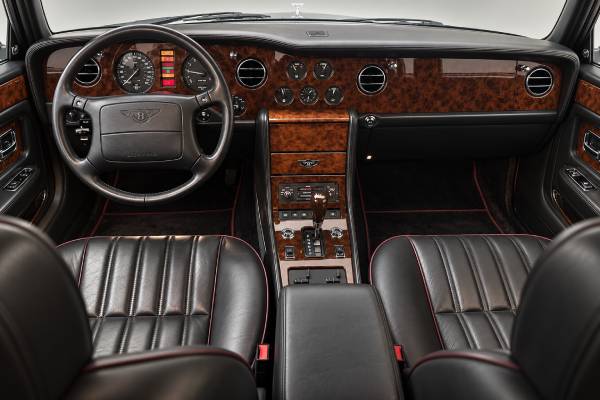
The 1997 Bentley Brooklands LWB is the most developed version of the long-wheelbase Brooklands. It combines the extra rear-compartment length introduced with the 1993 model with the final-year L410MT light-pressure-turbo V8, giving the formal saloon about 300 hp and a stronger reserve of torque than earlier naturally aspirated cars. The result is neither a stretched sports saloon nor a budget limousine. It is a hand-built Crewe car designed to carry four adults at high speed with little noise and effort.
Only 57 Brooklands LWB cars are recorded for the 1997 model year, making this specification much less common than the standard-wheelbase Brooklands. Rarity alone does not make one good. The extra body length, hydraulic rear levelling, large cabin, turbo heat load, and age-sensitive electrical equipment all create inspection points that a general used-car check can miss. A strong example should sit level, cool correctly in traffic, accelerate without smoke or hesitation, and have documentation for its factory specification. The best cars feel composed from either front seat or rear compartment; neglected ones reveal their problems in every system at once.
Table of Contents
- The Role and Rarity of the 1997 LWB
- Passenger Space and Chauffeur Packaging
- LWB Specification Data
- Driving the Turbocharged LWB
- Preserving Ride, Hydraulics, and Cooling
- LWB-Specific Inspection Priorities
- Ownership and Market Position
The Role and Rarity of the 1997 LWB
The 1997 Brooklands LWB was built for buyers who wanted more rear-seat room without moving to a more ostentatious coachbuilt limousine. Its identity comes from the factory long-wheelbase body, the final Brooklands styling revisions, and the 300 hp light-pressure-turbo engine.
The LWB version succeeded the long-wheelbase Mulsanne S and used the extended SZ architecture shared with related Rolls-Royce saloons. The extra length is concentrated in the rear passenger area rather than the boot or engine bay. From outside, the longer rear doors and stretched side profile are the clearest clues. From inside, the gain is obvious in knee room and the ability to sit behind a tall front-seat occupant without compromise.
Production figures underline how specialized it was. The broader Brooklands LWB run totaled 188 cars across model years 1993–1997. Recorded yearly production rose to 57 for 1997, split between left- and right-hand drive. That makes the final-year turbo car the most numerous single LWB model-year group, yet still rare enough that buyers cannot assume a comparable replacement will appear quickly.
The L410MT engine transformed the practical use of the LWB. Earlier versions could maintain high touring speeds, but acceleration with passengers required planning. Turbo torque reduces that sense of inertia. It is especially useful when merging, climbing, or passing with luggage aboard. The change also imposes more demand on cooling, ignition, fuel delivery, automatic-transmission condition, and engine mounts.
The 1997 LWB should not be confused with the Indonesian special edition, the two-car LWB Division commission, or a standard car later fitted with special trim. Those variants may share the same basic powertrain and body length, but their factory records and equipment are different. Correct identification requires VIN and build-sheet evidence, not badges or seller terminology.
A normal 1997 LWB can still be highly individualized. Crewe customers selected paint, hides, piping, veneers, audio equipment, telephones, rear accessories, and market-specific options. The originality question is therefore not whether every car looks alike. It is whether the existing specification matches the factory record and whether later alterations were carried out without damaging the structure or wiring.
Passenger Space and Chauffeur Packaging
The LWB’s main advantage is usable rear space, not an abstract increase in exterior length. It allows adults to sit with relaxed leg angles, makes entry easier through the longer rear doors, and gives the cabin a more formal division between front and rear occupants.
The standard Brooklands is already large, so the LWB difference is best appreciated with the seats occupied. A tall driver can establish a proper driving position without forcing the rear passenger’s knees against the seatback. Rear passengers have more freedom to cross their legs, use footrests or accessories where fitted, and enter without twisting around the front seat. For chauffeur use, that flexibility is the reason to accept the longer body.
The extra length changes the way the car fits into real life. It needs more care in underground garages, short parking bays, narrow hotel entrances, and multi-point turns. The long rear doors need generous opening space, and their weight increases strain on hinges and check straps. Door alignment should therefore be judged with the car on level ground and after opening each door fully.
Rear comfort depends on more than dimensions. The self-levelling system must hold the designed ride height when two adults and luggage are added. Dampers, bushes, subframe mounts, and tires must be correct. An LWB that pitches or floats can be tiring, while a properly set-up car isolates broken surfaces without losing control of body movement.
Climate performance is equally important. A large leather-lined cabin can absorb considerable heat, particularly in dark colors and hot markets. The air-conditioning should cool the rear compartment while the car idles, not only at road speed. Rear outlets must deliver air, heater controls must change temperature correctly, and condensate drains must not wet the carpets.
Equipment varies. Some cars have picnic tables, rear vanity mirrors, upgraded audio, telephones, drinks storage, special lighting, or bespoke embroidery. Every fitted function should be tested, but preservation should be sympathetic. Removing period telephones can leave holes and cut looms; retaining nonfunctional equipment can drain batteries or complicate diagnosis. The best approach is documented conservation or a reversible professional update.
For an owner-driver, the LWB still has merit. It provides a calmer rear cabin for family travel and can feel exceptionally stable on motorways. It is less agile in tight bends than the standard-wheelbase car, however, and the driver must account for the additional body behind the front seats. Buyers should choose it because they will use the space, not simply because the production number is smaller.
LWB Specification Data
This model is a conventional petrol ICE vehicle with a front-mounted turbocharged 6.75-litre V8, four-speed automatic transmission, rear-wheel drive, and a factory-extended four-door body. Exact homologation figures vary by market, but the key distinction from the standard Brooklands is the longer wheelbase and associated mass.
| Specification | Value | Ownership relevance |
|---|---|---|
| Engine family | L410MT | Light-pressure-turbo L-series V8 |
| Configuration | 90-degree OHV V8, 2 valves per cylinder | Hydraulic tappets and a gear-driven camshaft |
| Displacement | 6,747 cc (6.75 L) | Commonly marketed as 6.8 L |
| Induction | Single light-pressure turbocharger | Heat management and hose condition are critical |
| Fuel system | Electronic fuel injection and engine management | Diagnosis should consider sensors, ignition, and boost control together |
| Maximum power | About 300 bhp (224 kW) | Some period sources state 304 PS |
| Maximum torque | Approximately 600–605 Nm (443–446 lb-ft) near 2,000 rpm | Delivers the LWB’s relaxed loaded performance |
| Item | Specification |
|---|---|
| Transmission | 4-speed electronically controlled automatic |
| Drive | Rear-wheel drive |
| Engine position | Front longitudinal |
| Steering | Power-assisted rack and pinion with electrically adjustable column |
| Traction system | Market- and option-dependent electronic assistance |
| Rear ride-height control | Hydraulic self-levelling |
| Measure | Approximate figure | Comment |
|---|---|---|
| 0–100 km/h | About 8.0–8.5 seconds | The LWB’s additional mass may affect test results |
| Top speed | About 225 km/h (140 mph) | Comparable to the standard turbo Brooklands in period data |
| Fuel tank | About 108 L (28.5 US gal) | Actual usable capacity and gauge behavior should be checked |
| Typical mixed consumption | Approximately 19–26 L/100 km (9–12 mpg US) | Urban chauffeur work can be heavier |
| Best use | Long-distance, multi-passenger touring | Short cold trips are mechanically unfavorable |
| Specification | 1997 Brooklands LWB | Standard-wheelbase context |
|---|---|---|
| Body | 4-door long-wheelbase saloon | Longer rear doors and passenger cell |
| Overall length | Approximately 5,370 mm | Roughly 100 mm longer than the standard body |
| Wheelbase | Approximately 3,161 mm | About 100 mm added between the axles |
| Width | About 1,890–1,920 mm excluding mirrors | Broadly shared with the standard car |
| Height | About 1,485 mm | Correct hydraulic ride height matters |
| Kerb weight | Approximately 2,400–2,450 kg | Definition and equipment alter published numbers |
| Seating | 5 | Four-person use best expresses the cabin |
| Component | Specification | Inspection priority |
|---|---|---|
| Front suspension | Independent double wishbones and coil springs | Bushes, ball joints, dampers, alignment |
| Rear suspension | Semi-trailing arms, coils, hydraulic levelling | Spheres, valves, leaks, loaded ride height |
| Brakes | Four-wheel discs, ABS, high-pressure hydraulics | Pressure build, accumulator reserve, warning lamps |
| Optional brake package | Turbo R-type hardware on some cars | Confirm from build records and parts fitted |
| Typical wheels | 16-inch Bentley alloys | Check originality, cracking, and repairs |
| Tires | Matching high-load, high-speed rated set | Age and construction matter more than tread alone |
Dimensions should be verified against the official documentation for the specific chassis, particularly on cars with market-specific bumpers or coachwork. Do not use ordinary Brooklands figures to order body, exhaust, propeller-shaft, brake-line, or interior parts for an LWB without checking the relevant part number.
Driving the Turbocharged LWB
The turbo LWB should feel calm rather than slow. Its torque masks the body length in straight-line driving, while the stretched wheelbase becomes most apparent during tight turns, abrupt lane changes, and braking on uneven surfaces.
At low speed, the steering is light and the automatic transmission should take up drive smoothly. The long nose and rear overhang demand deliberate positioning, but visibility is good by modern luxury-car standards. Parking sensors were not part of the ordinary period specification, so any fitted system is likely later and should be evaluated for wiring quality.
On an open road, a healthy L410MT car builds speed with little engine noise. The turbocharger should not announce itself with a hard step in power. Instead, the driver feels a sustained push as the throttle opens. Loaded acceleration is the important test: two rear passengers should not turn the car into a reluctant machine. Hesitation, misfire, smoke, or a falling boost response suggests work is needed.
The long wheelbase brings excellent straight-line composure. Crosswinds and motorway undulations are handled with an unhurried motion when dampers and bushes are sound. The cost is slower rotation into bends. Smooth steering inputs keep the body settled; aggressive corrections make occupants aware of the car’s mass.
Ride quality must be assessed in both front and rear seats. A driver can accept movement that a rear passenger finds uncomfortable. Ask someone to sit in the rear during the road test and report pitching, vibration, wind noise, driveline hum, and air-conditioning performance. A premium inspection of an LWB is incomplete without this second perspective.
Brakes should provide strong deceleration with a firm, short-travel pedal. The longer body can exaggerate nose movement if rear damping or levelling is poor. A pull under braking may come from calipers, tires, suspension bushes, or road camber; it should not be dismissed as age. Repeat stops after the system is hot to reveal fade or pressure issues.
Noise can locate faults. A thump when selecting Drive may be a mount or driveline joint. A drone that rises with speed may come from tires, wheel bearings, differential, or propeller shaft. A knock behind the rear seat may involve levelling hardware or suspension mounts. Because trim insulation is extensive, a specialist lift inspection is often needed to confirm the source.
Preserving Ride, Hydraulics, and Cooling
The LWB remains satisfying only when its support systems work as a whole. Cooling and hydraulics deserve priority because failures in either can turn a drive-ending warning into major engine or brake-system expense.
For cooling, inspect the radiator internally and externally, test the viscous fan and auxiliary fans, verify thermostat operation, pressure-test the system, and examine every accessible hose. Rear-cabin heating and long coolant routes add possible leak points. Dried residue at a joint is evidence, even when the coolant level is currently correct.
The turbocharger increases under-bonnet heat, so brittle wiring, cooked vacuum hoses, loose intake clamps, and deteriorated heat shields should be expected on an untouched car. Replace only with materials suitable for the temperature and fluid involved. Generic hose substitutions can collapse under vacuum, soften in oil vapor, or fail at a hidden bend.
Hydraulic service should be based on pressure measurements. Accumulator spheres lose their nitrogen charge over time, which reduces reserve and changes ride or pedal behavior. Pumps, pressure switches, hoses, distribution valves, rear levelling valves, and calipers can all leak or wear. Correct mineral hydraulic fluid is mandatory; contamination with conventional brake fluid is a severe problem.
The LWB’s rear suspension should be checked under load. Measure ride height before and after adding passengers, observe how quickly the car corrects, and look for repeated pump cycling. A rear that remains high after unloading can be as significant as one that sags. Mechanical linkages and valve adjustment matter alongside hydraulic pressure.
Annual oil changes remain sensible even at low mileage. Transmission fluid, differential oil, coolant, and hydraulic fluid should be assessed by both age and condition. Keep written records of brands and specifications so incompatible products are not mixed later. A notebook in the car can also record temperature behavior, fluid usage, and intermittent warning lamps between services.
Battery health affects many apparent faults. A large saloon with infrequent use, interior lamps, alarm systems, telephones, and audio equipment can develop low-voltage behavior quickly. Use an appropriate maintainer during storage, but first measure parasitic draw. A charger should not conceal an excessive drain caused by a stuck relay or added equipment.
Exercise the car through full heat cycles. Run the air conditioning year-round, operate every seat and window, and apply the brakes firmly enough to keep surfaces clean. Rotate use of rear controls and accessories. A system that is never operated often fails just when it is needed.
LWB-Specific Inspection Priorities
A general SZ inspection is necessary but not sufficient for the LWB. The extended rear doors, longer structure, rear equipment, levelling behavior, and unique trim pieces deserve separate checks because replacements can be scarce and expensive.
Doors, apertures, and structure
Open each long rear door fully and watch for dropping, rubbing, or movement at the hinges. Inspect check straps, seals, window frames, drains, and lower seams. Compare gaps on both sides. Uneven alignment can come from hinge wear, previous body repair, corrosion, or structural movement. Check the extended sill sections and jacking areas from beneath.
Rear compartment
Move the front seats through their full range while checking rear clearance. Test rear lamps, vanity mirrors, reading lights, audio controls, outlets, tables, telephones, and any bespoke equipment. Inspect veneer edges and leather where passengers’ shoes contact trim. Lift removable mats to look for moisture.
Loaded suspension test
An empty car can hide a weak levelling system. With permission, place adults in the rear, start the engine, and observe correction. The car should settle to a level stance without warning lamps, fluid leakage, or constant pump noise. Road-test it loaded if possible.
Cooling under realistic conditions
A short drive in cool weather proves little. Allow the car to idle after reaching full temperature, operate the air conditioning, and watch the gauge. Then inspect for coolant odor, fan behavior, and fresh seepage. Buyers in hot climates should seek evidence that the radiator and fans have been serviced, not merely that coolant was changed.
Identity and model designation
Confirm LWB status through the VIN and build records. Measure or compare the rear door and wheelbase if any doubt remains. Special-edition plaques should not be accepted without corresponding documentation. A standard LWB with later Mulliner-style trim may still be desirable, but it must be represented accurately.
Corrosion assessment should include screen surrounds, wheelarches, lower front wings, door bottoms, sills, boot floor, fuel-filler area, rear suspension mounts, and the seams affected by the extended body. Paint depth and underside inspection help distinguish sound preservation from cosmetic refurbishment.
Ownership and Market Position
The 1997 LWB suits a buyer who will use its rear space and who has access to a workshop familiar with Crewe hydraulics and late SZ electronics. It is a poor choice for someone seeking the cheapest entry into Bentley ownership or expecting ordinary luxury-car running costs.
Its market is narrower than that for the standard-wheelbase car. Owner-drivers often prefer the shorter body, while collectors may focus on the Indonesian, Division, Mulliner, or Brooklands R derivatives. That can make a normal LWB good value, but it also means resale may require patience. Excellent history and an attractive original commission are more important than a speculative production claim.
Budget for a baseline service after purchase even when the seller has recent invoices. Independent verification protects both sides. Tires, batteries, cooling work, hydraulic testing, air-conditioning repairs, and small electrical faults can create a substantial first-year bill without any catastrophic failure. A reserve should also cover one major system.
Choose condition before color, and mechanical evidence before mileage. A regularly driven car with documented radiator, accumulator, hose, brake, and suspension work is usually preferable to a low-mileage example that has sat in a collection. Conversely, high mileage without interior care or body preservation can make LWB-specific trim restoration difficult.
The most valuable documentation includes the factory build sheet, service books, annual invoices, hydraulic test results, cooling-system work, tire dates, alignment records, transmission service, and photographs of restoration. Receipts that identify part numbers and the workshop are far more useful than stamps alone.
Before purchase, decide how the car will be stored and driven. The LWB needs a sufficiently long, dry garage, a battery strategy, regular exercise, and space to open its doors. If it will be used for events or passenger transport, confirm insurance, tire condition, air-conditioning performance, and roadside recovery arrangements.
A sorted example delivers something modern luxury cars rarely reproduce: a spacious rear cabin connected to a softly audible, low-revving V8 and a chassis that breathes with the road. The 1997 turbo powertrain removes the one major practical weakness of earlier LWB Brooklands cars. Preserved correctly, it is an exceptionally discreet way to travel.
References
- Bentley Brooklands LWB 2024 (Model History)
- Bentley Brooklands LWB 1993 2024 (Bentley Heritage Collection)
- Bentley Brooklands 2024 (Powertrain and Model-Year History)
- Bentley Brooklands Saloon Chassis Information | Technical Specifications & Features 2025 (Chassis Reference)
- Detailed Hydraulic Pressure Testing Guide for Rolls-Royce and Bentley Models 2025 (Technical Guide)
- Bentley Brooklands (1992–1998) — Common Car Problems, MOT Failures & Pass Rate Data | CarGarages.co.uk 2026 (Inspection Data)
Disclaimer
This article is for informational purposes and does not replace diagnosis, repair, or restoration by a qualified Bentley specialist. Specifications, torque values, service intervals, hydraulic procedures, and equipment can differ by VIN, market, and factory commission; check the official service literature and build record for the individual car. Please share this guide on Facebook, X/Twitter, or a suitable owners’ group if it was useful.