
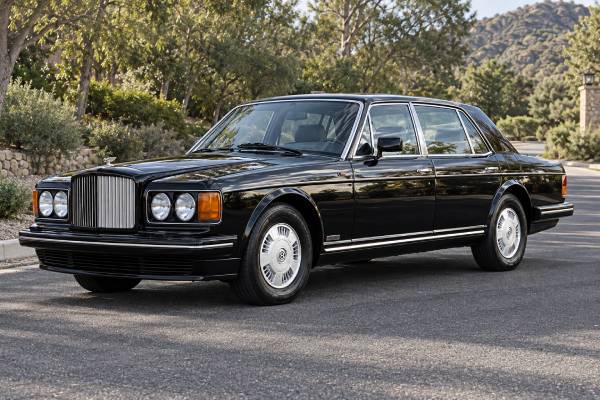
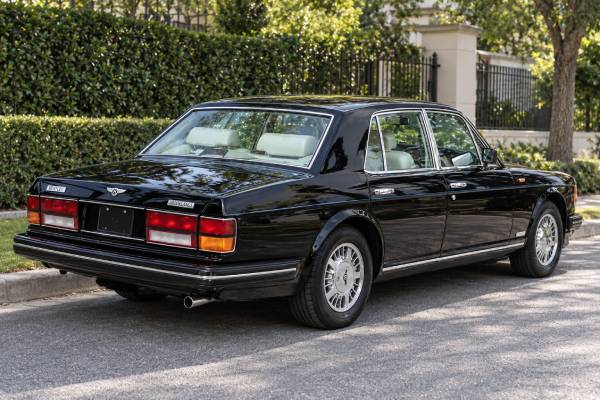
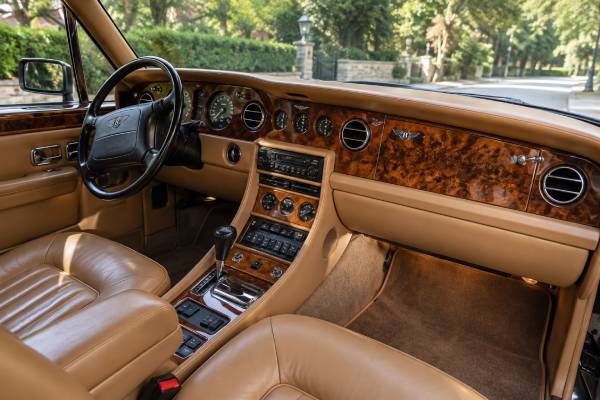
The 1993 Bentley Brooklands LWB is the rear-passenger-focused version of Bentley’s first Brooklands saloon. It combines the naturally aspirated 6.75-litre L410I V8 and four-speed automatic of the standard car with a longer wheelbase, a more spacious rear compartment, and the formal proportions associated with Crewe’s chauffeur-oriented models. It is not a stretched conversion performed after production; the LWB was a factory derivative with model-specific body and trim parts.
For a modern buyer, the extra length changes more than rear legroom. It affects maneuverability, body condition, rarity, and the way the car should be inspected. Only 30 Brooklands LWB cars are recorded for model year 1993, most of them left-hand drive, making exact identity and originality especially important. The LWB is still mechanically related to other SZ cars, but trim and long-body components can be harder to replace. The right example offers a remarkably private, quiet cabin. The wrong one can conceal costly hydraulic, structural, and interior problems beneath impressive paint and leather.
Table of Contents
- LWB Purpose, Identity, and Rarity
- Rear Space and Everyday Practicality
- 1993 LWB Specifications
- Driving the Long-Wheelbase Brooklands
- Preservation and Service Strategy
- Pre-Purchase Inspection by Area
- Who Should Buy One
LWB Purpose, Identity, and Rarity
The LWB was created for buyers who placed rear-seat comfort ahead of compact exterior dimensions. Its longer center section gives the rear compartment a more generous footwell and door aperture while preserving the Brooklands’ traditional saloon shape.
Bentley’s standard Brooklands replaced the Mulsanne S and Bentley Eight for 1993, while the Brooklands LWB succeeded the Mulsanne S LWB. The design retained the square SZ roofline, broad glass area, and upright seating position, but adopted Brooklands details such as the color-keyed vaned grille, revised front air dam, new alloy wheels, and console-mounted leather gear selector. First-year cars also carried green-enamel Bentley badges when built to original specification.
Production data matters because the LWB is substantially rarer than the normal saloon. The full 1993–1997 Brooklands LWB run totaled 188 cars. For model year 1993, 30 were built: 28 left-hand-drive and two right-hand-drive. Those numbers do not automatically make every survivor highly valuable, but they make a correct chassis and complete long-wheelbase trim more significant. A heavily modified or poorly repaired car may be difficult to return to factory form.
The fifth character of the VIN and the model-year chassis range help distinguish the genuine LWB from a standard car. On 1993 examples, the relevant chassis numbers fall within the early Brooklands LWB sequence beginning in the 46260 range and extending through the 46701 range. The official Bentley heritage catalogue can also identify a car by chassis number. Buyers should obtain the build specification rather than relying on a registration document that merely says “Brooklands.”
The LWB should not be confused with the later Brooklands LWB Division. The Division was a rare 1997 partition-equipped derivative based on the Silver Spur Division concept. A normal 1993 LWB has no fixed division, no special 1997 turbo engine, and no unique limousine chassis series. It is best understood as an extended-wheelbase luxury saloon for private or chauffeur use.
Rear Space and Everyday Practicality
The main reason to choose the LWB is its rear compartment, not a performance advantage. The extended wheelbase creates more usable knee and foot space and makes the car better suited to tall passengers, formal transport, or relaxed long-distance travel.
Rear access is a major benefit. The longer rear doors open into a less constrained footwell, allowing passengers to enter without twisting around the front seatback. Once seated, occupants have a more generous distance to the front seats and a stronger sense of separation from the driver. Optional picnic tables and rear-compartment equipment can reinforce that effect, although equipment varies by chassis.
The cabin should be evaluated as a complete environment. Check whether the rear air outlets deliver temperature-controlled air, whether reading lamps and vanity mirrors operate, whether the picnic tables are secure and level, and whether rear seat belts retract correctly. A functioning front climate-control panel does not guarantee that the rear receives proper airflow. Blocked ducts, failed servos, heater-valve problems, or weak blower performance can make the back of a long car uncomfortable.
The added wheelbase does not create an enormous luggage compartment. The boot remains shaped around the rear suspension, fuel tank, spare wheel arrangement, and body structure. Suitcases fit, but the car is not a modern hatchback and the rear seat does not fold. Before buying for touring use, test the actual luggage you expect to carry.
City use requires planning. The LWB is longer than the already large standard saloon, and its turning circle, long rear doors, broad body, and limited rearward visibility make tight parking awkward. Parking sensors and cameras were not part of the original specification. Any retrofitted equipment should be assessed for quality and reversibility, especially if installers drilled rare trim or altered original wiring.
Chauffeur use can also produce unusual wear patterns. A low-mileage car may have spent long periods idling, making short trips, or carrying passengers in the rear while the driver’s seat and front door saw constant use. Inspect the rear cabin for spilled drinks, sun damage, heater use, damaged tables, and worn carpets, but also examine the driver’s seat bolster, steering wheel, pedals, and door hinges for evidence that the odometer does not tell the whole story.
1993 LWB Specifications
This version is a naturally aspirated petrol ICE saloon with the L410I V8, a four-speed automatic, and rear-wheel drive. Its technical distinction from the standard 1993 Brooklands is primarily the longer wheelbase and body, not a different engine tune.
| Item | 1993 Brooklands LWB |
|---|---|
| Factory body type | Four-door long-wheelbase saloon |
| Model year covered | 1993 |
| Platform family | SZ |
| 1993 production | 30 cars |
| 1993 steering split | 28 LHD, 2 RHD |
| Total 1993–1997 LWB production | 188 cars |
| Early 1993 LWB chassis span | Within 46260–46701 model-year sequence |
| Specification | Value | Context |
|---|---|---|
| Engine | L410I 90-degree V8 | Naturally aspirated, electronic fuel injection |
| Displacement | 6,747 cc (6.75 L) | Commonly marketed as 6.8 L |
| Valve gear | OHV, 16 valves | Central camshaft, hydraulic tappets |
| Bore × stroke | 104.14 × 99.06 mm | Period L-series dimensions |
| Compression ratio | 8.0:1 | Period naturally aspirated tune |
| Rated output | 232 hp for this assignment variant | Period publications use several power standards |
| Peak torque | Approximately 450–460 Nm at 1,500 rpm | Published values vary by market documentation |
| Fuel | Premium unleaded petrol | Use the octane stated for the car’s market handbook |
| Fuel capacity | Approximately 108–113 L | Documentation uses slightly different capacity definitions |
| Specification | Value |
|---|---|
| Transmission | Four-speed electronically controlled automatic |
| Driven wheels | Rear |
| 0–100 km/h | About 10.6 seconds |
| Maximum speed | About 202 km/h (126 mph) |
| Performance character | Low-rpm torque and quiet cruising rather than rapid acceleration |
| Practical mixed consumption | Commonly around 19–25 L/100 km (9–12 mpg US) |
| Measure | Approximate factory value | Difference that matters |
|---|---|---|
| Length | About 5,375 mm (211.6 in) | Longer center body than standard Brooklands |
| Wheelbase | About 3,161 mm (124.4 in) | Roughly 100 mm more than standard wheelbase |
| Width | About 1,920 mm (75.6 in), body only | Mirror-inclusive figures are wider |
| Height | About 1,480 mm (58.3 in) | Varies slightly with load and levelling condition |
| Kerb weight | Approximately 2,400 kg (5,291 lb) | Source definitions and equipment alter the published figure |
| Seating | 5 | Rear compartment optimized for two principal passengers |
| System | Specification |
|---|---|
| Front suspension | Independent double wishbones, coil springs, anti-roll control |
| Rear suspension | Independent semi-trailing arms with hydraulic self-levelling |
| Steering | Power-assisted rack and pinion |
| Brakes | Four-wheel discs with high-pressure dual hydraulic circuits and ABS |
| Typical tire size | 235/70 R15 |
| Typical wheel specification | 6.5J × 15 alloy, period fitment |
Dimensions and weights should always be checked against the exact chassis documentation. Registration records may round measurements, list mirror-inclusive width, or apply a local definition of empty weight. A car’s current ride height can also distort measured height if the rear levelling system is not operating correctly.
Driving the Long-Wheelbase Brooklands
The LWB drives like a more deliberate version of the standard Brooklands. It is stable, quiet, and composed on open roads, but the extra length is noticeable in tight bends, parking spaces, and sudden transitions.
The naturally aspirated V8 produces its useful torque at very low speed. That allows the automatic to move the car away without drama and minimizes downshifts during normal touring. Full-throttle acceleration is steady rather than forceful, and the engine should remain smooth across the rev range. A flat spot, hesitation, fuel smell, or uneven idle is a fault, not an expected feature of an old low-output V8.
At motorway speeds, the longer wheelbase helps the car feel settled. Small road disturbances are absorbed without the body pitching as sharply as a shorter car might. Crosswinds and deep road grooves can still move a vehicle with this frontal area and tire profile, so correct tire pressures, matched tires, sound steering joints, and proper alignment are essential.
The best way to corner is to complete most braking before turn-in, use one clean steering input, and let the car settle before adding power. Aggressive mid-corner corrections expose worn bushes and can make the body feel cumbersome. A healthy LWB should not lurch, steer from the rear, or require constant correction. If it does, investigate the rear suspension, levelling system, tire condition, wheel alignment, and steering rack mountings.
Braking is powerful when the high-pressure system is healthy. Pedal feel is firmer and shorter than a conventional vacuum-assisted car, so first-time drivers need a few stops to adapt. The car should not pull, pulse, or illuminate a pressure warning. Because of the mass, brake condition and tire grip matter more than the modest engine output might suggest.
Noise levels can reveal condition. Wind noise around the longer doors may indicate tired seals or poor alignment. Rear suspension knocks can travel through the large cabin. A low hum that changes with road speed may be a wheel bearing or tire rather than the differential. Test from both front and rear seats, because sounds that are obvious to a passenger may be masked at the wheel.
Preservation and Service Strategy
An LWB Brooklands should be maintained on time as well as mileage. Low annual use does not protect hydraulic spheres, coolant hoses, seals, tires, batteries, or leather from aging.
Create a condition baseline before cosmetic upgrades. The priorities are safe hydraulic pressure, stable engine temperature, correct fluid levels, sound tires, working lights, and predictable steering. Only after those areas are proven should money go into veneer refinishing, audio modernization, or paint correction.
The cooling system deserves annual attention. Inspect the radiator, coolant reservoir, water pump, thermostat operation, fan coupling, heater hoses, and hidden pipes. A vehicle used for ceremonies or chauffeur work may idle for long periods with little airflow, which is harder on an old cooling system than steady road use. Verify temperature behavior in traffic, not only on a short open-road test.
Hydraulic mineral oil must be the correct type and uncontaminated. The two pressure circuits, pumps, accumulators, warning switches, valves, hoses, calipers, and rear levelling equipment should be assessed together. Replacing one failed sphere without checking the rest can leave the system unbalanced. Pressure testing is specialist work because stored hydraulic energy can be dangerous.
Annual engine-oil service is sensible even at very low mileage. Inspect ignition components, fuel hoses, vacuum lines, accessory belts, and engine mounts at the same time. The large V8 should start readily and settle to a smooth idle. Repeated cold starts without full warm-up encourage condensation and fouling; regular 30- to 60-minute drives are healthier than monthly idling in a garage.
The automatic transmission benefits from clean fluid, a sound cooler circuit, and correct adjustment. If history is uncertain, inspect the fluid and pan before deciding on service. Avoid a machine flush on an unknown high-mileage unit. A specialist may recommend a staged drain, filter replacement, and careful refill using the correct specification.
Long-wheelbase body preservation requires attention to drains and seals. Keep door and sunroof drains clear where fitted, dry the carpets after any leak, and inspect the lower door structures. Water trapped under thick sound insulation can damage floors before the cabin feels wet. The long rear doors also place greater leverage on hinges; lubricate and adjust them before sagging damages latches or paint edges.
Leather and veneer respond best to gentle care. Avoid heavy silicone dressings, household cleaners, and aggressive recoloring. Original leather can often be cleaned and fed, while cracked lacquer may be refinished by a specialist. A sympathetic interior with light patina is usually more convincing than one coated in glossy dye.
Pre-Purchase Inspection by Area
Inspect the LWB as a rare body first and a luxury car second. A strong engine does not compensate for a corroded structure, incomplete rear compartment, or contaminated hydraulic system.
Identity and documentation
Match the VIN on the car to the registration, service book, invoices, and official heritage record. Confirm that it is listed as a Brooklands LWB and that the model year is 1993. Ask for original handbooks, keys, tool kit, spare-wheel equipment, and build information. Review dates as well as mileage to find long storage gaps.
Extended body and doors
Examine sills, floor seams, wheelarches, door bottoms, jacking areas, rear subframe zones, screen surrounds, and the boot floor. Open each rear door halfway and lift gently at the trailing edge; movement may indicate hinge or pillar wear. Check that the doors close without being slammed and that the glass meets the seals evenly.
Rear compartment
Sit in both rear positions. Test seat movement if fitted, reading lamps, ventilation outlets, tables, cigar lighters or power sockets, audio controls, and all switches. Lift floor mats and press the carpet for moisture. Look under the front seats for damaged wiring caused by passengers’ shoes or aftermarket equipment.
Hydraulic operation
Start from cold and watch both brake-pressure warnings. They should go out as pressure rises. With a specialist present, assess accumulator reserve, pump cut-in behavior, leaks, levelling response under load, and fluid condition. The rear should not remain low, rise unevenly, or sink rapidly after parking.
Road test
Drive on rough and smooth roads, make several full-lock turns, brake progressively from different speeds, and cruise long enough to heat the drivetrain. Listen for body movement around the center pillars and long doors. Repeat the start after heat soak. Check for fuel vapor, coolant odor, transmission delay, and warning lights.
Originality and substitutions
Verify wheels, tire size, steering wheel, grille, badges, mirrors, lighting, audio equipment, and upholstery pattern. Some later upgrades improve usability, but undocumented changes can conceal accident repair or parts scarcity. Long-wheelbase-specific trim should be valued because replacing it may require used parts or custom fabrication.
The final inspection should be performed by a workshop that regularly services SZ-series Rolls-Royce and Bentley cars. A normal roadworthiness test may identify worn tires or weak brakes but will not establish hydraulic reserve pressure, correct model identity, or the condition of hard-to-access cooling and body components.
Who Should Buy One
The 1993 LWB is ideal for an enthusiast who values rear comfort, rarity, and formal Crewe craftsmanship more than acceleration or easy city parking. It makes the strongest case as a touring car, event vehicle, or carefully used private saloon with access to specialist support.
Choose it over the standard-wheelbase car when rear passengers are a genuine priority. The normal Brooklands is easier to maneuver and usually offers a broader selection of cars. The LWB justifies its added size only when the extra cabin space and rarer specification matter to the owner.
Choose the naturally aspirated 1993 version over a 1997 turbo LWB when smoothness, simplicity, and early styling are more important than speed. The later light-pressure-turbo car is much quicker, but it adds turbo hardware, greater heat output, and additional performance-related maintenance. Neither is inexpensive to restore; condition remains more important than the engine specification.
A realistic budget includes insurance, secure dry storage, fuel, annual specialist servicing, periodic hydraulic work, tires selected for load and age, climate-control repairs, and cosmetic preservation. Do not calculate affordability from the purchase price alone. A cheap LWB with neglected systems can require several major work packages at once.
Use the car regularly but thoughtfully. Bring the engine fully to temperature, operate the climate control and windows, exercise the brakes, and avoid leaving the fuel tank nearly empty for long storage. Maintain battery voltage with an appropriate conditioner, but investigate any drain rather than permanently masking it.
Value is strongest in cars with original colors, intact rear trim, clean structure, correct wheels, a complete history, and recent specialist work. Very low mileage is attractive only when accompanied by evidence that the car was maintained during storage. A higher-mileage example that has been driven and serviced consistently may be mechanically healthier.
The LWB is not the default Brooklands; it is the specialist choice within the range. That distinction is its appeal. It delivers the traditional experience of traveling in the rear of a hand-built Bentley without the fixed partition or extreme rarity of a Division model. Bought carefully, it can be both usable and historically interesting. Bought on appearance alone, its size and complexity can turn small neglect into a disproportionate restoration bill.
References
- Bentley Brooklands LWB 2026 (Model History and Production Data)
- Bentley Brooklands LWB 1993 2026 (Official Heritage Catalogue)
- Bentley Brooklands Saloon 2026 (Official Model Catalogue)
- Bentley Brooklands Saloon Chassis Information | Technical Specifications & Features 2026 (Chassis and Engine Identification)
- Bentley Brooklands (1992–1998) — Common Car Problems, MOT Failures & Pass Rate Data | CarGarages.co.uk 2026 (DVSA-Based Inspection Data)
- Detailed Hydraulic Pressure Testing Guide for Rolls-Royce and Bentley Models 2023 (Hydraulic System Guide)
Disclaimer
This article is provided for informational purposes and does not replace professional diagnosis, repair, or a chassis-specific inspection. Specifications, fluid requirements, torque settings, intervals, and procedures may differ by VIN, destination market, production date, and optional equipment. Confirm all technical work with the official handbook and service documentation for the exact vehicle.
Please share this article on Facebook, X/Twitter, or an appropriate Bentley community if it helped with your research and you would like to support our work.