
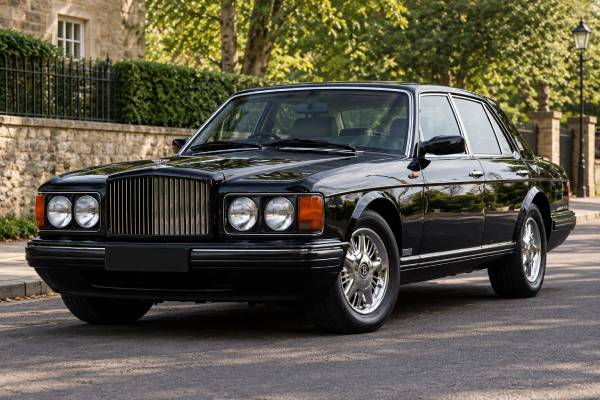
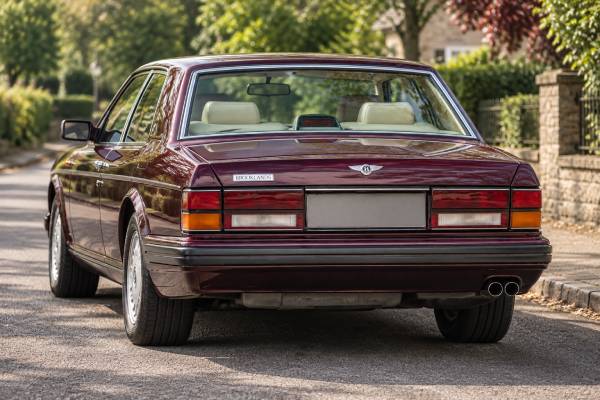
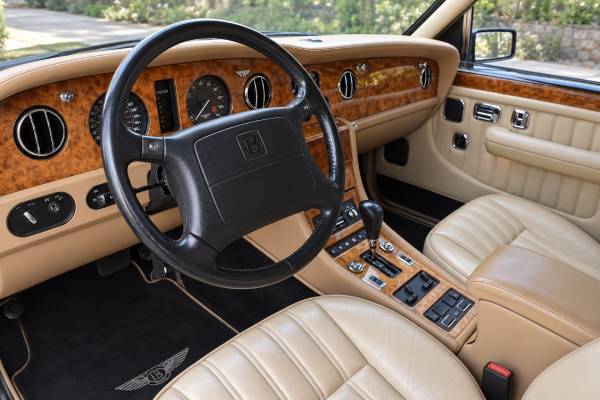
The 1994–1996 Bentley Brooklands is the most developed naturally aspirated version of the SZ saloon. It keeps the 6.75-litre L410I V8 and rear-wheel-drive four-speed automatic layout, but adds the 1994 power increase, dual front airbags, revised seats, smoother shift management, later 16-inch wheels, and a substantial 1996 exterior and cabin update. These changes make it more usable than the 1993 launch model without moving into the turbocharged character of the 1997 car.
There is no single “best” year within this three-year span. A 1994 car has the early body with meaningful safety and drivability improvements. A 1995 example adds 16-inch wheels while retaining the original quarterlight and bumper treatment. A 1996 car looks and feels newer because of its integrated bumpers, lower grille, door-mounted mirrors, revised fascia, electric steering-column adjustment, and extra headroom. Condition still outweighs model year. Buyers should prioritize hydraulic health, cooling-system integrity, corrosion-free structure, complete electrical operation, and credible specialist records before debating cosmetic details.
Table of Contents
- How the 1994–1996 Cars Evolved
- Model-Specific Technical Data
- Naturally Aspirated Performance
- What Changed for 1996
- Maintenance by System
- Fault Finding and Inspection
- Choosing the Right Year and Car
How the 1994–1996 Cars Evolved
The essential mechanical character remained stable, but Bentley made the Brooklands safer, more comfortable, and more contemporary during these years. The most important dividing line is the 1996 facelift, not a change in basic engine architecture.
For 1994, Bentley increased maximum output by roughly six percent, producing the 241 hp assignment specification. The car also gained driver and front-passenger airbags, redesigned seats with improved lumbar support, a black hide-trimmed steering-column cowl, a new lockable lower storage compartment, and Shift Energy Management. That system briefly reduced engine torque during an automatic gear change so the four-speed transmission could shift more smoothly.
These updates make a 1994 car more than a carryover with a new registration year. The seating revisions are noticeable on long journeys, and the engine feels less burdened when accelerating from medium speed. The Brooklands remains a heavy, naturally aspirated luxury saloon, but the additional output trims the performance gap without adding a turbocharger.
Model year 1995 brought 16-inch wheels. The larger diameter allowed a lower-profile tire than the original 15-inch fitment and subtly sharpened response. It also changed the replacement-tire question for present owners: correct load capacity, speed rating, sidewall construction, and rolling circumference matter more than simply fitting any available 16-inch tire.
The 1996 redesign is visually easy to identify. Bentley reduced the radiator height by about two inches, integrated the front bumper and air dam, adopted wraparound body-color bumpers, revised the rear bumper, moved the exterior mirrors to door cheater panels, and removed the front quarterlights. New 16-inch wheels and lower-profile tires accompanied the body changes.
Inside, 1996 brought a new fascia and center console, electric steering-column adjustment linked to the driver’s memory, an entry-and-exit lift function, a box-style front armrest, improved rear air outlets, and about an inch of additional headroom created through seat development. These details make the late naturally aspirated car feel closer to the 1997 turbo model than to the original 1993 Brooklands.
The production record covers all standard-wheelbase Brooklands saloons rather than separate power-output sub-series, so verify a car by model year, VIN, build sheet, and physical specification. Old registrations can be misleading when a vehicle was built late in one year and first registered in another.
Model-Specific Technical Data
All three years use the fuel-injected, naturally aspirated L410I V8, a four-speed automatic, and rear-wheel drive. The assignment scope is the 241 hp standard-wheelbase saloon, not the 1997 L410MT light-pressure-turbo car.
| Specification | Value | Application |
|---|---|---|
| Engine code | L410I | 1994–1996 naturally aspirated Brooklands |
| Fuel type | Premium unleaded petrol | Octane requirement should follow market handbook |
| Layout | Front-longitudinal 90-degree V8 | Rear-wheel drive |
| Displacement | 6,747 cc (6.75 L) | Rounded to 6.8 L in model descriptions |
| Valve train | OHV, 2 valves per cylinder | 16 valves, hydraulic tappets |
| Bore × stroke | 104.14 × 99.06 mm | L-series dimensions |
| Induction | Naturally aspirated | No turbocharger |
| Maximum output | 241 hp assignment rating | Period PS, bhp, and kW publications are not uniform |
| Peak torque | Approximately 500 Nm (369 lb-ft) | Use exact market literature when documenting a car |
| Compression ratio | About 8.0:1 | Period specification |
| Measure | Published value | Interpretation |
|---|---|---|
| Transmission | 4-speed electronically controlled automatic | Shift Energy Management from 1994 |
| Drive | Rear-wheel drive | Open-road luxury saloon layout |
| 0–100 km/h | About 9.6 seconds | Model-year figure for the uprated naturally aspirated car |
| Maximum speed | About 216 km/h (134 mph) | Period published figure |
| Typical mixed fuel use | Approximately 18–24 L/100 km | Real-world range, not an official standardized result |
| Fuel-tank capacity | About 108 L (28.5 US gal) | Some period approval records use a larger nominal figure |
| Specification | Value | Notes |
|---|---|---|
| Body style | Four-door saloon | SZ platform, standard wheelbase |
| Length | Approximately 5,268–5,310 mm | Measurement and bumper specification differ by source/year |
| Wheelbase | About 3,061 mm (120.5 in) | Not the LWB body |
| Body width | Approximately 1,890–1,920 mm | Exclude mirror-inclusive listings when comparing |
| Height | Approximately 1,485 mm (58.5 in) | Ride height and load affect measurement |
| Kerb weight | Roughly 2,350–2,385 kg | Varies with definition and equipment |
| Seats | 5 | Two principal rear seating positions plus center position |
| Area | Specification |
|---|---|
| Front suspension | Independent double wishbones with coil springs |
| Rear suspension | Independent semi-trailing arms, coil springs, hydraulic self-levelling |
| Steering | Power-assisted rack and pinion |
| Braking system | High-pressure dual hydraulic circuits, four-wheel discs, ABS |
| 1994 wheel/tire context | Early-style factory wheel package; verify build record |
| 1995 wheel change | 16-inch wheels introduced |
| 1996 wheel change | New 16-inch design with lower-profile tires |
| Model year | Key verified changes |
|---|---|
| 1994 | Power increase, dual front airbags, redesigned seats, Shift Energy Management, revised trim and storage |
| 1995 | 16-inch wheels |
| 1996 | Lower grille, integrated bumpers, door-mounted mirrors, no quarterlights, new fascia and console, electric steering column, improved rear ventilation and headroom |
A range is used where surviving documentation applies different weight definitions or body-measurement conventions. Do not combine a 1994 body dimension, a 1996 wheel package, and a later turbo specification into one supposed “universal” Brooklands data sheet.
Naturally Aspirated Performance
The 241 hp Brooklands is quicker and more flexible than the launch-year car, but it remains a torque-led luxury saloon rather than a performance model. Its strongest qualities are smooth response, quiet cruising, and predictable delivery.
The large V8 operates in a narrow, useful speed range. It does not need high rpm to move the car, and a well-adjusted throttle should produce a steady increase in speed without hesitation. Around town, the first part of pedal travel is enough for normal progress. On a two-lane road, the transmission may drop one gear for passing, after which the car gathers speed with little engine drama.
Shift Energy Management improves refinement by reducing torque during changes. On a healthy car, the shifts should be controlled and nearly unobtrusive under light throttle. A severe thump is not proof of “a strong gearbox,” and a long flare is not normal softness. Engine mounts, driveline joints, control signals, fluid condition, and internal transmission wear all affect perceived shift quality.
The 1994 power increase cuts the 0–100 km/h time to around 9.6 seconds, enough to keep pace with modern traffic. The advantage over the 1993 car is most useful when entering a fast road with passengers aboard. It does not transform the chassis or eliminate the need to plan overtaking space.
The suspension works best with smooth inputs. Turn in progressively, allow the body to take a set, then use the V8’s torque to exit. The car should roll but remain controlled. Excessive secondary bouncing suggests weak dampers or hydraulic levelling problems; steering correction through a bend can point to worn bushes, poor alignment, or mismatched tires.
The move to 16-inch wheels changes feel. Correctly specified tires can improve steering accuracy and braking stability while retaining enough sidewall for ride quality. Oversized modern wheels often reduce compliance and may overload suspension components. Check that any non-original wheel has the correct offset, center bore, load rating, fasteners, and tire circumference.
At speed, wind noise and road noise should remain low. A 1996 car may be quieter around the front side glass because of the revised mirror and door design, but seal condition matters more than brochure theory. Whistling, water entry, or glass movement indicates adjustment or seal deterioration.
What Changed for 1996
The 1996 Brooklands is the one to choose when a more modern appearance and cabin matter. It retains naturally aspirated power but adopts most of the visual language carried into the 1997 turbo and 1998 Brooklands R era.
The lower radiator and integrated bumpers make the body look less upright. Body-colored sills and bumper surfaces visually reduce the amount of black trim, while the wraparound design smooths the front and rear corners. The door-mounted mirrors replace the earlier arrangement and remove the small front quarterlights. These details also create different replacement-part needs, so accident repairs should use correct 1996 components rather than improvised earlier or later pieces.
Inside, the new fascia is a bigger change than photographs suggest. Switch positions, trim shapes, ventilation outlets, and console components differ from early cars. The electric steering column can store the preferred position with the driver’s seat and lift to ease entry. Test the full movement range and memory operation; stripped gears, failed motors, switches, or seat-memory faults are inconvenient and can be expensive to trace.
The revised seats provide additional headroom despite the unchanged roofline. This benefits taller drivers and rear passengers, but only if the seat mechanisms reach their intended positions. A seat that stops high because of a faulty motor or twisted frame can erase the improvement.
Rear cooling outlets gained individual control, useful in a long, heavily insulated cabin. Verify both airflow and temperature, not just the illumination of the controls. Climate-control faults can involve sensors, flap actuators, valves, relays, refrigerant loss, or degraded insulation around ducts.
The spare-wheel location and boot arrangement also changed. Confirm that the correct spare, jack, tools, and retaining hardware remain with the car. An empty boot may look tidy but can mean difficult-to-source equipment is missing.
A 1996 car is not automatically better built or better preserved than a 1994. The extra electrical equipment creates more functions to fail, and the integrated bumpers can be costly to repair correctly. Select it for its features, not because it is two years newer on paper.
Maintenance by System
The safest maintenance plan treats the Brooklands as several connected systems rather than a simple old V8. Cooling, hydraulics, electrical supply, transmission behavior, suspension geometry, and climate control can influence one another.
Engine and cooling
Change engine oil at least annually on a low-use car and monitor consumption between services. Inspect the radiator internally and externally, fan drive, thermostat, water pump, coolant reservoir, heater hoses, and metal pipes. Any unexplained coolant loss should be pressure-tested. Do not rely on the gauge alone; a partially blocked system can develop local hot spots before the needle becomes alarming.
Fuel hoses and injection components deserve close inspection because heat and age harden rubber. A petrol odor after shutdown, damp hose, or staining around a union requires immediate attention. Ignition leads, distributor components where fitted, spark plugs, and earth connections affect hot starting and idle quality.
Hydraulic brakes and levelling
Use only the correct mineral hydraulic fluid specified for the chassis. The accumulator spheres, pressure pumps, warning switches, distribution valves, hoses, calipers, and rear height-control system should be tested by pressure and function. Warning lamps that remain on, rapid pump cycling, a hard rear ride, or sinking suspension are diagnostic clues, not isolated annoyances.
Automatic transmission and driveline
Check fluid color and odor, look for cooler-line leakage, and road-test from cold and hot. A specialist should decide whether an unknown transmission should receive a filter and fluid service. Avoid high-pressure flushing. Inspect propeller-shaft joints, differential mounts, output seals, and engine/transmission mounts if there is vibration or clunking.
Electrical supply
Begin diagnosis with battery health, charging voltage, clean grounds, and correct fuses. Low voltage can create multiple intermittent symptoms. Remove poorly installed alarms, immobilizers, phone kits, and audio wiring carefully rather than cutting everything at once. Document every change.
Body and interior
Clear drains, keep the car dry, and inspect beneath carpets. Feed leather with appropriate products and avoid soaking perforated or stitched sections. Veneer repair should stabilize lifting lacquer before moisture reaches the wood. Door hinges, latches, window frames, and seals need lubrication and adjustment to prevent escalating wear.
Fault Finding and Inspection
A proper inspection begins with a cold start and ends after a hot restart. Cars presented already warm may be hiding slow pressure build, weak starting, smoke, or cold-shift problems.
Watch every warning lamp during the bulb check. Confirm that both hydraulic pressure lamps illuminate and then extinguish. Note how long the engine cranks, whether it catches on all cylinders, and whether the exhaust clears promptly. Listen for knocking, prolonged tappet noise, belt squeal, pump noise, and air leaks.
Inspect the body under strong light and from below. Common areas include wheelarches, sills, lower wings, door bottoms, screen frames, boot floor, subframe mounts, and seams beneath underseal. On a 1996 car, examine integrated bumper mounting points and the condition of model-specific plastic and trim components.
During the road test, assess straight-line tracking, steering free play, body control, transmission shifts, kickdown, brake response, and engine temperature. Drive over a sharp edge and a broad undulation; each reveals different suspension faults. Test the car at the legal maximum speed for the road long enough to expose wheel imbalance and driveline vibration.
Operate every electrical feature. For 1994–1996 cars that includes airbags and their warning lamp, seat adjustment, steering-column movement where fitted, memory functions, windows, mirrors, locks, climate control, rear outlets, cruise control, instruments, lights, demisters, and audio. An airbag lamp that has been removed or disguised is a serious concern.
After the drive, inspect again for fresh leaks and odors. Check coolant level only when safe and according to the handbook. Restart after 10–20 minutes of heat soak. Slow cranking, extended injection time, vapor smell, or a rough restart can reveal faults absent when cold.
Ask the specialist to compare the car’s physical parts with its VIN and build year. A 1995 car wearing 1996 bumpers may have been updated for taste or repaired after damage. Either can be acceptable if documented, but the effect on originality and value should be understood.
Choosing the Right Year and Car
Choose a 1994 for early Brooklands styling with the useful power, airbag, seating, and shift-control updates. Choose a 1995 if you want the same visual character with factory 16-inch wheels. Choose a 1996 for the facelifted body, newer fascia, electric steering column, improved ventilation, and added headroom.
That neat year-by-year choice applies only after condition is equal. In the real market, a corrosion-free 1994 with complete records is preferable to a neglected 1996 with fresh paint. Hydraulic and cooling work can cost more than the price premium between years, and incomplete facelift trim may be harder to replace.
Originality should be judged intelligently. Correct factory wheels, grille, mirrors, steering wheel, upholstery, and audio installation support value. Discreet upgrades such as a hidden Bluetooth receiver, modern tires in the correct size, or an improved battery maintainer can help use without changing the car’s identity. Large wheels, cut wiring, incorrect badges, and poorly fitted aftermarket electronics usually detract.
Review ownership history for patterns. A car serviced every year by one or two recognized specialists is easier to trust than one with several isolated invoices after long silence. Mileage should align with seat wear, pedal wear, steering-wheel condition, and test records. Very low mileage can mean preservation or prolonged inactivity; the records should show which.
Before purchase, obtain quotations for every identified fault. Do not assume that a small leak, weak air conditioning, or one dead seat motor is inexpensive because the car’s sale price is modest. Access time, parts scarcity, and the need to preserve trim can make seemingly minor repairs labor-intensive.
The 241 hp naturally aspirated Brooklands offers a distinctive balance in the range. It is faster and better equipped than the launch car, less complex and less aggressive than the 1997 turbo, and available in both early and facelifted forms. For an owner who wants the traditional Crewe experience without prioritizing maximum performance, it may be the most coherent first-generation Brooklands specification.
A final decision should also account for intended driving conditions. The 1994 and 1995 cars keep taller visual proportions and a slightly more traditional cabin, while the 1996 facelift feels more modern at speed and in daily controls. None is suited to repeated short urban trips without compensating longer runs. Before committing, confirm garage clearance, tire availability, local specialist access, insurance terms, and recovery arrangements. Those practical details often determine whether a Brooklands is exercised regularly or left standing, and regular, fully warmed use is one of the strongest protections against recurring seal, brake, battery, climate-control, and fuel-system problems.
References
- Bentley Brooklands 2026 (Model History and Year Changes)
- Bentley Brooklands 1996 2026 (Official Heritage Catalogue)
- Bentley Brooklands Saloon 2026 (Official Model Catalogue)
- Bentley Brooklands Saloon Chassis Information | Technical Specifications & Features 2026 (Chassis Identification)
- Bentley Brooklands (1992–1998) — Common Car Problems, MOT Failures & Pass Rate Data | CarGarages.co.uk 2026 (DVSA-Based Inspection Data)
- Detailed Hydraulic Pressure Testing Guide for Rolls-Royce and Bentley Models 2023 (Hydraulic System Guide)
Disclaimer
This article is for informational purposes and is not a replacement for professional diagnosis, repair, or an inspection of the exact car. Specifications, torque values, fluids, intervals, and procedures can vary by VIN, market, production date, and installed equipment. Confirm technical decisions with official Bentley service information and the documentation supplied for the vehicle.
Please share this guide through Facebook, X/Twitter, or a suitable owners’ group if it has been useful and you would like to support our work.