
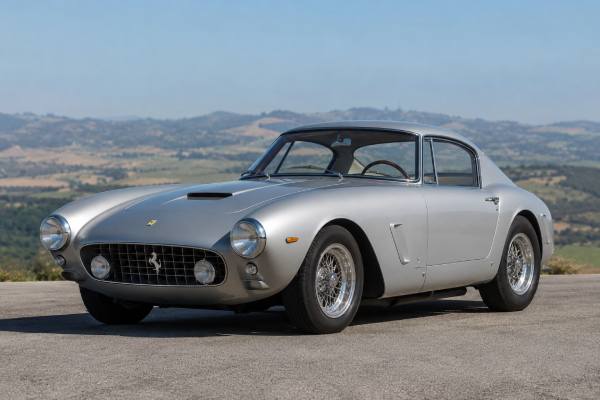
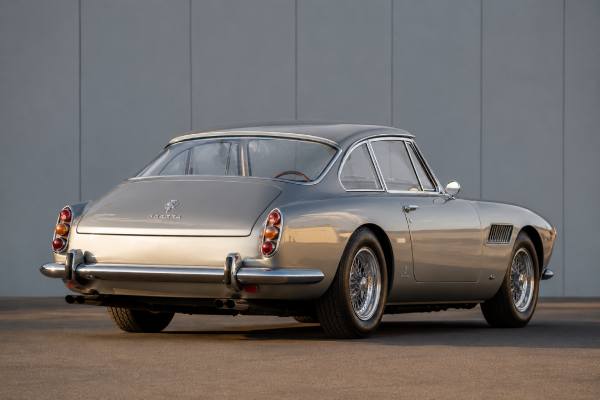
The Ferrari 250 GT Berlinetta Interim was a one-year, seven-car bridge between the long-wheelbase 250 GT “Tour de France” and the short-wheelbase 250 GT Berlinetta that followed. Built in 1959 on the Tipo 508D long-wheelbase chassis and commonly associated with the Tipo 128DF 3.0-liter Colombo V12, it carried the new Pinin Farina body shape that previewed the coming 250 GT SWB, but retained the 2,600 mm chassis and much of the proven mechanical package of the earlier LWB competition cars.
That narrow role is why the Interim matters. It was not a high-volume road GT, and it was not merely a styling exercise. It was a competition-minded development car used to test Ferrari’s next berlinetta shape in real racing, including Le Mans and the Tour de France Automobile. Today, its appeal sits in a rare space: it has the visual language of the SWB, the longer chassis character of the TdF, and the scarcity of a prototype-like Ferrari built for a very short moment in the company’s GT evolution.
Quick Take
The Ferrari 250 GT Berlinetta Interim is most appealing as the missing link between two of Ferrari’s most important 1950s and 1960s GT racers: the LWB Tour de France and the 250 GT SWB. Its aluminum coachwork, 3.0-liter Colombo V12, competition history, and seven-car production make it a serious collector Ferrari rather than a normal classic purchase. The main caution is that every example has individual details, race history, repairs, and restoration decisions that can change its value dramatically, so documentation, originality, chassis identity, engine specification, and expert inspection matter as much as the car’s headline rarity.
Table of Contents
- History and Significance
- Engine, Chassis and Key Specifications
- Production, Variants and Authenticity
- Design, Engineering and Special Details
- Driving Character and Performance
- Maintenance, Restoration and Ownership Risk
- Market Value, Buying Guide and Rivals
History and Significance
The 250 GT Berlinetta Interim matters because it marked the exact transition from Ferrari’s 1950s long-wheelbase competition berlinetta to the more compact 250 GT SWB. It used the established 2,600 mm LWB platform but wore the newer Pinin Farina-designed body shape that pointed directly toward Ferrari’s next great dual-purpose GT car.
Ferrari’s 250 GT Berlinetta lineage had already built a strong competition reputation before the Interim appeared. The long-wheelbase 250 GT Berlinetta, later nicknamed “Tour de France” after its success in the Tour de France Automobile, gave privateers a fast, durable, front-engined GT that could be driven on the road and raced hard. By the late 1950s, Ferrari needed the next step: a cleaner body, better high-speed packaging, and sharper handling for the coming short-wheelbase car.
The Interim was Ferrari’s answer during that development gap. It arrived in 1959, before the 250 GT SWB became the main production berlinetta. The first cars were used in competition, including the 1959 24 Hours of Le Mans. One of the most important results came from the N.A.R.T.-entered car, which finished fourth overall and second in the GT class. The final example, chassis 1523 GT, won the 1959 Tour de France Automobile with Olivier Gendebien and Lucien Bianchi, extending Ferrari’s dominance in the event.
Its historical position is unusually clean. The car was not a long-running series with many small production changes. It was a short, focused group of seven cars built in the summer and early autumn of 1959. One was bodied by Pinin Farina in Turin, while the other six used the Pinin Farina design but were built by Scaglietti in Modena. That mix gives the model a special identity: it is both a coachbuilt Ferrari and a development link in the path from TdF to SWB.
The “Interim” name is retrospective rather than a formal badge used like a modern trim level. It describes the car’s role. Ferrari was between generations, and these cars carried traits from both sides. From the earlier LWB car came the longer chassis, four-speed gearbox, live rear axle, drum brakes in standard form, and long-distance GT toughness. From the coming SWB came the new rounded body language, tighter visual mass, and more modern cockpit approach.
For collectors, this makes the Interim more than a rare derivative. It is a car with a clear historical job. It shows Ferrari testing ideas in public, under racing pressure, at a time when road cars, privateer racing cars, and factory development were closely connected. The model also sits within the broader 250 family, which remains central to Ferrari’s identity because it includes the TdF, California Spider, SWB, Lusso, and GTO.
The Interim’s reputation today rests on four pillars:
- Seven-car production, making it rarer than most famous 250 GT variants.
- Direct connection to the 250 GT SWB’s styling and development.
- Real period competition use, including Le Mans and the Tour de France Automobile.
- A mix of LWB stability and SWB-era design cues that gives it a distinct personality.
It is collectible because it is rare, but rarity alone is not the full story. Many low-production cars are obscure because they did not shape anything important. The Interim did. It helped move Ferrari from the ornate, 1950s-style TdF toward the cleaner, more purposeful SWB shape that became one of the defining Ferrari berlinettas.
Engine, Chassis and Key Specifications
The Interim combines a Tipo 508D steel tubular long-wheelbase chassis with a 3.0-liter Colombo V12 in late 250 GT competition tune. Specification details vary by chassis, period race preparation, and later restoration, so the most useful way to understand the car is as a hand-built competition berlinetta rather than a fixed modern production model.
| Category | Specification |
|---|---|
| Model | Ferrari 250 GT Berlinetta Interim |
| Production year | 1959 |
| Chassis type | Tipo 508D steel tubular frame |
| Body style | Two-seat aluminum berlinetta |
| Coachwork | Pinin Farina design; one body by Pinin Farina, six by Scaglietti |
| Layout | Front longitudinal engine, rear-wheel drive |
| Engine | Tipo 128DF Colombo 60-degree V12 |
| Displacement | 2,953 cc |
| Bore x stroke | 73.0 mm x 58.8 mm |
| Valvetrain | Single overhead camshaft per bank, two valves per cylinder |
| Induction | Triple Weber twin-choke carburetors, specification varying by car and period tune |
| Power | Commonly quoted at up to 260 hp in competition tune |
| Transmission | Four-speed manual gearbox |
| Differential | Rear limited-slip differential |
| Front suspension | Double wishbones with coil springs |
| Rear suspension | Live axle with semi-elliptic leaf springs |
| Brakes | Large finned drum brakes in standard homologated form |
| Wheelbase | 2,600 mm |
| Wheels | 16-inch Borrani wire wheels |
| Fuel capacity | About 136 liters |
| Estimated top speed | Up to roughly 160 mph-plus, depending on gearing and tune |
The engine is part of the Colombo “short block” V12 family that defined many early Ferrari road and competition cars. In the Interim, the relevant late-development V12 is often discussed as the Tipo 128DF, with outside spark-plug placement and improved breathing compared with earlier 250 GT units. The outside-plug layout mattered in practical terms. It made plug access easier and reduced some of the heat and service complications associated with plugs buried inside the vee of the engine.
The exact carburetor specification is a point to inspect car by car. Standard references often describe triple Weber 36 DCZ-type carburetors for the later cars, while the early Le Mans examples had experimental details, including different Weber setups and other competition changes. That is normal for a hand-built Ferrari competition model of this era. It also means a buyer should avoid treating a single printed specification as proof that every chassis left the factory in identical form.
The chassis was still the long-wheelbase frame associated with the late TdF family. It used large oval-section steel tubes with additional reinforcement around important load paths such as the engine bay and rear suspension pick-up areas. The layout was simple, strong, and familiar to Ferrari’s privateer customers.
The suspension shows the same practical balance. Independent front suspension with double wishbones and coil springs gave the car good front-end control for the period. At the rear, a live axle with semi-elliptic leaf springs was not advanced by modern standards, but it was durable, predictable, and well understood by racers. In a long-distance GT, reliability and serviceability mattered as much as ultimate sophistication.
Brakes require careful wording. The coming 250 GT SWB would make disc brakes central to its advantage. The Interim, in standard homologated form, used large finned drums. Some cars were later fitted with disc brakes or tested with them for competition, but authenticity depends on period documentation and the specific chassis. For a collector, “better” is not always better. A disc conversion may improve road confidence, but it can also change how the car is judged if originality is the priority.
The wheelbase is one of the car’s defining figures. At 2,600 mm, the Interim is 200 mm longer than the later SWB. That number explains much of the car’s visual and dynamic identity. It has the newer rounded body idea, but it stretches over the older long platform. The result is a car that looks close to the SWB at first glance, then reveals its longer canopy, rear quarter windows, and slightly more relaxed proportions.
Production, Variants and Authenticity
Only seven Ferrari 250 GT Berlinetta Interim examples were built, and each one has enough individual detail to deserve chassis-level research. For buying, valuing, restoring, or judging one, the safest assumption is that the car’s history matters more than any broad model description.
The seven chassis generally associated with the model are:
| Chassis | Key identity |
|---|---|
| 1377 GT | First Interim; uniquely bodied by Pinin Farina |
| 1461 GT | Scaglietti-bodied car; important Le Mans history |
| 1465 GT | Scaglietti-bodied production Interim |
| 1509 GT | Scaglietti-bodied car associated with Jo Schlesser |
| 1519 GT | Scaglietti-bodied car and one of the later examples |
| 1521 GT | Scaglietti-bodied late-production Interim |
| 1523 GT | Final example; 1959 Tour de France Automobile winner |
The easiest production distinction is between the first car and the remaining six. Chassis 1377 GT was bodied by Pinin Farina. The other six were built by Scaglietti using the Pinin Farina design. That does not make the Scaglietti cars lesser; it reflects Ferrari’s normal working method at the time. Design, construction, race preparation, and customer delivery often involved several specialist hands.
Because these were not mass-produced cars, small body differences matter. The quick-release fuel filler, front brake ducts, grille details, bumperettes, side-window arrangements, bonnet treatment, cabin trim, and race equipment can vary. Some cars had details driven by Le Mans preparation. Others were delivered to private customers and then modified for rallies, road use, or later historic racing.
How to identify an Interim
The Interim can be confused with the later SWB by casual observers, but several features help separate it:
- 2,600 mm long-wheelbase proportions rather than the later 2,400 mm SWB stance.
- Small rear quarter windows behind the side windows.
- A slightly squarer and longer cabin area.
- A longer bonnet intake compared with many SWB cars.
- Aluminum bodywork with hand-built variations.
- Tipo 508D LWB chassis identity.
- Period details such as 16-inch Borrani wire wheels and large external fuel filler.
The rear quarter windows are the most obvious visual clue. They exist because the long-wheelbase chassis created extra length in the cabin and rear quarter area. On the SWB, that area is tighter and more compact, giving the later car its famous short, muscular stance.
Originality and documentation
For a car like this, matching-numbers status is only the start. Buyers should want a complete chain of identity: chassis number, engine number, gearbox number, rear axle details, body-number references where available, period race entries, old photographs, import or registration documents, restoration invoices, ownership history, and Ferrari Classiche documentation.
A Ferrari Classiche Red Book can be valuable, but it should not replace independent investigation. A serious purchase should also involve a marque historian, a specialist who understands 1950s Ferrari construction, and a body expert who can read old repairs in aluminum. Many great cars have been repaired after racing accidents. The key question is not whether any work was done; it is whether the work is documented, correctly executed, and honestly represented.
Factory colors and interiors also matter, but not in the same way as on a high-production collectible where color charts define value neatly. These were bespoke competition cars. Original paint color, early livery, race numbers, upholstery material, and period modifications can all affect desirability. A car restored to a famous race appearance may be highly attractive, but only if the evidence supports it.
Design, Engineering and Special Details
The Interim’s design is special because it places the early SWB shape over the older LWB frame. That gives the car a look that is familiar but not identical to either the TdF before it or the SWB after it.
The earlier 250 GT TdF body had a sharper 1950s competition style, with vents, sculpted surfaces, and a more ornate sense of movement. The Interim moved toward the cleaner 1960s Ferrari look. Its nose was rounder, the wings were fuller, the tail was smoother, and the canopy flowed into a fastback shape. The car looks less decorated and more integrated.
At the same time, the long wheelbase changes the visual balance. The cabin is slightly longer, the side glass area is different, and the rear quarter windows give the profile a unique rhythm. The SWB looks taut and compact. The Interim looks a little more elegant, with a longer stride. That is part of its charm.
The aluminum body is central to the car’s character. Aluminum reduced weight and suited racing, but it also means each body is a crafted object rather than a set of identical pressings. Door gaps, bonnet fit, vent shapes, fuel-filler treatment, and interior details can vary from car to car. A perfectly uniform modern restoration can sometimes erase the subtle hand-built feel that makes these cars valuable.
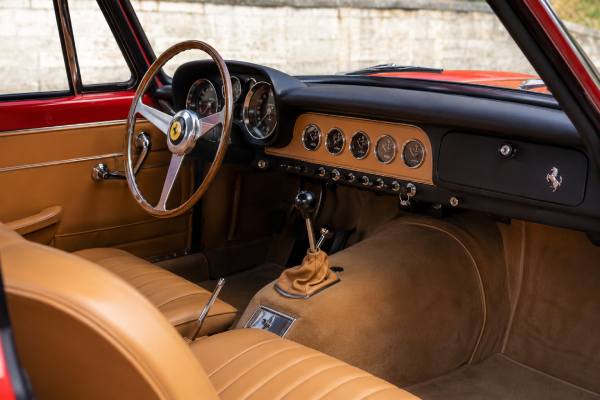
The cockpit also shows the move toward the next generation. Compared with earlier TdF interiors, the Interim used a more concentrated instrument layout, placing important gauges closer to the driver’s line of sight. That was not just a styling choice. In endurance racing and fast road rallies, the driver needed to read speed, revs, oil pressure, water temperature, and fuel information quickly. The passenger side could include a headrest, useful for co-drivers in long-distance events.
The engineering underneath was evolutionary. Ferrari did not throw away a successful package. The frame, front suspension, rear axle, gearbox, and braking layout were familiar because they worked. The V12 was improved, the body was new, and the overall package tested the next direction without abandoning known durability.
The sound is one of the car’s great sensory features. A carbureted Colombo V12 at high rpm has a crisp, layered note that feels very different from a larger American V8 or a later flat-plane Ferrari V8. The intake sound from the Webers, the mechanical valvetrain noise, and the slim exhaust tone combine into a sharp but musical character. In a lightweight alloy berlinetta, that sound is part of the driving experience, not a background effect.
Cooling and airflow are also worth noting. These cars were tested in real endurance conditions, and some early examples used special grille or bonnet details to manage temperature. On a modern restoration, cooling performance should be treated seriously. A car that looks correct but runs hot in traffic or at sustained speed may have radiator, fan, water-pump, ignition, carburetion, or airflow problems.
The most unusual engineering choice by modern standards is how much old and new sit together. The body points forward. The brakes, rear axle, and wheelbase point backward. That is not a flaw. It is the car’s identity. The Interim captures Ferrari at the moment when proven 1950s GT hardware was giving way to the tighter, disc-braked, short-wheelbase era.
Driving Character and Performance
A well-sorted 250 GT Berlinetta Interim should feel fast, flexible, stable, and mechanical rather than razor-sharp in the modern sense. Its long wheelbase and V12 torque give it confidence at speed, while the alloy body and competition tune keep it lively.
The engine is the center of the experience. The 3.0-liter Colombo V12 does not behave like a lazy large-displacement engine. It rewards revs, clean carburetion, and smooth throttle use. When properly tuned, it should pull cleanly from moderate rpm and then become harder, brighter, and more urgent as it approaches the upper range. The driver feels the engine through the pedal, the gear lever, the chassis, and the sound.
Warm-up matters. A cold classic Ferrari should not be rushed. Oil temperature, water temperature, gearbox oil, and brake condition all need time. A car that feels stiff or uneven in the first few minutes may come alive once everything has heat in it. A car that never settles, spits through the carburetors, overheats, or fouls plugs needs proper diagnosis rather than enthusiastic excuses.
The four-speed manual gearbox is part of the old-school appeal. When healthy, it should feel deliberate and satisfying, with a mechanical gate and a sense of weight. Synchro condition, clutch adjustment, engine mounts, and linkage setup all affect shift quality. A tired gearbox can make the car feel far older than it is, while a freshly built one can make the car surprisingly usable.
Steering effort is heavier at parking speeds than in a modern car, but it should lighten once moving. On the road, the front end should communicate clearly. The long wheelbase gives the car a calmer personality than the SWB. It is less eager to rotate, but it is also more settled on fast, flowing roads. That makes sense for the events it was built to run: long road races, high-speed touring, and endurance competition rather than tight modern track work.
The braking experience depends heavily on specification and condition. With well-prepared drum brakes, the car can be effective by period standards, but it will not feel like a disc-braked SWB or a modern performance car. Drum brakes need correct lining material, proper adjustment, round drums, fresh hydraulics, and intelligent driving. Heat management matters. A car used in historic competition may have period-style upgrades, but those must be evaluated for authenticity and safety.
Ride quality is often better than people expect. The tall tire sidewalls, long wheelbase, and relatively supple suspension can make the car comfortable on real roads. That is one reason Ferrari’s dual-purpose GTs were so successful. They were not fragile sprint cars that only worked on smooth circuits. They could cover distance quickly.
Visibility is also part of the charm. The driver sits with a view over the rounded bonnet and front wings, with more glass than in many later supercars. The cabin is narrow by modern standards, and heat, fuel smell, exhaust resonance, and mechanical noise are all part of the environment. A buyer coming from modern Ferraris should expect intimacy, not isolation.
Compared with a TdF, the Interim can feel a little more modern because of its body, cockpit layout, and late 250 GT development. Compared with an SWB, it feels longer, more relaxed, and more period-correct to the 1950s. That middle ground is exactly why enthusiasts find it fascinating. It is not simply slower or older than an SWB. It has its own rhythm.
Maintenance, Restoration and Ownership Risk
Ownership risk on a 250 GT Berlinetta Interim is not about routine reliability in the ordinary used-car sense. It is about authenticity, specialist workmanship, age-related deterioration, old race repairs, and the cost of correcting mistakes on a seven-car Ferrari.
The engine needs expert care. The Colombo V12 is robust when built and maintained correctly, but it is a high-value, high-precision unit. Carburetor tuning, ignition timing, valve adjustment, oil pressure, cooling performance, and fuel quality all matter. Small problems can become expensive if the car is driven hard while out of tune.
Common mechanical areas to inspect include:
- Oil leaks from gaskets, cam covers, timing covers, and seals.
- Weak oil pressure when hot.
- Overheating at idle, in traffic, or during sustained high-speed running.
- Carburetor imbalance, fuel starvation, or perished fuel lines.
- Ignition misfire from tired coils, distributors, leads, plugs, or poor setup.
- Worn clutch components or poor clutch adjustment.
- Gearbox synchro wear, noisy bearings, or damaged selector mechanisms.
- Differential noise, backlash, or limited-slip issues.
- Worn kingpins, bushings, dampers, and leaf-spring components.
- Brake drums, wheel cylinders, master cylinder, lines, and lining condition.
- Loose or damaged Borrani wire wheels, splines, hubs, and knock-offs.
The fuel system deserves special attention. Old tanks can shed debris, fuel lines age, and modern fuels can create vapor-lock or material-compatibility issues. Because the car uses carburetors and sits near hot mechanical parts, fuel leaks are not minor defects. They are urgent repair items.
Cooling is another major ownership area. A correct-looking radiator is not enough. The system needs clean internal passages, a healthy water pump, correct fan function, proper ignition timing, and a well-tuned mixture. Many old overheating complaints are not caused by one dramatic failure but by several small weaknesses stacked together.
Body and chassis inspection
The alloy body can hide difficult restoration problems. Aluminum panels can corrode, crack, stretch, or lose shape from old repairs. Paint may hide filler, patched stress cracks, or reshaped accident damage. A specialist should inspect panel fit, bonnet and door alignment, fuel-filler surround, lower body edges, wheel arches, and areas where aluminum meets steel.
The steel frame is even more important. A beautiful body over a compromised chassis is a serious risk. Inspect for corrosion, old accident distortion, non-original tube replacement, poor welds, and damage around suspension pick-up points. The rear spring mounts, engine bay structure, sills, floor supports, and front frame sections deserve careful measurement.
Accident history should be treated realistically. Many period competition Ferraris were crashed, repaired, upgraded, or modified. A documented period repair by a respected workshop may be part of the car’s history. An undocumented modern repair, incorrect tube layout, or hidden structural damage is a different matter.
Restoration difficulty
Restoring an Interim is not like restoring a normal 250 GT coupe. The low production count means there is no easy catalog of interchangeable parts and body panels. Many details must be researched, fabricated, or restored from the car’s own evidence. The wrong dashboard texture, filler-cap location, seat shape, window detail, carburetor setup, or brake arrangement can affect authenticity.
The biggest cost drivers are:
- Engine rebuild quality and originality of major castings.
- Gearbox, rear axle, and driveline condition.
- Chassis straightness and correct tube repairs.
- Aluminum body reconstruction and panel fit.
- Correct trim, instruments, glass, lighting, and race equipment.
- Documentation needed to support a period configuration.
- Reversing old modifications without erasing legitimate history.
Owners also face a choice between originality and usability. A car used for road tours may benefit from discreet improvements in cooling, fuel compatibility, lighting, brake materials, or safety equipment. A concours-focused car may need to be closer to a documented historical configuration. A historic race car may need compliance with event rules. The best decisions are reversible, documented, and made with the car’s identity in mind.
Market Value, Buying Guide and Rivals
The 250 GT Berlinetta Interim sits in the highest tier of 1950s Ferrari GT collecting, but its market is too thin for a simple price guide. With only seven cars, each example is valued individually by history, originality, condition, eligibility, restoration quality, and whether major components remain correct.
Public auction data for ordinary 250 GT LWB Berlinettas and related TdF cars can help set context, but it cannot define the Interim precisely. An Interim with Le Mans or Tour de France history is not merely another LWB Berlinetta. It is a rarer development car with SWB-preview bodywork and known chassis-level significance. Private sales, long-term collections, and quiet brokered deals are common in this part of the market, so published figures can lag behind reality.
The strongest value factors are:
| Factor | Why it matters |
|---|---|
| Chassis identity | Each of the seven cars has a distinct history and desirability profile |
| Competition history | Le Mans, Tour de France, and period privateer use can greatly affect value |
| Original major components | Engine, gearbox, rear axle, and body identity are central to authenticity |
| Documentation | Factory records, old photos, race entries, ownership chain, and restoration files reduce uncertainty |
| Restoration quality | Poor body or chassis work is extremely expensive to correct |
| Event eligibility | Access to major concours, tours, and historic races increases practical appeal |
| Configuration | Period-correct details, documented upgrades, and accurate livery choices matter |
A serious buyer should start with identity, not cosmetics. The car can be repainted, retrimmed, and mechanically refreshed, but a questionable chassis story is much harder to fix. Before price negotiation, the buyer should know exactly what the car is, what it was, what has changed, and what evidence supports those claims.
A focused inspection should include:
- Confirm chassis, engine, gearbox, rear axle, and body identity against records.
- Review Ferrari Classiche documentation and compare it with independent historical research.
- Study period photographs for body details, vents, filler position, lights, interior, and race equipment.
- Inspect the frame on a lift with a Ferrari specialist familiar with 1950s construction.
- Check aluminum body repairs under paint where possible.
- Test engine health through compression, leak-down, oil pressure, temperature behavior, and expert listening.
- Inspect gearbox, clutch, differential, suspension, brakes, steering, wire wheels, and hubs.
- Review restoration invoices for who did the work, what was replaced, and what was preserved.
- Confirm event eligibility if historic racing or top-tier tours are part of the ownership plan.
- Budget for immediate sorting even after a high-quality purchase.
Examples to seek are those with clear identity, known ownership chain, original or correctly restored major components, documented competition history, and sympathetic maintenance. Examples to avoid are cars with vague histories, inconsistent numbers, over-restored bodies that lost key details, unexplained frame repairs, incorrect engines presented as original, or cosmetic restorations hiding mechanical neglect.
Rivals and alternatives depend on what the buyer wants. A 250 GT LWB TdF offers the earlier racing identity and broader production pool, though still rare and valuable. A 250 GT SWB is the more famous successor, sharper to drive and often easier to recognize in the market. A 250 GT California Spider brings open-body glamour and strong collector demand, but a different driving and historical character. A 250 GTO sits far above as a later competition icon with a completely different market level. Outside Ferrari, the Aston Martin DB4 GT, Maserati A6G/54, and certain Jaguar competition GTs offer period appeal, but none provides the same Ferrari 250 development link.
The Interim is best for a collector who values historical nuance. It is not the obvious poster choice like an SWB, and it is not the most frequently discussed TdF form. Its strength is more specific: it is the car that shows Ferrari changing eras. For the right buyer, that makes it one of the most interesting front-engined Ferraris of the 1950s.
References
- Ferrari 250 GT Berlinetta (1956) 1956
- Ferrari 250 GT Berlinetta passo corto (1959) 1959
- 1959 Ferrari 250 GT LWB Berlinetta 2026
- Girardo & Co.’s guide to the 1959 Ferrari 250 GT LWB Berlinetta ‘Interim’ | Girardo & Co 2021
- 1959 Ferrari 250 GT LWB Interim Berlinetta – Images, Specifications and Information 2015
Disclaimer
This article is for informational purposes only and is not a substitute for professional diagnosis, repair, inspection, valuation, or restoration advice. Specifications, torque values, service intervals, procedures, and correct components can vary by chassis number, market, equipment, period race preparation, and restoration history. Owners and buyers should verify all details against official service documentation, factory records, Ferrari Classiche materials, and a qualified Ferrari specialist.
If you found this guide useful, please share it on Facebook, X/Twitter, or your preferred enthusiast community to support our work.