
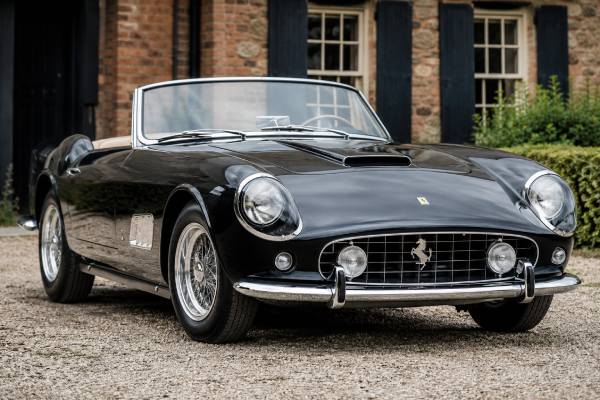
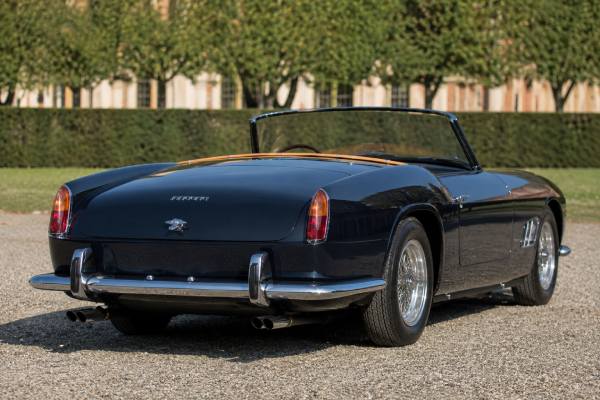
The Ferrari 250 GT Cabriolet Pinin Farina Series I, built from 1957 to 1959, is one of the most refined open Ferraris of the late 1950s. It used Ferrari’s 3.0-liter Colombo V12, commonly listed in Tipo 128C form for this version, and sat on the long-wheelbase 250 GT tubular chassis known in this context as Tipo 508C, with late cars moving through related chassis and engine developments. With about 240 hp in Ferrari’s published period specification, it was not simply a pretty convertible. It was a hand-built, front-engine V12 grand tourer with enough performance to sit close to Ferrari’s more sporting road cars.
This was Ferrari’s first genuinely series-produced open-top model, but “series-produced” needs context. Around 40 Series I cars were built, and many differ in body trim, headlamp treatment, bumper layout, vents, interior details, and original colors. That mix of small production, Pinin Farina coachwork, Colombo V12 character, and concours-level collector interest explains why buyers study individual chassis histories so closely.
Quick Take
The 250 GT Cabriolet Pinin Farina Series I is best understood as Ferrari’s elegant open grand tourer before the more standardized Series II. Its strongest appeal is the combination of early Pinin Farina styling, hand-built individuality, and a 3.0-liter Colombo V12 in a usable road-car chassis. The caution is that every example has its own history, and value depends heavily on originality, matching numbers, documentation, restoration quality, and correct Series I details. A beautiful car with weak paperwork or incorrect components can be far less desirable than a less glamorous example with a clean, traceable identity.
Table of Contents
- History and Collector Importance
- Engine, Chassis and Key Specifications
- Production, Variants and Originality
- Pinin Farina Design and Engineering Details
- Road Feel, Performance and Character
- Maintenance, Restoration and Known Risks
- Values, Buying Guide and Rivals
History and Collector Importance
The Series I Cabriolet matters because it turned Ferrari’s 250 GT platform into a luxurious, coachbuilt open road car before Ferrari convertibles became more standardized. It was aimed at wealthy road users who wanted refinement, exclusivity, and speed rather than a stripped competition identity.
Ferrari’s 250 GT family was already becoming the backbone of the company’s road-car business by the late 1950s. The 250 GT Berlinetta “Tour de France” proved the strength of the chassis and V12 in competition, while Boano and Ellena coupes helped establish the 250 GT as a road car for serious customers. The Cabriolet Pinin Farina Series I added another layer: open-air grand touring with a more formal, expensive, and highly tailored personality.
Pinin Farina was central to the car’s identity. The design house had been shaping Ferrari’s visual language through one-off and low-volume bodies, and the Series I Cabriolet helped deepen the relationship that later became essential to Ferrari road cars. Compared with the more aggressive 250 GT California Spider, the Pinin Farina Cabriolet was more polished. It was not intended as a competition-leaning spider for weekend racers. It was a refined open Ferrari for clients who wanted presence, comfort, and craftsmanship.
The model’s launch context also matters. A prototype appeared around the 1957 Geneva Motor Show period, and production followed in very small numbers. Even once the model entered limited production, the cars were not uniform in the modern sense. Pinin Farina built them with many detail variations, and some examples are close to one-off coachbuilt cars. Covered headlamps, open headlamps, bumperettes, vertical grille guards, side vents, hardtop equipment, and dashboard details can vary by chassis.
The Series I later gave way to the Series II, which was cleaner, more standardized, and easier to produce. The Series II is collectible in its own right, but the Series I sits in a more rarefied part of the market because it represents the earlier hand-built phase. Collectors often see it as a bridge between bespoke 1950s Ferrari coachbuilding and the more regular production methods that followed.
Today, its importance rests on four main points:
- It is Ferrari’s first series-built open-top model.
- It uses the classic 3.0-liter Colombo V12 architecture.
- It carries Pinin Farina coachwork from the coachbuilt era.
- It was produced in tiny numbers, with individual chassis differences that matter deeply to collectors.
The car also has strong concours relevance. Correctly restored examples appear at major events such as Pebble Beach, Cavallino Classic, Villa d’Este, and Ferrari Club of America concours gatherings. That matters because a Series I Cabriolet is not judged only as a usable classic Ferrari. It is judged as a historical object, where small details can affect authenticity and value.
Engine, Chassis and Key Specifications
The Series I Cabriolet combined Ferrari’s long-wheelbase 250 GT chassis with the 3.0-liter Colombo V12. The basic recipe was simple by modern standards, but sophisticated for a late-1950s road car: light tubular construction, front independent suspension, a live rear axle, drum brakes, rear-wheel drive, and a high-revving V12 fed by triple Weber carburetors.
The “250” name comes from the approximate displacement of each cylinder in cubic centimeters. With 12 cylinders, the total displacement is 2,953.21 cc, usually rounded to 3.0 liters. The engine was mounted longitudinally ahead of the cabin and drove the rear wheels through a 4-speed manual gearbox.
| Item | Ferrari 250 GT Cabriolet Pinin Farina Series I |
|---|---|
| Production period | 1957–1959 |
| Engine | Tipo 128C Colombo 60-degree V12 |
| Displacement | 2,953.21 cc |
| Bore x stroke | 73 mm x 58.8 mm |
| Induction | Three twin-choke Weber carburetors |
| Valve gear | Single overhead camshaft per bank, two valves per cylinder |
| Maximum power | About 240 hp at 7,000 rpm in Ferrari’s published specification |
| Compression ratio | Commonly listed at 8.5:1 for early 250 GT applications |
| Lubrication | Wet sump |
| Transmission | 4-speed manual |
| Drivetrain | Front engine, rear-wheel drive |
| Item | Specification |
|---|---|
| Chassis type | Tubular steel 250 GT chassis, commonly associated with Tipo 508C on Series I cars |
| Front suspension | Independent, unequal-length wishbones, coil springs, hydraulic dampers |
| Rear suspension | Live axle with semi-elliptic leaf springs and hydraulic dampers |
| Brakes | Hydraulic drum brakes |
| Steering | Worm-and-sector type steering |
| Wheelbase | 2,600 mm |
| Front track | 1,354 mm |
| Rear track | 1,349 mm |
| Dry weight | About 1,050 kg, depending on source and individual car |
| Fuel capacity | About 100 liters |
| Top speed | About 252 km/h in Ferrari’s published specification |
Period Ferrari specifications can be difficult because individual cars evolved during production. Some early and late examples may differ in engine detail, chassis designation, distributor layout, and trim. The safest approach is to treat the table as a model-level guide, then verify every serious purchase by chassis number, engine number, factory records, and expert inspection.
The engine is the central attraction. Colombo’s short-block V12 is compact, smooth, and eager to rev. It does not behave like a large, low-speed luxury engine. It needs correct carburetor setup, ignition health, valve adjustment, and cooling condition to feel right. When set up properly, it gives the Cabriolet a rare mix of civility and mechanical urgency.
The chassis is equally important. The 2,600 mm wheelbase gives the car a calmer grand touring character than shorter-wheelbase later Ferraris, but it still has precise steering and good balance when its suspension, tires, and alignment are correct. Drum brakes are part of the period experience. They can work well when rebuilt and adjusted properly, but they do not have the repeated high-speed stopping confidence of later disc-brake Ferraris.
Production, Variants and Originality
The Series I Cabriolet was built in extremely small numbers, with about 40 examples generally cited, including prototype or early development cars depending on how a source counts them. That rarity makes production details, chassis identity, and original configuration more important than broad model-year differences.
The earliest cars show more experimental detail variation. Later Series I cars became more consistent, but even then, the model was never a fully standardized production car. Pinin Farina’s custom-shop approach means two cars can both be authentic while having different exterior trim or interior arrangements.
Important identifiers include:
- covered or open headlamps
- bumper shape and bumperette layout
- vertical grille guards
- side vent style and placement
- dashboard layout
- original hardtop provision, when fitted
- hood scoop and bonnet vent treatment
- original exterior color and Connolly leather trim
- chassis, engine, gearbox, axle, and body-number continuity
One of the most valuable points for buyers is that “Series I” is not just a styling label. It places the car in the earlier, rarer, more coachbuilt phase of the Pinin Farina Cabriolet line. The later Series II, introduced for the 1960 model period, had a cleaner and more regular design with open headlamps and broader production. The Series II is often easier to understand visually. The Series I demands more research.
Chassis and engine-number importance
Matching numbers matter enormously. On a Ferrari of this level, the original chassis and engine relationship can make a major value difference. A correct-type replacement engine may still make a car usable and attractive, but it does not carry the same collector weight as a verified original engine. The same applies to the gearbox, rear axle, and body.
Ferrari Classiche certification, factory build records, Massini reports, old registration documents, restoration invoices, period photographs, and concours records all help establish identity. None should be considered alone. The strongest cars usually have several layers of evidence that agree with one another.
A buyer should confirm:
- chassis stamping location and style
- engine stamping and internal engine type
- gearbox and rear axle numbers
- original color and trim
- body-number evidence where available
- ownership chain from new or early life
- accident, fire, or major corrosion history
- restoration changes made over time
Options and special-order details
Because these were client-level Ferraris rather than mass-built cars, the idea of “factory options” is less tidy than it is on a modern car. Buyers specified colors, leather, trim details, and sometimes equipment such as a detachable hardtop. Some cars were show cars. Some were delivered to significant first owners. Some later received modifications through dealers, especially in the United States.
Originality does not always mean a car looks plain. A striking paint and leather combination can be correct if documented. Conversely, a familiar red repaint may be less desirable if the car was originally a subtle metallic grey, ivory, dark blue, or another period color. Current top-tier collectors often prefer restoration back to original build colors, especially when period photographs or factory records support the choice.
Pinin Farina Design and Engineering Details
The Series I Cabriolet’s design is formal, elegant, and more luxurious than the California Spider. Its long bonnet, upright grille treatment, open cabin, and hand-finished trim make it feel like a bespoke grand tourer rather than a competition car with a soft top.
Pinin Farina’s bodywork gave the Cabriolet a distinctive place in the 250 GT family. The proportions are classic front-engine Ferrari: long hood, set-back cabin, short rear deck, and a broad stance over Borrani wire wheels. The grille and front bumper treatment give many cars a more ceremonial look than the leaner Berlinettas. Covered-headlamp cars are especially prized by some collectors because they create a smooth, exotic late-1950s face.
The body was built using traditional coachbuilding methods over Ferrari’s tubular chassis. As with many coachbuilt Ferraris of the period, construction details can vary, and restorers must avoid assuming that every panel, seam, or trim piece should match another car exactly. The correct reference is the specific chassis being restored.
Exterior details that affect identity
Small details carry large meaning on a Series I. A vent shape or bumper treatment may identify a particular phase of production or a special build. Headlamps are among the most visible differences. Some cars have covered lamps, while others have open lamps. Bumperettes and vertical grille guards also vary. These features are not decoration alone; they are part of the car’s historical record.
A good restoration should not simply make the car “look like a Series I.” It should make it look like that particular Series I looked when delivered or when documented in an important period state. That is why period photographs are so valuable.
Cockpit and grand touring character
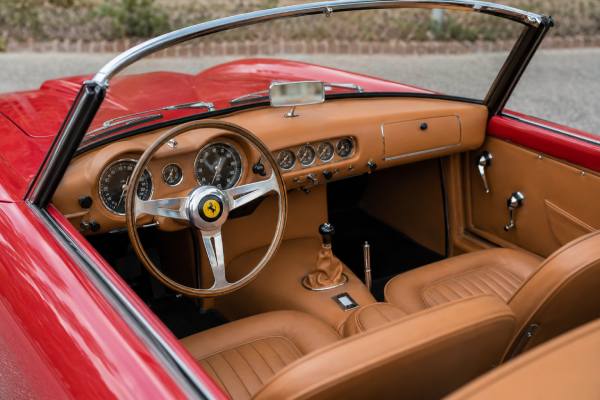
Inside, the Cabriolet is more comfortable and finished than Ferrari’s racing-derived machines. A large wood-rim steering wheel, leather upholstery, clear instruments, and a relatively refined driving position suit the car’s grand touring role. The cabin is still compact by modern standards, and heat, noise, and ventilation depend heavily on restoration quality and soft-top fit.
The dashboard layout can vary, but the general feeling is mechanical and direct. The driver faces analog gauges, a long gear lever, and a view over a long bonnet. The cabin is not isolated in the modern luxury sense. It is a place where the engine, gearbox, steering, and body structure are always present.
Sound and mechanical feel
The Colombo V12 gives the car much of its emotional value. At low rpm, it is smooth and cultured. As revs rise, the intake sound from the carburetors and the layered exhaust note create the classic early Ferrari experience. The car is not brutally loud when correctly silenced, but it has a fine, hard-edged note that separates it from larger luxury convertibles of the same era.
The engineering is straightforward enough to be understood, but not simple to restore. Carburetion, ignition, valve timing, cooling passages, drum brake setup, steering-box condition, and rear-axle setup all need experienced hands. The car’s beauty can hide the fact that it is a complex, hand-built V12 machine.
Road Feel, Performance and Character
A properly sorted Series I Cabriolet feels quick, mechanical, and surprisingly usable, but it remains a 1950s Ferrari. It rewards patience during warm-up, smooth inputs, and respect for its tires, brakes, gearbox, and cooling system.
The engine is flexible enough for grand touring, but it feels best when allowed to rev. The 3.0-liter V12 does not deliver modern low-rpm torque. It builds power cleanly, and the final part of the rev range is where the car feels most alive. Correct carburetor synchronization is critical. A tired or poorly tuned example can feel flat, hesitant, or rough, while a properly set-up car feels crisp and light.
The 4-speed gearbox has a period feel. It should not be forced when cold, and a careful owner will allow the oil to warm before making fast shifts. Synchro condition, clutch adjustment, engine mounts, and linkage setup all affect the shift quality. A healthy gearbox feels deliberate rather than heavy.
Steering is one of the car’s pleasures. At parking speeds, it needs effort, especially on modern tires or sticky surfaces. Once moving, it becomes more natural and communicative. The long wheelbase gives stability, but the car is not dull. It can flow beautifully through open roads when suspension bushings, dampers, wheels, and tires are correct.
Braking expectations must be realistic. The hydraulic drums can stop the car well when properly rebuilt, adjusted, and bedded in. They are not modern brakes, and they do not like repeated abuse on steep descents or fast mountain roads. Pulling, vibration, long pedal travel, or uneven response usually points to setup or wear problems, not something to ignore as “normal old-car behavior.”
Ride quality is part of the car’s charm. Compared with a harder-edged competition Ferrari, the Cabriolet is more relaxed. It is comfortable enough for touring when the seats, suspension, weather equipment, and cooling system are in good order. Cabin heat can still be an issue in warm weather, and the soft top should be treated as period weather protection rather than modern climate sealing.
On the open road, the car’s best use is fast touring rather than racing. It is happiest on flowing roads where the V12 can breathe, the chassis can settle, and the driver can use momentum. It can feel special at moderate speeds because the controls are alive. That is part of the reason these cars are valued not only as static concours objects but also as event cars for rallies and tours.
The difference between a restored car and a tired car is enormous. A fresh concours restoration may look perfect but still need road sorting. A long-used event car may not be cosmetically flawless but may drive better. The ideal example combines correct presentation with real mechanical development after restoration.
Maintenance, Restoration and Known Risks
The Series I Cabriolet is not difficult because it is fragile in one simple way; it is difficult because it is rare, hand-built, valuable, and highly sensitive to correct work. Maintenance and restoration require Ferrari 250 specialists, not general classic-car repair.
The Colombo V12 is a strong engine when assembled and maintained properly, but neglect is expensive. Cooling-system condition, oil pressure, valve adjustment, carburetor wear, ignition accuracy, and timing-chain health all matter. A small running problem can become a large invoice if the car is driven hard while out of tune.
Common ownership priorities include:
- regular fluid changes using specialist guidance
- valve-clearance checks at appropriate intervals
- carburetor cleaning, tuning, and synchronization
- ignition-system inspection, including distributors and coils
- cooling-system inspection, radiator health, hoses, and water pump
- fuel-line and fuel-tank condition
- clutch adjustment and gearbox oil condition
- brake drum, lining, wheel-cylinder, and hose inspection
- steering-box and suspension-bushing condition
- spoke-wheel inspection and correct tire age
Corrosion and body structure
Corrosion is a major concern, especially because these cars have coachbuilt bodies fitted to tubular chassis. Rust can appear in lower body areas, sills, wheel arches, floor sections, door bottoms, and areas where moisture sits behind trim. Chassis tubes need careful inspection for corrosion, old repairs, accident damage, and poor restoration work.
Body fit is another warning area. Door gaps, hood fit, trunk fit, windshield frame alignment, and soft-top fit can reveal previous damage or weak restoration. Because each car was hand-built, perfect modern uniformity is not the goal. However, uneven structure, stressed panels, cracking paint, or doors that do not close cleanly should be investigated.
Mechanical rebuild cost drivers
The largest expenses usually come from engine work, gearbox rebuilds, differential work, brake restoration, body correction, and interior or trim reconstruction. The engine alone can require specialist machining, correct internal parts, and careful assembly. Carburetors, distributors, and fuel-system parts must be correct for the car’s specification.
Drum brakes may seem simple, but making them work properly can require relining, machining, wheel-cylinder rebuilding, hydraulic renewal, and careful adjustment. Poorly set-up drums can make the car unpleasant and unsafe to drive.
The gearbox and rear axle also deserve attention. Noise, jumping out of gear, weak synchros, clutch shudder, or driveline vibration should be treated seriously. These are not cars where a buyer should assume a problem is minor because the vehicle still runs.
Restoration quality and originality tradeoffs
A restoration can add value or destroy it. The best restorations are research-led, using factory documents, period photographs, original parts, and marque experts. The weakest restorations make the car shiny while losing correct trim, body lines, finishes, hardware, and mechanical identity.
Originality is not always the same as condition. A preserved car with worn original materials may be more historically important than a freshly restored car with incorrect details. For buyers, the question is not simply “restored or unrestored?” It is “what was done, by whom, with what evidence, and what original material remains?”
Upgrades should be approached carefully. Some owners may want discreet improvements for touring, such as better cooling efficiency, modern tires in correct sizing, or carefully hidden electrical reliability improvements. But major visible changes, non-original mechanical substitutions, or incorrect interior redesigns can hurt collector value.
Values, Buying Guide and Rivals
The Series I Cabriolet sits in the multi-million-dollar Ferrari collector market, with the best examples valued according to chassis history, originality, restoration quality, specification, and public sale context. Recent market data and auction estimates place strong cars broadly around the mid-seven-figure range, though individual results vary sharply.
A top example can bring a premium if it has matching numbers, original colors, important show history, Ferrari Classiche certification, known ownership, and a respected restoration. A car with a replacement engine, unclear history, old accident repairs, incorrect trim, or weak documentation may trade at a meaningful discount. At this level, the difference is not cosmetic. It can be millions of dollars.
Value factors that matter most:
| Value factor | Why it matters |
|---|---|
| Matching-numbers engine | Strongly affects authenticity and top-tier collector demand |
| Factory documentation | Confirms original color, trim, delivery, and specification |
| Known ownership history | Adds confidence and can add prestige |
| Correct Series I details | Headlamps, bumpers, vents, interior, and trim must match the chassis history |
| Restoration quality | A respected specialist restoration can support concours and market value |
| Original colors | Documented period colors are increasingly important to serious buyers |
| Event eligibility | Usability for concours, tours, and Ferrari events supports desirability |
Pre-purchase inspection priorities
A normal classic-car inspection is not enough. The buyer needs a Ferrari 250 specialist, a historian familiar with the model, and enough time to compare the car against factory and period records.
The inspection should include:
- Confirm chassis, engine, gearbox, rear axle, and body identity.
- Compare current colors and trim with factory or period evidence.
- Inspect chassis tubes for corrosion, impact damage, and old repairs.
- Check body fit, panel shape, windshield fit, and soft-top frame alignment.
- Test engine compression, leak-down, oil pressure, cooling behavior, and carburetor response.
- Inspect the gearbox, clutch, driveshaft, differential, and rear axle.
- Confirm brake drum condition, hydraulic health, and straight stopping.
- Review restoration invoices and identify who performed the work.
- Check whether important original parts were retained.
- Verify event, concours, and certification claims independently.
Buyers should be cautious of cars described with vague language such as “believed matching,” “restored as needed,” “older restoration,” or “correct-type engine” without supporting records. Those phrases do not automatically mean trouble, but they require investigation.
Examples to seek and avoid
The best examples usually have clear identity, documented original specification, high-quality restoration or preservation, and a history that can be followed over decades. A car that has been shown, toured, and maintained by recognized experts can be especially attractive because it proves both presentation and function.
Cars to avoid include those with unclear chassis stampings, missing engine history, undocumented body changes, poor panel fit, heavy corrosion, or restoration work done without model expertise. A cheaper Series I Cabriolet can become very expensive if it needs body correction, engine work, trim reconstruction, and historical research at the same time.
Rivals and alternatives
The closest Ferrari alternative is the 250 GT California Spider, especially the long-wheelbase version. The California is sportier and generally more famous, while the Pinin Farina Cabriolet is more formal and luxurious. The 250 GT Pinin Farina Coupe is far more affordable but lacks the rarity and open coachbuilt glamour of the Series I Cabriolet. The later 250 GT Cabriolet Series II offers open-top Ferrari appeal with a more standardized design and lower typical value.
Outside Ferrari, natural rivals include the Mercedes-Benz 300 SL Roadster, BMW 507, Maserati 3500 GT Spyder, Aston Martin DB4 Convertible, and high-end coachbuilt Alfa Romeo or Lancia convertibles. The Ferrari stands apart for its Colombo V12, 250 GT lineage, and the particular status of Pinin Farina coachwork.
As a long-term collectible, the Series I Cabriolet has strong fundamentals: tiny production, historical first-open-Ferrari status, V12 power, major coachbuilder identity, and eligibility for prestigious events. Its market is not immune to broader collector-car cycles, but the best documented cars are likely to remain highly sought after because replacement opportunities are so rare.
References
- Ferrari 250 GT Cabriolet (1957) 1957 (Manufacturer Specifications)
- 1958 Ferrari 250 GT Cabriolet Series I by Pinin Farina | Monterey 2025 | RM Sotheby’s 2025 (Auction Listing)
- 1959 Ferrari 250 GT Cabriolet Series I by Pinin Farina | Monaco 2014 | RM Sotheby’s 2014 (Auction Listing)
- 1958 Ferrari 250 GT Series I Cabriolet | Gooding Christie’s 2021 (Auction Listing)
- Ferrari 250 GT Cabriolet Pinin Farina Series I Market – CLASSIC.COM 2026 (Market Data)
Disclaimer
This article is for informational purposes only and is not a substitute for professional diagnosis, repair, appraisal, or restoration advice. Specifications, torque values, service intervals, repair procedures, and correct parts can vary by chassis number, market, production date, and individual equipment. Owners and buyers should verify all details against official service documentation, factory records, and qualified Ferrari 250 specialists.
If this guide was useful, please consider sharing it on Facebook, X/Twitter, or your favorite car community to support our work.