
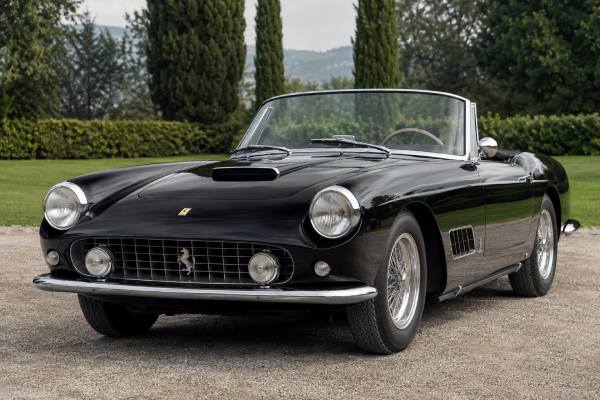
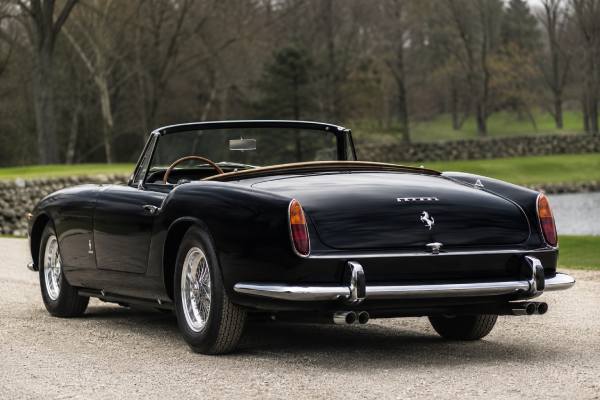
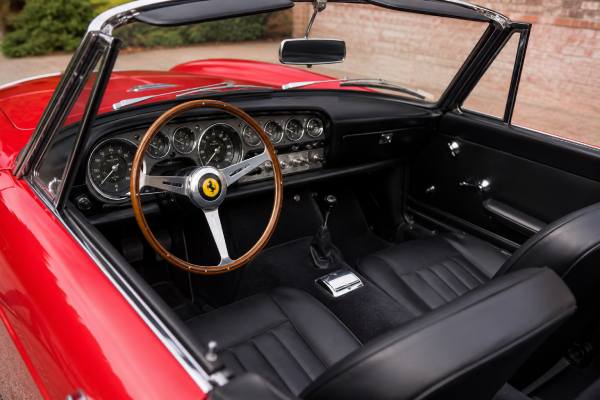
The Ferrari 250 GT Cabriolet Pinin Farina Series II in later Tipo 508F form is the refined open grand tourer of the 250 family, powered by the Tipo 128F 3.0-liter Colombo V12 and built during the mature 1960–1962 phase of the model. It sits in a different role from the more famous 250 California Spider. The California was the more sporting, Scaglietti-bodied open Ferrari; the Pinin Farina Cabriolet was the elegant, fully trimmed, road-focused car for buyers who wanted V12 performance with real comfort, a better top, more luggage space, and a less compromised touring character.
This later Series II version matters because it brought together several of the best developments of Ferrari’s early-1960s road cars: the outside-plug 240 hp V12, four-wheel disc brakes, improved drivability, overdrive gearing, and more production consistency than the earlier coachbuilt Series I cars. It is still hand-built, still rare, and still deeply dependent on originality, documentation, and restoration quality. For collectors, the key question is not simply whether it is a “250.” It is whether the chassis, engine, body, trim, colors, and paperwork line up well enough to justify the price.
Quick Take
The later Ferrari 250 GT Cabriolet Pinin Farina Series II is one of the most usable open classic Ferraris from the Colombo V12 era: elegant, beautifully proportioned, quick for its period, and more comfortable than the California Spider. Its identity rests on the Tipo 508F chassis specification and Tipo 128F outside-plug V12, plus disc brakes and overdrive that make it a true long-distance grand tourer. The main caution is condition sensitivity. A poor restoration, weak documentation, corrosion, incorrect trim, or non-original major components can change both the ownership experience and the value by a very large margin.
Table of Contents
- History, Position, and Collector Importance
- Tipo 128F V12 and Chassis Specifications
- Production, Series Changes, and Options
- Pinin Farina Design and Engineering Details
- Road Manners, Sound, and Performance
- Maintenance, Reliability, and Restoration Risk
- Market Value, Buying Checks, and Rivals
History, Position, and Collector Importance
The 250 GT Cabriolet Pinin Farina Series II was Ferrari’s civilized open grand tourer, not a stripped competition car. Its importance comes from how it translated Ferrari’s successful 250 GT mechanical package into a more formal, comfortable, and repeatable production cabriolet.
The broader 250 series was the backbone of Ferrari’s road-car and racing identity in the 1950s and early 1960s. The “250” name referred to the approximate displacement of each cylinder in the 3.0-liter Colombo V12. Across the family, that engine appeared in very different cars, from Tour de France berlinettas and California Spiders to Pinin Farina coupés, 2+2s, and luxury cabriolets. The Series II Cabriolet belongs to the road-biased side of that world, but it still carries the same basic front-engine, rear-drive Ferrari DNA.
The first Pinin Farina cabriolets were built in very small numbers and had a more delicate, show-car quality. They are now among the most valuable open 250 GT road cars. By 1959, Ferrari and Pinin Farina moved to a more practical Series II design. It was still expensive, rare, and hand-finished, but it was created with higher-volume production in mind. Pinin Farina’s growing industrial capacity helped Ferrari offer a more consistent open model to wealthy road-car customers.
The later 1960–1962 Tipo 508F cars are especially interesting because they represent the mature version of the Series II formula. They benefited from the more developed outside-plug Tipo 128F V12, stronger road manners, four-wheel disc brakes, and the more relaxed cruising ability provided by overdrive. This made the car better suited to the kind of fast European touring for which it was intended: long roads, high average speeds, luggage in the trunk, and a cabin that did not punish the occupants.
Its reputation today is shaped by comparison with the 250 GT California Spider. The California is racier, more glamorous in pop culture, and usually far more expensive. The Pinin Farina Cabriolet is more discreet and more comfortable. It does not have the same competition aura, but that is also part of its appeal. It is a proper open V12 Ferrari for driving, touring, concours display, and serious collection use, without pretending to be a race car with a folding roof.
For collectors, the model is important for four main reasons:
- It is an open Ferrari 250, which gives it immediate historical and market significance.
- It combines a Colombo V12 with disc brakes and overdrive, making it more usable than many earlier 1950s exotics.
- It was bodied by Pinin Farina during an important transition from pure coachbuilding toward more organized production.
- It remains rare enough that originality, provenance, and restoration quality have a major effect on value.
The Series II Cabriolet also marks a useful turning point in Ferrari road-car history. It points toward the more refined 275 GTS and later luxury open Ferraris, while still retaining the compact proportions and mechanical directness of the 250 era.
Tipo 128F V12 and Chassis Specifications
The key mechanical identity of this car is simple: a front-mounted Tipo 128F Colombo V12 in a later Tipo 508F 250 GT chassis. The result is a light, elegant, rear-drive cabriolet with about 240 hp, disc brakes, and long-legged manual overdrive gearing.
| Item | Ferrari 250 GT Cabriolet Pinin Farina Series II Tipo 508F |
|---|---|
| Production focus | Later Series II Cabriolet, mainly 1960–1962 |
| Chassis type | Tipo 508F tubular steel 250 GT chassis |
| Engine type | Tipo 128F Colombo 60-degree V12 |
| Displacement | 2,953.21 cc |
| Bore x stroke | 73 mm x 58.8 mm |
| Valve gear | Single overhead camshaft per bank, two valves per cylinder |
| Induction | Three twin-choke Weber carburetors, commonly 40 DCL/6 on later cars |
| Maximum output | About 240 hp at 7,000 rpm |
| Transmission | Four-speed manual with electric overdrive |
| Drive | Rear-wheel drive |
| Brakes | Four-wheel Dunlop hydraulic disc brakes |
| Wheelbase | 2,600 mm |
| Weight | About 1,050 kg dry, with real road weight varying by equipment and restoration |
The engine is the heart of the car’s appeal. The Colombo V12 is compact, smooth, and eager to rev. In Tipo 128F form, the outside-plug cylinder-head layout moved the spark plugs outward for easier service access and improved development over earlier inside-plug arrangements. It also used a 12-port head arrangement associated with the more mature 250 GT road engines.
The 2,953 cc displacement came from a 73 mm bore and 58.8 mm stroke. That short-stroke character helps explain why these engines feel different from many later large-capacity grand-touring engines. They are not lazy torque motors. They want revs, clean carburetion, correct ignition timing, and regular use.
The gearbox is a major part of the Series II driving character. The four-speed manual gives a traditional period Ferrari shift, while the electric overdrive allows calmer high-speed cruising. That matters in an open GT. Without overdrive, a high-revving V12 can feel busy on long highway runs. With it, the car feels more like the expensive European touring machine it was meant to be.
The chassis is a steel tubular structure with Pinin Farina bodywork. Front suspension uses independent wishbones with coil springs, while the rear uses a live axle located by leaf springs and links. This was normal for Ferrari road cars of the period. The setup is not modern, but when properly rebuilt and aligned, it gives a good blend of ride comfort, steering feel, and stability.
Four-wheel disc brakes are another major advantage. Earlier 1950s cars with drums can be wonderful, but they require more respect on fast roads. The Dunlop discs on the later Cabriolet provide a more reassuring baseline, especially in modern traffic. They are still period brakes, not modern assisted performance brakes, but they make the car much easier to use with confidence.
Period performance figures vary because gearing, body specification, measurement standards, and car condition all affect results. A healthy car is generally described as capable of roughly 240 km/h in favorable conditions, with 0–100 km/h commonly placed in the seven-to-eight-second range. More important than the exact number is the way the car performs: smooth, progressive, and fast enough to make the chassis feel alive without turning the car into a nervous competition machine.
Production, Series Changes, and Options
The Series II Cabriolet was built in small numbers, and the later Tipo 508F cars form a more specific subset within that production. Exact totals vary by source and counting method, but the accepted collector view is that roughly 200 Series II Cabriolets were built, with later cars carrying the more desirable Tipo 508F chassis identity.
The Series II followed the more ornate Series I Cabriolet. The first cars were highly coachbuilt, visually delicate, and closer to special-order creations. The Series II was more standardized, more practical, and more closely related in appearance and purpose to the Pinin Farina 250 GT Coupé. It had open headlights, a taller windshield, a more usable cabin, and a better-developed soft top.
Among Series II cars, collectors often refer to two broad groups. Early Series II examples used a Tipo 508E chassis, while later cars used the Tipo 508F chassis. The later Tipo 508F cars are commonly associated with chassis numbers beginning around 2211 GT and continuing into the later production run. Ferrari road-car numbering in this era used odd chassis numbers, and different 250 GT models were interspersed through the sequence, so the chassis range is not a simple continuous production list for this model alone.
| Area | What matters to collectors |
|---|---|
| Series identity | Series II cars have the more production-oriented Pinin Farina body, open headlights, and more practical cabin layout |
| Later chassis | Tipo 508F cars are the later and often more desirable Series II group |
| Engine | Tipo 128F outside-plug V12 is central to the later car’s mechanical identity |
| Brakes | Four-wheel discs are expected and important to the driving appeal |
| Transmission | Four-speed manual with overdrive is a major touring feature |
| Documentation | Original build data, ownership history, restoration invoices, and Ferrari Classiche certification can heavily affect value |
Options and special details were not handled like modern option packages. Buyers could request colors, interior trim, radio equipment, luggage details, and sometimes a removable hardtop. Because these cars were hand-finished, two examples can differ in small but meaningful ways. Dash details, top hardware, interior materials, chrome trim, and minor body features should be checked against period records and the car’s known history rather than judged only by a generic specification sheet.
Color and trim originality matter. A repaint into a popular red may make a car easier to recognize, but the original color combination can be more valuable if it was elegant, rare, and documented. Many of these cars were delivered in subtle metallic shades, dark blues, greys, silvers, whites, and formal interior combinations. A correct leather retrim in the original color can be a positive. A flashy color change with weak paperwork can be a problem.
Matching numbers are especially important. A car with its original engine, gearbox, rear axle, and body identity will usually be valued more highly than one assembled from replacement components. That does not mean a non-matching car has no value, but the discount can be significant. It also changes the buyer pool. The strongest collectors often want a car that can stand up to close inspection by marque experts.
Factory and specialist documentation should ideally include:
- Original chassis, engine, gearbox, and body-number confirmation.
- Known delivery color and trim.
- Early ownership records.
- Restoration invoices and photographs.
- Evidence of major mechanical rebuilds.
- Ferrari Classiche certification when available.
- Expert reports from recognized Ferrari historians or marque specialists.
Because the cars are rare and hand-built, authentication is not a casual process. A good file can add confidence and value; a missing or inconsistent file can create doubt that is expensive to resolve.
Pinin Farina Design and Engineering Details
The Series II Cabriolet is distinctive because it favors proportion, polish, and usability over dramatic decoration. Pinin Farina gave it the manners of a formal open GT, with clean sides, a practical roof line, and a cabin meant for real travel.
Compared with the Series I, the Series II looks more restrained. The windshield is more upright, the side glass is larger, and the body is less jewel-like but more usable. This was intentional. Ferrari needed an open car that could be built in higher numbers, and Pinin Farina needed a design that could move beyond one-off show-car methods while still feeling expensive.
The body is steel over a tubular chassis, with hand-finished details. Panel fit on a properly restored car should be even and convincing, but it should not be judged by modern mass-production standards. These cars were not stamped and assembled like contemporary factory sports cars. Door shut lines, hood fit, trunk alignment, and chrome fit should all look coherent, but slight period character is normal.
The front end has open headlights, a simple grille treatment, and cleaner bumper work than the earlier Series I cars. The profile is the real strength. The long hood, compact cabin, and short rear deck give the car classic front-engine Ferrari balance. With the top down, it has a relaxed elegance. With the top up, the best cars still look formal rather than awkward.
The cockpit is more comfortable than the sporting 250s. The seating position is upright by modern sports-car standards, the windshield gives good forward visibility, and the dashboard presents the main instruments in a clear, traditional layout. A wood-rim steering wheel, leather trim, chrome switchgear, and simple gauges provide the expected early-1960s Italian GT atmosphere.
The soft top is not just a decorative item. It is central to the car’s identity as a usable cabriolet. A correct, well-fitted top should fold cleanly, seal reasonably for the period, and look properly tensioned when raised. Poorly restored top frames, incorrect materials, and bad side-window fit can make a very expensive car feel shabby.
The engineering is conservative but carefully matched to the car’s purpose. The front V12 gives the car weight over the nose, but the engine itself is compact. The rear live axle is not exotic by modern standards, yet Ferrari knew how to make this layout work for fast road use. The long 2,600 mm wheelbase adds stability and comfort, which suits the Cabriolet better than the sharper responses of a short-wheelbase competition car would have.
Sound is a major part of the special feature set. Triple carburetors, a small-displacement V12, and a classic exhaust layout produce a crisp, layered engine note. It is smoother and more cultured than a big-cam race engine, but it still has the mechanical texture that makes a Colombo V12 memorable. A tired engine, incorrect exhaust, or badly synchronized carburetors can flatten that character, so the sensory experience is also a useful inspection clue.
Road Manners, Sound, and Performance
A healthy 250 GT Cabriolet Series II should feel quick, smooth, and mechanically alive, not harsh or nervous. Its performance is best understood as fast grand touring: strong acceleration, high cruising ability, and enough chassis control for flowing roads.
Starting and warming the car require patience. Like most carbureted classic Ferraris, it does not respond well to neglect, old fuel, weak ignition parts, or rushed cold driving. The engine should settle into a clean idle once warm, pull evenly, and rev willingly. Hesitation, popping through the carburetors, smoke, weak hot starting, or uneven running can point to expensive work.
The V12’s delivery is progressive. It is not a modern turbocharged engine with a wall of low-end torque. The reward comes from smooth revs and clean throttle response. Below the midrange it should feel tractable, but the engine becomes more interesting as the revs rise. At the top end, the 240 hp output was serious for an open road car of the period.
The manual gearbox needs a deliberate hand. A properly set up example should shift cleanly when warm, though it will never feel like a modern short-throw gearbox. Weak synchros, graunching, jumping out of gear, or overdrive faults are warning signs. The overdrive should engage predictably and make the car more relaxed at speed.
Steering is another major part of the charm. At parking speeds it can be heavy, especially on period-style tires, but it should lighten once moving. On the road, the steering should feel direct enough to place the car accurately without making it twitchy. Excess free play, wandering, shimmy, or vague response can indicate worn suspension joints, steering-box issues, poor wheel balance, tired tires, or chassis problems.
The ride is usually better than people expect from a classic Ferrari. The long wheelbase, touring setup, and relatively supple suspension make it suitable for imperfect roads. The tradeoff is that it is not as sharp as a 250 GT SWB Berlinetta or as sporting in attitude as a California Spider. That should not be seen as a flaw. The Cabriolet was built to cover distance with grace.
Braking is strong for the era when the system is fresh. The Dunlop discs give the car more confidence than many earlier drum-brake classics, but they still need correct maintenance. Old hoses, sticking calipers, contaminated fluid, worn discs, or poor pad material can make the car pull, fade, or feel wooden.
The best use case is a fast country road or long touring route. It is less happy in stop-start heat, where old wiring, cooling systems, clutches, and carburetion are tested. It can be used in modern traffic, but it requires space, mechanical sympathy, and an owner who understands that 1960s Ferrari engineering is robust only when maintained properly.
Visibility is good by classic exotic standards. The cabin is airy, the hood is long but easy to judge, and the car is narrow enough to feel manageable on older roads. Cabin heat, wind noise, fuel smell, and top sealing depend heavily on restoration quality. A sorted car feels special and usable. A tired one can feel fragile, hot, noisy, and expensive within the first few miles.
Maintenance, Reliability, and Restoration Risk
The 250 GT Cabriolet Series II is not unreliable in the modern sense; it is specialist-dependent. A properly restored and exercised car can be very rewarding, but deferred maintenance, corrosion, incorrect parts, and poor workmanship can turn ownership into a major restoration project.
The engine is durable when built and maintained correctly, but it is expensive to put right. The Colombo V12 has twelve cylinders, two distributors, multiple carburetor throats, complex ignition needs, and tight tolerances. A full rebuild by a respected Ferrari specialist is a major investment. Buyers should never assume that “runs well” means the engine is healthy.
Common mechanical inspection areas include:
- Compression and leak-down results across all cylinders.
- Oil pressure when hot.
- Timing-chain, camshaft, and valve-train condition.
- Carburetor wear, synchronization, and correct jetting.
- Distributor condition and ignition advance behavior.
- Cooling-system capacity, radiator condition, and fan operation.
- Exhaust smoke on start-up, overrun, and hard acceleration.
- Evidence of old overheating or poor rebuild work.
The fuel system deserves careful attention. Modern fuel can attack old hoses and reveal weakness in tanks, pumps, and carburetor seals. A car that sits for long periods may suffer from varnish, blocked jets, sticky floats, and poor running. Ethanol-resistant lines and careful setup are sensible, but visible modern upgrades should be handled discreetly if originality matters.
Gearbox and overdrive condition are important. The four-speed gearbox should be checked cold and hot. Overdrive engagement should be tested under the right conditions by someone who knows the system. Clutch work is not trivial, and a dragging clutch can make the gearbox feel worse than it is.
The braking system is a known cost center. Dunlop disc systems need correct caliper rebuilding, proper hoses, good master cylinders, and clean fluid. A car that has been stored may need a full hydraulic refresh even if the brakes appear to work during a short test drive.
Corrosion is one of the biggest risks. The body is steel, and the chassis is a steel tube structure. Beautiful paint can hide serious trouble. Rust and old accident repairs should be investigated around:
- Sills and lower door areas.
- Floor pans and footwells.
- Wheel arches and lower fenders.
- Trunk floor and spare-wheel area.
- Battery area.
- Door bottoms and hinge mounts.
- Windshield base and cowl.
- Chassis tubes, outriggers, and suspension pickup points.
Restoration quality varies widely. Some cars were restored decades ago when values, standards, and access to correct information were different. A shiny older restoration may look appealing at a distance but contain incorrect trim, filler-heavy bodywork, poor wiring, wrong hardware, or a weak mechanical rebuild. A recent restoration is not automatically better; it depends on who did it, what parts were used, and whether the work is documented.
Originality and usability can conflict. Sensible hidden improvements, such as improved cooling efficiency, discreet electrical protection, or modern fuel-compatible materials, may make the car easier to use. Visible changes, incorrect seats, non-original instruments, wrong carburetors, incorrect wheel type, or modernized interiors can hurt value. The best cars keep the original character while addressing safety and reliability in ways that can be documented and reversed.
Parts are available through specialists, but not cheaply. Some mechanical parts are shared with related 250 GT models, but body, trim, top-frame, chrome, and interior details can be extremely difficult to source. Missing small pieces can cost disproportionate money because they may require specialist fabrication.
Before purchase, a proper inspection should include a Ferrari 250 specialist, not just a general classic-car mechanic. The inspection should review the car physically, compare numbers and stampings, examine old restoration photos, and confirm whether the current specification matches known factory or period records.
Market Value, Buying Checks, and Rivals
The later Series II Cabriolet sits below the 250 California Spider and Series I Cabriolet in value, but it remains a seven-figure collector Ferrari when correct. As of the 2025–2026 market, strong public examples commonly sit around the low-to-mid $1 million range, while projects, modified cars, or weak-history cars can fall meaningfully below that.
The most desirable cars combine originality, known history, strong colors, correct mechanical components, and high-quality restoration or preservation. A famous owner or period event history can help, but only if the car itself is correct. Provenance does not erase serious mechanical or authenticity problems.
| Factor | Effect on value |
|---|---|
| Matching major components | Very important; original engine and drivetrain strongly support value |
| Tipo 508F identity | Important for later Series II collectors seeking the mature specification |
| Documentation | Build records, ownership history, restoration invoices, and certification reduce uncertainty |
| Restoration quality | High-quality specialist work adds confidence; poor cosmetic restoration creates risk |
| Original colors | Documented original colors can be more desirable than generic resale red |
| Body condition | Corrosion, filler, bad panel gaps, or accident repairs can heavily reduce value |
| Mechanical freshness | Recent specialist engine, brake, suspension, and fuel-system work supports usability |
A buyer should approach the car in stages. First, confirm identity. Then confirm condition. Then confirm whether the asking price matches both.
A practical inspection sequence would be:
- Confirm chassis, engine, gearbox, rear axle, and body numbers with a marque expert.
- Review factory or historical documentation before relying on seller claims.
- Inspect body structure on a lift, including chassis tubes and suspension pickup points.
- Check paint depth, panel fit, door fit, hood alignment, and evidence of old crash damage.
- Test engine health with compression, leak-down, hot oil pressure, and running behavior.
- Drive the car long enough to assess gearbox, overdrive, brakes, cooling, steering, and suspension.
- Compare trim, instruments, seats, top hardware, wheels, and chrome against period-correct details.
- Price the car after estimating immediate service needs, not before.
Cars to seek are complete, documented, mechanically sorted examples with known ownership history and no major identity questions. A preserved car with honest aging can be more desirable than a heavily restored car with missing records. Cars to avoid are those with vague provenance, incorrect major components, fresh paint over unknown metal, missing trim, weak hot oil pressure, poor brake function, or unexplained chassis-number inconsistencies.
The closest Ferrari alternatives include the 250 GT Pinin Farina Coupé, which offers much of the mechanical character at a lower price but without open-body glamour; the 250 GT/E 2+2, which is more practical and less valuable; the 275 GTS, which is newer and more relaxed; and the 250 California Spider, which is far more expensive and more sporting. The Series I Cabriolet is a more delicate and valuable predecessor, while the Series II is the more usable collector choice.
Non-Ferrari rivals include the Maserati 3500 GT Vignale Spyder, Aston Martin DB4 and DB5 convertibles, and Mercedes-Benz 300 SL Roadster. The Maserati offers Italian open GT glamour at a different price and character point. The Aston Martins offer British elegance and strong collectability. The 300 SL Roadster is more technically exotic and often more valuable. Against all of them, the Ferrari’s strongest draw is the combination of Colombo V12 sound, open Pinin Farina design, and direct connection to the 250 GT dynasty.
Long-term collectability should remain strong because the car has the right core ingredients: open body, V12, Pinin Farina coachwork, limited production, and Ferrari 250 identity. It is unlikely to overtake the California Spider in desirability, and it should not be bought on that assumption. Its best case is as a refined, rare, usable open Ferrari for someone who values authenticity and grand-touring character more than maximum auction drama.
References
- Ferrari 250 GT Cabriolet (1957) 1957 (Manufacturer Specifications)
- 1960 Ferrari 250 GT Series II Cabriolet | Gooding Christie’s 2024 (Auction/Technical Specs)
- 1961 Ferrari 250 GT Cabriolet Series II by Pininfarina | Munich 2025 | RM Sotheby’s 2025 (Auction/History)
- Ferrari 250 GT Cabriolet Pinin Farina Series II Market – CLASSIC.COM 2026 (Market Data)
- 1961 Ferrari 250 GT PF Cabriolet Series II – Sports Car Market 2023 (Collector Analysis)
Disclaimer
This article is for informational purposes only and is not a substitute for professional diagnosis, repair, appraisal, or inspection. Specifications, torque values, service intervals, factory details, and procedures can vary by chassis number, market, equipment, restoration history, and individual car. Always verify important details against official service documentation, factory records, and a qualified Ferrari specialist before buying, selling, repairing, or restoring a vehicle.
If you found this guide useful, please consider sharing it on Facebook, X/Twitter, or your preferred enthusiast community to support our work.