
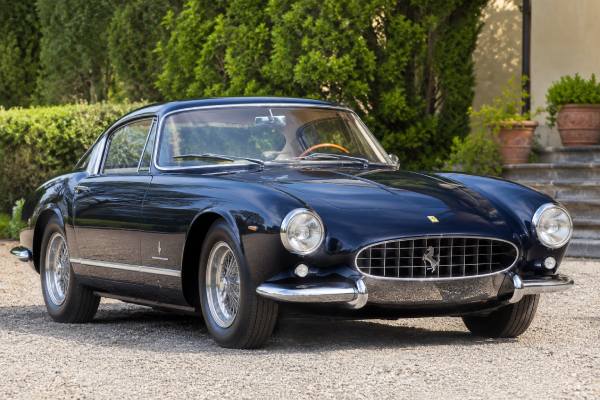
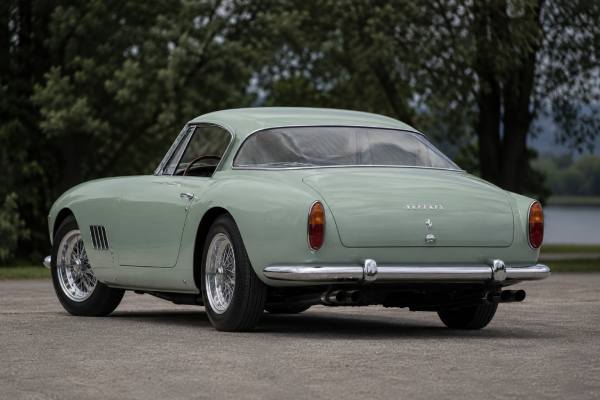
The Ferrari 250 GT Coupé Ellena is the 1957–1958 high-roof evolution of Ferrari’s early 250 GT road coupé, built on the Tipo 508C tubular chassis and powered by the 2,953 cc Tipo 128C Colombo V12. With around 50 examples completed by Carrozzeria Ellena, it sits between the Boano-bodied 250 GT coupés and the later Pinin Farina production coupé, making it one of the key transition cars in Ferrari’s move from custom-built postwar road cars to more consistent grand touring production.
Its appeal is not only rarity. The Ellena has the ingredients buyers want in an early Ferrari: a front-mounted 3.0-litre V12, a four-speed manual gearbox, coachbuilt Pinin Farina-derived styling, real luggage space, and enough refinement to make it a usable 1950s grand tourer rather than a thinly disguised competition machine. The important ownership questions are just as specific: matching numbers, Ferrari Classiche status, body originality, rust repair quality, and whether the car still represents an Ellena rather than a later re-bodied or heavily altered 250 GT chassis.
Quick Take
The Ferrari 250 GT Coupé Ellena is a rare, elegant, and historically important early Ferrari GT that combines the 240 hp Tipo 128C Colombo V12 with more cabin space and easier road manners than the earlier low-roof Boano cars. Its strongest appeal is the mix of coachbuilt 1950s style, usable grand-touring character, and direct connection to the 250 GT family that later produced the California Spider, Tour de France, SWB, Lusso, and GTO. The main caution is that value depends heavily on originality, documentation, and restoration quality; a beautiful-looking Ellena with a replacement engine, unclear body history, poor corrosion repairs, or weak paperwork can be a very different proposition from a matching-numbers, Classiche-certified car.
Table of Contents
- Ferrari 250 GT Ellena History
- Engine, Chassis and Specifications
- Production, Variants and Options
- Design, Engineering and Features
- Driving Experience and Performance
- Reliability, Maintenance and Restoration
- Market Value, Buying Guide and Rivals
Ferrari 250 GT Ellena History
The 250 GT Coupé Ellena matters because it helped turn Ferrari’s road-car business from small-batch coachbuilt production into a more organized GT model line. It was not a racing special, but it shared enough mechanical DNA with the 250 GT competition world to make it one of the most interesting road-focused Ferraris of the late 1950s.
Ferrari’s early 1950s road cars were beautiful but inconsistent. Bodies came from several coachbuilders, mechanical specifications changed often, and production numbers were tiny. By the mid-1950s, Enzo Ferrari needed a more repeatable road car that could be sold to wealthy private clients who wanted speed, style, and prestige without necessarily racing every weekend.
The result was the 250 GT coupé family. Pinin Farina shaped the design language, but Pinin Farina did not yet have the production capacity to build the full run. Ferrari therefore used outside coachbuilders, first Carrozzeria Boano and then Carrozzeria Ellena. Mario Felice Boano had been associated with Ghia and was capable of producing small-series bodywork. When Boano left to work with Fiat, his son-in-law Ezio Ellena continued the work through the renamed Carrozzeria Ellena.
The Ellena version followed the Boano coupé but introduced practical changes. The best-known difference is the raised roofline, often described as about two inches higher, which improved headroom and gave the car its “high roof” identity. Later Ellena cars also lost the small front quarter windows, giving the side glass a cleaner look. Mechanically, the Ellena generally used a more standardized four-speed gearbox shift pattern, larger drum brakes, ZF steering, and the Tipo 128C version of the Colombo V12.
In the Ferrari 250 story, the Ellena is a bridge. It came after the 250 Europa GT and the Boano coupé, before the Pinin Farina coupé moved Ferrari closer to fuller series production. It also sits beside more famous 250 models in mechanical spirit. The Tour de France berlinetta and California Spider are far more valuable and competition-oriented, but the Ellena uses the same broad front-engine, rear-drive, 3.0-litre V12 GT formula.
Today, collectors value the Ellena for three main reasons. First, it is rare, with around 50 built. Second, it is an early road Ferrari with attractive Pinin Farina-derived lines. Third, it offers a more usable cockpit than many earlier Ferraris, which makes it suitable for tours, concours lawns, and serious collections. It is not the most famous 250 GT, but it is one of the most important stepping stones in the family.
Engine, Chassis and Specifications
The Ellena’s core specification is classic 1950s Ferrari: a front-mounted Colombo V12, a tubular steel chassis, rear-wheel drive, a four-speed manual gearbox, and hydraulic drum brakes. Exact period figures vary by final-drive ratio, carburetor specification, and individual car history, so the most useful approach is to treat the numbers as well-supported period ranges rather than modern factory-certified data.
| Item | Specification |
|---|---|
| Production years | 1957–1958 |
| Chassis type | Tipo 508C tubular steel frame |
| Engine code | Tipo 128C Colombo V12 |
| Displacement | 2,953 cc |
| Configuration | 60-degree V12, single overhead camshaft per bank |
| Induction | Triple Weber downdraft carburetors |
| Power | About 240 hp at 7,000 rpm |
| Transmission | Four-speed manual |
| Drivetrain | Front engine, rear-wheel drive |
| Front suspension | Independent wishbones with coil springs |
| Rear suspension | Live axle with semi-elliptic leaf springs |
| Brakes | Four-wheel hydraulic drum brakes |
| Wheelbase | 2,600 mm |
The engine is the heart of the car. The Colombo V12 was compact, light for a twelve-cylinder engine, and central to Ferrari’s identity. In the Ellena, it is not tuned like a pure competition unit, but it is still a serious high-revving engine for its time. The 240 hp rating at 7,000 rpm tells you a lot about its personality: it rewards revs, precise carburetor tuning, and careful warm-up.
The chassis follows Ferrari’s early GT pattern. It is a tubular steel frame clothed in coachbuilt bodywork, not a unit-body structure. That matters for restoration because the frame, body mounts, sills, floors, and hand-formed panels must all be inspected as a system. A car can look straight from the outside while hiding old chassis repairs, poor sill reconstruction, or panel gaps that were “corrected” cosmetically rather than structurally.
Performance figures are best handled with context. Many sources put the Ellena’s top speed broadly between about 127 mph and 157 mph, depending on final-drive ratio. That sounds like a huge spread, but it reflects how Ferrari offered gearing choices and how period tests often measured individual cars rather than standardized production examples. A shorter final drive would make the car more responsive but limit maximum speed. A longer final drive would suit high-speed touring.
| Measure | Typical figure or range |
|---|---|
| 0–60 mph | Usually quoted around 6–7.5 seconds, depending on car and source |
| Top speed | About 127–157 mph, heavily affected by axle ratio |
| Power character | Strong upper-range pull, best when fully warm and properly tuned |
| Braking character | Effective for the period when correctly rebuilt, but not comparable to modern disc brakes |
For buyers, the most important technical detail is not whether one source quotes a slightly different acceleration figure. It is whether the engine, gearbox, axle, brakes, steering, cooling system, and chassis are correct to the car and maintained by people who understand early Ferrari construction.
Production, Variants and Options
The Ellena was not a mass-production car with a neat modern option sheet. It was a small coachbuilt run, so identification depends on chassis records, body details, engine numbers, period documentation, and expert inspection.
Most accepted accounts place Ellena production at around 50 cars. A common breakdown describes a small number of early low-roof or transitional examples and a larger group of high-roof Ellenas. This matters because not every car called an Ellena looks exactly the same. Some early cars share visual details with the Boano series, while later Ellenas more clearly show the raised roof and simplified side-window treatment.
Important identifying points include:
- Chassis number in the correct 250 GT sequence.
- Engine number and internal engine type.
- Gearbox and rear axle numbers where available.
- Body-number evidence and coachbuilder records.
- Roofline, side glass, door shape, and quarter-window treatment.
- Period photos, ownership history, and registration records.
- Ferrari Classiche certification or a detailed marque historian report.
Matching numbers are especially important. In ordinary used-car language, a replacement engine may be a practical repair. In the early Ferrari market, it can change value and desirability dramatically. Because 250 GT engines, gearboxes, and components have been separated, replaced, and occasionally used to build more valuable body styles, a buyer must verify what is present today against period records.
Factory colors and interiors were also more flexible than on later production cars. Customers could request specific paint, leather, carpets, and trim details. Some Ellenas were delivered to the United States through Luigi Chinetti, while others stayed in Europe or later migrated across markets. Original color is not always the most valuable choice in isolation, but a desirable original color combination backed by documentation can be a major plus.
Common Ellena identification themes
A buyer should understand the difference between three broad categories:
- A highly original Ellena with original chassis, body, engine, gearbox, and strong documentation.
- A restored Ellena that retains its key identity but has new paint, trim, mechanical rebuilds, and some replaced components.
- A compromised or altered car with unclear body history, non-original mechanical units, heavy reconstruction, or weak paperwork.
The first category is the most desirable, but not always the easiest to use. Original cars may need careful recommissioning. Restored cars can be excellent, but only if the restoration respected the correct construction details. Compromised cars can still be enjoyable, but the purchase price must reflect the risk.
Design, Engineering and Features
The Ellena’s design is important because it shows Ferrari learning how to make a refined roadgoing GT without losing the long-hood, short-deck drama of its earlier competition cars. The body is elegant rather than aggressive, with a clean beltline, upright glass, rounded wings, and a balanced roof that gives the car more comfort than the earlier low-roof coupés.
The underlying design came from Pinin Farina’s language for the early 250 GT coupé. Boano built the earlier cars, then Ellena continued the run with revisions. The raised roof is the signature change. It may sound minor, but in a 1950s coachbuilt GT it changes the way the car works. Taller drivers fit more comfortably, visibility improves, and the cabin feels less cramped on long trips.
The exterior details are restrained. The Ellena does not have the covered headlights and muscular haunches of later competition Ferraris. It is more formal and gentlemanly, with a long bonnet, compact cabin, slim pillars, and a practical boot. The proportions are still unmistakably Ferrari: front V12, rear-drive stance, and a shape that looks built for fast cross-country travel rather than boulevard cruising.
Engineering features worth noting include:
- Tubular steel chassis construction, typical of Ferrari’s period GT practice.
- Hand-formed coachbuilt body panels, which create small differences between cars.
- Front independent suspension, giving better road control than older front-axle layouts.
- Live rear axle with leaf springs, durable and period-correct but less sophisticated than later independent designs.
- Hydraulic drum brakes, large for the time but highly dependent on setup.
- ZF steering, valued for precision when properly rebuilt.
- A four-speed manual gearbox with a more conventional shift pattern than earlier Ferrari arrangements.
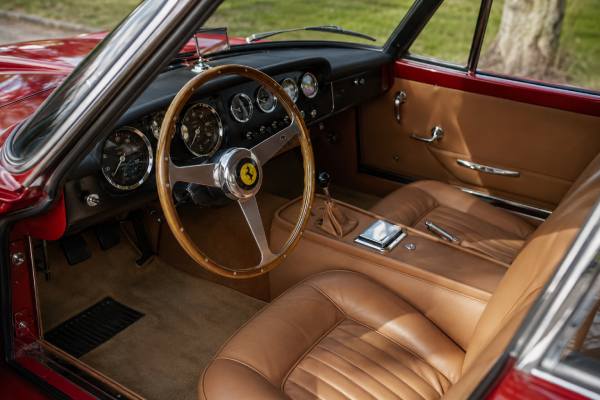
Inside, the Ellena is simple but rich in detail. The large steering wheel, clear gauges, leather seats, and relatively airy cabin make it feel more like a grand tourer than a racer. There is enough luggage space to support real touring, which is one reason restored Ellenas appear at events such as the Colorado Grand, concours tours, and Ferrari club gatherings.
The sensory character is also part of the design. The Colombo V12 sits ahead of the driver, with intake noise from the carburetors and a crisp exhaust note that builds as revs rise. Unlike later supercars, the Ellena does not rely on visual shock or electronic theatre. Its specialness comes from mechanical texture: the feel of the gearbox, the sound of the engine, the smell of leather and fuel, and the sense that every panel was shaped by hand.
Driving Experience and Performance
A properly sorted 250 GT Ellena feels fast, mechanical, and surprisingly usable for a late-1950s Ferrari. A tired one can feel heavy, hot, vague, and expensive within the first few miles.
The engine is the best part of the experience. The Tipo 128C V12 is smooth at low speeds when correctly tuned, but it becomes more exciting as the revs rise. It does not have modern instant torque, so the driver gets the best from it by using the gearbox and keeping the carburetors in their happy range. Warm-up matters. Oil temperature, coolant temperature, and carburetor behavior should be respected before using high revs.
The gearbox is part of the charm, but it demands patience. A strong example should shift cleanly once warm, with a positive mechanical feel. Worn synchros, poor clutch adjustment, tired engine mounts, or incorrect linkage setup can make the car unpleasant. The clutch should be firm but not brutal. Any slipping, juddering, or dragging should be investigated because access and parts costs are not minor.
Steering effort is low enough once moving, but parking speeds remind you that this is a classic front-engine GT with narrow tyres, no power steering, and a large steering wheel. On open roads, a good Ellena should feel stable and communicative rather than nervous. It is not a short-wheelbase competition berlinetta, but it has the balance and feedback that make early Ferraris satisfying at real-world speeds.
The brakes require the biggest adjustment for modern drivers. Well-rebuilt hydraulic drums can be confidence-inspiring on the road, but they need correct lining material, round drums, good hydraulics, and proper adjustment. They will not behave like modern ventilated discs. Repeated hard stops, mountain descents, and aggressive touring can reveal fade or imbalance if the system is not in excellent order.
Ride quality is better than many expect. The 2,600 mm wheelbase, taller cabin, and GT orientation make the Ellena more comfortable than more focused Ferrari competition cars. It is happiest on flowing roads, where the driver can settle into rhythm: listen to the V12, choose gears deliberately, let the chassis breathe, and enjoy the view over the long bonnet.
In town, the Ellena is less relaxed. Heat, heavy controls, drum brakes, carburetor manners, and limited low-speed airflow all matter. It can be driven in traffic, but it was designed for fast open-road travel, not modern congestion. A restored cooling system, healthy charging system, correct ignition setup, and well-synchronized carburetors make a huge difference.
The difference between a fresh, expert-maintained Ellena and a tired one is enormous. Two cars with similar paint quality can drive completely differently. That is why a proper road test by a specialist is essential before purchase.
Reliability, Maintenance and Restoration
The Ellena can be reliable in classic Ferrari terms, but only when maintained as a hand-built V12 GT rather than an ordinary old car. Most problems come from age, poor restoration work, inactivity, incorrect parts, and mechanics who do not understand early Ferrari systems.
The engine itself is robust when built correctly, but it is expensive to rebuild. Oil pressure, compression, leak-down results, timing-chain condition, valve-train noise, carburetor wear, distributor condition, and cooling behavior all deserve attention. A smooth idle is useful, but it is not enough. The engine should pull cleanly, hold temperature, and show no signs of excessive blow-by, smoke, fuel leaks, or oil contamination.
Fuel-system condition is critical. Old tanks, lines, pumps, and carburetor parts can cause poor running or worse. Modern fuels can also create issues with seals, floats, and vapor behavior. Many owners discreetly update materials while keeping the visible layout period-correct.
Cooling is another key area. A 3.0-litre V12 in a hand-built 1950s body needs a clean radiator, sound hoses, correct fan function, good ignition timing, and no hidden blockages. Overheating in traffic may be common on poorly prepared classics, but it should not be dismissed as normal without investigation.
The chassis and body are often the larger financial risk. Rust can affect sills, floors, lower doors, wheel arches, boot areas, battery sections, and body mounting points. Because the panels are coachbuilt, repair quality is everything. Heavy filler, uneven panel gaps, distorted door openings, and crude patching can signal serious trouble. A proper inspection should include the underside, frame tubes, suspension pickup points, and evidence of old accident damage.
High-priority inspection areas
| Area | What to check |
|---|---|
| Engine identity | Engine number, type, stamping style, internal specification, and documentation |
| Chassis | Frame condition, accident repairs, corrosion, body mounts, and alignment |
| Bodywork | Panel originality, sill work, door fit, roofline, and evidence of rebodying |
| Brakes | Drum condition, cylinders, master cylinder, hoses, lining material, and balance |
| Gearbox and clutch | Synchros, shift quality, clutch slip, noise, and oil leaks |
| Steering and suspension | ZF steering box wear, kingpins, bushings, dampers, springs, and axle location |
| Electrical system | Wiring age, charging output, starter condition, lighting, gauges, and period correctness |
| Documentation | Ownership chain, restoration invoices, historian reports, factory records, and Classiche book |
Restoration costs are difficult to generalize because condition varies so widely. A paint-and-trim refresh is one thing. A full body-off correction of poor old metalwork, a V12 rebuild, gearbox work, brake overhaul, interior retrim, and re-chroming is another. On a car of this value, cheap work is rarely cheap for long. Poor restorations often need to be redone at a far higher standard.
Originality versus upgrades is a delicate topic. Sensible safety and usability work, such as fresh brake hydraulics, correct tyres, improved wiring integrity, and modern fuel-compatible materials, can be wise. Visible non-period modifications, incorrect wheels, modern seats, non-original instruments, or major mechanical substitutions can damage value unless the car is already compromised.
For serious ownership, the best path is a relationship with a specialist who knows early 250 GT Ferraris. General classic-car experience is not enough. The correct shop should understand Colombo V12s, coachbuilt Ferrari body structures, early Ferrari documentation, and the market consequences of every repair decision.
Market Value, Buying Guide and Rivals
The Ellena sits in the high six-figure collector-Ferrari market, below the famous 250 California, Tour de France, SWB, Lusso, and GTO models but above many less rare or less historically important classic GTs. As of 2026, public results and listings show that good Ellenas can trade roughly from the mid-six figures toward about $1 million, with exceptional documentation, originality, restoration quality, and Ferrari Classiche certification pushing desirability.
Recent auction evidence shows why condition and paperwork matter. A restored, well-documented 1958 Ellena sold for $671,000 in 2020. A Ferrari Classiche-certified 1958 example sold for $940,000 in 2018. A 1958 Ellena connected to the Broad Arrow Amelia 2026 sale was reported at $984,000. At the same time, project cars, long-stored examples, cars with non-original engines, or cars needing major recommissioning may fail to sell or sit well below the best results.
Value drivers include:
- Matching original chassis, engine, gearbox, and body.
- Ferrari Classiche certification with Red Book.
- Known ownership chain and strong historian documentation.
- Original delivery colors, especially if attractive and well documented.
- High-quality restoration by recognized specialists.
- Preservation of coachbuilt body details.
- Correct Tipo 128C engine specification.
- Proven touring or concours history.
- Absence of serious accident history or rebody questions.
The buyer’s inspection should begin before anyone looks under the bonnet. First, establish the car’s identity. Confirm chassis number, engine number, gearbox number, body details, and documentation. Then compare the visible car with known Ellena features. Only after that should the mechanical inspection proceed.
A good buying sequence is:
- Review ownership history, factory documentation, historian reports, and Ferrari Classiche material.
- Confirm the identity of the chassis, engine, gearbox, axle, and body.
- Inspect the body structure, sills, floors, frame, suspension points, and corrosion-prone areas.
- Road-test the car from cold and again fully warm.
- Check oil pressure, cooling behavior, clutch action, gearbox synchros, steering play, brake balance, and charging output.
- Review restoration invoices and identify who did the work.
- Price the car according to what it is, not what it might become after expensive correction.
Cars to seek are complete, documented, matching-numbers examples with either honest originality or a properly researched restoration. Cars to approach carefully include those with missing engines, replacement V12s from other 250 models, unclear body histories, shiny but undocumented restorations, poor panel fit, or sellers who cannot explain the car’s provenance.
Rivals and alternatives depend on what the buyer wants. Within Ferrari, the 250 GT Boano is the closest relative. It is earlier and often visually lower and more delicate, while the Ellena is usually more comfortable. The later 250 GT Pinin Farina coupé is more common and more standardized, often less rare but easier to compare in the market. The 250 GT Lusso is far more famous and valuable, with later styling and greater glamour. The 250 GT Tour de France and California Spider are on a different price level because of racing identity, beauty, and collector status.
Outside Ferrari, period alternatives include the Aston Martin DB Mark III and early DB4, Maserati 3500 GT, Mercedes-Benz 300 SL Roadster, Jaguar XK150, and later Aston Martin DB5. These cars offer different mixes of performance, usability, parts support, and value. The Ellena’s advantage is pure early Ferrari V12 identity. Its disadvantage is that restoration and authenticity risks can be far more complex than on many more numerous rivals.
Safety expectations should be realistic. The Ellena predates modern crash structures, airbags, anti-lock brakes, stability control, and modern lighting standards. Seat belts may have been added later. Buyers planning long-distance touring should focus on tyre age, brake condition, lights, wiring, mirrors, seat mounting, fuel-system integrity, and careful route planning rather than expecting modern passive safety.
Long-term collectability looks strong because the Ellena has rarity, mechanical importance, and a direct place in the Ferrari 250 GT story. It is not a speculative novelty. It is an early V12 Ferrari with coachbuilt bodywork and a defined historical role. The best examples should remain attractive to collectors who want a serious but usable 1950s Ferrari, while weaker cars will continue to be judged harshly because the cost of correcting them is so high.
References
- 1958 Ferrari 250 GT Coupe by Ellena | Driving into Summer | RM Sotheby’s 2020
- 1958 Ferrari 250 GT Coupe by Ellena | Monterey 2018 | RM Sotheby’s 2018
- 1958 Ferrari 250 GT Coupe | Gooding Christie’s 2024
- 1958 Ferrari 250 GT Coupe Boano & Ellena sold at Broad Arrow The Amelia (2026) – CLASSIC.COM 2026
- Price Guide: Ferrari 250 GT Ellena [UPDATED 2026] 2026
Disclaimer
This article is for informational purposes only and is not a substitute for professional diagnosis, repair, restoration advice, valuation advice, or pre-purchase inspection. Specifications, torque values, service intervals, procedures, and originality details can vary by chassis number, market, equipment, restoration history, and factory records. Always verify details against official service documentation, Ferrari Classiche records, specialist inspection findings, and marque-expert research before buying, repairing, or restoring a Ferrari 250 GT Coupé Ellena.
If this guide helped you, please consider sharing it on Facebook, X/Twitter, or your favorite enthusiast community to support our work.