
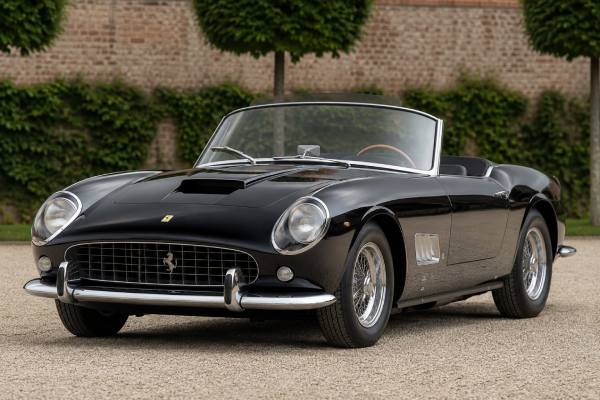
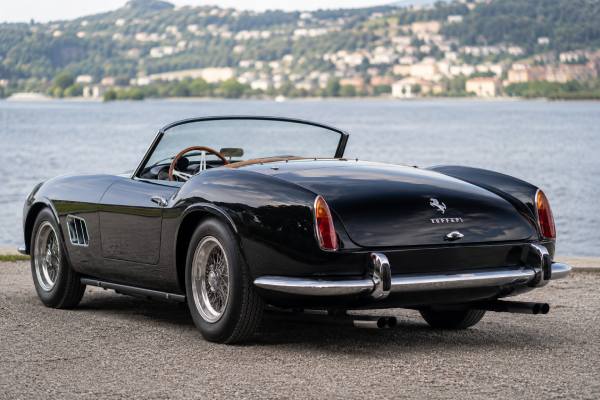
The Ferrari 250 GT LWB California Spyder with Tipo 508D chassis and Tipo 128D 3.0-liter V12 is one of the defining open Ferraris of the late 1950s. Built during the 1958–1960 long-wheelbase period, it combined the serious mechanical base of Ferrari’s 250 GT berlinettas with Scaglietti open bodywork, a 2,600 mm wheelbase, and a Colombo-derived V12 producing around 240 hp in standard road specification.
Its importance comes from more than beauty. The LWB California was conceived as an open car for fast road use, American buyers, and occasional competition, not as a soft boulevard cabriolet. It sat closer in spirit to the Tour de France berlinetta than to the more formal Pinin Farina Cabriolet, which is why collectors still treat it as a blue-chip Ferrari. The strongest cars today are not simply shiny restorations; they are cars with correct chassis, engine, body, period details, documented ownership, and careful restoration choices.
Quick Take
The 250 GT LWB California Spyder’s strongest appeal is its rare mix of open-air elegance and real 250 GT competition DNA: a Scaglietti body, a 3.0-liter V12, a four-speed manual gearbox, and the long, graceful proportions of the 2,600 mm chassis. The main caution is authenticity. These cars are valuable enough that engine type, body originality, covered-headlight history, brake specification, restoration quality, and Ferrari Classiche documentation can change value by millions, so buying one is as much a forensic exercise as an emotional decision.
Table of Contents
- History and Collector Significance
- V12, Chassis and Key Specifications
- Production, Variants and Original Details
- Scaglietti Design and Engineering Character
- Road Feel, Performance and Usability
- Maintenance, Restoration and Known Risks
- Values, Buying Advice and Rivals
History and Collector Significance
The LWB California Spyder matters because it turned Ferrari’s 250 GT performance platform into one of the most desirable open sports cars of its era. It was not merely a roofless luxury model; it was an open 250 GT with a sporting chassis, Scaglietti coachwork, and a direct link to Ferrari’s road-racing identity.
The idea is closely tied to the United States. Luigi Chinetti, Ferrari’s powerful American importer, understood that wealthy American buyers wanted fast open cars that could be used on the road, shown at events, and in some cases raced. California distributor John von Neumann also saw the opportunity. The result was a Ferrari aimed at a market where sunshine, sports-car racing, and open-road performance all mattered.
The first California Spyders appeared in the late 1950s, with the long-wheelbase version using the 2,600 mm 250 GT chassis. The cars covered here are the mature LWB examples associated with Tipo 508D chassis development and Tipo 128D V12 specification, built before the later short-wheelbase California arrived for 1960 onward production.
The LWB California’s place in Ferrari history is special because it bridges several identities at once:
- It is a 250 GT, sharing the basic 3.0-liter V12 family that made Ferrari’s road cars and GT racers famous.
- It is Scaglietti-bodied, giving it closer emotional and visual links to competition Ferraris than the more formal Pinin Farina Cabriolet.
- It was built in tiny numbers, with hand-finished details that vary from car to car.
- It has both concours and event eligibility, especially for examples with strong provenance.
- It sits among the most recognizable Ferrari shapes ever made.
The California was built during a period when Ferrari road cars were still deeply connected to racing. The company did not separate its image into neat road-car and competition-car departments the way modern manufacturers do. A customer could buy a refined open car that still carried much of the attitude of a sports racer.
That explains why collectors treat the LWB California differently from many glamorous convertibles of the period. A Mercedes-Benz 300 SL Roadster is more formally engineered and usable. An Aston Martin DB4 Convertible is elegant and rarer than many people realize. A Maserati 3500 GT Spyder offers Italian style with a more relaxed grand-touring nature. The Ferrari, however, has the 250-series mythology: V12 sound, hand-built bodywork, racing association, and extraordinary collector recognition.
The LWB version has its own following. The later SWB California is often more aggressive, more valuable in certain specifications, and more famous in popular culture. The LWB car is longer, more fluid, and more classically proportioned. Many enthusiasts prefer its stretched line, softer visual balance, and slightly more grand-touring road character.
For historians, the car represents a moment before Ferrari became a larger manufacturer with more standardized bodies and production processes. For buyers, it represents something harder-edged than a luxury cabriolet but more elegant than a pure competition car. For owners, it is a car that demands real stewardship. A poor restoration, incorrect mechanical specification, or weak documentation can damage both value and historical integrity.
V12, Chassis and Key Specifications
The heart of the 250 GT LWB California Spyder is Ferrari’s 2,953 cc Colombo-type V12, here in Tipo 128D form for the relevant later LWB specification. It is a compact, high-revving, naturally aspirated 60-degree V12 with three Weber carburetors and the crisp, mechanical character that defines early 250-series Ferraris.
| Item | Specification |
|---|---|
| Production period covered | 1958–1960 LWB California Spyder |
| Chassis type | Tipo 508D tubular steel chassis |
| Wheelbase | 2,600 mm |
| Engine type | Tipo 128D 60-degree V12 |
| Displacement | 2,953 cc |
| Bore x stroke | 73 mm x 58.8 mm |
| Valve gear | Single overhead camshaft per bank, two valves per cylinder |
| Fuel system | Three Weber twin-choke carburetors, commonly 36 DCL-series on standard LWB cars |
| Power | Approximately 240 hp at 7,000 rpm in standard road specification |
| Transmission | Four-speed manual |
| Drivetrain | Front-engine, rear-wheel drive |
| Front suspension | Independent front suspension with coil springs |
| Rear suspension | Live rear axle with period Ferrari locating links and springs |
| Brakes | Hydraulic drums on many LWB cars; later cars and some examples received disc brakes depending on build and specification |
| Body | Scaglietti open two-seat spider coachwork, typically steel with aluminum panels on many cars |
| Dry weight | About 1,100 kg, depending on body and equipment |
The 250 name comes from the approximate displacement of each cylinder in cubic centimeters. Twelve cylinders at about 250 cc each give the 3.0-liter total. That detail matters because the 250 series was not a single model but a whole family of road cars, berlinettas, cabriolets, and racing machines using related V12 architecture.
The Tipo 128D engine is an “inside-plug” V12, meaning the spark plugs sit within the vee of the engine. Later and more competition-focused outside-plug engines used different cylinder-head layouts and are more powerful, but a correct Tipo 128D unit is central to the identity of a later standard LWB California Spyder. A replacement engine may make the car usable, but it will not carry the same collector weight as a matching or correct-numbered engine.
The gearbox is a four-speed manual. By modern standards that sounds modest, but the engine’s flexibility and rev range make the car more usable than the gear count suggests. The driver still needs mechanical sympathy: deliberate shifts, proper warm-up, and respect for oil temperature are part of the experience.
The chassis is a tubular steel structure, not a modern monocoque. Its advantage is simplicity, lightness for the period, and suitability for hand-built bodies. Its drawback is that crash damage, corrosion, and old repairs can be difficult to detect without expert inspection. A chassis tube that looks acceptable from the outside may hide repairs, distortions, or replacement sections that matter greatly to value.
Performance figures vary by source, gearing, brake type, and engine tune. A healthy LWB California is a fast 1950s GT rather than a modern supercar. It can exceed 140 mph in suitable tune and gearing, and it accelerates with strong midrange pull once the carburetors are warm and properly synchronized. The real performance appeal is not a single number. It is the way the V12 gathers revs, the way the chassis settles into long corners, and the way the car feels light, alive, and expensive in the old-world sense of the word.
Production, Variants and Original Details
The LWB California Spyder is rare even before condition, specification, and history are considered. Around 50 long-wheelbase examples were built before the short-wheelbase version took over, and individual cars differ in headlights, body materials, engine specification, brakes, colors, and competition details.
The broad split is simple: LWB cars use the 2,600 mm chassis, while SWB cars use the later 2,400 mm chassis. The car in this article is the LWB type, specifically the later Tipo 508D / Tipo 128D identity rather than the later SWB California.
Within LWB production, the details become more important. Ferrari did not build these cars with modern option-sheet uniformity. They were coachbuilt machines produced in low numbers, often influenced by customer preference, market requirements, and evolving factory practice.
Important identification and value factors include:
- Chassis identity: The stamped chassis number must match factory records and known histories.
- Engine identity: A correct Tipo 128D engine matters, and a matching engine matters more.
- Body originality: Original Scaglietti bodywork is a major value anchor.
- Headlight style: Covered-headlight cars are especially desirable, though open-headlight cars can also be historically correct depending on market and specification.
- Brake specification: Drum-brake cars are period-correct for many LWB examples; later disc-brake cars may offer stronger usability.
- Factory color and trim: Original colors can add value, especially when unusual, elegant, or confirmed by documentation.
- Competition history: Real period race use can transform desirability, but only when properly documented.
- Certification and expert reports: Ferrari Classiche certification and respected historian reports are important in this market.
Covered headlights are one of the most discussed visual details. On some cars, the plexiglass-covered treatment gives the front end a smoother, more exotic look and is heavily valued by collectors. However, the inspection question is not simply “covered or uncovered.” The real question is whether the car was built that way, whether it was changed later, and whether the current body details match documentary evidence.
The same applies to engines. Some LWB cars used different versions of the 250 V12 family, and later competition-oriented examples can have more powerful engines. That does not mean every car should be upgraded or described as a competition car. In fact, an ordinary LWB California with its correct original specification can be more valuable than a car made “better” by later changes.
Factory documentation is critical because many details are easy to misstate. The best files include build-sheet copies, ownership records, old registration documents, restoration invoices, period photographs, concours records, and recognized expert reports. A Ferrari Classiche Red Book can help confirm major components and specification, but buyers should still read the full history file rather than relying on the presence of certification alone.
| Area | Why it matters |
|---|---|
| Chassis number | Defines the car’s legal and historical identity |
| Engine number and type | Confirms whether the V12 is original, correct, or replaced |
| Body number and panel history | Separates original coachwork from rebody or heavy reconstruction |
| Headlight configuration | Affects appearance, desirability, and originality |
| Brake type | Changes driving feel and must match build history |
| Original colors | Can influence both concours standing and market value |
| Restoration records | Show whether expensive work was done correctly |
Because values are so high, incorrect claims are not small problems. A wrong engine description, undocumented competition story, or later body conversion can materially alter the car’s place in the market. The safest approach is to treat every major claim as something to verify, not something to admire.
Scaglietti Design and Engineering Character
The LWB California Spyder’s design is distinctive because it looks elegant without becoming formal. Scaglietti gave the car a low, flowing body with muscular fenders, a long hood, a small cockpit, and enough racing influence to separate it from Ferrari’s more polished cabriolets.
Sergio Scaglietti’s work gave the California a hand-shaped quality that modern cars cannot easily copy. The lines are clean, but they are not sterile. The front wings rise gently over the wheels, the body sides have tension without sharp creases, and the rear haunches give the car a planted look. The long wheelbase helps the design. It stretches the car visually and gives it a relaxed, expensive stance.
The body was not just decoration over a generic frame. It reflected the way Ferrari packaged its front-engine GT cars: long V12 ahead of the driver, rear-wheel drive, compact cabin, and a tail shaped around luggage, fuel, and road use rather than downforce. Cooling openings, hood scoops, side vents, and grille shape all serve a practical purpose while contributing to the car’s identity.
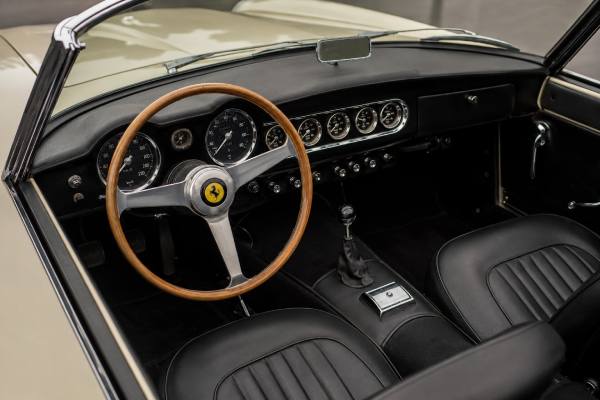
The cockpit is simple compared with later luxury GTs. The driver faces large round instruments, a wood-rimmed steering wheel on many cars, a tall manual gear lever, and a view down a long hood. There is leather and craftsmanship, but the mood is functional. This is not a car filled with insulation and convenience. It is a handmade sports GT that happens to be beautiful.
The sound is a major part of the engineering character. A carbureted Ferrari V12 has several layers: intake hiss, timing-chain and valvetrain texture, exhaust resonance, and the hardening note as revs rise. Correct carburetor setup is essential. A poorly tuned engine can feel flat, hesitant, or smoky; a good one feels crisp and eager without needing to be abused.
The California’s construction also explains why restoration is so demanding. Hand-built panels can vary, and repairs performed decades ago may not follow factory technique. Door fit, hood fit, windshield alignment, headlight covers, grille shape, and rear fender symmetry all need expert eyes. A car can look beautiful in photographs while hiding thick filler, incorrect panel contours, or structure that has been corrected cosmetically rather than properly.
Engineering-wise, the LWB California sits at the point where Ferrari was refining the road usability of its GT cars while keeping much of the racing simplicity. The engine is sophisticated for its day, but the suspension and brakes remain very mechanical. There are no electronic aids, no power modes, no stability systems, and no hidden safety net. The car’s “features” are the quality of its mechanical parts and the directness of the driver’s connection.
That is why originality matters. Modern upgrades may make an old Ferrari easier to use, but they can also dilute the historical experience. Sensible hidden improvements for safety or reliability may be accepted in some use cases, yet concours-level cars need period-correct materials, finishes, and components. The right choice depends on whether the car is being preserved, shown, toured, or actively driven.
Road Feel, Performance and Usability
A properly sorted LWB California Spyder feels fast, elastic, and vivid by 1950s standards, with a driving style based on rhythm rather than brute force. It rewards warm-up, smooth inputs, accurate shifting, and trust in the balance of the long chassis.
The engine is the center of the experience. At low rpm, the 3.0-liter V12 should feel tractable, not lumpy or unwilling. As revs rise, it becomes sharper and more urgent. The car does not deliver modern turbocharged torque; it builds speed through revs, gearing, and lightness. The reward is a clean mechanical surge that feels special every time the carburetors are in tune.
The gearbox requires patience until warm. First gear is used deliberately, and fast cold shifts are unwise. Once temperature comes up, the shift quality should be precise but still mechanical. This is not a modern synchronized gearbox that invites casual abuse. The best drivers pause slightly, match revs where needed, and let the lever move through the gate rather than forcing it.
Steering is heavier at parking speeds and more alive once moving. On a good road, the long wheelbase gives the car a stable, flowing nature. It does not dart like the later SWB version. Instead, it settles into bends and encourages the driver to carry speed cleanly. That is part of the LWB appeal: it feels like a fast open grand tourer with racing blood, not a nervous track special.
Braking expectations depend on the individual car. Drum-brake examples can work well when correctly rebuilt, adjusted, and driven with period awareness. They require more planning than modern brakes and can fade under repeated hard use. Disc-brake cars provide more confidence, especially in modern traffic or mountain driving, but originality and build history must be respected.
Ride quality is surprisingly usable when the suspension is fresh and properly set up. A tired car can wander, shake, tramline, or feel loose through the body. A well-restored car should feel taut but not harsh. Scuttle shake may be present because it is an open car on a period tubular chassis, but excessive movement suggests structural, body, or suspension issues.
Visibility is better than many modern supercars, though the long hood and valuable bodywork make urban driving stressful. Heat, fuel smell, oil smell, and mechanical noise are part of the environment. Owners who expect modern isolation will misunderstand the car. Owners who enjoy process, sound, and feel will find it deeply satisfying.
The best use case is not stop-start commuting. The car suits early-morning road drives, long touring events, concours rallies, and carefully chosen historic events. It can cover distance, but it needs preparation. Fluids, tires, wheel bearings, brakes, fuel lines, ignition parts, and cooling condition should be checked before serious use.
A restored example and a tired example can feel like different models. The restored car feels light, expensive, and responsive. The tired car may run hot, smell rich, pull under braking, shift poorly, and feel fragile. Because values are so high, some cars are over-cosseted and under-driven, which can create its own problems. A California that has been maintained through regular expert use is often more trustworthy than one that has only been polished and transported.
Maintenance, Restoration and Known Risks
Maintenance on a 250 GT LWB California Spyder is specialist work, not ordinary classic-car servicing. The main risks are incorrect restoration, hidden corrosion or accident damage, engine and gearbox originality issues, aging fuel and cooling systems, and the high cost of making small details right.
The V12 itself is durable when built and maintained correctly, but it is not tolerant of neglect. Oil quality, valve adjustment, ignition condition, carburetor synchronization, cooling health, and correct warm-up all matter. A poorly maintained engine can still sound impressive to a casual observer while hiding worn valve gear, tired rings, oiling issues, or incorrect internal parts.
The fuel system deserves close attention. Old tanks, pumps, lines, filters, and carburetor components can cause poor running or fire risk. Modern fuel can also create problems for seals and tuning. Many drivability complaints on carbureted classics trace back to fuel delivery, ignition, or air leaks rather than major engine failure.
Cooling must be excellent. A 3.0-liter V12 in an expensive coachbuilt body should not be allowed to run hot repeatedly. Radiator condition, fan setup, water pump health, hoses, thermostat choice, and internal block cleanliness are all part of the picture. Overheating can damage head gaskets, distort parts, and turn a manageable service issue into a major rebuild.
Chassis inspection is critical. These cars are old, valuable, and sometimes have long competition, restoration, or accident histories. Inspectors should check:
- chassis tube condition and evidence of replacement;
- suspension pickup points;
- front-end alignment and old impact repairs;
- door gaps under load;
- floors, sills, and lower body areas;
- signs of thick filler;
- corrosion around hidden seams and mounting points;
- body number evidence where available;
- old repairs hidden under fresh paint.
The brakes need specialist setup. Drum systems must be correctly arced, adjusted, and balanced. If a car has discs, the installation and specification should match its history. A brake system that looks restored but uses incorrect parts may be unsafe or damaging to value.
Suspension and steering wear can transform the car’s behavior. Bushings, kingpins, dampers, springs, steering boxes, wheel bearings, and wire wheels all need scrutiny. Borrani wire wheels, if fitted, must be checked for spoke tension, rim condition, and correct specification. Old tires are a major safety issue even if tread looks good; any serious driving requires fresh, correct-rated rubber.
Electrical systems are simple compared with modern cars but can be troublesome when aged or badly restored. Brittle wiring, poor grounds, weak charging, incorrect switches, and hidden modifications are common areas to review. The goal should be reliable function without erasing period-correct appearance.
Restoration is where the biggest money can disappear. A full, correct restoration of a California Spyder is not just paint, leather, and chrome. It may involve body buck work, chassis measurement, engine rebuilding, gearbox work, axle rebuild, brake system restoration, instruments, correct trim, period hardware, and research into how that specific chassis was originally built.
Originality versus usability is a real tradeoff. Some owners want a concours car with factory-correct finishes and minimal deviation. Others want a car that can run major tours without drama. The ideal is not always the same, but changes should be documented and reversible where possible.
Before purchase, a buyer should commission a specialist inspection from someone who knows 250-series Ferraris specifically. A general exotic-car inspection is not enough. The inspection should include a history review, mechanical evaluation, underside examination, body assessment, test drive, documentation audit, and comparison with known chassis records.
Values, Buying Advice and Rivals
The LWB California Spyder sits in the highest tier of open Ferrari collecting, but values vary widely by specification, originality, body history, documentation, and recent market mood. Ordinary language such as “excellent condition” is not enough at this level; the car must be judged by identity, provenance, correctness, and restoration integrity.
Recent public results show why nuance matters. Well-documented LWB cars have traded in the high seven-figure to low eight-figure dollar range, while special competition examples, exceptional covered-headlight cars, and highly publicized SWB cars can move far beyond that. A 1959 LWB California Spider sold by RM Sotheby’s in Miami in 2026 achieved just over $7 million, while other recent auction listings and results show estimates and outcomes varying significantly by car.
The market generally rewards:
- matching-numbers engine, gearbox, rear axle, and body where confirmed;
- Ferrari Classiche certification;
- strong expert documentation;
- original or well-supported color combinations;
- covered-headlight configuration when original;
- competition history with period proof;
- long-term known ownership;
- high-quality restoration by recognized specialists;
- eligibility for major concours and driving events;
- complete tools, books, and historical files.
The market punishes uncertainty. Missing history, unclear body replacement, incorrect engine claims, poorly documented restoration, non-original colors without explanation, and unresolved legal identity questions can all reduce buyer confidence. At this level, doubt is expensive.
A smart buying process should be slow and evidence-based:
- Confirm the chassis identity and known history.
- Verify engine, gearbox, axle, and body claims against documentation.
- Review Ferrari Classiche material and any expert reports.
- Inspect the car physically with a recognized 250 Ferrari specialist.
- Compare current specification with period photos and build information.
- Evaluate restoration quality underneath, not just paint and trim.
- Review recent maintenance and actual road use.
- Price the car against comparable sales, not against the seller’s adjectives.
Cars to seek are those with coherent stories. A restored car is not a problem if the restoration is correct, documented, and respectful of original configuration. A toured car is not a problem if it has been maintained properly. Even a car with some past changes can be attractive if the facts are transparent and the price reflects them.
Cars to avoid are those with exciting claims and weak evidence. “Believed to be,” “said to have,” and “reportedly raced” are not enough when millions are at stake. A buyer should also be cautious with cars restored long ago to older standards. Some older restorations looked beautiful when finished but may now hide aging mechanical systems, poor body repairs, or outdated assumptions about originality.
The closest rivals depend on what the buyer wants. The Mercedes-Benz 300 SL Roadster is the more technically formal choice, with fuel injection, iconic engineering, and broader usability. The Aston Martin DB4 Convertible is elegant and rare, but it lacks the Ferrari 250’s racing aura. The Maserati 3500 GT Spyder offers charm and style at a different market level. Within Ferrari, the 250 GT Cabriolet Series I is more formal, the 250 GT Tour de France is more competition-focused, and the SWB California is the sharper, later, often more expensive sibling.
Long-term collectability should remain strong because the LWB California combines the right ingredients: Enzo-era Ferrari, 250-series V12, Scaglietti bodywork, open coachbuilt design, tiny production, and international recognition. That does not make every example equally safe financially. The best cars will likely remain highly liquid among serious collectors. Questionable cars may become harder to sell as buyers become more forensic.
For an enthusiast, the LWB California is a dream car. For an owner, it is a responsibility. For a buyer, it is a document-driven acquisition where beauty should start the conversation, not finish it.
References
- Ferrari 250 California (1957) – Ferrari.com 1957
- CALIFORNIA DREAMING: Ferrari History 1957
- Ferrari Classiche: Certification – Ferrari.com 2026
- 1959 Ferrari 250 GT LWB California Spider by Scaglietti | Miami | RM Sotheby’s 2026
- 1958 Ferrari 250 GT LWB California Spider | Gooding Christie’s 2026
Disclaimer
This article is for informational purposes only and is not a substitute for professional diagnosis, repair, restoration advice, or pre-purchase inspection. Specifications, torque values, service intervals, parts, and procedures can vary by chassis number, market, build history, and equipment, so owners and buyers should verify all details against official Ferrari documentation and qualified marque specialists.
Please share this article on Facebook, X/Twitter, or other platforms if it helped you. Sharing supports our work and helps more enthusiasts find reliable classic-car information.