
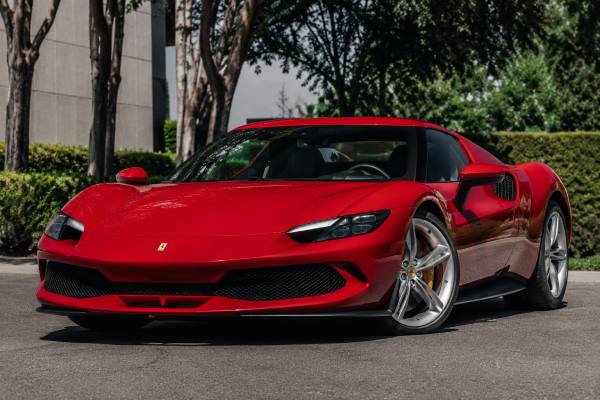
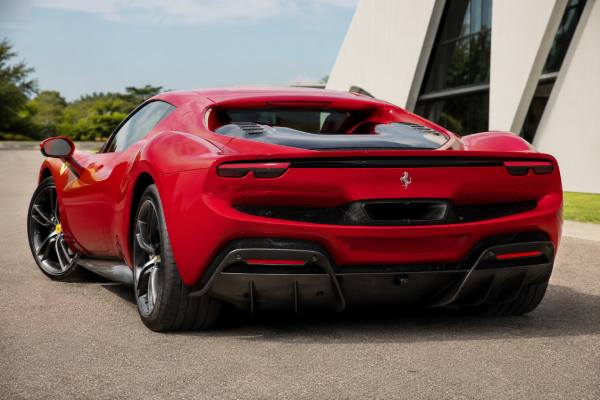
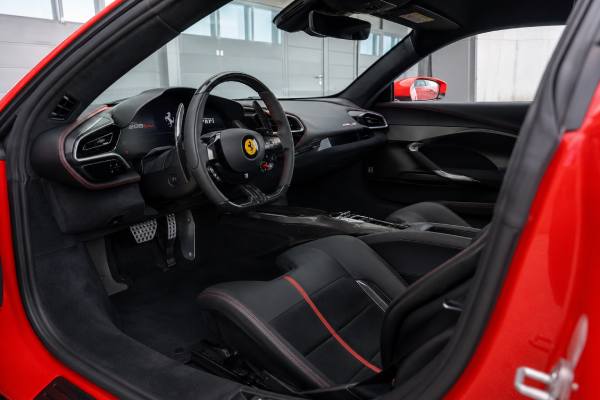
The Ferrari 296 GTB is the mid-rear-engined plug-in hybrid berlinetta that brought a V6 back to the center of Ferrari’s road-car range. Sold from the 2022 model year onward, the F171-generation 296 GTB uses the F163 BC 3.0-liter twin-turbo V6, a rear-mounted electric motor, and an eight-speed dual-clutch transmission to produce 830 cv of system output. It replaced the idea that Ferrari’s core mid-engine supercar had to be V8-powered, while also proving that hybrid hardware could make a car sharper rather than heavier-feeling.
Its importance is not just the headline power figure. The 296 GTB is compact by modern supercar standards, rear-wheel drive, extremely fast, and more technically complex than the F8 Tributo it effectively succeeded. It sits below Ferrari’s larger flagship hybrids, yet it delivers performance that only a few years earlier would have belonged to the top of the range. For buyers, it is also a car where specification, warranty status, battery condition, recall completion, and service records matter just as much as color and mileage.
Quick Take
The 296 GTB’s strongest appeal is the way it combines Ferrari’s compact mid-engine balance with instant hybrid torque and a high-revving twin-turbo V6 that feels more special than its cylinder count suggests. Its identity is clear: a rear-drive plug-in hybrid supercar that marks a major technical shift for Ferrari without becoming quiet, soft, or purely efficiency-focused. The main caution is complexity, especially around hybrid hardware, software, recalls, carbon-ceramic brakes, tires, lift systems, and option-heavy cars. The best examples are low-mileage but regularly serviced cars with complete Ferrari records, confirmed recall work, intact factory specification, and enough remaining warranty or official maintenance coverage to reduce early ownership risk.
Table of Contents
- Model History and Importance
- Powertrain, Chassis and Key Specs
- Production, Variants and Factory Options
- Design, Aero and Engineering Details
- Driving Character and Real Performance
- Reliability, Maintenance and Ownership Risks
- Market Values, Buying Advice and Rivals
Model History and Importance
The 296 GTB matters because it changed Ferrari’s mid-engine formula from twin-turbo V8 to plug-in hybrid V6 without moving down in performance or status. It arrived as a new technical center point for Ferrari: smaller than the SF90 Stradale, more advanced than the F8 Tributo, and more usable than a limited-run track special.
Ferrari revealed the 296 GTB in 2021, with customer cars arriving for the 2022 model year. The name follows a traditional Ferrari logic: “29” refers to the rounded 2,992 cc displacement, “6” refers to the number of cylinders, and GTB stands for Gran Turismo Berlinetta. The internal model family is commonly identified as F171, while the engine family is known as F163.
The key historical point is the V6. Ferrari had deep V6 history in racing, especially through the Dino lineage, but the 296 GTB was the first road-going Ferrari-badged production car to place a six-cylinder engine at the heart of a mainstream supercar. Earlier Dino road cars used V6 engines but did not wear Ferrari badges in the same way. The 296 GTB therefore sits at an important turning point: it connects Ferrari’s racing past with the brand’s hybrid future.
It also changed the role of electrification. The 296 is not a hybrid because Ferrari wanted to make a relaxed commuter car. Its electric motor fills torque gaps, sharpens throttle response, enables short-range electric driving, and supports high-speed performance. The car can move quietly in eDrive mode, but its main purpose is still response, speed, and driver engagement.
In the modern Ferrari range, the 296 GTB occupies the core two-seat mid-engine berlinetta role once held by cars such as the 458 Italia, 488 GTB, and F8 Tributo. Compared with those cars, it is shorter in wheelbase, more electronically integrated, and more dependent on software-controlled systems. That makes it fascinating to enthusiasts and important to collectors, but it also means buying one requires more than a normal used-supercar inspection.
Today, the 296 GTB is still a current-era exotic rather than an old collector car. Its long-term collectability will depend on how the market views Ferrari’s first mainstream hybrid V6 supercar, how many were built, how many were heavily optioned, and how the later 296 Speciale affects demand for the standard GTB. For now, the car is prized for its performance, technical significance, and unusually strong driving reputation.
Powertrain, Chassis and Key Specs
The 296 GTB is built around a 120-degree 3.0-liter twin-turbo V6 paired with a single rear electric motor. The result is 830 cv of combined output, rear-wheel drive, and acceleration figures that place it well beyond the previous V8 generation.
Core technical specifications
| Category | Specification |
|---|---|
| Model code | F171 |
| Engine code | F163 BC |
| Engine | 2,992 cc 120-degree twin-turbocharged V6, dry sump |
| Bore x stroke | 88 mm x 82 mm |
| Combustion-engine output | 663 cv at 8,000 rpm |
| Combustion-engine torque | 740 Nm at 6,250 rpm |
| Electric motor | Rear axial-flux motor between engine and gearbox |
| Electric-motor output | 122 kW, equal to 167 cv |
| Total system output | 830 cv |
| Battery | 7.45 kWh lithium-ion high-voltage battery |
| Transmission | Eight-speed F1 dual-clutch automatic |
| Drivetrain | Rear-wheel drive |
| Electric range | Up to 25 km on the WLTP cycle, market dependent |
The 120-degree V angle is more than an unusual talking point. It allows the turbochargers to sit within the vee of the engine, reducing the height of the powertrain and helping packaging. The wide V6 is compact from front to rear, and the electric motor sits between the engine and transmission. That layout gives the 296 immediate torque fill without adding a front electric axle, so the car keeps the feel and balance of a rear-drive Ferrari.
The 8-speed dual-clutch gearbox is related in concept to the unit used in other modern Ferraris. It shifts quickly, works smoothly at low speed when healthy, and allows the hybrid system to blend electric and combustion torque without the driver having to manage the process manually.
Dimensions and performance
| Item | Figure |
|---|---|
| Length | 4,565 mm |
| Width | 1,958 mm |
| Height | 1,187 mm |
| Wheelbase | 2,600 mm |
| Dry weight | 1,470 kg with lightweight specification |
| Weight distribution | 40.5% front, 59.5% rear |
| Fuel capacity | 65 liters |
| 0–100 km/h | 2.9 seconds |
| 0–200 km/h | 7.3 seconds |
| Top speed | Over 330 km/h |
The chassis is an aluminum structure developed around the shorter wheelbase and hybrid packaging. The 296 GTB is not a carbon-tub car like some rivals, but Ferrari’s aluminum construction gives it excellent stiffness and repairability within the brand’s established service network. Suspension is by double wishbones at the front and a multi-link rear layout, with magnetorheological dampers on standard cars.
Wheels, brakes and tires
The 296 GTB uses large carbon-ceramic brakes, wide 20-inch tires, brake-by-wire control, and advanced stability software. Tire choice makes a major difference. A car on road-focused performance tires will feel more progressive and usable in poor weather, while a car on track-focused rubber will feel sharper once warm but less forgiving when cold.
| Area | Specification |
|---|---|
| Front tires | 245/35 ZR20 |
| Rear tires | 305/35 ZR20 |
| Front brakes | Carbon-ceramic discs, 398 mm |
| Rear brakes | Carbon-ceramic discs, 360 mm |
| Steering | Electric power-assisted steering |
| Dampers | Magnetorheological dampers, with Assetto Fiorano Multimatic dampers available |
Production, Variants and Factory Options
The 296 GTB is the closed-roof berlinetta in the 296 family, while the 296 GTS is the retractable-hardtop spider. Ferrari has not publicly treated the standard GTB as a numbered limited edition, so condition, options, color, warranty status, and documentation matter more than a build number.
The main road-going 296 family is easy to understand at first glance, but the details matter when buying.
| Version | Role | Why it matters |
|---|---|---|
| 296 GTB | Fixed-roof berlinetta | Lightest and most focused standard road version |
| 296 GTS | Retractable-hardtop spider | Adds open-air driving with slightly more weight and complexity |
| Assetto Fiorano package | Track-focused factory package | Adds lighter and sharper hardware for buyers who prioritize circuit use |
| 296 Speciale | Higher-performance evolution | More power, more aero, lower weight, and stronger future collector interest |
| 296 GT3 and 296 Challenge | Race cars | Not road variants, but important for the 296’s motorsport identity |
The most important factory package for the GTB is Assetto Fiorano. It is aimed at owners who want a more focused car, especially for track days. The package can include Multimatic dampers, additional carbon-fiber parts, weight-saving details, and more aggressive aero elements. Some cars also have special livery options linked to the package.
For road use, Assetto Fiorano is not automatically “better.” It can make the car more desirable to some collectors and more precise on track, but a standard 296 GTB may be more comfortable, easier to use, and more appealing to buyers who want a road car first. The best choice depends on how the car will be driven.
Common desirable factory options include:
- Front suspension lift, especially for city use and steep driveways.
- Carbon-fiber exterior trim, including front, side, rear, and underbody elements.
- Carbon-fiber racing seats in the correct size for the owner.
- Carbon-fiber steering wheel with LED shift lights.
- Forged wheels or optional lightweight wheels.
- Parking cameras, front and rear sensors, and surround-view equipment where fitted.
- Premium audio, smartphone connectivity, and convenience options.
- Special paints, historical colors, Tailor Made finishes, and contrast stitching.
- Paint protection film, although aftermarket film should be documented and well installed.
For authenticity, the key is to compare the car against its original build sheet or Ferrari dealer option record. A heavily optioned car can carry a large premium, but only if the specification is coherent and the condition supports the asking price. Poor aftermarket carbon parts, non-factory wheels, lowered suspension, exhaust changes, or missing original parts can reduce appeal.
Design, Aero and Engineering Details
The 296 GTB looks simple because Ferrari worked hard to hide the complexity. Its compact proportions, short wheelbase, flying-buttress rear treatment, active aero, and low-mounted hybrid hardware are all tied to function rather than decoration.
The design came from the Ferrari Styling Centre under Flavio Manzoni. It avoids the busy surface treatment of some modern supercars and instead uses clean flanks, a tight cabin, and a rear shape that recalls the 250 LM without copying it. The result is a car that looks smaller and more compact in person than its power output suggests.
The most distinctive aero feature is Ferrari’s “tea-tray” front aerodynamic concept. Air is guided beneath the front bodywork to generate load and manage flow without relying on a large fixed front wing. At the rear, an active spoiler deploys from the tail when needed, adding downforce while preserving the clean shape at lower speeds and in normal driving.
Cooling is a major part of the design. The 296 GTB has to manage heat from a twin-turbo engine, electric motor, battery, power electronics, brakes, and gearbox. The side intakes, rear vents, underbody channels, and engine-bay airflow are all part of that package. This is one reason accident repairs or poor aftermarket modifications are such a concern. A panel gap or missing duct is not just cosmetic on a car like this.
The cockpit follows Ferrari’s modern digital layout, with most controls placed around the driver. The steering wheel includes touch-sensitive controls and the manettino drive-mode switch. Owners coming from older Ferraris may need time to adjust, because many functions that once had simple physical switches are now integrated into the digital interface.
The hybrid controls are also central to the car’s character. The eManettino lets the driver choose how the car uses electric power:
- eDrive allows short-distance electric driving.
- Hybrid balances efficiency and performance for normal use.
- Performance keeps the combustion engine running more often to maintain battery charge for hard driving.
- Qualify prioritizes maximum performance over charge preservation.
The sound is unusual for a modern turbocharged car. The V6 does not have the deep tone of an older Ferrari V8, but it is sharp, high, and urgent. The 120-degree layout, hot-vee turbo placement, intake tuning, and exhaust routing help the engine feel more exotic than a typical six-cylinder. It is not a quiet hybrid with a sporty mode; it is a Ferrari supercar that happens to use electric torque as part of its performance system.
Driving Character and Real Performance
The 296 GTB feels fast because the electric motor removes the delay that drivers often expect from a turbocharged engine. The car’s defining trait is not just acceleration, but the way it combines instant response, rear-drive balance, and a compact wheelbase.
At low speed, the 296 can be surprisingly calm. In Hybrid mode, it may move quietly on electric power, start the engine smoothly, and behave more politely than its performance numbers suggest. Visibility is reasonable for a mid-engine exotic, and the dual-clutch gearbox is smooth enough for traffic when properly calibrated and maintained. The ride is firm but not crude, especially on standard suspension.
Push harder and the character changes quickly. The electric motor fills the lower rev range, the V6 builds speed with little pause, and the gearbox shifts with the speed expected of a modern Ferrari. The car does not feel like a large, heavy plug-in hybrid. It feels light on its feet because the chassis, steering, power delivery, and electronic controls are all tuned around agility.
The steering is quick, and the short wheelbase helps the front end react immediately. That can be thrilling, but it also means the car deserves respect on cold tires or poor roads. A 296 GTB on warm performance tires feels deeply planted. A 296 on cold, old, or mismatched tires can feel nervous, especially with 830 cv available.
The brakes are extremely powerful. The brake-by-wire system blends regeneration and friction braking, so pedal feel may seem different to drivers used to older hydraulic-only Ferraris. In normal road use, the system is easy to trust once acclimated. On track, brake condition, tire temperature, and fluid service become much more important.
On a mountain road, the 296 GTB’s appeal is its rhythm. It changes direction quickly, fires out of corners with electric-assisted torque, and keeps the driver involved through sound and gear selection. On a circuit, it is much more serious. Heat management, tire wear, brake wear, and battery strategy become part of the experience. Performance and Qualify modes are not gimmicks; they change how ready the hybrid system is to deliver repeated hard laps.
The 296 is also more usable than many older supercars. It can creep through traffic, lift its nose if equipped with front lift, and cover highway miles without feeling fragile. But it is still wide, low, expensive to repair, and sensitive to tire and brake condition. It rewards owners who use it properly and maintain it on schedule.
Reliability, Maintenance and Ownership Risks
The 296 GTB is too new and too complex to judge like an old naturally aspirated Ferrari. The important ownership question is not whether it is “reliable” in a simple sense, but whether its hybrid system, recalls, software, tires, brakes, and service history have been managed correctly.
Ferrari’s seven-year scheduled maintenance program is a major advantage for early owners and buyers. It helps ensure annual servicing is not skipped just because the car has low mileage. However, scheduled maintenance is not the same as a full warranty, and it does not remove the need for a careful inspection.
Known recall areas to verify
Two U.S.-market recall areas are especially important for buyers to check by VIN:
| Recall area | Affected concern | Buyer action |
|---|---|---|
| Fuel tank connecting pipe | Potential corrosion from contact near the high-voltage battery protection cover on certain 2022–2023 296 vehicles | Confirm the pipe replacement or official remedy is complete before purchase |
| Turbocharger oil-feed pipe connection | Potential incorrect torque on a nut securing the oil filter connection on a small number of 2025 vehicles | Check VIN status and confirm dealer inspection or correction |
A recall does not automatically make a car undesirable. An unrepaired recall, poor documentation, or a seller who cannot explain the car’s status is the problem.
Hybrid system checks
The high-voltage battery and electric motor are central to the car’s value. Before buying, confirm that the car charges correctly, moves through its hybrid modes normally, shows no high-voltage warnings, and has received any required software updates. A Ferrari specialist or dealer diagnostic scan is essential.
Important hybrid checks include:
- Battery state-of-health information where available.
- Charging-port condition and charging-cable presence.
- Coolant-system condition for hybrid and combustion components.
- Warning lights or stored fault codes.
- Smooth transition between electric and combustion operation.
- Evidence of software updates performed by an authorized dealer.
Mechanical and wear items
The F163 engine is highly stressed, but it was designed for this output. The larger concern is heat, fluid condition, and evidence of misuse. Look for oil leaks, coolant seepage, damaged undertrays, missing heat shielding, and signs of repeated hard track use without matching service records.
The 8-speed dual-clutch transmission should shift cleanly and engage smoothly. Harsh low-speed behavior, warning messages, or delayed engagement need investigation. Launch-control use is not always visible, so tire wear, brake wear, and service history become clues.
Carbon-ceramic brakes can last a long time on road cars, but track use changes the calculation. Disc condition, pad thickness, heat checking, and dealer wear measurements matter. Replacement costs are high enough that a “cheap” car with tired brakes may not be cheap at all.
Tires are another major factor. A low-mileage 296 on old or mismatched tires is not properly ready to enjoy. Check tire date codes, tread condition, sidewall damage, and whether the tires match Ferrari-approved specifications.
Body, electronics and accident inspection
Because the 296 depends heavily on aerodynamic ducts, cooling paths, sensors, cameras, and electronic control modules, accident damage deserves extra scrutiny. Paintwork is not automatically bad, but it must be explained. Poor front-end repairs can affect parking sensors, radar or camera systems where fitted, cooling ducts, underbody airflow, and front-lift hardware.
A proper inspection should include:
- Paint-depth readings and panel-gap checks.
- Underside inspection for curb strikes and damaged carbon trim.
- Front lift operation, if fitted.
- Suspension and wheel inspection for impact damage.
- Diagnostic scan of all control modules.
- Confirmation that original wheels, books, keys, charger, tools, and accessories are present.
- Review of warranty, service, and recall history through Ferrari records.
Market Values, Buying Advice and Rivals
The 296 GTB market is still young, so values are driven more by supply, options, mileage, color, and warranty than by long-term collector patterns. The safest buys are not always the cheapest cars; they are the cars with the clearest history and the least expensive future risk.
As a current Ferrari, the 296 GTB occupies a tricky market position. New and nearly new examples can be heavily optioned, and used prices vary widely by country, tax structure, mileage, and specification. In the U.S. and Europe, many advertised cars sit around the original base-price zone or below the cost of a heavily optioned new build, while very special colors, Assetto Fiorano cars, delivery-mile examples, and Tailor Made specifications can ask more.
What drives value
| Factor | Effect on value |
|---|---|
| Service history | Complete Ferrari dealer history strongly supports value |
| Warranty and maintenance coverage | Remaining coverage reduces buyer risk |
| Recall completion | Unresolved recall status should delay or reduce a purchase |
| Options | Carbon, lift, seats, wheels, cameras, and special paint can add appeal |
| Assetto Fiorano | Often desirable, but best suited to buyers who want a sharper car |
| Mileage | Very low mileage helps value, but lack of use does not excuse skipped service |
| Color | Classic Ferrari colors are liquid; unusual Tailor Made colors depend on taste |
| Accident history | Structural, cooling, aero, or electronic repairs can heavily affect value |
A smart buyer should ask for the original build sheet, service invoices, recall confirmation, warranty status, diagnostic report, and paintwork disclosure before negotiating. A seller who provides those quickly is usually worth taking more seriously.
Examples to seek and avoid
Seek a 296 GTB with:
- Complete Ferrari service history.
- Known ownership history.
- No unresolved recalls.
- Clean diagnostic scan.
- Healthy tires and brakes.
- Sensible factory options.
- No unexplained aftermarket modifications.
- Remaining warranty or eligibility for Ferrari extended coverage.
- Documented paint protection film rather than hidden bodywork.
Avoid or heavily discount a car with:
- Missing service records.
- Unclear import history.
- Repeated warning lights.
- Unverified hybrid-system faults.
- Heavy track use with no supporting maintenance.
- Cheap aftermarket parts.
- Accident repairs around cooling ducts, underbody aero, suspension, or electronics.
- Worn carbon-ceramic brakes presented as “normal wear.”
Rivals and alternatives
| Car | Why compare it | 296 GTB difference |
|---|---|---|
| McLaren Artura | Closest V6 plug-in hybrid rival | The Ferrari is more powerful and more theatrical, usually at a higher cost |
| McLaren 750S | Light, fast, non-hybrid supercar alternative | The 296 has hybrid response and Ferrari brand pull; the 750S emphasizes low weight |
| Lamborghini Temerario | Modern hybrid replacement for the Huracán line | The Ferrari is rear-drive and more compact in feel; the Lamborghini brings a different AWD hybrid character |
| Ferrari F8 Tributo | Previous Ferrari mid-engine V8 choice | The F8 is simpler and V8-powered; the 296 is quicker and more advanced |
| Ferrari SF90 Stradale | Used flagship hybrid Ferrari alternative | The SF90 is more powerful and AWD; the 296 is smaller, lighter-feeling, and more playful |
| Maserati MC20 | Italian mid-engine V6 exotic | The MC20 is simpler and elegant; the 296 is far more powerful and technically intense |
The 296 GTB’s long-term appeal should be strong because it represents a clear Ferrari milestone: the first central mid-engine Ferrari supercar generation to make a plug-in hybrid V6 the main event. The question is not whether it is important, but which examples will be best preserved. Cars with elegant specifications, no stories, complete records, and the right factory options are likely to age better than neglected or heavily modified cars.
References
- Ferrari 296 GTB: defining fun to drive 2021
- Smart Guide Ferrari 296 GTB 2022
- Warranties And Official Ferrari Maintenance 2026
- Part 573 Safety Recall Report 23V-329 2023 (Recall Database)
- Part 573 Safety Recall Report 25V716 2025 (Recall Database)
Disclaimer
This article is for informational purposes only and is not a substitute for professional diagnosis, repair, inspection, or valuation. Specifications, torque values, service intervals, recall status, software requirements, and repair procedures can vary by VIN, market, equipment, and production date. Always verify details against official Ferrari service documentation and have any 296 GTB inspected by an authorized Ferrari dealer or qualified Ferrari specialist before purchase or repair.
If this guide helped you, please consider sharing it on Facebook, X/Twitter, or your favorite car community to support our work.