
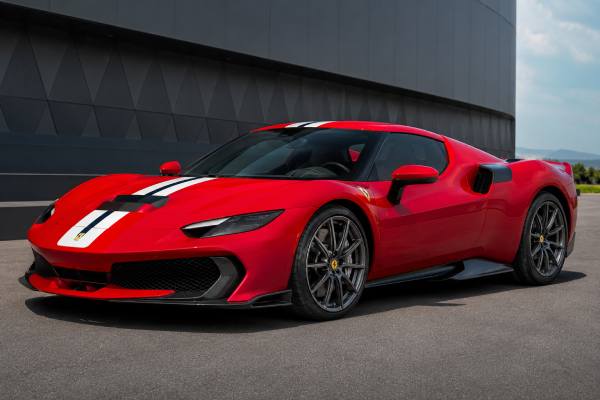
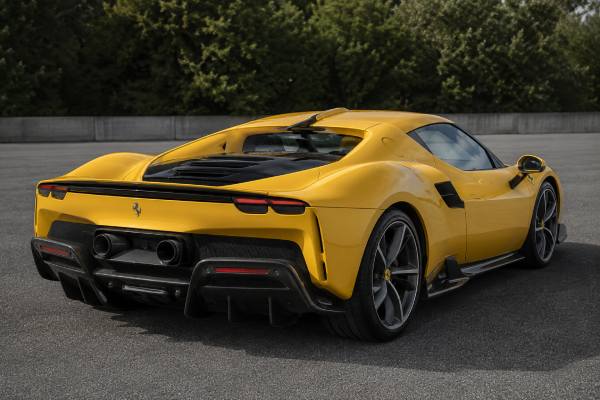
The Ferrari 296 Speciale (F171VS) is the sharper, lighter, more focused version of the Ferrari 296 GTB, using the F163 BC 3.0-liter 120-degree twin-turbo V6 with a plug-in hybrid system for a claimed 880 cv total output. Introduced in 2025, it sits in the modern line of Ferrari special-series mid-engine berlinettas, following the idea behind cars such as the 360 Challenge Stradale, 430 Scuderia, 458 Speciale, and 488 Pista, but with a very different technical identity: electrified torque, active software, high downforce, and a compact V6 instead of a naturally aspirated V8 or turbocharged V8.
Its importance is not just the power figure. The 296 Speciale shows how Ferrari is turning hybrid hardware into a driver-focused tool rather than simply using it for emissions or straight-line acceleration. Compared with the 296 GTB, it brings more engine output, more electric support in its most aggressive modes, lower weight, a revised aero package, a more serious chassis setup, and a cabin that leans harder into the lightweight special-version theme.
For buyers and collectors, the appeal is tied to allocation, specification, condition, and documentation. It is a new car rather than a settled classic, so its long-term value is still forming, but its place in Ferrari’s special-series bloodline already makes it one of the most closely watched modern Ferrari models.
Quick Take
The Ferrari 296 Speciale is the most intense road-going 296 coupe, combining an 880 cv plug-in hybrid V6 powertrain with lower weight, serious aerodynamics, and a chassis tuned for sharper track and road response. Its strongest appeal is the way it turns hybrid boost and software control into a more alert, more physical driving experience than the 296 GTB. The caution is that this is a complex, high-value Ferrari with carbon-ceramic brakes, hybrid systems, specialist tires, expensive bodywork, and allocation-driven market behavior, so originality, factory specification, warranty status, and authorized service history matter as much as mileage.
Table of Contents
- History, Position, and Ferrari Significance
- F163 BC Powertrain, Chassis, and Specs
- Production, Variants, and Factory Options
- Design, Aero, and Special Engineering
- Driving Feel, Speed, and Track Character
- Reliability, Maintenance, and Ownership Risk
- Market Value, Buying Checks, and Rivals
History, Position, and Ferrari Significance
The 296 Speciale matters because it takes Ferrari’s first mainstream V6 plug-in hybrid berlinetta and gives it the special-series treatment. It is not a replacement for the 296 GTB; it is the more focused version for owners who want a more intense, rarer, and more collectable expression of the same basic platform.
The regular 296 GTB had already changed Ferrari’s mid-engine road-car story. It moved the entry mid-engine line away from the V8 tradition and toward a compact 120-degree V6 combined with an electric motor. The Speciale builds on that layout and gives it a purpose closer to Ferrari’s modern lightweight specials. Those cars have usually followed a simple formula: more power, less weight, more aero, sharper suspension, more direct control response, and a cabin stripped of some normal grand-touring softness.
The 296 Speciale arrived at a point when Ferrari was balancing three ideas at once: combustion emotion, hybrid performance, and future electrification. That makes it more than a hotter trim. It is a bridge between old-school Ferrari special-series thinking and a new generation of software-supported performance cars.
Its position in the range is also important. The 296 Speciale is below limited halo cars such as the F80, but it borrows the attitude of Ferrari’s racing and track programs. It is still a road car, still a two-seat berlinetta, and still usable in a way a pure race car is not. But the engineering focus is clearly on lap time, turn-in response, braking stability, and driver engagement.
Ferrari has not treated the 296 Speciale as a normal high-volume derivative. It is best understood as a time-restricted, allocation-sensitive special model rather than a traditional numbered limited edition. That matters for buyers because the exact build, allocation history, delivery timing, and relationship to official Ferrari channels will all shape desirability.
Historically, the 296 Speciale follows cars that became reference points for their eras. The 458 Speciale is prized for its naturally aspirated V8 and purity. The 488 Pista is admired for its turbocharged violence and track ability. The 296 Speciale’s identity is different: it is about hybrid response, a lightweight V6, high aero load, and electronic control systems that let huge performance feel usable rather than intimidating.
That is why enthusiasts still care even if they are not buyers. The 296 Speciale answers a big question: can a plug-in hybrid Ferrari feel genuinely special, not just faster? Its engineering suggests Ferrari believes the answer is yes, provided the hybrid system is tuned as part of the car’s emotional core rather than treated as add-on technology.
F163 BC Powertrain, Chassis, and Specs
The technical heart of the 296 Speciale is the F163 BC 3.0-liter twin-turbo V6 paired with a plug-in hybrid electric motor and an 8-speed dual-clutch transmission. The main change from the 296 GTB is not the basic layout, but the way Ferrari has increased output, reduced weight, improved cooling, and tuned the hybrid system for sharper response.
| Category | Specification |
|---|---|
| Model | Ferrari 296 Speciale coupe |
| Internal reference | F171VS |
| Engine code | F163 BC |
| Engine type | 120-degree V6, twin turbo, dry sump |
| Displacement | 2,992 cc |
| Bore x stroke | 88 mm x 82 mm |
| Internal-combustion output | 515 kW / 700 cv at 8,000 rpm |
| Maximum torque | 755 Nm at 6,000 rpm |
| Maximum engine speed | 8,500 rpm |
| Compression ratio | 9.4:1 |
| Hybrid system output | 648 kW / 880 cv in Qualify mode |
| Electric-only power | 113 kW / 154 cv in eDrive mode |
| Battery capacity | 7.45 kWh |
| Electric range | Up to 25 km |
| Transmission | 8-speed F1 dual-clutch automatic |
| Drive layout | Rear-mid engine, rear-wheel drive |
The 120-degree V6 layout is central to the car’s character. A wide bank angle allows the turbochargers to sit in the “hot vee” between the cylinder banks, helping packaging and response. The engine is dry-sumped, which suits hard cornering and lowers the engine’s installed height compared with a conventional wet-sump setup.
The electric motor sits between the V6 and the dual-clutch gearbox. A separating clutch allows the car to run in electric mode, while the performance modes use the motor for torque fill, faster response, and short bursts of extra power. In a normal gasoline car, a turbocharged engine often has a brief delay before the turbos build full boost. In the 296 Speciale, electric torque helps cover that gap, making the car feel more immediate.
| Item | Ferrari 296 Speciale |
|---|---|
| Length | 4,625 mm |
| Width | 1,968 mm |
| Height | 1,181 mm |
| Wheelbase | 2,600 mm |
| Front track | 1,665 mm |
| Rear track | 1,632 mm |
| Dry weight | 1,410 kg with optional lightweight content |
| Dry weight-to-power ratio | 1.60 kg/cv |
| Weight distribution | 40 percent front / 60 percent rear |
| Fuel tank | 65 liters, including 10-liter reserve |
| Front tires | 245/35 ZR 20 on 9.0-inch wheels |
| Rear tires | 305/35 ZR 20 on 11.0-inch wheels |
| Front brakes | Carbon-ceramic, 398 x 223 x 38 mm |
| Rear brakes | Carbon-ceramic, 360 x 233 x 32 mm |
The 296 Speciale is heavily software-controlled, but not in a detached way. Systems such as Side Slip Control, traction control, the electronic differential, electric power steering, magnetorheological or motorsport-derived damping strategies, ABS Evo, brake-by-wire logic, and hybrid energy management all work together. In a car this fast, the electronics are not there only to rescue mistakes; they shape how the car rotates, brakes, boosts, and exits corners.
Official performance figures place the car among Ferrari’s quickest road cars. Ferrari quotes more than 330 km/h, 0–100 km/h in 2.8 seconds, 0–200 km/h in 7.0 seconds, 200–0 km/h braking in 106 meters, and a Fiorano lap time of 1 minute 19 seconds. Those figures are impressive on their own, but the more important point is the balance between acceleration, braking, aero, and repeatability.
Production, Variants, and Factory Options
The 296 Speciale family includes the coupe and the open-top 296 Speciale A, with the coupe being the focus of this guide. Ferrari has not presented the model as a conventional numbered limited edition, but availability is tightly managed through allocation, production timing, and official dealer relationships.
The 296 Speciale coupe is the cleanest expression of the car’s purpose. It has the closed berlinetta body, the most direct link to Ferrari’s mid-engine special-series tradition, and the quoted 1,410 kg dry-weight figure when equipped with the correct optional lightweight content. The 296 Speciale A adds a retractable hard-top open-air format and carries extra weight, but it keeps the same broad performance identity.
| Version | Body style | Buyer relevance |
|---|---|---|
| 296 Speciale | Two-seat coupe | Most focused road-car expression of the 296 platform and the main collector target |
| 296 Speciale A | Retractable hard-top spider | Open-air version with similar powertrain character and added rarity appeal |
| 296 Speciale Piloti Ferrari | Tailor Made configuration | Livery-led special configuration tied to Ferrari racing identity, not a separate mechanical platform |
Factory options matter because many Ferrari special-series cars become value-sensitive by specification. A well-chosen 296 Speciale should have a build that supports the car’s lightweight and track-focused identity. Carbon-fiber exterior parts, lightweight seats, carbon interior trim, Alcantara, special liveries, forged wheels, racing harness preparation where market-legal, telemetry-related equipment, and carefully chosen paint can all affect desirability.
The most important point is that options must be verifiable. A seller’s description is not enough on a car like this. Buyers should ask for the official build sheet, window sticker or market equivalent, dealer order record, warranty start date, service-plan documentation, and photos of the car as delivered. For special-order paint, Tailor Made interior work, or racing-inspired liveries, the documentation should clearly show factory origin.
Market-specific equipment can also matter. Emissions calibration, lighting, safety requirements, warranty terms, connected services, charger equipment, and labeling can vary by region. A car imported from another market may still be desirable, but the buyer should understand whether it can be serviced without complications and whether Ferrari warranty coverage follows it.
Originality is especially important for a new special-series Ferrari. Protective film is generally acceptable when installed well and documented, but aftermarket aero parts, non-factory wheels, ECU tuning, exhaust changes, or removed emissions hardware can damage value and create warranty risk. A track-used car is not automatically bad, because this model is designed for hard driving, but track use should be matched by careful maintenance records, tire and brake documentation, and honest inspection data.
For collectors, the ideal car is usually not simply the lowest-mileage example. The strongest examples tend to combine desirable color, tasteful options, full Ferrari documentation, no paintwork beyond accepted minor correction, clear ownership history, and continuous dealer servicing.
Design, Aero, and Special Engineering
The 296 Speciale looks more aggressive because its bodywork has a functional job: move air more effectively, cool harder-working components, and add stability at speed. The design is not just decoration added to a 296 GTB; it is a more serious aerodynamic package wrapped around the same basic berlinetta idea.
The front end has a more forceful shape, with a larger lower intake and a more sculpted bonnet area. These changes help manage front-end pressure, feed cooling systems, and support the car during braking and turn-in. On a high-downforce road car, the challenge is not only creating peak downforce. The car must also keep its aerodynamic balance predictable when the driver brakes hard, hits bumps, turns in aggressively, or changes ride height under load.
At the rear, the 296 Speciale’s motorsport influence becomes easier to see. The side wings, revised tail treatment, diffuser work, and active rear spoiler strategy help the car generate a claimed 435 kg of downforce at 250 km/h, about 20 percent more than the 296 GTB. That is a huge number for a road car that still has to meet noise, cooling, usability, and styling requirements.
The active spoiler is especially important. It can move through different positions rather than acting like a simple on/off air brake. Low-drag settings help straight-line speed, while medium and high-downforce positions support stability when braking, cornering, or loading the rear tires. The result is a car that can feel more secure at speed without carrying maximum drag all the time.
Ferrari also reduced weight in places that matter. Engine changes, lighter components, carbon-fiber body and interior parts, titanium pieces, reduced insulation, and special-version cabin materials all help the car feel more alert. The engine alone is lighter than the 296 GTB unit, and the overall package trims significant mass when configured with the relevant lightweight equipment.
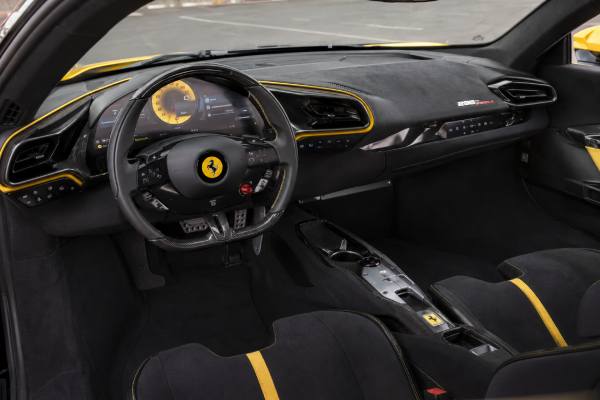
The cabin follows the same thinking. It is not bare like a race car, but it uses carbon fiber and Alcantara to create a more focused environment. The door panels, tunnel, seats, and trim are part of the experience. A car like this should feel different before it even moves, and the Speciale does that through a more serious driving position, less visual softness, and more tactile materials.
Sound is another special engineering point. The 296 family has always had to answer skepticism about a V6 Ferrari. The Speciale leans into intake, exhaust, and cabin sound tuning to create more drama. It will not sound like a 458 Speciale, and it should not be judged as if it were trying to. Its character is sharper, more technical, and more layered: V6 revs, turbo whistle, wastegate noises, electric torque, and fast DCT shifts.
The engineering story is also software-heavy. Extra boost in Qualify mode, energy recovery tuning, brake-by-wire calibration, ABS Evo behavior, eDiff strategy, and stability-control logic all shape the car’s feel. The best modern Ferraris are not analog in the old sense, but they can still be deeply engaging when the software makes the car easier to place, not less involving.
Driving Feel, Speed, and Track Character
The 296 Speciale is fast enough that its numbers almost understate the experience. What defines it is not only the 2.8-second 0–100 km/h time, but the immediacy of hybrid torque, the sharpness of the front end, the braking confidence, and the way aero and electronics help the car stay composed.
In low-speed driving, the plug-in hybrid system gives the car a split personality. It can move quietly in electric mode for short distances, which is useful in urban areas or when leaving home early. But the car’s real personality appears when the V6 and electric motor work together. The electric motor fills gaps in the torque curve and makes the car feel ready before the turbos are fully awake.
Acceleration is brutal but controlled. In the most aggressive modes, the 296 Speciale does not feel like a car waiting for the engine to catch up. The electric motor gives it instant shove, while the V6 builds speed with a hard, high-revving edge. The 8-speed dual-clutch gearbox is part of the excitement because shifts are quick, clean, and strongly integrated with the hybrid torque fill.
The steering is expectedly quick and light by modern Ferrari standards. The important question is not whether it is heavy, but whether it gives the driver enough confidence to place the front tires. In the Speciale, the combination of aero, front grip, tire choice, and chassis calibration makes the car feel more keyed-in than the regular 296 GTB. It should feel more alert on turn-in and more stable when the driver commits.
Braking is a major part of the performance. Carbon-ceramic brakes, brake-by-wire logic, energy recovery, and ABS Evo have to work together. The best setup is one where the driver feels a firm, repeatable pedal even while the car blends friction braking with regeneration. On track, brake temperature, pad condition, tire temperature, and software calibration will strongly affect consistency.
The chassis is designed to make the car more precise without turning it into a miserable road car. Compared with a normal 296, the Speciale is firmer and more serious, but it is still a road Ferrari. The suspension, tires, and electronics should allow a skilled driver to use the car on fast roads without feeling that it only works on a smooth circuit.
Tires are crucial. The dedicated Michelin Pilot Sport Cup 2-style fitment gives huge dry grip, but such tires are temperature-sensitive and less happy in cold or wet conditions. A 296 Speciale on warm, fresh tires will feel like a different car from one on old, heat-cycled rubber. Buyers should treat tire age and condition as a performance and safety issue, not just a consumable cost.
On a circuit, the Speciale’s extra downforce and 1:19 Fiorano lap time tell the story. The car is designed to brake late, turn hard, and deploy power early. The extra boost strategy is especially useful when exiting corners, where the electric motor helps reduce lap time. Unlike older special-series Ferraris, the drama is not just mechanical noise and high revs. It is the way the car layers combustion power, electric response, aero load, and electronic control into one fast, confidence-building package.
In normal road use, visibility, ride comfort, nose clearance, and tire noise matter more than the headline figures. The 296 Speciale is still a low, wide, expensive mid-engine Ferrari. It can be usable, but it asks for care on driveways, rough roads, and tight urban streets. The front lift system, if fitted, should be checked carefully because it is one of the features owners rely on most.
Reliability, Maintenance, and Ownership Risk
The 296 Speciale is too new for a deep long-term reliability record, so ownership judgment should focus on complexity, warranty, service history, and inspection quality. The car combines a high-output twin-turbo V6, plug-in hybrid battery, electric motor, dual-clutch gearbox, carbon-ceramic brakes, active aero, advanced dampers, and dense control electronics.
Ferrari’s new-car coverage and maintenance program are major ownership factors. New Ferraris are typically supported by a factory warranty period and a seven-year scheduled maintenance program, but buyers must verify the exact terms by VIN, market, registration date, and authorized dealer records. A car outside its original market or one with modifications may not be treated the same way.
The engine itself is highly stressed but built for serious performance. Maintenance concerns should focus on oil quality, correct service intervals, cooling-system health, turbocharger oil supply, software updates, and evidence of overheating or abuse. Because this is a dry-sump engine, the correct oil level checking procedure matters. Owners should not treat it like a normal mass-market engine.
The hybrid system adds another inspection layer. A buyer should ask for dealer diagnostic reports showing high-voltage battery condition, fault history, software status, charging behavior, and any warning events. A lightly used car that sat for long periods without correct battery care can be more concerning than a car with sensible mileage and regular dealer attention.
Important inspection areas include:
- High-voltage battery health and charging behavior
- 12-volt battery condition, because low voltage can trigger electronic faults
- Turbocharger oil-feed connections and evidence of leaks
- Cooling system, radiators, hoses, and heat exchanger condition
- Gearbox shift quality and stored transmission fault codes
- Carbon-ceramic brake disc condition, pad life, and edge chipping
- Tire age, heat cycling, uneven wear, and puncture repairs
- Front lift operation, damper condition, and suspension noises
- Active aero movement, alignment, and fault codes
- Paintwork, carbon-fiber panels, underside damage, and repaired splitters
- Interior carbon, Alcantara wear, seat bolster condition, and switchgear function
Recall and campaign history should be checked by VIN. A 2025 NHTSA recall report for certain 296 GTB and 296 GTS cars described an incorrectly tightened nut on turbocharger oil-feed pipe connections that could cause an oil leak. The chronology also noted two internal 296 Speciale cases that were not delivered to customers, with no further Speciale case detected in that report. That does not mean every Speciale has a problem; it means buyers should expect an authorized Ferrari dealer to confirm all campaigns, inspections, and software updates.
Track use is another key ownership question. A track-driven 296 Speciale can be perfectly acceptable if it has been maintained properly. The danger is undocumented use: worn Cup tires, cooked brake pads, overheated fluids, damaged underbody aero, and stone-chipped carbon panels presented as “low-mile collector condition.” A proper pre-purchase inspection should include underbody photos, diagnostic scans, brake measurements, tire date codes, and paint-depth readings.
Restoration is not the right word for most early 296 Speciale ownership, but repair difficulty is real. Carbon-fiber body parts, Ferrari-specific electronics, hybrid safety procedures, and calibration requirements make accident repair expensive and specialist-dependent. A poorly repaired car may drive correctly at low speed but have aero alignment, sensor calibration, or structural issues that only show under load.
For owners, the best strategy is simple: keep the car within Ferrari’s service network while under warranty, store it correctly, maintain battery charge, avoid non-factory tuning, document every service visit, and replace tires and fluids based on condition rather than ego. A complete digital and paper trail will matter later.
Market Value, Buying Checks, and Rivals
The 296 Speciale market is allocation-led rather than mileage-led at this stage. Early value is shaped by who can get one, when it arrives, how it is specified, and whether it remains factory-original with full Ferrari documentation.
Initial European pricing placed the coupe well above the regular 296 GTB, with Italy reported at roughly €407,000 before local market differences and options. U.S. pricing has been discussed around the high-$400,000 range before heavy options, but real transaction values can vary widely because many cars will be optioned far beyond base specification. Early secondary-market asking prices should be treated cautiously until enough cars have actually been delivered and sold.
The strongest value drivers are likely to be:
- Factory allocation and clean first ownership
- Desirable paint and interior combination
- Lightweight and carbon-heavy specification
- Factory livery or Tailor Made documentation
- No aftermarket tuning or cosmetic changes
- Full Ferrari service and campaign history
- Clear warranty status
- Low but believable mileage
- No track damage, accident history, or paintwork concerns
- Complete accessories, charger, books, tools, and delivery items
A buyer should avoid cars with unclear import status, missing build documentation, unexplained warning lights, aftermarket exhaust or ECU work, poor paint protection film installation, non-factory wheels, or vague claims about special specification. On a car this complex, a cheap example can become very expensive quickly.
| Area | What to verify | Why it matters |
|---|---|---|
| Documentation | Build sheet, warranty date, service records, campaign status | Confirms authenticity, options, and factory support |
| Hybrid system | Battery health, charging logs, fault-code scan | High-voltage repairs are specialist and expensive |
| Brakes and tires | Disc condition, pad life, tire dates, heat cycles | Track use can consume expensive components quickly |
| Body and aero | Carbon condition, underside damage, panel alignment | Aero and carbon repairs can affect value and drivability |
| Software | Dealer updates, stored faults, calibration status | Modern Ferrari performance depends on correct control systems |
| Originality | Factory wheels, exhaust, ECU, interior, livery | Collector value usually favors untouched factory specification |
The closest Ferrari alternatives depend on what the buyer wants. A 296 GTB Assetto Fiorano offers much of the same hybrid character for less money and broader availability. The 488 Pista is the direct earlier special-series comparison, with a twin-turbo V8 and a more established market. The 458 Speciale is the analog-emotional alternative, famous for its naturally aspirated V8 and sound. The SF90 Stradale is faster in many situations, with all-wheel-drive hybrid power, but it feels like a different category of car.
Outside Ferrari, the McLaren 750S is the most obvious lightweight mid-engine rival, especially for buyers who want raw speed, steering feel, and lower mass without plug-in hybrid complexity. The Lamborghini Temerario brings a new hybrid V8 direction and a very different brand personality. Porsche’s 911 GT3 RS is slower in a straight line but brutally effective on track, more transparent in some ways, and backed by a deep track-day ecosystem. The Mercedes-AMG One and other hypercar-level hybrids are far more expensive and less comparable as usable road cars.
Long-term collectability looks strong, but not guaranteed in a straight line. The 296 Speciale has the right ingredients: special-series lineage, allocation pressure, huge performance, motorsport-derived aero thinking, and a defining place in Ferrari’s V6 hybrid era. The risk is that modern hybrid supercars are expensive to maintain long after warranty, and future buyers may become selective about battery condition, software support, and electronic repair history.
The best buying advice is to choose the car like a collector, not like a normal used exotic. Buy the specification, the paperwork, the dealer history, and the condition. Mileage matters, but it is not everything. A well-documented, factory-original, properly serviced 296 Speciale with a tasteful build is far safer than a lower-mileage car with gaps, modifications, or unclear ownership.
References
- Ferrari 296 Speciale – Ferrari.com 2025
- Ferrari 296 Speciale for sale at Monza NV | Ferrari Dealer 2025
- Ferrari unveils new 296 Speciale hybrid models ahead of EV launch | Reuters 2025
- Part 573 Safety Recall Report 25V716 2025 (Recall Database)
Disclaimer
This article is for informational purposes only and is not a substitute for professional diagnosis, repair, valuation, or pre-purchase inspection. Ferrari specifications, torque values, service intervals, software procedures, warranty terms, and repair methods can vary by VIN, market, production date, and equipment. Always verify details against official Ferrari service documentation and an authorized Ferrari dealer or qualified specialist.
Please share this guide on Facebook, X/Twitter, or your preferred car community if it helped your research and you want to support our work.