
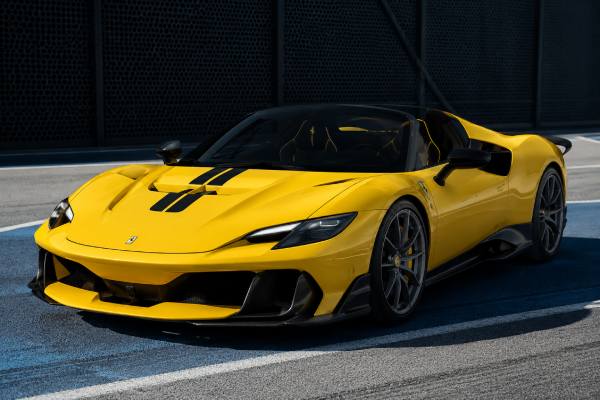
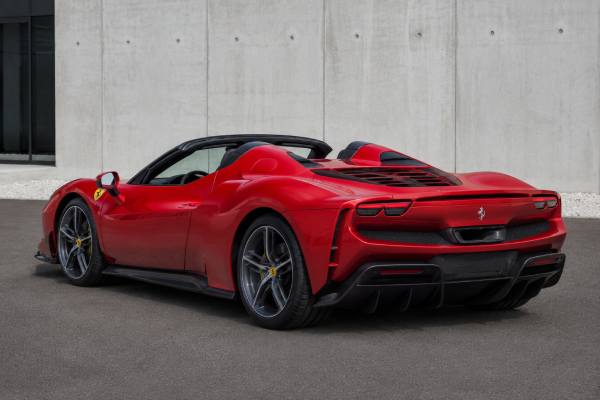
The Ferrari 296 Speciale A is the open-top, track-sharpened version of Ferrari’s mid-rear-engined 296 plug-in hybrid, unveiled in 2025 as the more extreme Spider companion to the 296 Speciale coupe. It uses the F163 BC 3.0-litre 120-degree twin-turbo V6 and a single electric motor to produce 880 cv, commonly rounded in search terms as 880 hp, with the immediacy of hybrid torque and the drama of a retractable-hardtop Ferrari.
Its importance comes from where it sits in the Ferrari line. The standard 296 GTS already proved that a V6 hybrid Ferrari could feel special, fast, and emotionally convincing. The 296 Speciale A pushes that formula into the territory traditionally occupied by cars such as the 458 Speciale A and 488 Pista Spider: lighter, rarer in allocation, more focused, and tuned for drivers who care about steering response, braking consistency, aero balance, and open-air sound. It is not just a faster 296 GTS. It is the sharper, more collectible version of the platform.
Quick Take
The Ferrari 296 Speciale A’s strongest appeal is the combination of an 880 cv plug-in hybrid powertrain, open-roof sound, and Ferrari special-series chassis tuning in a car that remains usable enough for road driving. Its identity is built around a lighter 296 GTS base, more downforce, extra hybrid boost, a 700 cv combustion engine, and a shorter, more selective production cycle. The caution is that the same technology that makes it special also makes inspection, warranty coverage, battery health, carbon-ceramic brake condition, software updates, and factory documentation unusually important for any buyer.
Table of Contents
- History, Position, and Ferrari Significance
- Engine, Chassis, and Key Specifications
- Production, Variants, and Factory Options
- Design, Engineering, and Special Features
- Driving Experience and Real Performance
- Reliability, Maintenance, and Ownership Risk
- Market Value, Buying Guide, and Rivals
History, Position, and Ferrari Significance
The 296 Speciale A matters because it turns Ferrari’s V6 plug-in hybrid Spider into a special-series driver’s car. It follows a familiar Ferrari pattern: take a highly capable mid-engined model, reduce weight, increase power, add race-derived aero, sharpen the controls, and make the open version feel more intense without turning it into a pure track car.
The standard 296 family marked a major shift for Ferrari. The 296 GTB coupe arrived as a mid-rear-engined plug-in hybrid with a V6 instead of the V8 layout buyers expected from modern Ferrari berlinettas. The 296 GTS added a retractable hardtop and brought the same powertrain character into an open-roof body. The 296 Speciale A sits above the GTS as the more focused Spider, paired with the 296 Speciale coupe.
The “A” follows Ferrari’s open special-version tradition. It stands in the same emotional lane as cars such as the 458 Speciale A, where the open car is not just the relaxed variant but a collectible version of the sharpest model in the range. In Ferrari language, this matters. Buyers often look at these cars not only for speed, but for their place in a chain of limited-allocation, high-demand driver’s models.
Ferrari presented the 296 Speciale and 296 Speciale A in April 2025. Deliveries were expected to follow later, with the open-top version after the coupe. That means “2025–present” is best understood as the model’s launch era rather than a long-established production run with deep resale history. Early buying information is still allocation-led, and the secondary market will need time to show where real transaction values settle.
The car’s historical importance rests on four points:
- It is part of Ferrari’s move from pure combustion mid-engined cars to high-performance electrified models.
- It proves the V6 hybrid platform can support a special-series Ferrari, not just a regular production sports car.
- It keeps the open special-version idea alive after celebrated cars such as the 458 Speciale A and 488 Pista Spider.
- It is one of the most powerful rear-wheel-drive open Ferraris of its era, using hybrid boost rather than a larger engine to raise performance.
The 296 Speciale A is also important because it shows how Ferrari now defines performance. More power is only one part of the story. The car’s real identity comes from sharper software, revised aerodynamics, lower weight, stronger braking control, a more focused cabin, and a powertrain that blends electric response with a high-revving twin-turbo V6.
For collectors, the key point is not simply that the car is fast. Many modern supercars are fast. The important question is whether the 296 Speciale A becomes the most desirable open version of the 296 family. Early signs point that way because it has the right ingredients: special-series positioning, higher output, technical distinction, limited availability by allocation, and a direct link to Ferrari’s racing and hybrid development work.
Engine, Chassis, and Key Specifications
The 296 Speciale A uses a 2,992 cc 120-degree twin-turbo V6 with a plug-in hybrid system and an 8-speed dual-clutch gearbox. The technical headline is 880 cv system output, but the deeper story is how Ferrari combines a 700 cv combustion engine, electric boost, rear-wheel drive, carbon-focused weight reduction, and active aero into one open-top package.
| Item | Specification |
|---|---|
| Engine code | F163 BC, 120-degree twin-turbo V6 |
| Displacement | 2,992 cc, commonly described as 3.0 litres |
| Induction | Twin turbo, hot-V layout, dry sump |
| Bore x stroke | 88 mm x 82 mm |
| Combustion-engine output | 515 kW / 700 cv at 8,000 rpm |
| Combustion-engine torque | 755 Nm at 6,000 rpm |
| Maximum engine speed | 8,500 rpm |
| Compression ratio | 9.4:1 |
| Hybrid system output | 648 kW / 880 cv |
| Electric-only power | 113 kW / 154 cv in eDrive mode |
| Battery capacity | 7.45 kWh |
| Electric range | Up to 25 km |
| Transmission | 8-speed F1 dual-clutch automatic |
| Drive layout | Mid-rear engine, rear-wheel drive |
The V6 is not a mild supporting act for the hybrid system. It produces 700 cv on its own, helped by Ferrari’s work on engine mapping, combustion control, lighter internal parts, and lower rotating mass. The 120-degree bank angle allows the turbochargers to sit within the V of the engine, shortening exhaust paths and helping packaging. The electric motor sits between the engine and gearbox, adding response and allowing electric-only operation when conditions permit.
The car’s power figure needs careful wording. Ferrari gives the output as 880 cv, which equals about 868 mechanical horsepower. Many buyers and search listings casually call it 880 hp, and the supplied article title uses that language, but the factory-style figure is 880 cv.
| Item | Specification |
|---|---|
| Length | 4,625 mm |
| Width | 1,968 mm |
| Height | 1,181 mm |
| Wheelbase | 2,600 mm |
| Front track | 1,665 mm |
| Rear track | 1,632 mm |
| Dry weight | 1,490 kg with lightweight content |
| Dry weight-to-power ratio | 1.69 kg/cv |
| Weight distribution | 40% front / 60% rear |
| Fuel tank | 65 litres |
| Luggage capacity | 169 litres |
Ferrari’s chassis work is just as important as the power increase. The Speciale A uses a Spider structure adapted for higher stiffness, more aero load, and more precise suspension response. The car is lower than the 296 GTS and tuned to reduce roll, which helps the tires and aerodynamics work more consistently.
| Item | Specification |
|---|---|
| 0–100 km/h | 2.8 seconds |
| 0–200 km/h | 7.3 seconds |
| Top speed | Over 330 km/h |
| 200–0 km/h braking | 106 metres |
| Front tires | 245/35 ZR20 on 9.0-inch wheels |
| Rear tires | 305/35 ZR20 on 11.0-inch wheels |
| Front brakes | Carbon-ceramic, 398 x 223 x 38 mm |
| Rear brakes | Carbon-ceramic, 360 x 233 x 32 mm |
The official figures are already extreme, but the most useful takeaway is this: the Speciale A is engineered around repeatable response, not just one impressive acceleration run. The electric motor helps fill torque, the gearbox calibration sharpens shift behaviour, the brakes are tuned for consistency, and the aero package adds stability when the car is driven hard.
Production, Variants, and Factory Options
The 296 Speciale A is the open-top member of the 296 Speciale pair. The coupe is the 296 Speciale, while the retractable-hardtop Spider is the 296 Speciale A, and buyers should treat the two as related but not identical when judging rarity, weight, specification, and long-term value.
Ferrari has not positioned the 296 Speciale A like a numbered, one-off hypercar. It is better understood as a special-series, allocation-sensitive model with a shorter life cycle and strong demand from existing Ferrari clients. That distinction matters. A car can be non-numbered and still be very difficult to buy new.
The main versions are simple:
| Version | Body style | Buyer appeal |
|---|---|---|
| 296 Speciale | Fixed-roof berlinetta | Lowest weight, strongest track focus, cleaner coupe packaging |
| 296 Speciale A | Retractable-hardtop Spider | Open-air sound, special-series status, added rarity appeal among Spider buyers |
The Speciale A’s factory specification can make a major difference to value. In this market, “a Ferrari is a Ferrari” is not a good buying principle. The difference between a highly desirable build and an awkward one can be large, especially once early hype settles.
Important factory-option areas include:
- Exterior colour, especially launch colours, historic Ferrari shades, and tasteful Tailor Made combinations.
- Livery choice, including stripe layouts and number treatment where available.
- Carbon-fibre exterior parts, such as aerodynamic and engine-bay components.
- Lightweight interior content, including carbon and Alcantara-heavy configurations.
- Wheel design and finish.
- Brake caliper colour, seat style, harness-related track equipment where market legal.
- Audio and comfort equipment, which can either improve usability or dilute the lightweight theme depending on the buyer.
- Dealer-ordered regional equipment, which may affect resale in certain markets.
- Documentation from the selling dealer, including order sheet, build confirmation, service plan status, warranty documents, and Ferrari-approved provenance records.
Because the 296 Speciale A is new, matching-numbers discussion is less like a classic Ferrari and more about documentation integrity. Buyers should still care about the original engine, gearbox, battery system, software status, factory colour, factory trim, and whether any carbon parts or aero pieces have been replaced after damage.
The internal identifiers, including F171VS for the vehicle family and F163 BC for the V6, are useful for enthusiasts and parts discussions. They should not replace VIN-based verification. Serious buyers should confirm the exact car through official Ferrari systems, not only through a listing description.
For future collectability, the most desirable cars are likely to share a few traits:
- Original paint and factory livery, not later cosmetic changes.
- Low but believable mileage, with enough use to show the car has been properly commissioned.
- Full official Ferrari service history.
- No accident or track-damage history.
- Correct tires and no signs of repeated heat-cycled track abuse without maintenance.
- Complete books, keys, charger equipment, build documentation, and invoices.
- A tasteful colour and interior combination that suits the Speciale A’s focused personality.
The car is still too new for a clear hierarchy of rare specifications to be fully established. However, Ferrari collectors usually reward originality, launch-correct details, low mileage, high documentation quality, and factory-special configurations more than aftermarket changes.
Design, Engineering, and Special Features
The 296 Speciale A looks different because its bodywork is doing real work. Ferrari changed the airflow, cooling, rear aero behaviour, and roof packaging while trying to preserve the clean 296 shape and the drama of an open special-series Spider.
The exterior is shaped around three needs: more downforce, better cooling, and a stronger visual link to motorsport. Compared with the 296 GTS, the Speciale A uses more aggressive aerodynamic elements, including a front aero damper concept, rear fins, side wing elements, and an active rear spoiler strategy. With the roof up, the car is credited with 435 kg of downforce at 250 km/h, about 20% more than the 296 GTS.
That extra aero load is not just for lap-time bragging. It helps the car feel calmer at high speed, gives the rear axle more support under heavy braking, and makes the chassis easier to trust when the driver is asking for both direction change and acceleration.
Retractable hardtop packaging
The retractable hardtop is central to the car’s identity. A soft top would have changed the feel and visual language of the car. Ferrari’s hardtop layout gives the Speciale A a more coupe-like profile when closed and a cleaner, more dramatic appearance when open.
Packaging the roof is not easy in a mid-engined hybrid car. The 296 Speciale A must fit the roof mechanism, the V6, the electric motor, the battery system, cooling paths, rear aero hardware, and luggage space into a compact body. That makes the car more complex than the coupe and explains why the Spider carries more weight.
Powertrain integration
The most interesting engineering feature is the way the electric motor supports the combustion engine. In normal use, the hybrid system can make the car smoother and quieter at low speed. In performance driving, it fills response gaps, adds boost on corner exit, and helps the dual-clutch gearbox feel more immediate during fast shifts.
The eManettino drive logic is also part of the ownership experience. A buyer is not simply choosing between “electric” and “petrol.” The car uses different modes to manage battery charge, performance availability, and the level of electric assistance. The most aggressive settings are about lap-time and repeated response, not energy economy.
Interior and materials
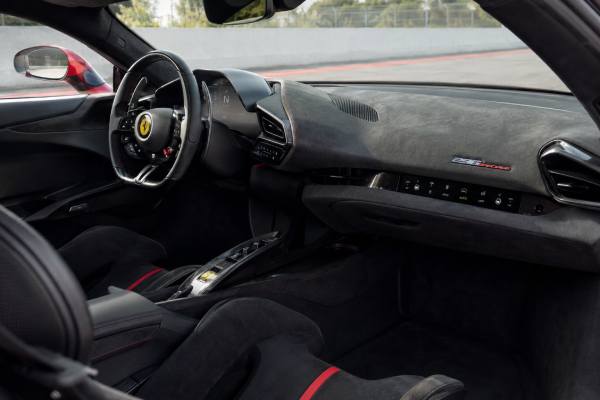
The cabin follows the special-series idea: less visual softness, more carbon fibre, more Alcantara, and a clearer focus on the driver. The door panels and central tunnel are simplified compared with a luxury-focused Ferrari interior. That is the point. The Speciale A should feel more purposeful than a standard GTS before the engine is even started.
This approach has a buying consequence. Some owners will specify extra comfort features because they want to use the car regularly. Others will chase the lightest, most focused specification possible. Neither is automatically wrong, but the market often pays a premium for a coherent build. A stripped, track-minded car should not look half luxury cruiser. A road-biased car should not lose its special-series character through overly casual specification choices.
Driving Experience and Real Performance
The 296 Speciale A should feel explosive, precise, and more emotional than the 296 GTS, especially with the roof open. The key difference is not only that it accelerates harder, but that Ferrari tuned the car to respond faster and feel more stable when driven near its limits.
Acceleration is brutally quick: 0–100 km/h in 2.8 seconds and 0–200 km/h in 7.3 seconds put it deep into modern hypercar territory. Yet the more interesting part is throttle response. The electric motor gives an instant hit before the turbos are fully doing their work, while the V6 keeps pulling toward its 8,500 rpm limit. That mix gives the car a layered personality: immediate low-speed shove, strong mid-range turbo torque, and a high-rpm Ferrari finish.
The sound is unusual for a Ferrari special-series car because it is not a naturally aspirated V8 or V12. It is a turbocharged V6 with hybrid assistance. Ferrari worked hard to make the 296 family sound distinctive, using equal-length exhaust paths and careful acoustic tuning. In the Speciale A, the open roof should make the intake, exhaust, turbo, and shift sounds more present. Some traditionalists will still prefer the scream of older naturally aspirated models, but the 296 Speciale A offers a different kind of drama: sharper, more technical, and more immediate.
Steering is expected to be quick and light by Ferrari standards, with the front end reacting eagerly. The lower ride height, stiffer tuning, and dedicated tires should make turn-in feel more alert than in the GTS. The challenge for Ferrari is always balance. Too much stiffness can make an open car nervous on real roads. The Speciale A’s appeal depends on feeling focused without becoming brittle.
Braking is a major part of the car’s character. Carbon-ceramic brakes can feel superb when warm and properly bedded, but they are expensive and sensitive to abuse. The Speciale A’s ABS Evo system is designed to improve braking precision and repeatability across different grip conditions. On track, that matters as much as peak stopping distance. A brake system that gives the same pedal confidence after several hard laps is more valuable than one single impressive number.
The tires are equally important. The car’s dedicated high-performance rubber gives it enormous grip, but these tires are temperature-sensitive. On a cold road, in heavy rain, or after long storage, the car will not feel like it does in a launch video. Owners need to understand that tire age, heat cycles, alignment, and pressures can transform how the car behaves.
As a road car, the Speciale A should remain easier to use than its numbers suggest. It can run in electric mode for short distances, the dual-clutch gearbox removes old-school supercar clutch effort, and the retractable hardtop makes it more flexible than a fixed-roof track special. Still, it is wide, low, expensive, and highly sensitive to road surface, tire condition, and front-lift use. It is usable, but it is not casual.
Reliability, Maintenance, and Ownership Risk
The 296 Speciale A is too new for a long reliability record, so buyers should focus on system health, warranty status, recalls, software updates, battery condition, and evidence of correct Ferrari servicing. The risk is less about old-fashioned engine neglect and more about complex hybrid, electronic, brake, cooling, and aero systems that require specialist diagnosis.
Ferrari’s 7-year Genuine Maintenance programme is a major ownership benefit. It covers scheduled routine maintenance for the first seven years of the car’s life, normally through official dealers and trained technicians. That does not mean the car is cost-free to own. Tires, damage, consumables outside the programme, accident repair, track wear, cosmetic work, and warranty-excluded abuse can still be expensive.
Maintenance-sensitive areas include:
- Hybrid battery health and charging behaviour.
- Electric motor and inverter diagnostics.
- Cooling systems for the engine, turbochargers, battery, and power electronics.
- Dual-clutch gearbox software, shift quality, and fluid service status.
- Carbon-ceramic brake disc wear, pad life, surface condition, and heat damage.
- Tire age, heat cycles, puncture repairs, and correct Ferrari-approved specification.
- Suspension links, dampers, front lift system, and alignment.
- Active aero operation and calibration.
- Roof mechanism adjustment, seals, drains, and noise.
- Carbon-fibre panels, underbody aero pieces, and repaired stone or kerb damage.
- Infotainment, driver-display, control-module, and battery-management software updates.
For a buyer, the most important service document is not a glossy listing sheet. It is the official Ferrari service history. A car that has sat unused for long periods may look perfect but still need tires, fluids, battery checks, software updates, brake inspection, and recommissioning. A car that has been tracked hard may need deeper inspection even if the mileage is low.
Hybrid-specific checks
The plug-in hybrid system changes the inspection process. A specialist should check state-of-health data, charging operation, fault codes, thermal history where available, and whether the car accepts and maintains charge normally. Short electric range by itself is not always a defect, because usage, temperature, and driving mode matter. But warning lights, charging interruptions, repeated low-voltage problems, or incomplete software updates should be treated seriously.
The 12-volt battery also matters. Modern Ferraris depend heavily on stable low-voltage power for control modules. Weak 12-volt batteries can cause confusing warning messages that look worse than they are, but they can also mask real issues. Any pre-purchase inspection should separate simple battery-related faults from deeper hybrid or electronic problems.
Track use and wear
Many 296 Speciale A owners will use the car sparingly, but some will drive it hard on track. Track use is not automatically bad if it is documented and followed by proper maintenance. Hidden track use is the problem.
Signs that need closer inspection include:
- Heavy brake-pad dust baked into wheels and calipers.
- Blueing, cracking, or rough surfaces on carbon-ceramic discs.
- Very worn outer tire shoulders.
- Replacement tires that do not match factory type or date expectations.
- Scraped underbody panels, splitters, diffusers, or side aero pieces.
- Repainted front panels without clear explanation.
- Repeated alignment changes or suspension repairs.
- Heat-stained exhaust or engine-bay hardware beyond normal use.
Restoration is not the right word for a nearly new 296 Speciale A, but future repair quality will matter. Carbon repair, hybrid diagnostics, roof adjustment, and calibration work should be done by Ferrari-approved facilities. Poor repairs may not only reduce value but also affect active aero, cooling, sealing, and high-speed stability.
Market Value, Buying Guide, and Rivals
The 296 Speciale A entered the market as an allocation-led Ferrari special-series Spider, with Italian launch pricing reported around €462,000 before market-specific taxes, options, and regional pricing effects. The real transaction price for many cars will be much higher once desirable options, local taxes, import costs, and early secondary-market premiums are included.
The market is still young, so any price range should be treated carefully. Early cars can trade above list because buyers want immediate access. Later, values may separate based on mileage, colour, options, provenance, and whether the broader supercar market is strong or soft. The best cars are likely to be the ones with the right factory specification, low but credible mileage, complete records, and no accident or track-abuse history.
Value drivers include:
| Factor | Why it matters |
|---|---|
| Factory specification | Colour, livery, carbon content, seats, and interior choices strongly affect desirability |
| Originality | Factory paint, factory carbon, and unmodified aero parts are preferred |
| Mileage | Very low mileage helps collectability, but unused cars still need recommissioning checks |
| Service history | Official Ferrari records support warranty, provenance, and buyer confidence |
| Battery and electronics | Hybrid health and software status are essential on a modern PHEV Ferrari |
| Brake and tire condition | Consumable replacement can be costly and can reveal hard use |
| Accident history | Carbon, aero, roof, and chassis repairs can seriously affect value |
| Allocation story | First-owner provenance and dealer relationship can matter in Ferrari collecting circles |
A proper buying inspection should include more than a normal used-car check. It should be done by an official Ferrari dealer or a specialist with current diagnostic access for the 296 hybrid platform.
A sensible inspection sequence is:
- Confirm the VIN, build sheet, original supplying dealer, warranty start date, and service-plan status.
- Check paint thickness, panel alignment, carbon-fibre condition, underbody aero, and front splitter damage.
- Scan all control modules and confirm hybrid, battery, roof, gearbox, suspension, and aero systems are fault-free.
- Inspect carbon-ceramic brakes for wear, cracking, pad life, and signs of overheating.
- Confirm tire specification, date codes, tread depth, and heat-cycle condition.
- Test the roof mechanism, seals, drains, windows, rear deck operation, and wind-noise behaviour.
- Review all invoices for service, software updates, warranty repairs, and recall work.
- Road test the car from cold and warm, checking shift quality, braking feel, charging behaviour, warning lights, and suspension noise.
The closest rivals depend on what the buyer values. For open-top hybrid performance, the McLaren Artura Spider is lighter and technically impressive, but it does not carry the same Ferrari special-series cachet. The Lamborghini Revuelto is far more dramatic and V12-powered, but it is larger, all-wheel drive, and positioned differently. The Ferrari SF90 Spider offers even more power and all-wheel-drive hybrid performance, but it is a different type of car: heavier, more complex, and less focused on the compact rear-drive feel of the 296 platform.
Within Ferrari’s own world, the biggest alternatives are the 296 Speciale coupe, 296 GTS, SF90 XX Spider, 488 Pista Spider, 458 Speciale A, and 812 Competizione A. The older naturally aspirated and V8 special-series cars may offer a more traditional sound and collector narrative. The 296 Speciale A offers newer technology, higher performance, and a bridge into Ferrari’s electrified future.
The best buyer for a 296 Speciale A is someone who wants a modern Ferrari special-series Spider and understands that ownership is about more than purchase price. The car rewards careful specification, proper storage, official service, correct tire and brake care, and disciplined documentation. Buy the wrong car, and the hybrid systems, carbon repairs, or track wear can become expensive distractions. Buy the right car, and it is one of the most important open Ferraris of the modern electrified era.
References
- 296 Speciale A: en plein air driving thrills reach new heights 2025
- Ferrari 296 Speciale A – Ferrari Beverly Hills 2025
- Ferrari unveils new 296 Speciale hybrid models ahead of EV launch | Reuters 2025
- Check for Recalls: Vehicle, Car Seat, Tire, Equipment 2026 (Recall Database)
Disclaimer
This article is for informational purposes only and is not a substitute for professional diagnosis, repair, inspection, or valuation. Specifications, torque values, service intervals, procedures, software requirements, and warranty coverage can vary by VIN, market, production date, and equipment. Always verify details against official Ferrari service documentation and consult a qualified Ferrari technician before buying, servicing, modifying, or tracking the vehicle.
If this guide helped you, please share it on Facebook, X/Twitter, or your preferred car community to support our work.