
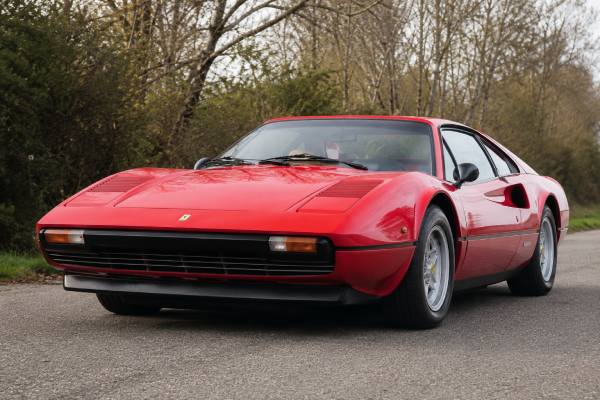
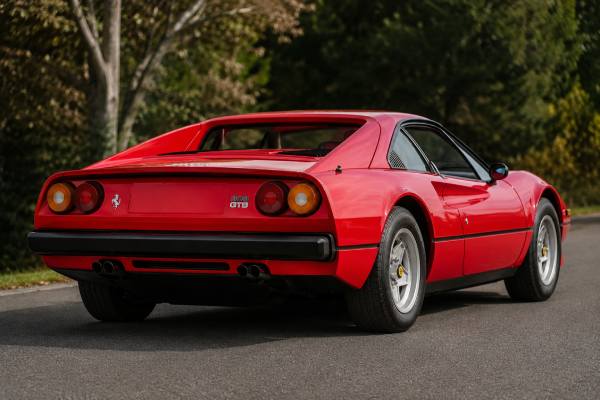
The Ferrari 308 GTB (F 106 AB 100) with the carbureted F106A 2.9-liter V8 is the original berlinetta version of one of Ferrari’s most recognizable mid-engine road cars. Built from 1975 into 1980 before the injected GTBi replaced it, this early 308 GTB combines Pininfarina wedge-era styling, a transverse V8, a five-speed gated manual gearbox, and the compact two-seat layout that helped define Ferrari’s V8 sports-car line for decades.
Its appeal is not only visual. Early European-specification cars used dry-sump lubrication and made 255 hp, while North American and some other export-market cars were detuned and usually used wet-sump lubrication. The first fiberglass-bodied “vetroresina” cars are especially prized, but later steel-bodied carbureted GTBs also have strong collector interest because they preserve the four-Weber, pre-fuel-injection character. For buyers, the 308 GTB is a car where originality, body type, market specification, service history, corrosion condition, and documentation matter as much as mileage.
Quick Take
The Ferrari 308 GTB’s strongest appeal is its mix of classic Pininfarina design, carbureted V8 response, compact mid-engine balance, and usable mechanical simplicity compared with later exotic cars. Its key identity is the first two-seat Ferrari V8 berlinetta after the Dino era, with early fiberglass cars carrying the highest collector premium and later steel cars offering much of the same character at lower cost. The main caution is condition sensitivity: neglected timing belts, cooling systems, carburetors, wiring, corrosion, and poor body repairs can turn an attractive car into a costly project. Buy the best-documented, most original example you can, and treat specialist inspection as essential rather than optional.
Table of Contents
- History and Collector Significance
- Engine, Chassis and Key Specifications
- Production, Variants and Factory Options
- Design, Engineering and Distinctive Details
- Driving Character and Real Performance
- Reliability, Maintenance and Restoration Realities
- Market Values, Buying Advice and Rivals
History and Collector Significance
The 308 GTB matters because it established the shape, layout, and emotional character of Ferrari’s modern V8 berlinetta line. It followed the Dino 246 GT as Ferrari’s compact two-seat mid-engine sports car and sat alongside the Bertone-designed Dino 308 GT4, but its Pininfarina body gave the formula a clearer Ferrari identity.
Ferrari showed the 308 GTB in 1975, with production beginning for the 1976 model era in many markets. It was not a supercar in the later F40 sense, but it was a serious exotic sports car: low, compact, mid-engined, hand-built, and expensive. The car arrived during a difficult period for performance cars, when emissions rules, fuel concerns, and safety regulations were changing the market. Against that background, the European 255 hp carbureted 308 GTB felt refreshingly pure.
The car’s place in Ferrari history is important for several reasons:
- It moved Ferrari’s two-seat entry sports car from the Dino badge era into the main Ferrari identity.
- It helped establish the mid-mounted V8 layout that later led to the 328, 348, F355, 360, F430, 458, 488, F8 Tributo, and beyond.
- It returned Ferrari’s compact sports-car styling to Pininfarina after the angular Bertone 308 GT4.
- It introduced fiberglass bodywork on early production cars, a rare move for Ferrari at the time.
- It became one of the most familiar Ferraris of the late 1970s and 1980s, helped by the related 308 GTS’s television fame.
The GTB is the fixed-roof berlinetta, not the targa-roof GTS. That matters to collectors. The GTB is generally rarer, stiffer, cleaner in profile, and often preferred by buyers who value the purer coupe form. The GTS became more famous in popular culture, but the GTB is usually the more serious enthusiast choice.
The 1975–1980 carbureted GTB is also different from the later injected 308 GTBi and the four-valve Quattrovalvole. The early car has four Weber carburetors, a more mechanical throttle response, and a sound that many owners consider central to the 308 experience. Later injected cars are often easier to live with in some situations, but they do not have the same induction character.
Today, the car is collectible because it combines beauty, usability, and historical importance without the extreme complexity of later Ferraris. It is still a demanding classic, but it is not an inaccessible one. A good 308 GTB can be driven regularly, maintained by a knowledgeable specialist, and enjoyed on real roads without needing modern hypercar speeds to feel special.
Engine, Chassis and Key Specifications
The European-specification Ferrari 308 GTB used a 2.9-liter, all-alloy, quad-cam V8 mounted transversely behind the seats and driving the rear wheels through a five-speed manual transaxle. The essential specification is simple on paper, but the combination of carburetors, dry-sump lubrication on many European GTBs, compact dimensions, and a tubular chassis gives the car its distinct personality.
| Item | Specification |
|---|---|
| Model | Ferrari 308 GTB |
| Chassis type | F 106 AB 100 tubular steel frame |
| Engine type | Rear-mid transverse 90-degree V8 |
| Engine code | F106A / Tipo F106 family |
| Displacement | 2,926.9 cc |
| Bore x stroke | 81 mm x 71 mm |
| Valvetrain | Double overhead camshafts per bank, two valves per cylinder |
| Fuel system | Four Weber 40 DCNF twin-choke carburetors |
| Maximum power | 255 hp European specification |
| Maximum torque | About 284 Nm / 210 lb-ft |
| Transmission | Five-speed manual transaxle with limited-slip differential |
| Drivetrain | Rear-wheel drive |
The engine is not a large-displacement torque motor. It is oversquare, meaning the bore is larger than the stroke, which helps it rev freely. It prefers clean ignition, balanced carburetors, correct cam timing, and a driver who lets it warm properly before asking for high rpm. In healthy tune, the engine feels crisp and eager rather than brutally powerful.
European GTBs are strongly associated with dry-sump lubrication, where oil is stored in a separate tank instead of only in the sump beneath the engine. The system helps oil control during hard cornering and allows the engine to sit slightly lower. Many North American and some other export cars used wet-sump lubrication and lower output because of emissions equipment and market requirements. This is one reason buyers must confirm the exact market specification of any car.
| Area | Detail |
|---|---|
| Front suspension | Independent unequal-length wishbones, coil springs, telescopic dampers, anti-roll bar |
| Rear suspension | Independent unequal-length wishbones, coil springs, telescopic dampers, anti-roll bar |
| Steering | Unassisted rack and pinion |
| Brakes | Four-wheel ventilated disc brakes |
| Standard tires | 205/70 VR14 Michelin XWX-type fitment |
| Wheelbase | 2,340 mm |
| Length | 4,230 mm |
| Width | 1,720 mm |
| Height | 1,120 mm |
| Fuel capacity | About 80 liters |
| Top speed | About 252 km/h for the 255 hp specification |
The official dry weight often quoted for the early car is around 1,090 kg, though real curb weights vary by body material, market equipment, fluids, air conditioning, emissions equipment, and measurement method. Early fiberglass cars are noticeably lighter than later steel-bodied cars, but condition and setup can make just as much difference to how a 308 feels on the road.
Production, Variants and Factory Options
The most important 308 GTB distinction is between early fiberglass-bodied vetroresina cars and later steel-bodied cars. Both are genuine carbureted 308 GTBs, but they occupy different places in the collector market.
Early production used glass-reinforced plastic bodywork, commonly called vetroresina. These cars were built by Scaglietti and are the most sought-after 308 GTBs. Published production counts vary depending on how cars are counted, with many market sources quoting the first 712 fiberglass cars and other histories using a figure closer to 800. The practical point for buyers is clear: fiberglass GTBs are scarce, lighter, and more valuable than regular steel-bodied cars.
By 1977, Ferrari moved to steel body panels. Steel GTBs are less rare and usually less valuable, but they remain highly desirable because they keep the carbureted engine, the fixed-roof body, and the early 308 look. They can also be better suited to an owner who wants to drive the car often without paying the full vetroresina premium.
Market and specification differences
The 255 hp identity applies mainly to European-specification carbureted cars. North American cars were typically rated lower because of emissions requirements, and they often have different lighting, bumpers, instrumentation, exhaust hardware, and engine-bay details. A U.S.-market car can still be a wonderful 308, but it should not be represented as a European dry-sump 255 hp car unless the evidence supports it.
Important identification points include:
- chassis and engine numbers
- market-delivery paperwork
- dry-sump or wet-sump engine layout
- fiberglass or steel body construction
- original exterior color and interior trim
- correct carburetors, airbox, ignition, and exhaust equipment
- original wheels, books, tools, jack, and service wallet
- Ferrari Classiche certification or other credible documentation
Factory options and equipment varied by market, but desirable items can include air conditioning, wider wheels, metallic paint, leather trim, and a deeper front spoiler on some cars. Power windows and tinted glass were part of the 308’s upscale character, although the window mechanisms are now a common maintenance item.
Original colors matter. Red over tan is the familiar image, but period Ferrari colors such as silver, blue, black, yellow, green, and brown metallics can be more interesting to collectors when documented. A rare color is not automatically more valuable if the repaint quality is poor or the car was originally another shade. Factory-correct color, confirmed by records, is the important point.
Matching numbers carry real value. For a 308 GTB, that means the chassis, engine, gearbox, and body details should match factory records or credible certification. A replacement engine of the correct type may make a car perfectly usable, but it affects collector desirability. For vetroresina examples, the body’s authenticity and repair history are especially important because fiberglass repair quality varies widely.
Design, Engineering and Distinctive Details
The 308 GTB is distinctive because its design is dramatic without being oversized. Pininfarina created a low, sharp, mid-engine berlinetta that looks exotic from every angle, yet the car remains compact enough for narrow roads and normal garages.
The body was designed under the Pininfarina tradition associated with Leonardo Fioravanti’s era, and it blends wedge-like 1970s surfaces with softer Ferrari details. The front has retractable headlamps, a low nose, and black bumper treatment. The flanks use sculpted side intakes that recall the Dino but look more angular and modern. At the rear, twin round taillights on each side became one of the car’s signature views.
The fixed roof is central to the GTB’s appeal. Compared with the GTS, the berlinetta has a cleaner side profile and a more cohesive roofline. It also avoids the removable-roof compromises that can bring extra noise, leaks, and body-flex concerns on older targa cars.
Packaging and cooling
The transverse engine layout made the car shorter than a longitudinal mid-engine design would have been. The gearbox sits with the engine in a compact rear package, while the fuel tanks sit close to the rear bulkhead. This packaging helps the 308 feel compact and alert, though it also makes some maintenance tasks tight.
Cooling is a major part of the design. The front radiator, side intakes, engine-cover vents, and underbody airflow all need to work as intended. Missing seals, blocked radiator cores, tired fans, incorrect thermostats, and poor hose condition can cause running-temperature problems. A 308 that overheats in traffic is not “just being Italian”; it needs proper diagnosis.
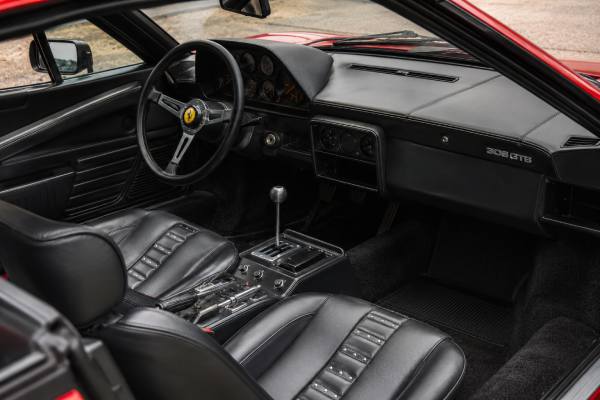
The cockpit is simple but special. The driver sits low, facing large analog gauges. The metal gated shifter is close at hand. The steering wheel, slim pillars, and curved rear glass help make the car feel more usable than its exotic shape suggests. Visibility is better than many later mid-engine cars, although rear three-quarter vision and parking judgment still require care.
The materials are period-correct rather than modern-luxury. Leather, vinyl, simple switches, thin carpeting, and a compact dashboard create an honest 1970s Ferrari cabin. Restoration should preserve that character. Overly modern leather grain, incorrect carpets, non-original stereos, and poorly retrimmed dashboards can make an expensive car feel wrong.
Driving Character and Real Performance
A good carbureted 308 GTB feels light, mechanical, and communicative rather than explosively fast by modern standards. Its performance is still enjoyable because the engine, gearbox, steering, sound, and seating position all work together.
The V8 needs temperature. When cold, the gearbox can be reluctant, the carburetors may feel uneven, and the engine should not be hurried. Once warm, the car becomes much happier. Throttle response is immediate, the induction sound hardens, and the engine pulls cleanly toward the upper rev range.
Acceleration depends heavily on specification, tune, tires, and test method. Period and modern figures vary, but a healthy European carbureted GTB is generally thought of as a mid-to-high six-second 0–60 mph car, with a top speed around 155–157 mph. North American cars can feel softer, especially if emissions equipment, ignition timing, or carburetor setup is not correct.
The shift is part of the theater. The five-speed gated manual rewards deliberate movement. Second gear can be stiff when cold, which is common on older Ferraris, but crunching, jumping out of gear, or excessive noise points to wear rather than charm. Once warm, a good gearbox should feel precise and satisfying.
Steering is unassisted. At parking speeds it is heavy, especially on modern sticky tires. At road speed it becomes one of the car’s best features: clear, textured, and direct. This is a major reason the GTB remains loved by drivers. It does not isolate the road the way newer performance cars do.
The ride is firm but not unbearable if the suspension is healthy. Old bushings, tired dampers, incorrect tires, and poor alignment can make a 308 feel nervous or harsh. With correct Michelin XWX-style tires or a carefully chosen equivalent, the car has progressive grip and a natural balance. It prefers smooth inputs. Abrupt throttle lifts or careless corner entry can still remind the driver that the weight is behind the seats.
The brakes are adequate for fast road use when freshly maintained, but they do not feel like modern carbon-ceramic systems. Pedal feel, fluid age, caliper condition, hose condition, and pad choice matter. A car used hard on mountain roads needs a braking system in excellent condition, not merely one that passed a casual road test.
In city use, the 308 GTB is warm, noisy, and sometimes heavy. The clutch, steering, low seating position, and old air conditioning are reminders that this is a 1970s exotic. On open roads, those drawbacks fade. The car feels alive at speeds that do not require a racetrack, which is part of its lasting appeal.
Reliability, Maintenance and Restoration Realities
The 308 GTB can be reliable when serviced correctly, but it is not a low-maintenance classic. Its biggest ownership risks come from deferred maintenance, poor restorations, corrosion, incorrect parts, and cars that look better than they run.
The timing belts are the headline service item. The F106A V8 uses belt-driven camshafts, and belt age matters as much as mileage. Service intervals vary by manual, market, and modern specialist practice, so owners should verify the correct schedule for the specific car and use a Ferrari specialist who understands cam timing, tensioners, seals, and related “while you are there” work. Unlike some later Ferraris, 308 belt service is commonly done with the engine in the car, but it still requires skill.
The fuel system deserves careful attention. Carburetor rebuilds, synchronization, fuel lines, filters, pumps, and tank condition all matter. Old fuel hoses are a fire risk in any carbureted mid-engine car. A car that smells strongly of fuel, runs unevenly, or has visible hose cracking needs immediate inspection.
Common mechanical and age-related concerns include:
- worn timing belts, tensioners, and cam seals
- poor carburetor balance or incorrect jetting
- tired ignition components and distributor issues
- old coolant hoses and weak radiator fans
- water-pump leaks
- oil leaks from cam covers, seals, and sump areas
- second-gear synchro wear or noisy gearbox bearings
- clutch wear from city use or poor adjustment
- slow electric windows and tired switches
- aging fuse panels, grounds, and connectors
- seized brake calipers, old hoses, and contaminated fluid
- worn suspension bushings, ball joints, and wheel bearings
Body condition is just as important as mechanical condition. Fiberglass cars do not rust in the same way as steel cars, but they can suffer stress cracks, poor paint adhesion, accident repairs, distorted panels, and hidden patchwork. Steel-bodied cars can rust in lower panels, wheel arches, door bottoms, floors, sills, front structure, suspension pickup areas, and around previous repair work. A shiny repaint can hide serious problems.
Restoration quality varies greatly. Some 308s were restored when values were lower, which means shortcuts are common. Look for correct panel gaps, original spot-weld and seam details where applicable, proper engine-bay finishes, correct fasteners, correct wheels, and trim that matches the car’s year and market.
The engine also needs careful evaluation. Compression and leak-down tests are useful, but they are only part of the picture. A specialist should inspect oil pressure, coolant behavior, carburetor condition, ignition timing, exhaust smoke, cam-belt history, and service receipts. Early two-valve Ferraris can raise questions about valve condition, especially if the engine has unknown history, so documented cylinder-head work can be a positive when done correctly.
Parts availability is generally better than for many obscure exotics, but prices are still Ferrari prices. Trim, original wheels, tools, books, exhaust parts, body pieces, and market-specific details can be expensive or difficult to source. A missing tool roll or incorrect airbox may seem minor until you price replacements.
The best ownership approach is preventive. A sorted 308 rewards regular use. A neglected one deteriorates quickly. Cars that sit for years often need fuel-system work, brake work, tires, belts, hoses, seals, battery cables, and electrical sorting before they are truly roadworthy.
Market Values, Buying Advice and Rivals
The 308 GTB market rewards originality, documentation, body type, specification, and condition more than simple mileage claims. A low-mileage car with old belts, weak documentation, poor paint, and incorrect details is not automatically better than a higher-mileage car with excellent records and careful ownership.
As of 2026, steel-bodied carbureted GTBs commonly trade below the best vetroresina cars, while early fiberglass examples can bring a large premium. Public market data shows ordinary steel GTBs often clustering around the high-five-figure to low-six-figure dollar range, with exceptional cars higher. Vetroresina cars often sit much higher, especially with rare colors, European dry-sump specification, Ferrari Classiche certification, original books and tools, and known ownership history.
Do not treat any guide number as universal. A 308 GTB’s value can change sharply based on:
- fiberglass versus steel body
- European dry-sump versus U.S. wet-sump specification
- original color combination
- matching-numbers status
- mileage credibility
- service history
- accident and corrosion history
- paint and interior originality
- completeness of books, tools, jack, and records
- quality of mechanical sorting
- Ferrari Classiche certification or equivalent documentation
Buyer inspection priorities
A serious pre-purchase inspection should be performed by a specialist who knows carbureted 308s, not just modern Ferraris. The inspection should include the chassis, body, engine, gearbox, suspension, brakes, electrics, documentation, and road behavior.
| Area | What to check | Why it matters |
|---|---|---|
| Identity | VIN, chassis plate, engine number, gearbox number, market paperwork | Confirms the car is represented correctly |
| Body | Fiberglass authenticity, steel corrosion, panel gaps, accident repairs | Body repairs can exceed mechanical costs |
| Engine | Compression, leak-down, oil pressure, leaks, smoke, belt history | Major engine work is expensive |
| Fuel system | Carburetors, hoses, tanks, pumps, fuel smell | Performance, drivability, and fire safety depend on it |
| Gearbox | Cold second gear, synchros, clutch action, noise | Transaxle repairs are specialist work |
| Cooling | Radiator, fans, thermostat, hoses, traffic temperature | Overheating can damage the engine |
| Documentation | Books, tools, service receipts, ownership chain, Classiche file | Paperwork strongly affects value |
Cars to seek are honest, complete, well-documented, and regularly maintained. A sympathetic older restoration can be excellent if it was done correctly. A mostly original car with aged paint and strong records may be more desirable than a freshly painted car with unclear history.
Cars to avoid include incomplete projects, cars with missing identification details, heavy corrosion, unexplained engine swaps, poor fiberglass repairs, overheated engines, long-term storage without recommissioning, and cars advertised with vague “recent service” claims that do not include invoices.
The closest rivals depend on what the buyer wants. The Porsche 911 Turbo offers more brutal performance and easier parts support but lacks the Ferrari mid-engine V8 character. The Maserati Merak SS is rarer and elegant, but usually less valuable and has its own complexity. The Lamborghini Urraco and Silhouette are more unusual but can be harder to sort. The Lotus Esprit S1 and S2 deliver dramatic wedge styling at lower prices, but they do not carry the same Ferrari collector weight.
Within Ferrari, the alternatives are just as important. The 308 GTS is more famous and open-air, but the GTB is rarer and cleaner. The later GTBi is usually less expensive but less powerful in early injected form. The 308 Quattrovalvole restores much of the performance with four-valve heads. The 328 is more developed, more refined, and often easier to live with, but it does not have the raw carbureted feel of the early 308 GTB. The Dino 246 GT is the spiritual predecessor and far more valuable, while the 288 GTO is a distant, turbocharged, ultra-valuable relative that shares visual DNA rather than market reality.
For the right buyer, the 308 GTB is one of the most satisfying classic Ferraris because it is beautiful, understandable, and still genuinely enjoyable to drive. The best examples are not cheap, and cheap examples are rarely bargains. Buy on condition, authenticity, and records first; color, mileage, and small options come after that.
References
- Ferrari 308 GTB (1975) 1975 (Official Specifications)
- FERRARI 308 GTB OWNER’S MANUAL Pdf Download | ManualsLib 1977 (Owner’s Manual)
- Check for Recalls: Vehicle, Car Seat, Tire, Equipment | NHTSA 2026 (Recall Database)
- 1976 Ferrari 308 GTB Market – CLASSIC.COM 2026 (Market Data)
- 1976 Ferrari 308 GTB ‘Vetroresina’ by Scaglietti | Munich 2025 | RM Sotheby’s 2025 (Auction Listing)
Disclaimer
This article is for informational purposes only and is not a substitute for professional diagnosis, repair, valuation, or inspection. Specifications, torque values, service intervals, fluids, procedures, and equipment can vary by VIN, market, production date, and prior repairs. Always verify details against official service documentation and consult a qualified Ferrari specialist before buying, servicing, or restoring a Ferrari 308 GTB.
If this guide was useful, please consider sharing it on Facebook, X/Twitter, or your favorite enthusiast community to support our work.