
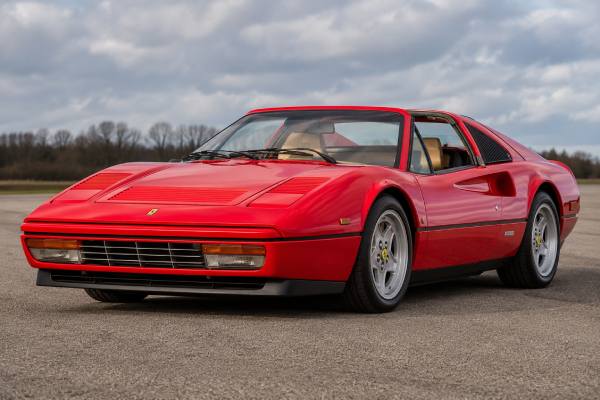
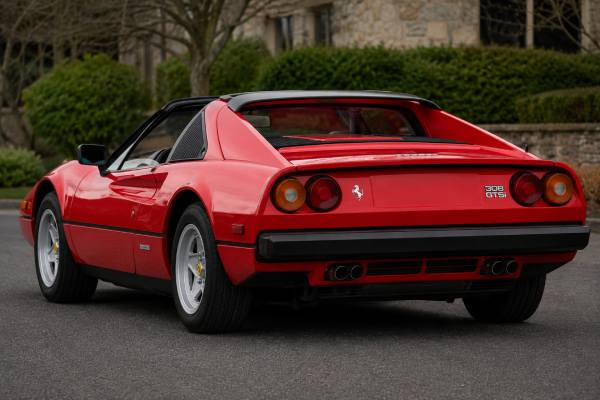
The Ferrari 308 GTSi, factory type F 106 BS 100 with the F106BB 2.9-liter V8, was the fuel-injected, targa-roof version of Ferrari’s mid-engine 308 line from the early 1980s. In European form it produced 214 hp, while North American cars were rated lower under SAE net measurement and emissions equipment. It sits in an interesting place in Ferrari history: visually close to the carbureted 308 GTS that made the shape famous, but mechanically updated with Bosch K-Jetronic fuel injection to meet tighter emissions rules and improve cold running.
This is not the quickest 308 variant, and collectors know it. The GTSi lost some of the crisp top-end power of the earlier carbureted cars before Ferrari restored performance with the later Quattrovalvole. Yet that is also why the 308 GTSi remains one of the more approachable classic open-roof Ferraris. It has the Pininfarina wedge shape, gated manual gearbox, transverse mid-mounted V8, removable roof panel, and compact proportions that define the 308 experience, but usually without the highest prices attached to early fiberglass GTBs or the later QV and 328 models.
Quick Take
The Ferrari 308 GTSi is most appealing as a usable, open-roof classic Ferrari with iconic Pininfarina styling, Bosch mechanical injection, and a relatively simple two-valve V8 layout. Its identity is tied to the emissions-era transition from carburetors to injection, which makes it smoother and often easier to live with than earlier cars, but less powerful and less valuable than the best carbureted or Quattrovalvole versions. The right car is bought on condition, originality, service history, corrosion inspection, timing-belt history, fuel-injection health, and documentation rather than mileage alone.
Table of Contents
- Why the 308 GTSi Still Matters
- Engine, Chassis, and Key Specs
- Production, Variants, and Options
- Design Details and Engineering Character
- Road Feel, Sound, and Performance
- Maintenance, Reliability, and Restoration Risk
- Market Value, Buying Guide, and Rivals
Why the 308 GTSi Still Matters
The 308 GTSi matters because it kept Ferrari’s small mid-engine V8 sports car alive during a difficult emissions period while preserving the shape and layout that made the 308 famous. It is the bridge between the carbureted 308 GTS of the late 1970s and the stronger 308 GTS Quattrovalvole introduced for the 1982 model cycle.
The wider 308 story began in the mid-1970s, when Ferrari moved beyond the Dino 246 and created a new two-seat, mid-engine V8 line. The 308 GTB coupe arrived first, followed by the 308 GTS with a removable roof panel. The GTS format became especially important because it gave buyers the look and balance of the berlinetta with open-air driving, without turning the car into a soft-top convertible.
By 1980, emissions and drivability demands had changed. Ferrari replaced the Weber carburetors with Bosch K-Jetronic mechanical fuel injection and renamed the cars GTBi and GTSi. The “i” mattered. It showed Ferrari was adapting the 308 to cleaner running, better starting, and market compliance, especially in the United States. The tradeoff was power. Compared with the livelier carbureted 308, the injected two-valve cars felt softer, especially at high rpm.
That loss of power shaped the GTSi’s reputation. For years, buyers treated the 1980–1982 injected cars as the least desirable 308s because they were the slowest and because they sat between two more celebrated versions: the carbureted cars and the later four-valve Quattrovalvole. Today that reputation is more nuanced. A sorted GTSi is still a compact, analog, mid-engine Ferrari with a gated five-speed gearbox and hydraulic controls. It also has fewer tuning headaches than a tired carburetor car and a lower entry point than many related models.
The 308 GTSi also carries cultural weight. The open-roof 308 silhouette became one of the defining Ferrari images of the early 1980s. Pop-up headlights, a low nose, side air intakes, a flying-buttress rear roof treatment, and round tail lamps made the car instantly recognizable. Even people who do not follow chassis codes often recognize the shape.
For collectors, the GTSi’s importance is tied less to rarity alone and more to authenticity. It is not a homologation special or a competition Ferrari, but it is a true classic Ferrari of the analog era. It has a tubular steel chassis, a naturally aspirated V8, manual steering, a manual transaxle, and a cabin that still feels hand-built. Those traits are increasingly rare in modern performance cars.
Engine, Chassis, and Key Specs
The 308 GTSi uses Ferrari’s F106BB 2.9-liter, 90-degree V8 mounted transversely behind the cabin and paired with a five-speed manual transaxle. European specification is the best match for the 214 hp figure, while North American documentation commonly lists 205 SAE net hp because of market-specific emissions equipment and rating standards.
| Item | Specification |
|---|---|
| Factory type | F 106 BS 100 |
| Engine code | F106BB |
| Layout | Transverse mid-mounted V8, rear-wheel drive |
| Displacement | 2,926.90 cc |
| Bore x stroke | 81 mm x 71 mm |
| Valvetrain | Double overhead camshafts per bank, two valves per cylinder |
| Fuel system | Bosch K-Jetronic mechanical fuel injection |
| Compression ratio | 8.8:1 |
| European output | 214 hp at 6,600 rpm |
| European torque | 243 Nm at 4,600 rpm |
| North American output | 205 SAE net hp at 6,600 rpm |
| Transmission | Five-speed manual transaxle with reverse |
| Differential | Plate-type limited-slip differential |
| Lubrication | Wet sump |
The engine is compact and busy rather than large and lazy. It uses a flat-plane-style Ferrari V8 character: quick to rev, hard-edged when warm, and happiest when the driver uses the upper half of the tachometer. The Bosch system meters fuel mechanically, using airflow and control pressure rather than modern electronic mapping. When healthy, it gives clean starting and steady running. When neglected, it can cause lean running, hot-start problems, uneven idle, and weak throttle response.
The chassis is a tubular steel frame clothed in steel bodywork. The GTSi was not a fiberglass-bodied early GTB, so corrosion inspection matters. Suspension is independent all around, using unequal-length wishbones, coil springs, telescopic dampers, and anti-roll bars. The brakes are discs at all four corners, with a conventional hydraulic system and servo assistance. Steering is rack-and-pinion without power assistance.
| Item | Specification |
|---|---|
| Frame | Tubular steel |
| Body style | Two-seat targa-top |
| Wheelbase | 2,340 mm |
| Length | About 4,230 mm in European trim; North American bumper cars are longer |
| Width | 1,720 mm |
| Height | 1,120 mm |
| Front/rear track | 1,460 mm / 1,460 mm |
| Dry weight | About 1,297 kg |
| Fuel capacity | 74 liters |
| Factory top speed | About 240 km/h, or roughly 149 mph |
| Period standing kilometer | About 27 seconds in North American owner documentation |
The 308 GTSi is compact by modern standards. Its width, short wheelbase, and low height make it feel narrow, low, and immediate on the road. The lightness of the body is not the same as an early fiberglass GTB, but the car still feels small compared with later supercars.
Production, Variants, and Options
The 308 GTSi was built in relatively meaningful numbers, but correct identification still matters because market specification, originality, and factory equipment can change value. Ferrari and specialist records generally place production at roughly 1,749 GTSi examples, with chassis numbers running in the low-31,000 to low-43,000 range.
The GTSi was the open-roof companion to the 308 GTBi coupe. The two shared the same basic engine, chassis layout, injection system, and interior updates. The GTSi’s removable roof panel is the main body difference. It gives the car much of its appeal, but it also introduces more potential for squeaks, rattles, seal leaks, and fit issues than the fixed-roof GTBi.
There were three broad ways to separate the cars:
- Body style: GTBi coupe or GTSi targa.
- Market specification: European, North American, and other export-market equipment.
- Production timing: early injected cars before the Quattrovalvole update, and later cars that overlap with the transition into QV production.
European cars are often discussed around the 214 hp rating. North American cars used additional emissions equipment and were rated at 205 SAE net hp. Federal bumper treatment also changes the visual length and stance. Buyers should avoid assuming that all figures or trim details apply across markets.
Factory and period options were not as elaborate as modern Ferrari personalization, but they still matter. Typical equipment and options included air conditioning, metallic paint, fog lamps, a passenger-side mirror, radio equipment, electric aerial, fitted luggage, deeper front spoiler, and wheel or tire variations depending on market and year. Some cars also carried contrasting lower-body “Boxer” style paint treatment, which can be desirable if original and properly documented.
The most important authenticity items are not always glamorous. A strong GTSi should have a clear chassis identity, consistent engine and gearbox history, original books, service records, tool roll, jack, emergency equipment, roof cover, and evidence that the removable roof panel belongs to the car and fits correctly. Replacement wheels, modern audio, non-original paint, aftermarket exhausts, and removed emissions equipment are common. Some changes improve use, but they should be documented and reversible when possible.
The major successor was the 308 GTS Quattrovalvole. Its four-valve cylinder heads restored much of the performance lost in the fuel-injected two-valve cars and made it more desirable for many buyers. That leaves the GTSi in a lower but still important collector tier: more affordable than the most sought-after 308s, but still a genuine classic Ferrari with the same core body shape and mechanical layout.
Design Details and Engineering Character
The 308 GTSi’s design is one of its greatest assets because the fuel-injected model changed the mechanical package without spoiling the famous 308 shape. Pininfarina’s wedge form gives the car drama, but the details are functional as well as visual.
The low nose helps airflow and gives the driver a clear sense of the front corners. Pop-up headlights keep the front clean when closed. The side air intakes feed the mid-mounted engine bay. The rear buttresses and louvered engine cover manage the visual transition from targa roof to engine compartment while helping heat escape from the V8 area. The round tail lamps and quad exhaust outlets give the rear view a classic Ferrari identity.
The removable roof panel is central to the GTSi character. It gives open-air driving without a full convertible mechanism, which saves complexity and keeps the side profile close to the coupe. The compromise is structural and practical. A GTS can flex and rattle more than a GTB, and roof seals need careful attention. Buyers should test the roof panel, latches, storage fit, and weather seals rather than treating the targa top as a cosmetic feature.
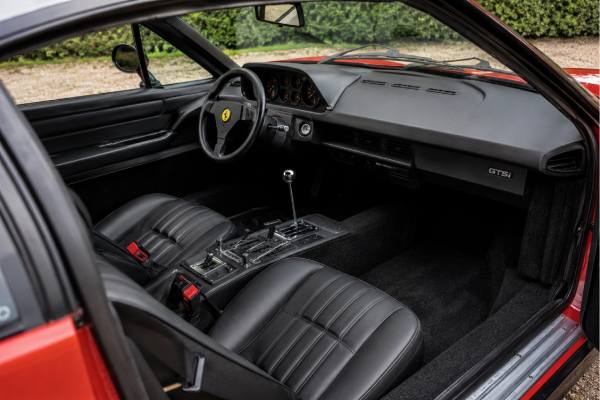
Inside, the GTSi kept the basic 308 cockpit but revised some details from earlier cars. The main instruments sit ahead of the driver, while the clock and oil-temperature gauge moved to the center console area. The steering wheel, seats, switchgear, gated shifter, and low seating position create a cabin that feels mechanical and focused. The pedals are offset because of the wheel-arch intrusion, and the footwell can feel tight for larger drivers.
Engineering choices reflect Ferrari’s priorities at the time. The transverse engine and gearbox package allowed Ferrari to keep the wheelbase short and the car compact. The five-speed transaxle sits with the engine assembly, and the plate-type limited-slip differential helps traction when the driver starts using the car properly. The suspension is conventional in layout but carefully judged: double wishbones, coil springs, dampers, and anti-roll bars at both ends.
The fuel-injection system is the defining engineering change. Bosch K-Jetronic is not electronic injection in the modern sense. It is a continuous mechanical system that responds to airflow and fuel pressure. Its strengths are durability and smoothness when maintained. Its weakness is sensitivity to vacuum leaks, stale fuel, dirty components, and poor adjustment. The system made the GTSi cleaner and more civilized, but it also softened the high-rev sparkle that many drivers associate with carbureted Ferraris.
Sound is part of the engineering character. The GTSi does not have the same induction roar as the earlier Weber-fed 308s, but a healthy car still has a sharp, metallic V8 note. Exhaust condition matters. Poor aftermarket systems can drone, fail emissions inspection, or make the car unpleasant. A good original-style system lets the engine sound mechanical without turning every drive into a noise event.
Road Feel, Sound, and Performance
A good 308 GTSi is more about feel, balance, and involvement than raw speed. It is quick enough to feel special on a road, but its real charm comes from the steering, gearbox, size, visibility, and the way the engine builds power when warm.
The first thing many drivers notice is the steering. At parking speed it is heavy, especially with wide modern tires or poor alignment. Once moving, it becomes one of the car’s best features. There is no power assistance filtering the road surface, so the driver feels front-end load and grip clearly. A properly set up car should not feel nervous. It should feel light, alert, and easy to place.
The gearbox is another defining feature. The gated shifter looks beautiful, but it is not just decoration. It needs a deliberate hand. Second gear can be reluctant when cold, a familiar trait on many classic Ferraris. Owners often let the oil warm and shift from first to third for the first few minutes rather than forcing the lever. Once warm, a healthy gearbox should feel precise, mechanical, and satisfying.
The engine has a different personality from the carbureted 308. It is smoother at low speed and less fussy in traffic, but it does not pull as hard at the top. Throttle response should still be clean. Hesitation, hunting idle, strong fuel smell, or hot-start difficulty suggests injection, ignition, vacuum, or fuel-pressure issues rather than normal character.
Performance is period-sports-car fast, not modern-supercar fast. Factory top speed was around 149 mph in European specification, with period North American documentation showing roughly 147 mph. Acceleration figures vary by market, test conditions, and vehicle condition. The car feels best when driven with momentum, using the midrange and letting the V8 rev freely after oil temperature is stable.
Ride quality is better than many people expect. The 14-inch tire sidewalls and relatively compliant suspension help the car breathe with the road. A tired car may feel loose, crashy, or vague, but that is usually a sign of worn bushings, old dampers, flat-spotted tires, or poor alignment. A restored suspension can transform a 308 GTSi.
The brakes are adequate for spirited road use when fresh, but they are not modern carbon-ceramic brakes. Pedal feel should be firm and progressive. Pulling, vibration, sinking pedal, seized calipers, old hoses, or contaminated fluid should be treated seriously. The factory maintenance mindset placed real emphasis on brake-fluid service, and buyers should do the same.
Usability is better than the shape suggests. Visibility is good for a low exotic, the car is narrow, and the cabin is less intimidating than later supercars. The downsides are heat, noise, old air conditioning performance, a low seating position, a tight footwell, and a targa roof that may leak or rattle. In town, clutch effort and steering weight remind the driver that this is a classic. On a flowing road, those same traits become part of the appeal.
Maintenance, Reliability, and Restoration Risk
The 308 GTSi can be reliable when used regularly and maintained by specialists, but deferred maintenance becomes expensive quickly. This is an exotic-car ownership case where condition and service history matter far more than a cheerful test drive.
The engine itself is strong, but it has several age-sensitive systems. Timing belts and tensioner bearings are central ownership items. Belt service is not as invasive as on some later Ferraris, but it must not be ignored. Many cars cover little annual mileage, so time-based belt replacement matters as much as mileage. Cam seals, cam-cover gaskets, distributor seals, oil hoses, and coolant hoses all deserve inspection.
Two-valve 308 engines also deserve careful attention to valve condition and valve-clearance history. A specialist familiar with these engines can assess compression, leakdown, cam timing, valve adjustment records, smoke on startup, oil pressure, and noise. A pretty engine bay is not proof of health.
The Bosch K-Jetronic system is durable but intolerant of neglect. Common problem areas include:
- stale fuel and dirty tanks
- tired fuel pumps and accumulators
- clogged injectors
- incorrect control pressure
- warm-up regulator problems
- auxiliary air valve faults
- vacuum leaks
- poor cold-start behavior
- fuel distributor issues after long storage
Ignition health is just as important. Coils, distributors, caps, rotors, plug leads, modules, grounds, and wiring connections age. Misfires under load should not be dismissed as “old Ferrari behavior.”
Cooling-system condition is another major inspection point. Radiator health, fans, relays, water pump, thermostat, hoses, expansion tank, and bleed procedure all matter. A 308 that runs hot in traffic may need simple fan work, but it may also be hiding years of cooling-system neglect.
Gearbox and clutch condition can be expensive. A reluctant cold second gear can be normal, but grinding when warm is not. Listen for differential noise, check for leaks, inspect CV boots, and verify that the clutch releases cleanly. Clutch effort is firm, but it should not be erratic or unpleasant.
Corrosion is one of the largest restoration risks because the GTSi is steel-bodied. Inspect sills, lower doors, wheel arches, front valance, rear lower quarters, battery area, windshield surround, floor sections, chassis tubes, suspension pickup areas, and behind bumpers. Accident damage is equally important. Uneven panel gaps, poor headlight fit, bad door shut lines, mismatched paint, or distorted chassis tubes can turn an apparently nice car into a costly restoration.
Interior and trim parts are often more expensive than expected. Correct seats, switchgear, lenses, targa seals, roof hardware, tool rolls, jack kits, books, and original wheels all influence value. A missing tool roll may sound minor until replacement cost and authenticity questions enter the discussion.
A sound maintenance plan should include:
- timing-belt and tensioner service at a specialist-approved interval
- annual fluid inspection, even with low mileage
- regular brake-fluid replacement
- valve-clearance checks based on use and service history
- fuel-system cleaning if the car has sat
- cooling-system pressure test and hose inspection
- tire age checks, not just tread depth
- suspension bushing and alignment review
- electrical fusebox, relay, and ground inspection
Restoration quality varies widely. The 308 spent years as an affordable entry Ferrari, so some cars received cosmetic repairs instead of proper mechanical or structural work. The best cars have invoices, photos, known specialists, coherent ownership history, and no attempt to hide modifications.
Market Value, Buying Guide, and Rivals
The 308 GTSi usually sits below carbureted 308s, Quattrovalvole models, and the 328 GTS in collector value, but strong examples are no longer cheap. The market rewards originality, documentation, low ownership risk, correct specification, and recent specialist maintenance more than simple mileage claims.
Recent public-sale data shows a wide spread. Driver-quality GTSi examples often trade in the middle five-figure range in the U.S. market, while exceptional low-mileage, highly original, or unusually well-presented cars can reach six figures. Projects and neglected cars may appear tempting, but restoration costs can erase any apparent saving.
| Value factor | Why it matters |
|---|---|
| Service history | Shows whether timing belts, valve work, fluids, fuel injection, cooling, and suspension were maintained properly |
| Originality | Correct wheels, trim, books, tools, emissions equipment, and interior details support collector confidence |
| Body and chassis condition | Rust or accident repair can cost more than engine service to correct properly |
| Market specification | European and North American cars differ in power rating, emissions hardware, bumper treatment, and buyer preference |
| Roof fit and seals | GTS targa parts affect comfort, weather sealing, rattles, and originality |
| Color and provenance | Desirable colors, long-term ownership, and known specialist care can lift a car above average |
A serious pre-purchase inspection should be Ferrari-specific. A normal classic-car inspection is not enough. The inspector should know 308 chassis tubes, belt service access, Bosch K-Jetronic behavior, Ferrari transaxle feel, correct trim, emissions equipment, and common corrosion points.
Before buying, verify:
- chassis number, engine number, and gearbox identity where records allow
- timing-belt and tensioner date, not just mileage
- compression and leakdown results
- warm and cold starting behavior
- oil pressure when hot
- cooling-fan operation in traffic
- gearbox shift quality when fully warm
- brake condition and fluid history
- suspension bushings, dampers, ball joints, and steering rack condition
- tire date codes
- targa roof fit, seals, latch condition, and storage bag
- tool roll, jack, books, manuals, and service wallet
- evidence of rust repair or accident damage
- emissions legality for the buyer’s location
The best examples to seek are honest, documented, regularly used cars with recent mechanical work and no hidden body issues. Very low-mileage cars can be valuable, but only if storage, recommissioning, and originality are beyond doubt. Long-dormant cars are risky because fuel injection, seals, brakes, cooling, and electrical systems often fail after sitting.
Cars to avoid include shiny repaints with no structural photos, cars with missing identification records, examples that overheat, cars with poor cold and hot starting, heavily modified interiors, removed emissions systems in strict markets, and cars sold without recent belt documentation.
Closest Ferrari alternatives include the carbureted 308 GTS, which is faster and more valuable; the 308 GTS Quattrovalvole, which restores performance while keeping the same basic shape; the 328 GTS, which is more developed and easier to use; and the Mondial 8 or Mondial QV, which shares related mechanical DNA but adds seats and a different market image.
Outside Ferrari, the period alternatives include the Porsche 911 SC and 3.2 Carrera, Lotus Esprit Turbo, Maserati Merak, Lamborghini Urraco or Jalpa, and De Tomaso Pantera. The Porsche is usually easier to own, the Lotus feels more exotic in some ways, the Maserati offers a different Italian flavor, and the Lamborghini choices are rarer but often more difficult to buy well. The Ferrari’s advantage is its blend of recognizability, parts support, specialist knowledge, and enduring 308 design appeal.
The 308 GTSi is not the fastest or most collectible 308, but that is part of its opportunity. Bought carefully, it delivers the essential open-roof 308 experience with a lower buy-in than the more celebrated variants. Bought carelessly, it becomes an expensive lesson in why classic Ferraris are never cheap simply because the purchase price looks reasonable.
References
- Ferrari 308 GTSi (1980) – Ferrari.com 1980 (Manufacturer Specifications) ([Ferrari][1])
- owner’s manual uso e manutenzione Ferrari 308 GTBi / 308 GTSi North American Version 1980 (Owner’s Manual)
- Ferrari 308 GTSi Specifications – SBR Engineering 2025 (Technical Specifications) ([SBR Engineering][2])
- Ferrari 308 GTSi Market – CLASSIC.COM 2026 (Market Data) ([Classic.com][3])
- Buying Guide: Ferrari 308 | Hagerty UK 2022 (Buying Guide) ([Hagerty UK][4])
Disclaimer
This article is for informational purposes only and is not a substitute for professional diagnosis, repair, inspection, valuation, or restoration advice. Specifications, torque values, service intervals, emissions equipment, and procedures vary by VIN, market, production date, and equipment, so owners and buyers should verify all details against official Ferrari service documentation and a qualified Ferrari specialist.
If this guide helped you, please consider sharing it on Facebook, X/Twitter, or your preferred automotive community to support our work.