
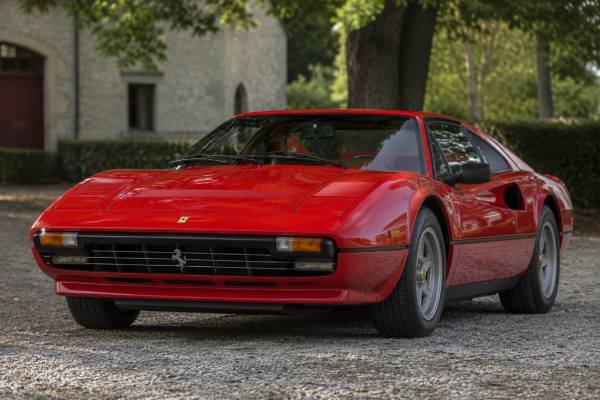
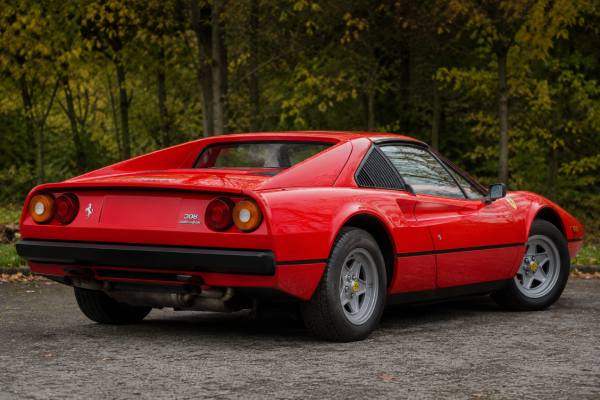
The Ferrari 308 GTB Quattrovalvole is the fixed-roof, four-valve version of Ferrari’s mid-engined 308, produced from 1982 to 1985 with a 2.9-liter transverse V8 rated at 240 hp in European specification. It sits at an important point in Ferrari history: late enough to gain Bosch fuel injection and 32-valve cylinder heads, but early enough to retain the compact, analog feel that made the original 308 one of the defining sports cars of its era.
This was not a clean-sheet replacement for the 308 GTB. It was the final and most developed form of the original 308 coupe before the arrival of the 328. The “Quattrovalvole” name means four valves, and that change mattered because it restored much of the performance lost when the earlier carbureted 308 gave way to emissions-era injected GTBi models. Today, the GTB Quattrovalvole attracts buyers who want the 308 shape, the security of fuel injection, the sharper 32-valve engine, and the added rarity of the berlinetta body over the more common GTS targa.
Quick Take
The Ferrari 308 GTB Quattrovalvole is one of the most usable and collectible versions of the classic 308: rarer than the GTS, stronger than the earlier injected GTBi, and more refined than the carbureted cars without losing the light, mechanical feel of an early mid-engined Ferrari. Its appeal is strongest when the car is original, well documented, freshly serviced, and correctly specified, but neglected examples can become expensive quickly because timing-belt access, fuel-injection setup, cooling health, corrosion repair, trim restoration, and provenance all matter more than ordinary mileage.
Table of Contents
- History and Collector Significance
- Engine, Chassis and Key Specifications
- Production, Variants and Factory Details
- Design, Engineering and Special Features
- Driving Character and Real Performance
- Maintenance, Reliability and Restoration Risk
- Values, Buying Advice and Rivals
History and Collector Significance
The 308 GTB Quattrovalvole matters because it is the final fixed-roof evolution of Ferrari’s first truly successful mid-engined V8 berlinetta line. It kept the Pininfarina shape and compact proportions of the original 308, but added the 32-valve engine that made the injected car feel like a Ferrari again.
The original 308 GTB arrived in the mid-1970s as the spiritual successor to the Dino 246 GT, although it used Ferrari branding and a V8 rather than the Dino’s V6. Designed by Leonardo Fioravanti at Pininfarina, it gave Ferrari a cleaner, more mature two-seat mid-engine coupe than the Bertone-styled Dino 308 GT4. Early 308 GTBs are famous for their carburetors and, in the first production run, fiberglass bodywork. Later steel-bodied cars became the more familiar form.
By 1980, Ferrari had moved the 308 to Bosch K-Jetronic mechanical fuel injection. That change helped with emissions and drivability, but it also reduced output compared with the livelier carbureted versions. The 308 GTBi and GTSi are respected today, yet in period they were often criticized for feeling softer than the car’s looks promised. The Quattrovalvole update, introduced for the 1982 model era, fixed the central problem by giving the V8 four valves per cylinder.
For the GTB, that update created a particularly interesting collector car. Most buyers in the 1980s wanted the open-roof GTS, helped later by the 308’s television fame. The fixed-roof GTB sold in much smaller numbers, which now gives it a stronger rarity story. It also has the cleaner roofline, better structural stiffness, and purer berlinetta identity. For buyers who see the 308 as a proper sports car rather than a style object, the GTB Quattrovalvole is often the sweet spot.
The model also connects several Ferrari eras. It has enough old-world character to feel hand-built and mechanical, yet it is modern enough to use fuel injection and electronic ignition. It directly preceded the Ferrari 328, which refined the concept with a larger 3.2-liter engine, updated bumpers, improved cabin ergonomics, and better cooling and service details. The 308 QV therefore feels like the last sharp-edged expression of the original design.
Its reputation today rests on four pillars:
- It is one of the most attractive and recognizable Ferrari shapes of the late 20th century.
- It has the desirable 32-valve version of the 2.9-liter V8.
- The GTB body is far rarer than the GTS.
- It remains more usable and approachable than many older carbureted Ferraris, while still demanding specialist care.
It is not a rare Ferrari in the pre-war or 1960s V12 sense. The wider 308 family was built in meaningful numbers. But within the 308 line, the GTB Quattrovalvole is scarce, especially in highly original condition with books, tools, correct wheels, matching numbers, factory colors, and a clear ownership trail.
Engine, Chassis and Key Specifications
The heart of the 308 GTB Quattrovalvole is a rear-mid-mounted, transverse 2.9-liter V8 with four camshafts and four valves per cylinder. Its 240 hp rating does not sound extreme today, but in a relatively light, compact, manual Ferrari, it gives the car the character expected from its shape.
| Category | Detail |
|---|---|
| Model | Ferrari 308 GTB Quattrovalvole |
| Production years | 1982–1985 |
| Body style | Two-seat berlinetta coupe |
| Layout | Transverse rear-mid engine, rear-wheel drive |
| Engine code | F105AB family, 90-degree V8 |
| Displacement | 2,926.90 cc |
| Bore x stroke | 81 mm x 71 mm |
| Valvetrain | Double overhead camshafts per bank, four valves per cylinder |
| Fuel system | Bosch K-Jetronic mechanical fuel injection |
| Ignition | Electronic ignition |
| Compression ratio | 9.2:1 |
| Maximum power | 240 hp at 7,000 rpm |
| Maximum torque | 260 Nm at 5,000 rpm |
| Transmission | 5-speed manual transaxle |
| Top speed | 255 km/h |
The engine is mounted across the car rather than lengthwise. That packaging kept the wheelbase short and the cabin-forward proportions compact. The gearbox sits with the engine in a combined transverse layout, sending power to the rear wheels through a limited-slip differential.
The chassis follows Ferrari practice of the period, with a tubular steel structure and separate body panels. The suspension uses independent double wishbones, coil springs, telescopic dampers, and anti-roll bars at both ends. Braking is by vented discs all around, with a firm, old-school pedal feel when the system is fresh.
| Item | Specification |
|---|---|
| Wheelbase | 2,340 mm |
| Length | 4,230 mm |
| Width | 1,720 mm |
| Height | 1,120 mm |
| Front track | 1,460 mm |
| Rear track | 1,460 mm |
| Dry weight | About 1,275 kg |
| Steering | Rack and pinion, unassisted |
| Front suspension | Double wishbones, coil springs, dampers, anti-roll bar |
| Rear suspension | Double wishbones, coil springs, dampers, anti-roll bar |
| Brakes | Vented discs front and rear |
| Common 16-inch tire sizes | 205/55 VR16 front, 225/50 VR16 rear |
Some cars use metric TRX wheels and tires, while many owners prefer or seek cars with the factory-style 16-inch wheel package because tire choice is easier and the stance is more familiar. A buyer should not judge wheels only by appearance. Correct wheel type, date, finish, and tire specification all affect originality and value.
The quoted performance figures vary by market, condition, test method, and whether the car is European or U.S.-specification. A healthy European 240 hp car is generally understood as a high-5-to-mid-6-second 0–100 km/h machine, with a top speed around 255 km/h. U.S. emissions equipment, catalytic converters, tune, tires, altitude, and age can change how a specific example feels.
Production, Variants and Factory Details
The GTB Quattrovalvole is the rare closed-roof member of the 308 QV family, with 748 examples produced. That number is central to its collector appeal because the open GTS Quattrovalvole was built in much larger volume.
The 308 QV was sold as both the GTB berlinetta and the GTS targa. Mechanically, the two are closely related, but they appeal to different buyers. The GTS offers open-air driving and broader pop-culture recognition. The GTB offers a fixed roof, cleaner design, greater rarity, and usually a more focused driving feel.
| Version | Body style | Production | Collector identity |
|---|---|---|---|
| 308 GTB Quattrovalvole | Fixed-roof coupe | 748 examples | Rarer, stiffer, more purist |
| 308 GTS Quattrovalvole | Targa-roof spider-style coupe | 3,042 examples | More common, more open-air appeal |
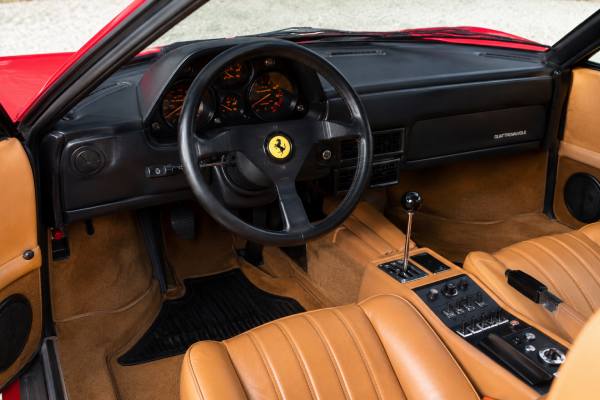
The GTB QV can be identified by several details that separate it from earlier 308s. The most obvious is the louvered panel in the front lid, added to improve radiator air extraction. The front grille was updated, rectangular driving lights appeared, and the side repeaters changed. Power mirrors with small Ferrari badges are also a common QV identifier. Inside, Ferrari made small trim changes, including steering wheel and upholstery updates.
Factory and period equipment varied by market. Air conditioning was a desirable option and is important for usability today, though it must be working properly to add real value. Metallic paint, a deeper front spoiler, 16-inch wheels, leather or cloth seat inserts, radio equipment, and rear aerofoil treatment can all affect how a car presents.
The most important originality points include:
- Correct chassis and engine identity for the model.
- Factory body type, not a converted or heavily altered car.
- Original colors or well-documented color changes.
- Books, pouch, tools, jack, warranty card, and service invoices.
- Evidence of timing-belt services and major mechanical work.
- Correct wheels, lights, mirrors, trim, badges, and interior materials.
- Clear import history for cars that moved between Europe, the U.K., Japan, and North America.
Matching numbers matter, but the phrase needs careful handling. On a Ferrari of this era, buyers should confirm chassis number, engine number, gearbox number, body tags, stamped plates, and documentation with a knowledgeable specialist. A Ferrari Classiche file or marque-expert inspection can help, but it should not replace a physical inspection.
Market-specific details also matter. European cars generally carry the cleaner 240 hp identity and often have lighter-looking bumpers and fewer emissions compromises. U.S.-market cars may have catalytic equipment, different side markers, emissions labels, and federalization history. A federalized European car can be desirable if the work was done correctly and documented, but poor conversions can create wiring, lighting, emissions, and value issues.
Design, Engineering and Special Features
The 308 GTB Quattrovalvole works so well visually because its engineering layout and body shape support each other. It is low, short, wide enough to look serious, and almost free of unnecessary decoration.
Pininfarina gave the 308 a wedge profile without making it harsh. The nose is slim, the pop-up headlights keep the front clean, and the side intake treatment gives the car purpose without the dramatic bulk of later supercars. The flying-buttress-like rear sail panels and vertical rear window create one of the most recognizable Ferrari silhouettes of the 1980s.
The GTB is the purest expression of that shape. Without the removable roof panel of the GTS, the roofline flows more naturally from windshield to rear deck. The fixed roof also helps the cabin feel tighter and reduces some of the flex and noise associated with the targa body. For many collectors, that is enough to make the GTB the more serious car.
Engineering choices were driven by compactness and balance. The transverse V8 kept the wheelbase short and helped the 308 feel agile. The engine sits behind the cabin but ahead of the rear axle line, giving the car mid-engined responses without the extreme footprint of later high-power Ferraris. The tubular chassis and double-wishbone suspension are straightforward but effective, and the manual steering keeps the driver closely connected to the front tires.
The Quattrovalvole engine is the main technical story. Four valves per cylinder allow better breathing at higher rpm. The car still uses Bosch K-Jetronic mechanical fuel injection rather than modern electronic injection, so it does not have the instant calibration flexibility of later cars. But when set up correctly, it starts reliably, idles cleanly, pulls smoothly, and becomes more urgent as the revs climb.
Several design and engineering details define the ownership experience:
- The gated manual shifter is a central part of the car’s personality.
- The engine sits close behind the cabin, so mechanical sound is always present.
- The front radiator layout makes cooling-system condition especially important.
- Cabin heat and air-conditioning performance depend heavily on maintenance.
- Low seating, slim pillars, and compact size make the car easier to place than many later exotic cars.
- Pop-up headlights, period switchgear, and analog gauges give the cabin a very specific 1980s Ferrari feel.
The QV is not as raw as an early fiberglass 308 GTB, and it is not as polished as a 328. That in-between character is exactly why many enthusiasts like it. It has the famous shape, a stronger engine than the first injected cars, and enough mechanical simplicity to remain understandable to a good specialist.
Driving Character and Real Performance
A good 308 GTB Quattrovalvole feels light, narrow, vocal, and mechanical rather than brutally fast. Its performance is best understood as balanced and involving, not as modern supercar speed.
The engine needs revs. Below the midrange, it is flexible enough for normal use, but the car feels most alive when the V8 is allowed to climb. The four-valve heads help the engine breathe, and the final third of the tachometer is where the QV feels meaningfully stronger than the earlier injected cars. It rewards smooth inputs rather than aggressive abuse.
The gearbox is part of the ritual. When cold, second gear can be reluctant, a familiar trait on many older Ferraris. Owners often let the oil warm and shift gently from first to third for the first few minutes. Once warm and correctly adjusted, the gated five-speed becomes one of the car’s great pleasures: precise, deliberate, and satisfying.
Steering effort is heavy at parking speeds because there is no power assistance. On the move, it becomes direct and detailed. The 308 communicates front-end grip well, and the relatively modest tire width helps the driver feel what the chassis is doing. Compared with modern sports cars, there is less grip, less brake assistance, and far less electronic protection. That is part of the appeal, but it also means the car should be driven with respect, especially on old tires or damp roads.
Ride quality is better than many expect. The car is firm but not punishing when bushings, dampers, tires, and ride height are correct. A tired car can feel loose, noisy, or nervous. A restored car with overly stiff modern suspension can lose the delicacy that makes the 308 enjoyable. The best examples feel supple, balanced, and alert.
Braking performance is period-correct. The vented discs are adequate for fast road use when the system is fresh, but the pedal and stopping distances will not feel like a modern Ferrari with large carbon-ceramic brakes and advanced ABS. Fluid age, hose condition, caliper health, pad compound, and tire quality make a large difference.
In normal use, the 308 GTB QV is more usable than its exotic image suggests. Visibility is good by mid-engine standards, the car is compact, and the engine is not highly stressed. The drawbacks are also real: low ground clearance, heat soak, heavy low-speed controls, limited luggage space, modest air-conditioning, and the need to warm the car properly before asking for full performance.
The most rewarding roads are flowing secondary roads and mountain routes where the driver can use the gearbox, hear the V8, and work with the chassis at sensible speeds. On a track, the car is enjoyable but should not be treated like a disposable modern track-day tool. Oil temperature, coolant temperature, brakes, tires, and old hoses need close attention.
Maintenance, Reliability and Restoration Risk
The 308 GTB Quattrovalvole can be dependable when serviced correctly, but it is still a hand-built classic Ferrari with age-sensitive systems. The biggest mistake is buying on cosmetics and postponing the expensive mechanical work that makes the car safe and enjoyable.
Timing belts are the first major topic. The QV V8 uses belt-driven camshafts, and belt service is a routine ownership cost. Intervals vary by documentation, use, and specialist advice, but buyers should treat old belts, unknown tensioners, and missing service records as immediate risk. A proper belt service often becomes a larger “major” service once seals, water pump condition, hoses, cam timing, valve adjustment, and ignition items are checked.
Fuel injection is another key area. Bosch K-Jetronic is robust, but it dislikes dirt, air leaks, stale fuel, poor warm-up components, and amateur adjustment. A QV that starts badly, idles unevenly, smells rich, surges, or lacks top-end pull may need careful diagnosis rather than simple tuning. Fuel hoses, accumulator, injectors, metering unit, warm-up regulator, and ignition health all work together.
Cooling-system condition is critical. The 308 has long coolant runs, a front radiator, electric fans, and many hoses. Age, corrosion, weak caps, tired fans, clogged radiators, and poor bleeding can cause overheating. A car that runs hot in traffic may need more than a thermostat. A full cooling refresh can be one of the best investments in usability.
Common inspection areas include:
- Timing belts, tensioners, cam seals, and service date.
- Water pump, radiator, fans, coolant pipes, and hose age.
- Fuel hoses, injectors, metering setup, and tank condition.
- Ignition modules, coils, plug extenders, wiring, and grounds.
- Clutch operation, gearbox synchros, shift linkage, and differential noise.
- Brake calipers, flexible hoses, master cylinder, discs, and handbrake mechanism.
- Suspension bushings, ball joints, dampers, wheel bearings, and alignment.
- Steering rack wear and play.
- Exhaust condition, manifolds, emissions equipment, and heat shielding.
- Air-conditioning compressor, hoses, condenser, evaporator, and controls.
Corrosion must not be ignored. The 308 is not a modern galvanized structure in the way buyers might expect today. Rust can appear around lower body sections, wheel arches, door bottoms, sills, floor areas, front compartment sections, battery area, and repaired accident damage. Paint bubbles may hide old filler, poor metalwork, or corrosion returning under a cosmetic restoration.
Electrical faults are common on neglected cars. Fuse boxes, relays, window motors, lighting, fans, grounds, and aged connectors can cause intermittent issues. Slow windows and weak fans may sound minor, but they can point to tired wiring and voltage drop. Many cars have had radios, alarms, immobilizers, or federalization equipment added over decades, so wiring originality matters.
Interior restoration can be expensive. Leather, carpets, seat inserts, dash material, switchgear, vents, gauges, and correct trim pieces are not always simple to source. A poor interior retrim may look fresh but hurt originality. Conversely, a lightly worn original interior can be more desirable than a shiny incorrect restoration.
A sensible ownership plan should include annual fluid service, regular exercise, careful warm-up, battery maintenance, and a relationship with a Ferrari specialist who knows 308s specifically. The car rewards preventive care. It punishes deferred maintenance.
Values, Buying Advice and Rivals
The 308 GTB Quattrovalvole now sits above ordinary 308 driver territory because rarity, fixed-roof desirability, and the 32-valve engine all support demand. The best cars are bought on condition, originality, documentation, and recent specialist work, not simply on mileage or red paint.
As of 2026, public market data shows the GTB QV generally trading above most GTBi/GTSi cars and often above equivalent GTS QV examples, though exact prices vary widely by market. Strong, original, low-mileage, well-documented GTBs can command a substantial premium. Project cars and poorly restored examples can look cheaper at purchase but become far more expensive after mechanical sorting, paint correction, trim work, and missing-parts sourcing.
The most important value drivers are:
- Body style: GTB rarity is a major advantage over the more common GTS.
- Specification: European 240 hp cars are especially attractive to some buyers.
- Originality: Factory colors, trim, wheels, books, tools, and unmodified mechanicals matter.
- Documentation: Long service history is more valuable than verbal claims.
- Recent maintenance: A fresh belt service and cooling/fuel-system work can justify a higher price.
- Condition: Rust-free structure and correct paintwork are more important than a low odometer reading.
- Provenance: Known ownership, Ferrari specialist invoices, and certification can add confidence.
- Market location: U.S., U.K., European, and Japanese-market cars can differ in equipment, paperwork, and buyer expectations.
A pre-purchase inspection is not optional. It should be done by someone who knows 308s, not just a general exotic-car workshop. The inspection should include compression or leak-down testing where appropriate, cold start observation, warm running behavior, gearbox operation, lift inspection, paint-depth readings, chassis and body checks, electrical function, cooling performance, brake condition, tire date codes, and documentation review.
| Area | What to confirm | Why it matters |
|---|---|---|
| Identity | Chassis, engine, gearbox, body tags, market specification | Protects authenticity and resale value |
| Service history | Timing belts, fluids, valve checks, fuel and cooling work | Deferred service quickly becomes expensive |
| Body | Rust, accident repair, panel fit, paint quality | Body correction can exceed mechanical costs |
| Mechanical health | Compression, leaks, temperatures, gearbox, clutch | Confirms the car is fit to drive, not just display |
| Original parts | Wheels, tools, manuals, trim, exhaust, lights | Missing correct parts can be costly to replace |
| Use pattern | Regular driving, storage conditions, fuel age | Long inactivity often creates hidden faults |
Cars to seek are honest, complete, structurally clean examples with a consistent paper trail and recent specialist maintenance. A little patina is acceptable, even attractive, if the car is original and mechanically strong. Cars to avoid include shiny resprays with no history, bargain cars with old belts, cars with unresolved overheating, weak second gear when warm, heavy accident repairs, missing tools and books, or unclear import paperwork.
The closest Ferrari alternatives are the carbureted 308 GTB, the 308 GTBi, the 308 GTS QV, the 328 GTB, and the Mondial QV or 3.2. A carbureted 308 may feel more raw and musical, but it needs carburetor expertise and can cost more in top condition. A 328 is generally more refined and often easier to live with, though some buyers prefer the earlier 308 styling. A GTS QV gives open-roof charm but is less rare. The Mondial offers a related V8 experience with more seats and a different image.
Period non-Ferrari rivals include the Porsche 911 Carrera 3.2, Lamborghini Jalpa, Lotus Esprit Turbo, De Tomaso Pantera, and Maserati Merak SS. The Porsche is easier to use and service. The Lotus is sharper in some ways but has its own specialist needs. The Jalpa is rarer and more dramatic but usually harder to source parts for. The Pantera brings V8 muscle and a different ownership culture. The 308 GTB QV stands apart because it combines Ferrari design, a mid-mounted V8, manual controls, and genuine collector recognition.
Long term, the GTB Quattrovalvole has a strong case. It is rare enough to matter, usable enough to enjoy, and iconic enough that demand is not limited to one generation of buyers. The key is buying the right car. A great 308 GTB QV is a satisfying classic Ferrari. A bad one is a restoration invoice wearing beautiful paint.
References
- Ferrari 308 GTB Quattrovalvole (1982) 2026 (Manufacturer Specifications)
- Ferrari 308 GTB Quattrovalvole: Ferrari History 2026 (Manufacturer History)
- Search Safety Issues | NHTSA 2026 (Recall Database)
- 1984 Ferrari 308 GTB Quattrovalvole Market 2026 (Market Data)
- Ferrari 308 GTB/GTS For Sale – BaT Auctions 2026 (Auction Results)
Disclaimer
This article is for informational purposes only and is not a substitute for professional diagnosis, repair, valuation, or inspection. Specifications, torque values, service intervals, procedures, emissions equipment, and factory details can vary by VIN, market, production date, and equipment, so readers should verify all technical work against official Ferrari service documentation and consult a qualified Ferrari specialist before purchase or repair.
If this guide helped you, please consider sharing it on Facebook, X/Twitter, or your preferred car community to support our work.