
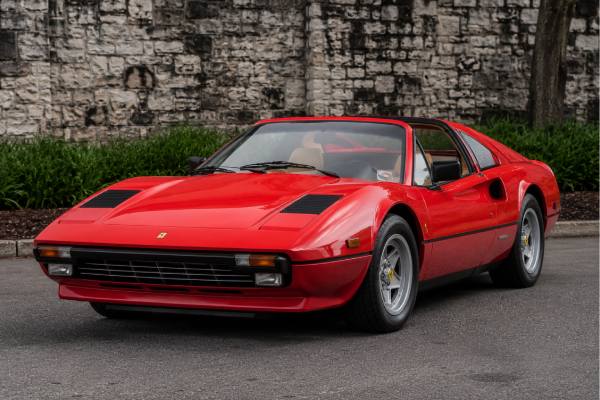
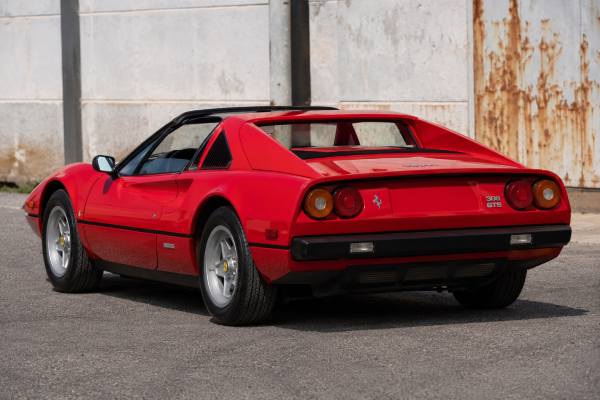
The Ferrari 308 GTS with the F 106 AS 100 chassis reference is the open-roof, carbureted version of Ferrari’s late-1970s mid-engine V8 sports car. Built from 1977 to 1980 before fuel injection arrived, it used a 2.9-liter F106A-series 90-degree V8, four Weber carburetors, a five-speed gated manual transaxle, rear-wheel drive, and a removable targa-style roof panel. In European-market form, the headline output was 255 hp, giving the 308 GTS the crisp, mechanical character that many buyers now associate with the purest road-going 308s.
This was not Ferrari’s fastest car of the era, but it became one of its most recognizable. The 308 GTS combined Pininfarina shape, compact proportions, mid-engine balance, and a usable two-seat cabin in a way that made it more approachable than a Berlinetta Boxer and more modern in feel than the Dino 246 GTS it effectively followed. Today, the strongest examples are valued less for raw speed than for originality, carburetor response, documentation, body condition, and the quality of past maintenance.
Quick Take
The 1977–1980 Ferrari 308 GTS is most appealing as a carbureted, targa-roof Ferrari with classic Pininfarina styling and a vivid, high-revving V8 character. Its identity rests on the steel-bodied F 106 AS 100 chassis, wet-sump 2.9-liter V8, Weber carburetors, and gated five-speed manual, rather than on modern performance numbers. The main caution is ownership condition: rust, old fuel lines, deferred belt service, tired suspension, cooling problems, and poor-quality restorations can turn an attractive car into an expensive project. The best buys are complete, matching, well-documented cars with correct trim, recent specialist maintenance, and no hidden accident or corrosion history.
Table of Contents
- History and Collector Importance
- Engine, Chassis and Key Specs
- Production, Variants and Original Details
- Design, Engineering and Special Features
- Road Feel, Performance and Usability
- Maintenance, Reliability and Restoration Risks
- Values, Buying Advice and Rivals
History and Collector Importance
The 308 GTS matters because it turned Ferrari’s mid-engine V8 layout into an enduring road-car formula. It was smaller, lighter, and more intimate than Ferrari’s flat-12 flagship models, yet it carried enough presence, sound, and engineering seriousness to become a core Ferrari collectible.
The 308 line began with the 308 GTB, shown in 1975 as a Pininfarina-designed two-seat successor to the Dino 246 GT and GTS. The 308 GTS followed in 1977 with a removable roof panel, giving buyers open-air driving without abandoning the mid-engine shape. The GTS was not a full convertible. Its roof structure kept much of the coupe’s visual line, while the lift-out panel made it more flexible for warm-weather use.
The model sat above the Bertone-designed Dino 308 GT4 in image and desirability, even though both shared the broad idea of a transverse mid-mounted V8. The GT4 was a 2+2 with sharper wedge styling. The 308 GTS was a pure two-seater with flowing Pininfarina lines, round tail lamps, pop-up headlights, deep side intakes, and a low cabin set ahead of the rear engine bay.
For the 1977–1980 carbureted GTS, the important identity points are simple:
- It is the first open-roof version of the 308 GTB/GTS family.
- It predates Bosch fuel injection and the later Quattrovalvole four-valve engine.
- It uses Weber carburetors, which give it a sharper intake sound and more period-correct throttle feel.
- It has steel bodywork, unlike the earliest fiberglass GTB cars.
- It uses a wet-sump engine layout, while some European GTB versions retained dry-sump lubrication.
The 308 GTS also became famous outside the usual Ferrari world. Later 308 GTS and GTSi models appeared heavily in popular culture, which helped cement the shape in the public imagination. That visibility still matters today. Many collectors first noticed the 308 because of its shape and image, then later learned the differences between carbureted, injected, and Quattrovalvole versions.
The carbureted GTS is especially appealing because it captures the early 308 feel while offering the removable roof that many buyers prefer. It is less rare than the fiberglass 308 GTB and generally less costly than the very best dry-sump European GTBs, but it has a stronger mechanical character than many injected two-valve cars from 1980–1982.
Its collector importance comes from balance. It is old enough to feel hand-built and analog, yet modern enough to use on real roads when maintained properly. It has classic Ferrari ingredients without the size, cost, or intimidation of a twelve-cylinder flagship. That combination explains why buyers still search for the exact carbureted 308 GTS rather than just any 308.
Engine, Chassis and Key Specs
The 1977–1980 Ferrari 308 GTS uses a transverse mid-mounted 2.9-liter V8, a five-speed manual transaxle, and a tubular steel chassis. The 255 hp figure applies to the higher-output European-style carbureted specification; North American and some market-specific cars used emissions equipment and lower output, so buyers must confirm the exact market version.
| Item | Specification |
|---|---|
| Production period | 1977–1980 for carbureted 308 GTS |
| Chassis reference | F 106 AS 100 for main European-market GTS |
| Body style | Two-seat targa-top coupe |
| Layout | Transverse mid-engine, rear-wheel drive |
| Engine | F106A-series 90-degree V8 |
| Displacement | 2926.90 cc |
| Bore x stroke | 81 mm x 71 mm |
| Valvetrain | Twin overhead camshafts per bank, two valves per cylinder |
| Fuel system | Four Weber 40 DCNF carburetors |
| Lubrication | Wet sump on the GTS |
| Maximum power | 188 kW / 255 hp at 7,700 rpm in European-style specification |
| Transmission | Five-speed manual transaxle plus reverse |
| Steering | Rack and pinion, unassisted |
| Brakes | Ventilated discs front and rear |
The engine is all-aluminum and compact. It sits behind the cabin and ahead of the rear axle line, mounted transversely with the gearbox below and alongside it. This packaging helped Ferrari keep the wheelbase short and the car’s proportions tight. The 308 GTS is not a large car by modern standards, and that compactness is central to the way it drives.
The F106A V8 is oversquare, meaning the bore is larger than the stroke. That helps the engine rev freely. The power peak comes high in the rev range, so the car rewards drivers who use the gearbox and keep the engine alive above the lazy lower range. The four Weber carburetors are a major part of the experience. When synchronized and tuned properly, they give smooth progression, sharp response, and a layered intake sound. When neglected, they cause hard starting, uneven idle, flat spots, fuel smell, and poor hot running.
The chassis is a tubular steel structure with steel body panels. Suspension is independent at all four corners using unequal-length wishbones, coil springs, telescopic dampers, and anti-roll bars. This layout was serious for the period and still feels precise when bushings, dampers, tires, and alignment are right.
| Measurement | Figure |
|---|---|
| Length | 4,230 mm |
| Width | 1,720 mm |
| Height | 1,120 mm |
| Wheelbase | 2,340 mm |
| Front track | 1,460 mm |
| Rear track | 1,460 mm |
| Dry weight | About 1,090 kg in factory specification |
| Fuel tank capacity | 80 liters |
| Standard tire size | 205/70 VR 14 front and rear |
| Top speed | About 252 km/h |
The dry weight figure should not be confused with curb weight. Real cars with fluids, tools, emissions equipment, air conditioning, larger bumpers, or market-specific equipment can weigh more. This is especially important when comparing European and North American examples.
Production, Variants and Original Details
The carbureted 308 GTS was built in meaningful but not huge numbers, and originality now has a strong effect on value. The most important distinctions are market specification, carbureted versus injected engines, early trim details, body condition, and whether the car still has its correct books, tools, wheels, roof panel, and engine-related components.
The 308 GTS was introduced for the 1977 model era and continued in carbureted form until 1980. After that, Ferrari moved to Bosch K-Jetronic fuel injection, creating the 308 GTSi. Later, the 308 GTS Quattrovalvole restored some lost performance with four valves per cylinder. Buyers often group all 308 GTS models together, but collectors do not treat them as identical.
For this exact 1977–1980 carbureted GTS, the key production identity is the steel targa body. Unlike the earliest GTB cars, the GTS was not built as a fiberglass-bodied vetroresina version. The removable roof panel required different structural treatment from the fixed-roof GTB, and the main European chassis type is commonly identified as F 106 AS 100.
Carbureted GTS versus later GTSi
The carbureted GTS has four Weber carburetors and a more old-school feel. It usually sounds harder-edged and responds more sharply when correctly tuned. The later GTSi is often easier to live with in some climates and conditions, but it lost power in many specifications and feels less urgent. The Quattrovalvole cars are stronger than the two-valve injected models and have their own following, but they do not have the same early carbureted character.
Market-specific differences
European and North American cars can differ in power output, emissions equipment, lighting, bumpers, side markers, instruments, exhaust layout, and weight. A European-style 255 hp car is the version most closely tied to the headline specification in this article. A U.S.-market 308 GTS may be more heavily equipped and lower in output, but a highly original U.S. car with complete history can still be very desirable.
Do not assume a car is European simply because it has small bumpers or Euro-style lights. Many 308s have been modified over decades. A proper inspection should confirm chassis numbers, engine type, market equipment, emissions label details where present, and import paperwork if the car crossed markets.
Options and desirable original equipment
Factory and period equipment can affect buyer interest, especially when still documented. Air conditioning, power windows, leather trim, Cromodora alloy wheels, correct Veglia instruments, correct steering wheel, original jack, tool roll, books, pouch, spare wheel, and roof bag all matter.
Common value-positive details include:
- Original color combination or a documented period repaint in the original color.
- Correct 14-inch wheels or documented period 16-inch upgrades.
- Complete books, warranty card, service invoices, and ownership history.
- Original carburetor setup and airbox.
- Correct bumpers, lights, mirrors, and trim for the car’s market.
- A roof panel that fits well and has not been poorly refinished.
- Matching chassis, engine, and gearbox where records can support it.
A color change is not automatically fatal, but it must be priced correctly. A high-quality color change to a popular shade may make a driver more appealing, while a poorly documented change can reduce collector confidence. On these cars, originality is not just cosmetic. It helps prove that the car has not been heavily crashed, federalized carelessly, or assembled from questionable parts.
Design, Engineering and Special Features
The 308 GTS is distinctive because it combines a compact mid-engine chassis with one of Pininfarina’s cleanest wedge-era Ferrari shapes. Its design is functional, but it also gives the car much of its long-term value.
Leonardo Fioravanti’s Pininfarina design avoided the bulk of Ferrari’s larger twelve-cylinder cars. The 308 sits low, with a pointed nose, pop-up headlights, a slim cabin, and sculpted side air intakes feeding the engine bay. The round rear lamps and quad exhaust outlets give it a traditional Ferrari identity, while the sharp beltline and wedge proportions place it firmly in the 1970s.
The GTS roof changes the car’s character. With the panel installed, it keeps the visual outline of the GTB fairly well. With the roof removed, the cabin feels open without turning the car into a soft convertible. The panel can be stored behind the seats, though doing so affects cabin space and requires care to avoid damaging trim.
Packaging and cooling
The transverse V8 layout keeps the car short, but it also makes access more demanding. The rear engine cover gives good visual access, yet many jobs require patience and specialist knowledge. Cooling relies on front-mounted radiators and long coolant pipes running through the chassis. This layout is effective when healthy, but old hoses, air pockets, corroded pipes, weak fans, and tired thermostats can cause trouble.
The side intakes and louvered engine cover are not decoration. They help manage airflow and heat around the engine bay. Heat management is a serious part of 308 ownership, especially in traffic or warm climates. A car that runs cool on a short test drive can still reveal cooling problems during a longer inspection.
Cabin and controls
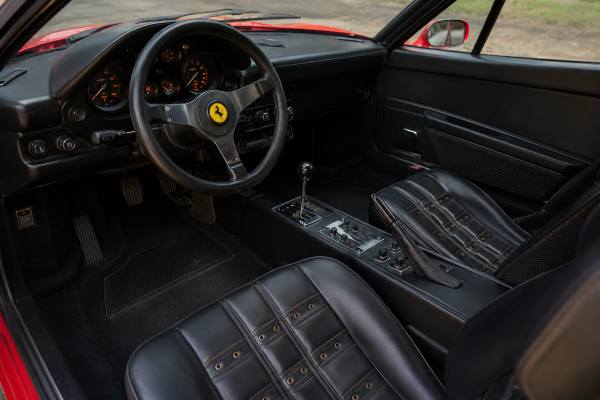
Inside, the 308 GTS feels narrow and low. The driving position is classic Italian sports car: long arms, pedals slightly offset, and a view over a low nose. Veglia instruments, toggle-style controls, leather upholstery, and the open metal shift gate create much of the sense of occasion.
The gated shifter is not just a styling feature. It defines the rhythm of the car. A careful shift through the metal gate is part of the experience, but it also exposes wear. A healthy gearbox should feel mechanical and deliberate, not vague, obstructive, or noisy once warm. Second gear can be reluctant when cold, which is common on many period Ferraris, but severe baulking after warm-up points to wear or adjustment issues.
Sound and sensory character
The carbureted 308 GTS has a more textured sound than later injected versions. At low speed, the engine can sound busy and mechanical. As revs rise, intake noise from the Webers blends with the exhaust note. The engine does not deliver modern turbocharged torque; it builds intensity as the tachometer climbs.
That sound is one reason originality matters. Non-standard exhausts, missing airboxes, altered carburetors, and poorly chosen ignition changes can make a 308 louder but not better. The best cars sound crisp, even, and clean, with no popping from air leaks, no fuel smell from tired hoses, and no misfire under load.
Road Feel, Performance and Usability
A good 308 GTS feels light, compact, alert, and mechanical rather than brutally fast. Its performance is strong for a late-1970s road car, but the real appeal is the way the engine, steering, gearbox, brakes, and chassis involve the driver at normal road speeds.
The V8 needs revs. Below the midrange, it is tractable but not muscular. Above that, the engine becomes sharper and more eager. Carburetor tuning makes a huge difference. A well-set-up car pulls cleanly, idles evenly once warm, and responds immediately to small throttle movements. A neglected car can feel flat, hesitant, and rough, even if compression is good.
Acceleration to 100 km/h is generally quoted in the mid-six-second range for strong carbureted examples, with top speed around 252 km/h. Those numbers are less important than condition. A tired 308 with old ignition components, dirty carburetors, aging fuel hoses, and weak compression will not feel like the factory figures suggest. A sorted car feels much younger than its age.
The steering is unassisted, so it is heavy at parking speed and alive once moving. On the road, this is one of the car’s best traits. The front end communicates clearly, and the compact wheelbase makes the car easy to place. The steering should not wander, shimmy, or feel sticky. If it does, look at tires, alignment, rack condition, suspension bushings, and previous accident repair.
The ride is firm but not harsh when the suspension is healthy. The car was designed for real roads, not just smooth tracks. Old dampers, worn bushings, incorrect ride height, and modern tires with unsuitable sidewalls can make it feel nervous or crashy. Many 308s have been fitted with 16-inch wheels, which can improve tire choice, but the setup must be done thoughtfully.
Braking is by ventilated discs all round. Pedal feel should be firm and progressive, but no one should expect modern carbon-ceramic stopping power or electronic safety nets. Brake hoses, calipers, master cylinders, fluid age, and pad choice matter. A car that pulls under braking or has a long pedal needs attention before spirited driving.
The open roof adds charm but also some compromise. With the panel removed, there is more wind noise and less structural calm over poor surfaces. Some flex is part of the design, but rattles, roof leaks, or poor panel fit can point to worn seals, incorrect adjustment, or body distortion.
As a usable classic, the 308 GTS is better than its exotic image suggests. It has reasonable visibility, compact dimensions, and enough luggage space for short trips. The cabin can get hot, air conditioning is often weak by modern standards, and the car does not enjoy constant stop-start traffic unless the cooling and fuel systems are excellent. It rewards regular use, but it punishes neglect.
Maintenance, Reliability and Restoration Risks
The 308 GTS is not fragile when maintained properly, but it is highly sensitive to age, storage, and deferred specialist work. The most expensive cars to own are often the ones that look shiny but have old belts, old hoses, poor carburetor setup, hidden corrosion, and incomplete records.
The timing belts are a central maintenance item. The F106A V8 uses belt-driven camshafts, and belt age matters as much as mileage. A recent belt service should be supported by invoices that show more than just belts. Sensible service often includes tensioners, cam seals, accessory belts, coolant hoses, fuel hoses, ignition work, valve clearance checks where needed, and fluid replacement.
Fuel-system condition is critical on carbureted 308s. Old rubber hoses, leaking carburetor seals, tired fuel pumps, and incorrect routing are not minor issues. Engine-bay heat and fuel leaks are a dangerous combination. Any smell of fuel should be investigated immediately.
Common inspection areas include:
- Timing belts, tensioners, cam seals, and service dates.
- Carburetor condition, synchronization, jetting, and throttle linkage wear.
- Fuel hoses, filler neck hoses, clamps, pumps, and filters.
- Ignition leads, distributors, coils, points or ignition upgrades, and plug condition.
- Cooling fans, radiator, thermostat, expansion tank, water pump, and coolant pipes.
- Oil leaks from cam covers, seals, gearbox joints, and sump areas.
- Clutch operation, gearbox synchros, and shift linkage adjustment.
- Suspension bushings, ball joints, wheel bearings, shocks, and alignment.
- Brake calipers, hoses, master cylinder, discs, and handbrake function.
- Electrical items, including windows, lights, fans, gauges, fuse panel, and grounds.
Rust is a major concern. The 308 GTS has steel bodywork, and corrosion can hide under paint, trim, wheel arches, lower panels, floor sections, door bottoms, sills, and around the windshield or rear buttress areas. Poor accident repair is just as important. Panel gaps, uneven door fit, distorted headlamp openings, cracked filler, mismatched undercoating, and inconsistent welds should all raise questions.
Restoration can be expensive because the car is both valuable and complex enough to demand correct work. A cheap repaint can cover corrosion for a short time while destroying originality clues. Interior retrims can look attractive but lose correct grain, stitching, seat shape, or material details. Mechanical rebuilds require Ferrari knowledge, not just general classic-car skill.
Parts availability is generally better than for many obscure exotics, but prices vary widely. Some trim pieces, original tools, correct wheels, carburetor parts, emissions components, and market-specific details can be costly or difficult to source. Buying a complete car is usually cheaper than restoring an incomplete one.
Upgrades need judgment. Electronic ignition improvements, better cooling fans, modern hose materials, and careful brake or suspension refreshes can improve reliability without harming the car’s character. Heavy modifications, non-original body changes, poor aftermarket wheels, incorrect seats, or engine swaps can reduce collector value unless the car is already a dedicated driver with transparent history.
A pre-purchase inspection by a Ferrari 308 specialist is not optional for serious buyers. It should include a cold start, warm running test, compression or leak-down test when appropriate, lift inspection, paint-depth readings, chassis inspection, records review, and verification of market-correct components.
Values, Buying Advice and Rivals
The carbureted 308 GTS sits in a desirable part of the 308 market: usually below the rare fiberglass GTB and top dry-sump GTB cars, but above many tired injected two-valve examples. Current values depend heavily on condition, originality, documentation, market specification, color, and recent specialist maintenance.
As of 2026, public market data often places usable 308 GTS examples in the broad five-figure to low-six-figure dollar range, with exceptional low-mileage or highly documented cars selling higher. Driver-quality cars with needs may appear cheaper, but the discount can disappear quickly once belt service, tires, brakes, fuel lines, cooling work, suspension renewal, and paint correction are included.
The strongest value factors are:
- Original body color and interior combination.
- Complete service records and known ownership history.
- Recent belt service from a recognized Ferrari specialist.
- Correct carburetors, airbox, wheels, trim, instruments, and roof panel.
- No structural corrosion or hidden accident repair.
- Matching engine and gearbox supported by documentation.
- Books, tools, jack, pouch, spare wheel, and factory literature.
- Clean import, title, and market history.
- High-quality paint that does not hide filler or rust.
- A car that starts cold, runs cool, shifts properly, and drives straight.
Cars to avoid are easy to describe but tempting in person: fresh paint over unknown metal, missing records, fuel smell, poor hot starting, uneven carburetor behavior, weak synchros, overheating, mismatched trim, incomplete tools, vague import history, or signs of long storage. A neglected Ferrari often looks glamorous while standing still. The cost appears after the first proper service.
A buyer should approach the car in order:
- Confirm identity: chassis, engine, gearbox, market specification, title, and documentation.
- Inspect the body: corrosion, accident repair, panel fit, paint quality, roof fit, and underside condition.
- Review maintenance: belts, fuel system, cooling system, brakes, tires, suspension, and invoices.
- Drive it properly: cold start, warm idle, throttle response, gearbox, steering, braking, temperature stability, and noise.
- Price the car realistically: compare condition and completeness, not just mileage and color.
Mileage should be treated carefully. Very low mileage can help value, but only if the car has been maintained and stored correctly. A regularly used 308 with excellent records may be safer than a long-idle garage queen with old rubber, stale fuel residue, sticky brakes, and dry seals.
The closest Ferrari alternatives include the 308 GTB, 308 GTSi, 308 Quattrovalvole, 328 GTS, Mondial 8, Mondial Quattrovalvole, and Dino 308 GT4. The GTB is structurally cleaner and often preferred by purists. The GTS is more open and more widely recognized. The 328 GTS is more developed, easier to live with, and often quicker in real use, but it feels less raw. The Dino 308 GT4 can offer similar mechanical roots for less money, though its 2+2 Bertone shape appeals to a different buyer.
Period rivals and alternatives include the Porsche 911 SC and Carrera 3.2, Maserati Merak, Lamborghini Urraco, Lotus Esprit, and later De Tomaso Pantera examples. The Porsche is easier to service and more robust for frequent use. The Lotus is lighter and more exotic in layout but has its own maintenance demands. The Maserati and Lamborghini alternatives can be rarer but more difficult to support. The Ferrari’s advantage is its blend of beauty, parts support, cultural recognition, and a driving experience that still feels special.
Long-term collectability looks solid because the carbureted 308 GTS has a clear identity. It is not the rarest 308, and it is not the fastest, but it is one of the most emotionally satisfying versions. The safest purchase is not the cheapest car; it is the most honest, complete, and mechanically current car that matches the buyer’s intended use.
References
- Ferrari 308 GTS (1977) 1977 (Factory Specifications)
- Ferrari 308 GTB (1975) 1975 (Factory Specifications)
- Search Safety Issues | NHTSA 2026 (Recall Database)
- 1979 Ferrari 308 GTS Base | Hagerty Valuation Tool® 2026 (Valuation Guide)
- Ferrari 308 GTS Market 2026 (Market Data)
Disclaimer
This article is for informational purposes only and is not a substitute for professional diagnosis, repair, appraisal, or pre-purchase inspection. Specifications, torque values, service intervals, procedures, equipment, and market details can vary by VIN, market, production date, and individual vehicle history. Always verify technical work against official service documentation and consult a qualified Ferrari specialist before buying, repairing, or restoring a 308 GTS.
If this guide helped you, please consider sharing it on Facebook, X/Twitter, or your favorite car community to support our work.