
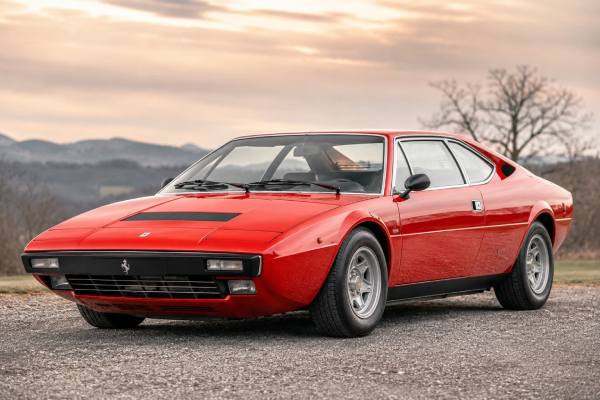
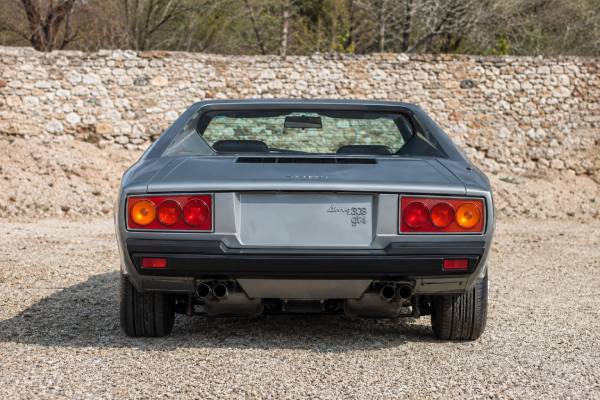
The Ferrari Dino 308 GT4 is the angular 2+2 coupe that introduced Ferrari’s production V8 road-car line. Built from 1973 to 1980, it used a 2926.90 cc transverse mid-mounted V8, a five-speed manual transaxle, and a stretched Dino-derived chassis known as F 106 AL 100. In early European form, the F106 AL engine produced 255 hp, giving the car real period performance while adding small rear seats and a more usable cabin than the earlier Dino 246.
The 308 GT4 matters because it sits at a turning point in Ferrari history. It was a Dino-branded Ferrari, a Bertone design instead of a Pininfarina shape, and a mid-engined V8 layout that later became central to Ferrari road cars. Long overlooked because of its wedge styling and 2+2 packaging, it is now valued for exactly those differences. Buyers search for it because it can still feel mechanical, compact, and usable, but ownership depends heavily on originality, rust condition, belt history, carburetor setup, and the quality of previous restoration work.
Quick Take
The Ferrari Dino 308 GT4’s strongest appeal is its mix of early Ferrari V8 character, Bertone wedge design, and practical 2+2 packaging. It is historically important as Ferrari’s first production V8 road car and one of the most distinctive cars to wear the Dino name, but it is not a cheap classic to revive. The best buys are complete, documented cars with sound bodies, correct trim, known engine and gearbox numbers, and evidence of specialist maintenance; neglected examples can cost more to correct than the price difference to a better car.
Table of Contents
- History, Context and Collectability
- Engine, Chassis and Key Specifications
- Production Changes, Variants and Options
- Bertone Design and Engineering Details
- Performance and Road Character
- Reliability, Maintenance and Restoration Risk
- Values, Buying Advice and Rivals
History, Context and Collectability
The Dino 308 GT4 is important because it changed Ferrari’s road-car formula. It brought the company’s first production V8 to a mid-engined 2+2 coupe, creating a path followed by the later 308 GTB/GTS, 328, Mondial, 348, F355 and beyond.
Ferrari launched the car at the Paris Motor Show in 1973, during a period when European sports-car makers were trying to make compact exotic cars more usable. The earlier Dino 246 GT and GTS had proved that a smaller mid-engined Ferrari-built car could succeed without a front-mounted V12. The 308 GT4 took that idea further: more displacement, more power, and a longer wheelbase for occasional rear seats.
The Dino name is central to the car’s identity. Ferrari used Dino branding for smaller non-V12 models in memory of Alfredo “Dino” Ferrari, Enzo Ferrari’s son. Early 308 GT4s therefore left the factory as Dino models, not as badge-forward Ferraris. That hurt sales in some markets, especially when buyers expected a Prancing Horse badge on a car of this price. In 1976, Ferrari badging became more prominent, although the Dino identity remained part of the model’s story.
The car also broke Ferrari styling tradition. Most postwar production Ferraris were associated with Pininfarina, but the 308 GT4 was designed by Marcello Gandini at Bertone. Gandini was already connected with some of the most radical wedge-shaped cars of the era, and the 308 GT4 reflects that language: a low nose, crisp surfaces, sharp creases, flying buttresses, pop-up headlights, and a compact cabin set into a mid-engine body.
Its reputation has changed over time. For years, the GT4 was seen as the awkward member of the 308 family: less glamorous than the 308 GTB, less famous than the 308 GTS, and less classically beautiful than the Dino 246. That view has softened. Collectors now recognize the GT4 as a historically important Ferrari, the only Bertone-designed production Ferrari, and a more usable classic than many two-seat exotics.
For collectors, the key appeal is not only rarity. It is the combination of firsts: first Ferrari production V8 road car, first mid-engined 2+2 Ferrari, a Dino-to-Ferrari transition model, and a Gandini design. That gives the car a layered identity. A good GT4 can interest Ferrari historians, design collectors, early V8 enthusiasts, and buyers who want a classic Ferrari that can be driven rather than displayed only at concours events.
Engine, Chassis and Key Specifications
The 308 GT4 uses a transverse, mid-mounted 2.9-litre V8 paired with a five-speed manual transaxle. The layout is compact, mechanical, and central to the way the car feels: the engine sits behind the cabin, the gearbox is mounted in unit with it, and the rear wheels do the driving.
European early cars are the reference point for the 255 hp figure. Later emissions-controlled cars, especially U.S.-market examples, can have lower output and additional weight. That matters when comparing performance claims, because a light European early car and a Federalized late car do not feel identical.
| Item | Specification |
|---|---|
| Model | Dino 308 GT4 / Ferrari 308 GT4 |
| Production period | 1973–1980 |
| Chassis type | F 106 AL 100 tubular steel structure |
| Engine type | F106 AL 90-degree V8, transverse rear-mid mounted |
| Displacement | 2926.90 cc |
| Bore x stroke | 81 mm x 71 mm |
| Induction | Four Weber 40 DCNF carburetors |
| Valve gear | Dual overhead camshafts per bank, two valves per cylinder |
| Maximum power | 255 hp at 7700 rpm, early European specification |
| Peak torque | About 284 Nm / 209 lb-ft at 5000 rpm |
| Transmission | Five-speed manual transaxle, rear-wheel drive |
| Suspension | Independent wishbones, coil springs, telescopic dampers, anti-roll bars |
| Brakes | Ventilated discs front and rear |
| Wheelbase | 2550 mm |
| Length | 4300 mm, European body; longer on U.S. bumper cars |
| Width | 1800 mm |
| Height | About 1180 mm |
| Dry weight | About 1150 kg quoted for early specification |
| Fuel capacity | About 80 litres |
| Top speed | About 250 km/h / 155 mph, early European specification |
The V8 is all-alloy and belt-driven, with a wet-sump lubrication system. It is not a lazy engine. It makes its best power high in the rev range and rewards correct warm-up, clean carburetor tuning, and a healthy ignition system. The four Weber carburetors give the car much of its sound and throttle character, but they also make setup quality very important.
The chassis is a tubular steel structure related in concept to the earlier Dino 246 but stretched for the 2+2 cabin. The 2550 mm wheelbase gives the GT4 a more settled road feel than the shorter two-seat Dino, while still keeping the car compact by modern standards. Suspension is independent at all four corners, with wishbones and coil springs. This was sophisticated for the time and helps explain why the GT4 has a reputation for real handling quality rather than simply straight-line speed.
Period performance figures vary because of market specification, test method, emissions equipment, gearing, and car condition. A strong early European car is generally quoted around 6.6 to 7.0 seconds for 0–100 km/h, with a top speed near 250 km/h. A U.S.-market car with emissions equipment and larger bumpers will usually feel softer and heavier, though still lively when properly tuned.
Production Changes, Variants and Options
The 308 GT4 was not a single unchanging model. Badging, wheels, trim, bumpers, ignition equipment, emissions systems, and market specifications changed during production, so identification matters when judging authenticity and value.
Total 308 GT4 production is generally given as 2,826 cars. The related 208 GT4, built mainly for the Italian market with a smaller 2.0-litre V8 to avoid tax penalties, is a separate variant and should not be confused with the 2.9-litre 308 covered here.
| Period or version | What matters |
|---|---|
| Early Dino-badged cars | Most strongly tied to the original Dino identity; often preferred by collectors who like early details and cleaner European specification. |
| 1976 Ferrari-badged transition | Ferrari emblems became more visible, creating cars with mixed Dino and Ferrari identity depending on market and build period. |
| U.S.-market cars | Federal bumpers, emissions equipment, side markers, and lower power make them visually and mechanically different from early European cars. |
| Late production cars | Often better equipped but may have lower output in some specifications because of emissions and ignition changes. |
| 208 GT4 | Italian-market 2.0-litre sister model; interesting but outside the 2.9-litre 255 hp specification. |
Originality can be complicated. Some cars were rebadged during their lives, and some owners later added Ferrari badges to earlier Dino cars. Others were restored with later-style wheels, non-original paint schemes, or updated interiors. That does not always ruin a car as a driver, but it affects value, judging, and historical accuracy.
Factory and period options included leather upholstery, air conditioning, electric windows, metallic paint, tinted glass, a heated rear window, wider alloy wheels, and the Boxer-style two-tone lower body treatment. Air conditioning is desirable for use, especially in warm climates, but it adds inspection points. Old hoses, weak compressors, missing parts, and poorly converted systems are common on cars that spent years in casual ownership.
The wheels are another useful identifier. Early cars often had Cromodora alloy wheels with covered hubs, while later cars could be fitted with more familiar five-spoke Campagnolo-style wheels. Many cars have had wheel changes, so buyers should confirm what is correct for the specific chassis, market, and build period.
Documentation is a major value factor. A strong file may include old registration records, service invoices, specialist notes, restoration photographs, engine and gearbox number records, previous ownership history, and Ferrari Classiche or other marque-expert documentation where applicable. The chassis number is usually found on the steering-column plaque and stamped on the frame in the engine bay. Engine and transmission numbers should be checked by someone who knows the model, because access can be awkward and incorrect assumptions are easy.
Matching-numbers status matters more now than it did when the cars were inexpensive. In the past, owners often repaired these cars pragmatically. Today, collectors care about whether the original engine, gearbox, body panels, trim, color, and market specification remain with the car. A non-original engine may not make a GT4 undriveable, but it changes the collector equation.
Bertone Design and Engineering Details
The GT4’s design is distinctive because it solves a difficult problem: fitting a mid-mounted V8, a driver-focused cockpit, and occasional rear seats into a compact exotic body. Bertone answered with a sharp wedge shape that looks very different from the curvier Dino 246 and the later Pininfarina 308 GTB.
Marcello Gandini’s design uses flat planes and clean edges rather than soft curves. The nose is low and broad, with pop-up headlights and a front cooling intake. The cabin is set forward enough to make space for the engine behind it, while the rear buttresses visually link the roofline to the tail. Side intakes feed the engine bay and cooling systems, and the short rear deck keeps the car compact.
The body is mostly steel, with lighter panels used in selected areas such as the front lid and engine cover on many cars. That matters for restoration. A GT4 is not a simple fiberglass exotic, and corrosion can hide in the steel structure and body seams. Paint quality, panel gaps, and evidence of older accident repair should be inspected carefully.
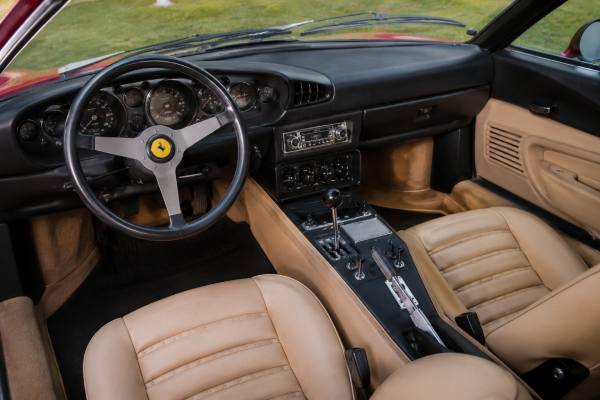
The cockpit is more practical than the shape suggests. The front seats are usable for real driving, visibility is good for a mid-engined classic, and the rear seats can carry children, small adults for short trips, or luggage. Many owners treat the rear compartment as a trimmed luggage area, which may be the most realistic use. Compared with a two-seat 308, the GT4 feels more airy and useful, though still very much a low 1970s Italian sports car.
The dashboard is functional rather than ornate. Large main instruments sit ahead of the driver, with additional gauges for oil pressure, oil temperature, coolant temperature, fuel and other essentials. The open-gate shifter is one of the car’s great tactile features. It is also a useful condition indicator: a vague shift, graunching synchros, or awkward selection after warm-up can point to clutch adjustment issues, worn linkage, tired gearbox components, or simply cold oil if judged too soon.
The engine packaging is compact. The V8 is mounted transversely, which helps keep the wheelbase reasonable while leaving space for the rear seats. This layout also means that belt service, carburetor access, ignition work, fuel hoses, and cooling-system checks require familiarity. The engine bay is not impossible to work in, but it rewards a specialist who knows what can be done in situ and what is better handled during a larger service.
The sound is a major part of the GT4’s identity. It does not have the shriek of a later five-valve Ferrari or the heavy roar of a V12. Instead, a healthy carbureted GT4 has a crisp mechanical intake sound, a busy valvetrain note, and a rising V8 exhaust tone that becomes more urgent above the midrange. Carburetor balance, ignition health, exhaust condition, and airbox originality all affect how the car feels and sounds.
Performance and Road Character
A good 308 GT4 feels lighter, sharper, and more usable than its long-overlooked reputation suggests. It is not a modern supercar, but it is a quick, balanced, high-revving classic with direct steering, strong visibility, and enough compliance for real roads.
The engine likes revs. Below the midrange it is tractable, but the car comes alive when the Webers are cleanly set and the V8 is allowed to pull toward the upper end of the tachometer. Throttle response should be crisp rather than woolly. Hesitation, popping, fuel smell, or uneven idle often points to carburetor imbalance, tired ignition components, vacuum leaks, stale fuel issues, or worn linkages.
The gearbox is part of the ritual. First gear is typically in a dog-leg position, with the main driving gears falling naturally once the car is moving. Like many period Ferraris, the shift can be stiff when cold. A patient driver lets the oil warm before rushing second gear. Once warm and correctly adjusted, the gate should feel precise and mechanical rather than obstructive.
Steering is unassisted and full of information. Parking speeds require effort, but the car lightens once moving. On a flowing road, the longer wheelbase gives the GT4 a stable, progressive feel. It is less nervous than some shorter mid-engined cars and more forgiving than its angular body might suggest. The balance is one of the car’s best traits.
Ride quality is another pleasant surprise. The GT4 was intended as a more practical Ferrari, not a stripped track special. On correct wheels, good bushings, quality dampers, and suitable tyres, it can cover distance without beating up the driver. Modern tyres must be chosen carefully. Too much grip, the wrong sidewall, or incorrect sizing can make the steering heavier and reduce the period delicacy.
The brakes are ventilated discs all round and are effective when properly rebuilt. They will not feel like modern carbon-ceramics, and they depend on good pads, fresh fluid, sound hoses, and healthy calipers. A long pedal, pulling, vibration, or sticking brakes should not be dismissed as “old car character.” These cars often sit, and sitting is hard on hydraulic systems.
Cabin heat, fuel smell, ventilation weakness, and noise are part of the classic experience, but extremes suggest faults. A sorted GT4 should not cook its occupants in normal conditions, leak fumes into the cabin, or overheat in ordinary traffic. Cooling systems, radiator condition, fans, thermostat operation, and correct bleeding are central to usability.
Compared with its rivals, the GT4 sits between sports car and junior exotic. It is more exotic than a period Porsche 911, more usable than many low-volume Italian mid-engined cars, and less glamorous than a Berlinetta Boxer or a Daytona. That middle ground is exactly why many owners enjoy it. It offers the sensations of a classic Ferrari without demanding the same space, budget, or nerve as the larger twelve-cylinder cars.
Reliability, Maintenance and Restoration Risk
A 308 GT4 can be reliable when it is used, serviced, and kept ahead of age-related deterioration. The danger is not a fundamentally fragile design; it is decades of deferred maintenance, corrosion, incorrect repairs, and owners treating an exotic Ferrari like a cheap old sports car.
The timing belts are the headline maintenance item. The V8 uses belt-driven camshafts, so belt age, tensioner condition, service date, and service quality matter. A seller saying “belts were done” is not enough. Ask who did the work, when it was done, whether tensioners and seals were addressed, and whether there are invoices and photographs.
Carburetors need proper setup. Worn throttle shafts, blocked jets, incorrect float levels, old fuel lines, weak ignition, and poorly synchronized Webers can make the car run badly. Many drivability complaints come from setup rather than design. A specialist with carbureted Ferrari experience can transform a car that feels flat, smoky, or difficult.
The cooling system deserves close inspection. Look for radiator condition, fan operation, coolant leaks, old hoses, corrosion, water pump issues, and signs of repeated overheating. A mid-engined car with long coolant runs needs proper bleeding and careful hose maintenance. Overheating can lead to expensive engine work, so temperature behavior during a test drive matters.
Rust is one of the biggest restoration risks. Check the lower body, wheel arches, sills, door bottoms, front and rear valances, floor areas, suspension pickup zones, engine-bay structure, battery area, and seams around repaired panels. Poor previous bodywork can hide under shiny paint. Because values were once low, many GT4s received budget repairs that now require expensive correction.
Electrical issues are common in aging Italian classics. Slow windows, weak lighting, poor grounds, tired fuse boxes, non-working fans, aftermarket alarm wiring, and old connectors are all normal inspection areas. The goal is not to find a perfect electrical system; it is to avoid a car with hacked wiring and multiple hidden faults.
Interior restoration can be surprisingly costly. Correct seat trim, dashboard materials, switchgear, instruments, carpets, steering wheel, badges, and small Bertone-specific details are not always easy to find. A complete, worn original interior may be more attractive than a retrimmed cabin using incorrect patterns and materials.
Key inspection priorities include:
- Timing-belt date, tensioner condition, and invoice quality.
- Cold start, hot restart, idle quality, and carburetor balance.
- Oil pressure when hot, coolant temperature stability, and fan operation.
- Gear selection when cold and warm, especially second gear behavior.
- Evidence of rust, filler, accident repair, and poor panel alignment.
- Brake caliper condition, hose age, pedal feel, and fluid history.
- Suspension bushings, dampers, steering rack mounts, and tyre age.
- Correct badges, wheels, lights, bumpers, interior trim, and market equipment.
- Chassis, engine, gearbox, and body-number documentation.
Restoration should be approached carefully. A full engine rebuild, gearbox work, rust repair, correct repaint, interior restoration, and missing-parts hunt can exceed the value of an average car. Sensible upgrades can improve drivability, such as better cooling fans, modern fuel hoses, electronic ignition improvements, or discreet brake and suspension refreshes. But irreversible modifications usually hurt collector value unless the car is already a modified driver.
The best ownership pattern is regular use plus planned maintenance. Cars that sit for years often need fuel-system cleaning, brake hydraulic work, tyres, belts, hoses, battery, cooling-system attention, and carburetor service before they can be trusted. A freshly recommissioned car should still be treated cautiously until it has completed enough miles to reveal leaks, heat issues, and electrical faults.
Values, Buying Advice and Rivals
The 308 GT4 is no longer the bargain Ferrari it once was, but it still tends to sit below the most desired two-seat 308 GTB/GTS and far below the Dino 246. Current market data in 2026 shows ordinary usable cars often trading around the lower-to-mid five-figure dollar range, while exceptional, rare, freshly restored, or unusually original examples can ask much more.
Market spread is wide because condition spread is wide. One GT4 may be a driver with older paint, non-original details, and a thick service file. Another may be a concours-level early Dino-badged car in a desirable color with documented numbers and correct trim. A third may be a shiny project hiding rust, weak compression, old belts, and missing original parts.
Value is driven by:
- Originality: correct engine, gearbox, body panels, trim, wheels, badges, and market specification.
- Condition: rust-free structure, good paint, healthy drivetrain, clean interior, and sorted electrics.
- Documentation: invoices, ownership history, old photographs, manuals, tools, and specialist records.
- Specification: early European cars, Dino badging, appealing colors, and correct period details can help desirability.
- Restoration quality: a well-documented restoration is valuable; a cosmetic repaint over problems is a risk.
- Usability: cooling, brakes, tyres, carburetors, and air conditioning can make a major difference to real ownership.
A pre-purchase inspection is essential. It should be done by a Ferrari specialist who knows carbureted 308-family cars and understands the GT4’s body, chassis, trim, and identification details. A general classic-car inspection is not enough. The buyer needs compression or leak-down data when appropriate, underside inspection, rust assessment, number checks, service-history review, and a proper road test.
| Seek | Avoid or price carefully |
|---|---|
| Complete cars with long specialist service history | Freshly painted cars with little mechanical documentation |
| Known belt service, cooling work, and brake overhaul | Cars that overheat, smell strongly of fuel, or run unevenly |
| Sound original structure with clear rust inspection | Rust in sills, floors, arches, suspension areas, or repaired crash zones |
| Correct wheels, badges, trim, manuals, and tools where available | Missing model-specific parts that are expensive or hard to source |
| Honest driver-quality cars priced as drivers | Projects priced like finished cars because they wear Ferrari badges |
The closest Ferrari alternatives are the 308 GTB and GTS, the later Mondial 8 and Mondial QV, and, at a much higher price level, the Dino 246. The 308 GTB/GTS has the stronger image and two-seat shape. The Mondial offers more space and later development but usually lacks the early Dino-era charm. The Dino 246 is prettier and more collectible, but it is now in a very different price world.
Period rivals include the Lamborghini Urraco, Maserati Merak, Porsche 911, and Porsche 911 Turbo. The Urraco is conceptually close as an Italian mid-engined 2+2, but parts and support can be more challenging. The Merak offers a V6 and elegant Giugiaro styling with a different ownership profile. A Porsche 911 is easier to use and support, but it does not provide the same mid-engined Ferrari experience. The 911 Turbo is faster and more famous, but it has its own cost and driving demands.
Long-term collectability looks positive for the best cars. The GT4 has strong historical anchors, limited production, a major designer, and a growing appreciation among younger collectors who like wedge-era design. It is unlikely to become a cheap classic again. That said, values are condition-sensitive. A poor car will not automatically rise enough to cover restoration mistakes.
The right GT4 is bought with patience. Pay more for a documented, complete, structurally sound, mechanically sorted example. Be cautious with cars that look inexpensive but need belts, tyres, brakes, carburetors, rust repair, interior parts, and electrical sorting. The cheapest 308 GT4 can become the most expensive one very quickly.
References
- Ferrari Dino 308 GT4 (1973) 2026
- Ferrari Dino 308 GT4 Guide — Supercar Nostalgia 2019
- Resources – Dino 308 GT4 2026 (Manuals and Technical Documents)
- Chassis – Dino 308 GT4 2026 (Identification Reference)
- Ferrari Dino 308 GT4 Market – CLASSIC.COM 2026 (Market Data)
Disclaimer
This article is for informational purposes only and is not a substitute for professional diagnosis, repair, appraisal, or restoration advice. Specifications, torque values, service intervals, parts, procedures, and identification details can vary by VIN, market, build date, equipment, and previous repairs. Always verify important information against official Ferrari service documentation and consult a qualified Ferrari specialist before buying, servicing, or restoring a Dino 308 GT4.
If this guide helped you, please share it on Facebook, X/Twitter, or your preferred enthusiast community to support our work.