

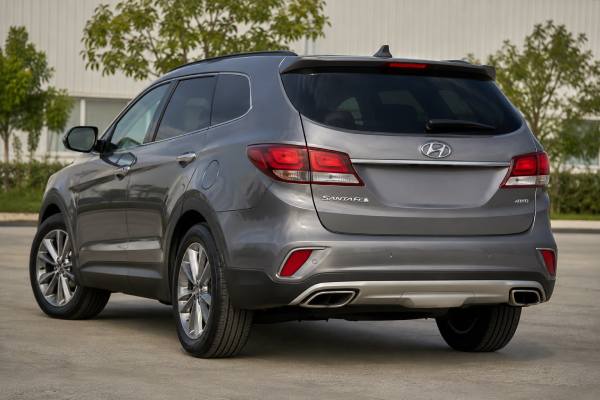

The facelifted Hyundai Grand Santa Fe NC with the 2.2 CRDi diesel is the long-wheelbase, seven-seat version of Hyundai’s third-generation Santa Fe family. In European and many export markets, it filled the space between a conventional midsize SUV and a larger family crossover: more cabin length, a usable third row, a torquey diesel engine, automatic transmission, and 4WD traction without moving into premium-brand running costs.
As a used buy, its appeal is easy to understand. The 200 hp D4HB diesel gives strong low-rpm pull, the cabin is practical for families, and the standard equipment level is usually generous. The important checks are less glamorous: service history, DPF use pattern, automatic-transmission fluid history, AWD driveline condition, corrosion, and whether market-specific recalls or service actions have been completed.
Quick Specs and Notes
- Strong 440 Nm diesel torque makes the Grand Santa Fe relaxed with passengers, luggage, and light towing.
- The long 2,800 mm wheelbase gives better third-row and cargo usefulness than the regular Santa Fe.
- 4WD traction is helpful in rain, snow, gravel, and towing, but it adds transfer-case and rear-differential service needs.
- Short-trip city use can accelerate DPF, EGR, battery, and oil-dilution issues on the 2.2 CRDi.
- A practical ownership interval is engine oil every 15,000 km or 12 months, shortened to about 10,000 km in severe use.
Table of Contents
- Grand Santa Fe NC Buyer Context
- Grand Santa Fe NC Core Specs
- Grand Santa Fe NC Trims Safety
- Reliability Issues and Service Actions
- Maintenance Schedule and Buying Checks
- Driving Performance and Efficiency
- Rival Comparisons and Final Fit
Grand Santa Fe NC Buyer Context
The Hyundai Grand Santa Fe NC is best understood as the stretched, more family-focused version of the Santa Fe sold during the third-generation model cycle. The facelifted 2016–2018 version sharpened the front and rear styling, updated equipment, and paired well with the revised 2.2 CRDi diesel rated at 200 hp. In most markets covered by this specification, the diesel came with a 6-speed torque-converter automatic and 4WD, with seven seats either standard or very common depending on trim.
The engine is Hyundai’s R-series 2.2-litre diesel, usually identified by the D4HB code. It is an inline-four, common-rail, turbocharged diesel with a timing chain, a diesel particulate filter, and Euro 6 emissions equipment in many European-market versions. The headline figures are not sporty by modern performance-SUV standards, but they suit the vehicle well: 200 hp at 3,800 rpm and 440 Nm from roughly 1,750 to 2,750 rpm. That torque band is the reason the Grand Santa Fe feels easier than its size suggests in everyday use.
Compared with the regular Santa Fe, the Grand Santa Fe’s extra length mainly benefits the third row and luggage area. It is still not a full-size body-on-frame SUV, and the rearmost seats remain best for children, shorter adults, or occasional use. But it is more convincing as a seven-seat family car than many compact “5+2” SUVs. With the third row folded, the boot is genuinely useful, and with the second row folded it becomes a large cargo hauler.
The 4WD system is road-biased. It is designed for traction and stability rather than heavy off-road work. On wet motorways, snow-covered rural roads, gravel tracks, and slippery boat ramps, it is a real advantage. For rutted trails, deep mud, or repeated steep climbs, the Grand Santa Fe is limited by clearance, tyres, underbody exposure, and the thermal limits of a clutch-based AWD system.
The main used-buying attraction is value. The Grand Santa Fe often offers more space and equipment than German premium SUVs at the same price, while avoiding the complexity of air suspension, large six-cylinder diesels, or expensive performance drivetrains. The trade-off is that many examples are now old enough to need serious maintenance beyond ordinary oil changes. A cheap car with no transmission-fluid history, tired suspension, sticking rear brakes, DPF warning lights, or mismatched tyres can quickly become less appealing.
The best examples are privately or dealer-sold cars with consistent annual servicing, clean MOT or inspection history, no long-standing warning lights, matching tyres, and evidence that fluids beyond engine oil have been changed. For buyers who need seven seats, diesel range, 4WD security, and sensible ownership costs, a well-kept Grand Santa Fe 2.2 CRDi remains a practical choice. It is not the sharpest SUV in its class, but it is comfortable, spacious, and strong where family use matters most.
Grand Santa Fe NC Core Specs
Specifications vary by market, trim, emissions package, wheel size, and whether the car is listed as Grand Santa Fe, Santa Fe Grand, or Santa Fe XL in that region. The figures below reflect the facelifted 2016–2018 long-wheelbase NC diesel 4WD automatic specification most commonly associated with the 200 hp 2.2 CRDi.
| Item | Hyundai Grand Santa Fe 2.2 CRDi 4WD automatic |
|---|---|
| Engine code | R II / D4HB |
| Engine layout | Front transverse inline-four diesel, DOHC, 4 valves per cylinder |
| Bore × stroke | 85.4 × 96.0 mm (3.36 × 3.78 in) |
| Displacement | 2.2 L (2,199 cc) |
| Induction | Turbocharged and intercooled |
| Fuel system | Common-rail direct injection |
| Compression ratio | Approximately 16.0:1, market dependent |
| Maximum power | 200 hp (147 kW / 200 PS) @ 3,800 rpm |
| Maximum torque | 440 Nm (325 lb-ft) @ 1,750–2,750 rpm |
| Timing drive | Chain |
| Official combined efficiency | About 7.0 L/100 km (33.6 mpg US / 40.4 mpg UK), NEDC-style rating for many listings |
| Real-world highway at 120 km/h | Typically about 8.0–9.2 L/100 km (25.6–29.4 mpg US / 30.7–35.3 mpg UK), depending on tyres, load, weather, and terrain |
| Item | Specification |
|---|---|
| Transmission | 6-speed torque-converter automatic, Hyundai/Kia A6LF-series; high-torque diesel applications commonly use A6LF3, verify by VIN |
| Drive type | 4WD/AWD with electronically controlled rear torque coupling |
| Differentials | Open differentials with brake-based traction control; no mechanical locker |
| Front suspension | MacPherson struts, coil springs, anti-roll bar |
| Rear suspension | Independent multi-link, coil springs, anti-roll bar |
| Steering | Electric power-assisted rack and pinion; ratio varies by market, around 14–15:1 in common Santa Fe applications |
| Brakes | Front ventilated discs about 321 mm (12.6 in); rear solid discs about 302 mm (11.9 in), verify by brake code |
| Popular tyre sizes | 235/60 R18 or 235/55 R19 |
| Ground clearance | About 180 mm (7.1 in) |
| Length / width / height | 4,905 / 1,885 / 1,695 mm (193.1 / 74.2 / 66.7 in) |
| Wheelbase | 2,800 mm (110.2 in) |
| Turning circle | About 11.2 m (36.7 ft), kerb-to-kerb |
| Kerb weight | Approximately 1,920–2,057 kg (4,233–4,535 lb), trim dependent |
| GVWR | Approximately 2,630 kg (5,798 lb) |
| Fuel tank | 71 L (18.8 US gal / 15.6 UK gal) |
| Cargo volume | About 634–1,842 L (22.4–65.1 ft³), published method varies; figures normally refer to seats folded configurations rather than all seats occupied |
| Item | Figure |
|---|---|
| 0–100 km/h | About 9.9 seconds |
| Top speed | About 201 km/h (125 mph) |
| 100–0 km/h braking distance | Typically high-30s to low-40s metres when tested on good tyres; not a fixed factory figure |
| Braked towing capacity | Up to 2,000 kg (4,409 lb), market and tow-pack dependent |
| Unbraked towing capacity | 750 kg (1,653 lb) |
| Towball download | About 100 kg (220 lb), where specified |
| Payload | Approximately 573–710 kg (1,263–1,565 lb), depending on kerb weight and equipment |
| System | Specification and capacity |
|---|---|
| Engine oil | 5W-30 low-SAPS diesel oil, commonly ACEA C3/C2 depending on market; about 6.3 L (6.7 US qt) with filter |
| Coolant | Ethylene-glycol long-life coolant suitable for aluminium engines; about 9.1 L (9.6 US qt), usually 50:50 premix |
| Automatic transmission | Hyundai/Kia SP-IV type ATF; full dry quantity around 7.7 L (8.1 US qt), service exchange amount is lower |
| Transfer case and rear differential | Hypoid gear oil, commonly 75W-90 GL-5 type; exact capacity depends on housing code, fill to level plug |
| Brake fluid | DOT 4; replace by time and moisture content, commonly every 2 years |
| A/C refrigerant | R-134a on most 2016-era vehicles; charge amount varies by market label, verify under-bonnet sticker |
| A/C compressor oil | PAG oil matched to compressor and refrigerant type; service by label and workshop procedure |
| Fastener | Typical value |
|---|---|
| Wheel nuts | 107–127 Nm (79–94 lb-ft) |
| Engine oil drain plug | Approximately 35–45 Nm (26–33 lb-ft), verify by sump and plug type |
| Brake caliper carrier bolts | Workshop-manual value required by brake code; do not rely on generic values |
| Transfer/differential plugs | Workshop-manual value required; replace sealing washers where specified |
| Area | Typical availability |
|---|---|
| Euro NCAP | The related third-generation Santa Fe was a five-star vehicle in 2012; applicability to Grand Santa Fe long-wheelbase versions should be checked by market and VIN |
| IIHS | No direct IIHS result for the European Grand Santa Fe 2.2 CRDi; US Santa Fe/Santa Fe XL data is not a perfect substitute |
| Core safety | Multiple airbags, ESC, ABS, traction control, hill-start assist, downhill brake control on many trims |
| ADAS | Blind-spot monitoring, lane support, adaptive cruise, parking assist, AEB, and rear cross-traffic alert may be fitted depending on trim and market |
Grand Santa Fe NC Trims Safety
Trim naming differs sharply by country. A Grand Santa Fe sold in Germany, the UK, Ireland, Eastern Europe, the Middle East, or Australia may carry different grade names even when the hardware is similar. Common equipment themes include leather upholstery on higher trims, seven-seat interiors, dual-zone or multi-zone climate control, heated front seats, navigation, reversing camera, larger alloy wheels, xenon or HID headlights on some versions, panoramic sunroof on upper grades, and upgraded audio systems.
Mechanical variation is usually smaller than the trim lists suggest. For the facelifted 2.2 CRDi 200 hp 4WD automatic, the key mechanical items are normally shared: D4HB engine, 6-speed automatic, road-biased 4WD, independent suspension, and four-wheel disc brakes. Differences to watch are wheel size, tyre brand and load rating, whether a factory tow package is fitted, lighting type, and the driver-assistance package.
A practical trim check should focus less on badge names and more on what the individual car has. Look for:
- 18-inch wheels if ride comfort and tyre cost matter most.
- 19-inch wheels if appearance and sharper response matter more, accepting firmer ride and costlier tyres.
- Factory navigation and camera operation, because replacement screens and camera wiring faults can be expensive.
- Heated rear seats, ventilation, panoramic roof, electric tailgate, and premium audio only if they work correctly.
- Towbar installation quality, including proper dedicated electrics rather than crude spliced wiring.
- Matching tyre sizes and similar tread depth on all four wheels, which is especially important for AWD driveline health.
Quick identifiers include the 2.2 CRDi badge, 4WD or AWD badging where fitted, seven-seat cabin layout, longer rear overhang than the regular Santa Fe, and the 2016 facelift front-end design. VIN decoding is the better route for confirming engine, market, emissions equipment, transmission, build date, and safety package.
Safety equipment is solid for the period, but the exact ADAS suite is trim-sensitive. Basic passive safety should include front, side, and curtain airbags, front seatbelt pretensioners, ISOFIX child-seat mountings, anti-lock braking, electronic stability control, and traction control. Higher-trim or market-specific cars may add blind-spot detection, rear cross-traffic alert, lane departure warning or lane keeping, adaptive cruise control, forward collision warning, AEB, and more advanced parking support.
The biggest safety-rating caveat is model applicability. The regular third-generation Santa Fe performed strongly in Euro NCAP testing earlier in the model cycle and was recognised as a highly rated large off-road 4×4. However, the Grand Santa Fe long-wheelbase diesel should not automatically be treated as separately tested unless the relevant rating body explicitly lists that body style and market. This matters because crash ratings are tied to body structure, equipment, test date, and safety-pack availability.
ADAS calibration is another ownership point. If the windscreen is replaced, front bumper removed, radar disturbed, wheel alignment changed, or suspension height altered, camera and radar systems may need calibration. A car that tracks straight but shows lane-support errors, adaptive-cruise faults, or front-sensor warnings may not simply need a reset. It may need proper diagnostic calibration after repair.
For family buyers, check all seatbelts, ISOFIX points, third-row access mechanisms, child-locks, rear HVAC vents, and airbag warning lights. The third row should fold and latch cleanly, and the second row should slide without sticking. A seven-seat SUV is only useful if the seating hardware has not been damaged by years of child seats, cargo, and hurried school-run use.
Reliability Issues and Service Actions
The Grand Santa Fe 2.2 CRDi is generally durable when serviced properly, but it is not a neglect-tolerant diesel. Most serious problems trace back to long oil intervals under severe use, repeated short journeys, ignored warning lights, poor-quality fuel, clogged emissions hardware, transmission-fluid neglect, or AWD fluid never being changed.
| System | Prevalence | Typical symptoms | Likely remedy | Cost tier |
|---|---|---|---|---|
| DPF and EGR system | Common on short-trip diesels | DPF warning, limp mode, poor economy, frequent regeneration | Diagnostic check, forced regeneration only when safe, EGR cleaning/replacement, fix root cause | Medium to high |
| Turbo and boost hoses | Occasional | Whistling, underboost codes, smoke, weak acceleration | Inspect intercooler hoses, clamps, actuator, vacuum/boost control; replace failed parts | Medium |
| Injectors and fuel system | Occasional | Hard starting, rough idle, diesel knock, fuel smell, rail-pressure faults | Leak-off test, fuel-filter service, injector coding or replacement | Medium to high |
| Timing chain system | Rare to occasional at high mileage | Cold-start rattle, correlation faults, metallic chain noise | Inspect chain stretch, guides, and tensioner; replace when out of spec | High |
| Automatic transmission | Occasional with poor service history | Harsh shifts, flare, delayed engagement, shudder | Fluid service with correct ATF, adaptations, TCU update, valve-body diagnosis | Medium to high |
| AWD transfer/rear driveline | Occasional | Binding, whining, clunks, rear coupling faults | Check tyre match, fluid condition, prop shaft, rear differential, AWD coupling | Medium to high |
| Suspension and wheel bearings | Common with age | Knocks, humming, uneven tyre wear, vague steering | Replace bushes, links, bearings, align after repairs | Low to medium |
| Brake corrosion and parking brake | Common in wet/salty climates | Rear brake drag, pulsing, weak parking brake, seized sliders | Clean/lubricate slides, replace discs/pads, service parking brake hardware | Low to medium |
The D4HB engine itself has a strong reputation when maintained with correct oil and clean filters. It does not use a timing belt, so there is no belt replacement interval, but the chain should not be ignored forever. Listen for rattling on cold start and check for cam/crank correlation faults. A quiet engine with clean oil history is far more reassuring than one with cosmetic detailing and missing invoices.
Diesel emissions equipment is the main weak point in urban use. A Grand Santa Fe that has spent years on short school runs may never complete passive DPF regeneration properly. Symptoms can include high idle, hot smell after shutdown, rising oil level, engine-management lights, or repeated requests for regeneration. Replacing a DPF without fixing thermostat, injector, EGR, boost, or driving-pattern issues is rarely a lasting repair.
The automatic transmission is smoother than a dual-clutch unit and better suited to towing, but it benefits from fluid changes even if some markets describe the fluid as long-life. Dark, burnt-smelling ATF, harsh engagement from Park to Drive, or flared upshifts are warning signs. A gentle fluid exchange with the correct SP-IV type fluid is preferable to aggressive flushing on an unknown, high-mileage unit.
Software and calibration work can matter. Engine, transmission, AWD, infotainment, and ADAS modules may have updates for shift quality, warning-light logic, sensor operation, and driveability. A Hyundai dealer or independent specialist with Hyundai-capable diagnostics can confirm whether updates apply. Avoid cars where owners have repeatedly cleared faults without diagnosis.
Recall and service-action history is market-specific. North American Santa Fe/Santa Fe XL campaigns have included ABS module fire-risk actions, hood-latch cable corrosion, and seatbelt reminder wiring concerns in certain years. European and other market cars may have different campaign lists. The only safe method is to check the VIN with the relevant Hyundai importer, dealer system, and official recall database for the car’s country of registration.
Pre-purchase checks should include a cold start, hot restart, full diagnostic scan, motorway drive, low-speed parking manoeuvres, brake inspection, tyre inspection, underbody corrosion check, and proof of engine oil, ATF, coolant, brake fluid, and AWD fluid servicing. For a seven-seat diesel SUV, condition and history matter far more than a low advertised price.
Maintenance Schedule and Buying Checks
A sensible maintenance plan for the Grand Santa Fe 2.2 CRDi should be based on the official schedule for the exact VIN and market, then tightened for age, towing, short trips, mountain use, dusty roads, cold climate, and heavy city driving. Many used examples are now outside warranty, so preventive maintenance is more valuable than minimum compliance.
| Interval | Service items |
|---|---|
| Every 10,000–15,000 km or 12 months | Engine oil and filter; inspect brakes, tyres, lights, wipers, battery, leaks, hoses, belts, and diagnostic faults |
| Every 15,000–30,000 km | Cabin filter; inspect engine air filter, suspension, steering, exhaust, driveshaft boots, prop shaft, brake pads, and rotors |
| Every 30,000 km or 2 years | Replace engine air filter if dirty; inspect fuel filter, fuel lines, parking brake, wheel alignment, and tyre wear pattern |
| Every 2 years | Brake fluid replacement; A/C performance check; corrosion inspection underneath |
| Every 40,000–60,000 km | Fuel filter on diesel models, especially in markets with variable fuel quality; inspect EGR and intake condition if symptoms appear |
| Every 60,000–90,000 km | Automatic transmission fluid service, transfer-case oil, rear differential oil; shorten interval for towing or heat |
| Every 80,000–100,000 km or 5 years | Coolant replacement where specified; inspect thermostat, radiator, water pump, and hoses |
| From 150,000–200,000 km | Listen closely for timing-chain noise; inspect mounts, turbo, injectors, wheel bearings, suspension arms, and AWD coupling |
There are no spark plugs or valve-clearance adjustments to schedule because this is a diesel engine with hydraulic valvetrain arrangements typical of the application. The serpentine belt, tensioner, idlers, and coolant hoses should be inspected regularly and replaced on condition. A fresh-looking belt alone is not enough if the tensioner is noisy or the pulley bearings are rough.
For engine oil, use a diesel-compatible low-SAPS specification suitable for DPF-equipped engines. Many listings specify 5W-30 ACEA C3 or C2/C3-type oil, with about 6.3 L needed with filter. In hot climates, dealer schedules may list different approved grades, so the owner’s manual and local Hyundai guidance matter. Cheap oil that does not meet the emissions-system requirement can shorten DPF life.
The automatic transmission deserves special attention during inspection. During a test drive, it should engage Drive and Reverse smoothly, change without flare, and kick down predictably. Light shift feel changes can sometimes improve with fresh ATF and adaptation reset, but harsh banging, slipping, or metal debris in fluid points to a more expensive problem.
A buyer’s inspection should cover the following:
- Cold-start noise, smoke, and idle stability.
- Oil leaks around the rocker cover, turbo oil lines, sump, and crank seals.
- Coolant level, heater performance, radiator condition, and signs of overheating.
- DPF status, ash load, regeneration history, and any deleted or modified emissions equipment.
- ATF colour and service evidence.
- Transfer case, rear differential, prop shaft, and rear coupling noises.
- Matching tyres with correct load rating and similar tread depth.
- Rear subframe, brake lines, suspension arms, tailgate seams, wheel arches, and underbody corrosion.
- Panoramic roof drains, tailgate motor, parking sensors, cameras, infotainment, seat heaters, and climate-control function.
- Third-row seat latches, second-row slide mechanism, ISOFIX points, and all seatbelts.
Recommended examples are usually late-facelift cars with documented maintenance, moderate motorway use, no engine or ABS warning lights, good tyres, and proof that fluids beyond engine oil were not ignored. Be cautious with cars used heavily for towing unless there is evidence of more frequent ATF, transfer-case, and differential service. Also be cautious with very low-mileage city cars, because diesel emissions systems often prefer regular hot running.
Long-term durability is good when the car is treated as a diesel workhorse rather than a maintenance-free appliance. Budgeting for suspension refresh, brakes, tyres, battery, filters, and fluid services is realistic. Buying the best-maintained example is usually cheaper than buying the lowest-priced one and catching up.
Driving Performance and Efficiency
On the road, the Grand Santa Fe 2.2 CRDi feels relaxed rather than athletic. The engine’s torque arrives early, so the vehicle moves away cleanly without needing high revs. Around town, the automatic transmission masks some turbo lag by letting the engine build torque smoothly. On faster roads, it settles into a quiet cruise, and the 2.2 diesel feels comfortable holding motorway speeds with a full cabin.
The 0–100 km/h time of about 9.9 seconds is adequate for a large seven-seat diesel SUV. The more relevant measure is mid-range response. From 80–120 km/h, the engine has enough pull for overtaking, but the gearbox may need to drop one or two gears if the car is loaded or climbing. Drivers coming from a smaller petrol SUV may notice the diesel’s low-rpm strength; drivers coming from a modern 8-speed diesel SUV may notice the older 6-speed transmission’s wider ratios.
Ride quality is one of the model’s strengths. On 18-inch wheels, the Grand Santa Fe is generally settled and comfortable, with good compliance over coarse roads. On 19-inch wheels, it looks sharper and steers a little more crisply, but pothole impact and tyre roar are more noticeable. The long wheelbase helps straight-line stability, especially on motorways, though it also makes the car feel large in tight urban streets.
Handling is safe and predictable rather than engaging. There is body roll in corners, and the steering is more about ease than feedback. That is not a major flaw for the vehicle’s purpose. It is a family SUV built for long-distance comfort, not a performance crossover. Braking feel is generally confidence-inspiring when the discs, pads, tyres, and fluid are fresh, but worn rear brakes or cheap tyres can make the car feel much older than it is.
Noise, vibration, and harshness are well controlled for a four-cylinder diesel of this era. The engine is audible when cold and under load, but it fades at cruise. Tyre choice has a large effect on cabin noise. Premium touring tyres usually suit the car better than aggressive all-season or budget tyres unless winter traction is the priority.
Real-world fuel economy depends heavily on route type:
- City use: about 9.5–11.5 L/100 km (20.5–24.8 mpg US / 24.6–29.7 mpg UK), sometimes worse in winter or with short trips.
- Mixed driving: about 7.8–9.0 L/100 km (26.1–30.2 mpg US / 31.4–36.2 mpg UK).
- Steady highway at 100–110 km/h: about 7.0–8.0 L/100 km (29.4–33.6 mpg US / 35.3–40.4 mpg UK).
- Highway at 120 km/h with load: about 8.0–9.2 L/100 km (25.6–29.4 mpg US / 30.7–35.3 mpg UK).
Cold weather can increase consumption by 10–20 percent on short trips because the engine warms slowly and the DPF regeneration strategy may run more often. Roof boxes, winter tyres, heavy cargo, and towing can all raise fuel use noticeably. Moderate towing can push consumption into the 11–14 L/100 km range depending on trailer shape, speed, and terrain.
The 4WD system improves traction but is not a substitute for proper tyres. With good winter tyres, the Grand Santa Fe is secure in snow and slush. With worn summer tyres, the AWD system cannot overcome poor grip. The lock mode, where fitted, can help at low speeds on slippery surfaces, but it is not for high-speed dry-road use and does not turn the vehicle into a serious off-roader.
For everyday driving, the Grand Santa Fe’s biggest advantage is effortlessness. It carries people and luggage without drama, feels stable at speed, and has enough performance for long trips. Its weakness is that it hides wear well. A tired suspension, old tyres, sticky brakes, or dirty transmission fluid may not make the car undriveable, but they gradually remove the refinement that makes a good example feel appealing.
Rival Comparisons and Final Fit
The Grand Santa Fe 2.2 CRDi sits among practical seven-seat SUVs rather than luxury off-roaders. Its closest alternatives include the Kia Sorento 2.2 CRDi, Toyota Highlander in markets where available, Mitsubishi Outlander diesel or PHEV, Nissan X-Trail seven-seat versions, Skoda Kodiaq 2.0 TDI, and larger premium used SUVs such as the Volvo XC90, BMW X5, Audi Q7, and Mercedes-Benz GLE.
Compared with the Kia Sorento, the Hyundai feels closely related in concept. Both use strong diesel power, family-friendly cabins, and road-biased AWD. The Sorento may be easier to find in some markets and often has a similarly strong equipment list. The Hyundai Grand Santa Fe’s appeal is its slightly different cabin layout, styling, and availability. Condition should decide more than badge preference.
Against the Skoda Kodiaq 2.0 TDI, the Hyundai has a larger-displacement diesel and a more old-school torque-converter character, while the Kodiaq can feel more modern inside and more efficient depending on gearbox and engine version. The Skoda may be sharper to drive, but the Hyundai counters with strong towing manners and a comfortable, straightforward feel.
Compared with the Nissan X-Trail seven-seater, the Grand Santa Fe is more substantial, stronger when loaded, and better suited to regular motorway use with passengers. The X-Trail can be cheaper to run and easier to park, but its third row is smaller and its powertrains do not always feel as relaxed under load.
The Mitsubishi Outlander PHEV is a different proposition. It is excellent for short electric commutes and urban use, but it is less natural for long diesel-style towing and high-speed motorway economy when the battery is depleted. Buyers with mostly short trips may be better served by the Mitsubishi or another hybrid, because the Hyundai diesel’s DPF system prefers regular hot running.
Premium rivals can be tempting at similar used prices, but they often bring higher risk. A high-mileage X5, Q7, GLE, or XC90 may offer more prestige, more power, or better materials, but air suspension, large tyres, complex infotainment, emissions hardware, and premium labour rates can make ownership far more expensive. The Grand Santa Fe is not as polished, but it is usually more rational.
The Grand Santa Fe NC 2.2 CRDi 4WD is a good fit for buyers who need seven seats, diesel range, a comfortable ride, and 4WD traction without paying premium-SUV repair bills. It is less ideal for mostly short urban journeys, drivers who want sporty handling, or buyers unwilling to maintain the automatic and AWD systems properly.
The best verdict is conditional but positive. Buy a well-documented facelift car, inspect it carefully, service it more thoroughly than the minimum schedule, and it can be a very capable family SUV. Buy a neglected one because it is cheap, and the same car can become a diesel-emissions, transmission, and suspension catch-up project.
References
- Hyundai Grand Santa Fe (NC, facelift 2016) 2.2 CRDI (200 Hp) AWD Automatic 7 Seat | Technical specs, data, fuel consumption, Dimensions 2026 (Technical Data)
- Santa Fe Pressetext 2018 (Manufacturer Publication)
- Hyundai Owners manuals | Hyundai Motor UK 2026 (Owner’s Manual Portal)
- Euro NCAP is Announcing 2012 Top Choices for Safety and Recommended Vehicles in their Class 2013 (Safety Rating)
- Check for Recalls: Vehicle, Car Seat, Tire, Equipment | NHTSA 2026 (Recall Database)
Disclaimer
This article is for informational purposes only and is not a substitute for professional diagnosis, repair, inspection, or official Hyundai service guidance. Specifications, torque values, maintenance intervals, fluids, procedures, safety equipment, and recall applicability can vary by VIN, market, trim, production date, and installed equipment. Always verify critical information against the official owner’s manual, workshop manual, vehicle labels, dealer records, and the relevant recall database for the exact vehicle.
If you found this useful, please consider sharing it on Facebook, X/Twitter, or another platform to help other Hyundai Santa Fe and Grand Santa Fe owners make better-informed decisions.