
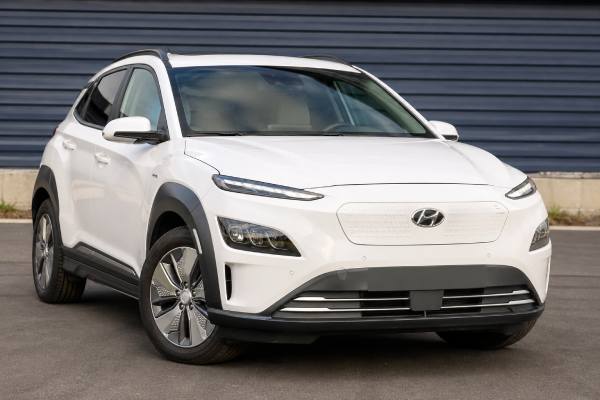
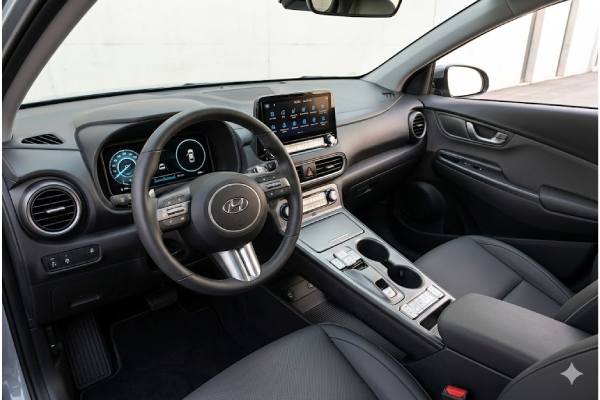
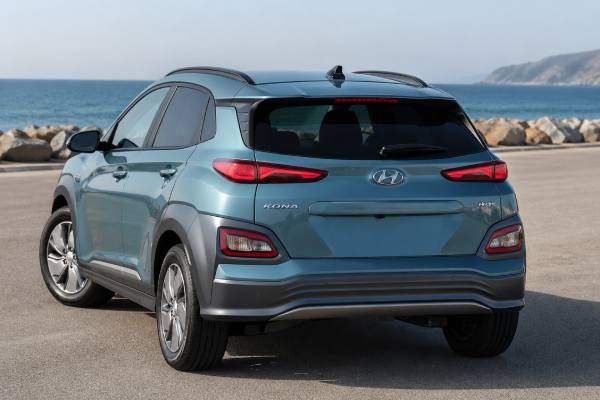
The facelift Hyundai KONA Electric OS EV with the 100-kW motor is the smaller-battery version of Hyundai’s first-generation electric crossover. It is not the fastest KONA Electric, and it is not the long-range 64-kWh model, but it has a clear appeal: useful urban range, strong low-speed response, compact dimensions, sensible running costs, and a simpler front-drive EV layout.
For used buyers, the important questions are not just horsepower and official range. Battery condition, charging speed, heat-pump availability, brake condition, software updates, and service history matter more than they would on a petrol KONA. This version is best understood as an efficient daily EV with enough range for commuting and regional use, rather than a long-distance motorway car.
Quick Overview
- The 100-kW motor gives smooth, immediate response and 395 Nm of torque, making the smaller-battery KONA Electric feel stronger in town than its 134 hp figure suggests.
- WLTP range is around 305 km, while realistic highway range is much lower, especially in cold weather or at 120 km/h.
- The compact size, front-wheel drive layout, 17-inch tyres, and efficient drivetrain make it easy to live with in dense traffic and tight parking.
- Check battery health, charge-port condition, 12 V battery age, brake corrosion, coolant service history, and all open recalls before purchase.
- Typical tyre rotation is every 8,000 km or 5,000 miles, and EV coolant service can be due at 200,000 km or 120 months, then every 40,000 km or 24 months depending on market schedule.
Table of Contents
- Hyundai KONA Electric OS EV Scope
- Hyundai KONA Electric 39 kWh Specs
- Hyundai KONA Electric Trims and Safety
- Reliability and Service Actions
- Maintenance and Used Buying
- Driving Range and Charging
- Rivals and Value Context
Hyundai KONA Electric OS EV Scope
This version covers the facelift first-generation Hyundai KONA Electric, internal code OS EV, sold roughly from 2021 to 2023 with the smaller 39.2-kWh battery and 100-kW permanent-magnet front motor. Output is commonly listed as 136 PS, which equals about 134 hp, with 395 Nm of torque. It is a front-wheel-drive, five-door electric crossover with a single-speed reduction gear and no conventional gearbox.
Market naming varies. In the UK and much of Europe, the small-battery facelift model was often sold as the 39 kWh or 39.2 kWh KONA Electric, usually in SE Connect or Premium-type grades. In some Asia-Pacific markets it sat alongside the 64-kWh version under trim names such as Elite, Highlander, or local equivalents. North America mainly focused on the larger-battery KONA Electric, so a 100-kW facelift OS EV is more commonly a European, UK, Australian, Hong Kong, or similar-market car.
The key distinction is battery and power output. The 39.2-kWh version uses the same basic body and EV architecture as the 64-kWh model, but it has a smaller pack, lower peak power, shorter official range, and slightly lower kerb weight. Its torque figure is still high for a small crossover, so it does not feel weak in ordinary driving. Where it gives ground is at higher speeds, during repeated overtakes, and on long journeys where the smaller pack and modest DC charging rate become more noticeable.
The facelift brought cleaner front and rear styling, improved infotainment availability, wider deployment of Hyundai SmartSense driver assistance, and equipment updates such as larger digital displays on many trims. The basic vehicle concept remained the same: a compact crossover adapted to battery-electric drive, rather than a dedicated EV platform with a flat-floor cabin and ultra-fast charging.
That matters for ownership expectations. The KONA Electric OS EV is efficient and easy to use, but it is not as spacious as some newer dedicated EVs. Rear-seat room is acceptable rather than generous, the boot is practical but not large, and there is no meaningful front boot. The charge port sits in the nose, which is convenient at many public chargers but can be awkward if a home wallbox cable is positioned for a rear-side port.
Its strongest use case is predictable daily driving. Owners who can charge at home or work, drive mostly urban and mixed routes, and only occasionally need rapid charging will get the best from it. Drivers who regularly cover long motorway distances at 120 km/h, carry a full load, or rely on public DC charging should compare it carefully with the 64-kWh KONA Electric and newer rivals.
Hyundai KONA Electric 39 kWh Specs
Powertrain and Battery
| Specification | Value |
|---|---|
| Vehicle | Hyundai KONA Electric OS EV facelift |
| Model years | 2021–2023 |
| Body style | 5-door compact electric crossover |
| Motor type | Permanent-magnet synchronous motor |
| Motor count and axle | Single front-mounted motor |
| Drive type | Front-wheel drive |
| Maximum power | 134 hp (100 kW), 136 PS |
| Maximum torque | 395 Nm (291 lb-ft) |
| Battery type | Lithium-ion polymer |
| Gross battery capacity | 42.0 kWh |
| Usable battery capacity | 39.2 kWh |
| Nominal battery voltage | 327 V |
| Battery layout | Underfloor traction battery |
| Thermal management | Liquid-cooled EV battery and power electronics |
| Heat pump | Market/trim dependent |
| Transmission | Single-speed reduction gear |
| Final drive ratio | 7.981:1 |
| Differential | Front open differential with electronic traction and stability control |
Range, Efficiency and Charging
| Specification | Value |
|---|---|
| Official test standard | WLTP |
| Rated range | 305 km (189 mi) |
| Rated efficiency | 14.3 kWh/100 km (230 Wh/mi) |
| Real-world highway at 120 km/h | 18.5–23.0 kWh/100 km (298–370 Wh/mi) |
| Real-world highway range at 120 km/h | 170–210 km (106–130 mi) |
| AC connector | Type 2 |
| DC connector | CCS Combo 2 |
| Charging port location | Front grille / front centre |
| Onboard AC charger | 7.2 kW single-phase or 10.5 kW three-phase, market dependent |
| AC charging time | About 6:00 at 7.2 kW, 10–100% |
| AC charging time with 10.5 kW OBC | About 4:20, 10–100% |
| DC fast-charge peak | About 44–50 kW |
| DC fast-charge average, 10–80% | About 37 kW |
| DC charging time, 10–80% | About 47–48 minutes |
| Major DC taper point | Most noticeable above about 70–80% SOC |
| Battery preconditioning for DC charging | No route-based automatic preconditioning |
| Battery heater | Market/trim dependent |
Performance and Capability
| Specification | Value |
|---|---|
| 0–100 km/h | 9.9 seconds |
| 0–62 mph | 9.9 seconds |
| Top speed | 155 km/h (96 mph) |
| Towing approval | Not approved for towing in common 39.2-kWh European specifications |
| Payload | 427–485 kg (941–1,069 lb) |
| Roof load | 80 kg (176 lb) |
Chassis, Brakes and Dimensions
| Specification | Value |
|---|---|
| Front suspension | MacPherson strut |
| Rear suspension | Multi-link |
| Steering | Column-mounted motor-driven power steering |
| Steering turns lock-to-lock | 2.5 |
| Turning circle | 10.4 m (34.1 ft) |
| Front brakes | 305 mm (12.0 in) ventilated discs |
| Rear brakes | 300 mm (11.8 in) solid discs |
| Parking brake | Electronic parking brake |
| Wheel size | 17 x 7.0J alloy |
| Tyre size | 215/55 R17 |
| Recommended tyre pressure | 250 kPa (36 psi) |
| Length | 4,205 mm (165.6 in) |
| Width | 1,800 mm (70.9 in) |
| Width including mirrors | 2,070 mm (81.5 in) |
| Height | 1,570 mm (61.8 in) |
| Wheelbase | 2,600 mm (102.4 in) |
| Ground clearance | 158 mm (6.2 in) |
| Kerb weight | 1,535–1,593 kg (3,384–3,512 lb) |
| GVWR | 2,020 kg (4,453 lb) |
| Cargo volume, seats up | 332 L (11.7 ft³), VDA |
| Cargo volume, seats down | 1,114 L (39.3 ft³), VDA |
Safety and Driver Assistance
| Specification | Value |
|---|---|
| Euro NCAP rating | 5 stars, first-generation KONA assessment |
| Euro NCAP adult occupant | 87% |
| Euro NCAP child occupant | 85% |
| Euro NCAP vulnerable road users | 62% |
| Euro NCAP safety assist | 60% |
| IIHS crashworthiness | Good ratings across main 2018–2023 KONA crashworthiness tests |
| IIHS front crash prevention | Superior vehicle-to-vehicle with qualifying equipment |
| IIHS pedestrian front crash prevention | Advanced with qualifying equipment |
| IIHS LATCH ease of use | Marginal |
| Core systems | ESC, ABS, EBD, brake assist, TPMS |
| Common ADAS | Forward Collision-Avoidance Assist, Lane Keep Assist, Lane Follow Assist, adaptive cruise, blind-spot assist, rear cross-traffic assist, High Beam Assist |
| Child-seat provisions | Two rear outboard ISOFIX/LATCH positions plus centre tether provision in many markets |
Fluids, Capacities and Torque
| Specification | Value |
|---|---|
| Reduction gear fluid | 1.0–1.1 L (1.0–1.1 US qt) |
| Reduction gear fluid specification | 70W, API GL-4, TCGO-9 (MS517-14) |
| EV coolant without heat pump | 12.5–13.0 L (13.2–13.7 US qt) |
| EV coolant with heat pump | 13.0–13.4 L (13.7–14.2 US qt) |
| Coolant specification | Designated coolant water for electric vehicles |
| Brake fluid | 0.7–0.8 L (0.74–0.85 US qt) |
| Brake fluid specification | SAE J1704 DOT-4 LV / FMVSS 116 DOT-4 / ISO 4925 Class 6 |
| A/C refrigerant | R-1234yf |
| A/C refrigerant, standard climate system | 550 ± 25 g (19.4 ± 0.9 oz) |
| A/C refrigerant, inner condenser | 650 ± 25 g (22.9 ± 0.9 oz) |
| A/C refrigerant, heat pump | 1,000 ± 25 g (35.3 ± 0.9 oz) |
| A/C compressor oil | POE8-6, 180 ± 10 cc (6.34 ± 0.35 oz) |
| Wheel lug nut torque | 107–127 Nm (79–94 lb-ft) |
Hyundai KONA Electric Trims and Safety
The 100-kW facelift KONA Electric was usually positioned below the 150-kW long-range version, but equipment was not always basic. In the UK, the 39.2-kWh car appeared in SE Connect and Premium forms, while the Ultimate grade was generally tied to the 64-kWh battery. Other markets used names such as Elite or Highlander, and some allowed the smaller battery with higher equipment levels.
Mechanically, the important 39.2-kWh identifiers are the 100-kW motor, 327 V battery specification, 0–100 km/h time around 9.9 seconds, and WLTP range around 305 km. Exterior badging is not always enough to confirm the version. The safer way is to check the registration data, VIN-linked build sheet, battery capacity shown in official documentation, and the vehicle information screen where available.
Most versions use 17-inch aerodynamic alloy wheels with 215/55 R17 tyres. That is a positive for ride quality and efficiency. Larger visual changes are mainly trim-related: LED headlamps, LED rear lamps, sunroof availability, heated or ventilated front seats, heated rear seats, head-up display, premium audio, wireless phone charging, larger infotainment, and digital cluster availability depend on grade and market.
The heat pump deserves special attention. It reduces the cabin-heating energy penalty in cold weather and can noticeably improve winter range on short trips. Some markets made it optional, some bundled it with higher trims, and some cold-climate regions equipped it more widely. A used buyer should not assume it is fitted. Confirm it by build sheet, under-bonnet components, or dealer VIN data.
Safety equipment also varies by year and trim, but the facelift cars generally have a strong suite for the class. Common systems include Forward Collision-Avoidance Assist, Lane Keep Assist, Lane Follow Assist, Driver Attention Warning, adaptive cruise control, blind-spot collision avoidance, rear cross-traffic collision avoidance, High Beam Assist, rear camera, parking sensors, and tyre-pressure monitoring. Higher trims may add Highway Drive Assist or more complete blind-spot and rear traffic functions.
The KONA platform received a five-star Euro NCAP result under the first-generation assessment, with strong adult and child occupant scores. The IIHS ratings for the 2018–2023 KONA are also broadly positive in crashworthiness, though child-seat anchor ease of use was rated less favourably. Because test protocols evolve, a 2017 Euro NCAP five-star result should not be read as equal to a newer five-star result under tougher later rules.
From a practical safety perspective, check that all ADAS features operate without warning lights. Windscreen replacement, front camera work, bumper repair, radar replacement, steering-angle sensor work, and suspension alignment can require calibration. Poor calibration may cause lane support, AEB, adaptive cruise, or blind-spot warnings to behave inconsistently.
Reliability and Service Actions
The facelift KONA Electric 39.2-kWh is generally a robust EV when maintained correctly, but it is not maintenance-free. Its main ownership risks are clustered around the high-voltage system, charging hardware, 12 V battery support, reduction gear noise, brake corrosion, and software/campaign history.
The traction battery is usually the largest financial concern, but widespread catastrophic failure is not typical on the 2021–2023 small-battery version. Normal degradation is usually gradual, and many cars retain useful range well if they are charged sensibly and not exposed constantly to high heat or repeated high-SOC storage. More important than odometer reading alone is evidence: a battery state-of-health report, cell balance data where available, charging behaviour, and range consistency after a full charge.
Known and reported issues can be grouped as follows:
- Common, low to medium cost: weak 12 V battery, infotainment glitches, app or Bluelink connection problems, brake disc corrosion, tyre wear from front-drive torque, cabin filter neglect, charge-door or latch irritation.
- Occasional, medium to high cost: onboard charger faults, charge-port latch or seal problems, coolant pump or cooling-system faults, heat-pump or HVAC faults, wheel bearing noise, suspension bush wear, reduction gear or drive motor bearing noise.
- Rare, high severity: high-voltage isolation faults, moisture ingress into HV connectors, EPCU/DC-DC faults, battery module faults, or serious BMS warnings.
A weak 12 V battery can create confusing symptoms on an EV. Owners may see warning lights, failed remote functions, charging interruptions, or no-start behaviour even though the traction battery is charged. Testing the 12 V battery under load is a basic used-EV check, and replacement every three to five years is a realistic expectation.
Drive-unit noise is worth taking seriously. A faint EV whine is normal, but grinding, rumbling, cyclical bearing noise, or a “wheel-of-fortune” tone that changes with road speed can point to reduction gear or motor bearing wear. The correct remedy depends on diagnosis: fluid inspection, reduction gear replacement, motor replacement, or related mount and half-shaft checks. A short test drive around the block is not enough; listen at 20–80 km/h, on light throttle, lift-off, and steady cruise.
Brake condition is another common EV issue. Regenerative braking means the friction brakes may be used lightly for long periods, especially on cars driven in one-pedal or high-regen modes. That saves pads but can leave discs rusty, pitted, or noisy. Regular brake servicing, occasional firm braking where safe, and inspection during tyre rotation help prevent seized sliders and uneven rear-disc wear.
Charging faults tend to show up in predictable ways: AC charging fails above a certain current, the wallbox trips, the car charges slowly, DC charging stops unexpectedly, or the charge-port lock does not release. The likely root cause may be the onboard charger, charge-port actuator, cable detection, software, or temperature management. A used inspection should include both AC and DC charging tests when possible.
Software matters on this car. Updates may address BMS monitoring, charging behaviour, thermal management, infotainment bugs, ADAS warnings, and diagnostic thresholds. Some campaign remedies are software-only; others require inspection, component replacement, and reprogramming. A complete dealer printout is more valuable than a seller saying “all recalls done.”
For certain 2021 Kona EV vehicles in the U.S., Hyundai Safety Recall 239 addressed an Electric Power Control Unit sealing issue that could allow coolant contamination and trigger limited-mobility fail-safe behaviour or loss of motive power. Other regions and years may have different campaigns. The correct approach is always VIN-based: check the manufacturer recall portal, national safety database, and dealer service records.
Pre-purchase checks should include:
- Dealer VIN report for open recalls, field service actions, and completed software updates.
- Battery state-of-health report and any history of pack, module, BMS, OBC, DC-DC, EPCU, or charge-port replacement.
- AC charging test at the car’s maximum accepted rate.
- DC charging test from a low enough state of charge to confirm peak and taper behaviour.
- Inspection of brake discs, calipers, tyres, wheel bearings, suspension joints, underbody covers, battery case, and coolant condition.
- Confirmation that all ADAS, infotainment, climate, heat pump, and charging-timer functions work correctly.
Maintenance and Used Buying
A KONA Electric does not need oil changes, spark plugs, exhaust work, timing belts, or fuel-system servicing, but it still needs structured maintenance. The biggest mistake is treating it as a sealed appliance until something fails.
A practical schedule for the 39.2-kWh OS EV should include:
- Every charge stop or weekly: check tyre condition, warning lights, washer fluid, and obvious coolant-level changes.
- Every month: check tyre pressures, exterior lights, windscreen wipers, coolant level, and signs of fluid leakage.
- Every 8,000 km or 5,000 miles: rotate tyres where the tyre pattern allows, check balance, inspect brake pads and discs, and recheck wheel nut torque.
- Every 12,000–20,000 km or 12 months: inspect brakes, suspension, steering, driveshaft boots, coolant hoses, underbody fixings, electrical system, charge-port condition, and 12 V battery health.
- Every 24,000 km or 24 months: replace the cabin air filter in normal use; shorten this in dusty, humid, or high-pollen regions.
- Every 48,000 km or 48 months: replace brake fluid where the applicable schedule uses this interval.
- At 200,000 km or 120 months, then every 40,000 km or 24 months: replace designated EV coolant where specified by the market schedule.
- Per official schedule: inspect reduction gear fluid; consider preventive replacement on higher-mileage cars if noise, contamination, or harsh use is present.
- Every three to five years: expect possible 12 V battery replacement, depending on climate and usage.
Severe use changes the picture. Frequent DC fast charging, extreme heat or cold, repeated high-speed driving, mountainous routes, poor roads, salted winter roads, and long storage at very high state of charge all justify more frequent inspections. EVs can hide wear well because they are quiet, so small noises or vibrations deserve attention.
For the used buyer, the battery is the first decision point. Ask for a state-of-health report, not just the range displayed after charging. The guess-o-meter changes with temperature and driving history, so it is not proof of battery condition. A healthy car should charge predictably, show stable range estimates, avoid unexplained rapid percentage drops, and not throw “Check electric vehicle system” warnings.
Charging hardware is next. Inspect the nose-mounted charge port for broken plastics, water marks, bent pins, damaged seals, sticky locking, and poor door alignment. Test the supplied Type 2 cable or portable EVSE if included. A car that charges on a low-power domestic lead but fails on a wallbox may have an onboard charger, cable signalling, or port issue.
Cooling and climate checks are important because they affect range and battery care. Verify heat-pump operation if fitted, listen for abnormal pump or fan noises, inspect radiators for blockage or damage, and check that the correct designated EV coolant has been used. Mixing incorrect coolant or topping up casually can create expensive problems.
On the road, listen for motor or reduction-gear noise, clunks from half-shafts, wheel-bearing hum, and suspension knocks. Check steering centring, braking smoothness, and whether the car pulls under acceleration or regen. Heavy front-drive torque can work the front tyres hard, so uneven wear may point to alignment, pressure neglect, or aggressive driving.
The safest purchase strategy is to seek a car with a complete Hyundai or EV-specialist service history, documented recall completion, healthy battery report, clean underbody, working heat pump where needed, and no charging faults. Avoid cars with unresolved HV warnings, unclear battery repair history, coolant contamination, missing service records, or sellers who refuse AC/DC charging tests.
Long term, the KONA Electric OS EV should be durable if the battery, cooling system, brakes, tyres, and software are kept in good order. The most expensive possible items are the traction battery, drive unit, onboard charger, DC-DC/EPCU hardware, and heat-pump components. The most common ownership costs are more ordinary: tyres, brakes, 12 V battery, cabin filters, wipers, coolant service, and suspension wear.
Driving Range and Charging
The 100-kW KONA Electric feels more energetic than its horsepower figure suggests because maximum torque arrives instantly. In town, it moves away cleanly, gaps in traffic are easy, and the front motor gives enough punch for confident urban driving. Sport mode sharpens accelerator response, while Eco mode makes the pedal gentler and helps stretch range.
At higher speeds, the smaller motor is less assertive than the 150-kW version. It can cruise comfortably at motorway speeds, but 80–120 km/h passing takes more planning, especially with passengers or on uphill sections. The single-speed reduction gear keeps delivery smooth, with no shift interruptions, but there is no second ratio to make high-speed acceleration feel stronger.
Ride quality is generally good on the 17-inch wheels. The low-mounted battery helps body control, and the car feels settled for a small crossover. It is not a sporty chassis in the hot-hatch sense, but it resists excessive roll and feels secure in normal driving. Steering is light, accurate, and easy in town, though it does not offer much road texture.
Noise levels are low at city speeds. At motorway pace, tyre and wind noise become more obvious because there is no combustion engine to mask them. Tyre choice matters. Efficient low-rolling-resistance tyres help range, while replacement tyres with a noisier tread can make the cabin feel less refined.
Regenerative braking is one of the car’s strengths. Steering-wheel paddles allow the driver to vary regen, from a more coasting-like feel to stronger deceleration. Many drivers adapt quickly, using regen for most routine slowing and saving the friction brakes for the final stop or harder braking. The handoff between regen and friction braking is generally smooth, but brake feel can vary if the discs are corroded or the car has been driven gently for months.
Real-world range depends heavily on speed and weather. In mild city driving, the 39.2-kWh KONA Electric can be impressively efficient, and range near or above the WLTP figure is possible with gentle use. In mixed driving, 230–280 km is a more realistic everyday window. On faster highway routes, especially around 120 km/h, expect roughly 170–210 km depending on temperature, wind, tyres, elevation, and HVAC load.
Cold weather can cut range sharply. Heating demand, denser air, cold battery chemistry, wet roads, and winter tyres can combine to reduce efficiency. A heat pump helps but does not remove the winter penalty. Short winter trips are often the least efficient because the cabin and battery systems must warm repeatedly.
Charging is adequate rather than fast by modern standards. Home charging is the easiest way to own this version. On a 7.2-kW wallbox, a 10–100% charge takes about six hours; a market-specific 10.5-kW three-phase onboard charger can shorten that to roughly four hours and twenty minutes. For most owners, overnight AC charging is simple and gentle on the battery.
DC charging is the limiting factor for long trips. The smaller-battery model typically peaks around the mid-40-kW range and averages about 37 kW from 10–80%. A 10–80% session of about 47–48 minutes is normal in good conditions. Plugging into a 150-kW or 350-kW charger does not make the car charge like a newer 800-V EV because the vehicle’s own charge acceptance is the limit.
The best charging practice is to use AC for routine charging, keep daily state of charge moderate when possible, charge to 100% shortly before a longer trip rather than leaving it full for days, and use DC charging when it is genuinely useful. On road trips, stopping around 70–80% is usually more time-efficient than waiting for the upper taper.
Rivals and Value Context
The smaller-battery KONA Electric sits in a competitive used-EV space. Its closest alternatives include the Kia e-Niro 39 kWh, Kia Soul EV, MG ZS EV, Peugeot e-2008, Vauxhall/Opel Mokka-e, Renault Zoe, Nissan Leaf, and the 64-kWh KONA Electric. Some are roomier, some are cheaper, and some charge faster, but the Hyundai’s blend of efficiency, compact size, warranty coverage, and mature EV hardware remains attractive.
Against the 64-kWh KONA Electric, the 39.2-kWh model is cheaper and lighter, but less versatile. The long-range car is the better choice for regular motorway use, rural commuting, and public-charging dependence. The 100-kW version makes more sense for city and suburban owners who can charge at home and prefer a lower purchase price.
Compared with the Nissan Leaf, the KONA’s liquid-cooled battery and CCS charging are major advantages in many markets. The Leaf may offer good value, but CHAdeMO availability is declining in some areas, and battery temperature management differs significantly. For buyers thinking long term, charging-network compatibility can matter as much as range.
Against Stellantis rivals such as the e-2008 or Mokka-e, the KONA often feels more efficient and more proven, though cabin design and infotainment preferences are subjective. The Hyundai’s rear-seat space is not outstanding, but its drivetrain efficiency is a strong point.
The MG ZS EV can offer more cabin space and strong value, especially in later larger-battery forms. The Hyundai counters with a more polished drivetrain feel, good efficiency, and established dealer familiarity. A buyer choosing between them should compare battery health, warranty remaining, charging needs, and real equipment, not just advertised range.
The Kia e-Niro is arguably the toughest in-house rival. It is more practical and often better for families, while the KONA is more compact and easier to park. Mechanically, the shared Hyundai-Kia EV technology makes the decision largely about body style, price, equipment, and condition.
The 100-kW KONA Electric is worth considering when the price reflects its shorter range. It is not ideal as a one-car solution for frequent long trips unless the driver is patient with charging stops. But as a daily EV with occasional regional travel, it can be a very sensible used purchase. The best examples are those with verified battery health, clean service records, completed campaigns, healthy charging hardware, and tyres and brakes that have not been neglected.
References
- New KONA Electric 2021 (Technical Specifications) ([Hyundai News][1])
- OS EV CAN-E 7.qxp 2023 (Owner’s Manual: Maintenance) ([Hyundai Canada][2])
- OS EV CAN-E 8.qxp 2023 (Owner’s Manual: Specifications) ([Hyundai Canada][3])
- Euro NCAP | Hyundai KONA 2017 (Safety Rating) ([Euro NCAP][4])
- 2023 Hyundai Kona 2023 (Safety Rating) ([IIHS Safety Tests][5])
Disclaimer
This article is for informational purposes only and is not a substitute for professional diagnosis, repair, or vehicle inspection. Specifications, torque values, fluid capacities, service intervals, recall coverage, and procedures can vary by VIN, market, equipment, and software level. Always verify against the official service documentation for the exact vehicle before maintenance, repair, or purchase decisions.
If this helped you, please consider sharing it on Facebook, X/Twitter, or your preferred community to support our work.