


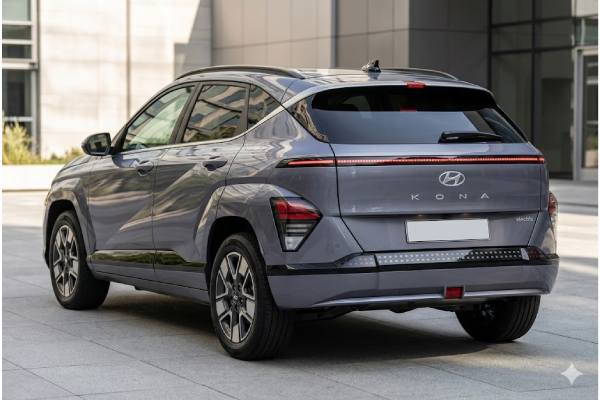
The second-generation Hyundai KONA Electric, known by the SX2 EV code, is a compact electric crossover built around everyday usability rather than headline performance. In standard-range form, it pairs a front-mounted permanent-magnet motor with a 48.4 kWh battery, front-wheel drive, a single-speed reduction gear, and a noticeably more spacious body than the first-generation KONA Electric.
This specific version is the lower-output European/UK-style standard-range model. Hyundai launch and technical documents have used slightly different power notation for this variant, with early material showing 111 kW and later technical sheets listing about 114.6–115 kW, equivalent to 156 PS or roughly 154 bhp. In real ownership terms, the important distinction is simple: this is the efficient, smaller-battery SX2 KONA Electric, not the 65.4 kWh long-range model.
What to Know
- Efficient city and mixed driving are its strongest advantages, with realistic day-to-day range often feeling better than the modest battery size suggests.
- The larger SX2 body brings a roomier cabin, useful cargo space, V2L capability, and stronger driver-assistance coverage than the earlier KONA Electric.
- Highway range and DC charging speed are adequate rather than outstanding, so it suits commuters and regional trips better than repeated long motorway days.
- Plan tyre rotations about every 10,000–12,000 km or 6,000–7,500 miles, especially because front-drive EV torque can wear front tyres quickly.
- Battery, charging, ADAS, and recall status should always be checked by VIN because software campaigns and equipment vary by market and build date.
Table of Contents
- KONA Electric SX2 Real-World Profile
- KONA Electric SX2 Core Specs
- KONA Electric SX2 Trims and Safety
- Reliability Issues and Service Actions
- Maintenance and Used Buyer Checks
- Driving Range and Charging Behavior
- KONA Electric Rival Comparison
KONA Electric SX2 Real-World Profile
The KONA Electric SX2 is best understood as a mature compact EV adapted for family, commuter, and urban-crossover use. It keeps the familiar KONA footprint but grows in all the places that matter: wheelbase, rear-seat comfort, cargo volume, technology, and driver-assistance coverage. The result is a car that feels less like a converted small SUV and more like a carefully packaged electric crossover.
The 48.4 kWh standard-range version is the sensible-efficiency model in the lineup. It does not have the punch or longer range of the 65.4 kWh version, but it is lighter, rides on efficiency-friendly 17-inch wheels in many markets, and is usually the more affordable way into the SX2 KONA Electric range. For drivers covering mostly city, suburban, and moderate regional mileage, this version can make more financial sense than paying for battery capacity that is rarely used.
The main technical layout is straightforward. A single front motor drives the front wheels through a one-speed reduction gear. There is no multi-speed gearbox, no all-wheel drive, and no combustion engine support. This simplicity helps reduce routine maintenance compared with petrol or hybrid KONA models, but it does not mean the car is maintenance-free. The coolant system, brake hardware, reduction gear, 12 V battery, tyres, suspension, charging equipment, and software all remain important ownership areas.
The standard-range SX2 EV is also shaped strongly by its market. In the UK and much of Europe, the 48.4 kWh version is associated with the Advance-style specification and a WLTP range around 377 km, or 234 miles. In North America, the base KONA Electric has a similar positioning but different battery/output data and EPA range figures, so numbers should not be mixed without checking the exact market. This is one of the biggest accuracy traps with this model: the badge may look similar, but homologation, charging hardware, trim content, and even output figures can differ.
As a used or nearly new purchase, the 48.4 kWh KONA Electric makes the most sense for buyers who want low running costs, compact dimensions, good equipment, and enough range for normal life without paying for the longest-range version. It is less convincing for drivers who regularly sit at 120 km/h or 75 mph for long distances, tow often, or depend on very fast charging. Its DC charging is useful, but the peak is below what newer 800 V EVs and some larger-battery rivals can sustain.
The ownership appeal comes from balance. The KONA Electric SX2 is easy to park, efficient, quiet, practical for its size, and covered by Hyundai’s strong EV warranty terms in many markets. Its limits are equally clear: front-wheel-drive traction can be challenged by wet roads and instant torque, the smaller pack gives less buffer in winter, and real motorway range falls quickly with speed. For the right usage pattern, those are manageable compromises rather than deal-breakers.
KONA Electric SX2 Core Specs
Powertrain, Battery and Efficiency
| Spec | Value |
|---|---|
| Vehicle scope | Hyundai KONA Electric SX2 EV, standard-range 48.4 kWh, front-wheel drive |
| Body style | 5-door compact electric SUV |
| Motor type | Permanent Magnet Synchronous Motor |
| Motor count and axle | Single motor, front axle |
| Published output | 154 bhp / 156 PS / 114.6–115 kW |
| Early launch output notation | 111 kW in selected launch material |
| Maximum torque | 255 Nm / 188 lb-ft |
| Battery type | Lithium-ion polymer traction battery |
| Nominal / usable battery capacity | 51.0 kWh / 48.4 kWh |
| System voltage | 295 V |
| Battery pack location | Underfloor traction battery |
| Battery thermal management | Liquid-cooled high-voltage battery and power electronics |
| Heat pump | Fitted on UK specification grades |
| Official efficiency standard | WLTP |
| Rated efficiency | 14.6 kWh/100 km / 235 Wh/mi |
| Rated range | 377 km / 234 mi WLTP |
| 120 km/h highway planning consumption | About 19–24 kWh/100 km / 306–386 Wh/mi |
| 120 km/h highway planning range | About 200–250 km / 125–155 mi |
Driveline and Charging
| Spec | Value |
|---|---|
| Drive type | Front-wheel drive |
| Transmission / drive unit | Single-speed reduction gear |
| Differential / torque control | Front open differential with electronic traction and stability control |
| AC charging connector | Type 2, single-phase and three-phase market-dependent support |
| DC charging connector | CCS Combo 2 |
| Charging port location | Front centre charging door |
| Onboard charger | 10.4 kW maximum AC acceptance |
| AC 10–100% at 7.4 kW | 6 hr 0 min |
| AC 10–100% at 11 kW wallbox | 4 hr 0 min at 10 kW maximum |
| DC fast-charge peak | 74–75 kW |
| Typical DC 10–80% average | About 50 kW |
| DC 10–80% time | About 41–43 min |
| 50 kW CCS 10–100% | 1 hr 38 min |
| 150 kW CCS 10–100% | 1 hr 22 min |
| Battery preconditioning | Available with automatic navigation-based triggering in equipped markets |
| Vehicle-to-Load | Supported, up to 3.6 kW AC where enabled |
Performance and Capability
| Spec | Value |
|---|---|
| 0–100 km/h / 0–62 mph | 8.8 s |
| Top speed | 160 km/h / 101 mph |
| Drive modes | Eco, Normal, Sport, Snow |
| Regenerative braking | Driver-adjustable regen with i-PEDAL one-pedal mode |
| Braked towing capacity | 300 kg / 661 lb |
| Unbraked towing capacity | 300 kg / 661 lb |
| Payload | 420–495 kg / 926–1,091 lb |
| Gross vehicle weight | 2,110 kg / 4,652 lb |
| Maximum roof load | 100 kg / 220 lb |
Chassis and Dimensions
| Spec | Value |
|---|---|
| Front suspension | MacPherson strut |
| Rear suspension | Multi-link |
| Steering | Column-mounted motor-driven power steering |
| Steering turns lock-to-lock | 2.55 |
| Braking system | Power-assisted braking with ABS and EBD |
| Front brakes | Ventilated discs |
| Rear brakes | Solid discs |
| Parking brake | Electric parking brake |
| Wheels | 17 x 7.0J alloy |
| Tyres | 215/60 R17 |
| Length | 4,355 mm / 171.5 in |
| Width excluding mirrors | 1,825 mm / 71.9 in |
| Width including mirrors | 2,100 mm / 82.7 in |
| Height | 1,580 mm / 62.2 in |
| Wheelbase | 2,660 mm / 104.7 in |
| Turning circle | 10.6 m / 34.8 ft |
| Kerb weight | 1,615–1,690 kg / 3,560–3,726 lb |
| Cargo volume, seats up | 466 L / 16.5 ft³ VDA |
| Cargo volume, seats down | 1,300 L / 45.9 ft³ VDA |
| Front storage | 27 L / 1.0 ft³ |
Safety and Driver Assistance
| Spec | Value |
|---|---|
| Euro NCAP rating | 4 stars, 2023 |
| Euro NCAP adult occupant | 80% |
| Euro NCAP child occupant | 83% |
| Euro NCAP vulnerable road users | 64% |
| Euro NCAP safety assist | 60% |
| Airbags | Front, front side, curtain, and centre front airbags |
| AEB / forward collision assist | Car, pedestrian, cyclist, and junction-turning detection |
| Smart cruise control | Standard on UK specification grades |
| Lane systems | Lane Keep Assist and Lane Follow Assist |
| Speed assistance | Intelligent Speed Limit Assist |
| Driver monitoring | Driver Status Monitor |
| Highway assistance | Highway Driving Assist 1.5 standard; HDA 2.0 on selected packages |
| Blind-spot systems | Higher-trim or package-dependent |
| Rear cross-traffic collision avoidance | Higher-trim or package-dependent |
| Parking collision avoidance reverse | Higher-trim or package-dependent |
| ISOFIX / child-seat provision | Rear outboard ISOFIX positions |
Fluids and Service Items
| Spec | Value |
|---|---|
| Brake fluid | DOT 4 |
| Wheel nut torque | 107–127 Nm / 79–94 lb-ft |
| Reduction-gear lubricant | Hyundai-specified EV drive-unit lubricant |
| Battery and power-electronics coolant | Hyundai-approved coolant by VIN and market |
| A/C refrigerant | R-1234yf |
| Cabin filter | Replace by service schedule or sooner in dusty conditions |
| 12 V battery | Test during routine service and after low-voltage warnings |
KONA Electric SX2 Trims and Safety
In the UK, the 48.4 kWh KONA Electric is most closely tied to the Advance grade, while the more powerful 65.4 kWh version is offered more widely across Advance, N Line, N Line S, and Ultimate. Other European markets may use different trim names, but the same broad logic often applies: the smaller-battery model is positioned as the value-focused standard-range version, while higher trims and sportier visual packages tend to be paired with the long-range battery.
The 48.4 kWh car is not a stripped-out EV. Typical UK equipment includes 17-inch alloy wheels, the 12.3-inch instrument display, 12.3-inch navigation infotainment, Bluelink connected services, wireless phone charging depending on package, multiple USB-C ports, heat pump, smart cruise control, lane support, navigation-based connected functions, and V2L capability. The 17-inch wheel and tyre package is important because it helps ride comfort and efficiency compared with the larger 19-inch wheels used on many higher-spec long-range cars.
The easiest identifiers are the battery/range data in the infotainment, the trim badge and wheel package, the charging flap at the nose, the EV-specific pixel lighting details, and the absence of N Line styling on standard Advance-style cars. N Line and N Line S models add sportier bumpers, side skirts, alloy designs, interior trim changes, and often more premium convenience equipment, but they do not make the standard-range car into a performance model. Mechanical changes are limited; there is no AWD variant and no special differential.
Safety equipment is a major SX2 improvement. The structure was assessed by Euro NCAP in 2023, with the tested electric KONA receiving four stars. Adult and child occupant protection are respectable, while the overall score is held back by some adult frontal-impact and vulnerable-road-user findings compared with the very best cars in the class. For buyers, the practical point is that the KONA has strong mainstream safety coverage, but the rating is not a five-star headline.
Standard driver assistance typically includes Forward Collision-Avoidance Assist, Lane Keep Assist, Lane Follow Assist, Intelligent Speed Limit Assist, Driver Status Monitor, eCall, stability control, hill-start assist, and smart cruise control with stop-and-go. Higher trims and option packs add or expand blind-spot monitoring, Blind-spot View Monitor, Rear Cross-Traffic Collision-Avoidance Assist, Parking Collision-Avoidance Assist in reverse, Safe Exit Warning, Surround View Monitor, Remote Smart Parking Assist, and Highway Driving Assist 2.0.
The calibration implications are worth noting. Windscreen replacement, front bumper repairs, wheel alignment, suspension work, radar removal, camera replacement, or collision repairs may require ADAS calibration. A cheap repair that leaves the camera or radar slightly misaligned can create false warnings, poor lane centring, or weak emergency-braking performance. For a used car, check that any crash or glass work was followed by documented calibration.
Year-to-year changes so far are mostly equipment, software, pricing, and trim-pack changes rather than fundamental mechanical redesigns. Build timing still matters because infotainment software, charging logic, driver-assistance alerts, and connected-service behavior can be updated. A car with a full dealer update history is preferable to one that has simply had tyres and wipers replaced.
Reliability Issues and Service Actions
The SX2 KONA Electric is still a relatively young model, so long-term reliability data is developing. It also benefits from lessons learned on the first-generation KONA Electric, but it has its own electronics, battery, software, body, and driver-assistance architecture. The best reliability approach is to separate normal EV wear from faults that need dealer diagnostics.
Common, low-cost ownership issues are likely to involve tyres, brake corrosion, software annoyances, trim rattles, and driver-assistance alerts. Front tyres can wear quickly if the car is driven hard from low speed because all torque goes through the front axle. Brake rotors may develop surface corrosion because regenerative braking means the friction brakes work less often. The cure is usually regular inspection and occasional firm braking where safe, not unnecessary early brake replacement.
Occasional, medium-cost issues to watch include 12 V battery weakness, charging interruptions, charge-port latch or seal problems, heat-pump or HVAC faults, coolant seepage, wheel-bearing noise, suspension bush or ball-joint wear, and reduction-gear whine. Symptoms matter. A low-voltage warning, random electrical errors, or failure to wake up can point to a weak 12 V battery or charging-management issue. A clunk over bumps may be suspension hardware. A high-pitched whine that changes with road speed can justify drive-unit and wheel-bearing checks.
Rare but high-cost issues involve the high-voltage battery, inverter, onboard charger, DC–DC converter, HV junction hardware, isolation faults, and moisture ingress into high-voltage connectors or the charge-port area. These faults normally trigger warning messages, charging failure, reduced-power mode, or a refusal to enter Ready mode. Diagnosis should be done by an EV-qualified technician because high-voltage isolation testing and connector inspection require proper equipment and safety procedures.
Software is central to this car. Updates can affect battery management, charging behavior, thermal conditioning, ADAS warnings, infotainment stability, Bluelink functions, navigation routing, and over-the-air update behavior. A software update may be the correct official remedy for a charging or warning-light complaint, while other cases may need a control unit, sensor, latch, OBC, or DC–DC converter replacement. Do not assume every EV fault is a failed battery pack.
Recall and campaign status must be checked by VIN. In the U.S., certain 2024 KONA vehicles were covered by a safety recall involving 12 V positive battery cable protection, with a dealer remedy to add protective sheathing. That recall should not be assumed to apply globally or to every KONA Electric. European, UK, Australian, and other-market cars have their own campaign systems, and service actions may be software-only or equipment-specific.
Battery health is the largest used-EV question. The 48.4 kWh pack should show modest degradation under normal use, especially if mostly charged on AC and not regularly held at 100% in hot weather. A state-of-health report is more useful than dashboard range alone because the guess-o-meter reflects recent driving, temperature, HVAC use, and tyre setup. For a used example, ask for:
- A documented high-voltage battery state-of-health report.
- Proof that all recalls and service campaigns are closed.
- Records of software updates, charging complaints, or OBC repairs.
- Evidence of correct coolant inspection or replacement where scheduled.
- Confirmation that no battery pack, module, inverter, or HV junction repair has been hidden from the sales file.
- A road test from cold and after charging, listening for drive-unit, wheel-bearing, and suspension noises.
Corrosion checks should not be skipped. Look underneath for damaged undertrays, corroded fasteners, scuffed battery protection, poor jack placement, and corrosion around suspension mounting points. A clean body can hide a rough underside if the car has lived near salt, flooded roads, or poorly maintained rural lanes.
Maintenance and Used Buyer Checks
The KONA Electric needs less routine servicing than a combustion KONA, but the items that remain are important. A good maintenance plan protects range, braking performance, battery cooling, ADAS reliability, and resale value. The safest schedule is always the official VIN-specific schedule for the market, but the following pattern is a practical ownership baseline.
Check tyres monthly and rotate them about every 10,000–12,000 km or 6,000–7,500 miles. EVs are sensitive to tyre pressure and alignment because rolling resistance directly affects range. Uneven front tyre wear, feathering, or a steering wheel that sits off-centre should trigger an alignment check. Use the correct load and efficiency-rated tyre specification; fitting a cheap non-EV tyre can increase road noise and reduce range.
Inspect brakes at every service. Regeneration reduces pad wear, but it can allow rotors to corrode, especially in wet or salted climates. The rear brakes deserve particular attention because light-load driving may not use them heavily. Brake fluid should be tested regularly and typically replaced around every 24 months, or sooner if moisture content is high. DOT 4 fluid is specified, and the brake system should be serviced carefully because it works with electronic brake blending and stability systems.
Replace the cabin air filter every 12 months in dusty, polluted, or high-pollen areas, even if the official interval allows longer. A clogged filter reduces HVAC efficiency, increases fan noise, and can make demisting worse. In an EV, efficient HVAC matters because heating and cooling draw directly from the high-voltage battery.
The 12 V battery should be tested annually after the first couple of years and immediately after any low-voltage warning, repeated app wake-up issue, or failure to enter Ready mode. Many EV complaints begin with a weak 12 V battery, not the traction battery. Replacement around three to five years is normal depending on climate, usage, and accessory load.
The high-voltage coolant circuit should be inspected at each scheduled service for level, leaks, staining, pump noise, blocked radiators, and fan operation. Coolant replacement must follow Hyundai’s official procedure and coolant specification for the VIN. Mixing incorrect coolant, using universal antifreeze, or ignoring air-bleeding procedures can create expensive thermal-management problems.
Reduction-gear service depends on market documentation and drive-unit specification. Even where the fluid is not a frequent scheduled replacement item, buyers should check for leaks, metallic noise, vibration, and service records. If the reduction gear oil is serviced, it should use Hyundai-specified EV drive-unit lubricant and correct fill procedure. Do not treat it like a conventional automatic transmission.
For charging hardware, inspect the Type 2/CCS port closely. The flap should open and close smoothly, the latch should lock reliably during AC charging, seals should be intact, and pins should be clean and undamaged. Test AC charging on a home-style wallbox and, if possible, perform a short DC fast-charge session from a low-to-mid state of charge. A car that charges normally on AC but fails on DC, or vice versa, needs diagnosis before purchase.
For the traction battery, ask for a state-of-health report and compare displayed range at a known state of charge with real conditions. A 100% dashboard estimate is less useful than consumption over a proper drive. In mild mixed driving, the car should feel efficient; in cold, wet motorway use, range will fall sharply. That is normal, but sudden drops, repeated charging faults, or large imbalance warnings are not.
A used-buyer inspection should include:
- Cold start into Ready mode with no warning lights.
- AC and DC charging test where practical.
- Heat pump and cabin heating test in cold conditions.
- Air conditioning performance and fan noise check.
- Full ADAS function check, including lane systems and cruise control.
- Underbody inspection around battery housing, covers, and suspension.
- Brake rotor condition after a normal road test.
- Service records showing recall closure, software updates, and dealer inspections.
- Tyre brand, load rating, tread depth, and matching axle pairs.
- Confirmation that supplied charging cables, V2L adapter, wheel kit, and manuals are present.
The best examples are unmodified, have complete dealer or specialist EV service history, show stable battery health, charge consistently, and have not been repaired after structural or high-voltage damage. The 48.4 kWh model is a smart buy when priced below the long-range version by enough to offset its shorter motorway range. If the price gap is small and long trips are common, the 65.4 kWh KONA Electric is usually the easier car to live with.
Driving Range and Charging Behavior
On the road, the standard-range KONA Electric feels smooth, quiet, and easy rather than overtly sporty. The 255 Nm torque output arrives quickly, so the car steps away from junctions with confidence, but it does not have the strong mid-range surge of the 65.4 kWh model. The 0–100 km/h time of 8.8 seconds is quick enough for normal overtaking and city driving, and Sport mode sharpens response without changing the basic front-drive character.
Ride comfort is one of the 48.4 kWh car’s advantages when fitted with 17-inch wheels. The taller tyre sidewalls help absorb sharp urban impacts better than the 19-inch packages used on some higher trims. The low-mounted battery gives the car good body control for a compact SUV, although it still feels taller and softer than a hatchback. Steering is light and accurate, with enough weight in Normal mode for confidence but limited road feel.
Regenerative braking is easy to adapt to. Paddle adjustment lets the driver choose more coasting or stronger deceleration, and i-PEDAL allows near one-pedal driving in urban traffic. Brake blending is generally smooth, but the friction brakes still need regular use to keep rotors clean. Drivers moving from a petrol car may need a few days to settle into the regen levels, after which the system becomes one of the car’s best daily-use features.
Real-world efficiency depends heavily on speed. Around town, consumption in mild weather can sit near 12–15 kWh/100 km if driven smoothly. Mixed use is commonly in the 14.5–17 kWh/100 km range. At motorway speeds, the taller body and cold-weather heating load matter more, so 19–24 kWh/100 km is a realistic planning range at about 120 km/h or 75 mph. That turns the 48.4 kWh usable battery into roughly 200–250 km of practical highway range, with more in mild, slower conditions and less in winter headwinds.
Cold weather has two effects: the battery is less efficient, and cabin heating uses energy. The heat pump helps, but it does not make winter range equal to summer range. Short winter trips can be inefficient because the cabin and battery system are repeatedly warmed from cold. Preconditioning while plugged in is worthwhile before commuting or starting a longer journey.
Charging is competent but not class-leading. At home, the KONA is easy to live with. A 7.4 kW single-phase wallbox can take the car from 10% to 100% in about six hours, while a three-phase 11 kW setup is quicker where supported. Most owners will rarely charge from very low to full; overnight charging to 80% is normally enough.
DC fast charging is more limited. The standard-range model peaks around 74–75 kW and averages around 50 kW from 10% to 80% in good conditions. A 10–80% stop of about 41–43 minutes is realistic when the battery is warm and the charger is working properly. Starting too cold, arriving at a high state of charge, or using a congested charger will reduce speed. Navigation-based battery preconditioning helps, but it needs enough time and the correct charger destination set in the system.
Loaded driving is stable because the battery weight sits low, but extra passengers, roof bars, bikes, and a small trailer reduce range quickly. The 300 kg towing rating makes the KONA suitable only for very light towing. Even modest towing or roof-load use can cut range by 25–45% depending on speed and weather, so conservative charging plans are necessary.
The overall driving verdict is positive if expectations are right. The 48.4 kWh KONA Electric is quiet, efficient, comfortable, and easy to manage. It is not the car for drivers who want frequent 300 km motorway legs between charging stops, but it is excellent for daily use, school runs, commuting, urban deliveries, and weekend trips where charging can be planned without stress.
KONA Electric Rival Comparison
The KONA Electric 48.4 kWh competes in a crowded part of the EV market, where buyers often compare battery size, real range, charging speed, cabin space, and equipment more than outright performance. Its strongest selling point is not one spectacular number, but a combination of efficiency, usability, warranty confidence, and compact-SUV practicality.
Against the Kia Niro EV, the Hyundai feels a little more modern inside and more compact from behind the wheel. The Niro’s larger battery gives it a clear long-distance advantage, while the KONA 48.4 kWh counters with lower purchase cost and strong efficiency. For high-mileage drivers, the Niro-style larger battery is easier. For urban and mixed use, the KONA standard range can be the better-value choice.
Against the Peugeot E-2008 and related Stellantis small electric crossovers, the KONA offers stronger EV-specific usability, better practicality in many configurations, and generally more convincing driver-assistance coverage. The Peugeot may appeal on style and cabin design, but the Hyundai feels more rounded as an electric vehicle.
Against the Jeep Avenger Electric, the KONA is larger, roomier, and more family-friendly. The Jeep is easier to place in tight streets and has a more rugged design character, but it is not as practical for rear passengers or cargo. The KONA is the more sensible only-car choice.
Against the Volvo EX30, the Hyundai is less powerful and less fashionable, but it is easier to use as a small family car. The Volvo can be much quicker and has a premium badge, yet its minimalist controls and compact rear/cargo packaging will not suit everyone. The KONA is calmer, more conventional, and more practical.
Against the MG4, the Hyundai has a crossover body, a more upright driving position, and a polished ownership package. The MG4 often wins on price and, in some versions, rear-drive driving balance. The KONA fights back with efficiency, equipment integration, and Hyundai’s dealer network.
The biggest internal rival is the 65.4 kWh KONA Electric. If long motorway journeys are common, the larger battery is worth serious consideration because it gives more range buffer and a more powerful 160 kW motor. If most journeys are below 160 km, charging is available at home, and value matters, the 48.4 kWh car is the more disciplined choice.
The standard-range SX2 KONA Electric is therefore not the longest-range, fastest-charging, or quickest compact EV. Its advantage is that it gets the basics right: efficient energy use, compact dimensions, useful cabin space, strong daily comfort, sensible equipment, and manageable running costs. For many owners, that is more valuable than paying extra for capability they rarely use.
References
- Hyundai KONA Electric | Technical, Specifications and Pricing | Model year 2024 | June 2024 2024 (Technical Specifications)
- Hyundai Owners manuals | Hyundai Motor UK 2026 (Owner’s Manual)
- Euro NCAP | Hyundai KONA 2023 (Safety Rating)
- Check for Recalls: Vehicle, Car Seat, Tire, Equipment | NHTSA 2026 (Recall Database)
- Hyundai Kona Electric 48 kWh (MY24-25) (2023-2025) price and specifications – EV Database 2026 (Real-World Range Data)
Disclaimer
This article is for informational purposes only and is not a substitute for professional diagnosis, repair, or official Hyundai service information. Specifications, torque values, maintenance intervals, software campaigns, procedures, and equipment can vary by VIN, market, build date, trim, and option package. Always verify technical work against the official service documentation for the exact vehicle.
If you found this useful, please consider sharing it on Facebook, X/Twitter, or your preferred community so other KONA Electric owners and shoppers can benefit from it.