
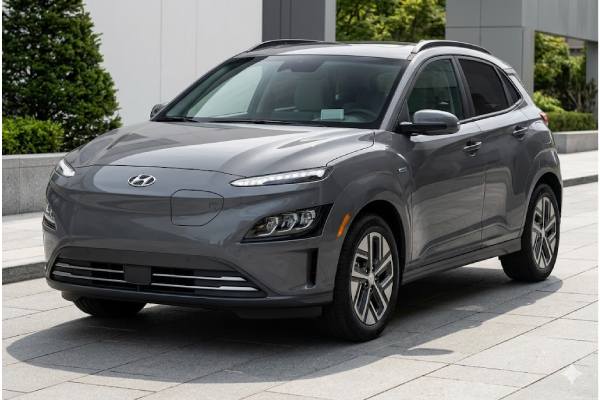

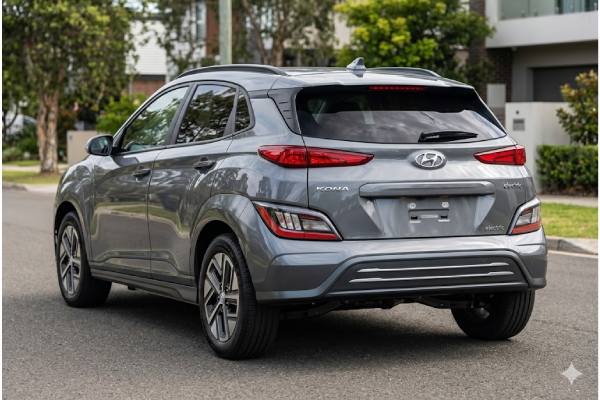
The facelifted Hyundai KONA Electric OS EV with the 150-kW motor is one of the more practical long-range compact electric crossovers from its period. It combines a relatively small body with a 64-kWh-class battery, strong front-wheel-drive performance, low running costs, and enough real-world range to make it useful beyond short urban trips.
For used buyers, the key questions are less about outright power and more about range consistency, charging speed, battery health, recall history, coolant service, brake condition, and whether the specific car has the right equipment for the climate and charging network it will use.
Quick Specs and Notes
- Strong 201 hp output and instant 291 lb-ft torque make it quicker than most compact EV crossovers of the same size.
- The 64.0 kWh battery gives an EPA range of 258 miles and a WLTP range of up to 300 miles in favorable specifications.
- Low energy use is a major strength, especially in city and mixed driving where the KONA Electric can feel unusually efficient.
- Used examples should be checked for completed EPCU, battery, coolant, BMS, and charging-related campaigns by VIN.
- Brake fluid replacement is typically due every 48,000 km or 48 months, with tyre rotation commonly listed every 6,000 km or 6 months in some markets.
Table of Contents
- KONA Electric OS EV Character
- KONA Electric OS EV Specs
- KONA Electric OS EV Equipment
- Reliability, Faults and Recalls
- Maintenance and Used Buying
- Range, Charging and Performance
- Comparison With Electric Rivals
KONA Electric OS EV Character
The 2021–2023 facelift Hyundai KONA Electric OS EV sits in an interesting place in the used EV market. It is not a dedicated long-wheelbase EV platform like later E-GMP Hyundai models, and it does not charge as fast as newer 800-volt cars. But it is compact, efficient, quick, easy to drive, and often cheaper to buy used than newer electric crossovers with similar official range.
The version covered here is the 150-kW front-motor model with the 64.0 kWh battery, sold in many markets as the Long Range or higher-output KONA Electric. In North America it was rated at 201 hp, while European material often listed it as 204 PS. Both refer to the same 150-kW electric motor output. The car uses a single permanent-magnet synchronous motor driving the front wheels through a single-speed reduction gear. There is no multi-speed gearbox, no combustion engine, and no mechanical all-wheel-drive version in this OS EV generation.
The facelift brought revised exterior styling, updated lighting details, equipment changes, and trim reshuffles depending on market. It did not fundamentally change the car’s main appeal: a relatively large battery in a small crossover body. That combination is why real-world efficiency is such a strong part of the KONA Electric’s reputation. In city use, gentle mixed driving, and moderate-speed commuting, it can travel a long way on each kilowatt-hour. On highways, especially above 110–120 km/h, its small size helps but its upright crossover shape still creates the usual EV speed penalty.
The cabin is practical rather than luxurious. Front-seat space is good, the dashboard is simple, and the driving position suits everyday use. Rear-seat space and cargo volume are more limited than in larger EVs such as the Volkswagen ID.4, Hyundai IONIQ 5, or Kia EV6. For a single driver, couple, or small family, it can work well. For regular rear-seat adult use, bulky child seats, or frequent holiday luggage, it feels closer to a compact hatchback than a full family SUV.
The main advantages are efficiency, usable range, easy drivability, and modest maintenance needs. The main drawbacks are moderate DC fast-charging speed, front-wheel-drive traction limits under hard acceleration, and the need to verify recall and service history carefully. A well-maintained 64 kWh facelift car can still be a very sensible used EV, but the best examples are those with documented software updates, coolant services, healthy 12 V batteries, clean charge-port hardware, and no unresolved high-voltage warnings.
KONA Electric OS EV Specs
Powertrain, Battery and Efficiency
| Spec | Value |
|---|---|
| Model | Hyundai KONA Electric |
| Generation / code | OS EV facelift |
| Model years | 2021–2023 |
| Body style | 5-door compact crossover |
| Powertrain type | Battery electric vehicle |
| Motor type | Permanent-magnet synchronous motor |
| Motor count and axle | Single front motor |
| Drive type | Front-wheel drive |
| Maximum power | 201 hp (150 kW) |
| Maximum torque | 395 Nm (291 lb-ft) |
| Battery type | Lithium-ion polymer |
| Battery cell supplier | LG Chem |
| Cell construction | Prismatic |
| Battery structure | 3P98S |
| Battery system capacity | 64.0 kWh |
| Nominal system voltage | 356 V |
| Battery placement | Underfloor traction battery pack |
| Thermal management | Liquid-cooled EV coolant circuit |
| Battery warmer | SEL / Limited in U.S. 2023 specification |
| EPA rated range | 415 km (258 mi) |
| EPA efficiency | 134 city / 106 highway / 120 combined MPGe |
| EPA energy use | 28 kWh/100 mi |
| WLTP rated range | 484 km (300 mi) |
| WLTP rated efficiency | 14.7 kWh/100 km |
| Real highway at 120 km/h | 20–24 kWh/100 km (322–386 Wh/mi) |
| Real highway range at 120 km/h | 265–320 km (165–199 mi) |
Driveline and Charging
| Spec | Value |
|---|---|
| Transmission / drive unit | Single-speed reduction gear |
| Gear ratio | 7.981:1 |
| Differential / traction control | Front open differential with electronic traction and stability control |
| Drive modes | Comfort / Eco / Sport |
| AC connector | J1772 in North America; Type 2 in Europe/UK |
| DC connector | CCS Combo 1 in North America; CCS Combo 2 in Europe/UK |
| Charging port location | Front grille, driver side |
| Onboard charger | 7.2 kW North America; 10.5–11 kW Europe/UK |
| AC charge time | 9 hr 15 min from 10–100% at 7.2 kW |
| AC charge time | 6 hr 50 min from 10–100% at 10.5 kW |
| DC fast-charge class | 100 kW public charger class |
| Typical DC peak | 77–80 kW |
| Typical DC average 10–80% | About 60–61 kW |
| DC 10–80% at 50 kW | About 64 min |
| DC 10–80% at 100 kW class | About 47 min |
| Battery preconditioning for DC charging | No navigation-linked DC preconditioning |
Performance and Capability
| Spec | Value |
|---|---|
| 0–100 km/h | 7.9 sec |
| 0–62 mph | 7.9 sec |
| Top speed | 167 km/h (104 mph) |
| Front brakes | 305 mm x 25 mm ventilated discs |
| Rear brakes | 300 mm x 10 mm solid discs |
| Parking brake | Electric parking brake |
| Regenerative braking | Steering-wheel paddle control |
| Towing capacity | 100 kg (220 lb) braked / unbraked in UK specification |
| Payload | 427–485 kg (941–1,069 lb) |
Chassis and Dimensions
| Spec | Value |
|---|---|
| Front suspension | MacPherson strut with coil spring |
| Rear suspension | Multi-link and trailing arm |
| Steering | Column-mounted motor-driven power steering |
| Steering ratio | 13.4:1 |
| Steering turns lock-to-lock | 2.5 |
| Turning circle | 10.4–10.6 m (34.1–34.8 ft) |
| Wheel / tyre size | 215/55 R17 on 7.0J x 17 alloy |
| Length | 4,205 mm (165.6 in) |
| Width | 1,800 mm (70.9 in) |
| Width with mirrors | 2,070 mm (81.5 in) |
| Height | 1,570 mm (61.8 in) |
| Wheelbase | 2,600 mm (102.4 in) |
| Kerb weight | 1,685–1,743 kg (3,715–3,842 lb) |
| GVWR | 2,170 kg (4,784 lb) |
| Cargo volume VDA | 332 L / 1,114 L seats up / down |
| Cargo volume SAE | 544 L / 1,296 L seats up / down |
| Roof load | 80 kg (176 lb) |
Safety and Driver Assistance
| Spec | Value |
|---|---|
| Euro NCAP rating | 5 stars |
| Euro NCAP adult occupant | 87% |
| Euro NCAP child occupant | 85% |
| Euro NCAP vulnerable road users | 62% |
| Euro NCAP safety assist | 60% |
| Airbags | Front, side, and curtain airbags by market specification |
| Child-seat anchors | ISOFIX / LATCH rear outboard positions |
| Stability systems | ABS, EBD, brake assist, stability control, hill-start assist |
| ADAS availability | AEB, pedestrian detection, lane keeping, lane following, blind-spot warning, rear cross-traffic alert, adaptive cruise control by trim and market |
| EV-specific driver features | Regenerative-brake paddles, energy-use display, range estimator, charge scheduling |
Fluids and Service Capacities
| Spec | Value |
|---|---|
| Reduction gear fluid | 1.0–1.1 L (1.0–1.1 US qt) |
| Reduction gear fluid specification | 70W, API GL-4, TCGO-9 (MS517-14) |
| Coolant without heat pump | 12.5–13.0 L (13.2–13.7 US qt) |
| Coolant with heat pump | 13.0–13.4 L (13.7–14.2 US qt) |
| Coolant specification | Designated coolant water for electric vehicles |
| Brake fluid capacity | 0.7–0.8 L (0.74–0.85 US qt) |
| Brake fluid specification | SAE J1704 DOT-4 LV, FMVSS 116 DOT-4, ISO 4925 Class 6 |
| A/C refrigerant | R-1234yf |
| A/C refrigerant, standard climate | 550 ± 25 g (19.4 ± 0.9 oz) |
| A/C refrigerant, inner condenser | 650 ± 25 g (22.9 ± 0.9 oz) |
| A/C refrigerant, heat pump | 1000 ± 25 g (35.3 ± 0.9 oz) |
| A/C compressor oil | POE8-6 |
| A/C compressor oil charge | 180 ± 10 mL (6.34 ± 0.35 fl oz) |
| Wheel lug nut torque | 107–127 Nm (79–94 lb-ft) |
KONA Electric OS EV Equipment
The facelift 64 kWh KONA Electric was sold with different trim names by region, but the basic structure was similar: a high-output 150-kW model with comfort, infotainment, safety, and winter-equipment differences layered on top. North American trims commonly included SE/SEL/Limited-style equipment ladders, while UK and European cars used names such as SE Connect, Premium, and Ultimate. Australia used Elite and Highlander, and Canada had its own Preferred/Ultimate-style mix depending on model year.
The important used-buying point is that most mechanical fundamentals are shared. The 64.0 kWh battery, 150-kW front motor, single-speed reduction gear, front-wheel drive layout, and 395 Nm torque output do not change dramatically between most trims. What changes more often is equipment: heat pump availability, battery warmer, adaptive cruise control, blind-spot monitoring, LED lighting, larger infotainment screens, navigation, premium audio, seat heating and ventilation, steering-wheel heating, head-up display, and wheel design.
A few quick identifiers help when checking a used car:
- A 64 kWh / 150 kW car should feel significantly stronger than the 39.2 kWh / 100 kW version and will usually be badged or advertised as the longer-range model.
- The higher trims often have LED headlights, larger infotainment, upgraded upholstery, heated rear seats in some markets, and more complete driver assistance.
- Cars with factory navigation may have more integrated EV routing and energy displays, although the OS EV does not match the route-based charging intelligence of newer Hyundai EVs.
- Heat-pump-equipped cars are more desirable in cold climates because cabin heating can consume less battery energy than a purely resistive heater.
- Wheel and tyre packages matter: 17-inch tyres tend to support better ride comfort and efficiency than larger, heavier wheels where fitted.
Safety equipment also varies by trim and year. Core passive safety includes a strong unibody, front and side airbags, curtain airbags, ABS, stability control, traction control, brake assist, and child-seat mounting points in the rear. Driver-assistance availability can include forward collision-avoidance assist, pedestrian detection, lane keeping assist, lane following assist, blind-spot collision warning, rear cross-traffic alert, driver attention warning, adaptive cruise control, high-beam assist, and parking sensors or camera systems.
The Euro NCAP rating for the KONA family is strong for its launch-era test cycle, with a five-star result and good adult and child occupant scores. The caveat is that safety testing is tied to specific test years, equipment assumptions, and market configurations. A 2023 facelift car may have more standard ADAS than an earlier car, but the rating body’s test protocol may still reflect the original model assessment. For U.S. buyers, trim-level differences are especially important because some active-safety features were optional or tied to higher trims during parts of the model run.
ADAS calibration should be treated seriously after repairs. Windscreen replacement, front-camera work, bumper repairs, radar-area impact, alignment changes, or suspension damage can require inspection or calibration. On a used example, warning lights, unavailable lane support, inconsistent adaptive cruise behavior, or a replaced windscreen with no calibration record are not minor details. They can affect both convenience and emergency intervention performance.
Reliability, Faults and Recalls
The facelift KONA Electric is generally viewed as a durable EV when maintained correctly, but it is not free of known issues. The most important distinction is between common ownership wear items, occasional EV-system faults, and rare but high-consequence high-voltage problems.
Common, lower-cost issues include tyre wear, brake corrosion, 12 V battery weakness, charge-port latch problems, worn wiper blades, cabin-filter neglect, and suspension noises on rough roads. The instant torque can wear front tyres quickly if the car is driven hard, and the front axle can chirp or tug under aggressive acceleration on wet roads. Brake pads may last a long time because regeneration does much of the slowing, but rotors can rust or develop surface corrosion if the friction brakes are rarely used. A healthy KONA Electric should brake smoothly, without pulsing, scraping, or a long pedal.
Occasional medium-cost issues include charge-port door or locking faults, onboard charger problems, coolant warnings, HVAC or heat-pump faults, wheel-bearing noise, suspension bush wear, and infotainment glitches. The usual symptom pattern is straightforward: slow or failed AC charging may point to the onboard charger, EVSE compatibility, or charge-port latch; repeated coolant-level warnings may point to leaks, air in the system, wrong coolant, or campaign-related service needs; humming that rises with road speed may point to tyres or wheel bearings; and drivetrain whine that changes with load may require reduction gear or motor inspection.
High-cost issues are less common but more important to rule out. These include high-voltage battery faults, isolation faults caused by moisture or damaged HV components, DC–DC converter faults, EPCU faults, and drive-unit problems. The warning signs include “Check Electric Vehicle System,” reduced power, inability to charge, sudden charge interruption, coolant contamination, repeated high-voltage isolation codes, or a car that enters a limited-mobility fail-safe mode. These symptoms require proper dealer-level diagnosis, not guesswork.
The best-known safety action for certain 2021 U.S. KONA Electric vehicles is Recall 239, involving the Electric Power Control Unit. Hyundai’s campaign described a low-conductivity coolant leak into the EPCU on certain 2021MY OS EV vehicles produced from June 18, 2020 through July 31, 2020. The concern was warning lights and possible loss of motive power, with the remedy involving inspection and EPCU replacement if required. This is exactly the kind of recall that a used buyer should verify by VIN rather than by model year alone.
Earlier KONA Electric battery recalls are also worth knowing, even though they mainly affected 2019–2020 vehicles rather than the facelift 2021–2023 scope. They involved high-voltage battery cell manufacturing concerns, BMS software, inspections, and battery replacement actions where needed. A shopper comparing pre-facelift and facelift cars should not assume all 64 kWh KONA Electrics have the same recall history. VIN-specific records matter.
Software updates can be important. BMS updates may change battery monitoring, diagnostic thresholds, or charging behavior. Charging-system updates can improve compatibility or fault handling. Infotainment updates can fix phone-projection, navigation, or connectivity bugs. ADAS calibration and software status matter after camera, radar, windscreen, steering, or alignment work. A car with a complete dealer record and no persistent warning lights is much more attractive than one with a vague “software issue” explanation.
For pre-purchase checks, ask for:
- A completed recall and campaign printout from a Hyundai dealer.
- Battery state-of-health data or a dealer diagnostic report.
- Evidence of correct coolant service using approved EV coolant.
- Brake fluid replacement history.
- Reduction gear fluid inspection or service records.
- Records for any charge-port, onboard charger, EPCU, DC–DC, or HV battery work.
- A road test from cold and warm, including AC charging and, ideally, a short DC fast-charge session.
- An underside inspection for impact damage, corrosion, damaged undertrays, loose fasteners, battery-housing marks, and coolant leaks.
The long-term outlook is good for careful owners. The battery is not usually the weak point if the car has not lived on constant rapid charging, extreme heat, deep discharge, or unresolved thermal faults. The more realistic ownership risks are neglected coolant/brake service, weak 12 V batteries, unresolved campaigns, tyres, brake corrosion, and occasional charging or electronics faults.
Maintenance and Used Buying
A KONA Electric does not need engine oil, spark plugs, timing belts, exhaust parts, or emissions-system service. That makes routine maintenance simpler than on a petrol or diesel crossover, but not optional. EVs still have brakes, tyres, suspension, coolant loops, reduction gears, air conditioning, 12 V systems, charge ports, and software-dependent safety systems.
A practical schedule for a used 64 kWh OS EV should include these items, adjusted to the official market schedule for the car’s VIN:
- Tyre rotation: commonly every 6,000 km or 6 months in some Hyundai schedules, with pressure and tread-wear checks at the same time.
- Cooling-system inspection: every 24,000 km or 12 months.
- EV coolant replacement: commonly every 60,000 km or 36 months where specified.
- Brake fluid: inspect every 12,000 km or 12 months; replace every 48,000 km or 48 months where specified.
- Brake pads, rotors, calipers and lines: inspect at least annually, and more often where road salt, humidity, or steep terrain are common.
- Cabin air filter: replace annually or sooner in dusty or polluted areas.
- Reduction gear fluid: inspect according to the normal schedule; severe-use schedules may call for replacement at 120,000 km or 75,000 miles.
- 12 V battery: test annually after year three; replacement is often needed around three to five years depending on climate and usage.
- Suspension, steering, drive shafts and boots: inspect at routine service visits.
- A/C and heat pump system: check performance, refrigerant leaks, fan operation, and condenser condition.
- Battery health: request a diagnostic scan if range drops suddenly, charging behavior changes, or warning lights appear.
Severe use is not limited to towing or off-road driving. For an EV, severe use can include repeated high-speed motorway driving, frequent DC fast charging, steep climbs in hot weather, heavy city use with constant acceleration, winter road salt, coastal corrosion, and long periods parked at very high or very low state of charge. Under these conditions, shorter inspection intervals are sensible.
Fluid specifications matter. The reduction gear uses a specific 70W API GL-4 fluid, with a capacity around 1.0–1.1 L. The coolant must be the designated EV coolant; ordinary antifreeze or water can create problems in the electric cooling circuit. The brake system uses DOT-4 LV-type fluid meeting the required specifications, and the A/C system uses R-1234yf refrigerant with POE compressor oil. These are not areas for random substitutions.
As a used buyer, start with the battery. A normal car should show plausible range at a given state of charge, charge without interruption, and not throw high-voltage or battery-management warnings. A state-of-health report is better than relying on the dashboard range estimate, because the guess-o-meter reflects recent driving style, temperature, HVAC use, and tyre setup. Check whether the car has had any battery module or pack work, and whether warranty coverage remains.
Next, test charging. Bring or inspect the supplied cable, check the port for broken pins or damaged seals, confirm the latch works, and verify that AC charging begins cleanly. A short DC fast-charge test is valuable if practical. The car should climb to a reasonable charging rate at low-to-mid state of charge when the battery is warm, then taper as expected. Very slow charging in mild conditions, repeated session failures, or port-lock errors need investigation.
Chassis checks should be thorough. Listen for front-end clunks, bearing hum, clicking on tight turns, and reduction-gear whine. Inspect tyres for uneven wear, which can indicate alignment issues or worn suspension. Look underneath for corrosion around subframes, suspension arms, brake lines, battery-mounting areas, and underbody fasteners. The battery housing should not show impact gouges or crushed areas.
The most desirable examples are usually higher-trim 64 kWh cars with heat pump or battery-warming equipment in colder climates, complete safety equipment, documented dealer updates, and clean charging history. Cars to avoid are those with unresolved warning lights, missing recall documentation, poor coolant records, unexplained range loss, accident repairs near HV components, or signs that the owner ignored basic brake and tyre maintenance.
Range, Charging and Performance
The 150-kW KONA Electric feels quicker than its size suggests. The front motor delivers full torque instantly, so the first few metres away from a stop are brisk. In Normal mode it is smooth and easy to meter; in Sport mode it can feel sharp enough to overwhelm the front tyres on wet or broken pavement. The car does not have the rear-drive balance of some newer EVs, but it is responsive and confidence-inspiring in normal road use.
Mid-range performance is one of its best traits. Passing from urban speeds or accelerating onto a motorway is easy because there is no gearshift delay. At higher speeds the acceleration naturally fades, but it remains adequate up to legal motorway pace. The official 0–100 km/h time of 7.9 seconds is realistic for the European 204 PS rating, while some North American 0–60 mph tests have been quicker because of the different speed benchmark.
Ride and handling are tuned for daily usability. The battery sits low, which helps body control and reduces the top-heavy feel common in small crossovers. The steering is light and accurate rather than communicative. The rear multi-link suspension is a useful advantage over simpler rear axle layouts, helping the car stay settled over uneven surfaces. On 17-inch tyres, ride comfort is generally good, though short-wheelbase firmness appears over sharp ridges and potholes.
Noise levels are low around town. At motorway speed, tyre and wind noise become more noticeable, especially on coarse surfaces. Because there is no engine noise, worn tyres, bearing hum, brake scrape, and suspension knocks are easier to hear. That makes a careful road test especially useful.
Regenerative braking is controlled by steering-wheel paddles, allowing the driver to choose stronger regen, lighter regen, or a more coasting-like feel. Hyundai’s system is easy to adapt to and gives good control in traffic. The brake pedal blends regenerative and friction braking well in normal use, but cars with corroded rotors can feel rough or noisy during harder stops. Regular firm braking in a safe setting helps keep the discs clean.
Real-world range depends heavily on speed and temperature. In city driving, the KONA Electric can be extremely efficient, often returning energy use in the low-to-mid teens kWh/100 km when driven gently in mild weather. Mixed driving commonly sits around 15–18 kWh/100 km. At 110–120 km/h, expect closer to 20–24 kWh/100 km depending on temperature, wind, tyres, elevation, and HVAC use. Cold weather can reduce useful range noticeably, especially on cars without a heat pump or when short trips require repeated cabin heating.
Charging is reliable but not class-leading by modern standards. Home charging is the easiest use case: a 7.2 kW wallbox takes roughly overnight for a large refill, and European 10.5–11 kW cars can be quicker where three-phase supply is available. DC charging is acceptable for occasional long trips, but it is not a 15-minute road-trip EV. The useful 10–80% window is usually around three-quarters of an hour on a suitable charger, with tapering as the battery fills. A warm battery and low starting state of charge produce the best results.
For long-distance use, the smartest strategy is to arrive at a fast charger with a lower state of charge, charge to about 70–80%, then continue rather than waiting for the upper battery range to fill slowly. Above 80%, charging speed falls enough that the extra time is rarely worthwhile unless the next leg requires it.
With passengers and cargo, the KONA Electric remains stable, but range drops with weight, roof accessories, cold weather, and high speeds. It is not a natural towing EV in this generation; where towing is approved, limits are very low. For most owners, its strengths are commuting, regional travel, and efficient daily driving rather than heavy-load or frequent trailer work.
Comparison With Electric Rivals
Against the Kia Niro EV of the same broad era, the KONA Electric feels smaller and a little more agile, while the Niro is roomier and more family-friendly. Both share closely related electric hardware in many versions, so the choice often comes down to cabin space, price, trim, and condition. If rear-seat room and cargo flexibility matter, the Niro is usually easier to live with. If efficiency, compact size, and a lower used price matter more, the KONA Electric remains very appealing.
Compared with the Chevrolet Bolt EV and Bolt EUV, the Hyundai has a more crossover-like driving position and, in many markets, broader equipment availability. The Bolt often offers strong range for the money and a practical cabin, but DC fast charging is slower than the KONA’s already moderate rate. The Hyundai also feels more conventional in its controls and interior layout, which some drivers prefer.
Against the Nissan Leaf e+, the KONA Electric has a major charging-network advantage in markets where CCS is dominant. The Leaf’s CHAdeMO connector is less future-proof in many regions, and the Leaf lacks active liquid battery thermal management. The Nissan can still be comfortable and good value, but for repeated motorway use and long-term battery confidence, the KONA is usually the stronger used-EV choice.
The Volkswagen ID.3 and ID.4 are roomier and feel more modern in platform design, especially for rear passengers. They can also offer better road-trip packaging and, depending on version, better charging behavior. The KONA counters with excellent efficiency, simpler controls, a smaller footprint, and often lower used prices. It is less spacious but easier to park and cheaper to run.
Compared with the MG ZS EV and Peugeot e-2008, the KONA Electric’s 64 kWh efficiency and mature Hyundai EV hardware are strong points. Some rivals offer more cabin space, fresher infotainment, or stronger value when new, but the Hyundai’s real-world range per battery size remains impressive. It is one of the better examples of doing more with less energy.
The Tesla Model 3 is the tougher rival for long-distance driving. It charges faster, has stronger performance, and benefits from Tesla’s charging ecosystem where available. But it is a sedan rather than a compact crossover, often costs more used, and may not suit drivers who want a smaller, simpler, higher-riding car. The KONA Electric makes more sense for buyers who prioritize compact dimensions, low energy use, and conventional controls over outright speed and rapid-charge performance.
The overall verdict is balanced. The facelift KONA Electric 64 kWh is not the most spacious EV, not the fastest charging EV, and not the most advanced by current standards. Its advantage is efficiency. It turns a modest-size battery into genuinely useful range, delivers strong everyday performance, and keeps routine maintenance straightforward. For a used buyer who can live with the size and verify the service history, it remains one of the most sensible compact electric crossovers from 2021–2023.
References
- 2023 Kona Electric Product Guide 2022 (Specifications) ([Hyundai News][1])
- OS EV CAN-E 7.qxp 2021 (Owner’s Manual) ([Hyundai Canada][2])
- OS EV CAN-E 8.qxp 2021 (Owner’s Manual) ([Hyundai Canada][3])
- Euro NCAP | Hyundai KONA 2017 (Safety Rating) ([Euro NCAP][4])
- Recall 239: Electric Power Control Unit (EPCU) Leak Inspection and Replacement – Dealer Best Practice 2023 (Recall Database)
Disclaimer
This article is for informational purposes only and is not a substitute for professional diagnosis, repair, or inspection. Specifications, torque values, service intervals, procedures, software campaigns, and approved fluids can vary by VIN, market, model year, trim, and equipment. Always verify details against the official owner’s manual, service information, recall database, and Hyundai dealer records for the specific vehicle.
If you found this useful, please consider sharing it on Facebook, X/Twitter, or another platform to support our work.