
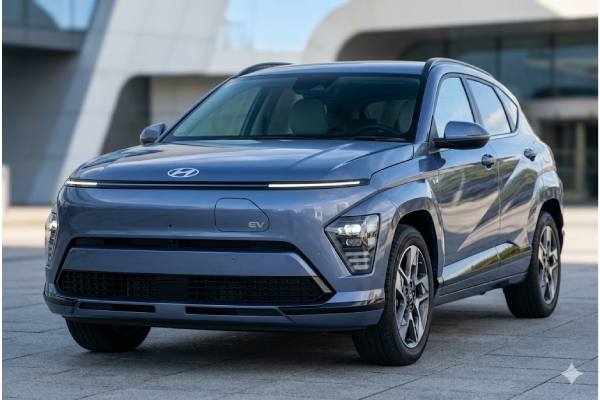
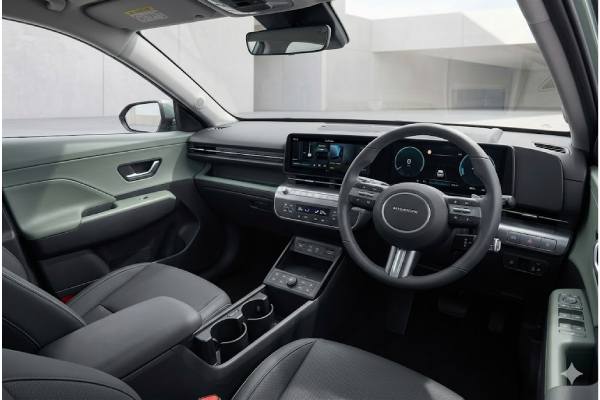
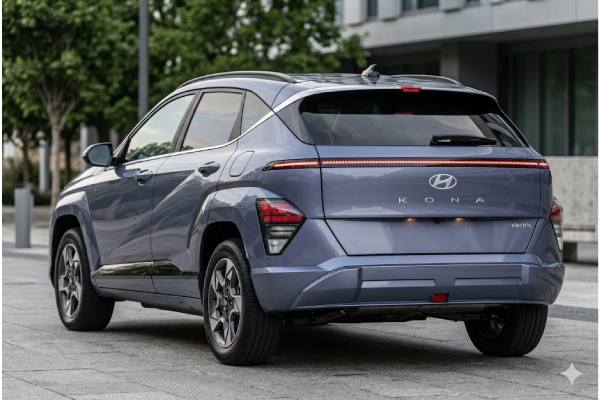
The SX2-generation Hyundai KONA Electric is larger, more mature, and more refined than the first KONA EV, but the 99-kW version remains the efficiency-focused entry point. In North America it is best understood as the standard-range SE model, using a 48.6-kWh battery, a front-mounted permanent-magnet motor, and front-wheel drive. In some global markets, the closely related standard-range SX2 EV is listed with slightly different battery-capacity and output figures, so exact specifications should always be checked by market and VIN.
For buyers, the key question is not whether this is the quickest KONA Electric. It is not. The real question is whether the smaller-battery, lower-output model delivers enough range, charging convenience, safety equipment, and long-term durability to make sense as a daily EV. For urban and suburban use, it is one of the more efficient small electric SUVs. For frequent high-speed road trips, the larger-battery KONA Electric is usually the easier choice.
Quick Overview
- Efficient standard-range EV with about 197–200 miles of EPA-rated range in North American specification.
- Smooth front-drive power delivery, compact SUV practicality, and a useful 10.8-kW AC onboard charger.
- Strong standard driver-assistance coverage, with recent KONA models earning high IIHS recognition.
- Main caveat: the smaller battery and moderate DC charging speed make long highway trips less convenient.
- Typical U.S. maintenance includes tire rotation every 8,000 miles or 12 months, with brake fluid replacement around 48,000 miles or 48 months.
Table of Contents
- KONA SX2 EV Core Profile
- KONA SX2 EV Technical Specs
- KONA SX2 EV Trims and Safety
- Reliability Issues and Service Actions
- Maintenance and Used Buying Advice
- Driving Range and Charging Performance
- How KONA Electric Compares
KONA SX2 EV Core Profile
The Hyundai KONA Electric SX2 EV is the second-generation electric KONA, built around a five-door small-SUV body with a dedicated electric front-drive layout. The 99-kW version is the lower-output, standard-range model. In the U.S. and Canada, it is associated mainly with the SE grade, where the specification is a 99-kW motor, 188 lb-ft of torque, a 48.6-kWh battery system capacity, a single-speed reduction gear, and front-wheel drive.
That makes it a very different proposition from the 150-kW KONA Electric versions. The more powerful models have stronger acceleration and a larger battery, but the 99-kW model is lighter, less expensive, and still quick enough for most commuting. Its instant torque makes it feel responsive at city speeds, even though its 0–60 mph time is modest by modern EV standards. The car is strongest in stop-and-go traffic, short daily trips, and mixed suburban driving, where regenerative braking and low-speed efficiency matter more than peak power.
The SX2 body is a major improvement over the first KONA Electric. It is longer, has a longer wheelbase, and provides better rear-seat and cargo space. The cabin is also more modern, with a wide dual-screen layout, improved infotainment, cleaner switchgear, and more driver-assistance features. It still feels like a compact crossover rather than a large family SUV, but it no longer has the cramped feel that limited the original KONA EV for some owners.
Its battery and charging hardware place it in the practical commuter class rather than the long-distance EV class. The standard-range version can manage a typical week of local driving for many households, but high-speed range drops noticeably at 70–75 mph. DC charging is usable, not class-leading. It can recover from 10% to 80% in roughly three-quarters of an hour under good conditions, but it does not charge like an 800-volt Hyundai IONIQ model.
The ownership appeal is built on efficiency, simplicity, and Hyundai’s EV warranty coverage. There is no engine oil, timing belt, exhaust system, or conventional automatic transmission to maintain. The key long-term systems are the traction battery, onboard charger, DC–DC converter, cooling circuits, reduction gear, brake system, suspension, tires, and software. For a used buyer, the most important evidence is a clean recall history, documented routine service, good tire and brake condition, healthy 12-volt battery behavior, and a battery state-of-health report.
KONA SX2 EV Technical Specs
Identity and Powertrain
| Spec | Value |
|---|---|
| Vehicle | Hyundai KONA Electric SX2 EV |
| Body style | 5-door small SUV |
| Covered powertrain | 99-kW standard-range BEV |
| Baseline market fit | North American SE / comparable standard-range global SX2 EV |
| Model years | 2023–present global SX2 EV generation |
| Motor type | Permanent-magnet synchronous motor |
| Motor count and axle | Single motor, front axle |
| System voltage | 269 V |
| Battery chemistry | Lithium-ion NCM |
| Traction battery capacity | 48.6 kWh |
| Battery layout | Under-floor pack |
| Max power | 133 hp (99 kW) |
| Max torque | 255 Nm (188 lb-ft) |
| Drive type | Front-wheel drive |
| Transmission | Single-speed reduction gear |
| Final drive ratio | 10.65:1 |
Range and Efficiency
| Spec | Value |
|---|---|
| Official test standard | EPA |
| Rated efficiency | 29 kWh/100 mi (18.0 kWh/100 km) |
| EPA combined MPGe | 118 MPGe |
| EPA city MPGe | 131 MPGe |
| EPA highway MPGe | 105 MPGe |
| EPA rated range | 197–200 mi (317–322 km) |
| Real-world highway at 120 km/h | 22–26 kWh/100 km (354–418 Wh/mi) |
| Real-world highway range at 120 km/h | 185–220 km (115–137 mi) |
Charging
| Spec | Value |
|---|---|
| AC connector | SAE J1772 |
| DC connector | CCS1 |
| Charging-port location | Front-left side |
| Onboard charger | 10.8 kW AC |
| DC fast-charge peak | 100 kW |
| Typical 10–80% DC average | 50–60 kW |
| DC 10–80% time | 43 min |
| AC 10–100% time | 4 hr 55 min |
| Battery conditioning | Navigation-linked battery conditioning |
| Vehicle-to-load | Available by market and equipment |
Performance and Chassis
| Spec | Value |
|---|---|
| 0–100 km/h | 8.5 s |
| Top speed | 162.5 km/h (101 mph) |
| Front suspension | MacPherson strut |
| Rear suspension | Multi-link |
| Steering | Electronic rack-and-pinion |
| Turning circle | 10.6 m (34.8 ft) |
| Front brakes | 305 mm ventilated discs |
| Rear brakes | 300 mm discs |
| Wheels | 17 x 7.0 in alloy |
| Tires | 215/55 R17 |
| Parking brake | Electronic parking brake |
Dimensions and Weight
| Spec | Value |
|---|---|
| Length | 4350 mm (171.3 in) |
| Width | 1826 mm (71.9 in) |
| Height | 1580 mm (62.2 in) |
| Wheelbase | 2660 mm (104.7 in) |
| Ground clearance | 150 mm (5.9 in) |
| Curb weight | 1620 kg (3571 lb) |
| GVWR | 2110 kg (4652 lb) |
| Payload | 490 kg (1080 lb) |
| Cargo volume, seats up | 722 L (25.5 ft³) |
| Cargo volume, seats folded | 1803 L (63.7 ft³) |
| Front storage | 27 L (0.95 ft³) |
Safety and Assistance
| Spec | Value |
|---|---|
| IIHS recognition | 2024–25 Top Safety Pick+ for Hyundai KONA |
| IIHS small-overlap front | Good |
| IIHS updated moderate-overlap front | Good |
| IIHS updated side | Good |
| Euro NCAP rating | 4 stars, 2023 Hyundai KONA electric test |
| Euro NCAP adult occupant | 80% |
| Euro NCAP child occupant | 83% |
| Euro NCAP vulnerable road users | 64% |
| Euro NCAP safety assist | 60% |
| Core ADAS | AEB, lane support, blind-spot monitoring, rear cross-traffic alert, adaptive cruise availability |
Service Data
| Spec | Value |
|---|---|
| Tire rotation interval | 8,000 mi (13,000 km) or 12 months |
| Brake fluid interval | Replace at 48,000 mi (78,000 km) or 48 months |
| Battery coolant initial interval | 120,000 mi (200,000 km) or 120 months |
| Battery coolant subsequent interval | 24,000 mi (40,000 km) or 24 months |
| Brake fluid type | DOT 4 |
| Wheel-nut torque | 108–127 Nm (80–94 lb-ft) |
KONA SX2 EV Trims and Safety
In the North American lineup, the 99-kW KONA Electric is the SE model. It is the efficiency and price-focused version, while SEL, N Line, and Limited versions use the stronger 150-kW motor and larger 64.8-kWh battery. That distinction matters because the trim name is not just cosmetic: moving from SE to the higher-output versions changes battery capacity, range, power, and charging behavior. All North American SX2 KONA Electric versions remain front-wheel drive and use a single-speed reduction gear.
The 99-kW SE is easy to identify by its standard-range specification, 17-inch wheel package, and simpler equipment set. It usually lacks some of the luxury and appearance features found on higher trims, such as N Line exterior trim, premium audio, more advanced parking views, power or ventilated front seats, and certain interior materials. Mechanically, the important identifiers are the 48.6-kWh battery, 99-kW motor rating, and 133-hp output. A build sheet, window sticker, or VIN-based dealer inquiry is the cleanest way to confirm the exact configuration.
The model-year picture needs care because the SX2 KONA Electric arrived globally before it became a 2024 model in North America. In Europe and the UK, the standard-range car may be listed with a 48.4-kWh battery and a different metric output figure, while North American publications usually list the SE at 48.6 kWh and 99 kW. Those are not interchangeable specifications for every market, even though they refer to closely related SX2 standard-range cars.
Safety equipment is a major advantage. Depending on year and trim, the KONA Electric can include forward collision avoidance with car, pedestrian, and cyclist detection; lane keeping assist; lane following assist; blind-spot monitoring; rear cross-traffic collision avoidance; smart cruise control with stop-and-go; driver attention warning; safe exit warning; parking sensors; surround-view monitoring; and highway driving assist. Some features are standard, while others move up with trim level, so buyers should test each system rather than assuming all KONA Electric badges include the same driver-assistance package.
For families, the rear outboard seats have ISOFIX/LATCH child-seat provisions, and the body structure is designed around modern side-impact and occupant-protection expectations. Euro NCAP’s 2023 result for the electric KONA was four stars, with solid child-occupant protection but lower vulnerable-road-user and safety-assist percentages than the best-rated vehicles. In the U.S., the KONA nameplate has performed strongly in IIHS testing, with recent model years earning Top Safety Pick+ recognition.
ADAS calibration is an ownership point that should not be ignored. Windshield replacement, front-end collision repair, bumper removal, suspension repairs, wheel alignment, and some steering or sensor work may require camera, radar, or ultrasonic sensor calibration. A cheap repair that leaves the car with misaligned safety sensors can create false warnings, weak lane-centering behavior, poor adaptive cruise performance, or disabled driver-assistance functions.
Reliability Issues and Service Actions
The SX2 KONA Electric is still relatively new, so long-term reliability patterns are not as established as they are for the first-generation KONA Electric. Early evidence points to a generally simple and efficient EV platform, but the usual electric-vehicle checks still matter: 12-volt battery condition, charging hardware behavior, software version history, battery thermal management, drive-unit noise, brake condition, and recall completion.
The most important reliability caveat is that a modern EV can feel mechanically simple while still being electronically complex. A weak 12-volt battery can create warnings that look far more serious than the root cause. Symptoms may include no-start behavior, random warning lamps, infotainment resets, charging interruptions, or driver-assistance faults. The correct remedy is not guesswork; it is a proper battery test, charging-system check, scan-tool diagnosis, and software review.
Battery degradation should be gradual rather than dramatic. Under normal use, the standard-range pack should retain useful capacity for many years, especially if the owner avoids repeated deep discharges, excessive heat exposure, and unnecessary daily 100% charging. Occasional DC fast charging is not a problem, but heavy fast-charging use in hot climates can increase thermal stress. A used buyer should ask for a battery state-of-health report and compare the car’s displayed range against temperature, recent driving style, and state of charge.
Charging-system complaints are usually more likely than traction-battery failures. Watch for AC charging that starts and stops, a charge-port latch that fails to lock, poor connector fit, damaged charge-port seals, water or corrosion around the inlet, and DC sessions that peak much lower than expected in mild weather. Some cases are charger-side issues, but repeated failures across several chargers point toward the vehicle. Remedies can range from software updates and charge-port service to onboard-charger or wiring diagnosis.
Drive-unit issues are less common, but they are expensive enough to take seriously. During a test drive, listen for whining, grinding, bearing growl, clunks during forward-reverse transitions, or vibration under light acceleration. A faint electric-motor whir is normal; harsh mechanical noise is not. The reduction gear and half-shafts should feel smooth, and there should be no fluid seepage around the drive unit.
Brakes can suffer from underuse because regenerative braking does much of the daily slowing. That is good for pad life, but rotors can corrode, especially in wet or salted-road regions. Symptoms include scraping noises after the car sits, pulsing, uneven rotor faces, sticking calipers, or poor friction-brake feel during the final stop. The remedy is regular inspection, occasional friction-brake use, proper brake service, and timely fluid replacement.
Known service-action attention should include recall checks for the 2024 KONA family. One U.S. campaign involved a 12-volt positive battery cable condition on certain 2024 KONA vehicles, with a protective-sheathing remedy. Not every KONA Electric is affected, and recall applicability is VIN-specific. Owners and buyers should run the VIN through the official recall database and request dealer paperwork showing completed repairs.
Corrosion checks are also worthwhile. Inspect the underbody fasteners, suspension arms, brake lines, subframe areas, battery-pack exterior, underbody shields, and charge-port area. Salt-belt cars need more attention. The battery housing should not show impact damage, heavy corrosion, missing covers, or poorly repaired mounting points. Any high-voltage isolation warning, moisture-intrusion code, or unexplained turtle-mode event deserves specialist diagnosis before purchase.
Maintenance and Used Buying Advice
The KONA Electric does not need engine oil, spark plugs, belts for an engine accessory drive, exhaust service, or fuel-system maintenance. That simplifies ownership, but it does not make the car maintenance-free. The most important routine items are tires, brakes, cabin filtration, coolant, software updates, 12-volt battery health, suspension wear, and charging hardware.
A practical schedule for the 99-kW SX2 EV should include tire rotation and a multi-point inspection every 8,000 miles or 12 months. EVs can wear front tires quickly because the motor’s torque acts on the same axle that steers the car. On the front-drive KONA Electric, uneven front wear, shoulder wear, and alignment-related feathering are worth checking at each visit. Wheel alignment is not always required on a fixed interval, but it should be checked after curb impacts, uneven wear, steering pull, or tire replacement.
Brake inspections should happen at the same routine visits. Regenerative braking reduces pad wear, but it can hide caliper and rotor deterioration. The technician should inspect pad thickness, rotor faces, slide pins, parking-brake function, brake hoses, and brake-fluid condition. Brake fluid replacement around 48,000 miles or 48 months is important because moisture-contaminated fluid can affect hydraulic performance and corrosion resistance.
Cabin air filter service is a small but useful ownership item. A dirty filter weakens airflow, makes defogging less effective, and can put extra load on the HVAC system. In dusty, pollen-heavy, or urban environments, replacing it more often than the minimum schedule is sensible.
Cooling-system service is more EV-specific. The traction battery, motor, inverter, onboard charging components, and associated electronics rely on correct thermal management. Use the specified Hyundai coolant, avoid mixing incompatible coolant types, and do not treat EV coolant service like a generic flush. The battery coolant interval is long at first, but after the initial service it becomes more frequent. Any coolant loss, sweet smell, warning message, or reduced charging performance in warm weather deserves inspection.
The 12-volt battery should be tested at least annually once the car is a few years old. Many EV breakdowns begin with a weak auxiliary battery rather than a failed traction battery. Replacement is commonly needed somewhere around three to five years, depending on climate and usage. A car that sits for long periods, makes many short trips, or has aftermarket electronics may shorten that window.
For a used purchase, focus on evidence rather than impressions. A clean, quiet, well-presented KONA Electric can still hide open recalls, poor charging behavior, a weak 12-volt battery, or neglected tires. Ask for:
- A VIN-based recall report and dealer service printout.
- Battery state-of-health data, including any prior module or pack replacement.
- AC and DC charging proof, ideally with recent public fast-charge behavior.
- Tire age, tread depth, matching tire type, and alignment history.
- Brake rotor condition and brake-fluid service records.
- Evidence of software updates for infotainment, ADAS, charging, and battery-management systems.
- Inspection of the charge port, underbody, suspension, and battery housing.
The best examples are usually one-owner cars with routine dealer history, no open recalls, even tire wear, clean underbody condition, and predictable charging behavior. Cars to approach carefully include those with unexplained warning lights, repeated 12-volt failures, accident repairs near the front sensors or charge port, missing service records, abnormal drive-unit noise, or unusually low displayed range that cannot be explained by weather and recent driving.
Long-term durability should be good if the car is maintained and charged sensibly. The highest-cost risks are traction-battery damage, onboard-charger faults, drive-unit replacement, collision-related sensor repairs, and neglected coolant or brake issues. For most owners, tires, brake service, cabin filters, 12-volt battery replacement, and occasional suspension wear will be the more common expenses.
Driving Range and Charging Performance
The 99-kW KONA Electric is not a performance EV, but it is pleasant in the way many modest-power electric cars are pleasant. The first few yards of movement are smooth and immediate, throttle response is easy to meter, and there is no gear hunting. In city traffic, the 188 lb-ft of torque is enough to make the car feel alert. On faster roads, the lower output becomes more obvious, especially above 60 mph, where the 150-kW KONA Electric pulls more confidently.
Ride quality is one of the SX2 generation’s better traits. The low-mounted battery helps body control, and the longer wheelbase gives the car a more settled feel than the original KONA Electric. The standard 17-inch wheel package is the best choice for range, comfort, and tire cost. Larger wheels on higher trims look sharper but can increase road noise and reduce efficiency.
Steering is light and predictable rather than sporty. The front-drive layout means hard acceleration out of tight corners can ask a lot of the front tires, but the standard-range motor is not powerful enough to overwhelm the chassis in normal driving. In wet weather, smooth inputs matter. The stability and traction systems are generally unobtrusive, stepping in when the front tires begin to slip.
Regenerative braking is one of the car’s strengths. Hyundai’s paddle-based regen control lets the driver choose between coasting and stronger energy recovery, and i-PEDAL allows near one-pedal driving in many conditions. The brake pedal handoff is usually smooth, though drivers who use maximum regen all the time should still make a point of using the friction brakes occasionally to keep rotors clean.
Real range depends heavily on speed and temperature. In mild city driving, the KONA Electric can feel impressively efficient and may exceed expectations. In mixed use, many drivers can expect roughly 3.7–4.5 miles per kWh depending on climate, route, and tire choice. At 70–75 mph, the range picture changes. The smaller battery means sustained highway use can bring practical range into the 115–140-mile zone when maintaining a reserve. Cold weather, winter tires, standing water, elevation gain, and cabin heat all reduce that further.
Charging is convenient at home. With a 10.8-kW onboard charger, a suitable Level 2 wallbox can recharge the standard-range battery overnight with ease. For many households, this is more important than DC charging speed because the car starts each day with enough range for commuting.
Public fast charging is adequate but not a standout. A 10–80% session of about 43 minutes is workable for occasional trips, but the average charging power is modest compared with newer dedicated EV platforms. Battery temperature matters. Preconditioning helps the pack reach a better fast-charging temperature before arrival, but it works best when the charger is entered into the navigation system and the battery has enough time to warm or cool before the session.
With passengers and cargo, the KONA Electric remains stable and easy to place, but payload reduces acceleration and range. Towing should be treated cautiously and only according to the exact market approval. Some global versions have low tow ratings, while North American use is more limited. Even light towing can cause a major range penalty, so buyers who plan to tow regularly should consider a larger EV with a higher tow rating and a bigger battery.
How KONA Electric Compares
The 99-kW KONA Electric competes with small and compact EVs that prioritize efficiency and value rather than maximum range. Its closest conceptual rivals include the Kia Niro EV, Chevrolet Bolt EUV, Chevrolet Equinox EV, Nissan Leaf, Volvo EX30, and entry versions of larger electric crossovers. The exact comparison depends heavily on price, incentives, charging access, and whether the buyer needs maximum range or simply a dependable daily EV.
Against the Kia Niro EV, the KONA Electric is closely matched in mission. The Niro is usually a little more conventional and roomy-feeling, while the KONA feels more modern inside and more youthful in design. The 99-kW KONA’s smaller battery gives it less range than many Niro EV versions, but it can be less expensive and still offers strong day-to-day efficiency.
Against the Chevrolet Bolt EUV, the KONA has the advantage of a newer cabin, more current driver-assistance presentation, and a fresher platform feel. The Bolt EUV remains attractive on used price and practical range, but its DC charging rate is slow by current standards. The KONA’s fast charging is not exceptional, but it is more usable for occasional road trips.
Against the Chevrolet Equinox EV, the KONA is smaller and easier to park, but the Equinox offers more space and, in many versions, more range. Buyers who want a primary family EV may prefer the Equinox. Buyers who want a compact commuter with good efficiency and easier urban manners may prefer the KONA.
Against the Volvo EX30, the KONA is less powerful and less premium-feeling, but it is more conventional in controls, packaging, and ownership approach. The Volvo is quicker and more stylish, while the KONA is easier to understand, easier to service through a broad Hyundai dealer network, and more practical for buyers who dislike minimalist interiors.
The biggest internal rival is the larger-battery KONA Electric. For drivers who regularly take highway trips, live in cold climates, or do not have reliable home charging, the 150-kW long-range model is the more flexible choice. It has stronger acceleration and a much larger range buffer. For drivers with home charging, predictable daily mileage, and a desire to keep purchase cost down, the 99-kW standard-range version can be the smarter buy.
The best reason to choose the 99-kW KONA Electric is disciplined practicality. It gives up acceleration and long-distance convenience, but it keeps the core advantages of the SX2 platform: efficient electric driving, useful cargo space, modern safety equipment, simple daily charging, and relatively low routine maintenance. It is not the KONA Electric for every buyer, but for the right use case it is a sensible, low-stress small EV.
References
- 2024 Kona Electric Specifications 2023 (Manufacturer Specifications)
- 2024 – Hyundai : Kona Electric Standard Range 2024 (EPA Efficiency Data)
- Euro NCAP | Hyundai KONA 2023 (Safety Rating)
- 2024 Hyundai Kona 2024 (Safety Rating)
- Check for Recalls: Vehicle, Car Seat, Tire, Equipment | NHTSA 2026 (Recall Database)
Disclaimer
This article is for informational purposes only and is not a substitute for professional diagnosis, repair, or inspection. Specifications, torque values, service intervals, procedures, software campaigns, and equipment can vary by VIN, market, model year, trim, and production date. Always verify details against official Hyundai service documentation, the owner’s manual, dealer records, and a VIN-specific recall check before making maintenance or purchase decisions.
If this helped, consider sharing it on Facebook, X/Twitter, or your preferred automotive community to support our work.