

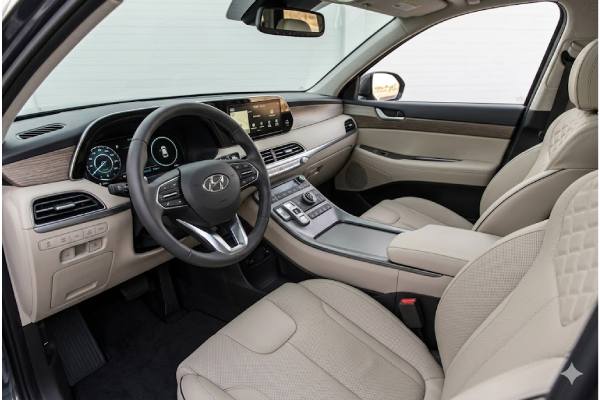
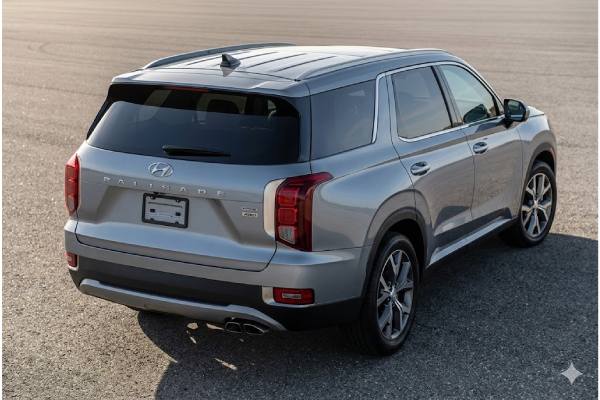
The LX2-generation Hyundai Palisade with HTRAC all-wheel drive is a large three-row SUV built around comfort, space, and relaxed V6 performance rather than rugged off-road hardware. In 2020–2022 form, the North American-market Palisade used Hyundai’s naturally aspirated Lambda II 3.8-liter GDi V6, an 8-speed automatic transmission, and an active on-demand AWD system that could send torque rearward when traction or drive mode demanded it.
For used buyers, the appeal is easy to understand: strong standard safety equipment, generous passenger room, useful towing capacity, and a cabin that feels more premium than many mainstream rivals. The main ownership questions are not about whether the Palisade is powerful enough, but whether the exact vehicle has had recall work completed, whether its fluids and tires have been maintained properly, and whether the trim has the equipment that matters for family use.
Fast Facts
- 291 hp and 262 lb-ft from a 3.8-liter direct-injected V6 gives the AWD Palisade confident everyday performance.
- HTRAC AWD, Snow mode, a large cabin, and up to 5,000 lb towing capacity make it useful for family, winter, and light trailer duty.
- Best-value used examples are often well-equipped SEL AWD or Limited AWD models with complete service and recall records.
- Check recall completion carefully, especially tow-hitch wiring, wiper-related campaigns, seat-belt buckle actions, and current VIN-specific safety work.
- Plan on oil/filter service and tire rotation about every 8,000 miles or 12 months in normal use, with shorter intervals for severe use.
Table of Contents
- Palisade LX2 AWD Model Scope
- Palisade LX2 AWD Specs
- Palisade LX2 AWD Trims Safety
- Reliability Issues and Recalls
- Maintenance and Used Buying
- Real-World Driving Performance
- Rivals and Final Verdict
Palisade LX2 AWD Model Scope
The covered vehicle is the first-generation Hyundai Palisade, internal code LX2, sold for the 2020, 2021, and 2022 model years before the later facelifted versions arrived in many markets. The focus here is the HTRAC AWD version with the Lambda II 3.8 GDi gasoline V6. In U.S. specification, that means a 3,778 cc naturally aspirated V6, gasoline direct injection, 291 hp at 6,000 rpm, 262 lb-ft at 5,200 rpm, and an 8-speed automatic transmission coded A8LF1 in Hyundai product material.
The Palisade is a unibody crossover, not a body-on-frame 4×4. That distinction matters. HTRAC AWD improves traction on wet pavement, snow, gravel roads, and steep driveways, but it is not built around low-range gearing or locking differentials. Its “AWD Lock” function changes torque distribution behavior at low speeds, yet it should be viewed as a traction aid, not a substitute for dedicated off-road hardware.
This generation’s strongest use case is family transport. It offers three rows, a quiet ride, a large cargo area, and available second-row captain’s chairs. Seven-seat and eight-seat layouts were offered depending on trim and market. The third row is more usable than in many smaller midsize SUVs, and the second row is generous enough for adults. Cargo volume is also a major advantage: about 18.0 cu ft behind the third row, 45.8 cu ft behind the second row, and 86.4 cu ft behind the front seats under the SAE method.
The 3.8 GDi engine gives the Palisade a simple character compared with turbocharged rivals. It has no turbocharger, no hybrid battery, and no plug-in system. That helps long-term mechanical simplicity, but the engine is direct-injected, so fuel quality, oil quality, and regular maintenance still matter. The transmission is generally smooth when serviced properly, and the AWD system adds weight and service items compared with FWD versions.
The most important used-buying distinction is not the engine output, which is consistent across the 2020–2022 U.S. range, but trim and equipment. Headlights, driver-assistance features, seating, cameras, audio, rear occupant alerts, and convenience features vary by year and grade. A 2020 SE AWD and a 2022 Calligraphy AWD can feel like very different vehicles even though the core engine, transmission, and dimensions are broadly shared.
Palisade LX2 AWD Specs
The figures below reflect the 2020–2022 U.S.-market LX2 Palisade AWD 3.8 GDi where public Hyundai product data is consistent. Exact values can vary by market, trim, equipment, tires, and production date.
| Item | Hyundai Palisade HTRAC AWD 3.8 GDi |
|---|---|
| Engine family / code | Lambda II 3.8 GDi V6; engine-code references vary by market, commonly listed as G6DN family for this Atkinson-cycle 3.8 GDi |
| Layout | V6, 6 cylinders, DOHC, 4 valves per cylinder, D-CVVT, 24 valves |
| Bore × stroke | 96.0 × 87.0 mm (3.78 × 3.43 in) |
| Displacement | 3.8 L (3,778 cc) |
| Induction | Naturally aspirated |
| Fuel system | Gasoline direct injection (GDi) |
| Compression ratio | 13.0:1 |
| Maximum power | 291 hp (217 kW) at 6,000 rpm |
| Maximum torque | 355 Nm (262 lb-ft) at 5,200 rpm |
| Timing drive | Timing chain |
| EPA-rated AWD economy | 19 / 24 / 21 mpg US city/highway/combined; about 12.4 / 9.8 / 11.2 L/100 km; about 22.8 / 28.8 / 25.2 mpg UK |
| Real-world highway at 120 km/h (75 mph) | Typically around 10.5–12.0 L/100 km (20–22 mpg US), depending on tires, load, wind, terrain, and temperature |
| Item | Specification |
|---|---|
| Transmission | 8-speed automatic, A8LF1, shift-by-wire, SHIFTRONIC manual shift mode |
| Drive type | HTRAC active on-demand AWD |
| Differentials | Open front/rear differentials with electronic traction control; no mechanical locking axle |
| AWD torque behavior | Normal operation can vary from front-biased to about 50:50; AWD Lock can target stronger rear engagement at lower speeds |
| Front / rear suspension | MacPherson strut front; independent multi-link rear, self-leveling rear suspension on selected grades/packages |
| Steering | Column-mounted motor-driven rack-and-pinion power steering, 15.6:1 ratio, 2.87 turns lock-to-lock |
| Brakes | Front ventilated discs 340 × 30 mm (13.4 × 1.2 in); rear solid discs 305 × 11 mm (12.0 × 0.4 in) |
| Common tire sizes | 245/60 R18 or 245/50 R20 |
| Ground clearance | 201 mm (7.9 in) |
| Length / width / height | 4,981 / 1,976 / 1,750 mm (196.1 / 77.8 / 68.9 in) |
| Wheelbase | 2,901 mm (114.2 in) |
| Turning circle | 11.8 m (38.7 ft), curb-to-curb |
| AWD curb weight | About 1,990 kg (4,387 lb) for 7-passenger AWD; about 1,943 kg (4,284 lb) for 8-passenger AWD, trim-dependent |
| AWD GVWR | 2,663 kg (5,871 lb) |
| Fuel tank | 71.2 L (18.8 US gal / 15.7 UK gal) |
| Cargo volume, SAE | 510 L (18.0 cu ft) behind third row; 1,297 L (45.8 cu ft) behind second row; 2,447 L (86.4 cu ft) behind front seats |
| Item | Typical figure or guidance |
|---|---|
| 0–100 km/h (0–62 mph) | About 7.3 seconds, depending on test conditions and load |
| Top speed | About 210 km/h (130 mph) in published market data; verify local specification |
| 100–0 km/h braking | About 40 m (131 ft) in typical independent testing with good tires |
| Towing capacity | 2,268 kg (5,000 lb) braked; 748 kg (1,650 lb) unbraked in U.S. specification |
| Approximate payload | About 673–720 kg (1,484–1,587 lb), depending on seating and curb weight |
| Engine oil | Public Hyundai product data lists 6.9 L; many service references list 6.9 US qt, so verify by VIN and dipstick. SAE 5W-30 meeting the required API/ILSAC specification is commonly specified for these years. |
| Coolant | Public product data lists 4.9 L; use Hyundai-approved ethylene-glycol coolant mixed with deionized water to the service-manual ratio |
| Automatic transmission fluid | Public product data lists 7.0 L; use Hyundai/Kia SP-IV family ATF or exact VIN-specific supersession |
| Transfer case / rear differential | Use VIN-specific Hyundai hypoid gear oil specification and measured service fill; do not rely on generic fill amounts |
| A/C refrigerant and oil | Many Hyundai owner-data pages list R-1234yf and PAG oil for contemporary models; Palisade charge must be confirmed from the underhood label before service |
| Key torque values | Wheel lug nuts are commonly serviced around 107–127 Nm (79–94 lb-ft); oil drain plug commonly around 39–41 Nm (29–30 lb-ft). Confirm service data before repair. |
| Area | 2020–2022 Palisade AWD notes |
|---|---|
| Euro NCAP | No directly applicable Euro NCAP rating for this U.S.-market LX2 AWD configuration |
| IIHS | 2020 Top Safety Pick with specific headlights; 2021 and 2022 Top Safety Pick+ in listed configurations |
| IIHS headlights | 2020 varied by trim: LED projector headlights rated Good, halogen projectors rated Marginal. 2021–2022 ratings improved in IIHS listings. |
| NHTSA | U.S. Palisade received a 5-Star Overall Safety Rating in available 2020-era federal NCAP data; check the exact year and drivetrain in NHTSA’s database |
| ADAS | Forward Collision-Avoidance Assist, Lane Keeping Assist, Driver Attention Warning, High Beam Assist, and stability systems were broadly available, with blind-spot, rear cross-traffic, surround camera, Highway Drive Assist, and parking aids varying by trim/year |
Palisade LX2 AWD Trims Safety
The 2020 U.S. Palisade range launched mainly as SE, SEL, and Limited. For 2021, Calligraphy joined as a more luxurious flagship grade, and the equipment ladder became more clearly separated. Trim names and standard features can differ by country, but the major U.S. pattern is simple: SE is the practical base model, SEL adds desirable comfort and safety options, Limited moves into near-luxury territory, and Calligraphy adds the most premium trim details.
SE AWD is the simplest version. It usually has 18-inch wheels, cloth seating, core safety systems, and the same V6/AWD hardware as upper grades. It can be a good buy when condition and price matter more than luxury features, but it lacks many of the interior upgrades that make the Palisade feel special.
SEL AWD is often the sweet spot if equipped with popular packages. Depending on year and package, it can add blind-spot assistance, rear cross-traffic systems, larger wheels, upgraded seating, roof rails, power liftgate, sunroof, and Highway Drive Assist. A used SEL should be checked carefully against the original window sticker because two SEL AWDs can have very different equipment.
Limited AWD adds the Palisade’s upscale identity: larger wheels, more advanced lighting, premium audio, ventilated seats, heated rear seats, power-folding third row on some versions, surround-view camera, head-up display, and richer cabin materials. Calligraphy goes further with unique exterior details, quilted interior trim, and the most complete equipment mix.
Quick identifiers include the tailgate HTRAC badge, 20-inch wheels on many upper trims, LED headlight signatures, seat upholstery, second-row captain’s chairs, the head-up display opening, surround-view camera button, and the original Monroney/window sticker. Mechanically, the AWD system is best confirmed by underbody inspection for the rear differential, prop shaft, and AWD components, not only by badges.
Safety equipment is one of the Palisade’s major strengths, but it still varies by trim and year. All versions include a strong restraint package with front airbags, front side airbags, side-curtain airbags, driver knee airbag, stability control, anti-lock brakes, tire-pressure monitoring, LATCH/ISOFIX-style child-seat anchors, and rear child locks. Hyundai listed two lower anchors and three tether anchors for the second row, plus additional third-row child-seat provisions, making the Palisade more family-practical than many three-row crossovers.
The important service caveat is ADAS calibration. If the windshield is replaced, front bumper removed, radar disturbed, alignment changed, or suspension repaired, the camera and radar systems may require calibration. A Palisade that has had collision work should be inspected for correct panel fit, sensor mounting, and stored diagnostic trouble codes before purchase.
Reliability Issues and Recalls
The 2020–2022 Palisade 3.8 AWD is generally a durable vehicle when maintained properly, but used examples must be checked for recalls and service actions. Some issues are minor comfort complaints; others are safety-related and should not be ignored.
| Issue | Prevalence | Severity / cost tier | Symptoms and remedy |
|---|---|---|---|
| Tow-hitch harness moisture intrusion | Recall-related on affected 2020–2022 vehicles with genuine accessory tow harness | High safety concern | Risk of short circuit and fire. Verify recall completion, fuse/harness remedy, and dealer records before towing or parking near structures. |
| Windshield wiper motor / wiper-arm campaign | Affected certain 2020–2021 vehicles | High safety concern in snow/ice | Intermittent or inoperative wipers, especially with snow or ice load. Remedy involves revised parts or dealer campaign repair depending on VIN. |
| Seat-belt buckle recall actions | Affects a broad 2020–2025 population in later recall data | High safety concern | Buckle may not latch fully. Owners should confirm VIN status and repair availability, and always tug-test belt engagement. |
| Third-row side-curtain airbag recall | Affects certain 2020–2025 vehicles in later federal recall data | High safety concern | Potential noncompliance with ejection-mitigation requirements. Verify VIN status and official remedy timing. |
| Infotainment, Blue Link, camera, or sensor glitches | Occasional | Low to medium | Frozen display, connection dropouts, camera warnings, or false alerts. Check for software updates and diagnostic codes. |
| Brake vibration or uneven tire wear | Occasional | Low to medium | Pulsation, shimmy, steering vibration, or cupped tires. Inspect rotors, pads, alignment, suspension bushings, and tire condition. |
| AWD driveline neglect | Rare to occasional, worse with towing or severe use | Medium | Binding, rear noise, vibration, or delayed engagement. Inspect transfer case, rear differential, prop shaft, coupler, and fluid history. |
The Lambda II 3.8 GDi V6 is not known for the same pattern of high-profile failures as some smaller Hyundai/Kia four-cylinder engines, but it still deserves careful inspection. Listen for cold-start chain rattle that lasts more than a moment, check for oil seepage around covers and seals, inspect coolant level and condition, and look for misfires under load. Direct injection can contribute to intake-valve deposits over high mileage, especially on short-trip vehicles, though severe carbon issues are not the dominant Palisade concern.
Transmission behavior should be smooth. Harsh engagement, delayed reverse, flare between shifts, or repeated hunting on gentle throttle can point to software, fluid, mount, sensor, or internal issues. Some shift adaptation behavior is normal, but a used Palisade should not clunk or hesitate dramatically. A scan for TCU codes and a road test from cold are worthwhile.
Recall verification should be done by VIN, not by model year alone. Ask for dealer printouts showing completed campaigns and any open recalls. A clean advertisement or a seller’s verbal assurance is not enough, especially for safety-related items.
Maintenance and Used Buying
Maintenance on the Palisade 3.8 AWD is straightforward, but the vehicle is heavy and uses several systems that reward regular attention. Normal-use schedules commonly place oil/filter service and tire rotation around every 8,000 miles or 12 months, while severe use should be shorter. Severe use includes repeated short trips, dusty roads, extreme heat or cold, heavy city driving, roof loads, towing, mountain driving, and extended idling.
| Interval | Service items |
|---|---|
| Every 8,000 miles / 12 months | Engine oil and filter; tire rotation; brake inspection; fluid-level check; battery and charging-system check; suspension, steering, lights, wipers, and tire-pressure inspection |
| Every 16,000 miles | Inspect driveshafts, boots, fuel lines, hoses, vapor lines, parking brake function, AWD components, and underbody corrosion points |
| Every 24,000 miles | Replace or inspect engine air filter depending on use; replace cabin air filter if not done earlier; inspect A/C performance and condenser condition |
| Every 32,000 miles | Inspect transfer case and rear differential fluid condition on AWD models, especially if towing or driving in snow/salt |
| Every 48,000 miles | Replace brake fluid if due by time/condition; inspect serpentine belt, hoses, mounts, cooling system, and drive belt tensioner |
| Every 64,000 miles | Inspect rear differential oil, valve train condition if specified by market, fuel tank air filter, and higher-mileage driveline wear points |
| About 96,000–105,000 miles | Spark plugs are commonly due in this range for modern Hyundai V6 applications; confirm the exact interval by VIN |
| 3–5 years | Test 12 V battery, inspect coolant age, replace weak battery before winter, and check electronic parking brake operation |
The timing chain does not have a routine belt-style replacement interval. Instead, inspect for chain stretch symptoms: extended cold rattle, cam/crank correlation faults, poor running, or timing-related diagnostic codes. Chain guides and tensioners should be replaced only when service data and symptoms justify the work.
A proper buyer inspection should include the following:
- Cold start after sitting overnight, with attention to rattle, smoke, misfire, and idle quality.
- Full scan of engine, transmission, AWD, ABS, airbag, steering, camera, and ADAS modules.
- Check for completed recalls and pending VIN-specific campaigns.
- Underbody inspection for corrosion around subframes, suspension arms, brake lines, exhaust hangers, tow-hitch wiring, and rear AWD components.
- Road test at city speed, highway speed, and during low-speed parking maneuvers.
- Tire inspection for mismatched brands, uneven tread depth, cupping, or sidewall damage.
- Brake inspection for pulsation, rotor lip, pad thickness, and parking-brake operation.
- Verification of all cameras, parking sensors, rear climate control, seat heaters/ventilation, power liftgate, sunroof, and power-folding seats where fitted.
The best used examples are not necessarily the newest or most expensive. A clean SEL AWD with documented oil changes, matching tires, completed recalls, and no accident history can be a better long-term buy than a neglected Limited or Calligraphy. Avoid vehicles with incomplete recall records, unexplained airbag lights, mismatched tires on AWD, signs of flood exposure, harsh transmission engagement, or evidence that a tow-hitch harness issue was ignored.
Real-World Driving Performance
The Palisade 3.8 AWD feels relaxed rather than sporty. The V6 builds power smoothly, and the 8-speed automatic usually chooses higher gears early to keep noise and fuel use down. Around town, the throttle is gentle in Comfort and Eco modes, while Sport mode sharpens response and holds lower gears longer. The engine’s peak torque arrives high in the rev range, so hard passing requires a downshift, but the transmission is generally willing to provide one.
Acceleration is strong enough for a three-row family SUV. A lightly loaded AWD Palisade typically reaches 100 km/h in the low-seven-second range, which is comparable to V6 rivals and quicker than many older three-row crossovers. Passing from 80–120 km/h is confident when the transmission drops two or three gears, though the engine becomes clearly audible at higher rpm.
Ride comfort is one of the Palisade’s best traits. It has a soft, settled feel over broken pavement, and upper trims with 20-inch wheels still ride well as long as tires are in good condition. The 18-inch tire package has more sidewall and can be preferable for rough roads, winter use, and lower replacement cost. Steering is light, accurate enough, and easy in parking lots, but it does not provide much road texture.
Handling is predictable. The Palisade leans when pushed, and the front tires will give up before the rear, but the chassis is stable and reassuring. HTRAC AWD helps on wet exits, snowy starts, and loose surfaces. In normal dry driving, the system often behaves front-biased for efficiency, then transfers torque when needed. Snow mode and AWD Lock improve low-speed confidence, but the Palisade’s real limitation is tire choice. A Palisade AWD on worn all-seasons will be worse in winter than a FWD vehicle on proper winter tires.
Cabin noise is low for the class. Wind noise is generally controlled, road noise depends heavily on tire brand and tread wear, and the V6 is quiet while cruising. At 120 km/h, the main sounds are tire noise and wind around mirrors and roof rails. Fuel economy at that speed is usually worse than the EPA highway number, especially with 20-inch tires, roof bars, winter fuel, strong headwinds, or a full passenger load.
Towing is possible and useful, but the Palisade is not a heavy-duty tow vehicle. With a moderate trailer, expect fuel consumption to rise sharply, braking distances to lengthen, and transmission temperature management to matter on long grades. Use the correct hitch, wiring, brake controller strategy where applicable, tongue weight, tire pressures, and load distribution. Any Palisade used for regular towing should receive more frequent driveline and transmission inspections.
Rivals and Final Verdict
The closest rival is the Kia Telluride. It shares much of the underlying engineering, including the 3.8-liter V6 and related platform, but presents a different design and cabin personality. The Telluride often feels a little more upright and rugged in style, while the Palisade leans more premium and comfort-focused. Buying between them usually comes down to price, condition, equipment, and personal preference rather than a major mechanical advantage.
The Toyota Highlander V6 is a strong alternative for buyers who prioritize resale value and a long reliability reputation. It is not as spacious in the third row, and some versions feel less plush inside, but ownership costs can be predictable. The Highlander Hybrid is much more efficient than the Palisade, though it gives up some V6 character.
The Honda Pilot of the same era is practical, roomy, and mechanically familiar, with a useful all-wheel-drive system in higher trims. Its cabin is less premium than the Palisade’s, but it remains a strong family choice. The Volkswagen Atlas offers even more third-row and cargo space, but its cabin materials and long-term ownership record vary more by year and maintenance history. The Mazda CX-9 is more enjoyable to drive and more refined in some ways, but it is smaller inside and uses a turbocharged four-cylinder rather than a naturally aspirated V6.
The Palisade’s advantages are clear: large interior, strong safety equipment, smooth V6, comfortable ride, good towing capacity, and upscale trim availability. Its weaknesses are also clear: fuel economy is only average, the vehicle is large in tight urban spaces, AWD adds service complexity, and recall verification is essential.
For a used 2020–2022 purchase, the best choice is a well-documented AWD example with matching quality tires, completed recalls, clean accident history, and the right trim features. A neglected Palisade can become expensive quickly because sensors, safety systems, tires, brakes, and AWD components are not cheap. A properly maintained one remains one of the more comfortable and capable three-row SUVs of its period.
References
- 2022 Palisade Specifications 2021 (Manufacturer Specifications)
- 2022 Hyundai Palisade 2022 (Safety Rating)
- Part 573 Safety Recall Report 22V-633 2022 (Recall Database)
- Part 573 Safety Recall Report 25V607 2025 (Recall Database)
- Part 573 Safety Recall Report 26V034 2026 (Recall Database)
Disclaimer
This article is for informational purposes only and is not a substitute for professional diagnosis, inspection, or repair. Specifications, torque values, fluid capacities, service intervals, software procedures, safety equipment, and recall applicability can vary by VIN, market, build date, trim, and installed equipment. Always verify details against the official service documentation, owner’s manual, underhood labels, and a Hyundai dealer VIN check before servicing or buying a vehicle.
If this information helped you, please consider sharing it on Facebook, X/Twitter, or another platform so more owners and buyers can make informed decisions.