
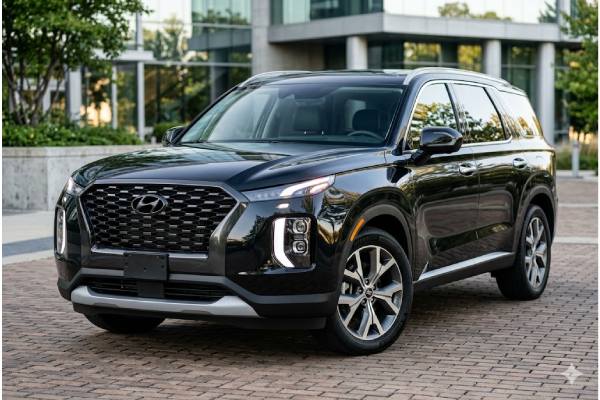

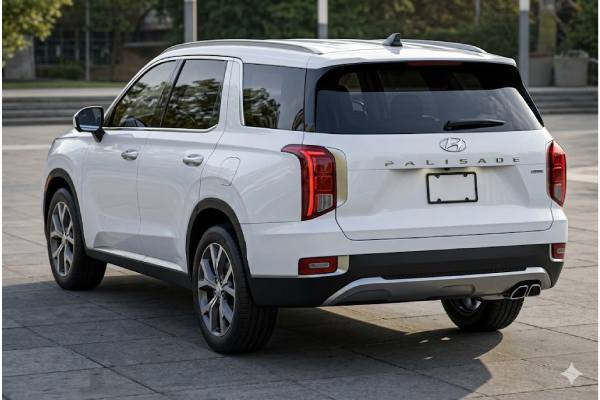
The 2020–2022 Hyundai Palisade LX2 is a large three-row crossover built around a naturally aspirated 3.8-liter Lambda II GDi V6, an eight-speed automatic transmission, and either front-wheel drive or Hyundai’s HTRAC all-wheel-drive system. It arrived as Hyundai’s flagship family SUV, positioned above the Santa Fe, with an emphasis on passenger space, quiet road manners, towing ability, and a long standard-equipment list.
For used buyers, the Palisade is appealing because it offers near-premium cabin comfort without the running costs of a luxury-badged SUV. The main questions are not whether it is roomy or well equipped—it clearly is—but whether the V6 is durable, which years and trims make the most sense, what maintenance is easy to overlook, and which recalls or service actions should be verified before purchase.
Quick Overview
- Strong 291 hp V6, smooth eight-speed automatic, and up to 5,000 lb towing when properly equipped.
- Excellent passenger packaging, with adult-friendly first and second rows and a usable third row for a midsize three-row SUV.
- Safety credentials are strong, especially on 2022 models with broader headlight qualification and IIHS Top Safety Pick+ recognition.
- Check recall completion carefully, especially tow-hitch harness, windshield-wiper motor, and seat-belt buckle campaigns where applicable.
- Normal oil and tire-rotation service is typically every 7,500 miles or 12 months; severe use can reduce oil service to 3,750 miles or 6 months.
Table of Contents
- Hyundai Palisade LX2 Used Context
- Hyundai Palisade LX2 Technical Specs
- Hyundai Palisade LX2 Trims and Safety
- Reliability, Issues and Recalls
- Maintenance and Used Buyer Checks
- Driving, Performance and Efficiency
- Comparison With Key Rivals
Hyundai Palisade LX2 Used Context
The LX2 Palisade is a unibody, front-engine, three-row SUV sold in North America with one gasoline engine during the 2020–2022 period: the 3.8-liter Lambda II Atkinson-cycle GDi V6. The powertrain is simple by modern three-row-SUV standards because there is no turbocharger, no hybrid system, and no dual-clutch transmission. That makes the vehicle easier to understand as a used purchase, although it still has modern direct injection, idle stop-start, electronic shift-by-wire controls, and extensive driver-assistance systems.
In the United States, the 2020 launch range centered on SE, SEL, and Limited trims. For 2021, Hyundai added the more upscale Calligraphy grade, which brought more premium interior trim, unique exterior details, and standard AWD in the U.S. market. The 2022 model year remained part of the pre-facelift LX2 range; the major styling and equipment refresh came for 2023, outside the scope of this article.
The Palisade’s strongest advantage is its packaging. At about 196.1 inches long, it is easier to park than a full-size body-on-frame SUV, but it still provides three real rows, generous second-row legroom, and a cargo area that expands from grocery duty to flat-load family-hauler space. Seven-seat versions use second-row captain’s chairs, while eight-seat versions use a second-row bench. The choice matters: captain’s chairs improve access and comfort, while the bench gives maximum passenger capacity.
Mechanically, the Palisade is closely related to the Kia Telluride. Both share the same basic platform, V6 output, transmission family, towing rating, and much of their safety engineering. The Hyundai leans slightly more toward a refined, soft-touch, upscale cabin presentation, while the Kia has a boxier, more rugged design character.
For most buyers, the best ownership profile is a well-maintained SEL with the right packages or a Limited/Calligraphy with full service records and completed recalls. The higher trims are desirable, but they also bring more electronics, powered comfort features, larger 20-inch wheels, and more expensive cosmetic repair items. A base SE can be a smart value if seating capacity, safety equipment, and mechanical condition matter more than leather, panoramic glass, premium audio, and camera systems.
The Palisade is not a heavy-duty off-roader or a substitute for a truck-based SUV. Its HTRAC AWD system is useful in rain, snow, gravel roads, and light trails, but the vehicle’s ground clearance, long overhangs, road-biased tires, and unibody layout define its realistic use. Its sweet spot is family transport, highway travel, school runs, airport trips, light towing, and long-distance comfort.
Hyundai Palisade LX2 Technical Specs
The 2020–2022 Palisade 3.8 GDi uses the same core engine output across trims. The figures below are most applicable to U.S.-market gasoline models; imported vehicles from Korea, Canada, the Middle East, or other regions can differ in lighting, emissions hardware, service intervals, trim names, towing equipment, and warranty coverage.
| Item | Hyundai Palisade LX2 3.8 GDi |
|---|---|
| Engine code/family | Lambda II 3.8 GDi, Atkinson-cycle capable |
| Layout | 60-degree V6, aluminum block and head, DOHC, D-CVVT, 24 valves, 4 valves/cyl |
| Bore × stroke | 96.0 × 87.0 mm (3.78 × 3.43 in) |
| Displacement | 3.8 L (3,778 cc / 230.5 cu in) |
| Induction and fuel system | Naturally aspirated; gasoline direct injection |
| Compression ratio | 13.0:1 |
| Maximum power | 291 hp (217 kW) @ 6,000 rpm |
| Maximum torque | 355 Nm (262 lb-ft) @ 5,200 rpm |
| Timing drive | Timing chain; no scheduled belt replacement |
| EPA fuel economy, FWD | 12.4 / 9.0 / 10.7 L/100 km city/highway/combined (19 / 26 / 22 mpg US; 22.8 / 31.2 / 26.4 mpg UK) |
| EPA fuel economy, AWD | 12.4 / 9.8 / 11.2 L/100 km city/highway/combined (19 / 24 / 21 mpg US; 22.8 / 28.8 / 25.2 mpg UK) |
| Real-world highway at 120 km/h | Typically about 10.0–12.0 L/100 km (20–24 mpg US), depending on tires, load, wind, roof accessories, and AWD use |
| Item | Specification |
|---|---|
| Transmission | 8-speed automatic, A8LF1, SHIFTRONIC manual mode, shift-by-wire |
| Drive type | FWD standard on most trims; HTRAC AWD optional, standard on some upper trims by year/market |
| Differentials | Open differentials with electronically managed AWD coupling; no locking axle differentials |
| Front suspension | MacPherson strut with coil springs and stabilizer bar |
| Rear suspension | Independent multi-link; self-leveling rear suspension available or included with some packages |
| Steering | Column-mounted motor-driven power steering; 15.6:1 ratio; 2.87 turns lock-to-lock |
| Turning circle | 11.8 m (38.7 ft), curb-to-curb |
| Brakes | Front ventilated discs 340 mm (13.4 in); rear solid discs 305 mm (12.0 in) |
| Common tires | 245/60 R18 on base/lower trims; 245/50 R20 on many SEL-optioned, Limited, and Calligraphy models |
| Ground clearance | 201 mm (7.9 in) |
| Length / width / height | 4,981 / 1,976 / 1,750 mm (196.1 / 77.8 / 68.9 in) |
| Wheelbase | 2,901 mm (114.2 in) |
| Curb weight | Approx. 1,872–1,990 kg (4,127–4,387 lb), depending on seating, trim, and drivetrain |
| GVWR | Approx. 2,600 kg FWD / 2,663 kg AWD (5,732 / 5,871 lb) |
| Fuel tank | 71.2 L (18.8 US gal / 15.7 UK gal) |
| Cargo volume, SAE | 510 L (18.0 ft³) behind third row; 1,297 L (45.8 ft³) behind second row; 2,447 L (86.4 ft³) behind first row |
| Item | Specification or guidance |
|---|---|
| 0–100 km/h / 0–62 mph | Typically around 7.3–7.8 seconds in independent testing, depending on trim, drivetrain, load, and conditions |
| Top speed | Market-dependent; not a central factory-published buying metric for this model |
| 100–0 km/h braking | Comparable road tests place 62–0 mph braking roughly around 39–40 m (128–130 ft), tire-dependent |
| Towing capacity | 2,268 kg (5,000 lb) braked; 748 kg (1,650 lb) unbraked, where properly equipped |
| Engine oil | Use the VIN-correct Hyundai/API/ILSAC gasoline-engine oil; 5W-30 is commonly specified for this V6 in many references; capacity about 6.9 L (7.3 US qt) with filter |
| Coolant | Ethylene-glycol coolant suitable for aluminum engines; typically 50/50 premix; listed capacity about 4.9 L (5.2 US qt) in Hyundai specification data |
| Automatic transmission fluid | Hyundai/Kia SP-IV family ATF or exact supersession by VIN; listed capacity about 7.0 L (7.4 US qt) |
| Transfer case / rear axle oil | AWD only; verify exact Hyundai specification by VIN before service |
| A/C refrigerant and oil | Check the under-hood label; refrigerant type and charge can vary by market and production specification |
| Key torque values | Oil drain plug commonly about 39–41 Nm (29–30 lb-ft); wheel lug nuts commonly about 108–127 Nm (80–94 lb-ft). Verify with service data for the exact VIN. |
Hyundai Palisade LX2 Trims and Safety
The 2020 Palisade launched in the U.S. mainly as SE, SEL, and Limited. SE is the practical entry grade, usually with cloth seating, 18-inch wheels, the full three-row body, and a strong core safety package. SEL is the flexible middle trim and is often the best used value because it could be optioned with convenience and premium packages. Limited sits near the top with leather or premium leather trim, larger screens, more cameras, ventilated seats, a premium audio system, and additional comfort equipment.
For 2021, Calligraphy became the flagship grade. It added more distinctive exterior trim, upgraded interior materials, a richer cabin finish, and standard AWD in the U.S. market. For 2022, the formula stayed similar, with the pre-facelift styling and powertrain continuing before the 2023 update.
Important trim identifiers include the wheel size, second-row seating configuration, grille and lower trim finish, digital cluster availability, seat material, head-up display, surround-view camera, and whether the vehicle has HTRAC badging. A window sticker, build sheet, or VIN report is better than relying on badges alone, because SEL package content can vary widely.
| Trim | Typical role | Used-buyer notes |
|---|---|---|
| SE | Base family transport | Often eight seats, 18-inch wheels, fewer luxury features, lower replacement-cost risk |
| SEL | High-value middle trim | Best balance if fitted with desired packages; check whether it has leather, captain’s chairs, navigation, and advanced parking/camera features |
| Limited | Luxury-focused trim | Desirable comfort equipment, but inspect electronics, seat functions, panoramic roof operation, cameras, and interior wear carefully |
| Calligraphy | Top grade from 2021 | Most premium feel; usually strongest equipment level and higher resale price |
Safety is one of the Palisade’s strongest areas. It performed very well in the original IIHS crash-test structure for this generation, and the 2022 model earned Top Safety Pick+ recognition. Earlier 2020 models were also highly rated by IIHS, but the award language depended on specific headlights. That distinction matters for used buyers: two vehicles with the same engine can have different headlight performance depending on trim and build.
NHTSA overall safety ratings for these model years are also strong, with five-star overall results commonly associated with the Palisade. The rollover category is naturally more challenging for any tall three-row SUV than for a lower car, so tire condition, correct pressures, load placement, and stability-control health still matter.
Driver assistance is branded under Hyundai SmartSense. Common equipment across the range includes forward collision avoidance, lane keeping or lane following support, driver attention warning, adaptive cruise capability, rear parking support, and high-beam assist, although exact standard and optional status varies by year and trim. Blind-spot monitoring, rear cross-traffic systems, surround-view cameras, highway driving assistance, parking collision avoidance, and blind-spot camera views are more trim-dependent.
A pre-purchase inspection should include a road test of adaptive cruise, lane support, blind-spot alerts, parking sensors, and cameras. After windshield replacement, bumper repair, suspension work, alignment changes, or front-end collision repair, ADAS sensors may need calibration. Poor calibration can cause warning lights, false alerts, inactive driver aids, or inconsistent lane-centering behavior.
For child seats, the Palisade is one of the more accommodating three-row SUVs. LATCH/ISOFIX provisions are practical in the second row, and the wide rear doors help with child-seat installation. Still, the third row is best tested with the actual child seats a family plans to use, because tether access, seatbelt geometry, and passenger space can change the setup.
Reliability, Issues and Recalls
The Palisade’s 3.8-liter V6 and eight-speed automatic have generally proven robust when serviced correctly, but the model has several known ownership points that should be checked before purchase. The most important distinction is between ordinary wear issues and safety recalls. Recalls should be verified by VIN through official databases and dealer records, not by verbal assurance from a seller.
| Issue or system | Prevalence | Severity/cost | What to check |
|---|---|---|---|
| Tow-hitch harness recall | VIN/equipment-dependent | High safety relevance | Applies to certain 2020–2022 vehicles with genuine accessory tow-hitch wiring; verify remedy completion |
| Windshield-wiper motor recall | Some 2020–2021 vehicles | Medium to high safety relevance | Intermittent or failed wiper operation, especially under snow/ice load; check recall status |
| Seat-belt buckle recall | Broad 2020–2025 population | High safety relevance | Confirm buckles latch positively; verify inspection or replacement by VIN |
| Direct-injection carbon buildup | Occasional over higher mileage | Medium | Rough idle, misfires, hesitation, reduced economy; inspect if short-trip use is heavy |
| Oil consumption or leaks | Rare to occasional | Low to high depending on cause | Check dipstick history, underbody, valve-cover areas, timing-cover seams, and service records |
| Transmission shift complaints | Occasional | Medium | Look for flare, shudder, harsh downshift, delayed engagement, or missed ATF service under severe use |
| Suspension, tires, and wheel bearings | Occasional | Low to medium | More likely on 20-inch wheels, rough roads, heavy loads, and poor alignment history |
| Interior odor or material issues | Occasional on early high-trim examples | Low to medium | Inspect cabin smell, leather condition, damp carpets, sunroof drains, and HVAC odor |
The tow-hitch harness recall is especially important because it involves fire risk on certain 2020–2022 Palisades equipped with Hyundai accessory tow-hitch wiring. Moisture and debris could enter the harness module and cause a short circuit. The remedy involves dealer inspection and updated fused wiring components. Any Palisade used for towing should have documented recall completion and the correct trailer wiring configuration.
The windshield-wiper motor recall affects certain 2020–2021 vehicles. The issue is related to wiper motor operation becoming intermittent or inoperative, especially when load increases because of snow or ice. On a test drive, do not simply flick the wipers once. Run all speeds, washer function, rain-sensing behavior if equipped, and check for noise, hesitation, or parking-position errors.
The 2025 seat-belt buckle campaign is also relevant to 2020–2022 vehicles because the affected population extends across much of the first-generation Palisade run. A buckle that gives a weak click, has an odd button position, or releases unexpectedly is a serious concern. Until a vehicle is verified, every buckle should be tested physically.
For the V6 itself, there is no scheduled timing-belt service because it uses timing chains. That does not mean timing components are lifetime under all conditions. Chain rattle on cold start, cam/crank correlation fault codes, metal debris, poor oil-change history, or persistent timing-related diagnostic codes justify deeper inspection. Clean oil is especially important for chain tensioners, variable valve timing components, and GDi engine longevity.
The transmission should shift smoothly from cold and warm starts. Some gear hunting is normal on hills because the V6 makes peak torque high in the rev range, but harsh engagement, repeated flare, or vibration under light throttle is not normal. AWD models should also be checked for transfer-case seepage, rear coupling noise, and binding during tight low-speed turns.
Corrosion protection is generally good, but region matters. In salted climates, inspect subframes, brake lines, rear suspension arms, fasteners, exhaust flanges, trailer-hitch mounting points, and the lower tailgate area. A clean-looking upper body does not guarantee a clean underside.
Maintenance and Used Buyer Checks
The Palisade rewards conventional maintenance. The drivetrain is not exotic, but it is large, heavy, direct-injected, and often used for short trips, commuting, family hauling, winter driving, and towing. Those conditions are harder on fluids, brakes, tires, batteries, and suspension parts than a relaxed highway-only life.
| Item | Typical interval or guidance |
|---|---|
| Engine oil and filter | Every 7,500 miles or 12 months normal use; about 3,750 miles or 6 months severe use |
| Tire rotation | Every 7,500 miles; inspect alignment if wear is uneven |
| Cabin air filter | Replace about every 12 months, sooner in dusty or high-pollen areas |
| Engine air filter | Inspect regularly; replace around 22,500 miles or sooner if dirty |
| Brake system | Inspect pads, rotors, hoses, and parking brake every service; inspect brake fluid around 15,000-mile intervals and replace by condition/time |
| Spark plugs | Replace around 97,500 miles on the 3.8 GDi, or sooner if misfire diagnosis requires it |
| Coolant | First replacement around 120,000 miles or 10 years, then about every 30,000 miles or 24 months |
| Automatic transmission fluid | No routine replacement under normal use in some Hyundai schedules; replace around 60,000 miles under severe service |
| Transfer case and rear axle oil | AWD only; inspect around 37,500 miles and service more aggressively if towing, driving in snow, or operating in severe conditions |
| Drive belts and hoses | Inspect at major services; first belt inspection commonly around 60,000 miles or 72 months |
| Valve clearance | Inspect if specified by the maintenance schedule or if valvetrain noise, misfire, or performance symptoms appear |
| 12 V battery | Test annually after year three; many original batteries are due between years four and six |
A good used Palisade should come with oil-change receipts, tire history, brake records, recall documentation, and evidence that AWD fluids were not ignored if the vehicle towed or lived in a severe climate. For a 60,000-mile example, budget for tires, brake work, battery replacement, cabin and engine filters, AWD fluid inspection, alignment, and possibly transmission service if severe-use conditions apply.
On inspection, start with the basics. The V6 should start quickly, idle evenly, and pull cleanly without misfires. Check for oil leaks around the upper engine, timing cover area, oil pan, and filter housing. Look at the coolant level when cold and inspect for crusting around hose connections. The exhaust should not show excessive smoke after warm-up.
Then test every comfort and safety feature. High-trim Palisades can include ventilated seats, heated rear seats, power-folding functions, panoramic roof hardware, surround-view cameras, a head-up display, premium audio, power tailgate, blind-spot camera views, and multiple USB ports. None of these should be assumed to work because the vehicle looks clean.
During the road test, include low-speed turns, broken pavement, a highway merge, steady cruising, and moderate braking. Listen for front strut noise, rear suspension clunks, humming wheel bearings, brake pulsation, steering vibration, and wind noise from poor glass or roof-seal fit. The transmission should engage Drive and Reverse without a heavy delay.
Recommended used-buy choices depend on priorities. An SEL with the right convenience and safety packages is often the rational pick. Limited and Calligraphy versions make sense if luxury equipment is important and the inspection is clean. A neglected top trim is usually worse than a well-kept mid trim, because electronic and cosmetic repairs can erase the value advantage quickly.
Driving, Performance and Efficiency
The Palisade drives like a large, comfort-focused crossover rather than a sporty SUV. Its strongest dynamic quality is calmness. The body structure feels substantial, the suspension filters everyday bumps well, and the cabin is quiet enough for long highway trips. On 18-inch wheels, the ride is generally softer and more forgiving. On 20-inch wheels, steering response sharpens slightly, but tire impact noise and harshness can increase on broken pavement.
The 3.8-liter V6 is smooth and refined, but its torque peak arrives high in the rev range. Around town, the engine feels relaxed rather than muscular. It responds well when revved, and the eight-speed automatic usually shifts cleanly, but the Palisade does not have the effortless low-rpm shove of a turbocharged six-cylinder or a hybrid with electric torque. In Sport mode, throttle response and shift mapping become more eager; in Eco mode, the vehicle feels more subdued and can upshift earlier.
Highway passing is adequate for the class. With passengers and luggage aboard, the transmission may downshift two or three gears to access the stronger part of the V6’s powerband. That behavior is normal, although repeated hunting on grades can become noticeable when towing or fully loaded.
Braking feel is confidence-inspiring when the system is healthy. Because the Palisade is heavy, brake condition matters. Pulsation under light pedal pressure often points to rotor thickness variation or uneven pad deposits. A soft pedal can indicate fluid condition, air, or hydraulic issues. A pre-purchase brake inspection is worthwhile, especially on vehicles used in mountains or dense city traffic.
AWD models use Hyundai’s HTRAC active on-demand system. In normal steady cruising, the vehicle behaves mainly like a front-drive crossover, but it can send torque rearward when traction, mode selection, or acceleration demand calls for it. Snow mode and AWD lock improve low-speed confidence on slippery surfaces, but tire quality remains the real limiting factor. A Palisade on worn all-season tires will not feel secure simply because it has AWD.
Real-world fuel economy is reasonable for a large gasoline three-row SUV but not exceptional. In city driving, expect roughly 12.5–15.0 L/100 km (16–19 mpg US) depending on traffic, idling, and trip length. Mixed use often lands around 10.5–12.5 L/100 km (19–22 mpg US). At 100–120 km/h highway speeds, a lightly loaded FWD model can be efficient for its size, while AWD, roof boxes, winter tires, crosswinds, and heavy loads can push consumption noticeably higher.
Towing is one of the Palisade’s useful strengths. The 5,000 lb braked rating is competitive, and trailer sway control plus the available self-leveling rear suspension are helpful. Still, this is not a truck. Tongue weight, cooling health, trailer brakes, tire pressures, and transmission temperature matter. A moderate trailer will increase fuel consumption sharply; a 20–35 percent penalty is realistic depending on speed, frontal area, grade, and wind.
Overall, the Palisade is best appreciated as a quiet, comfortable family vehicle with enough performance, not as a driver’s SUV. Its advantage is how little effort it asks from the driver over long distances.
Comparison With Key Rivals
The Palisade competes with some of the most practical three-row SUVs on the market. Its closest rival is the Kia Telluride, but buyers also cross-shop the Toyota Highlander, Honda Pilot, Mazda CX-9, Volkswagen Atlas, Ford Explorer, Chevrolet Traverse, and Subaru Ascent.
| Rival | Where the Palisade is stronger | Where the rival may be stronger |
|---|---|---|
| Kia Telluride | More upscale cabin presentation in some trims; similar powertrain and safety foundation | Boxier styling, slightly more rugged image, very strong resale appeal |
| Toyota Highlander | More third-row and cargo space; richer feature content for the money | Hybrid availability, fuel economy, Toyota resale reputation |
| Honda Pilot | More premium interior feel in upper trims; quieter highway character | Honda practicality, cargo flexibility, long-term familiarity among independent shops |
| Mazda CX-9 | Better third-row room, more cargo volume, higher tow rating | Sharper handling, smaller-feeling road manners, turbo low-rpm torque |
| Volkswagen Atlas | More refined cabin materials in higher trims; smoother V6 character | Very roomy third row and cargo space, squared-off interior packaging |
| Ford Explorer | Smoother family-focused ride, simpler naturally aspirated V6 ownership profile | Available rear-drive platform, stronger turbo engines, hybrid and performance variants |
Against the Telluride, the choice is mostly taste and equipment. Both are fundamentally similar, so condition, price, service history, and available trims matter more than small specification differences. Against the Highlander, the Palisade feels roomier and more luxurious, but Toyota’s hybrid option is a major advantage for high-mileage drivers. Against the Pilot, the Hyundai offers more visual polish and often more equipment per dollar, while the Honda counters with a long record of family-SUV practicality.
The Mazda CX-9 is more enjoyable to drive on a winding road, but it gives up space. The Atlas has excellent room but can feel less polished inside depending on trim. The Explorer offers a broader powertrain range, but its more complex turbocharged variants can be less straightforward for buyers who want simple long-term ownership.
The Palisade’s best argument is balance. It is spacious without being full-size, refined without luxury-brand repair costs, powerful enough without turbo complexity, and well equipped without needing the highest trim. Its weaknesses are mostly predictable: average fuel economy, potentially expensive upper-trim electronics, tire and brake wear on heavy-use examples, and the need to verify recall completion carefully.
For a used 2020–2022 purchase, the ideal example is not necessarily the newest or most expensive one. It is the Palisade with clean service records, matching tires, smooth transmission behavior, no unresolved safety campaigns, no accident-repair warning signs, and the exact seating and equipment layout the buyer needs.
References
- 2020 Palisade Specifications 2020 (Manufacturer Specifications)
- All-New 2020 Palisade Product Guide 2022 (Manufacturer Specifications)
- Fuel Economy of the 2022 Hyundai Palisade AWD 2022 (Fuel Economy)
- 2022 Hyundai Palisade 2022 (Safety Rating)
- Recall: Hyundai Palisade, Kia Telluride Fire Risk 2022 (Recall Database)
Disclaimer
This article is for informational purposes only and is not a substitute for professional diagnosis, repair, inspection, or official service information. Specifications, torque values, service intervals, capacities, software updates, recall applicability, and procedures can vary by VIN, market, equipment, production date, and later service documentation. Always verify details against the official owner’s manual, service manual, under-hood labels, dealer records, and VIN-specific recall databases before maintenance or purchase decisions.
If this overview helped, consider sharing it on Facebook, X/Twitter, or with someone comparing three-row SUVs. Your support helps us continue producing detailed, practical automotive resources.