

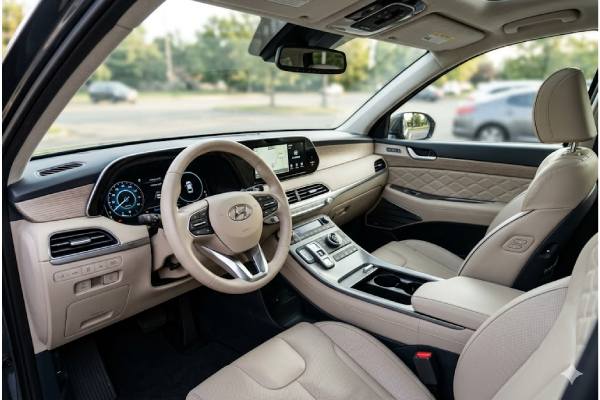

The LX2-generation Hyundai Palisade diesel is a large three-row SUV aimed at buyers who want space, towing ability, and long-distance efficiency without moving to a petrol V6. In 2021–2022 form, the 2.2-litre R-series turbo-diesel was commonly paired with Hyundai’s HTRAC all-wheel-drive system and an 8-speed automatic, giving it a very different character from the North American petrol-only Palisade.
The key appeal is practical rather than sporty. This version is about relaxed torque, family comfort, strong equipment levels, and lower highway fuel use than the larger petrol engines. It is also a vehicle where market details matter: equipment, safety ratings, service schedules, emissions hardware, and even published power figures vary by country and build date.
Quick Specs and Notes
- Strong 440 Nm diesel torque suits highway driving, full passenger loads, and moderate towing better than stop-start city use.
- HTRAC AWD, multi-link rear suspension, and a long 2,900 mm wheelbase give the Palisade stable, composed family-SUV manners.
- The 7.3 L/100 km official combined figure is achievable only in gentle conditions; mixed real-world use is usually higher.
- Maintenance history matters: fuel filter, ATF, axle oil, coolant, brake fluid, and recall completion should all be verified before purchase.
- A typical market service pattern is every 10,000 km or 6 months, with engine oil and filter replaced at each scheduled visit.
Table of Contents
- Palisade LX2 Diesel AWD Profile
- Palisade LX2 Specs and Data
- Palisade LX2 Trims and Safety
- Reliability, Issues and Recalls
- Maintenance and Used Buyer Checks
- Driving, Performance and Economy
- Palisade Diesel Against Rivals
Palisade LX2 Diesel AWD Profile
The 2021–2022 Hyundai Palisade HTRAC AWD with the 2.2 R VGT diesel belongs to the first-generation LX2 Palisade line. It is a unibody large SUV with three seating rows, transverse engine layout, front-biased on-demand all-wheel drive, and a conventional torque-converter automatic transmission. In many right-hand-drive and Asia-Pacific markets, this diesel AWD version was the practical alternative to petrol V6 variants.
The engine is Hyundai’s R-series 2.2-litre CRDi diesel, commonly identified as D4HB. In the Australian-market data for the 2021 model, it is rated at 147 kW, which converts to about 197 hp, at 3,800 rpm. Some markets describe the same engine as 200 PS, so apparent power differences often reflect metric horsepower, DIN horsepower, or local certification wording rather than a fundamentally different engine.
The Palisade’s purpose is easy to understand once the numbers are put in context. It is nearly five metres long, has a 2.9-metre wheelbase, and can be configured with seven or eight seats depending on trim and second-row layout. It is not a rugged ladder-frame 4×4, but its 203 mm ground clearance, HTRAC system, diesel torque, and 2,200 kg braked towing rating make it useful for family travel, wet roads, gravel routes, ski trips, and loaded highway use.
The diesel version is usually the one to choose when efficiency and torque matter more than outright acceleration. It is not quick by modern SUV standards, but the 440 Nm torque band from roughly 1,750 to 2,750 rpm gives it an easy low-rev character. It feels most at home settling into a steady cruise, climbing long grades without dramatic downshifts, or moving seven occupants without the strained feeling that smaller petrol engines can show.
Its main caveat is complexity. A modern common-rail diesel uses high-pressure injection, turbocharging, exhaust aftertreatment, multiple sensors, EGR control, and strict oil and fuel-quality requirements. Short urban trips, neglected filters, wrong oil, poor diesel quality, and skipped fluid services can shorten the life of expensive parts. Buyers considering a used 2021–2022 Palisade diesel should treat service records as seriously as mileage.
The 2022 model year also sits around a transition point in some markets. Pre-facelift and facelift vehicles may have different safety equipment, crash-test applicability, styling, infotainment details, and trim content. That makes build date, market, VIN, and trim more important than model year alone.
Palisade LX2 Specs and Data
The figures below focus on the 2021–2022 LX2 Palisade 2.2 CRDi / R VGT diesel AWD where the diesel HTRAC layout was sold. Values can vary by market, trim, wheel package, emissions standard, seating layout, and build month.
| Category | Specification |
|---|---|
| Model code | LX2 |
| Body style | 5-door large SUV, 7 or 8 seats |
| Engine code/family | D4HB / R-series 2.2 CRDi |
| Engine layout | Transverse inline-4 diesel |
| Valvetrain | DOHC, 16 valves, hydraulic lash adjusters |
| Bore × stroke | 85.4 × 96.0 mm |
| Displacement | 2.2 L / 2,199 cc |
| Induction | Variable-geometry turbocharger, intercooler |
| Fuel system | Common-rail direct injection |
| Compression ratio | 16.0:1 |
| Max power | 147 kW / 197 hp / 200 PS @ 3,800 rpm |
| Max torque | 440 Nm / 325 lb-ft @ 1,750–2,750 rpm |
| Timing drive | Chain-driven cam timing; inspect for noise, stretch, and correlation faults |
| Official combined efficiency | 7.3 L/100 km / 32.2 mpg US / 38.7 mpg UK |
| Official urban / extra-urban | 9.2 / 6.2 L/100 km |
| Real-world highway at 120 km/h | Typically about 7.5–8.5 L/100 km when lightly loaded; higher with roof loads, headwinds, towing, or cold weather |
| Transmission and driveline | Specification |
|---|---|
| Transmission | 8-speed torque-converter automatic |
| Likely transmission family | Hyundai A8LF2/A8F42-type 8-speed automatic for high-torque diesel applications |
| Drive type | HTRAC AWD, active on-demand, front-biased |
| Terrain functions | Snow, Mud, Sand on diesel AWD variants in many markets |
| Differential type | Open differentials with electronic traction control; no locking differentials |
| Final drive | 3.510:1 in published Australian diesel AWD data |
| Chassis and dimensions | Specification |
|---|---|
| Front suspension | MacPherson strut |
| Rear suspension | Multi-link |
| Steering | Column-mounted motor-driven power steering |
| Lock-to-lock | 2.87 turns |
| Turning circle | 11.8 m / 38.7 ft |
| Front brakes | Ventilated discs, 340 mm / 13.4 in |
| Rear brakes | Ventilated discs, 314 mm / 12.4 in |
| Common tyres | 245/60 R18 or 245/50 R20 |
| Ground clearance | 203 mm / 8.0 in |
| Approach / departure / breakover | About 18.5° / 21.2° / 16.3° for diesel AWD |
| Length | 4,980 mm / 196.1 in |
| Width | 1,975 mm / 77.8 in |
| Height | 1,750 mm / 68.9 in |
| Wheelbase | 2,900 mm / 114.2 in |
| Kerb weight | About 1,983–2,069 kg / 4,372–4,561 lb, depending on trim and seating |
| GVWR / GVM | About 2,680–2,755 kg / 5,908–6,074 lb |
| Fuel tank | 71 L / 18.8 US gal / 15.6 UK gal |
| Cargo volume | 311 L / 11.0 ft³ behind row 3; 704 L / 24.9 ft³ behind row 2, VDA method |
| Performance and capability | Specification |
|---|---|
| 0–100 km/h | About 10.5 seconds for AWD diesel versions |
| Top speed | About 190 km/h / 118 mph |
| 100–0 km/h braking distance | Not consistently published for this diesel variant; condition, tyres, and load matter heavily |
| Braked towing capacity | 2,200 kg / 4,850 lb |
| Unbraked towing capacity | 750 kg / 1,653 lb |
| Practical payload | Varies by trim; roughly 600–770 kg before accessories, passengers, luggage, and towball load are accounted for |
| Fluids and service capacities | Specification |
|---|---|
| Engine oil | 5W-40 commonly listed in Hyundai Malaysia service schedule; use the VIN-specific ACEA/API diesel oil standard required for the market |
| Engine oil capacity | About 6.3 L / 6.7 US qt with filter in the cited 2.2 CRDi service schedule |
| ATF | Hyundai/Kia SP-IV-type ATF listed in regional service schedule |
| ATF service quantity | About 7 L / 7.4 US qt listed as service quantity |
| Axle / AWD gear oil | SAE 75W-90 or API GL-5 listed regionally |
| Axle oil service quantity | About 1 L / 1.1 US qt listed as service quantity |
| Coolant | Hyundai-approved premixed coolant; use the correct long-life ethylene-glycol coolant for the VIN |
| A/C refrigerant | R-1234yf, 450 ± 25 g / 15.9 ± 0.9 oz in Hyundai digital owner-manual data |
| A/C compressor oil | PAG, 120 ± 10 g / about 4.1 fl oz in Hyundai digital owner-manual data |
| Critical torque values | Wheel nuts and oil drain plug torque should be verified against the VIN service manual; do not rely on generic values for safety-critical work |
| Safety and driver assistance | Specification |
|---|---|
| ANCAP, Australian diesel before Aug 2022 | 4 stars; adult 79%, child 88%, vulnerable road user 63% |
| ANCAP, upgraded Australian variants from Aug 2022 sale date | 5 stars; adult 84%, child 88%, vulnerable road user 62%, safety assist 83% |
| IIHS, 2021–2022 US Palisade | Top Safety Pick+; Good headlights on all trims in listed IIHS data |
| ADAS commonly fitted | AEB with car/pedestrian/cyclist detection, adaptive cruise, lane keeping, lane following, blind-spot assistance, rear cross-traffic assistance, driver attention warning, high-beam assist |
| Child-seat provisions | ISOFIX/LATCH-style lower anchors on selected rear outboard seats and top-tether anchors depending on seating layout and market |
Palisade LX2 Trims and Safety
Trim naming varies widely. In Australia, the pre-facelift LX2 range used names such as Palisade, Elite, and Highlander. In some Asian markets, names such as Luxe, Exec, Signature, or Calligraphy appeared. The mechanical core of the 2.2 diesel AWD was broadly similar, but equipment content could differ substantially.
The most important functional distinction is not usually the engine tune but the wheel, seating, lighting, safety, and comfort package. Base or mid-grade cars often used 18-inch wheels with 245/60 R18 tyres, which generally give the best ride comfort and tyre durability. Higher trims commonly used 20-inch wheels with 245/50 R20 tyres. These look more premium and can sharpen turn-in slightly, but they add tyre cost and may ride more firmly over sharp broken surfaces.
Seating layout is another key identifier. Seven-seat versions usually have second-row captain’s chairs, while eight-seat versions use a second-row bench. Families carrying three child seats across the second row should check the exact anchor layout, top-tether positions, and seatbelt buckle accessibility rather than assuming every seating configuration works equally well.
Interior tells are straightforward. Higher trims may add Nappa leather, a head-up display, ventilated front seats, heated rear outboard seats, a surround-view monitor, blind-spot camera display, premium audio, dual sunroofs, power tailgate features, and more advanced convenience settings. Mid-grade trims can still be well equipped, often including three-zone climate control, large touchscreen navigation, smart key, adaptive cruise, lane support, and major SmartSense features.
For safety, the Palisade’s story depends heavily on market and build date. The US 2021–2022 Palisade performed strongly in IIHS testing, earning Top Safety Pick+ status. However, the diesel AWD variant sold outside North America should not automatically be treated as identical in every test detail because engine, steering side, trim, and safety equipment can vary.
In Australia, early diesel LX2 vehicles sold before the 2022 safety upgrade carried a 4-star ANCAP rating. ANCAP cited strong child occupant protection but weaker adult occupant and safety-assist outcomes under its protocol, and noted that a centre airbag was not fitted to the earlier version. Later upgraded Australian variants gained a 5-star rating with improved safety specification. This makes build date especially important for a 2022 vehicle.
The standard driver-assistance suite is one of the Palisade’s strengths, but it must be maintained correctly. Windscreen replacement, front bumper repair, grille removal, suspension work, wheel alignment, or collision repair can disturb cameras and radar sensors. Any warning lights, unavailable adaptive cruise, lane-system errors, or false alerts after repair should be treated as a calibration issue until proved otherwise.
Reliability, Issues and Recalls
The 2.2 R-series diesel has a long service history across Hyundai and Kia models, and in the Palisade it is not highly stressed for the vehicle’s size. The main ownership risks are less about one notorious engine defect and more about diesel operating conditions, fluid neglect, sensor issues, and the cost of large-SUV components.
Common to occasional diesel concerns include EGR contamination, intake soot build-up, DPF regeneration complaints, glow-plug or sensor faults, and fuel-system sensitivity to poor diesel quality. Symptoms include rough cold starting, frequent regeneration fans or smells, warning lights, limp mode, increased fuel use, or hesitation under load. Short urban trips are the worst pattern because the engine may not reach stable temperatures long enough to complete regeneration cycles.
The timing chain should not be treated like a scheduled belt replacement, but it is not a lifetime guarantee. On any D4HB diesel, listen for cold-start rattles, check for cam/crank correlation fault codes, and inspect service history for correct oil. Chain stretch, guide wear, or tensioner issues are usually age-, oil-, and mileage-related rather than a routine service item at a fixed kilometre mark.
The 8-speed automatic is generally smooth when maintained, but a used example should be driven from cold and hot. Look for delayed engagement, harsh 2–3 or 3–4 shifts, shudder under gentle torque, flare during kickdown, or repeated hunting on grades. Hyundai sometimes resolves shift-quality complaints with software updates, adaptive resets, or calibration work, but dirty fluid, incorrect ATF, or high-mileage internal wear requires deeper diagnosis.
Suspension and chassis checks should include rear shocks, lower control-arm bushes, stabiliser links, wheel bearings, and tyre wear. A heavy three-row SUV can hide worn dampers until it is loaded, so a test drive should include low-speed bumps, highway expansion joints, and braking from moderate speed. Uneven tyre wear can point to alignment neglect, worn bushes, or impact damage.
Recalls and service actions need VIN confirmation because the Palisade was sold in different markets with different engines and equipment. Notable actions affecting the wider LX2 family include brake master-cylinder concerns in an Australian 2021 recall, US-market tow-hitch harness fire-risk recalls for certain 2020–2022 vehicles with the genuine accessory tow wiring, and US wiper-motor recalls affecting certain 2020–2021 or 2021–2023 vehicles depending on campaign. A diesel AWD in Australia, Malaysia, Indonesia, or another market may not match a US recall population, but the same principle applies: verify by VIN through the official national or Hyundai recall tool and ask the seller for dealer completion records.
Pre-purchase checks should include:
- Full service history showing oil, filters, brake fluid, coolant, fuel filter, ATF, and AWD fluids at sensible intervals.
- Proof of recall completion by VIN, not just a verbal statement.
- Cold start after sitting overnight, with no excessive rattle, smoke, or warning lights.
- Diagnostic scan of engine, transmission, AWD, ABS, ADAS, and infotainment modules.
- Inspection for underbody corrosion, damaged plastic shields, oil leaks, coolant crusting, and towbar wiring condition.
- Test of every seat, USB port, camera, parking sensor, blind-spot function, power tailgate, and climate zone.
Maintenance and Used Buyer Checks
A sensible maintenance plan for the Palisade diesel is conservative rather than minimal. The vehicle is heavy, often used for family duty, and may tow or idle with the air conditioning running. In markets with 10,000 km / 6-month service schedules, treating that as the baseline is wise, especially for short-trip use.
| Item | Practical interval |
|---|---|
| Engine oil and filter | Every 10,000 km or 6 months in markets using the regional Hyundai schedule; sooner for severe use |
| Engine air filter | Inspect/clean regularly; replace around 40,000 km or sooner in dust |
| Cabin filter | Inspect frequently; replace around 30,000 km or sooner in polluted or humid climates |
| Fuel filter | Commonly replaced at repeated scheduled intervals; do not stretch it on diesel engines |
| Brake fluid | Usually every 20,000–40,000 km or 12–24 months depending on market schedule and moisture test |
| Coolant | Follow VIN documentation; regional schedule lists coolant service at longer intervals, with hoses inspected every visit |
| Automatic transmission fluid | Regional 2.2 CRDi schedule lists service around 60,000 km |
| AWD axle/gear oil | Regional schedule lists SAE 75W-90/API GL-5 service around 80,000 km |
| Drive belt | Inspect regularly; regional schedule lists replacement around 60,000 km in one published market schedule |
| Tyre rotation | Every 10,000 km or at each oil service |
| Alignment check | Annually, after tyre impacts, or whenever wear becomes uneven |
| Brake pads/rotors | Inspect at each service; loaded city use and towing shorten life |
| 12 V battery | Test annually after year three; many last about 3–5 years depending on heat and use |
| ADAS calibration | After windscreen, bumper, radar, suspension, or alignment work when required by service procedure |
Used buyers should pay close attention to tow history. The Palisade diesel has the torque to tow confidently, but towing increases heat load, ATF stress, brake wear, rear suspension load, and tyre wear. A towbar is not a problem by itself, but missing wiring documentation, corroded connectors, a sagging rear end, overheated brake smell, or neglected transmission fluid are warning signs.
The most desirable examples are usually not the highest trim at any cost, but the best-documented car with the right seating layout. A mid-grade diesel AWD on 18-inch wheels can be a better long-term family car than a poorly maintained flagship on 20-inch tyres. Higher trims are attractive for cameras, ventilation, premium trim, and driver aids, but every added powered seat, sunroof, camera, and electronic module is another item to inspect.
A strong example should feel quiet at idle once warm, pull smoothly from low rpm, shift without flares or bangs, track straight, stop without vibration, and show no ADAS warnings. The coolant should be clean, the oil level correct, the transmission should not smell burnt, and all tyres should be a matched set with even tread depth.
Long-term durability should be good when the diesel is used as intended: regular longer drives, proper oil, clean fuel, timely filters, and fluid changes before deterioration becomes expensive. The worst use case is repeated short trips, skipped maintenance, cheap tyres, and “sealed for life” thinking applied to the transmission and AWD system.
Driving, Performance and Economy
The Palisade diesel feels more relaxed than fast. Its 0–100 km/h time of roughly 10.5 seconds is adequate for a large family SUV but not lively. The useful performance is in the middle of the rev range, where the 440 Nm torque output lets the car accelerate without high engine speeds. This suits highway merging, overtaking with planning, and climbing grades with passengers aboard.
Throttle response is generally measured rather than sharp. In Comfort and Eco modes, the transmission prefers early upshifts and low revs, which helps economy but can make the car feel slightly delayed if the driver asks for sudden acceleration. Sport mode holds gears longer and gives more immediate response, but it does not turn the Palisade into a sporty SUV. Smart mode adapts well enough for mixed use and is often the easiest setting to leave engaged.
The 8-speed automatic is a good match when healthy. It keeps the engine near its torque band and avoids the droning feel of some continuously variable transmissions. Under load or on rolling roads, it may downshift decisively rather than relying on the diesel to pull from very low rpm. A harsh, confused, or slipping shift pattern is not normal and should be investigated.
Ride comfort is one of the vehicle’s strengths. The long wheelbase gives the Palisade a settled highway feel, and the cabin is generally quiet for a diesel three-row SUV. On 18-inch wheels it absorbs rough surfaces well. The 20-inch package gives a firmer edge over potholes and expansion joints, though it remains comfortable by large-SUV standards. Steering is light and predictable, with enough accuracy for confident lane placement but limited feedback.
Handling is secure rather than agile. The Palisade has the mass and height of a large family vehicle, so quick direction changes create body movement. It is stable in long bends and reassuring in wet conditions, but it prefers smooth inputs. Braking feel is progressive, and the large ventilated discs are suitable for the vehicle’s role, though repeated heavy braking with a full load or trailer will expose the limits of tyres and brake temperature faster than solo driving.
Real-world economy depends strongly on use. A gentle highway run at 100 km/h may sit in the mid-6 to low-7 L/100 km range. At 120 km/h, a realistic figure is closer to 7.5–8.5 L/100 km. Mixed driving often lands around 8.0–9.0 L/100 km, while dense city use, cold starts, short trips, heavy air-conditioning, roof boxes, and towing can push it into double digits. Towing a moderate trailer can easily add 25–50% to fuel use depending on speed, frontal area, weight, wind, and terrain.
HTRAC AWD works quietly in the background. It is not designed for rock crawling, but it improves traction on wet pavement, loose surfaces, snow, and steep driveways. Snow, Mud, and Sand modes adjust throttle, shift, and traction-control behaviour, but tyres remain the deciding factor. A Palisade on worn highway tyres will not perform like a smaller SUV on proper winter or all-terrain rubber.
Palisade Diesel Against Rivals
The 2021–2022 Palisade diesel AWD sits in an interesting space. It is larger and more family-focused than many mid-size SUVs, but less off-road-oriented than ladder-frame SUVs. Its closest alternatives depend on market, but common comparisons include the Kia Sorento diesel, Kia Telluride petrol, Toyota Kluger/Highlander, Mazda CX-9, Volkswagen Teramont/Atlas, Ford Everest, Toyota Fortuner, and larger seven-seat crossovers.
Against the Kia Sorento diesel, the Palisade offers more cabin width and a more generous third-row feel. The Sorento is easier to park, lighter, and often cheaper to run, but it does not have the same big-SUV presence or cargo flexibility with all seats in use. Families with older children or frequent third-row passengers will usually prefer the Palisade.
Against petrol V6 rivals such as the Telluride, Kluger, Atlas, or CX-9, the Hyundai diesel’s main advantage is torque and highway efficiency. It can feel less refined at idle than a smooth petrol engine, and it is slower than some higher-output petrol versions, but it uses fuel more sparingly on long trips. For owners covering high annual mileage, that matters.
Against ladder-frame SUVs such as the Everest, Fortuner, Pajero Sport, or similar models, the Palisade is more comfortable, quieter, and more car-like on sealed roads. The trade-off is off-road toughness. The Hyundai’s unibody structure, open differentials, road-oriented tyres, and lower mechanical clearance mean it is better for slippery roads and gravel travel than for deep ruts, heavy corrugations, or remote touring.
| Rival type | Palisade diesel advantage | Palisade diesel drawback |
|---|---|---|
| Smaller diesel crossovers | More space, stronger third row, premium cabin feel | Bigger, heavier, costlier tyres and servicing |
| Petrol three-row SUVs | Better highway economy, strong low-rpm torque | Slower, more diesel-system complexity |
| Ladder-frame 4×4 SUVs | Better ride, quieter cabin, easier daily driving | Less off-road durability and axle articulation |
| Luxury seven-seat SUVs | Lower purchase cost, strong equipment value | Less badge prestige and less sophisticated chassis tuning |
The best reason to choose this Palisade is not because it wins every category. It is because it combines genuine three-row practicality, diesel range, AWD security, a comfortable cabin, and strong standard safety equipment in a package that feels easy to live with. The best reason to avoid it is if most driving is short urban work, if off-road capability is a priority, or if service history is incomplete.
For a used buyer, the verdict is simple: a well-maintained 2.2 diesel HTRAC AWD is a very capable long-distance family SUV. A neglected one can become expensive quickly. Buy condition, documentation, build date, and equipment fit before chasing the lowest price.
References
- Hyundai Palisade. Specifications. 2021 (Manufacturer Specifications)
- PERIODIC MAINTENANCE SERVICE FOR PALISADE 2.2 CRDI 2024 (Maintenance Schedule)
- Hyundai Palisade | Safety Rating & Report 2022 (Safety Rating)
- 2022 Hyundai Palisade 2022 (Safety Rating)
- Hyundai Motor Company – HYUNDAI Palisade (LX2) 2021 2021 (Recall Database)
Disclaimer
This article is for informational purposes only and is not a substitute for professional diagnosis, repair, inspection, or official service information. Specifications, torque values, fluid requirements, safety equipment, recalls, service intervals, and repair procedures vary by VIN, market, build date, trim, and equipment. Always verify critical information against the official owner’s manual, workshop manual, dealer service system, and recall database for the exact vehicle.
If this helped you evaluate the Hyundai Palisade diesel AWD, please consider sharing it on Facebook, X/Twitter, or another platform to support our work.