
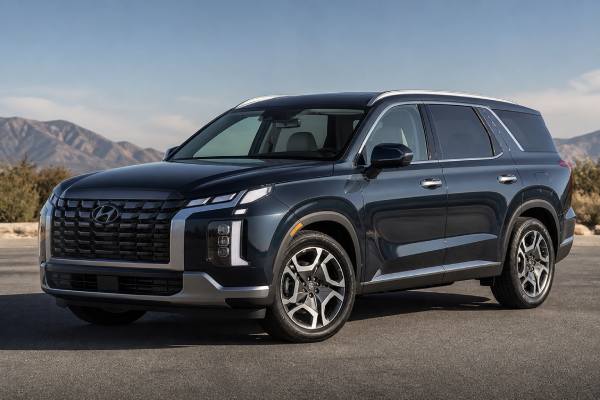
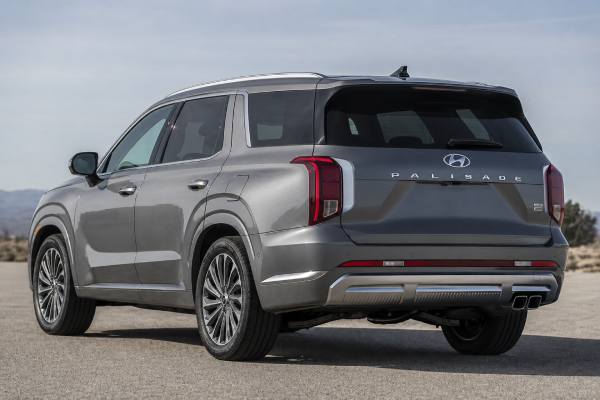
The facelifted LX2 PE Hyundai Palisade with HTRAC AWD is a large three-row family SUV built around a naturally aspirated 3.8-liter Lambda II GDi V6, an eight-speed automatic transmission, and an on-demand all-wheel-drive system. For 2023–2025, it sits in a useful middle ground: more polished and spacious than many midsize crossovers, less expensive than most luxury-badged three-row SUVs, and mechanically simpler than newer turbo-hybrid alternatives.
Its strengths are clear. The Palisade is roomy, quiet, comfortable, well equipped, and capable of towing up to 5,000 lb when properly equipped. Its main ownership questions are also practical: fuel use is not small, some recall and service-action checks matter, and buyers should confirm maintenance history rather than assuming low mileage alone is enough.
Quick Overview
- Strong 291 hp naturally aspirated V6 with smooth eight-speed automatic and useful HTRAC AWD traction.
- Spacious three-row cabin, up to 86.4 cu ft of SAE cargo space with rear rows folded.
- Comfortable ride, strong feature value, and a 5,000 lb braked towing rating when properly equipped.
- Check VIN-specific recall completion, especially seat-belt buckle and third-row curtain-airbag campaigns.
- Normal oil and filter service is commonly scheduled every 8,000 miles or 12 months, with severe-use service sooner.
Table of Contents
- Palisade LX2 PE AWD Profile
- Palisade LX2 PE Technical Specs
- Palisade LX2 PE Trims and Safety
- Reliability, Issues and Service Actions
- Maintenance and Used Buyer Checks
- Driving Performance and Efficiency
- Rivals and Final Advantages
Palisade LX2 PE AWD Profile
The 2023–2025 Palisade LX2 PE is the facelifted version of Hyundai’s first-generation Palisade, sold in many markets as a large three-row SUV. In North America, the relevant gasoline version uses the Lambda II 3.8 GDi V6 across the range, paired with an eight-speed automatic transmission. HTRAC AWD is optional on many trims and standard on some higher or special-edition versions, depending on model year and market.
The facelift is more than a grille change. Hyundai revised exterior styling, cabin screens, driver-assistance availability, trim packaging, and some comfort features. The underlying formula stayed familiar: unibody construction, transverse V6 layout, front-drive-based AWD, independent suspension, and seating for seven or eight depending on the second row.
The engine is one of the Palisade’s defining traits. It is a naturally aspirated 3.8-liter V6 rather than a turbocharged four-cylinder. That gives it a smooth, linear feel, especially under gentle throttle and highway passing. Peak torque arrives higher in the rev range than in turbocharged rivals, so the transmission often downshifts when the vehicle is loaded, climbing, or towing. That is normal for this powertrain and not a fault by itself.
HTRAC AWD is best understood as a traction and stability system rather than a dedicated off-road driveline. In normal driving it can send most torque to the front axle, then shift torque rearward when grip, acceleration, steering angle, drive mode, or AWD Lock logic calls for it. The system improves winter confidence and wet-road stability, but the Palisade does not have low-range gearing, locking axle differentials, or the underbody geometry of a true trail vehicle.
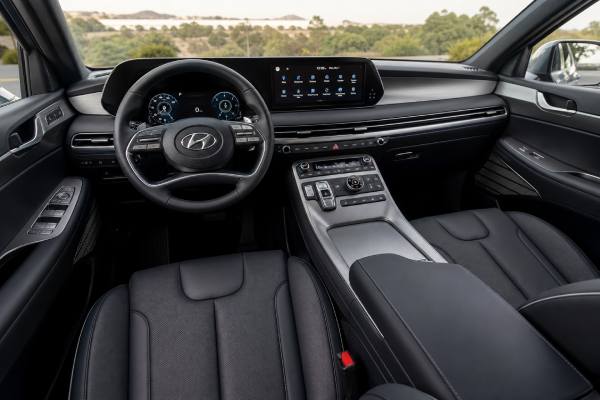
The LX2 PE Palisade is most convincing as a family travel vehicle. It offers a calm cabin, adult-usable second row, a third row suitable for children and many adults on shorter trips, and a cargo area that remains useful even with all seats raised. It also gives buyers a choice between practical lower trims and near-luxury upper trims with Nappa leather, ventilated seats, premium audio, head-up display, and extensive driver assistance.
The main compromise is operating cost. Fuel economy is respectable for a V6 three-row AWD SUV, but it is not hybrid-like. Owners who drive mostly in dense city traffic or cold weather should expect noticeably higher fuel use than the window-sticker combined figure. Tires, brakes, AWD fluids, and alignment also matter because the Palisade is a heavy vehicle, particularly in 7-passenger upper trims with 20-inch wheels and self-leveling rear suspension.
Palisade LX2 PE Technical Specs
The figures below are for the 2023–2025 facelifted Palisade 3.8 GDi with HTRAC AWD in the North American-style specification unless noted. Market equipment, curb weight, lighting, tire fitment, and service fluids can vary by VIN.
| Item | Hyundai Palisade HTRAC AWD 3.8 GDi |
|---|---|
| Generation / code | LX2 PE facelift, 2023–2025 model years |
| Engine code / family | Lambda II 3.8L Atkinson-cycle-capable GDi V6 |
| Layout and valvetrain | 60-degree V6, 6 cylinders, DOHC, 24 valves, 4 valves/cylinder, D-CVVT |
| Bore × stroke | 96 × 87 mm (3.78 × 3.43 in) |
| Displacement | 3.8 L (3,778 cc) |
| Induction | Naturally aspirated |
| Fuel system | Gasoline direct injection |
| Compression ratio | 13.0:1 |
| Maximum power | 291 hp (217 kW) at 6,000 rpm |
| Maximum torque | 355 Nm (262 lb-ft) at 5,200 rpm |
| Timing drive | Timing chain |
| Rated AWD efficiency | 19 city / 24 highway / 21 combined mpg US; about 12.4 / 9.8 / 11.2 L/100 km; about 22.8 / 28.8 / 25.2 mpg UK |
| Real-world highway at 120 km/h | Typically about 10.5–12.0 L/100 km (20–22 mpg US / 24–27 mpg UK), depending on tires, load, wind, roof bars, and temperature |
| Item | Specification |
|---|---|
| Transmission | 8-speed automatic, A8LF1, shift-by-wire, SHIFTRONIC manual mode |
| Drive type | HTRAC active on-demand AWD |
| Torque distribution | Normal operation can vary roughly from front-biased to 50:50; AWD Lock varies roughly 80:20 to 50:50 |
| Differentials | Open differentials with electronic traction/stability control; no low range or mechanical axle locker |
| Front suspension | MacPherson strut with coil springs and stabilizer bar |
| Rear suspension | Independent multi-link; self-leveling rear suspension standard on XRT and above in many U.S. specifications |
| Steering | Column-mounted motor-driven rack-and-pinion power steering; 15.6:1 ratio |
| Brakes | Front ventilated discs 340 × 30 mm (13.4 × 1.18 in); rear solid discs 305 × 11 mm (12.0 × 0.43 in) |
| Common tire sizes | 245/60 R18 on lower trims; 245/50 R20 on many upper trims |
| Ground clearance | 201 mm (7.9 in) |
| Length / width / height | 4,996 / 1,976 / 1,750 mm (196.7 / 77.8 / 68.9 in) |
| Wheelbase | 2,901 mm (114.2 in) |
| Turning circle, curb-to-curb | 11.8 m (38.7 ft) |
| Curb weight, AWD | About 1,951–2,044 kg (4,301–4,506 lb), depending on 7-seat/8-seat layout and trim |
| GVWR, AWD | About 2,663 kg (5,871 lb) |
| Fuel tank | 71.2 L (18.8 US gal / 15.7 UK gal) |
| Cargo volume, SAE | 509 L (18.0 cu ft) behind third row; 1,297 L (45.8 cu ft) behind second row; 2,447 L (86.4 cu ft) behind first row |
| Item | Typical figure or specification |
|---|---|
| 0–100 km/h / 0–62 mph | About 7.3–7.8 seconds, depending on trim, tires, load, and test method |
| Top speed | About 210 km/h (130 mph), market and limiter dependent |
| 100–0 km/h braking | About 38–40 m (125–131 ft from 62 mph), test-condition dependent |
| Towing capacity | 2,268 kg (5,000 lb) braked; 748 kg (1,650 lb) unbraked in U.S. specifications |
| Payload | Typically about 619–712 kg (1,365–1,570 lb) by GVWR minus curb weight; use the door-jamb label for the exact vehicle |
| Engine oil | Full-synthetic gasoline-engine oil meeting the owner’s manual specification; commonly 5W-30 or approved market-specific viscosity; about 6.5 L (6.9 US qt) drain-and-refill |
| Coolant | Ethylene-glycol phosphate coolant suitable for aluminum engines; common 50:50 mix; listed service quantity varies by procedure |
| Automatic transmission fluid | Hyundai/Kia specified ATF for the 8-speed automatic; about 7.0 L (7.4 US qt) listed capacity |
| Transfer case / rear differential | AWD gear oil specification and capacity vary by market; verify by VIN, and replace if submerged in water |
| A/C refrigerant and oil | R-1234yf, about 850 ± 25 g (29.98 ± 0.88 oz); PAG compressor oil about 180 ml (6.35 fl oz) |
| Critical torque values | Wheel lug nuts commonly 107–127 Nm (79–94 lb-ft); oil drain plug commonly about 39–40 Nm (29–30 lb-ft), verify by service manual |
For safety equipment, the LX2 PE Palisade includes a broad SmartSense suite. Core systems include forward collision-avoidance assist with vehicle, pedestrian, and cyclist detection, lane keeping assist, lane following assist, blind-spot collision warning, rear cross-traffic collision-avoidance assist, driver attention warning, safe exit assist, trailer sway control, stability control, ABS, and tire-pressure monitoring. Higher trims add or expand functions such as Highway Driving Assist II, more advanced junction/lane-change logic, surround-view camera, reverse parking collision-avoidance assist, and parking sensors.
Palisade LX2 PE Trims and Safety
The 2023–2025 Palisade trim walk depends on market, but the North American range is a useful baseline. Typical U.S. trims include SE, SEL, XRT, Limited, Calligraphy, and later Calligraphy Night. Canada uses different grade names such as Preferred, Urban, Ultimate Calligraphy, and Ultimate Calligraphy Night. Mechanically, the important point is that the same 3.8 GDi V6 and eight-speed automatic sit underneath the range. The biggest differences are seating layout, wheel size, suspension equipment, trim materials, infotainment, cameras, parking aids, audio, lighting, and ADAS depth.
SE is the practical entry point, usually with 8-passenger seating, cloth upholstery, 18-inch wheels, core SmartSense features, and the same basic powertrain. SEL adds comfort and convenience equipment and is often the best-value grade when fitted with the right packages. XRT brings a more rugged appearance, dark exterior accents, roof rails or cross bars depending on market, 20-inch wheels, and self-leveling rear suspension in many U.S. specifications, but it does not add a low-range transfer case or locking differential.
Limited and Calligraphy are the luxury-leaning versions. They add richer interior materials, ventilated seating, more power adjustments, larger screens or enhanced displays depending on model year, premium audio, more camera coverage, heated third-row seats on some versions, remote smart parking features on some upper trims, and broader driver-assistance capability. Calligraphy Night adds dark exterior and interior styling cues rather than a major mechanical upgrade.
Quick identifiers are straightforward. HTRAC AWD models usually carry AWD badging and have AWD-specific drive-mode functions including Snow mode and AWD Lock. Seven-seat models have second-row captain’s chairs; eight-seat models use a second-row bench. Upper trims can be identified by 20-inch wheels, quilted or premium leather-style cabin trim, head-up display, surround-view camera, blind-view monitor display, and more advanced highway-assist functions.
Safety ratings require some nuance. The Palisade has performed well in many crashworthiness areas, but test protocols changed during this generation. IIHS ratings for 2025 show Good ratings in small overlap front and updated side testing, Good headlights, Good pedestrian front crash prevention, and Acceptable LATCH ease of use, while the updated moderate-overlap front evaluation is rated Poor for the listed 2025 result. Earlier 2023 ratings under the previous award structure were stronger in award terms, but they should not be treated as identical to newer IIHS criteria.
Euro NCAP has not been the main rating reference for this U.S.-oriented LX2 PE 3.8 HTRAC specification. In markets such as Australia, local ANCAP coverage may apply to different timing or market equipment. For a used buyer, the safest approach is to check the rating body, test year, vehicle build date, and equipment level rather than assuming one rating applies to every Palisade worldwide.
The passive safety package includes multiple airbags, including front airbags, a driver knee airbag, front and second-row side-impact airbags, and side-curtain airbags for outboard occupants. LATCH/ISOFIX-style child-seat provisions include two lower-anchor positions and multiple top-tether points across the rear rows, but installation ease depends heavily on seating layout and child-seat shape.
ADAS calibration matters after repairs. Windshield replacement, front-end repair, bumper removal, suspension alignment, camera replacement, or radar-area damage can require calibration or confirmation scans. A Palisade that tracks poorly, gives repeated sensor warnings, or shows inconsistent lane-centering behavior should not be dismissed as “normal electronics.” It needs a proper diagnostic check and, where required, calibration by a qualified repairer.
Reliability, Issues and Service Actions
The 2023–2025 Palisade 3.8 AWD has a generally solid reliability profile when maintained properly, but it is not a vehicle to buy without records. It is large, heavy, electronically complex, and often used for family hauling, winter driving, road trips, and towing. Those use cases make service history more important than a clean-looking interior.
| Area | Prevalence | Severity / cost | What to watch for |
|---|---|---|---|
| Recall completion | Important across affected VINs | Safety-critical | Seat-belt buckle campaigns, third-row curtain-airbag campaign, and any VIN-specific 2025 powertrain recall |
| Brake wear and vibration | Occasional | Low to medium | Pedal pulsation, uneven pad wear, vibration after long descents or towing |
| Suspension and tire wear | Occasional | Low to medium | Inner-edge tire wear, clunks, alignment drift, worn rear components on heavily loaded vehicles |
| AWD driveline service neglect | Occasional | Medium | Binding, hum, neglected transfer case or rear differential fluid, water exposure |
| GDi carbon deposits | Possible over higher mileage | Medium | Rough cold starts, misfires, reduced response, especially after many short trips |
| Infotainment, camera, and sensor faults | Occasional | Low to medium | Blank camera views, update needs, intermittent warning messages, calibration errors after repair |
The Lambda II 3.8 GDi uses a timing chain rather than a scheduled timing belt. That reduces routine replacement cost, but it does not make the timing system immune to neglect. Chain stretch, guide wear, tensioner issues, or timing-correlation faults are not normal maintenance items, yet they can become expensive if oil service is ignored. Cold-start rattles, cam/crank correlation fault codes, rough idle, or metal debris in oil should be investigated quickly.
Oil consumption should be monitored, especially during break-in and as mileage rises. A small amount of oil use can be normal for gasoline engines, but the level should not be allowed to run low. Buyers should check service records for regular oil changes with the correct specification, then monitor the dipstick every few fuel stops until they know the vehicle’s pattern.
Direct injection improves power and efficiency but can contribute to intake-valve deposits because fuel does not continuously wash the back of the valves. Symptoms include rough idle, hesitation, misfires, or reduced fuel economy at higher mileage. Good fuel, proper oil, regular highway operation, and timely diagnostics help. Walnut-shell cleaning or intake service should be considered only when symptoms and inspection support it.
The automatic transmission is usually smooth, but a test drive should include cold operation, gentle acceleration, rolling stops, highway kickdown, and low-speed parking maneuvers. Harsh engagement, repeated shift flare, delayed reverse, or shudder under light throttle deserves diagnostic attention. The transmission fluid is not a casual dipstick check item; fluid service should use the specified ATF and correct procedure.
For AWD models, listen for humming, whining, clunks, or binding from the transfer case, propeller shaft, rear differential, and half-shafts. These are not common failures in well-maintained vehicles, but towing, water exposure, mismatched tires, and neglected fluid can shorten component life. Keep all four tires matched in brand, size, tread depth, and pressure.
Two recall themes are especially important for 2023–2025 used shoppers. A 2025 seat-belt buckle recall affects certain 2020–2025 Palisades, with concern that some buckles may fail to latch properly. A later safety recall covers certain 2020–2025 Palisades for third-row side-curtain airbag performance related to ejection-mitigation compliance. Some 2025 vehicles also have a more limited recall involving an electric oil pump controller seal that may allow moisture intrusion and create a fire risk. These are VIN-specific matters, so a clean vehicle history report is not enough. Verify completion through the official VIN recall check and dealer service records.
Pre-purchase checks should include a full scan report, recall proof, oil-change history, tire wear inspection, brake measurement, coolant and oil leak check, underbody corrosion inspection, AWD fluid-service evidence, and confirmation that all cameras, parking sensors, lane systems, seat functions, power tailgate, climate zones, USB ports, and infotainment functions work.
Maintenance and Used Buyer Checks
A Palisade HTRAC AWD rewards boring maintenance. It is not a fragile vehicle, but it is heavy enough that skipped fluid services, cheap tires, poor alignments, and ignored warning lights can turn into expensive ownership.
| Interval | Service items |
|---|---|
| Every fuel stop or monthly | Check engine oil level, coolant reservoir, washer fluid, tire pressure including spare, exterior lights, and visible leaks. |
| Every 8,000 miles / 13,000 km or 12 months | Replace engine oil and filter under normal-use schedules; rotate tires; inspect brakes, suspension, steering, battery condition, hoses, exhaust, and AWD-related visible components. |
| Severe use, often 5,000 miles / 8,000 km or 6 months | Short trips, heavy city use, dusty roads, extreme temperatures, repeated idling, roof loads, mountains, or towing justify shorter oil and inspection intervals. |
| Every 16,000–24,000 miles / 26,000–39,000 km | Replace or inspect cabin air filter and engine air filter depending on schedule and environment; inspect brake fluid condition and tire alignment. |
| 48,000 miles / 78,000 km or 72 months | First major drive-belt inspection, then inspect regularly; check belt cracking, glazing, noise, and tension. |
| 60,000 miles / 96,000 km | Consider automatic transmission fluid service in severe-use or Canadian-style schedules; inspect AWD transfer case and rear differential fluid condition. |
| 96,000 miles / 156,000 km | Replace spark plugs under many schedules; inspect coils, valve-cover seepage, intake condition, and cooling system. |
| 120,000 miles / 192,000–200,000 km or 10 years | Initial coolant replacement interval varies by market; afterward coolant is commonly replaced at shorter time/distance intervals. |
The engine oil should meet the specification in the owner’s manual for the market and model year. Many North American 3.8 GDi references use full-synthetic 5W-30-type oil, while some markets allow different viscosity choices based on climate and specification. The safe rule is to follow the under-hood label and service manual by VIN.
The timing chain has no routine replacement interval. It should be inspected indirectly through symptoms, fault codes, oil history, and mechanical noise. Replace chain components only when they are out of specification, noisy, damaged, or linked to timing faults.
Brake fluid deserves more attention than many owners give it. Even when pad thickness is good, old fluid absorbs moisture and can reduce braking consistency on long descents. For a family SUV that may tow or carry seven people, periodic brake-fluid testing or replacement is sensible.
For HTRAC AWD, fluid care is important even if the owner’s manual language appears light under normal use. Water crossings, flooded roads, boat ramps, deep snow, or muddy tracks are reasons to inspect or replace transfer case and rear differential oil. Any used Palisade with a tow hitch should get extra driveline scrutiny.
A good used example should start cleanly, idle smoothly, shift without flare, track straight, stop without vibration, and show no persistent warning lights. Check the following before purchase:
- Service invoices showing regular oil changes, brake work, tire rotations, and recall completion.
- Matching tires with even tread depth and no inner-edge wear.
- No coolant smell, oil seepage, or transmission fluid residue underneath.
- Smooth AWD operation in tight turns with no binding or grinding.
- Working power tailgate, rear climate controls, seat heaters and ventilation, USB ports, cameras, and parking sensors.
- No water stains under carpets, in the spare-tire well, or around the panoramic roof area.
- Dealer confirmation that all open campaigns and software updates are complete.
Best-value picks are usually SEL or similarly equipped mid-level grades with AWD, the desired seating layout, and a clean maintenance file. Limited and Calligraphy trims are excellent for comfort, but repairs to cameras, powered features, premium lighting, and trim-specific parts can cost more. XRT is attractive if the styling and self-leveling suspension matter, but it should not be bought as a substitute for a true off-road SUV.
Driving Performance and Efficiency
The Palisade HTRAC AWD drives like a large, comfort-biased family SUV rather than a sporty crossover. Its strongest dynamic quality is composure. It tracks well on highways, absorbs rough pavement with a mature feel, and keeps wind and road noise well controlled for the class. Upper trims with 20-inch tires can feel a little firmer over sharp impacts than 18-inch versions, but the ride remains generally comfortable.
Steering is light and predictable. It does not provide much road texture, yet it is accurate enough for urban driving and long highway trips. The Palisade’s size is noticeable in tight parking lots, where the 11.8 m turning circle and broad body require attention. Surround-view cameras and parking sensors make a major difference on upper trims.
The V6 is smooth rather than explosive. Around town, throttle response is calm and easy to meter. At highway speeds, the engine has enough power for confident passing, but it often needs a downshift because peak torque sits high at 5,200 rpm. The eight-speed automatic usually handles this well, with smooth upshifts and sensible kickdown logic. In Eco mode, it can feel more relaxed; in Sport, it holds gears longer and sharpens the response.
HTRAC AWD adds confidence in rain, snow, and on loose surfaces. Snow mode softens responses and helps the system manage traction more gently. AWD Lock can be useful at low speeds on slippery driveways, snowy lanes, gravel launches, or boat ramps, but it is not meant for high-speed dry-pavement use. Tire quality has a bigger effect on winter performance than the AWD badge alone.
Real-world efficiency depends heavily on use. In steady suburban and highway driving, the Palisade can stay close to its combined rating. In dense city use, winter operation, or frequent short trips, it can move into the mid-teens mpg US. Typical expectations are:
- City: about 13.0–16.0 L/100 km, or 15–18 mpg US.
- Mixed driving: about 11.0–13.5 L/100 km, or 17–21 mpg US.
- Highway at 100–110 km/h: about 9.0–10.5 L/100 km, or 22–26 mpg US.
- Highway at 120 km/h: about 10.5–12.0 L/100 km, or 20–22 mpg US.
Cold weather, winter tires, roof boxes, crossbars, remote start, and short journeys can increase consumption significantly. Towing has an even larger effect. A moderate trailer can raise fuel use by 30–60 percent depending on shape, speed, wind, terrain, and load. For long towing trips, the Palisade is more comfortable with realistic speeds, trailer brakes, correct tongue weight, and careful attention to payload.
Braking feel is generally stable for normal family use. Under heavy load or repeated mountain descents, the driver should use lower gears and avoid riding the brakes. Brake vibration on used examples often points to heat cycling, uneven pad deposits, or worn components rather than a fundamental design flaw.
The Palisade’s advantage is not a single performance number. It is the combination of smooth V6 response, quiet cruising, easy controls, strong seating comfort, useful towing capacity, and low-effort AWD traction. Buyers looking for hybrid fuel economy or sharp handling will find better matches elsewhere, but those who want relaxed long-distance family travel will understand the appeal quickly.
Rivals and Final Advantages
The closest rival is the Kia Telluride, which shares much of the Palisade’s platform and V6 character. The Telluride has a boxier, more rugged design personality, while the Palisade leans more upscale and formal inside. Mechanically, they are close enough that condition, price, equipment, and dealer support matter more than small specification differences.
The Toyota Highlander and Grand Highlander are natural alternatives. The Highlander Hybrid is much more efficient, while the Grand Highlander offers stronger space in newer versions. Toyota’s ownership reputation is a major draw, but comparable equipment can be expensive, and the Palisade often feels richer inside for the money.
The Honda Pilot is another strong rival. It has a naturally aspirated V6, good packaging, and a more adventure-oriented TrailSport option. The Pilot feels a little more utilitarian and can be more appealing for buyers who prioritize cargo practicality and rough-road use. The Palisade counters with a quieter, more premium-feeling cabin in many trims.
The Mazda CX-90 is more driver-focused and offers inline-six and plug-in hybrid choices. It feels more premium from the driver’s seat, but its third row and cargo packaging are not as family-friendly as the Palisade’s. The Volkswagen Atlas offers huge interior space and easy access, though its powertrain character and cabin richness vary by year and trim.
The Palisade HTRAC AWD’s best advantages are clear:
- It gives near-luxury comfort without luxury-brand pricing.
- The 3.8 V6 is smooth, proven in broad use, and free of turbocharger complexity.
- The cabin is genuinely useful for families, not just technically three-row.
- HTRAC AWD improves all-weather confidence without changing daily drivability.
- Towing capacity, cargo space, and highway refinement make it a strong road-trip vehicle.
The main reasons to hesitate are fuel economy, recall verification, and the cost of upper-trim electronic features as the vehicle ages. A well-maintained SEL, Limited, Calligraphy, or equivalent market trim can be a very satisfying used buy. A neglected one with mismatched tires, incomplete recalls, brake vibration, sensor warnings, or vague service history should be priced accordingly or avoided.
For buyers who want a comfortable, spacious, V6-powered three-row SUV from 2023–2025, the Hyundai Palisade HTRAC AWD remains one of the strongest choices in its class. It is not the most efficient or the most rugged, but it is refined, practical, well equipped, and easy to live with when maintained properly.
References
- 2024 Palisade Specifications 2024 (Manufacturer Specifications)
- Hyundai_LX2 PE_en_CA 2024 (Owner’s Manual)
- 2025 Hyundai Palisade 2025 (Safety Rating)
- Part 573 Safety Recall Report 25V607 2025 (Recall Database)
- Part 573 Safety Recall Report 26V034 2026 (Recall Database)
Disclaimer
This information is for general informational purposes only and is not a substitute for professional diagnosis, repair, or inspection. Specifications, torque values, service intervals, fluids, procedures, safety equipment, and recall applicability can vary by VIN, market, build date, trim, and installed equipment. Always verify details against the official owner’s manual, service documentation, under-hood labels, dealer records, and current VIN-based recall checks before making maintenance, repair, towing, or purchase decisions.
If you found this useful, please consider sharing it on Facebook, X/Twitter, or another platform to support our work.