
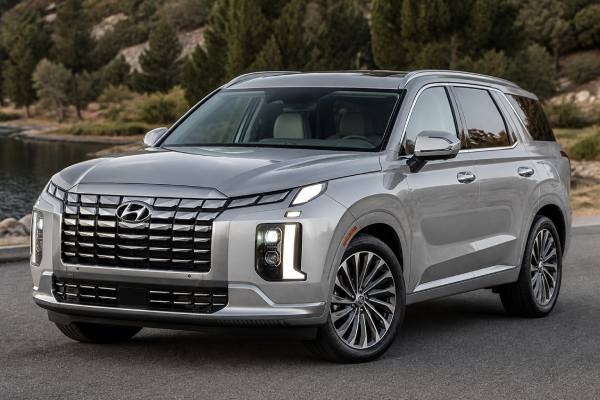
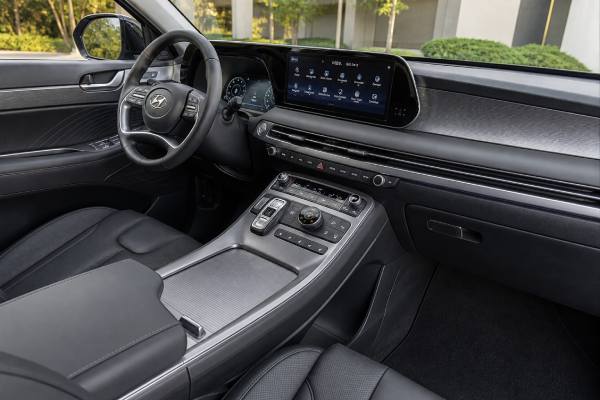
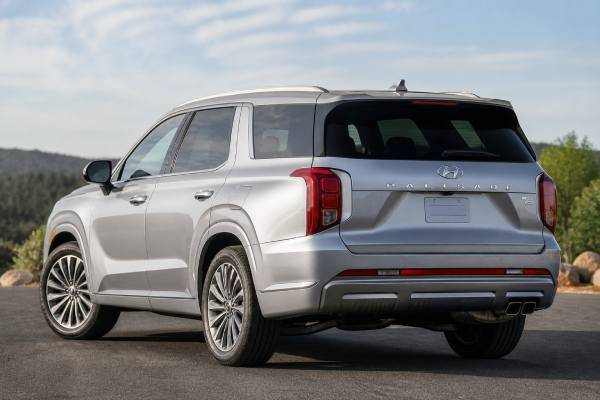
The facelifted LX2 PE Hyundai Palisade with the 2.2-litre R-series diesel and HTRAC all-wheel drive is one of the more practical versions of Hyundai’s large three-row SUV. It pairs a torquey four-cylinder turbo-diesel with an 8-speed automatic, a roomy seven- or eight-seat body, strong safety equipment, and better long-distance fuel use than the petrol V6 versions sold in some markets.
This version is especially relevant for families, high-mileage drivers, regional users, and buyers who want a comfortable large SUV without moving into a body-on-frame 4×4. It is not a heavy-duty off-roader or a 3.5-tonne tow vehicle, but as a road-biased diesel AWD family SUV, it has a very balanced package.
Owner Snapshot
- Strong 440 Nm diesel torque makes the Palisade relaxed with passengers, luggage, and highway overtaking.
- HTRAC AWD improves traction on wet roads, gravel, snow, and ramps without turning the SUV into a true off-roader.
- The facelifted safety package is a major advantage, with standard AEB, lane support, blind-spot systems, and a front centre airbag in key markets.
- Short-trip diesel use can increase DPF/EGR, battery, and oil-contamination risk; regular longer drives help.
- Typical diesel service scheduling is around 10,000–15,000 km or 6–12 months depending on market and usage severity.
Table of Contents
- Palisade LX2 PE AWD Identity
- Palisade LX2 PE Technical Data
- Palisade LX2 PE Trims and Safety
- Reliability Issues and Service Actions
- Maintenance Schedule and Buying Advice
- Driving Performance and Economy
- Rivals and Ownership Verdict
Palisade LX2 PE AWD Identity
The Hyundai Palisade LX2 PE is the facelifted version of the first-generation Palisade. In diesel HTRAC form, it uses Hyundai’s 2.2-litre R-series CRDi four-cylinder turbo-diesel, usually identified by the D4HB engine family, matched to an 8-speed torque-converter automatic transmission and active on-demand all-wheel drive. The body is a large five-door monocoque SUV with three seating rows and either seven seats with second-row captain’s chairs or eight seats with a second-row bench, depending on trim and market.
The “PE” facelift matters because it was more than a styling update. It brought a broader safety package in key markets, revised equipment, a bolder front-end design, updated infotainment, and detail changes to driver assistance. In Australia and New Zealand, the upgraded Palisade safety specification applied to later facelift vehicles, while earlier diesel examples retained a lower ANCAP rating. That makes build date and market especially important when comparing used vehicles.
The 2.2 CRDi diesel is the sensible long-distance powertrain. Its 147 kW output translates to about 197 hp, but the more important figure is 440 Nm of torque delivered from low revs. In everyday use, that makes the Palisade feel more effortless than its cylinder count suggests. It does not have the smooth, rev-happy character of the petrol V6, but it suits loaded highway driving better than a small turbo-petrol engine would.
HTRAC AWD is also worth understanding correctly. It is an active, road-biased AWD system that can send torque rearward as conditions demand, with drive modes and an AWD lock function in some specifications. It helps with wet roads, gravel, snow, steep driveways, and towing stability. It is not the same as a low-range 4×4 system, and the Palisade does not have locking differentials, heavy-duty underbody protection, or the suspension travel of a dedicated off-road vehicle.
The LX2 PE diesel AWD is best viewed as a refined, efficient, high-capacity family SUV rather than a rugged expedition wagon. Its strengths are cabin space, safety equipment, diesel range, relaxed cruising, and comfort. Its limitations are urban size, diesel emissions-system sensitivity to short trips, and a tow rating that is useful but below ladder-frame SUVs such as the Ford Everest or Toyota Prado in many markets.
Palisade LX2 PE Technical Data
The following data reflects the 2.2 CRDi HTRAC AWD facelift specification most commonly seen in Australia/NZ-style documentation. Always verify against the vehicle’s VIN plate, owner’s manual, tyre placard, and local homologation documents because specifications vary by country, trim, emissions equipment, and model year.
| Item | Hyundai Palisade 2.2 CRDi HTRAC AWD |
|---|---|
| Platform / generation | LX2 PE facelift, large three-row SUV |
| Engine code / family | R-series D4HB 2.2 CRDi |
| Engine layout | Transverse inline-4 diesel, DOHC, 4 valves per cylinder, 16 valves total |
| Bore × stroke | 85.4 × 96.0 mm (3.36 × 3.78 in) |
| Displacement | 2.2 L (2,199 cc) |
| Induction | Electronic variable-geometry turbocharger, intercooling |
| Fuel system | Common-rail direct injection diesel |
| Compression ratio | 16.0:1 |
| Maximum power | 147 kW at 3,800 rpm; about 197 hp / 200 PS |
| Maximum torque | 440 Nm (325 lb-ft) at 1,750–2,750 rpm |
| Timing drive | Timing chain |
| Rated fuel use | 7.3 L/100 km combined; about 32.2 mpg US / 38.7 mpg UK |
| Urban / extra-urban rating | 9.2 / 6.2 L/100 km; about 25.6 / 37.9 mpg US |
| Real highway at 120 km/h | Typically about 7.0–8.5 L/100 km depending on load, tyres, wind, and terrain |
| Item | Specification |
|---|---|
| Transmission | 8-speed torque-converter automatic, Hyundai/Kia A8 family; shift-by-wire in many trims |
| Drive type | HTRAC active on-demand AWD |
| Differentials | Open differentials with electronic traction control; no mechanical locker |
| Front / rear suspension | MacPherson strut front; multi-link rear |
| Steering | Column-mounted motor-driven power steering; 2.87 turns lock-to-lock |
| Turning circle | 11.8 m (38.7 ft) |
| Brakes | Front ventilated discs 340 × 30 mm; rear ventilated discs 314 × 18 mm |
| Common wheel and tyre size | 20 × 7.5J alloy wheels; 245/50 R20 102V tyres |
| Ground clearance | 203 mm (8.0 in) |
| Approach / departure / breakover | 18.5° / 20.3° / 17.9° |
| Length / width / height | 4,995 / 1,975 / 1,750 mm (196.7 / 77.8 / 68.9 in) |
| Wheelbase | 2,900 mm (114.2 in) |
| Kerb weight | About 1,980–2,070 kg (4,365–4,564 lb), depending on trim and seating |
| GVWR / GVM | 2,755 kg (6,074 lb) |
| Fuel tank | 71 L (18.8 US gal / 15.6 UK gal) |
| Cargo volume | 311 L behind third row / 704 L behind second row, VDA method (11.0 / 24.9 ft³) |
| Item | Specification or guidance |
|---|---|
| 0–100 km/h | About 10.5 seconds for AWD diesel versions |
| Top speed | About 190 km/h (118 mph) |
| 100–0 km/h braking | About 43 m (141 ft), depending on tyres and surface |
| Towing capacity | 2,200 kg braked / 750 kg unbraked (4,850 / 1,653 lb) |
| Maximum tow-ball mass | 100 kg standard; up to 180 kg with certain genuine load-assist kits in some markets |
| Estimated payload | About 685–775 kg (1,510–1,709 lb), depending on kerb weight |
| Engine oil | Market-specific; service schedules list 5W-40 in some diesel markets, while other data may specify 0W-30 or 5W-30 low-SAPS oil. Service-fill commonly around 6.3–6.5 L (6.7–6.9 US qt). |
| Automatic transmission fluid | Hyundai ATF SP-IV family; service quantity around 7 L (7.4 US qt) in published diesel service schedules |
| Axle / AWD oils | API GL-5 gear oil, commonly SAE 75W-90 or market-specified equivalent; verify front transfer/rear drive unit capacities by VIN |
| Brake fluid | DOT 4 |
| Coolant | Hyundai long-life ethylene-glycol coolant for aluminium engines; use correct premix or 50/50 mix as specified locally |
| A/C refrigerant and oil | Use the under-bonnet label and service manual; R-1234yf is common on later Hyundai applications, but charge quantity is VIN and HVAC-package specific |
| Wheel nut torque | 11–13 kgf·m, about 107–127 Nm (79–94 lb-ft) |
| Safety ratings | ANCAP 5 stars for upgraded facelift vehicles in applicable AU/NZ build periods; IIHS data applies to U.S.-market Palisade, not specifically the diesel |
Palisade LX2 PE Trims and Safety
Trim names vary by market, but the diesel HTRAC AWD facelift is commonly seen in grades such as Elite, Highlander, Calligraphy, or market-specific equivalents. In Australia, the diesel AWD was offered in higher family-oriented trims with seven- and eight-seat layouts. Elite versions generally focus on the core equipment package, while Highlander or Calligraphy-style grades add more convenience, luxury, and parking-assistance features.
The quick trim identifiers are straightforward. Diesel AWD examples usually carry HTRAC or AWD identification in the specification, and the VIN/build documentation will show the diesel powertrain and drivetrain. Inside, higher trims often show a head-up display, premium audio, surround-view camera, blind-spot view monitor, ventilated front seats, heated second-row outboard seats, rain-sensing wipers, suede-like headlining, and more power-seat or memory functions. Baseline trims may still have the same powertrain and safety core but fewer camera, comfort, and upholstery upgrades.
Mechanical differences are limited compared with some rivals. The Palisade diesel AWD does not gain a low-range transfer case, locking differential, air suspension, or major brake upgrade by trim in the usual family-SUV specification. The meaningful functional differences tend to be tyre package, tow hardware, seat layout, driver-assistance equipment, and parking systems. The 20-inch wheel and 245/50 R20 tyre package is common; buyers who prioritise ride comfort and tyre cost should check whether smaller wheels are available in their market.
Safety is one of the facelift’s strongest points. The upgraded specification added or standardised important features in key markets, including dual frontal airbags, side chest-protecting airbags, side curtain airbags, and a front centre airbag designed to reduce front-occupant contact in side impacts. ISOFIX/LATCH provision depends on market and seating layout, but the Palisade is generally well suited to child-seat use because of its wide second row and accessible third row. Always test actual child seats before purchase because captain’s chairs, bench seats, and third-row access change the setup.
The driver-assistance suite is broad. Common systems include autonomous emergency braking with car, pedestrian, cyclist, and junction support; lane keeping assist; lane following assist; blind-spot collision-avoidance assist; rear cross-traffic collision-avoidance assist; smart cruise control with stop-and-go; high-beam assist; driver attention warning; intelligent speed limit assistance; safe exit assist; rear occupant alert; and trailer stability assist. Higher trims may add surround-view monitoring, blind-spot camera views, rear parking collision avoidance, remote smart parking assistance, and a digital centre mirror.
Calibration matters after repairs. Windscreen replacement, bumper repair, wheel alignment, suspension work, radar removal, or front camera disturbance can affect ADAS accuracy. A used Palisade with warning lights, inconsistent lane assistance, or parking-sensor faults should not be dismissed as merely “software.” It may need camera/radar calibration, sensor replacement, wiring repair, or a dealer-level scan.
Reliability Issues and Service Actions
The LX2 PE Palisade diesel is generally a mature design rather than a fragile one, but reliability depends heavily on use pattern. A diesel SUV that regularly covers longer trips, reaches full operating temperature, and receives correct fluids is usually a better bet than one used only for short school runs. The 2.2 CRDi engine has strong low-rpm torque and a chain-driven valvetrain, but its emissions hardware and fuel system still need clean fuel, correct oil, and enough operating temperature.
| Prevalence | System | Symptoms | Likely cause | Remedy / check | Cost tier |
|---|---|---|---|---|---|
| Common in poor use | Diesel emissions system | Frequent regeneration, warning lights, rising fuel use | Short trips, interrupted DPF cycles, low operating temperature | Diagnostic scan, forced regeneration only when appropriate, correct driving pattern, fix root causes | Medium to high |
| Occasional | EGR / intake | Rough running, hesitation, soot buildup, limp mode | Soot deposits, EGR valve or cooler restriction | Inspect, clean or replace affected parts; update software if prescribed | Medium |
| Occasional | Fuel system | Hard starting, poor idle, water-in-fuel warning | Contaminated diesel, overdue fuel filter, injector wear | Replace fuel filter, drain contamination, test injectors and rail pressure | Medium to high |
| Occasional | 8-speed automatic | Shift flare, hesitation, harsh engagement | Software adaptation, degraded fluid under heavy use, mount or driveline issues | Dealer scan, adaptation reset/update, fluid service if applicable | Medium |
| Occasional | AWD coupling / rear driveline | Binding, hum, vibration, delayed rear engagement | Fluid condition, tyre circumference mismatch, coupling or bearing wear | Check tyre set matching, inspect leaks, service transfer/rear oils | Medium to high |
| Common wear | Brakes and tyres | Brake judder, fast tyre wear, edge wear | Heavy vehicle mass, city use, alignment drift, 20-inch tyre cost | Brake inspection, quality pads/rotors, alignment, tyre rotation | Low to medium |
| Occasional | ADAS / infotainment | Sensor warnings, camera faults, display glitches | Software version, calibration, sensor contamination, battery voltage | Software update, clean sensors, battery test, calibration after repair | Low to medium |
Timing chain concerns are not a scheduled-belt issue, but that does not mean the chain can be ignored forever. Listen for cold-start rattles, timing-correlation faults, metallic chain noise, or oil-pressure-related symptoms. Chain, guide, and tensioner wear is more likely with poor oil quality, extended oil intervals, and repeated cold starts. A healthy chain system should be quiet, with no timing faults.
Software and calibration updates are part of modern Palisade ownership. Engine, transmission, ADAS, infotainment, and body-control updates may address shift logic, drivability, sensor alerts, connected services, and false warnings. When a dealer reflash is the official remedy, replacing parts first can waste money. A pre-purchase inspection should include a dealer-level scan and a check of open campaigns.
Recall coverage is market-specific. U.S. records show certain 2023 Palisade LX2 vehicles were subject to a brake-booster recall, and some 2021–2023 Palisade vehicles were involved in a wiper-system recall. Those examples do not automatically apply to diesel vehicles in every market, but they show why VIN verification matters. For any used Palisade, request the 17-digit VIN, check official recall databases, and ask for dealer invoices showing completed recalls and field service actions.
Maintenance Schedule and Buying Advice
A diesel Palisade rewards conservative maintenance. The official schedule varies by market, but a practical approach is to treat 10,000–15,000 km or 6–12 months as the normal oil-service window, then shorten it for severe use. Severe use includes repeated short trips, dusty roads, towing, heavy city traffic, long idling, mountain driving, and very hot or very cold operation.
| Interval | Service items | Notes |
|---|---|---|
| Every 10,000–15,000 km or 6–12 months | Engine oil and filter, inspection, tyre rotation, brake inspection | Use correct diesel-rated oil; shorten interval for short trips or towing |
| Every 15,000–30,000 km | Cabin filter, engine air filter inspection/replacement | Replace more often in dusty areas |
| Every 20,000–40,000 km | Fuel filter, brake fluid condition, underbody and driveline inspection | Fuel filter interval depends strongly on diesel quality and local schedule |
| Every 40,000–60,000 km | Transmission, transfer case, rear differential inspections; coolant and hose checks | Service driveline oils earlier after water exposure, towing, or heat stress |
| Every 60,000–100,000 km | ATF service where specified, axle oils, drive belt, coolant service, brake fluid replacement | Published diesel schedules show ATF and axle-oil replacement by 80,000 km in some markets |
| Every 3–5 years | 12 V battery test/replacement window, coolant age check, A/C service check | Low battery voltage can trigger misleading electronic faults |
| As symptoms require | Timing chain inspection, injectors, EGR, DPF, turbo hoses, engine mounts | Replace chain components only when noise, faults, or measured wear justify it |
For a used purchase, the best Palisade is not necessarily the newest or most highly trimmed one. It is the one with clear service history, matching tyres, no unresolved recalls, clean diagnostics, and evidence of correct diesel use. Ask for invoices rather than stamps alone. Oil type, fuel-filter replacement, ATF service, brake-fluid replacement, and AWD-fluid service are all more informative than a generic “serviced” statement.
Inspect the vehicle cold. A diesel that starts quickly, idles cleanly, and settles without chain rattle, smoke, or warning lights is a good sign. During the road test, check for smooth part-throttle shifts, clean kickdown, no driveline clunks, and no vibration under load. Drive at car-park speed on full lock to check for tyre scrub, AWD binding, or suspension knocks.
Check the rear of the vehicle carefully. The Palisade is a family SUV, so interior wear, third-row mechanisms, power tailgate operation, seat motors, child-seat anchor covers, rear climate controls, and cargo trim often reveal how it was used. Also inspect the towbar, wiring, and rear bumper. Towing is within the Palisade’s design brief, but heavy towing without fluid servicing is not ideal.
The preferred configuration for many buyers is the diesel HTRAC AWD with the safety-upgraded facelift build and a full dealer or specialist service record. Higher trims are attractive for long trips because of ventilated seats, premium audio, surround cameras, and better parking support, but they also add more electronics to inspect. Avoid examples with warning lights, missing service records, mismatched tyres, overdue diesel filters, accident repairs around ADAS sensors, or unexplained coolant loss.
Driving Performance and Economy
The Palisade diesel AWD drives like a large, comfortable touring SUV. It is not sharp or sporty, but it feels stable and secure at speed. The long wheelbase helps highway composure, and the suspension is tuned more for family comfort than aggressive cornering. Around town, the size is obvious, especially in narrow parking spaces, but the steering is light and the turning circle is manageable for such a large vehicle.
The 2.2 diesel’s character suits the Palisade well. It produces its best torque from 1,750 to 2,750 rpm, so it does not need to rev hard in normal driving. Initial throttle response is measured rather than punchy, and there can be a brief pause before the turbo and transmission agree on a downshift, but once moving it pulls cleanly. With passengers and luggage, the diesel feels more confident than the power figure suggests.
The 8-speed automatic is generally smooth. It upshifts early in Eco or Comfort-style modes, holds gears more assertively in Sport, and may use Smart mode logic to adapt to the driver. Some hunting can occur on rolling hills if the vehicle is heavily loaded or towing, but the broad torque band keeps it calmer than many smaller turbo engines. A harsh shift or flare should be investigated rather than accepted as normal.
Ride quality depends on tyres. The common 20-inch wheel package looks right on the Palisade and gives good steering response, but it can transmit sharper road edges than a smaller-wheel setup. On coarse-chip roads, tyre roar is more noticeable than engine noise. At highway speed, wind noise is usually well controlled, and the diesel settles into the background once cruising.
Fuel economy is one of the diesel AWD’s strongest advantages. The official combined figure of 7.3 L/100 km is achievable on gentle highway-heavy use, while mixed real-world driving often falls around 7.5–9.5 L/100 km. Dense city use, school-run cycles, cold weather, roof racks, heavy loads, and towing can push it beyond 10 L/100 km. At 120 km/h, expect the Palisade to use more than its laboratory extra-urban rating, but it still remains economical for a two-tonne three-row SUV.
Towing performance is competent within the 2,200 kg braked limit. The diesel torque, AWD traction, and trailer stability assist help, but tow-ball mass, payload, brake condition, tyres, and cooling margins matter. A full cabin plus luggage plus tow-ball load can consume payload quickly. For regular heavy towing, a body-on-frame SUV or ute-based wagon with a 3,000–3,500 kg rating may be more suitable.
Rivals and Ownership Verdict
The Palisade diesel AWD sits in an interesting space. It is larger and more comfortable than many medium SUVs, more efficient than petrol V6 family SUVs, and more refined on-road than most ladder-frame 4×4 wagons. Its closest alternatives depend on market, but typical cross-shops include the Kia Sorento diesel AWD, Mazda CX-9 or CX-90, Toyota Kluger/Highlander, Nissan Pathfinder, Ford Everest, Toyota Prado, and sometimes the Kia Telluride where available.
Against the Kia Sorento diesel, the Palisade offers more cabin width, a more substantial third row, and a more relaxed large-SUV feel. The Sorento is easier to park and usually cheaper to run, but it does not feel as spacious with adults across all rows. Against the Toyota Kluger hybrid, the Hyundai diesel may be better for long highway running and towing within its limit, while the Toyota hybrid is better suited to urban efficiency and short-trip use.
Compared with the Ford Everest or Toyota Prado, the Palisade is smoother, quieter, and more car-like. It is a better school-run and highway vehicle for families who do not need serious off-road ability. The Everest and Prado, however, are stronger choices for rough tracks, heavy towing, deeper payload demands, and remote-area durability. The Palisade has ground clearance and AWD traction, but it is not built around the same heavy-duty mission.
Compared with petrol V6 versions of the Palisade, the diesel AWD is usually the more rational ownership choice for high-mileage drivers. It uses less fuel, has more low-rpm torque, and brings AWD in markets where petrol versions may be front-drive or less efficient. The petrol can be smoother, simpler for low-mileage urban use, and less sensitive to diesel emissions-system conditions, but it consumes more fuel under load.
The strongest reasons to choose the Hyundai Palisade HTRAC AWD 2.2 diesel are cabin space, safety equipment, diesel touring range, relaxed torque, and a comfortable long-distance ride. The main reasons to pause are short-trip diesel suitability, urban size, tyre and brake costs, and the need to verify market-specific recalls and service history.
For the right use case, the LX2 PE diesel AWD is one of the most well-rounded Palisade versions. It is not the cheapest large SUV to maintain, and it is not the toughest towing or off-road choice, but it delivers a rare mix of three-row comfort, real diesel efficiency, strong safety equipment, and family practicality.
References
- Hyundai Palisade. Specifications. 2023 (Manufacturer Specifications)
- Hyundai Palisade | Safety Rating & Report | ANCAP 2022 (Safety Rating)
- 2023 Hyundai Palisade 2023 (Safety Rating)
- PMSS – Update Nov 2024- Website .xlsx 2023 (Maintenance Schedule)
- Car Recalls | Owning | Hyundai Australia 2026 (Recall Database)
Disclaimer
This article is for informational purposes only and is not a substitute for professional diagnosis, repair, inspection, or official Hyundai service information. Specifications, torque values, service intervals, fluid requirements, safety equipment, and procedures can vary by VIN, market, build date, trim, and installed equipment. Always verify details against the official owner’s manual, service manual, VIN plate, recall database, and authorised Hyundai repair information for the exact vehicle.
If you found this useful, please consider sharing it on Facebook, X/Twitter, or your preferred platform to support our work.