


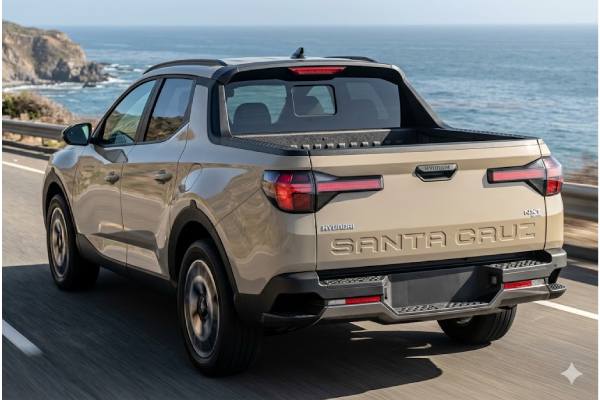
The Hyundai SANTA CRUZ with HTRAC all-wheel drive and the naturally aspirated Smartstream 2.5 GDI + MPI engine is the more practical, efficiency-minded version of Hyundai’s compact unibody pickup. It is not the quickest Santa Cruz, and it is not built for heavy-duty truck work, but it offers a useful mix of crossover comfort, open-bed utility, available AWD traction, and manageable size.
For 2024–present examples, the important distinction is engine choice. This article focuses on the 191 hp non-turbo 2.5-liter model with the conventional 8-speed automatic, not the 281 hp turbocharged version. That matters for towing, performance, maintenance expectations, long-term costs, and used-buying decisions.
Quick Overview
- The 2.5 GDI + MPI engine is smoother and simpler than the turbo model, with lower output but fewer heat and boost-related stresses.
- HTRAC AWD adds useful bad-weather traction while keeping the Santa Cruz easy to drive in city and highway use.
- The unibody chassis gives it a comfortable ride and tidy handling, but payload and towing expectations should stay realistic.
- Main ownership caveats are direct-injection carbon buildup potential, AWD fluid care, software/recall completion, and short-bed utility limits.
- Typical normal-service oil interval is about 8,000 miles or 12 months; severe use is better served by about 5,000 miles or 6 months.
Table of Contents
- Santa Cruz NXT AWD Profile
- Santa Cruz 2.5 Specs Data
- Santa Cruz Trims and Safety
- Reliability, Issues and Recalls
- Maintenance and Buying Advice
- Driving Feel and Performance
- Santa Cruz Against Rivals
Santa Cruz NXT AWD Profile
The Hyundai SANTA CRUZ is a compact, four-door, five-seat pickup based on a crossover-style unibody platform rather than a traditional body-on-frame truck chassis. In practical terms, that makes it feel closer to a Hyundai Tucson with an open cargo bed than to a midsize pickup such as a Toyota Tacoma or Nissan Frontier. This is a major part of its appeal: it is easier to park, quieter on the highway, and more comfortable over broken pavement than many conventional trucks.
The 2024–present HTRAC AWD 2.5-liter version sits in the middle of the Santa Cruz idea. It gives buyers the traction advantage of all-wheel drive without requiring the turbocharged engine. In the U.S. lineup, the naturally aspirated 2.5-liter engine is commonly found in SE, SEL, and SEL Activity grades, depending on model year. Higher trims such as XRT and Limited generally use the turbo engine, so careful trim identification is important when shopping.
The engine is Hyundai’s Smartstream G2.5 GDI + MPI inline-four, commonly associated with the G4KN engine family. It uses both gasoline direct injection and multi-port injection. That dual-injection setup is useful because it supports efficiency and output while also reducing some of the intake-valve deposit concerns that can affect direct-injection-only engines. It is still not immune to carbon buildup, especially with short trips and poor maintenance, but the system is a better long-term arrangement than pure GDI in many use cases.
Power output is 191 hp at 6,100 rpm and 181 lb-ft at 4,000 rpm. Those numbers are adequate rather than strong. The Santa Cruz 2.5 AWD is best understood as a daily-use compact pickup with light towing and lifestyle utility, not a performance truck. It can handle commuting, snowbelt driving, gravel roads, camping gear, bicycles, home-improvement runs, and small trailers. It is less convincing for repeated heavy towing, mountain passes with a loaded trailer, or drivers who expect quick passing response at highway speed.
HTRAC AWD is an on-demand system that can send torque rearward when traction or driving conditions require it. It is helpful in rain, snow, loose surfaces, and steep driveways, but it does not turn the Santa Cruz into a low-range 4×4. There is no locking rear differential, no transfer-case low gear, and no body-on-frame underbody toughness. Ground clearance is useful for light trails and rough access roads, but the Santa Cruz remains best suited to roads, unpaved tracks, campsites, and winter conditions rather than rock crawling.
The main advantages are comfort, compact dimensions, easy loading, strong safety equipment, and everyday versatility. The main compromises are modest acceleration with the non-turbo engine, a short cargo bed, limited rear-seat legroom compared with larger pickups, and lower heavy-work durability margins than a traditional truck. For buyers who want a comfortable utility vehicle rather than a work truck, those trade-offs can make sense.
Santa Cruz 2.5 Specs Data
The following specifications apply to the 2024–present Hyundai SANTA CRUZ HTRAC AWD with the naturally aspirated Smartstream 2.5 GDI + MPI engine. Some values vary by model year, trim, wheel package, market, and factory equipment, so VIN-specific service data should always be checked before repair work or parts ordering.
| Powertrain item | Specification |
|---|---|
| Engine code/family | Smartstream G2.5 GDI + MPI, commonly G4KN |
| Layout | Transverse inline-four gasoline |
| Valvetrain | DOHC, 16 valves, CVVT |
| Cylinders / valves per cylinder | 4 / 4 |
| Bore × stroke | 88.5 × 101.5 mm (3.48 × 4.00 in) |
| Displacement | 2.5 L, 2,497 cc |
| Induction | Naturally aspirated |
| Fuel system | Direct injection + multi-port injection |
| Compression ratio | 13.0:1 |
| Maximum power | 191 hp (142 kW) @ 6,100 rpm |
| Maximum torque | 245 Nm (181 lb-ft) @ 4,000 rpm |
| Timing drive | Chain |
| Recommended fuel | Regular unleaded gasoline |
| EPA efficiency, 2024 AWD | 9.4 / 11.2 / 10.2 L/100 km highway/city/combined, approx. 25 / 21 / 23 mpg US |
| EPA efficiency, 2025–2026 AWD | 8.1 / 11.2 / 9.8 L/100 km highway/city/combined, approx. 29 / 21 / 24 mpg US |
| Real-world highway at 120 km/h | Commonly about 8.5–10.0 L/100 km, depending on wind, tires, load, roof accessories, and terrain |
| Transmission and driveline | Specification |
|---|---|
| Transmission | 8-speed automatic with SHIFTRONIC manual mode |
| Common transmission family | Hyundai/Kia 8-speed automatic, A8-series |
| Drive type | HTRAC AWD |
| Center coupling | Electronically controlled AWD clutch system |
| Differential type | Open front/rear differentials with brake-based traction control |
| Low-range gearing | Not fitted |
| Trailer sway control | Standard where towing equipment is fitted |
| Chassis and dimensions | Specification |
|---|---|
| Front suspension | MacPherson strut |
| Rear suspension | Independent multi-link |
| Steering | Electric power-assisted rack-and-pinion |
| Brakes | 4-wheel disc with ABS |
| Brake rotor diameter | Approx. 325 mm (12.8 in) front and rear |
| Common tire sizes | 245/60 R18 or 245/50 R20 |
| Ground clearance | 218 mm (8.6 in) |
| Approach / departure angle | Approx. 16.9–17.5° / 23.2° |
| Breakover angle | Approx. 18.6° |
| Length | 4,970–4,976 mm (195.7–195.9 in) |
| Width without mirrors | 1,905 mm (75.0 in) |
| Height | Approx. 1,694–1,699 mm (66.7–66.9 in) |
| Wheelbase | 3,005 mm (118.3 in) |
| Turning circle | Approx. 12.1 m (39.6 ft) curb-to-curb |
| Bed length | 1,229–1,323 mm approx. (48.4–52.1 in, depending on measuring point) |
| Bed width max / between wheelhouses | 1,369 / 1,085 mm (53.9 / 42.7 in) |
| Bed volume | Approx. 765 L (27.0 ft³), SAE-style cargo-box volume |
| Fuel tank | 67 L (17.7 US gal / 14.7 UK gal) |
| Weight, towing and payload | Specification |
|---|---|
| Curb weight, 2.5 AWD | Approx. 1,760–1,865 kg (3,879–4,110 lb), trim-dependent |
| GVWR | Approx. 2,545–2,570 kg (5,611–5,666 lb), trim-dependent |
| Maximum braked towing, 2.5 AWD | 1,588 kg (3,500 lb), when properly equipped |
| Unbraked trailer limit | Commonly about 750 kg (1,650 lb), market-dependent |
| Payload | Often around 640–760 kg (1,400–1,680 lb), depending on trim and equipment |
| Fluids and service capacities | Specification |
|---|---|
| Engine oil | SAE 0W-20 full synthetic, API SP / ILSAC GF-6 or later |
| Engine oil capacity | 5.8 L (6.13 US qt) with filter |
| Coolant | Hyundai long-life ethylene-glycol coolant, typically 50/50 premix |
| Coolant capacity | Approx. 9.5 L (10.0 US qt), confirm by VIN |
| Automatic transmission fluid | Hyundai/Kia low-viscosity ATF for 8-speed automatic; service by exact specification |
| Rear differential / transfer case | Hyundai hypoid gear oil specification by VIN; inspect for towing or severe service |
| A/C refrigerant | R-1234yf on recent U.S.-market models; charge amount must be checked on underhood label |
| Wheel-nut torque | 107–127 Nm (79–94 lb-ft) |
| Engine oil drain plug torque | Approx. 39 Nm (29 lb-ft), replace washer when serviced |
| Safety and assistance | Specification |
|---|---|
| IIHS crash rating | 2024–2025 Top Safety Pick; Good-rated headlights on all trims in the tested period |
| NHTSA overall rating | 5-star overall rating shown for tested recent model years |
| Airbags | Front, side, curtain airbags; side curtains include rollover sensing |
| Child-seat provisions | LATCH anchors in rear seating positions |
| Core stability systems | ABS, ESC, traction control, brake assist, trailer sway control |
| Typical ADAS availability | Forward collision-avoidance assist, lane keeping/lane following, driver attention warning, blind-spot and rear cross-traffic systems, smart cruise on selected trims |
Santa Cruz Trims and Safety
For the 191 hp 2.5-liter AWD version, the key trims are usually SE, SEL, and SEL Activity, though exact availability varies by model year and market. The easiest way to identify the non-turbo model is by checking the engine listing, window sticker, underhood label, VIN build data, or transmission type. The 2.5 GDI + MPI model uses the conventional 8-speed automatic; turbo models have different output, higher tow ratings in some trims, and different trim positioning.
The SE is the simplest version. It usually carries the essential powertrain, LED lighting, the basic safety suite, cloth seating, and a straightforward infotainment package. For 2025 onward, the cabin and display presentation became more modern, with a larger central screen and revised controls, which makes the newer models feel less basic than earlier trucks.
The SEL adds comfort and convenience equipment that many daily drivers will value: heated seats, upgraded upholstery in some packages, proximity key, dual-zone climate control in many configurations, roof rails, and broader availability of AWD. The SEL Activity package is often the sweet spot for this engine because it can add practical features such as a sunroof, integrated tonneau cover, digital cluster, wireless charging, and extra cargo-bed convenience while keeping the simpler naturally aspirated engine.
Mechanical differences among the non-turbo trims are limited. The same 191 hp engine, 8-speed automatic, and HTRAC AWD system are used when AWD is selected. Wheel and tire size can affect ride quality and tire replacement cost more than outright capability. The 18-inch tire package is generally the more forgiving choice for rough roads and winter tires, while 20-inch wheels look sharper but can ride more firmly and cost more to replace.
For safety, the Santa Cruz performs well for a compact pickup. Recent tested models earned strong IIHS results, including a Top Safety Pick designation for 2024–2025. IIHS notes that the 2024 model received structural improvements around the B-pillar and door reinforcements to improve side-impact occupant protection. Headlight performance is also a strength, with Good-rated LED projector headlights across trims in the relevant tested period.
NHTSA ratings are also favorable, with a 5-star overall score shown for recent tested Santa Cruz models. Frontal and side-impact results are strong, while rollover resistance is typically rated below the frontal and side scores, which is common for higher-riding pickups and SUVs. Stability control, traction control, ABS, and rollover-sensing curtain airbags are important parts of the safety package.
Driver-assistance equipment varies by trim and year. Core systems normally include forward collision-avoidance assist, lane keeping assist, driver attention warning, high-beam assist, and rearview camera. Blind-spot collision warning, rear cross-traffic collision-avoidance assist, safe exit warning, smart cruise control, and more advanced lane-centering features are trim-dependent. When buying used, do not assume every Santa Cruz has adaptive cruise or blind-spot monitoring; verify the exact build.
ADAS calibration matters after windshield replacement, front-end collision repair, alignment changes, suspension work, or sensor replacement. A Santa Cruz that has had bumper, camera, radar, or steering repairs should have documentation showing proper calibration. Poor calibration can cause false alerts, missed warnings, steering-assist oddities, or warning lights.
Reliability, Issues and Recalls
The naturally aspirated 2.5 GDI + MPI Santa Cruz is generally the lower-risk powertrain compared with the turbocharged version because it avoids turbocharger heat, boost plumbing, and higher torque loading. That does not make it maintenance-free. It still uses a modern high-compression engine, direct injection hardware, electronic AWD controls, and multiple driver-assistance systems.
Common or reasonably expected issues are usually low to medium severity when caught early. Direct-injection carbon buildup can occur over long mileage, especially on vehicles used mostly for short trips. Symptoms include rough idle, hesitation, reduced fuel economy, misfires, and intake-related fault codes. The MPI side of the dual-injection system helps reduce this risk, but it does not eliminate it. Good oil quality, regular highway operation, and timely air-filter changes help.
Oil consumption should be monitored, particularly during the first ownership year and after long highway trips. A small amount of oil use can be normal in modern engines, but frequent top-ups, blue smoke, fouled plugs, or low-oil warnings should be investigated. The timing chain is designed for long life, but chain noise at startup, cam/crank correlation codes, or persistent rattling should not be ignored. These symptoms point to inspection of chain stretch, guides, tensioner function, and oil-pressure condition.
Cooling-system issues are not a dominant pattern for this exact version, but the usual checks matter: coolant level, hose condition, radiator damage, water-pump seepage, thermostat behavior, and fan operation. The high-compression 2.5-liter engine depends on correct coolant and oil condition, especially in hot climates or when towing.
The 8-speed automatic is usually smoother and more conventional than the dual-clutch transmission used in earlier turbo applications. It should shift cleanly when warm, downshift without harsh banging, and hold gears predictably on grades. Shift flare, delayed engagement, shudder, harsh 2–3 or 3–4 shifts, or repeated hunting can point to software, fluid condition, adaptive learning issues, mounts, or internal transmission concerns. A diagnostic scan and service-history review are more useful than a short test drive alone.
HTRAC AWD adds rear driveline components that need inspection. Listen for rear differential whine, clunks on throttle transitions, vibration under load, or binding during tight low-speed turns. Leaks around the transfer case, rear differential, and axle seals should be addressed promptly. Vehicles used in snowbelt regions also need careful inspection around subframes, brake lines, suspension fasteners, wheel hubs, and body seams.
Known safety recalls and campaigns are important for this generation. Recent Santa Cruz-related recall topics include motor-driven power steering electric power pack replacement on certain 2024 vehicles, console extension wiring routing on certain 2025 vehicles that could allow shifting out of Park without pressing the brake, side curtain airbag installation concerns on certain 2025–2026 vehicles, and instrument-panel display software concerns on certain 2026 vehicles. Older Santa Cruz campaigns involving turbo models or earlier production years may not apply to this exact 2.5 AWD version, but a VIN check is still essential.
Pre-purchase checks should include:
- VIN recall check through Hyundai and NHTSA databases.
- Dealer service printout showing completed recalls, campaigns, and software updates.
- Cold start after sitting overnight, listening for chain rattle or rough idle.
- Scan for stored and pending powertrain, AWD, ABS, steering, and ADAS codes.
- Inspection for oil leaks, coolant seepage, axle seal leaks, and underbody corrosion.
- Road test at city speed, highway speed, and tight parking-lot turns.
- Brake inspection for rotor scoring, pad taper, caliper slide condition, and parking-brake function.
- Confirmation that tires match in brand, size, load rating, and tread depth, which matters on AWD vehicles.
Maintenance and Buying Advice
A Santa Cruz 2.5 AWD rewards ordinary but consistent maintenance. The engine is not exotic, but it is a high-compression direct-and-port-injected design with tight oil requirements. Skipping oil changes, using the wrong viscosity, ignoring fluid leaks, or letting mismatched tires run on the AWD system can turn an otherwise sensible vehicle into an expensive one.
| Service item | Practical interval |
|---|---|
| Engine oil and filter | Normal: about 8,000 miles / 12 months; severe use: about 5,000 miles / 6 months |
| Tire rotation | About every 8,000 miles, or at each oil service |
| Engine air filter | Inspect every 8,000–16,000 miles; replace more often in dust |
| Cabin air filter | Usually 12,000–16,000 miles or annually |
| Brake inspection | Every service; measure pad thickness and rotor condition |
| Brake fluid | About every 2–3 years, or per test results and local service schedule |
| Coolant | First major service around 120,000 miles / 10 years, then about every 30,000 miles / 2 years, market-dependent |
| Spark plugs | Around 96,000 miles under normal use |
| Automatic transmission fluid | Often inspection-only in normal service; consider around 60,000 miles under severe use |
| Transfer case / rear differential oil | Inspect regularly; consider 30,000–60,000 miles under towing, snow, heat, or repeated AWD load |
| Serpentine belt and hoses | Inspect annually after 4 years; replace when cracked, noisy, swollen, or leaking |
| 12 V battery | Test annually after year 3; replacement often falls around 4–6 years |
| Alignment | Check after tire impacts, uneven wear, suspension work, or annually in rough-road use |
Severe service includes repeated short trips, heavy traffic in hot weather, dusty roads, mountain driving, towing, frequent cold starts, long idling, and extensive winter use. Many Santa Cruz owners fit this category even if they do not think of their driving as harsh. Short trips are especially hard on oil because the engine may not fully evaporate moisture and fuel dilution.
For fluids, use the exact Hyundai specifications. Engine oil should be 0W-20 full synthetic meeting API SP / ILSAC GF-6 or later for the non-turbo 2.5. Engine oil capacity is about 5.8 L with filter. The transmission, transfer case, and rear differential should not be filled with generic fluids unless they clearly meet the required Hyundai/Kia specification. Torque values also matter: wheel nuts should be tightened to 107–127 Nm, and the oil drain plug should receive a new washer and correct torque rather than being over-tightened.
A used-buyer checklist should start with equipment verification. Confirm that the truck is truly the 191 hp non-turbo AWD model, not a turbo trim or a front-drive truck. Look for the 2.5 GDI/MPI engine listing, conventional 8-speed automatic, HTRAC AWD notation, and trim content. The SEL Activity is often attractive because it offers useful comfort and bed features without moving into the turbo-only upper trims.
Recommended buys are well-documented 2025–2026 SEL or SEL Activity AWD models if the budget allows, because the refreshed cabin and improved highway fuel economy make them feel more current. A 2024 SEL AWD can be a good value if recalls are complete and the price reflects the older interior and lower highway EPA rating. Avoid neglected examples with mismatched tires, missing service records, unresolved recalls, accident-damaged front sensors, repeated warning lights, or evidence of heavy towing beyond the truck’s rating.
Long-term durability should be good if the vehicle is used within its design limits. Treat it as a compact utility pickup with crossover roots, not as a half-ton work truck. Keep fluids clean, protect the underbody in salt climates, rotate tires consistently, and verify software updates. Those habits matter more than the trim badge.
Driving Feel and Performance
The 2.5-liter HTRAC AWD Santa Cruz drives with a crossover-like polish that separates it from most traditional pickups. The seating position is higher than a sedan, the body is compact enough for urban driving, and the steering is light but stable. It does not feel rugged in the old-school truck sense; it feels composed, tidy, and easy to place.
Ride quality is one of its better traits. The independent rear suspension helps the Santa Cruz stay settled over uneven pavement, and the unibody structure avoids much of the shudder and rear-hop that can affect unloaded body-on-frame pickups. With 18-inch tires, it is more forgiving over potholes and broken winter roads. With 20-inch wheels, it can feel sharper but less cushioned.
Handling is secure rather than sporty. The Santa Cruz corners with predictable understeer, good body control for a small pickup, and confidence in poor weather when fitted with suitable tires. HTRAC AWD can move power rearward when needed, which helps on wet ramps, snowy intersections, and gravel roads. It is not a performance AWD system, and it will not mask poor tire choice, but it makes the truck more usable across seasons.
The engine’s character is smooth and willing at moderate rpm, but low-rpm torque is modest. Around town, the 8-speed automatic helps by using shorter lower gears, so normal starts are easy. On faster roads, the engine needs revs for stronger acceleration. Passing from 80–120 km/h can require a decisive downshift, especially with passengers, cargo, a headwind, or hills. Drivers coming from a turbocharged SUV may find it relaxed; drivers coming from older compact crossovers may find it perfectly adequate.
Typical 0–100 km/h performance for the 2.5 AWD is roughly in the high-8 to low-9-second range, depending on trim, test conditions, and load. That is enough for daily driving, but it is well behind the turbo Santa Cruz. The top speed is electronically limited and not central to the vehicle’s purpose. Braking feel is generally steady, with 4-wheel disc brakes and stability control providing a secure baseline, though loaded downhill driving and towing require sensible speed management.
Fuel economy depends heavily on year and use. A 2024 AWD model is commonly rated around 21 mpg city, 25 mpg highway, and 23 mpg combined. Later 2025–2026 AWD versions are listed around 21 mpg city, 29 mpg highway, and 24 mpg combined. In real mixed driving, many owners should expect roughly 9.5–11.5 L/100 km, with higher numbers in cold weather, short trips, city traffic, winter tires, or roof-rack use. Sustained 120 km/h highway travel often lands near 8.5–10.0 L/100 km if the truck is not heavily loaded.
Towing should be approached conservatively with the non-turbo model. The 3,500 lb braked rating is useful for a small utility trailer, lightweight camper, motorcycle trailer, or personal watercraft, but it is not a license to tow at the limit in heat and mountains without planning. Use the correct hitch, trailer brakes where required, proper tongue weight, and fresh fluids. Expect fuel consumption to rise sharply when towing; a 25–40 percent penalty is realistic with a moderate trailer, and more is possible with poor aerodynamics.
Santa Cruz Against Rivals
The Santa Cruz 2.5 AWD competes most directly with the Ford Maverick, while also overlapping with the Honda Ridgeline, Subaru Outback, compact crossovers, and used midsize pickups. Its strongest case is comfort plus utility. It is not the cheapest compact pickup, not the most efficient, and not the most truck-like, but it is one of the most refined.
| Rival | Where the Santa Cruz is stronger | Where the rival is stronger |
|---|---|---|
| Ford Maverick AWD | More refined cabin feel, stronger available safety equipment, smoother crossover-like ride | Better bed practicality, available hybrid efficiency, stronger value focus |
| Honda Ridgeline | Smaller, easier to park, usually less expensive, more efficient in 2.5 AWD form | Larger cabin and bed, standard V6 power, higher overall truck usefulness |
| Toyota Tacoma | Better ride comfort, easier daily driving, lower step-in effort | Much stronger off-road and work-truck credibility, body-on-frame durability |
| Subaru Outback | Open bed, higher utility for dirty cargo, compact pickup identity | Better passenger/cargo flexibility in enclosed space, strong AWD wagon efficiency |
| Hyundai Tucson AWD | Open-bed versatility, stronger lifestyle utility | More rear cargo security, better rear-seat/cargo balance for family use |
Against the Ford Maverick, the Santa Cruz feels more premium and more SUV-like. Its cabin is quieter, its steering and ride feel more polished, and its styling is more distinctive. The Maverick, however, is more truck-practical in several ways. It offers a more square cargo bed, strong payload usefulness, and a hybrid option with excellent fuel economy. For buyers who want maximum utility per dollar, the Maverick is hard to beat. For buyers who want the small-truck idea with a more refined daily feel, the Santa Cruz makes more sense.
Against the Honda Ridgeline, the Santa Cruz is smaller and easier to handle in tight spaces. The Ridgeline is more expensive but also more spacious and capable for family-truck duty. Its V6 gives stronger effortless response, and its larger bed is more useful. The Santa Cruz counters with lower running costs, better maneuverability, and a more compact footprint.
Against body-on-frame midsize pickups, the comparison depends on priorities. A Tacoma, Frontier, Ranger, or Colorado is better for rugged trails, repeated towing, and rough work use. The Santa Cruz is better for people who mostly drive paved roads and only occasionally need a bed. It rides better, fits easier, and feels less cumbersome.
The best reason to choose the 2.5 AWD Santa Cruz is that it solves everyday problems without pretending to be a full-size truck. It carries messy items outside the cabin, handles winter better than a front-drive model, fits in normal garages, and remains comfortable enough for commuting. The best reason not to choose it is if towing, acceleration, rear-seat space, or bed size are top priorities. In that case, the turbo Santa Cruz, Ridgeline, Maverick turbo, or a conventional midsize pickup may be a better match.
References
- 2024 Santa Cruz Specifications 2024 (Manufacturer Specifications)
- Gas Mileage of 2024 Hyundai Santa Cruz 2024 (EPA Fuel Economy)
- 2025 Hyundai Santa Cruz AWD 2025 (EPA Fuel Economy and Safety Summary)
- 2024 Hyundai Santa Cruz 2024 (Safety Rating)
- Check for Recalls: Vehicle, Car Seat, Tire, Equipment | NHTSA 2026 (Recall Database)
Disclaimer
This article is for informational purposes only and is not a substitute for professional diagnosis, inspection, repair, or factory service information. Specifications, torque values, capacities, software procedures, maintenance intervals, and safety equipment can vary by VIN, market, trim, production date, and installed options. Always verify details against the official owner’s manual, service documentation, emissions label, underhood labels, dealer records, and current recall databases before performing maintenance or making a purchase decision.
If you found this useful, please consider sharing it on Facebook, X/Twitter, or another social platform to support our work.