
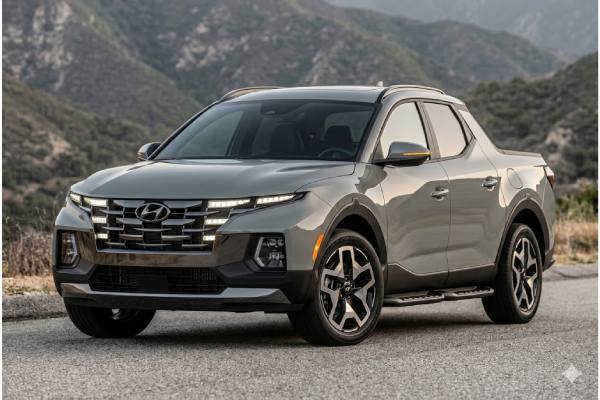
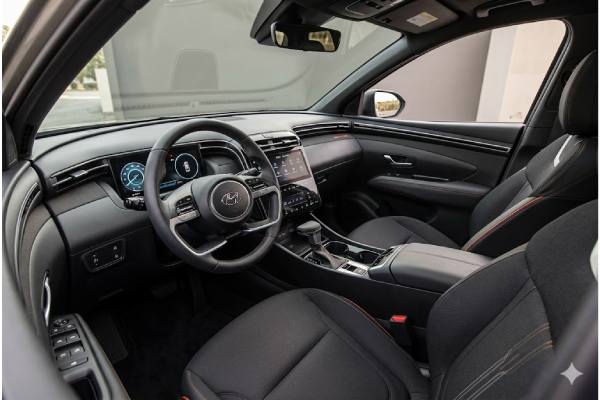

The front-wheel-drive Hyundai Santa Cruz with the naturally aspirated Smartstream 2.5L GDI + MPI engine is the most straightforward version of Hyundai’s compact pickup. It is built around a unibody crossover platform, uses a conventional 8-speed automatic transmission, and focuses more on everyday comfort, light-duty hauling, and outdoor practicality than on traditional truck toughness.
For 2024, this powertrain sat in the pre-refresh Santa Cruz range. From 2025 onward, the same basic 191 hp engine and FWD layout continued with a redesigned cabin, updated infotainment, revised exterior details, and some equipment changes. The result is a useful small pickup for drivers who want an SUV-like daily vehicle with an open bed, but it needs to be judged by compact-crossover standards rather than full-size truck standards.
Quick Overview
- Uses a non-turbo 2.5L four-cylinder with port and direct injection, giving simpler long-term ownership than the turbo/DCT versions.
- Compact exterior size, 27.0 cu ft bed volume, and SUV-like ride make it easy to use in cities, suburbs, and light recreational use.
- FWD versions are lighter and usually more efficient, but they lack the traction and towing confidence of AWD trims.
- Known service actions include power steering, shifter wiring, airbag, and display-software campaigns depending on model year and VIN.
- Typical normal-service oil and tire-rotation interval is about 8,000 miles or 12 months; severe use can justify shorter intervals.
Table of Contents
- Santa Cruz NXT Practical Overview
- Santa Cruz NXT Technical Specs
- Santa Cruz NXT Trims and Safety
- Reliability, Issues and Service Actions
- Maintenance and Used Buying
- Driving Feel and Performance
- Rivals and Final Advantages
Santa Cruz NXT Practical Overview
The Hyundai Santa Cruz FWD 2.5L is a compact, four-door, five-seat pickup sold mainly in North America. Hyundai often presents it as a “Sport Adventure Vehicle,” which is more than marketing language: it drives, packages, and feels closer to a compact crossover than a body-on-frame pickup. The platform is closely related to the Tucson, and the Santa Cruz uses a unibody structure rather than a separate ladder frame.
The “NXT” identifier appears in service and campaign contexts for later Santa Cruz vehicles, while the vehicle is also commonly discussed as part of the Tucson-derived NX4 family. In practical ownership terms, the important identifiers are simpler: 2024–present Santa Cruz, front-wheel drive, Smartstream 2.5L naturally aspirated four-cylinder, 8-speed automatic, and 191 hp.
This is not the high-output version. The turbocharged Santa Cruz is much quicker and can be paired with higher tow ratings in some configurations, but the naturally aspirated FWD model has several advantages of its own. It avoids the extra heat, boost control hardware, and more complex driveline behavior of the turbo models. It also uses a conventional torque-converter automatic rather than the earlier turbo model’s wet dual-clutch gearbox, which some owners may prefer for slow traffic, parking maneuvers, and long-term simplicity.
The Santa Cruz’s strongest use case is mixed daily life: commuting, grocery runs, bikes, garden supplies, camping gear, small trailers, wet sports equipment, and occasional home-improvement loads. The bed is short compared with a traditional pickup, but it is wide enough between the wheel wells for useful cargo, and the lockable underfloor storage helps with muddy or wet items.
The main limitation is that FWD traction and the base engine define its ceiling. It is fine for light-duty hauling, but not ideal for frequent towing, steep gravel access roads, heavy payloads, or drivers who expect strong passing performance with a loaded bed. Rear-seat space is also tighter than in many compact SUVs, especially behind taller front occupants.
For many owners, the best reason to choose this exact version is balance. It gives the Santa Cruz’s distinctive shape and open-bed utility without pushing into the higher cost and mechanical complexity of the turbo AWD trims.
Santa Cruz NXT Technical Specs
The figures below focus on U.S.-market 2024–present Santa Cruz FWD models with the naturally aspirated Smartstream 2.5L GDI + MPI engine. Some numbers vary by year, trim, tire package, installed accessories, and certification label, so VIN-specific service data should always be used for repairs.
| Item | Specification |
|---|---|
| Vehicle scope | Hyundai Santa Cruz FWD, NXT/NX4-derived compact unibody pickup, 2024–present |
| Engine code / family | Smartstream G2.5 GDI + MPI, G4KN-family 2.5L naturally aspirated inline-four |
| Layout and valvetrain | Inline-4, aluminum block/head, DOHC, 4 valves per cylinder, 16 valves total |
| Bore × stroke | 85.5 × 101.5 mm (3.37 × 4.00 in) |
| Displacement | 2.5 L / 2,497 cc (152 cu in) |
| Induction | Naturally aspirated |
| Fuel system | Combined gasoline direct injection and multi-port injection |
| Compression ratio | 13.0:1 |
| Maximum power | 191 hp (142 kW) at 6,100 rpm |
| Maximum torque | 245 Nm (181 lb-ft) at 4,000 rpm |
| Timing drive | Timing chain |
| Fuel | Regular unleaded gasoline |
| Rated fuel economy | 2024 FWD: 10.7 / 9.0 / 10.2 L/100 km city/highway/combined (22 / 26 / 23 mpg US; 26 / 31 / 28 mpg UK). 2025–2026 FWD ratings commonly improve to about 22 / 30 / 25 mpg US depending on trim. |
| Real-world highway at 120 km/h | Typically about 8.8–9.8 L/100 km (24–27 mpg US / 29–32 mpg UK), depending on wind, tyres, load, roof accessories, and terrain |
| Item | Specification |
|---|---|
| Transmission | 8-speed torque-converter automatic with SHIFTRONIC manual control; A8-family service identification varies by parts catalog |
| Drive type | Front-wheel drive |
| Differential | Open front differential with brake-based traction and stability control |
| Front / rear suspension | MacPherson strut front; multi-link rear |
| Steering | Motor-driven electric power steering, rack-and-pinion; turning circle about 12.1 m (39.6 ft) |
| Brakes | Four-wheel discs; approximately 325 mm (12.8 in) front ventilated discs and 325 mm (12.8 in) rear discs |
| Common tyre sizes | 245/60 R18 on many lower trims; 245/50 R20 on some higher or package-equipped trims |
| Ground clearance | About 218 mm (8.6 in) |
| Approach / departure angles | About 17.5° / 23.2° |
| Length / width / height | 4,970 mm / 1,905 mm / about 1,694 mm (195.7 in / 75.0 in / 66.7 in) |
| Wheelbase | 3,005 mm (118.3 in) |
| Curb weight | Approximately 1,680–1,715 kg (3,704–3,780 lb) for 2.5L FWD versions, depending on trim and year |
| GVWR | Approximately 2,475–2,545 kg (5,456–5,611 lb), certification-label dependent |
| Fuel tank | 67.0 L (17.7 US gal / 14.7 UK gal) |
| Bed volume | About 765 L (27.0 ft³), SAE-style open-bed volume |
| Towing capacity | Up to 1,588 kg (3,500 lb) with trailer brakes; lower unbraked limits apply |
| Payload | Varies by trim and equipment; many FWD examples fall around 640–795 kg (1,411–1,753 lb) |
| Item | Specification or practical range |
|---|---|
| 0–100 km/h / 0–62 mph | Typically about 9.0–9.8 seconds depending on trim, load, tyre, and test conditions |
| Top speed | Not a key factory selling metric; generally around 185–195 km/h (115–121 mph) if unrestricted by conditions |
| 100–0 km/h braking | Typically around 40–43 m (131–141 ft) on good tyres and dry pavement |
| Engine oil | 5.8 L (6.1 US qt) with filter; use the Hyundai-approved viscosity and API/ILSAC specification listed for the exact VIN and climate, commonly full synthetic 0W-30 in U.S. service references |
| Coolant | Hyundai long-life ethylene-glycol coolant, normally 50/50 with distilled or deionized water; total system capacity around 8.6 L (9.1 US qt), verify by VIN |
| Automatic transmission fluid | Hyundai/Kia-approved 8-speed automatic fluid; service-fill quantity depends on drain method, with full dry capacity higher than a simple drain-and-fill |
| Differential / transfer case | Not applicable for FWD rear driveline; front final drive is integrated with the transaxle |
| A/C refrigerant | R-1234yf; charge amount must be verified on the under-hood label or service data |
| A/C compressor oil | PAG oil compatible with R-1234yf; quantity is component-service dependent |
| Key torque values | Wheel nuts about 108–127 Nm (80–94 lb-ft); oil drain plug about 39 Nm (29 lb-ft), with new sealing washer; verify service manual before repair |
Safety ratings depend on model year and test protocol. The Santa Cruz has performed well in IIHS crash testing, including Good ratings in small-overlap and updated side testing for recent years, but the updated moderate-overlap rear-occupant test is stricter and separates the 2026 evaluation from some earlier results. Euro NCAP ratings do not apply to the U.S.-market Santa Cruz, and NHTSA star-rating availability should be checked by model year and body configuration.
Santa Cruz NXT Trims and Safety
For 2024, the naturally aspirated 2.5L FWD Santa Cruz was mainly associated with the lower and midrange trims, such as SE and SEL, while higher trims and sportier equipment groups often used the turbocharged engine and AWD. From 2025 onward, the range was refreshed with revised styling, a more modern dashboard, a larger infotainment display arrangement, and trim/equipment changes. The naturally aspirated FWD version remained the sensible entry point.
The easiest quick identifier is the powertrain and drivetrain combination. A 191 hp Santa Cruz with FWD and an 8-speed conventional automatic is the base-engine vehicle. Turbo models advertise 281 hp, use different badging and equipment combinations, and are more likely to have AWD and higher tow-oriented content. VIN decoding, the Monroney label, and the under-hood emissions label are the most reliable identifiers.
| Area | What to check |
|---|---|
| Base trims | Usually cloth seating, 18-inch wheels, core safety systems, 2.5L engine, FWD availability, and the lowest curb weight |
| Mid trims / packages | May add convenience features, roof rails, tonneau or bed features, upgraded infotainment, heated seats, and blind-spot features depending on year |
| 2025–present refresh | Updated interior controls, larger screen layout, revised exterior trim, and more modern connectivity features |
| Mechanical differences | The 2.5L FWD model keeps the simpler naturally aspirated engine and automatic; AWD, turbo output, and some higher tow-capacity configurations are separate |
| Wheel and tyre packages | 18-inch tyres ride more comfortably and are cheaper to replace; 20-inch tyres sharpen appearance but can reduce compliance and raise tyre cost |
Safety equipment is one of the Santa Cruz’s stronger areas, but availability still depends on year and trim. Forward Collision-Avoidance Assist, lane support, electronic stability control, anti-lock braking, multiple airbags, rearview camera, and high-beam assist form the core set. Blind-spot and rear cross-traffic functions became increasingly common and are important to look for because the sloped rear pillars and short pickup bed can make rear-quarter visibility less open than in a conventional hatchback or SUV.
Higher trims and newer model years may add features such as Smart Cruise Control, more advanced lane-centering support, surround-view monitoring, rear parking collision-avoidance functions, and improved infotainment-based driver settings. When windshields, bumpers, grilles, radar sensors, cameras, or suspension parts are replaced, calibration matters. A Santa Cruz with forward-facing camera or radar faults after a windshield replacement or front-end repair may need formal ADAS calibration rather than simple code clearing.
Child-seat provisions are better than the compact exterior suggests, but the rear cabin is still not large. The Santa Cruz has two complete rear LATCH positions and a center tether provision, while the middle seating position is narrow. Families should test the exact child seat behind the intended front occupant before buying.
IIHS results are generally favorable for recent Santa Cruz models. The headlights have been rated Good in applicable IIHS evaluations, and the model has earned Top Safety Pick recognition in relevant years. The stricter updated moderate-overlap test is worth noting because it places more emphasis on rear-occupant protection; shoppers comparing model years should treat 2026 results separately from earlier 2024–2025 build results where applicable.
Reliability, Issues and Service Actions
The 191 hp 2.5L FWD Santa Cruz is still relatively young, so long-term high-mileage evidence is not as mature as it is for older Hyundai models. Early reliability impressions should therefore be framed carefully. The base powertrain has some ownership advantages: no turbocharger, no intercooler, no AWD coupling, no rear differential, and no dual-clutch transmission. That reduces the number of expensive systems compared with upper Santa Cruz trims.
The engine still needs careful maintenance. It uses direct injection as part of a dual-injection system, and although the port injectors help keep intake valves cleaner than pure direct-injection designs, oil quality and PCV health still matter. Short-trip use, extended idling, poor fuel quality, and neglected oil changes are the main conditions that can accelerate deposits, fuel dilution, and varnish.
| System | Prevalence | Severity | Symptoms and remedy |
|---|---|---|---|
| Engine oil condition / consumption | Occasional | Medium | Low oil level, oil smell, timing or valvetrain noise. Confirm oil level history, inspect for leaks, shorten oil intervals under severe use, and document consumption if present. |
| Direct-injection deposits | Rare to occasional at this age | Medium | Rough idle, misfire codes, reduced response. Use quality fuel, keep PCV system healthy, and diagnose before cleaning or parts replacement. |
| 8-speed automatic shift quality | Occasional | Medium | Harsh shifts, hunting, delayed engagement. Check fluid condition, software updates, mounts, and adaptive values before assuming internal failure. |
| Brake wear and corrosion | Common in harsh climates | Low to medium | Brake pulsation, scraping, uneven pad wear. Inspect rotors, slider pins, parking-brake operation, and rear pad condition at each service. |
| Suspension and tyre wear | Occasional | Low to medium | Cupped tyres, pull, clunks, steering vibration. Rotate tyres, check alignment, and inspect control-arm bushings, struts, and wheel bearings. |
| Electronics and infotainment | Occasional | Low to medium | Screen resets, camera warnings, phone pairing issues. Check software level, battery condition, USB devices, and campaign status. |
Several service actions and recalls are important for VIN checks. Some 2024 Santa Cruz vehicles were included in a motor-driven power steering recall involving the electric power pack; the risk was loss of steering assist, with dealer replacement as the remedy. Certain 2025 Santa Cruz vehicles were included in a console extension wiring recall where harness routing near the shifter could interfere with the shift-lock mechanism; the remedy is rerouting the wiring, and owners were advised to use the parking brake.
For 2025–2026 vehicles, side-curtain airbag installation and instrument-cluster/display software campaigns may apply depending on production date and VIN. These are not routine wear issues, but they matter because an unrepaired recall can affect safety and resale value. A buyer should run the VIN through both Hyundai’s campaign lookup and NHTSA, then ask the seller or dealer for completed repair records.
Pre-purchase checks should include:
- Full maintenance history with oil-change dates, mileage, and oil specification.
- Recall and service-campaign completion printout.
- Cold start with the hood open to listen for chain rattle, accessory-belt noise, or exhaust leaks.
- Transmission engagement test from Park to Drive and Reverse after sitting overnight.
- Inspection for bed damage, tonneau drain issues, underbody scrapes, and rear suspension wear.
- ADAS warning-light check after windshield, bumper, grille, or collision repair.
- Tyre date codes, alignment pattern, brake rotor condition, and evidence of towing overload.
The durability outlook is cautiously positive for buyers who want the simplest Santa Cruz configuration. It should not be treated as a heavy-duty truck, but as a compact crossover with a bed and a modest tow rating.
Maintenance and Used Buying
A Santa Cruz 2.5L FWD responds well to ordinary preventive maintenance. The most important choice is to set the service schedule around use, not just mileage. Long highway trips in mild weather are easy on the oil and brakes. Short trips, cold starts, dusty roads, steep grades, stop-and-go traffic, heavy payload, and towing are severe use and justify shorter intervals.
| Item | Normal interval | Severe-use guidance |
|---|---|---|
| Engine oil and filter | About every 8,000 miles / 12 months | About every 5,000 miles / 6 months for frequent short trips, towing, heat, dust, or heavy traffic |
| Tyre rotation | Every oil service | Shorten interval if front tyres shoulder-wear quickly on FWD models |
| Cabin air filter | About every 16,000 miles / 24 months | Replace yearly in dusty, pollen-heavy, or urban conditions |
| Engine air filter | Inspect regularly; replace around 24,000–32,000 miles when dirty | Inspect more often on gravel, construction roads, or dusty climates |
| Brake fluid | Inspect at services; replacement commonly around 48,000 miles or 4 years | Replace sooner if moisture content is high or pedal feel changes |
| Coolant | Follow Hyundai schedule; long-life coolant is not a lifetime fluid | Test freeze protection, pH, and contamination during used-car inspection |
| Spark plugs | Often near 97,500 miles / 156,000 km under normal use | Replace earlier for misfires, poor idle, or heavy-use history |
| Timing chain | No routine replacement interval | Inspect if cold-start rattle, cam/crank correlation faults, or metal debris appear |
| Accessory belt and hoses | Inspect at routine services | Replace for cracking, glazing, swelling, seepage, or age-related hardening |
| Automatic transmission fluid | Inspect per schedule; many owners service preventively around 60,000–75,000 miles | Shorten interval for towing, hot climates, mountains, or heavy urban use |
| 12 V battery | Test annually after year three | Replace proactively around 4–6 years if cranking or voltage reserve weakens |
Fluid choices should be conservative. Use Hyundai-approved oil, coolant, brake fluid, and automatic-transmission fluid. A cheaper universal fluid can create more cost than it saves, especially in the transmission and cooling system. For A/C work, R-1234yf equipment and recovery procedures are required; topping off blindly from small cans is not a good diagnostic method.
For used buying, the FWD 2.5L version is often the most sensible value. It avoids the highest trim prices and the turbo powertrain’s extra complexity, while still giving the core Santa Cruz shape and bed utility. The best examples are privately owned or dealer-maintained vehicles with matching tyres, clean bed condition, no underbody damage, and complete recall history.
Avoid examples with vague service records, evidence of heavy towing, mismatched tyres, persistent warning lights, poor accident repair, water intrusion into the bed storage area, or unresolved ADAS faults. A cheap Santa Cruz with collision-history electronics problems can become expensive quickly.
A 2025-or-newer refreshed model is attractive for its interior improvements, but a clean 2024 can be a strong buy if the price is right and safety campaigns are completed. The final decision should come down to condition, service evidence, trim equipment, and whether the buyer values the newer cabin enough to pay the premium.
Driving Feel and Performance
The Santa Cruz FWD 2.5L feels more like a compact SUV than a pickup from the driver’s seat. Steering effort is light at parking speeds and stable enough on the highway. The long wheelbase helps straight-line composure, while the unibody structure avoids much of the hop and shake associated with older body-on-frame pickups.
Ride quality is one of the main advantages. With 18-inch wheels, the Santa Cruz absorbs patched pavement and expansion joints reasonably well. The rear suspension can feel firmer when the bed is empty, but it does not have the loose, unloaded rear-end feel of a traditional leaf-sprung truck. Larger 20-inch wheels look sharper but can add impact harshness and raise replacement-tyre cost.
The base 2.5L engine is smooth enough, but it is not muscular. Around town, throttle response is predictable and easy to meter. The automatic tends to upshift early for economy, so the Santa Cruz can feel relaxed unless the driver asks firmly for more power. Passing performance is acceptable with one or two occupants, but a full cabin, full bed, headwind, or uphill grade makes the engine work harder.
At highway speeds, the base engine’s main limitation is torque. The 181 lb-ft peak arrives at 4,000 rpm, so the transmission must downshift for strong acceleration. That is normal for a naturally aspirated four-cylinder, but shoppers coming from a V6 SUV, turbo crossover, or midsize truck should test it on the road they actually use.
Real-world efficiency depends heavily on speed. At 60–65 mph, careful drivers can see respectable numbers. At 75 mph / 120 km/h, aerodynamic drag from the tall front end and open-bed shape becomes more noticeable. Crossbars, rooftop accessories, all-terrain tyres, and heavy cargo can reduce economy quickly.
| Condition | Typical result |
|---|---|
| City driving | About 10.5–12.5 L/100 km (19–22 mpg US / 23–26 mpg UK), worse with short cold trips |
| Mixed driving | About 9.4–10.7 L/100 km (22–25 mpg US / 26–30 mpg UK) |
| Highway at 100–110 km/h | About 7.8–8.8 L/100 km (27–30 mpg US / 32–36 mpg UK) in favorable conditions |
| Highway at 120 km/h / 75 mph | About 8.8–9.8 L/100 km (24–27 mpg US / 29–32 mpg UK) |
| Moderate towing or full payload | Fuel consumption can rise by 25–60% depending on trailer shape, load, grade, and speed |
Braking feel is generally confidence-inspiring for normal use, and the four-wheel disc setup is adequate for the vehicle’s rating. With a trailer, correct tongue weight, trailer brakes, tyre pressure, and conservative speed matter more than peak horsepower. The FWD model can tow light loads, but frequent towing is a better match for AWD and higher-output configurations.
Noise levels are acceptable rather than luxury-quiet. Tyre noise varies by tyre package, and wind noise rises with crossbars or roof accessories. The 2025–present interior updates help the cabin feel more modern, especially for drivers who disliked the earlier touch-heavy layout.
Rivals and Final Advantages
The Santa Cruz FWD 2.5L sits in a narrow but useful space. Its closest rival is the Ford Maverick, especially in hybrid or front-wheel-drive form. The Maverick usually wins on fuel economy, bed simplicity, and price-sensitive utility. The Santa Cruz counters with a more SUV-like cabin feel, stronger design personality, a more refined interior in many trims, and a covered-bed lifestyle approach rather than a basic work-truck feel.
Against the Honda Ridgeline, the Santa Cruz is smaller, less powerful, and less spacious, but easier to park and usually less expensive. The Ridgeline is the better choice for buyers who want V6 power, standard AWD, a larger cabin, and more consistent towing confidence. The Santa Cruz is better for drivers who do not need midsize dimensions.
Compared with body-on-frame pickups such as the Toyota Tacoma, Nissan Frontier, Chevrolet Colorado, and Ford Ranger, the Santa Cruz is not a direct substitute. Those trucks offer more traditional truck durability, off-road hardware, payload/towing headroom, and aftermarket support. The Hyundai is more comfortable and efficient in daily use, but it is not designed for heavy-duty work or rough-trail abuse.
| Rival | Where the rival is stronger | Where the Santa Cruz is stronger |
|---|---|---|
| Ford Maverick | Fuel economy, bed practicality, hybrid availability, value-oriented trims | Cabin finish, ride refinement, distinctive design, available premium features |
| Honda Ridgeline | Cabin room, V6 performance, towing confidence, standard AWD layout | Smaller footprint, lower entry cost, easier urban parking |
| Toyota Tacoma / Ford Ranger | Truck capability, off-road hardware, payload/towing headroom | Ride comfort, daily drivability, compact-crossover feel |
| Hyundai Tucson | Enclosed cargo space, rear-seat practicality, easier family use | Open-bed utility, wet/dirty cargo handling, lifestyle-pickup flexibility |
The main advantages of this exact Santa Cruz version are mechanical simplicity, daily comfort, manageable size, useful bed features, and favorable safety credentials. It is a strong choice for owners who want one vehicle for commuting, errands, bikes, pets, small projects, and weekend gear.
The main reasons to skip it are equally clear. It is not quick, not especially roomy in the rear seat, not ideal for repeated heavy towing, and not as fuel-efficient as a hybrid Maverick. Buyers who want real truck capability should step up to a midsize pickup; buyers who never use an open bed may be happier in a Tucson or another compact SUV.
As a used or new purchase, the Santa Cruz FWD 2.5L makes the most sense when priced as a practical crossover alternative with added cargo flexibility. Choose a well-documented example, verify campaign completion by VIN, keep the oil and tyres on schedule, and it should deliver the clearest ownership case in the Santa Cruz lineup: less complexity, enough utility, and a driving experience that stays easy to live with.
References
- 2024 Santa Cruz Specifications 2024 (Manufacturer Specifications) ([Hyundai News][1])
- 2025 Santa Cruz Specifications 2025 (Manufacturer Specifications) ([Hyundai News][2])
- Gas Mileage of 2024 Hyundai Santa Cruz 2024 (Fuel Economy) ([Fuel Economy][3])
- 2026 Hyundai Santa Cruz 2026 (Safety Rating) ([IIHS Crash Testing][4])
- Check for Recalls: Vehicle, Car Seat, Tire, Equipment 2026 (Recall Database) ([NHTSA][5])
Disclaimer
This article is for informational purposes only and is not a substitute for professional diagnosis, repair, or factory service information. Specifications, torque values, fluid capacities, maintenance intervals, safety equipment, and procedures can vary by VIN, market, model year, trim, production date, and installed equipment. Always verify repair and maintenance data against the official owner’s manual, service manual, certification label, and dealer or manufacturer records for the exact vehicle.
If you found this useful, please consider sharing it on Facebook, X/Twitter, or another platform to support our work.