

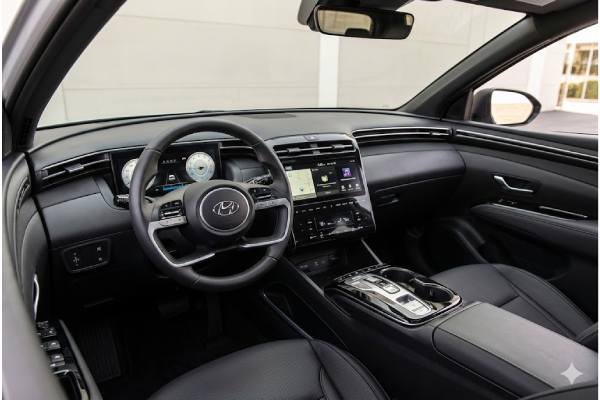
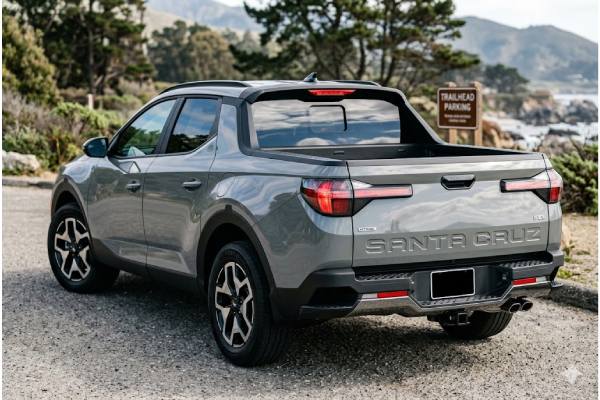
The turbocharged HTRAC AWD Hyundai Santa Cruz is the higher-output version of Hyundai’s compact unibody pickup, sharing much of its platform thinking with the Tucson while adding an open cargo bed, higher tow rating, and a more activity-focused layout. For the 2021–2024 pre-facelift build period, the key version is the Smartstream 2.5-liter T-GDI engine with combined direct and multi-point injection, an 8-speed wet dual-clutch transmission, and active on-demand all-wheel drive.
It is not a traditional body-on-frame truck, and that matters. The Santa Cruz is at its best as a quick, comfortable daily driver that can tow a small trailer, carry bikes or home-improvement materials, handle winter roads confidently, and park more easily than a midsize pickup. Its main trade-offs are a short bed, limited rear-seat space, and some extra maintenance sensitivity around the turbo engine, wet DCT, AWD hardware, and recall completion.
Quick Specs and Notes
- Strong 281 hp turbo engine gives the Santa Cruz quick real-world passing performance for a compact pickup.
- HTRAC AWD, independent suspension, and a unibody structure make it more refined than most traditional trucks.
- Properly equipped turbo AWD models are rated to tow up to 2,268 kg (5,000 lb) with trailer brakes.
- Check recall completion carefully, especially for early 2022 DCT, tow-hitch harness, and turbo oil-feed concerns.
- Typical oil service is every 8,000 km / 6 months in some schedules, with severe-use service needed sooner in hard use.
Table of Contents
- Santa Cruz HTRAC AWD buyer snapshot
- Santa Cruz HTRAC AWD technical data
- Santa Cruz HTRAC AWD trims and safety
- Reliability issues and service actions
- Maintenance schedule and buying checks
- Driving performance and towing behavior
- Rivals and ownership advantages
Santa Cruz HTRAC AWD buyer snapshot
The Hyundai Santa Cruz HTRAC AWD with the 2.5 T-GDI engine is best understood as a compact crossover pickup rather than a scaled-down work truck. It uses a transverse front-engine layout, independent suspension at both ends, a five-seat crew-cab body, and a short integrated pickup bed. In North America, the turbo AWD version sits above the naturally aspirated 2.5-liter models and is the one to choose if towing, mountain driving, fast highway merging, or regular all-weather use matters.
The 2.5 T-GDI is a 2,497 cc turbocharged inline-four from Hyundai’s Smartstream family. It uses both gasoline direct injection and multi-point injection, which helps balance performance, emissions, and intake-valve cleanliness better than a DI-only setup. Output is 281 hp at 5,800 rpm and 422 Nm (311 lb-ft) from roughly 1,700 to 4,000 rpm. That torque plateau is the reason the Santa Cruz feels stronger than its size suggests, especially from 50–80 mph or when climbing with passengers and gear.
HTRAC AWD is an active on-demand system. In normal dry driving it behaves front-biased for efficiency, then sends torque rearward when sensors detect slip, driver demand, cornering load, or selected drive modes. It is not a low-range 4×4 system, and it does not turn the Santa Cruz into a rock crawler. Its value is in rain, snow, loose gravel, boat ramps, and light trail access.
The Santa Cruz’s biggest advantages are daily usability, refinement, and packaging. It is shorter and easier to manage than most midsize pickups, yet it gives owners a lockable under-bed storage area, a molded composite bed, side storage, tie-down points, and a useful factory tonneau arrangement on many trims. The cabin feels closer to a well-equipped compact SUV than a commercial vehicle, especially in Limited trim.
Its limitations are just as important. The bed is short, rear legroom is tighter than in many family SUVs, and the wet dual-clutch transmission prefers decisive throttle inputs over repeated creeping in traffic or on steep driveways. The turbo AWD version is also heavier, more complex, and costlier to maintain than the base 2.5-liter Santa Cruz. For buyers comparing used examples, service history, tire condition, DCT behavior, recall completion, and evidence of towing are more important than mileage alone.
The 2021–2024 scope mainly refers to the first production and pre-facelift period. U.S. retail model years started with 2022, while early production and some databases may list 2021 build timing. Equipment varies by market, so a VIN-specific check remains essential.
Santa Cruz HTRAC AWD technical data
The figures below focus on the North American-style Santa Cruz 2.5 T-GDI HTRAC AWD before the 2025 facelift. Some weights, payload ratings, tire packages, and equipment details vary by trim and model year.
| Item | Hyundai Santa Cruz 2.5 T-GDI HTRAC AWD |
|---|---|
| Platform / code | NX4A / NX4 OB family, compact unibody pickup |
| Engine | Smartstream G2.5 T-GDI, commonly associated with G4KP family |
| Layout | Front transverse inline-4, aluminum block/head, DOHC, 4 valves/cylinder |
| Bore × stroke | 88.5 × 101.5 mm (3.48 × 4.00 in) |
| Displacement | 2.5 L / 2,497 cc (152.4 cu in) |
| Induction and injection | Turbocharged, intercooled, GDI + MPI |
| Compression ratio | 10.5:1 |
| Maximum power | 281 hp (210 kW) @ 5,800 rpm |
| Maximum torque | 422 Nm (311 lb-ft) @ about 1,700–4,000 rpm |
| Timing drive | Chain |
| Transmission | 8-speed wet dual-clutch automatic with manual shift mode |
| Drive type | HTRAC active on-demand AWD |
| Differentials | Open differentials with electronic traction/stability control support |
| EPA efficiency, turbo AWD | 12.4 / 8.7 / 10.7 L/100 km; 19 / 27 / 22 mpg US; 22.8 / 32.4 / 26.4 mpg UK |
| Real-world 120 km/h highway | About 7.8–9.4 L/100 km (25–30 mpg US) when unloaded, depending on tires, wind, temperature, and speed control |
| 0–100 km/h | About 6.3–6.7 seconds, depending on test method and surface |
| Top speed | About 214 km/h (133 mph), governed in some tests |
| Item | Specification |
|---|---|
| Front / rear suspension | MacPherson strut / multi-link independent |
| Steering | Electric rack-and-pinion; approximately 14.2:1 overall ratio where listed |
| Brakes | Ventilated front disc and rear disc, 325 mm (12.8 in) rotors |
| Popular tire sizes | 245/60 R18 or 245/50 R20, depending on trim |
| Ground clearance | 218 mm (8.6 in) |
| Approach / departure / breakover | 17.5° / 23.2° / about 18.6° |
| Length / width / height | 4,970 mm / 1,905 mm / about 1,695 mm (195.7 / 75.0 / 66.7 in) |
| Wheelbase | 3,005 mm (118.3 in) |
| Turning circle | About 12.1 m (39.6 ft), curb-to-curb |
| Curb weight | About 1,860–1,910 kg (4,101–4,211 lb), trim dependent |
| GVWR | Up to about 2,600 kg (5,732 lb), depending on market/trim |
| Fuel tank | 67 L (17.7 US gal / 14.7 UK gal) |
| Bed volume | About 765 L (27.0 ft³), SAE-style pickup bed volume |
| Towing capacity | Up to 2,268 kg (5,000 lb) braked; about 748 kg (1,650 lb) unbraked |
| Payload | Typically about 640–740 kg (1,411–1,631 lb), trim and year dependent |
| System | Specification / capacity |
|---|---|
| Engine oil | Full synthetic SAE 0W-30, API SN PLUS/SP or ILSAC GF-6; 5.8 L (6.13 US qt) with filter |
| Coolant | Ethylene-glycol coolant for aluminum engines; about 8.63 L (9.12 US qt) |
| DCT gear oil | GS WDCTF HD G or approved equivalent; about 3.3–3.4 L (3.49–3.59 US qt) |
| DCT control oil | GS WDCTF HD H or approved equivalent; about 2.45–2.50 L (2.59–2.64 US qt) |
| Rear differential oil | API GL-5 SAE 75W/85; about 0.53–0.63 L (0.56–0.67 US qt) |
| Transfer case oil | API GL-5 SAE 75W/85; about 0.48–0.52 L (0.51–0.55 US qt) |
| Brake fluid | DOT-4, as required |
| A/C refrigerant | R-1234yf; 600 g ± 25 g (21.16 oz ± 0.88 oz) |
| A/C compressor oil | PAG; 100 g ± 10 g (3.53 oz ± 0.35 oz) |
| Wheel nut torque | 107–127 Nm (79–94 lb-ft) |
| Engine oil drain plug | About 39 Nm (29 lb-ft); replace washer when serviced |
For safety, 2024 Santa Cruz models are notable for strong IIHS crashworthiness results, standard LED projector headlights, and a 5-star overall NHTSA rating in commonly reported U.S. data. The details depend on production date and test protocol, especially because IIHS updated side-impact and moderate-overlap procedures changed during this period.
Santa Cruz HTRAC AWD trims and safety
For the turbo HTRAC AWD version, the key North American trims are the upper grades rather than the base SE and SEL models. In 2022, the turbo AWD powertrain was strongly associated with SEL Premium and Limited. By 2024, the turbo AWD setup appeared on Night, XRT, and Limited, while lower trims generally used the naturally aspirated 2.5-liter engine.
Trim names vary by market, but the mechanical pattern is simple: the 281 hp turbo engine brings the wet 8-speed DCT and the 5,000 lb braked tow rating when properly equipped. The base engine uses a conventional 8-speed automatic and is rated lower for towing. That distinction matters more than badges because the driving character, maintenance needs, and resale value are different.
Useful trim identifiers include the “2.5T” style powertrain listing on build sheets, paddle shifters, the wet DCT specification, factory tow equipment on many examples, larger wheels on upper trims, and interior tells such as the larger infotainment screen, Bose audio on Limited, ventilated front seats on higher trims, and surround-view or blind-view camera features where equipped. XRT added a more rugged appearance package for 2024, but it should not be confused with a locking-differential off-road model.
Safety equipment is one of the Santa Cruz’s stronger points. Standard and available systems across the 2021–2024 period include forward collision-avoidance assist, pedestrian and cyclist detection on many trims, lane keeping assist, lane following assist, driver attention warning, blind-spot collision-avoidance assist, rear cross-traffic collision-avoidance assist, safe exit warning, adaptive cruise control on upper trims, parking sensors, rear camera, and surround-view monitoring on the most equipped versions.
The airbag package generally includes front airbags, front side airbags, and side-curtain airbags for front and rear outboard passengers, with rollover sensing. Child-seat provisions include LATCH/ISOFIX-style lower anchors in the rear seating area, though the compact rear cabin means bulky rear-facing seats can push the front passenger seat forward.
IIHS ratings are nuanced. Earlier 2022 models earned Top Safety Pick recognition when equipped with specific better-performing headlights, while later 2023–2024 equipment improved headlight availability. For 2024, IIHS lists Good ratings in small overlap front, original moderate overlap front, updated side, and headlights, while the updated moderate overlap front rating is more demanding and shows the importance of production date and rear-seat restraint changes.
After windshield replacement, front-end repair, suspension work, bumper removal, or collision repair, ADAS calibration is important. The forward camera, radar, parking sensors, and blind-spot monitoring components rely on correct alignment. A used Santa Cruz with mismatched bumpers, aftermarket accessories around sensors, or unexplained warning lights should be inspected carefully before purchase.
Reliability issues and service actions
The Santa Cruz 2.5 T-GDI AWD is still a relatively modern platform, so its long-term pattern is clearer than at launch but not as mature as older Hyundai models. The best examples are well maintained, recall-complete, and driven with an understanding that a turbocharged engine and wet DCT need proper fluid quality, warm-up, and inspection.
| Area | Prevalence | Severity / cost | What to check |
|---|---|---|---|
| 8-speed wet DCT behavior | Occasional, more visible on early 2022 units | Medium to high | Hesitation, warning lamps, harsh engagement, fail-safe history, recall 236 completion |
| Tow-hitch harness recall | Relevant on affected 2022–2023 vehicles with accessory tow wiring | High safety concern | VIN recall status, harness remedy, fuse/jumper update, dealer records |
| Turbo oil-feed pipe recall | Rare, narrow early 2022 population | High if leaking | Oil smell, visible oil near turbo line, recall 222 completion |
| AWD driveline fluids | Maintenance-sensitive | Medium | Transfer case and rear differential seepage, water exposure, service proof |
| Brake and tire wear | Common ownership item | Low to medium | Uneven tire wear, rotor pulsation, rear brake corrosion in salty climates |
| Infotainment and camera issues | Occasional | Low to medium | Software updates, camera display, Bluelink function, parking sensor faults |
The highest-profile service action for early turbo AWD models is the 8-speed DCT recall campaign. The issue involved the high-pressure electric oil pump and fail-safe behavior. Symptoms could include multiple warning lamps, diagnostic trouble codes, hesitation, rough shifts, or loss of motive power after a short fail-safe period. The official remedy involved TCU software updates and inspection, with transmission replacement when required by the diagnostic result. A test drive should include gentle launch, rolling stop-and-go traffic, moderate kickdown, and a full operating-temperature check.
The tow-hitch harness recall is important because it is safety-related and may apply to vehicles equipped with a Genuine Hyundai accessory tow hitch harness. Moisture intrusion could cause an electrical short and fire risk. Any used Santa Cruz that has been used for towing should have documented recall completion and a visual check of the hitch wiring, connector, fuse update, and harness routing.
A smaller early recall concerned cracking in the turbocharger oil supply pipe on certain 2022 vehicles. Although the affected population was limited, the consequence was serious because oil leaking onto hot components can raise fire risk. A pre-purchase inspection should include a clean look around the turbocharger, oil-feed line, undertray, and nearby heat shielding.
For the engine itself, the 2.5 T-GDI benefits from the combined GDI/MPI fuel system, but it still depends on correct oil. Use the specified full synthetic 0W-30 and do not stretch intervals on vehicles used for short trips, towing, repeated idling, or hot climates. Watch for low-oil warnings, consumption complaints, coolant smell, turbo whistle changes, misfires, or rough cold starts.
Corrosion is not a dominant platform weakness, but the usual areas matter: underbody seams, suspension fasteners, rear subframe areas, bed hardware, tow-hitch mounts, brake backing plates, and the underside in road-salt regions. A clean cabin and shiny paint do not prove clean underbody condition.
Maintenance schedule and buying checks
Maintenance on the Santa Cruz 2.5 T-GDI HTRAC AWD is not difficult, but it should be consistent. The powertrain is more sensitive to fluid quality than the base model because it combines a turbocharged engine, wet DCT, AWD transfer hardware, and rear differential.
| Interval | Service items |
|---|---|
| Every fuel stop / monthly | Check engine oil level, coolant level, washer fluid, tire pressures, lights, and visible leaks |
| 8,000 km / 6 months | Replace engine oil and filter where this interval applies; inspect brakes, tires, suspension, hoses, DCT operation, and underbody |
| 12,000–16,000 km / 12 months | Rotate tires, inspect brake fluid, battery condition, air filters, parking brake, steering, and cooling system |
| 24,000 km / 12 months | Replace cabin air filter where specified; inspect fuel system, vapor hoses, exhaust, and brake lines |
| 32,000 km / 24 months | Inspect intercooler hoses after the first early inspection; check for oil misting, loose clamps, and boost leaks |
| 48,000 km / 48 months | Replace brake fluid in schedules that specify it; inspect DCT fluid condition and AWD driveline fluids |
| 52,000 km / 48 months | Inspect DCT fluid, rear differential oil, transfer case oil, and propeller shaft; replace sooner after water submersion or hard towing |
| 72,000 km | Replace spark plugs on the turbo engine |
| 96,000 km / 72 months | First drive-belt inspection, then repeat about every 24,000 km / 24 months |
| 192,000 km / 120 months | First coolant replacement in some schedules, then replace about every 48,000 km / 24 months |
For many owners, “severe use” is more common than it sounds. Short trips, repeated cold starts, dusty roads, long idling, hot climates, towing, mountain driving, roof or bed loads, and frequent stop-start traffic all justify shorter service intervals. A turbocharged Santa Cruz used for towing should not be treated like a gently driven commuter.
The timing chain does not have a routine belt-style replacement interval. Instead, listen for cold-start rattle, check for timing-correlation faults, and investigate chain, guide, and tensioner concerns only if symptoms or diagnostic data indicate a problem. The same logic applies to the accessory belt: inspect first, then replace for cracking, glazing, contamination, or tension loss.
Buyer checks should start with the VIN. Confirm open recalls through Hyundai or NHTSA, then ask for dealer repair records. Look for oil-change receipts showing correct 0W-30 oil, not just generic “synthetic oil.” Check whether spark plugs have been replaced at the correct interval on higher-mileage examples. Inspect all four tires for matching brand, size, speed/load rating, and tread depth, because mismatched tires can affect AWD behavior and stability-control operation.
During a road test, the DCT should engage smoothly, shift cleanly, and avoid warning lights. A slight dual-clutch feel at crawling speeds is normal; banging, slipping, shuddering, delayed reverse, or repeated driveline clunks is not. Under the vehicle, inspect the transfer case, rear differential, axle seals, prop shaft area, exhaust heat shields, and hitch wiring.
The best used examples are usually lightly to moderately used Limited, SEL Premium, Night, or XRT models with complete service documentation, no unverified collision repairs, and factory-correct tires. Avoid any example with unresolved warning lights, missing recall proof, poor oil history, aftermarket electrical towing work, or signs of repeated heavy towing without more frequent fluid service.
Driving performance and towing behavior
The Santa Cruz 2.5 T-GDI HTRAC AWD is one of the quicker compact pickups from this period. The turbo engine gives it a broad midrange, and the wet DCT shifts quickly once moving. In daily driving, the engine’s useful torque starts low enough that it does not need constant high-rpm operation. Highway merging, two-lane passing, and climbing grades are all strong points.
The transmission is more nuanced. At speed, it feels crisp and efficient. In slow creeping traffic, tight parking maneuvers, or steep driveway starts, it can feel less fluid than a torque-converter automatic. This is normal to a point, but harsh engagement, repeated shudder, or warning lights are not. Drivers who tow, launch on inclines, or crawl in traffic should avoid riding the throttle and brake together for long periods.
Ride quality is closer to a compact SUV than a traditional pickup. The unibody structure, independent rear suspension, and relatively long wheelbase give it good highway stability. With the bed empty, the rear can still feel slightly lighter over broken pavement than a Tucson-style SUV, but it is far more settled than many body-on-frame trucks. Steering is direct enough for urban driving, and the Santa Cruz feels smaller than its length suggests.
Braking performance is strong for the class when tires are in good condition. Instrumented tests have shown short 60–0 mph stops for a small pickup, while 70–0 mph results around 171 ft have been reported in independent testing. Pedal feel is generally predictable, though towing, mountain descents, and heavy payloads demand more following distance.
Fuel economy depends heavily on speed and tire package. Around town, expect roughly 12–14 L/100 km (17–20 mpg US) in mixed traffic. At 100–110 km/h, careful drivers may see near or above the EPA highway figure. At 120 km/h, a realistic unloaded range is about 7.8–9.4 L/100 km (25–30 mpg US), but headwinds, winter tires, roof racks, and cold weather can erase that advantage quickly. Towing can increase fuel use dramatically, often by 30–60 percent depending on trailer shape and weight.
HTRAC AWD improves confidence more than off-road capability. Snow mode and traction-control logic help on slick roads, while the ground clearance is useful for rutted tracks and campsites. The limiting factors are approach angle, tire choice, no low range, and no locking rear differential. Proper all-season or winter tires make a larger difference than trim badges.
For towing, the 5,000 lb braked rating is useful but should be treated with respect. A compact unibody pickup is happiest with smaller boats, utility trailers, light campers, motorcycles, or recreational gear rather than frequent maximum-load hauling. Use trailer brakes where required, stay within tongue-weight limits, monitor temperatures on long grades, and shorten service intervals for fluids and brakes if towing is routine.
Rivals and ownership advantages
The Santa Cruz’s closest rival is the Ford Maverick, while the Honda Ridgeline sits one size larger and the Toyota Tacoma, Nissan Frontier, Chevrolet Colorado, and Ford Ranger represent more traditional truck alternatives. The right choice depends on whether daily comfort, compact size, fuel economy, towing, bed utility, or long-term ruggedness matters most.
Against the Ford Maverick, the Santa Cruz turbo AWD feels quicker, more refined, and more premium inside in upper trims. The Maverick counters with a more practical bed shape, better entry pricing, and outstanding hybrid fuel economy in non-AWD versions. Buyers who want the most efficient urban pickup often lean Maverick; buyers who want stronger acceleration, a more SUV-like cabin, and a richer feature set often prefer the Santa Cruz.
Against the Honda Ridgeline, the Santa Cruz is smaller, easier to park, and often more affordable used. The Ridgeline has a larger cabin, a more useful bed, V6 smoothness, and a more relaxed towing character. The Santa Cruz is the better fit for people who do not need midsize-pickup space but still want an open bed and AWD confidence.
Against body-on-frame trucks, the Santa Cruz gives up rugged trail hardware, payload reserve, and heavy-duty feel. In return, it is quieter, easier to maneuver, more efficient in many situations, and more pleasant as a daily driver. It is not the right answer for regular construction use or serious off-road travel, but it works very well for homeowners, cyclists, kayakers, commuters, and small-trailer owners.
| Model | Strength | Trade-off |
|---|---|---|
| Hyundai Santa Cruz 2.5T AWD | Quick, refined, compact, strong feature content | Short bed, DCT complexity, tighter rear seat |
| Ford Maverick EcoBoost AWD | Practical bed, good value, simpler truck utility | Less premium cabin feel, lower refinement in some trims |
| Ford Maverick Hybrid | Excellent fuel economy and low running costs | Not the same power or AWD availability in early years |
| Honda Ridgeline | Roomier, smoother, larger bed and proven V6 character | Larger footprint and typically higher running cost |
| Toyota Tacoma / Ford Ranger | Stronger traditional truck image and off-road potential | Less car-like ride, larger size, heavier feel |
The Santa Cruz’s ownership advantage is balance. It gives drivers most of what they need from a light-duty pickup without the bulk and ride compromise of a conventional truck. The turbo AWD model adds genuinely strong performance, a useful tow rating, and excellent bad-weather confidence. Its weak points are manageable if the vehicle has correct service history, completed recalls, matched tires, and no neglected towing or DCT symptoms.
For a used buyer, the sweet spot is not necessarily the cheapest example. A clean turbo AWD with documented maintenance and recall completion is worth more than a lower-priced truck with vague records. When maintained properly, the Santa Cruz 2.5T HTRAC AWD can be a distinctive and practical alternative to both compact SUVs and midsize pickups.
References
- 2024 Santa Cruz Specifications 2023 (Manufacturer Specifications)
- Gas Mileage of 2024 Hyundai Santa Cruz 2024 (EPA Fuel Economy)
- 2024 Hyundai Santa Cruz 2024 (Safety Rating)
- Vehicle Detail Search – 2024 Hyundai Santa Cruz | NHTSA 2024 (Recall Database)
- 9. Maintenance 2022 (Owner’s Manual)
Disclaimer
This article is for informational purposes only and is not a substitute for professional diagnosis, repair, inspection, or official service guidance. Specifications, torque values, service intervals, fluids, safety equipment, recalls, and procedures can vary by VIN, market, production date, trim, and installed equipment. Always verify details against the official owner’s manual, service documentation, recall database, and a qualified Hyundai technician before performing maintenance or making a purchase decision.
If this information was useful, consider sharing it on Facebook, X/Twitter, or other platforms to help support our work.