
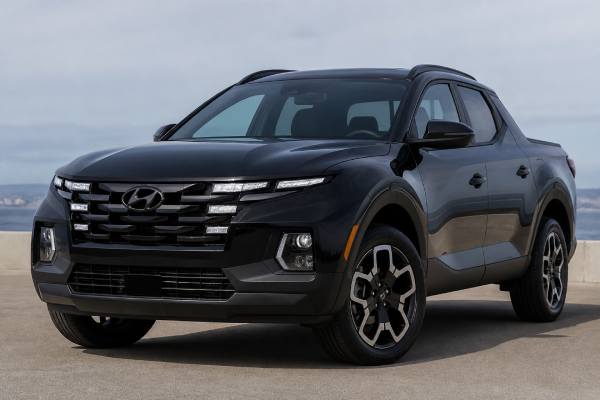
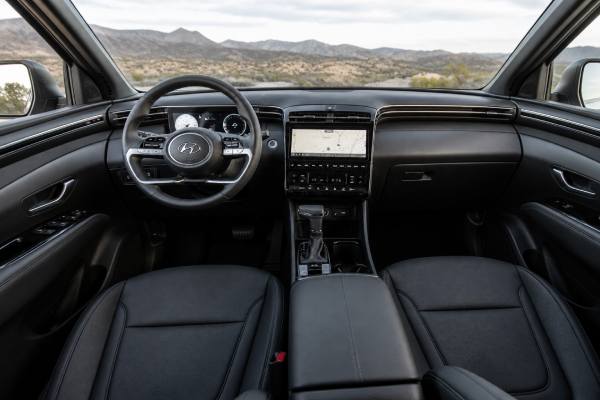
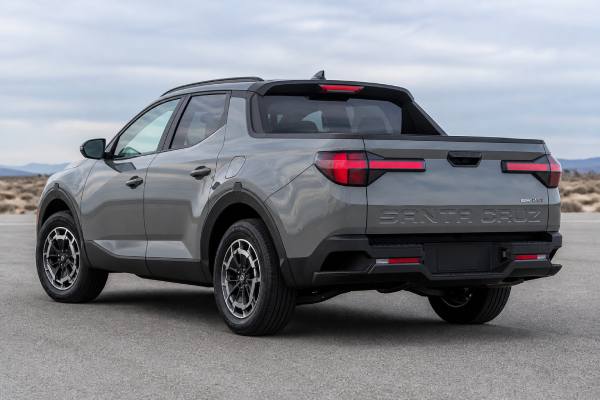
The turbocharged HTRAC AWD Hyundai Santa Cruz is the most capable version of Hyundai’s compact unibody pickup. It combines a Tucson-derived platform, a short open bed, a high-output 2.5-liter turbocharged engine, an eight-speed wet dual-clutch transmission, and Hyundai’s active all-wheel-drive system. The result is not a traditional body-on-frame truck, but a crossover-based pickup aimed at drivers who want useful towing and cargo flexibility without the size, ride firmness, and fuel cost of a larger truck.
For 2024 and newer models, the 281 hp Santa Cruz is most relevant in XRT, Night, SEL Activity AWD, and Limited-type configurations, depending on model year and market. The important details are trim-sensitive: towing, tire package, equipment, fuel economy, driver-assistance features, and even some safety-test applicability can vary by build date and region.
Quick Specs and Notes
- The 2.5T HTRAC AWD setup gives the Santa Cruz strong passing power and a maximum braked tow rating of 2,268 kg (5,000 lb) when properly equipped.
- Its unibody chassis delivers a quieter, more car-like ride than many body-on-frame pickups.
- The short bed is highly usable for lifestyle cargo, but it is not a replacement for a long-bed work truck.
- The wet dual-clutch transmission needs clean fluid, correct software, and sensible low-speed use, especially in heavy traffic or towing.
- Normal-service visits are commonly scheduled around 12,900 km (8,000 miles) or 12 months; severe use may require shorter oil and driveline-fluid intervals.
Table of Contents
- Santa Cruz NXT Turbo AWD Scope
- Santa Cruz NXT 25T Technical Specs
- Santa Cruz NXT Trims and Safety
- Reliability, Recalls and Service Checks
- Maintenance Schedule and Buying Advice
- Driving Character and Real-World Performance
- Rivals, Alternatives and Ownership Value
Santa Cruz NXT Turbo AWD Scope
The vehicle covered here is the Hyundai Santa Cruz NXT with HTRAC all-wheel drive and the Smartstream G2.5 T-GDI + MPI turbocharged four-cylinder gasoline engine. In North America, this is the high-output Santa Cruz powertrain: a 2,497 cc inline-four using a turbocharger, intercooler, dual overhead cams, continuously variable valve timing, and both direct and multi-port fuel injection. Output is rated at 281 hp and 311 lb-ft, or about 210 kW and 422 Nm.
The Santa Cruz is a compact crew-cab pickup with a short integrated bed, not a separate-frame truck. Its platform relationship with Hyundai’s compact SUVs gives it independent suspension at both ends, a low step-in height, and a cabin that feels closer to a crossover than a commercial pickup. That is the point of the model: it is meant to carry bikes, tools, camping gear, home-improvement supplies, small trailers, and outdoor equipment while remaining easy to park and comfortable in daily traffic.
HTRAC AWD is an active on-demand system. In normal cruising, it can bias torque toward the front wheels for efficiency. Under acceleration, cornering, slippery-road starts, or selected drive modes, it can send more torque rearward. There is no low-range transfer case and no locking differential, so it should be understood as road-biased AWD with useful poor-weather and light-trail traction rather than a rock-crawling 4×4 system.
The 2024 model year is important because Hyundai had already moved the Santa Cruz into a more mature phase of production, while 2025 brought a noticeable refresh in many markets. The 2025 update sharpened the exterior, revised the interior interface, expanded display technology on higher trims, and adjusted trim packaging. The core 2.5T AWD mechanical formula stayed familiar: turbo four-cylinder, eight-speed wet DCT, independent suspension, compact dimensions, and up to 5,000 lb towing when configured correctly.
The strongest reasons to consider this version are power, traction, and refinement. The naturally aspirated 2.5-liter Santa Cruz is adequate for commuting, but the turbo AWD model feels much more relaxed with passengers, cargo, hills, or a trailer. It also suits drivers who want a small truck but do not want the ride and size penalties of a midsize pickup.
The main compromise is that the Santa Cruz is a niche vehicle. Its bed is shorter than most pickups, rear-seat space is tighter than in larger crew cabs, and the dual-clutch transmission has a different low-speed feel from a torque-converter automatic. Buyers who understand those trade-offs usually find the 2.5T HTRAC AWD model far more satisfying than those expecting a scaled-down full-size truck.
Santa Cruz NXT 25T Technical Specs
The following specifications focus on the 2024-present Santa Cruz HTRAC AWD with the 2.5T engine. Some values vary by trim, wheel package, model year, region, accessories, and installed towing equipment, so the ranges below are more useful than a single number for every vehicle.
| Item | Specification |
|---|---|
| Vehicle / platform code | Hyundai Santa Cruz NXT, unibody crew-cab compact pickup |
| Engine code / family | Smartstream G2.5 T-GDI, commonly identified as G4KP / Theta III family |
| Layout | Transverse inline-four, 4 cylinders, DOHC, 4 valves per cylinder |
| Bore × stroke | 88.5 × 101.5 mm (3.48 × 4.00 in) |
| Displacement | 2.5 L (2,497 cc) |
| Induction | Turbocharged and intercooled |
| Fuel system | Gasoline direct injection + multi-port injection |
| Compression ratio | 10.5:1 |
| Max power | 281 hp (210 kW) @ 5,800 rpm |
| Max torque | 422 Nm (311 lb-ft) from about 1,700 rpm |
| Timing drive | Timing chain |
| EPA rated efficiency | Typically 18–19 mpg city, 26–27 mpg highway, 21–22 mpg combined depending trim; about 13.1–12.4 / 9.0–8.7 / 11.2–10.7 L/100 km |
| Real-world highway at 120 km/h (75 mph) | About 7.8–9.0 L/100 km (30–26 mpg US / 36–31 mpg UK), depending tires, wind, load, and temperature |
| Item | Specification |
|---|---|
| Transmission | Hyundai Smartstream eight-speed wet dual-clutch automatic, with manual shift mode and paddles on many trims |
| Drive type | HTRAC active on-demand AWD |
| Differentials | Open differentials with electronic traction and stability control; no mechanical locker |
| Front suspension | MacPherson strut with coil springs and stabilizer bar |
| Rear suspension | Independent multi-link with coil springs and stabilizer bar |
| Steering | Motor-driven rack-and-pinion; approx. 14.2:1 ratio, 2.6 turns lock-to-lock |
| Brakes | Front ventilated discs approx. 325 mm (12.8 in); rear solid discs approx. 325 mm (12.8 in) |
| Popular tire sizes | 245/60 R18 on XRT-type trims; 245/50 R20 on Limited-type trims |
| Ground clearance | Approx. 218 mm (8.6 in) |
| Approach / departure / breakover | Approx. 18° / 23° / 19° |
| Length / width / height | Approx. 4,971 / 1,905 / 1,694 mm (195.7 / 75.0 / 66.7 in) |
| Wheelbase | 3,005 mm (118.3 in) |
| Turning circle | Approx. 12.1 m (39.6 ft) kerb-to-kerb |
| Curb weight | Approx. 1,900–1,948 kg (4,190–4,295 lb), depending model year and trim |
| GVWR | Approx. 2,600–2,630 kg (5,732–5,798 lb) |
| Fuel tank | 67 L (17.7 US gal / 14.7 UK gal) |
| Cargo volume | Bed volume approx. 765 L (27.0 ft³), SAE-style pickup-bed measure; no SUV-style seats-down cargo figure |
| Item | Specification |
|---|---|
| 0–100 km/h (0–62 mph) | Approx. 6.3–6.8 seconds depending trim, surface, tires, temperature, and test method |
| Top speed | Not a core factory marketing figure; independent data commonly places it around 205–220 km/h (127–137 mph) |
| 100–0 km/h braking | Typically low-to-mid 40 m range when tested on suitable tires; condition-sensitive |
| Towing capacity | Braked: up to 2,268 kg (5,000 lb) when properly equipped; unbraked around 748 kg (1,650 lb) |
| Payload | Approx. 640–700 kg (1,411–1,540 lb), depending equipment and certification label |
| Engine oil | SAE 0W-30 full synthetic for 2.5T; API SN PLUS / SP type specification; 5.8 L (6.13 US qt) with filter |
| Coolant | Ethylene-glycol coolant suitable for aluminum engines, typically 50/50 mix; approx. 8.63 L (9.12 US qt) |
| 8DCT fluid | Wet-DCT-specific fluid; separate gear-oil and control-oil circuits on this transmission family, approx. 3.3–3.4 L and 2.45–2.5 L respectively where specified |
| Rear differential oil | API GL-5 SAE 75W/85 hypoid gear oil; approx. 0.53–0.63 L (0.56–0.67 US qt) |
| Transfer case oil | API GL-5 SAE 75W/85 hypoid gear oil; approx. 0.48–0.52 L (0.51–0.55 US qt) |
| Brake fluid | DOT 4 / DOT 4 LV as specified by market |
| A/C refrigerant | R-1234yf; verify exact charge on under-hood label |
| Key torque specs | Engine oil drain plug approx. 39 Nm (29 lb-ft); wheel lug nuts commonly about 108–127 Nm (80–94 lb-ft), verify by VIN documentation |
| System or rating | Applicable notes |
|---|---|
| Euro NCAP | Not generally rated because the Santa Cruz is not a mainstream European-market model |
| IIHS | 2024 Santa Cruz earned Top Safety Pick status; Good small-overlap and updated side ratings, with Marginal in the updated moderate-overlap test |
| IIHS headlights | LED projector headlights rated Good on tested trims |
| NHTSA | Commonly listed with a five-star overall rating in U.S. sources; verify by model year and drivetrain on the NHTSA page |
| ADAS | Forward Collision-Avoidance Assist, lane support, driver attention warning, blind-spot systems, rear cross-traffic systems, and adaptive cruise features vary by year and trim |
Santa Cruz NXT Trims and Safety
For 2024, the turbo AWD Santa Cruz was commonly associated with upper trims such as Night, XRT, and Limited, depending market. For 2025, Hyundai refreshed the model and adjusted trim naming, with XRT and Limited remaining the most recognizable high-output AWD choices in the U.S. market. Canada has generally leaned more heavily toward turbo AWD availability in its Santa Cruz lineup.
The XRT-type Santa Cruz is the rugged-looking version. It usually carries 18-inch wheels, higher-sidewall tires, darker exterior trim, roof rails or adventure-themed details, and equipment aimed at buyers who use the bed and tow rating more often. The Limited-type model is the more premium road-biased version, typically adding 20-inch wheels, leather or leather-trimmed seating, more advanced displays, Bose audio on many builds, surround-view or blind-spot-view camera features where available, and higher-grade convenience equipment.
Quick identifiers include:
- XRT badging, 18-inch wheels, darker grille/trim, all-season or more sidewall-rich tire fitment, and a more outdoors-oriented appearance.
- Limited badging, 20-inch wheels, upgraded seating materials, more premium interior trim, and a stronger emphasis on comfort and technology.
- HTRAC AWD badges or VIN/build-sheet confirmation for the all-wheel-drive variant.
- Turbo models paired with the eight-speed wet dual-clutch transmission rather than the base eight-speed automatic used with naturally aspirated versions.
Mechanically, the most important trim differences are tires, weight, towing preparation, and equipment. A smaller wheel with a taller tire sidewall can ride better on rough surfaces and may be more forgiving on gravel roads. A Limited’s 20-inch setup can feel sharper on pavement but may be more expensive to replace and less tolerant of potholes. Towing capacity should be verified through the door label, owner’s manual, hitch wiring, and installed equipment rather than assumed from the engine alone.
Safety equipment is broad, but not identical in every trim. Forward Collision-Avoidance Assist is a central system, and later models may include pedestrian, cyclist, and junction-turning logic depending trim and market. Lane Keeping Assist and Lane Following Assist help with lane support, while Blind-Spot Collision-Avoidance Assist and Rear Cross-Traffic Collision-Avoidance Assist are especially useful because the pickup body and bed sides can limit rear-quarter visibility.
The passive-safety package includes front airbags, front side airbags, side-curtain airbags, and rear side-impact airbags on many configurations, plus three-point belts, head restraints, stability control, traction control, anti-lock brakes, brake assist, trailer sway control, and LATCH/ISOFIX child-seat anchors. The rear bench has two full lower-anchor positions and a center tether-anchor arrangement; parents should test child-seat fit because the rear legroom is more compact than in a midsize crew-cab truck.
The IIHS results are a strong point but should be read carefully. Good ratings in small-overlap and updated side testing are reassuring. The updated moderate-overlap result is more nuanced, because that test places greater attention on rear-seat occupant protection. Some 2024-and-newer build changes improved rear-belt hardware, but the rating still shows why build date and seatbelt equipment matter. After windshield replacement, front-end repair, suspension work, or radar/camera disturbance, ADAS calibration should be treated as a safety item rather than an optional add-on.
Reliability, Recalls and Service Checks
The 2024-present Santa Cruz 2.5T HTRAC AWD is still a relatively young vehicle, so long-term reliability evidence is developing. The major systems are shared with other Hyundai and Kia models, which helps parts familiarity, but the combination of turbo torque, wet DCT, AWD hardware, towing use, and compact cooling space makes maintenance quality important.
The most discussed ownership areas are the wet dual-clutch transmission, turbocharged engine care, software updates, and recalls. A wet DCT can be durable when serviced correctly, but it does not behave exactly like a conventional automatic. Repeated creeping in traffic, holding the vehicle on the throttle on hills, backing trailers slowly uphill, and using the transmission to “slip” for long periods can generate heat. Symptoms worth investigating include harsh engagement, repeated shudder when hot, delayed reverse engagement, warning messages, flares during shifts, or loss-of-drive events.
| Area | Prevalence | Severity / cost tier | Symptoms and likely remedy |
|---|---|---|---|
| 8-speed wet DCT behavior | Occasional | Medium to high | Low-speed shudder, harsh take-up, warning lights; check for software updates, fluid condition, clutch adaptation, and dealer diagnostic codes |
| Turbo / oil system care | Occasional | Medium | Oil smell, seepage, low oil, smoke, or boost-related hesitation; inspect feed/return lines, PCV system, oil grade, and service history |
| GDI/MPI intake deposits | Lower than GDI-only engines, but possible | Low to medium | Rough idle or misfire at higher mileage; confirm plugs, coils, injectors, vacuum leaks, and intake condition before cleaning |
| AWD transfer case / rear differential fluid | Occasional under towing or severe use | Medium | Whine, binding, or fluid discoloration; inspect fluid level and replace with correct GL-5 75W/85 where specified |
| Suspension, tires and alignment | Common wear item | Low to medium | Uneven tire wear, pull, vibration; rotate tires, align after impacts, inspect bushings and wheel bearings |
| Infotainment, cluster or ADAS software | Occasional | Low to medium | Blank display, warning messages, connection faults; check for OTA or dealer updates and campaign completion |
Known recall and service-action awareness is important. For certain 2024 Tucson and Santa Cruz vehicles, Hyundai issued a motor-driven power steering recall involving the MDPS electric power pack. The concern was possible loss of power steering assist, with replacement of the affected power pack as the remedy. For certain 2025 Santa Cruz vehicles, a console-extension wiring recall involved the possibility of shifting out of Park without pressing the brake pedal. For certain 2025-2026 Santa Cruz vehicles, a side-curtain airbag installation recall required dealer correction. More recent software-related display recalls may also affect some 2025-2026 Hyundai models, so VIN checking is essential.
For a used example, do not rely only on a seller’s claim that the vehicle has “no recalls.” Ask for:
- A printed or digital official VIN recall check.
- Dealer records showing completed recall campaign numbers.
- Oil-change receipts with correct viscosity and mileage.
- DCT, transfer case, and rear differential service evidence if the vehicle towed or lived in severe conditions.
- Proof of ADAS calibration after windshield, bumper, steering, or suspension work.
- Tire replacement records, because mismatched tire circumference can stress AWD systems.
Corrosion risk depends heavily on climate. The Santa Cruz uses a unibody structure, so inspect underbody seams, rear subframe areas, suspension mounting points, brake lines, hitch mounts, bed drains, tailgate edges, and the spare-tire area. In salted climates, a clean underbody and regular washing matter more than low mileage alone.
Maintenance Schedule and Buying Advice
The 2.5T HTRAC AWD Santa Cruz rewards conservative maintenance. Hyundai’s normal schedule is suitable for light use, but many real vehicles live in severe conditions: repeated short trips, hot weather, dusty roads, salted roads, heavy traffic, towing, roof loads, mountain driving, rideshare use, or long idle time. In those cases, shorter intervals are sensible.
| Interval | Service items |
|---|---|
| Every month / before trips | Check engine oil level, coolant level, brake fluid level, tire pressures, lights, wipers, bed drains, trailer wiring if used, and visible leaks |
| 8,000 miles / 12,900 km or 12 months | Replace engine oil and filter under normal use; rotate tires; inspect brakes, suspension, steering, CV boots, hoses, battery terminals, exhaust, and underbody |
| 5,000 miles / 8,000 km or 6 months under severe use | Shorten oil and inspection interval, especially for towing, heat, cold, heavy traffic, dusty roads, or repeated short trips |
| 16,000 miles / 25,700 km | Replace cabin air filter; inspect engine air filter and replace sooner in dusty use |
| 32,000 miles / 51,500 km | Replace engine air filter in normal use; inspect fuel lines, vapor hoses, drive belt, cooling hoses, brake lines, parking brake, and suspension joints |
| Every 2 years | Replace brake fluid if moisture content or service documentation calls for it; inspect calipers and parking-brake function |
| 45,000–60,000 miles / 72,000–96,000 km under severe use | Service DCT fluid where specified, plus transfer case and rear differential fluids; inspect AWD coupling behavior and axle seals |
| 96,000 miles / 154,000 km | Replace spark plugs if due by market schedule; inspect ignition coils, PCV system, belt, hoses, and cooling system |
| 120,000 miles / 193,000 km or 10 years | Replace long-life coolant if not already serviced; repeat major inspections and verify timing-chain noise or correlation faults |
The timing chain has no routine belt-style replacement interval. It should be inspected by symptoms and diagnostic evidence: cold-start rattle that persists, cam/crank correlation codes, oil-pressure problems, guide or tensioner noise, or metal contamination. Regular oil service with the correct 0W-30 full synthetic is the best protection for the chain, turbocharger, cam phasers, and DCT-adjacent drivability.
For buyers, the best examples are not simply the newest or most loaded. A well-maintained XRT with 18-inch tires, clean fluids, and recall documentation may be a better long-term choice for rough roads and towing than a neglected Limited on worn 20-inch tires. Conversely, a Limited makes sense for buyers who prioritize cameras, premium audio, ventilated seats, and daily comfort.
Inspection priorities include:
- Cold start: listen for timing-chain noise, exhaust leaks, and abnormal turbo sounds.
- Road test: check smooth launch, reverse engagement, steady cruising, kickdown, and hill starts.
- AWD: make tight low-speed turns and listen for binding, clunks, or rear differential noise.
- Brakes: check pedal feel, rotor condition, parking brake, and vibration from highway stops.
- Body and bed: inspect tonneau tracks, tailgate operation, bed drains, in-bed storage sealing, and under-bed corrosion.
- Electronics: test every camera view, blind-spot warning, adaptive cruise, lane support, infotainment, USB ports, digital key features, and all displays.
- Towing hardware: verify hitch rating, wiring, brake-controller setup if applicable, and evidence of overheated fluids.
Long-term durability should be good when the vehicle is used within its design envelope. The Santa Cruz is happiest as a daily driver with weekend utility, not as a constant maximum-load tow rig. Buyers who need to tow 5,000 lb weekly through mountains should consider whether a larger truck with more cooling margin, a longer wheelbase, and a conventional transmission is a better match.
Driving Character and Real-World Performance
The turbo AWD Santa Cruz feels quicker than its size and shape suggest. The 2.5T engine’s broad torque curve gives it easy midrange response, so it does not need to be revved hard in daily driving. From low speeds, it has a short moment of turbo and transmission decision-making, then pulls strongly. In passing situations from about 80–120 km/h (50–75 mph), the engine has enough torque to feel confident even with passengers or cargo aboard.
The wet dual-clutch transmission is a key part of the character. At speed, it shifts quickly and cleanly, and it helps the Santa Cruz feel more responsive than a softer torque-converter automatic. In parking lots, stop-and-go traffic, or slow trailer maneuvering, it can feel more mechanical. Smooth brake release, avoiding throttle-hold on hills, and allowing the vehicle to engage cleanly help reduce heat and clutch wear.
Ride quality is one of the Santa Cruz’s main advantages. The independent rear suspension gives it a more composed, crossover-like feel than many leaf-sprung pickups when empty. It does not hop as much over broken pavement, and the cabin is relatively quiet for a pickup body with an open bed. The Limited’s 20-inch tires can add sharper impacts over potholes, while XRT-style 18-inch tires add useful sidewall compliance.
Handling is stable and predictable. The front-biased AWD system does not make the Santa Cruz feel like a rear-drive sport truck, but it adds confidence in rain, snow, gravel, and fast highway merges. Steering is light to moderate in effort, accurate enough for daily driving, and easy in tight spaces. The turning circle is not tiny, but the overall length is still manageable compared with midsize crew-cab pickups.
Fuel economy depends heavily on use. In urban driving with frequent boost, short trips, winter fuel, and AWD traction events, 12.5–14.5 L/100 km (16–19 mpg US / 19–23 mpg UK) is realistic. Mixed driving often falls around 10.5–12.0 L/100 km (20–22 mpg US / 24–26 mpg UK). Calm highway cruising can be much better, especially on the Limited tire package and in warm weather, with some 75 mph results around 7.8–8.7 L/100 km (30–27 mpg US / 36–32 mpg UK). A roof box, bed load, winter tires, or trailer can erase that advantage quickly.
Towing is stable for the class when the trailer is properly loaded and braked. The 118.3-inch wheelbase is helpful, and the turbo torque reduces strain on grades. Still, a 5,000 lb trailer is a serious load for a compact unibody pickup. Expect a major fuel-economy penalty, longer stopping distances, more heat in driveline fluids, and more sensitivity to crosswinds. A moderate trailer at 50–70% of maximum capacity is a better real-world match than running at the limit every weekend.
The braking system is adequate for the vehicle’s intended use, with a firm enough pedal and good daily modulation. Towing, mountain descents, or heavy cargo demand more planning. Trailer brakes are not just a legal or rating detail; they materially improve control and reduce heat in the vehicle’s own brake system.
Rivals, Alternatives and Ownership Value
The Santa Cruz 2.5T HTRAC AWD sits between several categories. Its closest conceptual rival is the Ford Maverick, especially in EcoBoost AWD form. The Maverick has a more traditional small-truck shape, a larger and more squarely useful bed, and often better value. The Santa Cruz counters with a more refined cabin, stronger premium-trim feel, and a higher-output turbo engine in upper trims.
The Honda Ridgeline is larger, smoother, and more spacious. It also uses a unibody layout and independent suspension, but it belongs closer to the midsize class. The Ridgeline has more rear-seat room, a larger bed, a naturally aspirated V6, and excellent everyday comfort. The Santa Cruz is easier to park, feels more compact, and can be more engaging, but it cannot match the Ridgeline’s cabin and bed space.
Body-on-frame midsize pickups such as the Toyota Tacoma, Chevrolet Colorado, GMC Canyon, Ford Ranger, and Nissan Frontier bring more rugged truck credentials. They are better for harder off-road use, repeated towing, larger tires, and work-oriented abuse. They also tend to ride more firmly, cost more in comparable trims, use more fuel, and feel larger in town. A buyer who regularly needs skid plates, low-range gearing, or high payload should move toward that class.
| Rival | Santa Cruz advantage | Rival advantage |
|---|---|---|
| Ford Maverick EcoBoost AWD | More premium feel in upper trims, stronger rated output, refined road manners | More conventional truck bed, strong value, simple packaging |
| Honda Ridgeline | Smaller footprint, turbo punch, easier urban parking | More cabin and bed space, V6 smoothness, stronger midsize utility feel |
| Toyota Tacoma | Smoother daily ride, lower step-in height, easier city use | Body-on-frame toughness, off-road hardware, stronger truck resale image |
| Ford Ranger / Chevrolet Colorado | More crossover-like comfort and maneuverability | Higher work-truck capability and better match for frequent heavy towing |
The Santa Cruz makes the most sense for a driver who wants one vehicle for commuting, bad weather, weekend gear, light-to-moderate towing, and occasional home-project hauling. It is less ideal for someone who needs a long bed, frequent maximum payload, hard off-road use, or a simple work-truck interior.
As an ownership proposition, the 2.5T HTRAC AWD model’s advantages are clear: strong acceleration, secure traction, high feature content, comfortable ride, manageable size, and a useful open bed. Its caveats are equally clear: DCT care matters, tire and wheel choices affect ride and cost, towing at the maximum should not become routine, and recall completion must be verified by VIN.
For many buyers, the XRT-type trim is the sweet spot because it pairs the turbo AWD hardware with more forgiving tires and the maximum tow-focused personality. The Limited is better for drivers who want the Santa Cruz to feel like a premium crossover with a bed. Either can be a smart choice when the service history is complete and the vehicle is used for the kind of mixed-duty life it was designed to handle.
References
- 2025 Santa Cruz Specifications 2025 (Manufacturer Specifications) ([Hyundai News][1])
- Gas Mileage of 2024 Hyundai Santa Cruz 2024 (Fuel Economy) ([Fuel Economy][2])
- 2024 Hyundai Santa Cruz 2024 (Safety Rating) ([IIHS Crash Testing][3])
- IMPORTANT SAFETY RECALL 2024 (Recall Notice)
- Part 573 Safety Recall Report 25V809 2025 (Recall Report)
Disclaimer
This article is for informational purposes only and is not a substitute for professional diagnosis, repair, inspection, or service advice. Specifications, torque values, fluid capacities, service intervals, recall applicability, and repair procedures can vary by VIN, market, build date, trim, installed equipment, and software level. Always verify details against the official owner’s manual, service information, certification label, recall database, and a qualified Hyundai technician.
If you found this useful, consider sharing it on Facebook, X/Twitter, or with another owner or buyer who is researching the Hyundai Santa Cruz.